
It’s no secret that the Hollywood Comet loves musicals.
In 2010, I revealed I had seen 400 movie musicals over the course of eight years. Now that number is over 600. To celebrate and share this musical love, here is my weekly feature about musicals.
This week’s musical:
Gold Diggers of 1933 (1933) – Musical #146

Studio:
Warner Bros.
Director:
Busby Berkeley and Mervyn Leroy
Starring:
Warren William, Joan Blondell, Dick Powell, Aline MacMahon, Ruby Keeler, Ginger Rogers, Guy Kibbee, Ned Sparks, Billy Barty (uncredited), Eric Blore (uncredited), Hobart Cavanaugh (uncredited), Theresa Harris (uncredited), Charles Lane (uncredited), Clarence Nordstrom (uncredited), Sterling Holloway (uncredited)
Plot:
Broadway performers (Blondell, MacMahon, Keeler, Rogers) are having a hard time, because shows keep closing due to the Depression. Finally, producer Barney Hopkins (Sparks) is able to put on a show when songwriter Brad Roberts (Powell) says he can back the show, who is in love with one of the performers, Polly (Keeler). The showgirls are astonished and questioning where his funds could possibly have come from. After the show becomes a hit, it’s reveled that Brad comes from a wealthy family, his brother (William) and family lawyer (Kibbee) arrive to untangle Brad from show business and show girls, believing they are all gold diggers. Carol (Blondell) and Trixie (MacMahon) keep the two relatives distracted so Polly and Brad can be together.
Trivia:
• When Ginger Rogers’s character begins singing “We’re in the Money” in Pig Latin, she wrote in her autobiography that was her idea.
• “Pettin’ in the Park” was originally supposed to close the film, instead of “Remember My Forgotten Man,” according to Busby Berkeley’s biographer.
• Busby Berkeley appears in a small, uncredited role in the film telling the performers to get on stage. He performed the line, because Warner Bros. didn’t want the expense of actors speaking a quick line, according to his biographer.
• George Brent was originally considered for the film.
• Working title was “High Life.”
• The top grossing film of 1933.
• It was originally planned that Ginger Rogers would sing the song “I’ve Got to Sing a Torch Song” but it didn’t make it into the film.
• After the success of 42nd Street, musical numbers were added to the film.
• One of five “Gold Digger” films produced between 1923 and 1938.

Highlights:
• The “Remember My Forgotten Man” number
• The credits with the cast photos over money, which promptly rolls into the “We’re in the Money” number.
• The cast
Notable Songs:
• “We’re in the Money” performed by Ginger Rogers and the chorus
• “Pettin’ in the Park” performed by Dick Powell, Ruby Keeler and the chorus
• “Shadow Waltz” performed by Dick Powell, Ruby Keeler and the chorus
• “Remember My Forgotten Man” performed by Joan Blondell (spoken) with singing dubbed by Jeane Cowann at the end of the song, and Etta Moten, who sings after Blondell’s spoken part.
My review:
What a cast! What songs! What fun!
It’s hard to adequately sing the praises of “Gold Diggers of 1933” but I’ll do my best.
The film tells of Broadway performers, played by Joan Blondell, Aline MacMahon, Ruby Keeler and Ginger Rogers. They’re down on their luck because of the Great Depression. Every show has closed because of the economic downturn. When a producer, played by Ned Sparks, is ready to put on the show, the only hitch is he needs a financial backer. The girl’s piano playing neighbor, Brad Roberts performed by Dick Powell, presents songs for the show, and says he can give the show money. At first they think he’s joking, but then when they realize he really has the money, the girls are suspicious, and his sweetheart Polly (Keeler) is concerned. After the show is a success — and Brad is thrown in as a replacement male lead right before the curtain goes up—the press learns that he comes from a wealthy family. And Brad’s wealthy relatives and family lawyer (Warren William, Guy Kibbee) promptly arrive in New York City to save him from gold digging show girls.
While this is a funny film with stupendous musical numbers, it’s also an interesting historical highlight of the effects of the Great Depression on Broadway shows. From my recent memory of musical viewing, I can’t think of another musical film that so directly discusses this topic — many films of the time instead focused on glamour to distract from the issue the country was facing. With the revamped musical, the show’s producer, played by Ned Sparks, says he wants to make a show about the Great Depression.
But despite this focus, the film is quite funny and has an incredible cast. It’s hard to go wrong with Joan Blondell, Aline MacMahon, Ruby Keeler, Dick Powell, Ginger Rogers, Ned Sparks, Guy Kibbee and Warren William (the last two show up 45 minutes into the 97 minute film).
There are several humorous and pre-code lines, such as “What does he use, I’ll smoke it too.” Or some more inside joke lines, such as Sparks saying, “Cancel Warren and Dubin” for the show’s music, since the pair wrote the music for this film.
I especially like the first actor playing the male juvenile in the play when he says, “I’ve been a juvenile for 18 years!”
And of course, “Gold Diggers of 1933” includes some of Busby Berkeley’s fabulous staged musical numbers.
“Pettin’ in the Park” is fun, cheeky and quite pre-code. After slapping Dick Powell for being too fresh, Ruby Keeler has to rent skates to home. Billy Barty is often peaking at girls, especially at the ones who are undressing (and appear to be nude) behind a screen after getting caught in the rain.
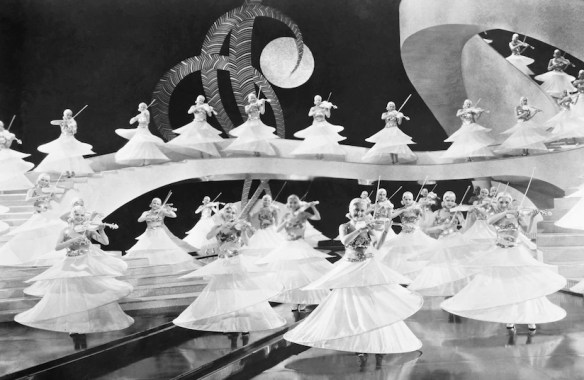
The “Shadow Waltz” number features some of his signature kaleidoscope effects. This time, he had girls in platinum blond wigs playing violins lit with neon tubing.
To get top shots, Berkeley used a wide-angle lens when he was 60 feet up. But other time she wanted the camera higher than the sound stage ceiling so he had workers make a hole in the roof, according to Berkeley’s biographer.
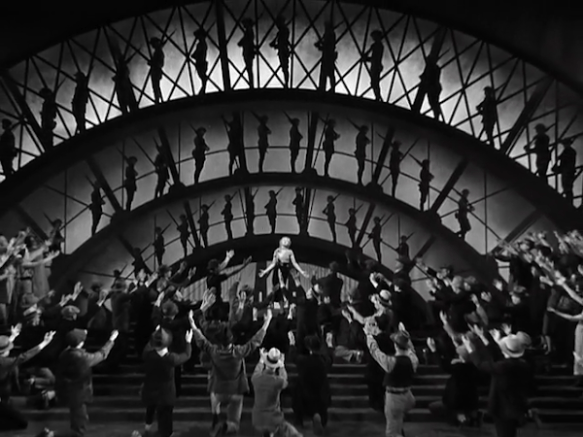
But perhaps the most unique and memorable number is “The Forgotten Man” number, which details how soldiers were celebrated when they marched off to World War I, suffered the horrors of war, and now they are forgotten and forced to stand in breadlines.
The number begins with Joan Blondell speaking the lyrics to the song. She’s very effective with tears in her eyes. Then we see Etta Moten sitting in a window singing as other women in neighboring apartments look on sadly. The action changes to men leaving for war, men in war and then men in today’s world, with the action moved along with a conveyor belt-like stage. The whole number is astonishing and grim, and perhaps one of the most unique numbers I’ve seen in a film.
I read a few discrepancies about Joan Blondell singing. Some sources say she was dubbed by Etta Moten, which isn’t true. Moten has a solo and is seen on screen. Jeane Cowann then dubs Blondell at the end of the song, when she picks up after the action with the soldiers, it’s brief and the chorus chimes in.
Overall, “Gold Diggers of 1933” is an incredibly fun and clever film. It’s easy to think of it only as Busby Berkeley musical, but it holds its own with a very different look at creating entertainment during the Great Depression. Truly, a must see.
Check out the Comet Over Hollywood Facebook page, follow on Twitter at @HollywoodComet or e-mail at cometoverhollywood@gmail.com
 Comet Over Hollywood