
In 2011, I announced I was trying to see every film released in 1939. This new series chronicles films released in 1939 as I watch them. As we start out this blog feature, this section may become more concrete as I search for a common thread that runs throughout each film of the year. Right now, that’s difficult.
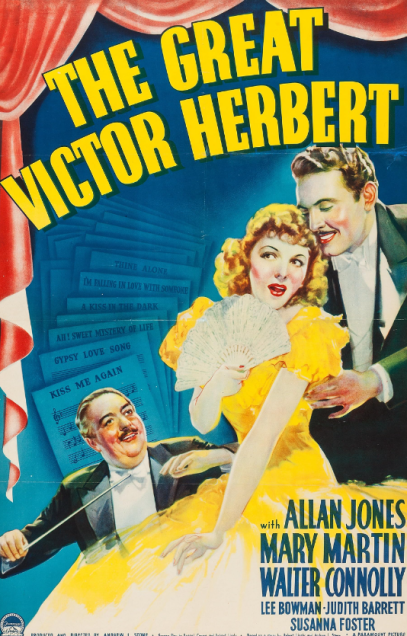 1939 film:
The Great Victor Herbert (1939)
Release date:
Dec. 6, 1939
Cast:
Walter Connolly, Allan Jones, Mary Martin, Lee Bowman, Susanna Foster, Judith Barrett, Jerome Cowan, John Garrick, Pierre Watkin, Richard Tucker, Mary Currier, Sandra Lee Richards
Studio:
Paramount Pictures
Director:
Andrew L. Stone
Plot:
Louise Hall (Martin) has dreams of becoming a stage star. Her career is shepherded by the pushy tactics of performer John Ramsey (Jones). As Louise and John find success and star in a show by composer Victor Herbert (Connolly), they fall in love and marry. However, billing and Louise’s stardom hurts John’s ego, and even when Louise retires, John’s career falters.
1939 Notes:
• Feature-film debut of stage star, Mary Martin. This was her only film of 1939.
• This was the last feature of actor Walter Connolly, who died in May of 1940.
• First feature film of singer, Susanna Foster.
• Last film of John Harrick.
• By the numbers:
– Walter Connolly was in seven films in 1939.
– Allan Jones was in two films released in 1939.
– Lee Bowman was in eight films released in 1939.
– Judith Barrett was in six films released in 1939.
– John Garrick was in three films released in 1939.

Victor Herbert and Walter Connolly, who played Victor Herbert in “The Great Victor Herbert” (1939)
Other trivia:
• Working title was “The Gay Days of Victor Herbert,” but his daughter Ella asked for the title to be changed, because it would “affect father’s reputation and character,” according to Herbert’s biographer.
• Paramount started discussing the film in 1935, and finally went into production when Victor Herbert’s 80th birthday was posthumously celebrated at the 1939 New York World’s Fair and Herbert’s likeness was released on a postage stamp, according to film historian Edwin M. Bradley.
• Before the closing credits, the film closes with the statement: “No attempt has been made to depict in this picture the actual life of the immortal Victor Herbert. Many of the episodes, incidents and characters are entirely fictious. A careful effort has been made, however, to preserve the character and mood of the great composer whose music serves as the inspiration for this picture.”
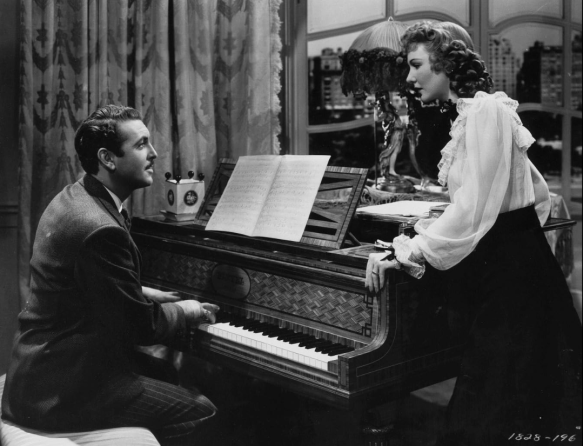
Allan Jones and Mary Martin
Notable Songs
• “Ah, Sweet Mystery of Life” performed by Alan Jones and Mary Martin
• “There Once was an Owl” performed by Alan Jones and Mary Martin
• “A Kiss in the Dark” performed by Mary Martin
• “Kiss Me Again” performed by Susannah Foster
My review: Searching for the “1939 feature”:
Judging by the title of this film, “The Great Victor Herbert” (1939), you would think it was a biography on the composer who brought us music for “Babes in Toyland” or “Naughty Marietta.”
Instead, this is less of a biopic about Victor Herbert, but he is just a character in the film and participating in the fictional events — and this was intentional.
The film follows a rising singing star Louise, played by Mary Martin, as she becomes famous. Louise’s leading man, John played by Allan Jones, becomes her leading man in real life when they marry. But problems erupt in their relationship as Lousie’s fame outpaces John’s, and clauses in his contract — like always having to have top billing — start to make him a joke in the entertainment world. To save their marriage, Louise decides to retire and start a family, but this doesn’t help John’s career and the family flounders.
Victer Herbert, played by the wonderful character actor Walter Connolly, is intertwined in their lives and casting the couple in plays, and he’s even there to see their newborn baby (a major highlight for me was Walter Connolly barging in and demanding, “Where’s that baby?!” Relatable.)
Victor Herbert passed away in 1924 and his family was involved in the film, particularly his daughter Ella, who was pleased that the film was fictional, according to Herbert’s biographer. When it was released, Ella’s husband wrote a letter to director Andrew L. Stone:
“You may be interested to know that we are going to see The Great Victor Herbert for the third time on Thursday. It is a picture which grows on one and the more we see it, the better we like it. We watch the great interest, the success of it as reporter each week in Variety and we are sure you must be gratified with its records.”
When the film ends, a closing note says that the film was meant to be fictional. Rather than depict his life, it was meant to celebrate his music and work.
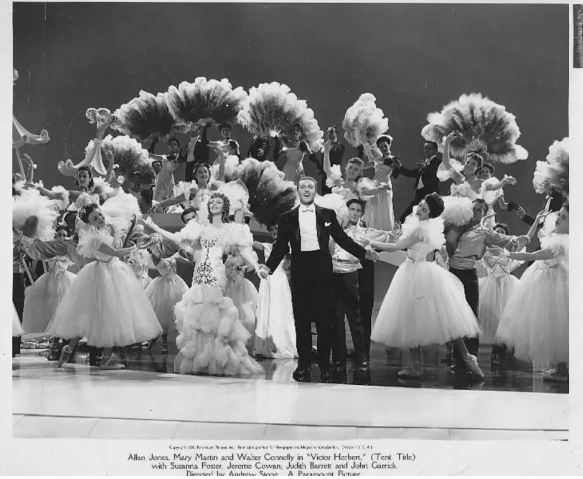
And celebrate his music it does! Within the first 28 minutes of the film, Mary Martin and Allan Jones performed four duets. The film is chockful of beautiful songs and a frothy musical montage. It’s fun and gorgeous. I also love how the film begins — we really just dive right into the story. The movie stars with the opening curtain of a new stage musical with Victor Herbert conducting the orchestra. The audience is perplexed about the leading lady who is unexpectedly a young woman (Susannah Foster), when they were expecting Louise Hall (Martin). Then the story is told in retrospect and we come full circle to the moment on stage.
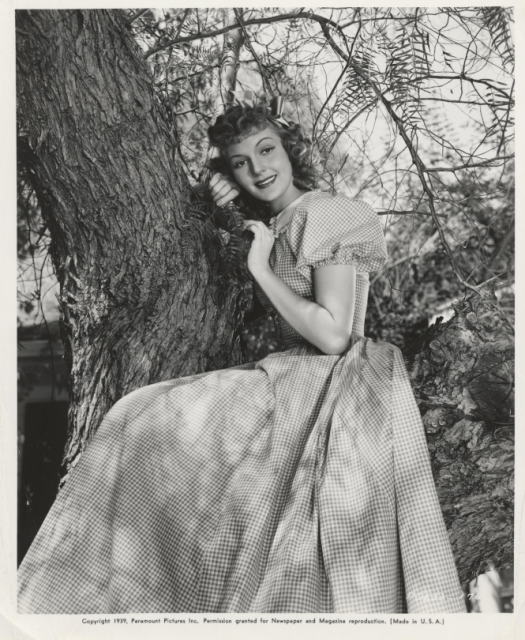
Mary Martin in a publicity photo for the film
In a strange way, art imitated life (sort of) in this film. While actress Mary Martin was well-established on stage, 1939 was her introduction to the screen and this was her debut to film audiences. Her co-stars like Allan Jones, Walter Connolly and Jerome Cowan helped give her tips about performing on camera. While Martin’s movie career did not flourish and she is still best known for her stage career, it is a treat to see her in this movie.
Allan Jones is a highlight in this film, because though he was in several films around this time period and had a wonderful singing voice, he never reached the height of fame as his contemporaries, like Nelson Eddy.
On a mournful note, this is also the last film of Walter Connolly, who is wonderful in all of his films. Connolly died the following year. It’s a little sad watching this knowing it was to be his last performance.
It’s really a shame that this gem of a 1939 film isn’t better known or easier to find. It is a pleasant and tuneful watch. And it really is a history-making film bringing Broadway star Mary Martin to the screen.
Check out the Comet Over Hollywood Facebook page, follow on Twitter at @HollywoodComet or e-mail at cometoverhollywood@gmail.com
 Comet Over Hollywood
Jessica,
I have two questions regarding your quest to watch all of the movies of 1939. Is there a comprehensive list of all of the films from that year? I ask because I believe that 1939 was the greatest year for Hollywood movies and would love to be able to watch as many as I could. A list would make it easier to check off the movies as I watch them or find new movies that I am not familiar with because they aren’t well known. My second question is; Where can you watch all of these movies? I know that sometimes when I want to watch a particular movie, I can’t find it on any streaming service provider, or sometimes there are costs to watch a movie that I don’t know I’d want to pay, especially if I don’t know the movie. I’d be afraid to pay for something that I didn’t care for and would have to watch it all the way through to get my monies worth.
Best regards,
David Mawbydmawby@yahoo.com
LikeLike
Hi David,
Thank you for reading and stopping by!
To answer you first questions: I agree that 1939 is Hollywood’s greatest year (and why I’ve been featuring it!). For a comprehensive list of 1939 films, I have largely worked off of IMDB and Letterboxd for their yearly lists. The book “1939: Hollywood’s Greatest Year” by Thomas Hischak also seems to include most films made in Hollywood in 1939.
For your second question: This may not be as clear cut or satisfactory of an answer, because in short, I watch all of these movies everywhere. I find a few (very few) on streaming/rental platforms like Amazon Prime (Films like Backdoor to Heaven or Of Mice and Men are there); I’ve found some uploaded online when you Google and hit “video” (like this one, The Great Victor Herbert); I’ve blind bought studio released DVDs to watch some (including “Chicken Wagon Family”), and lastly I search on eBay for “homemade” DVR-ed DVDs. You highlight an issue that I try to acknowledge in each post – classic films aren’t always accessible (and rarely are streaming!) so to review I go to a “by any means necessary” approach in order to see them. It’s true, not all of the films I pay for are outstanding, but I decided that seeing them is still a valuable experience.
I hope that helps!
– Jessica
LikeLike