
It’s no secret that the Hollywood Comet loves musicals.
In 2010, I revealed I had seen 400 movie musicals over the course of eight years. Now that number is over 600. To celebrate and share this musical love, here is my weekly feature about musicals.
 This week’s musical:
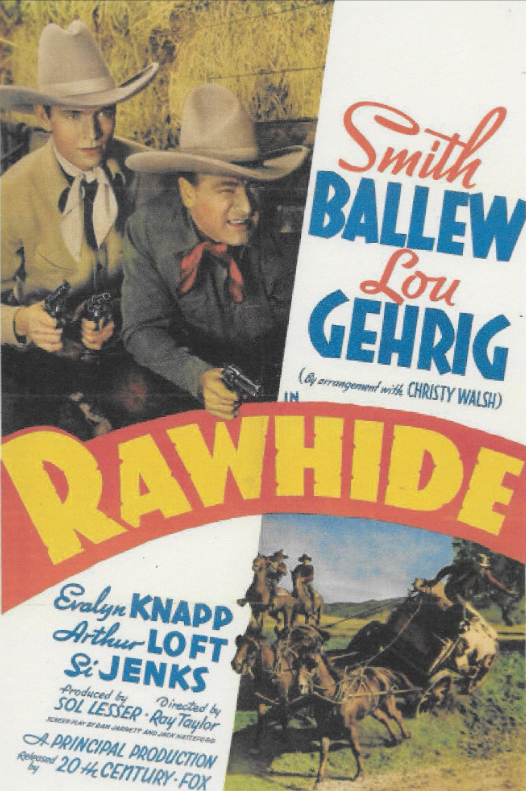
Rawhide (1938) – Musical #776
Studio:
Distributed by 20th Century Fox
Director:
Ray Taylor
Starring:
Smith Ballew, Lou Gehrig (as himself), Evalyn Knapp, Arthur Loft, Cy Kendall, Dick Curtis, Si Jenks
Plot:
Lou Gehrig (as himself) decides to retire from baseball and moves out west to work a ranch with his sister, Peggy (Knapp). When Gehrig arrives, he finds that all the local businesses in town and the ranchers are being strong armed into joining an organization where all the goods are run through one businessman. Gehrig refuses and lawyer Larry Kimball (Ballew) to smash the syndicate.
Trivia:
• The only film that features baseball player Lou Gehrig in an acting role.
• The film premiered in St. Petersburg, Fla., where the New York Yankees were training, according to Gehrig’s biographer.
• Lou Gehrig’s singing voice is dubbed by Ray Whitley.
• Filmed at Sol Lesser’s studio, Principle Productions, and distributed by 20th Century Fox.
• Physicians have studied this film to see if they can spot early effects of ALS in Lou Gehrig. While one physician in 1989 says he could, other physicians who studied the film in 2006 say they didn’t detect anything, especially because Gehrig did his own stunts with skill and strength, according to Gehrig’s biographer and an MLB article.
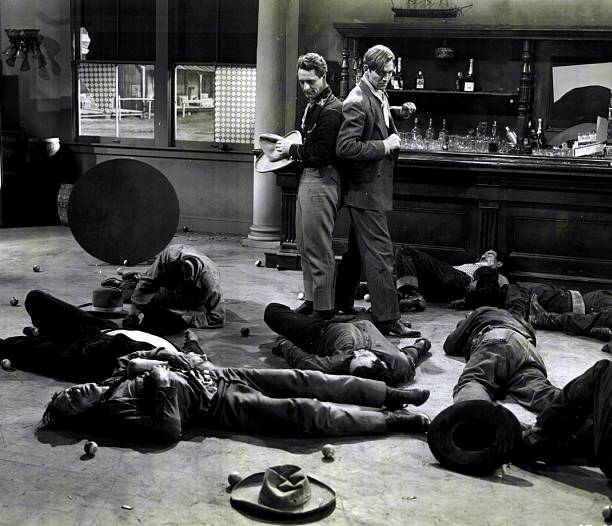
Lou Gehrig and Smith Ballew
Highlights:
• Watching my first Smith Ballew film
• Lou Gehrig in his only feature film role
Notable Songs:
• “When a Cowboy Goes to Town” performed by Smith Ballew
• “A Cowboy’s Life” performed by Smith Ballew
• “Drifting” performed by Smith Ballew
• “That Old Washboard Band” performed by Smith Ballew
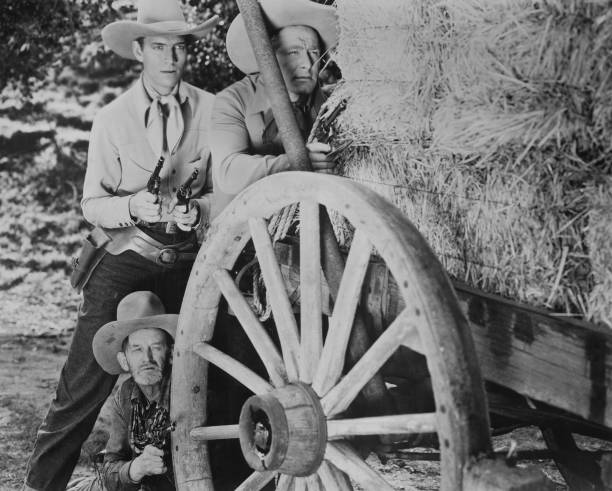
Smith Ballew, Lou Gehrig, Si Jenks
My review:
For a 58-minute film, RAWHIDE (1938) is fascinating and immensely enjoyable. When I started researching this Musical Monday, I kept digging and digging to learn more about this interesting, low-budget curio and eventually had to force myself to stop and write this review (largely because there’s only so much information on RAWHIDE that you can find online).
This is what interests me about this film:
– For starters, I wasn’t previously familiar with orchestra leader turned singing cowboy, Smith Ballew.
– This is the only film that well-known New York Yankees baseball player, Lou Gehrig, made.
In the film, Gehrig plays himself. RAWHIDE begins with him leaving New York City and telling reporters at the train station that he’s done with baseball and ready to lead a quiet life on a ranch out west with his sister (played by Evelyn Knapp). But when Gehrig arrives, he finds the small town run by racketeers. Smith Ballew plays one of the few corrupt people in town, lawyer Larry Kimball. When Gehrig and Kimball end up unexpectedly teaming up in a fight in a saloon, the two decide to clean up the crowd together.
I previously wasn’t familiar with Smith Ballew until watching this film, but now I want to seek out more of his singing cowboy movies (Sadly, Hawaiian Buckaroo wasn’t easy to find or I would have been reviewing that today!). Born in Texas, before Ballew became an actor, he is perhaps better known for his band, the Smith Ballew Orchestra, which he led from 1928 to 1937, and some of his musicians over the years included Glenn Miller, Tommy Dorsey and Jimmy Dorsey. Overall, Ballew has a smooth, nice singing voice and is also quite handsome.
Ballew also smoothly performs several pleasant songs throughout. I personally liked his expressions and movements through his opening number, “When a Cowboy Goes to Town.”
As for Lou Gehrig, a knee-jerk reaction may be that it seems strange that a famous athlete to star in a film. But Gehrig is a long line of athletes who tried their hand at acting. Others that were more successful include Johnny Weissmuller, Bruce Bennett, Jim Brown, Buster Crabbe or Nat Pendleton.
Gehrig’s manager, Christy Walsh, looked for other ways for Gehrig to earn money when he was off the baseball field. In addition to product endorsements, Hollywood seemed like a natural fit, especially in the role of Tarzan, which had become an athlete-turned-actor tradition for those like Weissmuller, Bennett and Crabbe. Gehrig was photographed in costume as Tarzan in 1937, but both producer Sol Lesser and “Tarzan” author, Edgar Rice Burroughs, were not pleased with the costume test, according to an article by the Society for American Baseball Research (SABR).
Lesser remained interested in Gehrig acting in general and signed him for a one-picture deal, according to the SABR. The film ended up being RAWHIDE.
While contemporary film reviews tend to be critical of Gehrig, I think he does a good job and is charming to watch. Gehrig’s raspy voice reminds me a bit of a star who appeared in films a couple of decades later, Aldo Ray.
The film has humorous moments, like where Gehrig starts pitching pool balls like baseballs in a saloon fight. Or after a dangerous stage coach crash he says, “To think I came out here for peace and quiet.”
I don’t know that Gehrig would have been leading-man material, but perhaps he could have been the comic relief or secondary male lead in films. Even film historian Leonard Maltin feels Gehrig could have found success in B-budget movies.
Gehrig also had no illusions of replacing Hollywood’s top stars. In quotes to reporters during this time, he humbly acknowledged he was no actor, but was going to do his best, according to the SABR.
“Boy, I never had so much fun in my life as I’m having on this picture. You ought to see me in my boots and saddle and 10-gallon hat. I’d sure like to get all dolled up in my movie togs and ride a horse into Yankee Stadium on opening day,” Gehrig told a reporter.
At the time of the film’s release, critics were largely kind to Gehrig. Quoted by Gehrig’s biographer, Wanda Hale of the Daily News wrote:
“Of all the movie-struck athletes, Lou Gehrig is my favorite. Why, he’s no more afraid of the camera than he is one of Carl Hubbell’s screw balls. The big, amiable first baseman walks through a scene and tosses off his lines as naturally as he walks to the plate … He looks as though he’s having such a good time at playacting, and what’s more, it’s fun watching him.”
Hale’s review sums up what makes this brief musical western so much fun. Because the people in it appear to be having a good time.
At the premiere, Gehrig said he was lucky. And at the time he was. Gehrig returned to baseball, and soon after, the signs and symptoms of ALS (later known as Lou Gehrig’s Disease), began to take its toll. He died at age 37 in 1941.
Overall, I found RAWHIDE to be pleasant and enjoyable, and incredibly interesting to see Lou Gehrig in his only film. I now plan to also seek out more Smith Ballew films. However, knowing the outcome of Gehrig’s life not long after this, it does make watching this a little sad.
Check out the Comet Over Hollywood Facebook page, follow on Twitter at @HollywoodComet, follow on Instagram or e-mail at cometoverhollywood@gmail.com
 Comet Over Hollywood