
It’s no secret that the Hollywood Comet loves musicals.
In 2010, I revealed I had seen 400 movie musicals over the course of eight years. Now that number is over 600. To celebrate and share this musical love, here is my weekly feature about musicals.
This week’s musical:
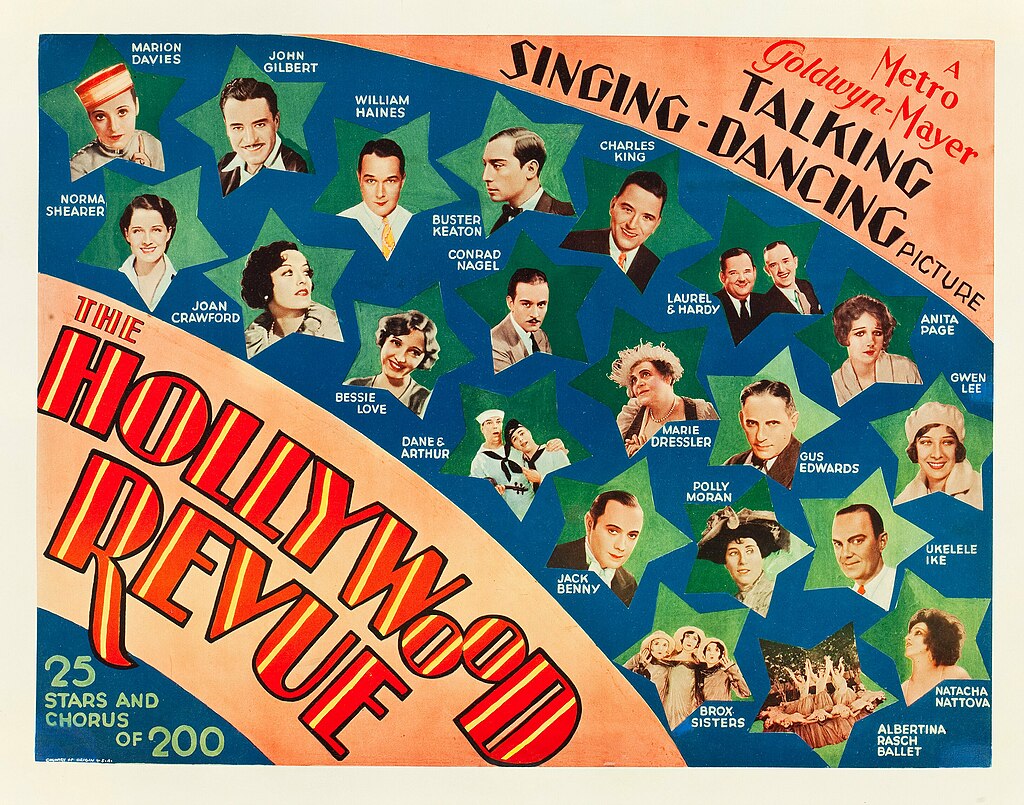
The Hollywood Revue of 1929 (1929) – Musical #795
Studio:
Metro-Goldwyn-Mayer
Director:
Charles F. Riesner
Starring:
All Performers as themselves:
Master of Ceremony: Conrad Nagel, Jack Benny
Galaxy of Stars: John Gilbert, Norma Shearer, Joan Crawford, Bessie Love, Anita Page, Buster Keaton, Marion Davies, Lionel Barrymore, William Haines, Marie Dressler, Cliff Edwards, Stan Laurel, Oliver Hardy, Nils Asther, Charles King, Polly Moran, Gus Edwards, Karl Dane, George K. Arthur, Gwen Lee
Uncredited: Ann Dvorak (uncredited)
Plot:
To introduce audiences to Metro-Goldwyn-Mayer stars in a talking picture, the MGM stars, all as themselves, perform a revue of songs and skits with actors Conrad Nagel and Jack Benny as the hosts.
Trivia:
• The first of the all-star revue film version, which the other studios followed.
• While much of the film is shot in black-and-white, there are three Technicolor sequences:
– The “Romeo and Juliet” skit with Norma Shearer, John Gilbert and John Barrymore
– The “Orange Blossom Time” ballet
– The “Singin’ in the Rain” finale with the full cast
• During the “Orange Blossom Time” ballet, some theater owners filled their theaters with the scent of orange blossoms, according to a Turner Classic Movies article.
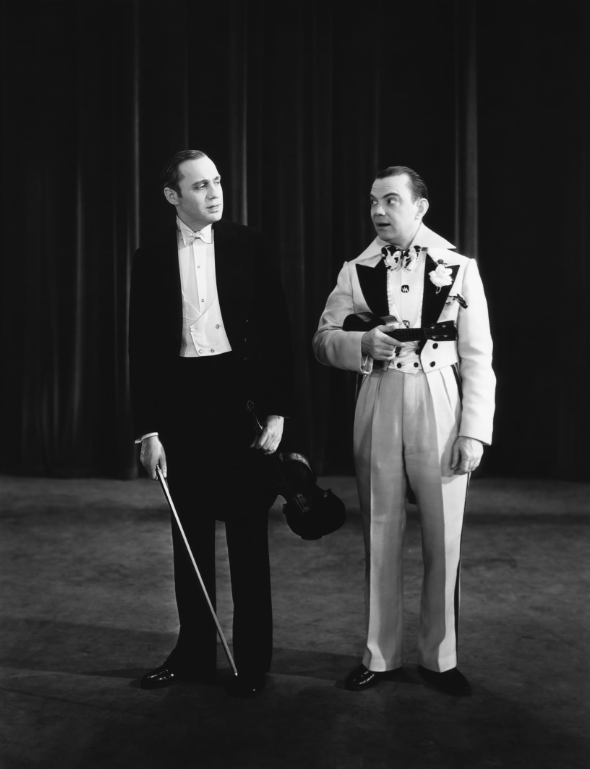
• Jack Benny’s first feature film appearance.
• According to TCM, Gilbert’s Romeo & Juliet sequence inspired the “talkie disaster” sequence in Singin’ in the Rain (1952).
• While nearly all of MGM’s top stars are in the film, absence from the production include Greta Garbo, Ramon Novarro and Lon Chaney.
• The film’s choreographer, Sammy Lee, staged dances on Broadway in shows like “Show Boat” and No, No Nanette.” MGM hired Lee to stage numbers for their other musical talking film, “Broadway Melody,” prior to working on this film, according to Ann Dvorak’s biographer.
• Actress Ann Dvorak appears in an uncredited role as a dancer, who gets a close up opportunity when she slaps Jack Benny.
• To promote the film, a billboard on Wilshire Blvd. and Shatto Place in Hollywood spelled out “Metro-Goldwyn-Mayer’s Hollywood Revue, Grauman’s Chinese Theater,” with real chorus girls spelling out the words, according to Ann Dvorak’s biography.
• Charles King dubs Conrad Nagel when he sings “You Were Meant for Me.”
Highlights:
• The color “Romeo and Juliet” sequence
• “Singin’ in the Rain” sequence
Notable Songs:
• “Gotta Feelin’ for You” performed by Joan Crawford
• “Singin’ in the Rain” performed by Cliff Edwards, the Brox Sisters and the chorus
• “Lon Chaney Will Get You If You Don’t Watch Out” performed by Gus Edwards
• “Turkish Adagio” danced by the Albertina Rasch Dancers
• “Orange Blossom Time” performed by Charles King to Myrtle McLaughlin
• “I Never Knew I Could Do a Thing Like That” performed by Bessie Love
• “For I’m the Queen” performed by Marie Dressler
• “Tommy Atkins on Parade” performed by Marion Davies
• “You Were Meant for Me” performed by Anita Paige and Conrad Nagel, dubbed by Charles King
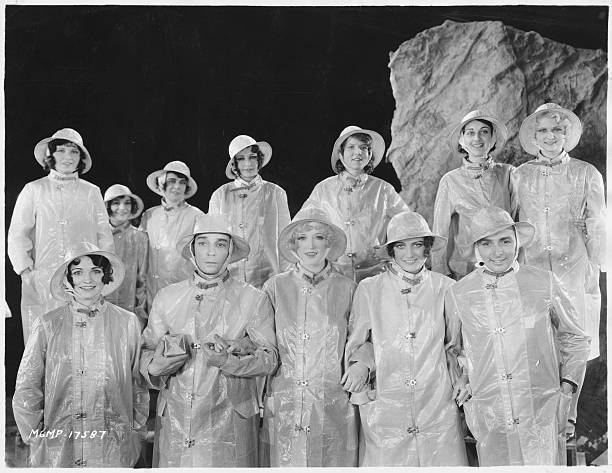
Cast members of the movie The Hollywood Revue of 1929. Notable stars in the front row, left to right: Buster Keaton (second from left), Marion Davies, Joan Crawford, and George K. Arthur.
My review:
When sound was incorporated into motion pictures, studios wanted to showcase their stars in this new technology. Metro-Goldwyn-Mayer pulled out all the stops in 1929 with THE HOLLYWOOD REVUE of 1929, spotlighting most of their major stars with a big stage production filled with songs, dances and skits.
THE HOLLYWOOD REVUE of 1929 has no plot. It literally filmed like a stage variety show, where Jack Benny and Conrad Nagel the hosts. Each star is introduced as themselves and they perform in some fashion.
Parts of this film are fun, some fascinating, some boring and some annoying. But all of it is fascinating as a time capsule, illustrating the history of Hollywood and the technological growth.
The film is shot straight on at the stage with little variation in angle. There are a few overhead shots that precede Busby Berkeley, but they aren’t quite as well done. However, while the songs, dances and filming seem a little creaky, it’s fascinating to watch a musical just made two or three years later to see the growth in musicals.
The credits tout a “Galaxy of Stars” and it doesn’t disappoint, the film includes appearances from: John Gilbert, Norma Shearer, Joan Crawford, Bessie Love, Anita Page, Buster Keaton, Marion Davies, Lionel Barrymore, William Haines, Marie Dressler, Cliff Edwards, Stan Laurel, Oliver Hardy, Nils Asther, Charles King, Polly Moran, Gus Edwards, Karl Dane, George K. Arthur and Gwen Lee.
It’s interesting to look at this list today, because if you watch silent film, you are familiar with all or most of the stars. But only a handful are still well-known today by the mainstream film viewer.
Now, I’ll breakdown a few key star performances. The film is divided into two acts with an intermission, and Act I seems to be frontloaded with the most performances. Below are highlights (good or bad), but does not include every musical performance. Some songs are performed by the chorus and other stars performed more than one song.
Highlights of Act I:
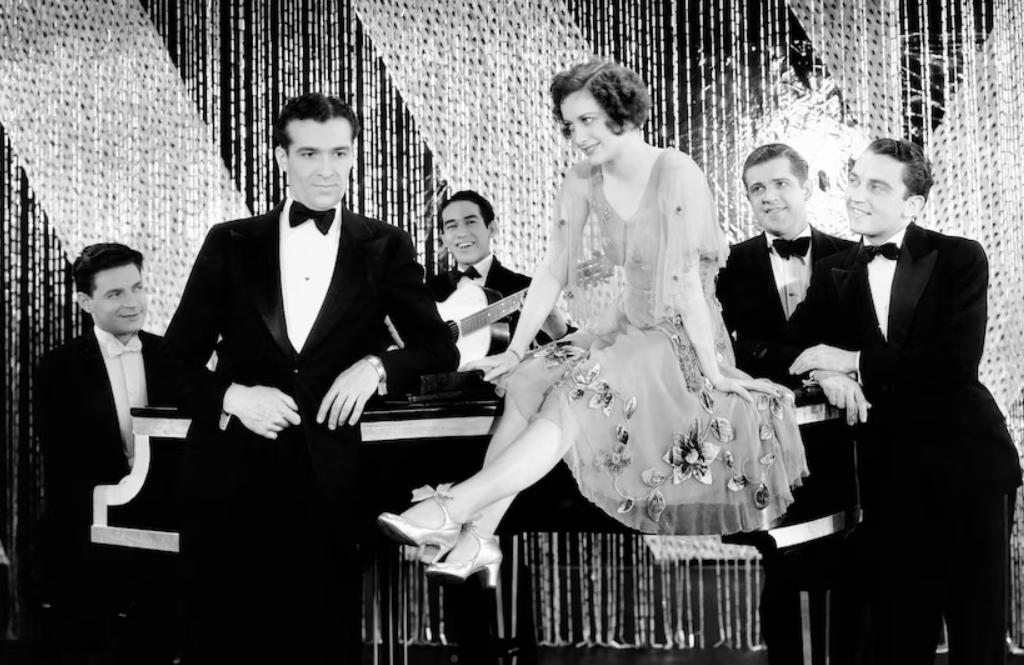
– Joan Crawford performs the first solo number in the film with “Got a Feeling for You.” Conrad Nagel introduces her as the “personification of youth, beauty, joy and happiness.” At this time, she was known as the ideal flapper. Crawford does well with her song and dancing, which may be surprising to viewers who only know her from her later persona. This is probably my favorite performance of the film.
– Charles King receives a great build up in the film from Conrad Nagel. King sings several songs at the start of the film (too many, if you’re asking me), but his key song is “Your Mother and Mine,” which admittedly to me is an odd song and then is performed too many times. King isn’t well-known today, but introduced hits in 1929, including “You Were Meant for Me” and “Broadway Melody” from BROADWAY MELODY OF 1929. But by 1932, he largely left films for the stage.
– William Haines doesn’t sing, but he and Jack Benny have a comedic skit where Haine rips up Benny’s suit.
– Bessie Love sings a song, “I Never Knew I Could Do a Thing Like That,” which isn’t a great song, but the scene is interesting because Love starts out as small and in Jack Benny’s pocket and then grows before the camera.
– Marie Dressler arrives as the queen with Polly Moran as a princess. Dressler sings a stale song called “For I’m the Queen.” It’s fun to see her, though.
– Laurel and Hardy perform a magic act, which is a nice reprieve from the rest of the performances. It also seems different than the others, perhaps because it was filmed at a different time.
– Marion Davies performs a military dance, where she also appears to be very small. The choreographer in this film, isn’t great, because I know Davies can dance, but the performance here is not great.
Highlights of Act II:
– Buster Keaton doesn’t get to sing or speak, but performs the comedic “Dance of the Sea.”
– Lon Chaney was not in the film, but instead, Gus Edwards performs the comedic number “Lon Chaney’s Gonna Get You If You Don’t Watch Out.” It’s a unique number that’s also a highlight of the film.
– The Natova Company performs “The Adagio Dance,” and it’s one of the better numbers of the film. Perhaps the lease unhinged.
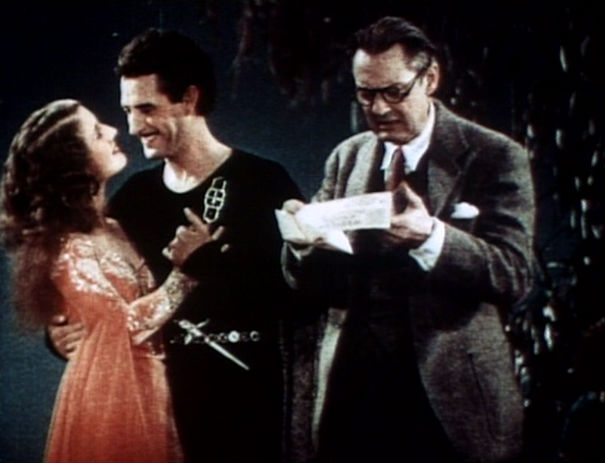
– John Gilbert and Norma Shearer perform the other major highlight of this film. In a Technicolor sequence, Gilbert and Shearer perform “Romeo & Juliet,” and it’s beautiful. But in a comedic twist, Lionel Barrymore as the director, comes out to say that he received a notice that they have to perform a more hip version of the story, which will now be called “The Neckers.” Gilbert and Shearer then perform a version with modern day lingo. It’s too funny and lots of fun. And I have to say, there’s nothing wrong with John Gilbert’s voice, though this is allegedly credited as the decline of his career.
– Cliff Edwards — known largely today as the voice of Jiminy Cricket — sings several songs and is probably the most enjoyable of the group. His standout performance as he sings “Singin’ in the Rain” with his ukulele (which is why he was known as Ukulele Ike). The filming makes the appearance that he’s signing in a downpour and other performers come out dancing in
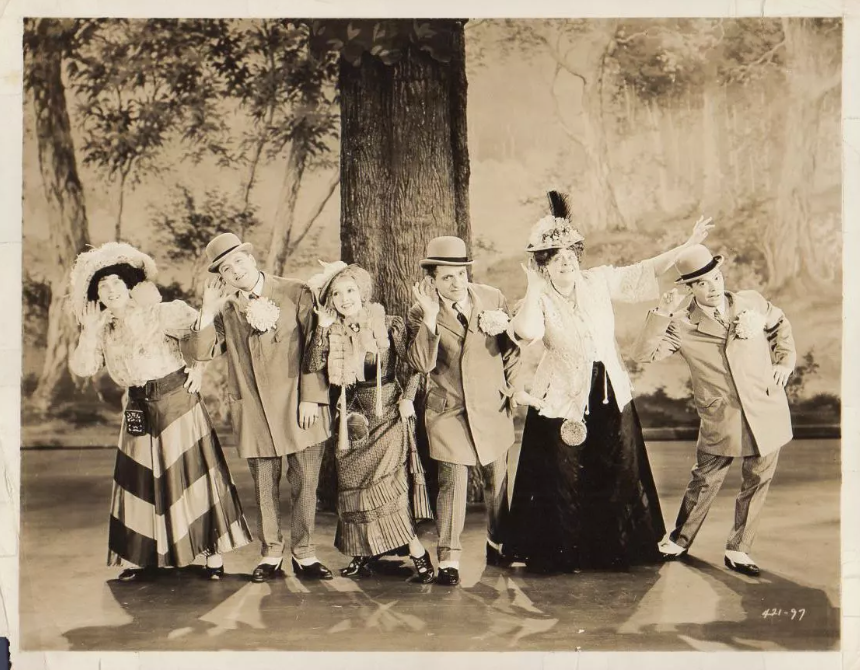
– The second half of the film is overtaken by two comedic trio numbers: “Charlie, Gus and Ike” with Charlie King, Gus Edwards and Cliff Edwards. And then “Marie, Polly and Bess,” with Marie Dressler, Polly Moran and Bessie Love. Both of these sequences go on much, much too long.
– The film ends with two gorgeous two-color Technicolor sequences: “Orange Blossom Time” performed by Charles King and then a ballet dance. And the finale, the whole cast “Singin’ in the Rain” performed by the entire cast in front of an ark. The color is fun and stunning.
You may be looking at all of those acts and thinking, “Wow, that’s a lot!” And if you are, you’re right! It feels like a lot to sit through and after a while, I got a bit tired. I wondered “Why did they pick this awful song” for some of the performers, like Bessie Love and Marie Dressler. And while choreographer Sammy Lee may have been acclaimed in their time, but these dances leave a lot to be desired. I’m not clear if it’s the choreography or the dancers, because often the dancers aren’t even together! A mess.
However, there are lots of great things. For starters, it was the first time audiences were introduced to the comedy of Jack Benny. We also see up-and-coming actress Ann Dvorak gets a key scene where she slaps Benny in a close up.
The film does have three key performances, in my opinion: Joan Crawford’s song, John Gilbert and Norma Shearer in their “Romeo and Juliet” skit, and Cliff Edwards singing and playing the ukulele.
It’s fun to see Crawford sing and dance during her flapper era, especially for those who aren’t familiar with that aspect of her career. I also thought the “Romeo and Juliet” skit was hilarious. While I know they were acting, I liked to see John Gilbert and Norma Shearer acting casual. And let me reiterate here: Everyone talks about how awful John Gilbert’s voice was and how it was “high pitched.” I disagree and he sounds fine. He’s great here!
THE HOLLYWOOD REVUE OF 1929 is also interesting, because it set a precedent that other studios followed. After this, other studios created their own variety show-like films, like Warner Bros. with THE SHOW OF SHOWS (1929) and Paramount with PARAMOUNT ON PARADE (1930). These types of variety performance films continued, especially in the World War II era with THIS IS THE ARMY or STAR SPANGLED RHYTHM.
Overall, yes, parts of this musical revue are a slog, but I still think it’s worth seeing — particularly if you have any interest in film history.
Check out the Comet Over Hollywood Facebook page, follow on Twitter at @HollywoodComet, follow on Instagram or e-mail at cometoverhollywood@gmail.com
 Comet Over Hollywood