
It’s no secret that the Hollywood Comet loves musicals.
In 2010, I revealed I had seen 400 movie musicals over the course of eight years. Now that number is over 600. To celebrate and share this musical love, here is my weekly feature about musicals.
This week’s musical:
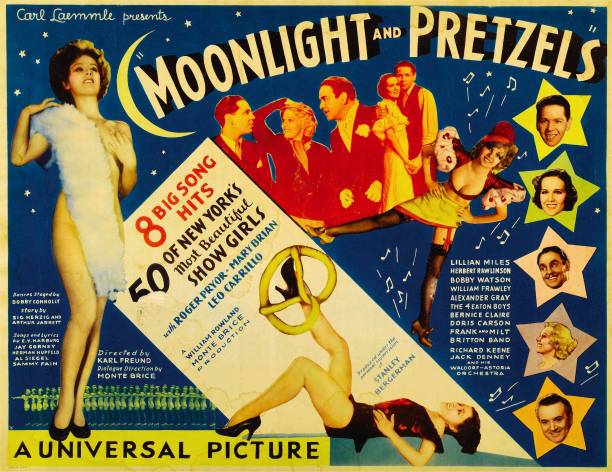
Moonlight and Pretzels (1933) – Musical No. 809
Studio:
Universal Pictures
Director:
Karl Freund
Starring:
Roger Pryor, Mary Brian, Leo Carrillo, Lillian Miles, Herbert Rawlinson, Bobby Watson, William Frawley, Donald MacBride, Bernice Claire, Alexander Gray, Robert Young (uncredited)
Themselves: Jack Denny and His Orchestra, Frank and Milt Britton and His Band
Plot:
Songwriter George Dwight (Pryor) is down-on-his-luck and fired from a vaudeville show while performing in a small town. There, he meets Sally Upton (Brian), who hires him to work in her music store and encourages his songwriting. With her motivation, George successfully sells a song and heads to New York City, promising to write to Sally. While George climbs to fame and works with singer Elise Warren (Miles), he never writes to Sally, so she comes to New York.
Trivia:
• Roger Pryor’s first feature film
• Dance numbers staged by Bobby Connolly. This was his first credited film as dance director.
• Working title was “Shoot the Works”
• Many of the film’s scenes were filmed at the Paramount-Astoria Studio in New York.
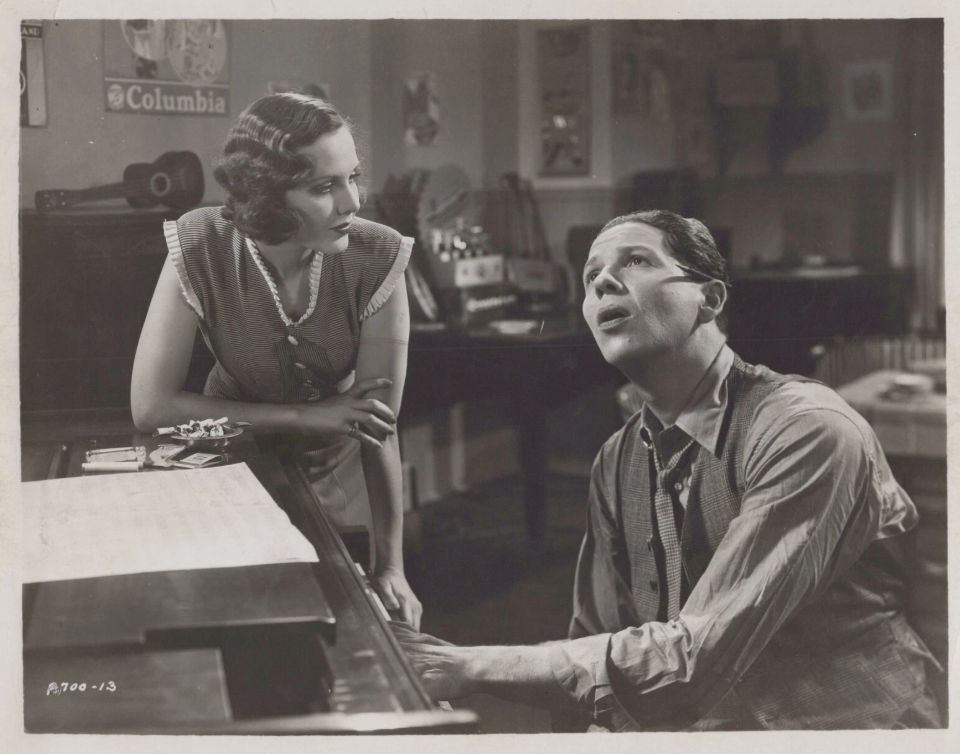
Mary Brian and Roger Pryor
Highlights:
• The attempt to create Busby Berkeley-like numbers
Notable Songs:
• “I’ve Gotta Get Up and Go to Work” performed by the Chorus
• “Moonlight and Pretzels” performed by the chorus
• “Let’s Make Love Like Crocodiles” performed by Roger Pryor
• “There’s a Little Bit of You (In Every Love Song)” performed by Mary Brian and Roger Pryor
• “Ah, But Is It Love?” performed by Bernice Clair
• “Are You Making Any Money” performed by Lillian Miles
• “Dusty Shoes” performed by Alexander Gray
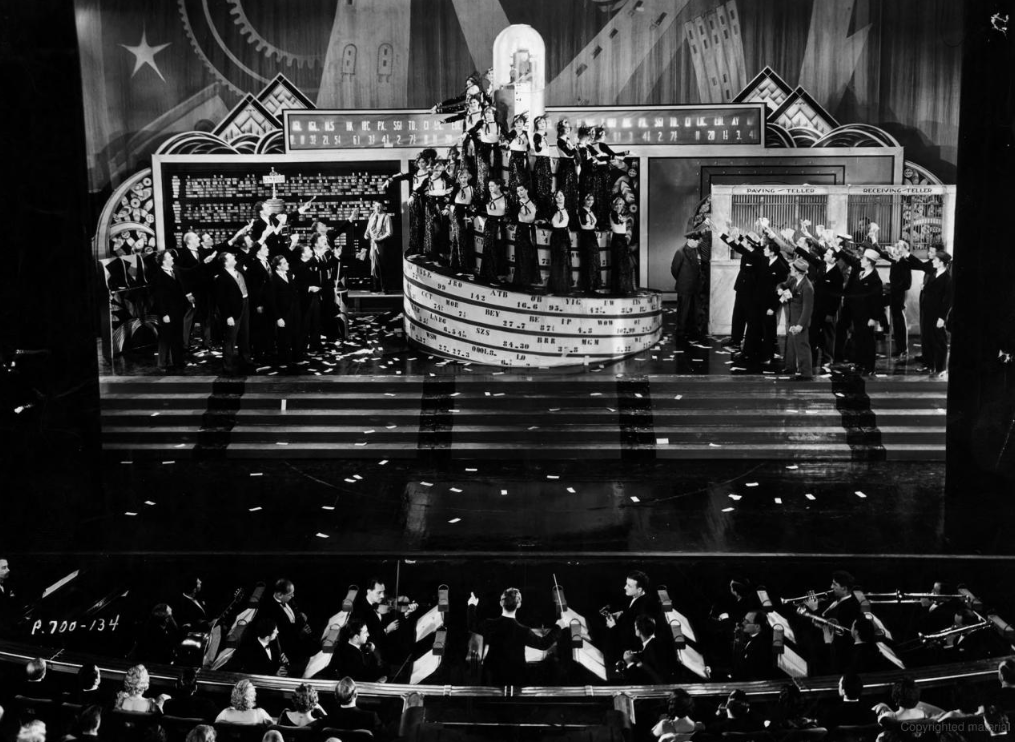
A shot of the “Dusty Shoes” number
My review:
With the dawn of sound in film, what better way to display the new medium than through song? However, from 1929 through the early 1930s, movie musicals were so poorly executed that they were failing. That is … until Busby Berekely came along and helped transform the movie musical at Warner Bros. with his kaleidoscopic musical numbers.
So why not copy Berkeley’s model at Warner Bros. at Universal? That’s what was attempted in MOONLIGHT AND PRETZELS (1933).
In this backstage musical, the plot follows songwriter George Dwight (Pryor), who is down on his luck and fired from a vaudeville show while performing in a small town. There, he meets Sally Upton (Brian), who hires him to work in her music store and encourages his songwriting. With her motivation, George successfully sells a song and heads to New York City, promising to write to Sally. While George climbs to fame and works with singer Elise Warren (Miles), he never writes to Sally, so she comes to New York.
The musical numbers in the film, staged by Bobby Connelly, are similar to what you might see in 42ND STREET (1932) or GOLD DIGGERS OF 1933 (1933). The charming number “I’ve Gotta Get Up and Go to Work” features a kaleidoscope overhead shot and the silhouette of girls who appear nude and are dressing, similar to GOLD DIGGERS OF 1933.

Overhead shot of the “I’ve Gotta Get Up and Go to Work” number
A further comparison is “Dusty Shoes,” a song about the Depression detailing how the singer once had new leather shoes and now they are dusty from sleeping on park benches. There’s a montage of economic conditions, and Lillian Miles appears to sing, pleading for those who are poor, with hands outstretched in a German Expressionism style. The number is similar to “Remember My Forgotten Man” in GOLD DIGGERS.
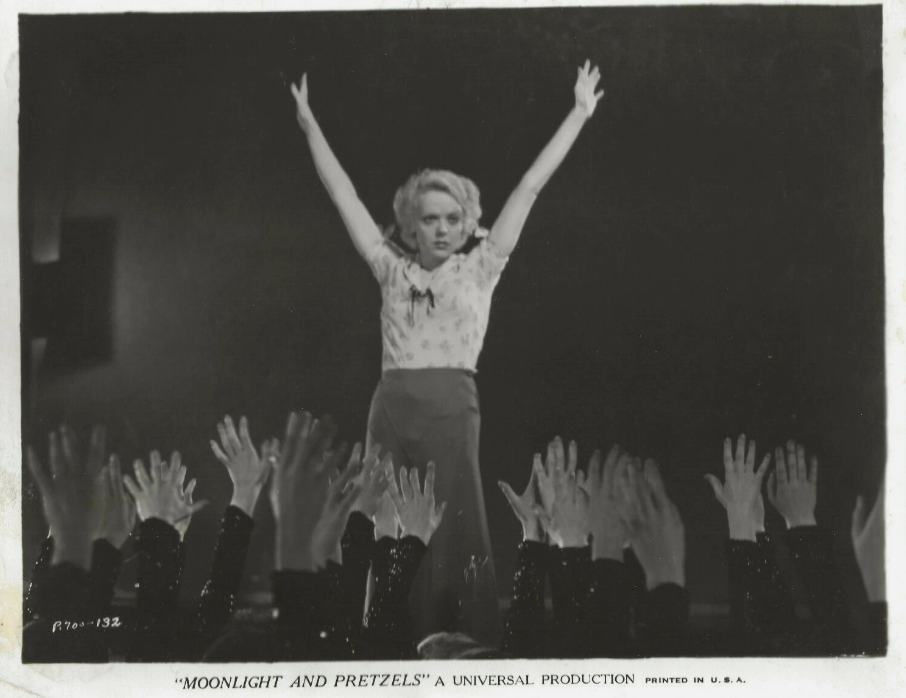
Lillian Miles in the “Dusty Shoes” number
The cast also has similarities: Mary Brian is cute and sweet like Ruby Keeler and Lillian Miles attempts to be Joan Blondell but isn’t snappy enough.
Even reviews written when MOONLIGHT AND PRETZELS was released in Aug. 1933 note the similarities.
Time noted the film’s similarity to 42ND STREET AND GOLD DIGGERS, but also about the similarities in the casting.
“Its ingenue, Mary Brian, not only looks like Ruby Keeler but has obviously been coached to speak in the same soft monotone,” Time wrote.
However, the Hollywood Reporter said the copycat numbers were flattering. “Bus Berkeley can be proud of his picture disciples,” their Aug. 1933 review said.
Despite the obvious similarities, MOONLIGHT AND PRETZELS is a fairly pleasant film. And the August 1933 reviews liked it as well.
“Blessed with a fund of comedy, several catchy songs, a good cast and enough of a story to hold all the ingredients together, Moonlight and Pretzels can be expected to linger at the Rialto for some time. It merits inclusion among the screen’s most successful invasions of the musical comedy field,” F.S.N. wrote in their Aug. 23, 1933, New York Times review.
Although it is filled with catchy songs and excellent Pre-Code moments, it feels like a “Diet” version of Berkeley’s Warner Bros. films.
It’s also interesting to see some actors very early in their careers. You see a very young Donald MacBride. You also can catch a very young Robert Young who has a line.
Leo Carillo receives top billing but doesn’t show up in the film until 30 minutes in. Roger Pryor, who was well-known on Broadway prior to this film, makes his feature film debut here. Pryor became more palatable in his later films but lacks here.
Lillian Miles is just okay, and I felt that they couldn’t decide if she was a bad girl or a saucy dame here. Mary Brian is the bright spot, sweet and beautiful, but is missing from the middle of the film.
Bobby Watson reminded me of Roscoe Karns and hilariously could not do a time step, though he was supposed to be a choreographer in the film.
When you walk away from the film, you’ll have the song “Moonlight and Pretzels” in your head and “I’ve Gotta Get Up to Go to Work” is an incredibly cute number.
While I enjoyed the film, it doesn’t leave the lasting impression that a 1930s Warner Bros. musical will leave on you. The issue? The cast–while all are capable, they don’t hold a candle to Dick Powell, Ruby Keeler, Joan Blondell, and the rest of the Warner Bros. mainstays.
Other places you can follow Comet Over Hollywood:
- Letterboxd
- X at @HollywoodComet
- BlueSky
- Or e-mail us at cometoverhollywood@gmail.com
 Comet Over Hollywood