
It’s no secret that the Hollywood Comet loves musicals.
In 2010, I revealed I had seen 400 movie musicals over the course of eight years. Now that number is over 600. To celebrate and share this musical love, here is my weekly feature about musicals.
This week’s musical:
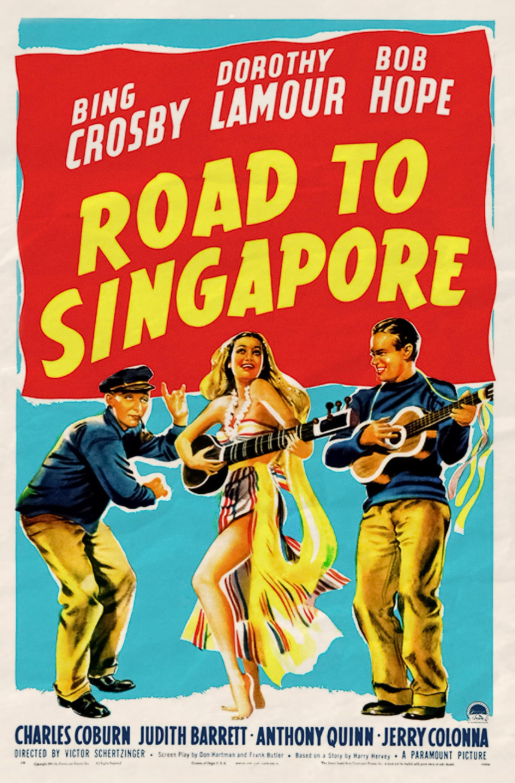
Road to Singapore (1940) – Musical No. 156
Studio:
Paramount Pictures
Director:
Victor Schertzinger
Starring:
Bing Crosby, Dorothy Lamour, Bob Hope, Charles Coburn, Judith Barrett, Anthony Quinn, Jerry Colonna, Edward Gargan (uncredited), Cyril Ring (uncredited), Steve Pendleton (uncredited)
Plot:
Josh Mallon V (Crosby) is in the Navy, but his wealthy father (Coburn) wants him to settle down and work at the shipping business and marry wealthy Gloria Wycott (Barrett). Josh brings his pal, Ace (Hope), to his and Gloria’s engagement party. At the party, I fight breaks out when Gloria’s brother (Pendleton) makes snide remarks. Josh and Ace then run away to Singapore. There, they meet beautiful Mima (Lamour). The two fight over Mima, while Josh’s family searches for him to bring him back to the United States.
Trivia:
• The first “Road” movie starring Bing Crosby and Bob Hope. A total of 7 “Road” films were made, including:
-ROAD TO SINGAPORE (1940)
-ROAD TO ZANZIBAR (1941)
-ROAD TO MOROCCO (1942)
-ROAD TO UTOPIA (1946)
-ROAD TO RIO (1947)
-ROAD TO BALI (1952)
-ROAD TO HONG KONG (1961)
• The film went through several iterations, originally considered for George Burns and Gracie Allen with Charles Ruggles. When Burns and Allen left for MGM to make HONOLULU (1939), the cast was revised with Fred MacMurray, Ruggles and Dorothy Lamour. Ruggles dropped out was replaced by Bob Hope and then MacMurray had to drop out and was replaced by Bing Crosby. So then making the trio Hope, Crosby and Lamour, according to an interview with Dorothy Lamour.
• Working title was “Follow the Sun.” “Road to Mandalay” was also considered as a title.
• One of Judith Barrett’s last films. She made two others following ROAD TO SINGAPORE
Highlights:
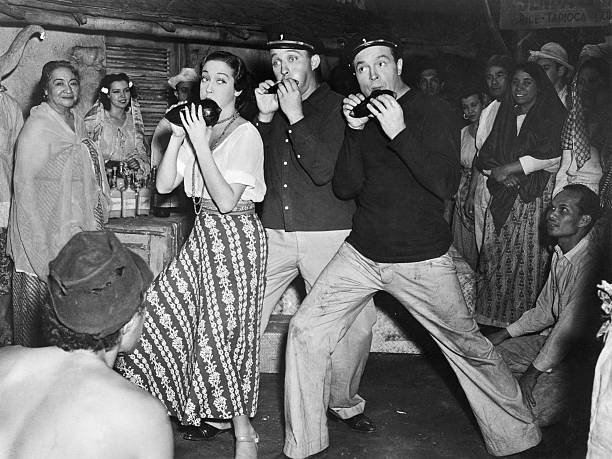
• Dorothy Lamour performing “The Moon and the Willow Tree”
Notable Songs:
• “The Moon and the Willow Tree” performed by Dorothy Lamour
• “Too Romantic” performed by Bing Crosby
• “Sweet Potato Piper” performed by Bing Crosby and Bob Hope
• “Captain Custard” performed by Bing Crosby and Bing Crosby
My review:
It’s the film that created one of film’s most iconic screen teams: Bing Crosby and Bob Hope in THE ROAD TO SINGAPORE (1940).
In the 1940s and 1950s, there were few performers as popular as Bing Crosby and Bob Hope. They already were popular separately — Crosby had been crooning on the radio and in films since the early 1930s. Hope also rose to fame in the mid-1930s with his fast-talking jokes, often picking fun at contemporary pop culture and politics.
The two had performed together on the stage in 1932, and in 1940, were teamed for the first time in the Paramount Pictures film, THE ROAD TO SINGAPORE.
In the THE ROAD TO SINGAPORE (1940), Bing Crosby plays wealthy Josh Mallon V, who has joined the Navy to avoid his stuffy business responsibilities to his wealthy family. His pal, Ace (Hope), tags along for their adventures and supports Josh’s desire to stay footloose and fancy free. However, Josh’s father (Coburn) wants him to work at the family shipping business and marry wealthy Gloria Wycott (Barrett).
At Ace and Gloria’s engagement party, Ace’s lighthearted jokes and antics are off-putting to Gloria and her family, and a fight breaks out with Gloria’s brother (Pendleton) when he makes rude remarks. After the fight, Ace and Josh run away to Singapore. There, they meet Mima (Lamour). The two fight over Mima while Josh’s family searches for him to return him back to his duties in the shipping business.
Today, the “Road” film series is iconic in film history. While ROAD TO SINGAPORE launched the successful screen team of Crosby and Hope and this series, Paramount Pictures didn’t expect this film to be anything more than a standalone feature film. In fact, Bing Crosby and Bob Hope weren’t even billed together.
“I’m billed over Bob. That was the first time and last time in any Road picture,” Dorothy Lamour said an interview with James Bawden and Ron Miller.
The film originally had an entirely different cast that was adjusted several times. The story was originally planned to be a vehicle for George Burns and Gracie Allen with Charles Ruggles. Burns and Allen then had a conflict while making HONOLULU (1939) at MGM. The cast was then revised to Fred MacMurray, Ruggles and Dorothy Lamour. Ruggles dropped out and was replaced with Bob Hope. MacMurray then had to drop out and was replaced with Bing Crosby, creating the well-known trio of Hope, Crosby and Lamour, according to the Bawden and Miller interview with Lamour.
While it’s difficult to imagine now, Crosby and Lamour received top billing over Hope, because they were already more established in Hollywood. Crosby had been crooning on film and on the radio since the early 1930s, and Lamour hit stardom with films like JUNGLE PRINCESS (1936) and THE HURRICANE (1937).
At the start of 1940, Bob Hope was only seen as cautiously promising, in the annual ranking of stars, but after this film, he became a star.
ROAD TO SINGAPORE (1940) not only established a new screen team, it also set the standard for “buddy pictures,” said Turner Classic Movies host, Dave Karger in his introduction of the film.
After this first film, the two never went in public without making a joke about the other, according to Crosby’s biographer, Gary Giddens.
Much of their dialogue in the film was adlibbed.
“After the first Road film, I never studied dialogue. Never,” Giddens quote Dorothy Lamour. “I’d wait to get to set to see what they were planning. I was the happiest and highest-paid (comedic) straight woman in the business.”
Bob Hope’s wife, Dolores, said the way that Crosby and Hope were in the “Road” films is how they really were in daily life, according to Gidden’s Crosby biography.
ROAD TO SINGAPORE (1940) is a good time and has some fun songs. Dorothy Lamour’s “Moon and the Willow Tree” is so beautifully shot and lit. The trio shows early chemistry, though the film differs from the later formula of the “Road” pictures a bit. There is one questionable scene where Hope and Crosby dress as natives to attend a party in order to join a feast.
Anthony Quinn makes a brief appearance as a menacing character, though isn’t in the film enough, and Jerry Colona briefly brings his comedy to the film.
The popularity of this musical comedy led Hope, Crosby and Lamour to co-star in a total of seven “Road” films between 1940 and 1962. Actress Dorothy Lamour joined the duo in each of the films, though her role in “Road to Hong Kong” (1962) was a cameo and Joan Collins was the lead female.
Even separately, Crosby and Hope might incorporate jokes about each other in their films.
The rest of this month, we will be hitting the road to review more of these films, so stay tuned.
Other places you can follow Comet Over Hollywood:
- Letterboxd
- X at @HollywoodComet
- BlueSky
- Or e-mail us at cometoverhollywood@gmail.com
 Comet Over Hollywood