
It’s no secret that the Hollywood Comet loves musicals.
In 2010, I revealed I had seen 400 movie musicals over the course of eight years. Now that number is over 600. To celebrate and share this musical love, here is my weekly feature about musicals.
This week’s musical:
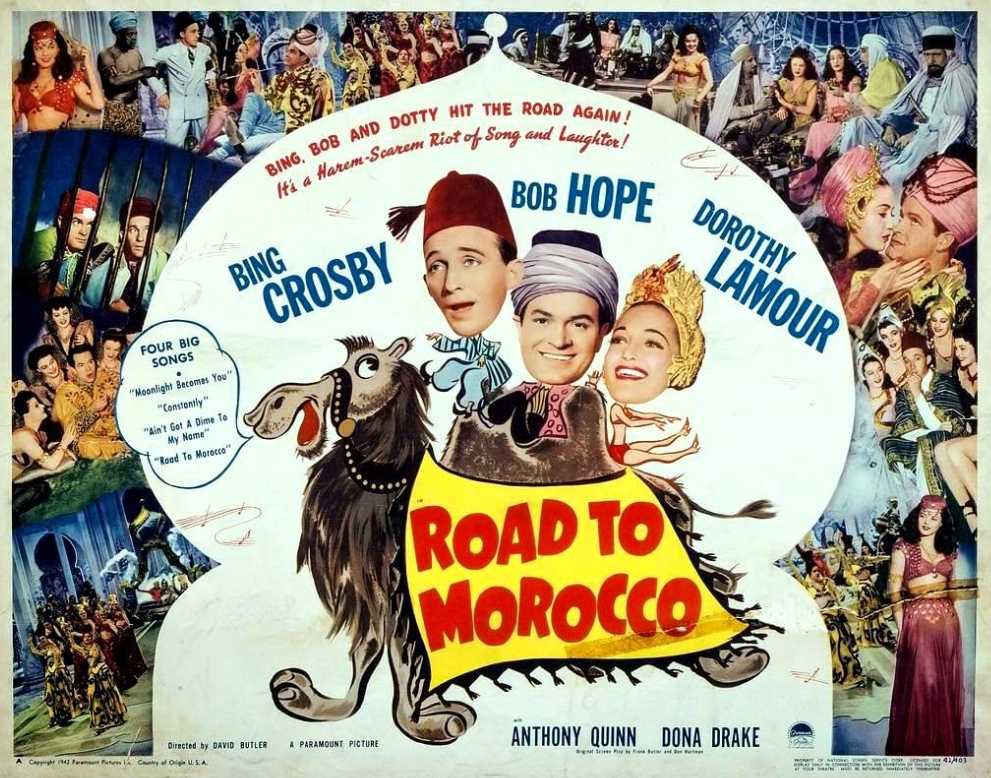
Road to Morocco – Musical #147
Studio:
Paramount Pictures
Director:
David Butler
Starring:
Bing Crosby, Bob Hope, Dorothy Lamour, Anthony Quinn, Dona Drake, Vladimir Sokoloff, Mikhail Rasumny, Yvonne De Carlo (uncredited), Vivian Dandridge (uncredited), Richard Loo (uncredited)
Plot:
Jeff Peters (Crosby) and Orville “Turkey” Jackson (Hope) are adrift on a raft after their boat blows up (thanks to Turkey). When they find land, they find themselves in a desert and ride a camel towards town. They find themselves in an “Arabian Nights”-like setting. In need of money, Jeff sells Turkey. When Turkey sends Jeff a note saying he’s being tortured but to flee, Jeff sets out to save him. The note is a ruse, as Turkey is in the lap of luxury and cuddled up to Princess Shalmar (Lamour), who believes the stars have dictated that they should be married. Problems arise when Princess Shalmar falls in love with Jeff, and also is betrothed to Mullay Kasim (Anthony Quinn).
Trivia:
• Bob Hope and Bing Crosby were in seven “Road to” films together. “Road to Morocco” was the third “Road to” film in the series.
• Victor Schertzinger was originally slated to direct ROAD TO MOROCCO, his third “Road” film, but he passed away in Oct. 1941. David Butler replaced him as director
• The third “Road” picture was originally set to be “Road to Moscow,” but the direction was changed due to the wartime conditions and the script was never developed.
• The first of the “Road” pictures specifically written for Crosby and Hope.
• Another, unused ending was written for the end of the film that had Crosby and Hope enlisting in the Marines and saying, “See you on the road to Tokyo.”
• Johnny Burke and James Van Heusen wrote a song, “Aladdin’s Daughter” that was unused in the film.
• Desert scenes were filmed in Yuma, Ariz.
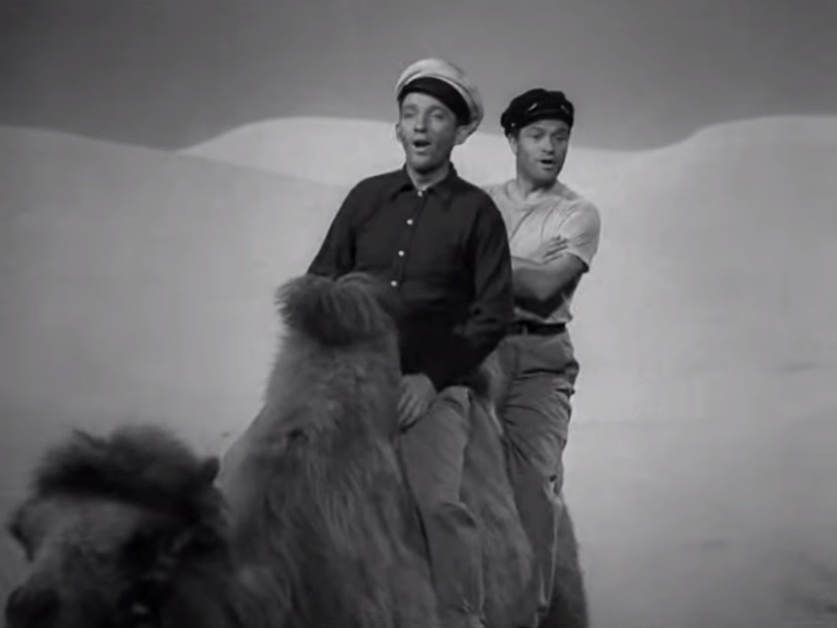
• The scene where the camel spits in Bob Hope’s face was unscripted, but the reactions caught on camera were funny enough that they were left in the film.
• Added to the Library of Congress National Film Registry in 1996.
Highlights:
• Talking camels that sound like Katharine Hepburn
• Switched voices singing “Moonlight Becomes You”
• Aunt Lucy scenes
• Bob Hope at the end saying he might have won an Academy Award
Notable Songs:
• “(We’re Off on the) Road to Morocco” performed by Bing Crosby and Bob Hope
• “Ain’t Got a Dime to My Name” performed by Bing Crosby
• “Constantly” performed by Dorothy Lamour
• “Moonlight Becomes You” performed by Bing Crosby
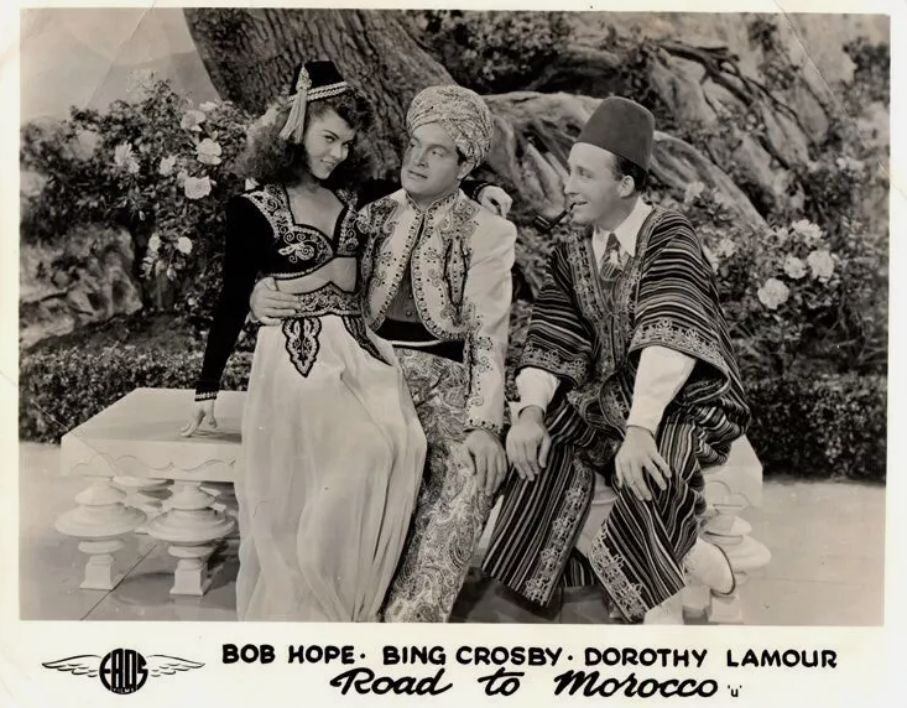
Dona Drake, Bob Hope, Bing Crosby
My review:
After two successful “Road” films, Bing Crosby and Bob Hope were on the road again.
Many people consider the third “Road” film ROAD TO MOROCCO (1942) the best of the series, and I’m inclined to agree- at least up to this point in the films.
Maybe it’s because this was the first of the series that was specifically written for Crosby and Hope, as the other film scripts were adapted from other stories.
In the film, Jeff Peters (Crosby) and Orville “Turkey” Jackson (Hope) are adrift on a raft after their boat blows up (thanks to Turkey). When they find land, they find themselves in a desert and ride a camel towards town. They find themselves in an “Arabian Nights”-like setting. In need of money, Jeff sells Turkey. When Turkey sends Jeff a note saying he’s being tortured but to flee, Jeff sets out to save him. The note is a ruse, as Turkey is in the lap of luxury and cuddled up to Princess Shalmar (Lamour), who believes the stars have dictated that they should be married. Problems arise when Princess Shalmar falls in love with Jeff, and also is betrothed to Mullay Kasim (Anthony Quinn).
While I enjoyed ROAD TO SINGAPORE and ROAD TO ZANZIBAR just fine, ROAD TO MOROCCO was lots of fun. Throughout the film, there are hilarious moments:
– The title song, “Road to Morocco” has several humorous film references, such as censorship and running into Dorothy Lamour
– Bob Hope plays the ghost of his Aunt Lucy who comes to speak to Crosby and Hope.
– The mixed up singing voices of Bob Hope, Bing Crosby and Dorothy Lamour in the performance of “Moonlight Becomes You.”
– The talking camels through early special effects
– Bob Hope acting dramatically and then saying he wanted an Academy Award
But I think one of the funniest scenes wasn’t in the script. When Hope and Crosby first meet the camel, the camel spits in Hope’s face. He recoils and Crosby laughs out loud, patting the camel in approval. Scenes like this happened, because director David Butler would keep the camera running after yelling cut so he could catch any spontaneous moments.
While Bing Crosby always wins over Dorothy Lamour in the film, Bob Hope also has romance in the film–lovely Dona Drake.
Actor Anthony Quinn appears in the first “Road,” film and again plays a villain in this film. Quinn is underutilized, not appearing until later in the film, but is there for the climatic scenes.
Silent film actor, Monte Blue, appears in the film, and told Quinn that he resembled Rudolph Valentino, according to Dorothy Lamour’s autobiography, “My Side of the Road.”
“It’s remarkable you look so much like Rudy Valentino. I’ve never seen such a likeness, and I should know – I worked with him,” Lamour quoted Blue as saying.
ROAD TO MOROCCO premiered in New York City on Nov. 10, 1942, while the United States was nearly a year into World War II. The Road pictures were pure escapism for audiences, as the films were filled with humor and different locations.
The release of this “Road” film had a location that matched the headlines. Shortly before the premiere, United States troops landed in Morocco as part of Operation Torch in North Africa.
Two endings were written for this film. The unused ending included Hope and Crosby dressed as Marines saying they would next be on the Road to Tokyo. While this wasn’t the ending, audiences wouldn’t see Hope and Crosby again until the war was over, when THE ROAD TO UTOPIA was released (1945 in the UK, 1946 in the U.S.)
Other places you can follow Comet Over Hollywood:
- Letterboxd
- X at @HollywoodComet
- BlueSky
- Or e-mail us at cometoverhollywood@gmail.com
 Comet Over Hollywood