
It’s no secret that the Hollywood Comet loves musicals.
In 2010, I revealed I had seen 400 movie musicals over the course of eight years. Now that number is over 600. To celebrate and share this musical love, here is my weekly feature about musicals.
This week’s musical:
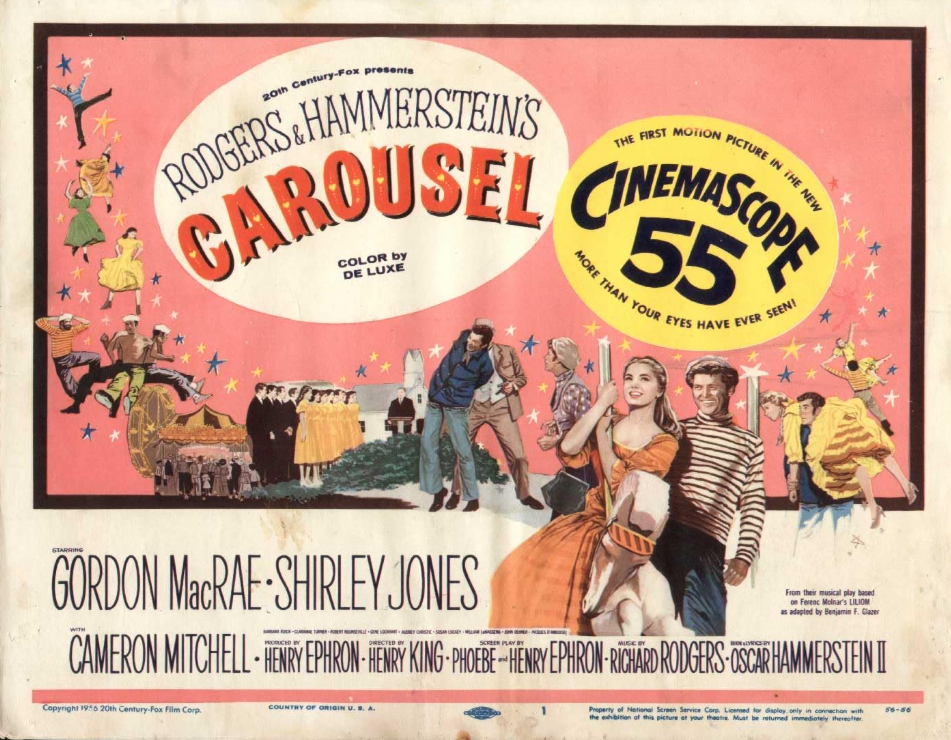
Carousel (1956) – Musical #87
Studio:
20th Century Fox
Director:
Henry King
Starring:
Gordon MacRae, Shirley Jones, Cameron Mitchell, Barbara Ruick, Claramae Turner, Robert Rounseville, Gene Lockhart, Audrey Christie, Susan Luckey, William LeMassena, John Dehner, Jacques d’Amboise, Robert Banas, Richard Deacon (uncredited), Bambi Linn (uncredited), Dee Pollock (uncredited)
Plot:
Naive Julie Jordan (Jones) visits a carnival one day and gets swept up in a whirlwind romance with carousel barker, Billy Bigelow (MacRae). Their happiness is brief as Billy is out of work and refuses to work, taking his anger on lack of money out on Julie. When he finds out that they are going to have a baby, Billy decides to get money a quick and illegal way. Things don’t turn out in his favor.
Trivia:
• Based on the 1945 Richard Rodgers and Oscar Hammerstein stage musical, CAROUSEL. The stage musical was based off the French story and film, LILIOM, which starred Charles Boyer.
• The film eliminates the songs that originated in the stage production, “The Highest Judge of All” and “Blow High, Blow Low.”
• The film introduced a new filming method, Cinemascope 55. Cinematographer Charles Clarke explained that Twentieth Century Fox converted their old 70mm cameras to accept 55mm film stock. The 55mm film was then optically printed back to 35mm for theater projection. Since this was the first time the new process was used, the studio decided to shoot additional takes of every scene in 35mm as a precaution, according to Clarke’s autobiography.
• Frank Sinatra was originally cast in the male lead role of Billy Bigelow, but walked off the set when he learned each scene was to be filmed twice. He said it was like making two films. He walked off the set on the first day of filming, according to Shirley Jones’s memoir.
• When Sinatra walked off the set, producer Henry Ephrone asked Shirley Jones if she could ask Gordon MacRae to co-star. Jones called him where he was performing in Lake Tahoe and he agreed, according to her memoir.
• Filmed on location in Maine, including Boothbay, Newcastle and Camden.
• Judy Garland was rumored to be the lead before Shirley Jones was approached for the lead, according to Jones’s memoir.
• Shirley Jones calls this her all-time favorite musical.
• Only film appearance of Metropolitan Opera Star, Claramae Turner
• Robert Rounseville was only in two feature films and CAROUSEL was his last film.
Highlights:
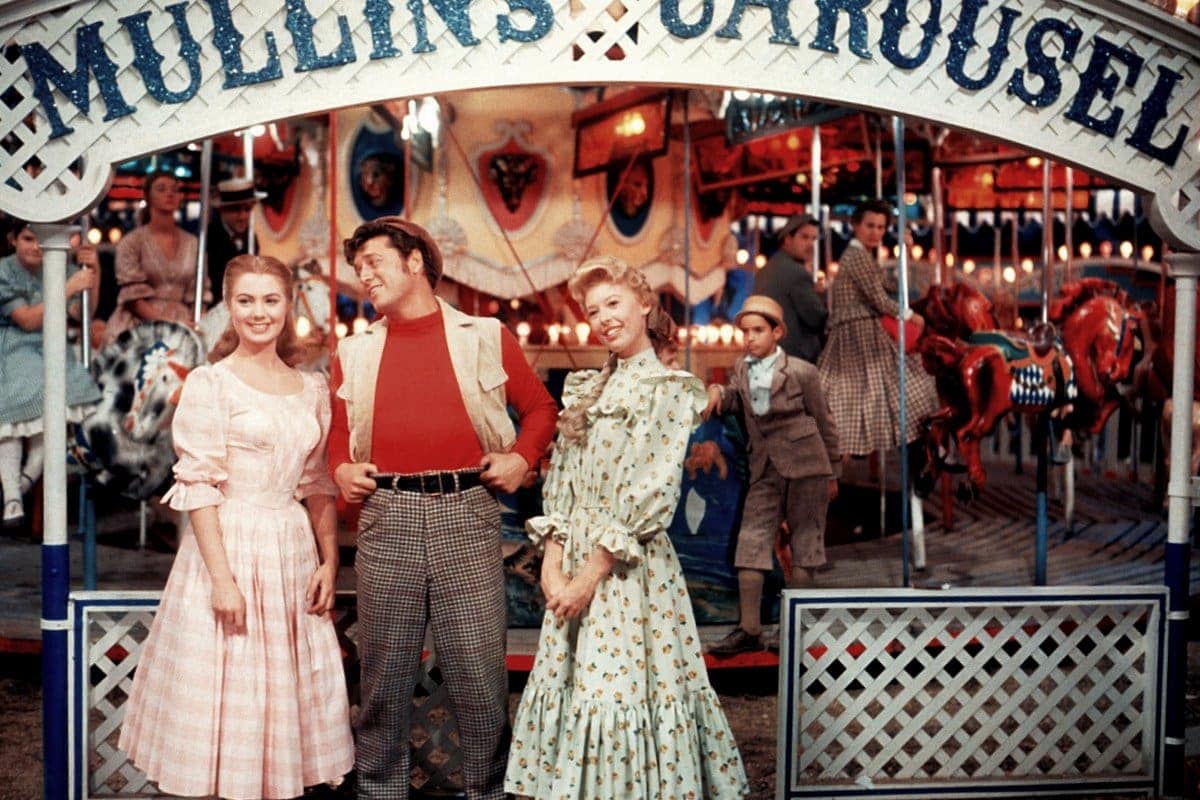
• The music, especially “The Carousel Waltz”
• The on location cinematography of Maine.
Notable Songs:
• “The Carousel Waltz”
• “If I Loved You” performed by Shirley Jones and Gordon MacRae
• “June Is Bustin’ Out All Over” performed by Claramae Turner, Barbara Ruick and the chorus
• “Soliloquy” performed Gordon MacRae
• “When the Children are Asleep” performed by Barbara Ruick and Robert Rounseville
• “This is a Real Nice Clambake” performed by the chorus, Cameron Mitchell, Barbara Ruick, Claramae Turner, Robert Rounseville
• “Stonecutters Cut It On Stone” performed by Cameron Mitchell, Robert Rounseville and the chorus
• “You’ll Never Walk Alone” performed by Claramae Turner
My review:
I will never forget the first time I saw CAROUSEL. I checked it out from the library sometime between 2004 and 2006, and I was so excited. The film begins and there’s Gordon MacRae in heaven polishing stars. Right off the bat, we know he’s dead (so I’m not spoiling anything).
I thought, “HE’S DEAD?!” and was immediately disappointed. I had envisioned a romantic, musical dream, like other MacRae musicals of this era. I remember thinking CAROUSEL was just okay, but not what I expected.
I finally revisited CAROUSEL for the first time in 20 years for this review, and have left feeling much more kindly towards it.
In the story, Naive Julie Jordan (Jones) visits a carnival one day and gets swept up in a whirlwind romance with carousel barker, Billy Bigelow (MacRae). Their happiness is brief as Billy is out of work and refuses to work, taking his anger on lack of money out on Julie. When he finds out that they are going to have a baby, Billy decides to get money a quick and illegal way. Things don’t turn out in his favor.
The story is based on the Hungarian stage play “Liliom” by Ferenc Molnár, which was made into a 1934 French film starring Charles Boyer. “Liliom” is an even darker story where the title character is never redeemed. Richard Rodgers and Oscar Hammerstein took the story, changing the male lead from Liliom to Billy Bigelow and transforming the location from Budapest to Maine. While the story is still dark and sad, they lightened it some from the Molnár play for the 1945 stage musical.
The stage musical was then made into this feature film. After the success of OKLAHOMA (1954), Shirley Jones was still under contract to Hammerstein and starred in her next film with them.
Like OKLAHOMA, the film used another innovative but difficult filming method, called Cinemascope 55. Cinematographer Charles Clarke explained that Twentieth Century Fox converted their old 70mm cameras to accept 55mm film stock. Since this was the first time the new process was used, the studio decided to shoot additional takes of every scene in 35mm as a precaution, according to Clarke’s autobiography.
Though CAROUSEL reteams Jones and Gordon MacRae following their OKLAHOMA success, MacRae wasn’t supposed to play Billy Bigelow. Frank Sinatra was.
In her memoir, Jones recounts Frank Sinatra “made it clear he was thrilled about starring in CAROUSEL and kept telling me that Billy Bigelow was the best role for a male singer there is.” Sinatra asked Jones to meet so they could rehearse, discuss the film and so he could ask what it was like to work with Rodgers and Hammerstein.
After his initial excitement for the role, the cast and crew had whiplash when Sinatra walked off the set the first day of filming on location in Maine. Due to the new Cinemascope 55 process, every scene was filmed twice. He said it was like making two films. Jones asked to call Gordon MacRae, who said he would happily star in the film, according to Shirley Jones’s memoir.
While this perhaps an unpopular opinion, Frank Sinatra walking off the set was the best thing that happened to CAROUSEL. While watching MacRae sing with his rich and beautiful voice, all I could think is, “Frank Sinatra could never.” While one of the greatest American singers, he did not have the range for these songs that MacRae (and John Raitt before him) possessed. I also think Sinatra would have looked ridiculous in the striped carnival barker costume. It’s supposed to be loud, but Sinatra would have looked as ridiculous as he did in THE KISSING BANDIT.
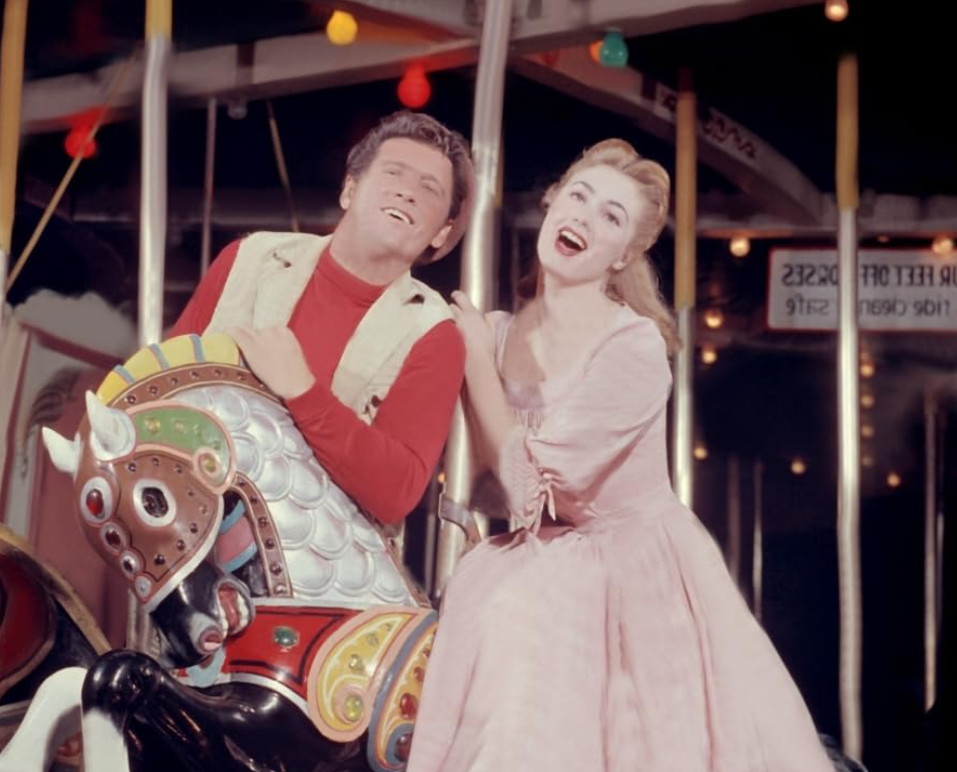
That said, Gordon MacRae is perfect in the role and incredibly underrated. What a voice! You both dislike Billy Bigelow for being a low life louse who refuses to get a job, but also understand why Julie would love him.
Shirley Jones is of course stunning—looking both angelic and also singing like an angel. Her scene when Billy dies is heartbreaking. My only complaint is that I feel she doesn’t get to sing enough songs. Jones wrote in her memoir that this was her favorite musical film.
Barbara Ruick is also lovely as Julie’s friend, Carrie. She offers a bright prettiness and also a bit of comedic relief. I was also surprised to see Cameron Mitchell sing! It was also a treat to see opera singer Claramae Turner in her only film.
I was glad to revisit CAROUSEL after all this time as I was more prepared for what to expect. It’s a story that’s not a traditional romance or wrapped up like a nice gift package with a bow. The audience watches a whirlwind romance between an innocent girl and a gruff, crass carnival barker. Their quick infatuation shows its cracks immediately, as Billy Bigelow is really not ready to settle down and exhibits his personal frustrations in violence. Julie naively is blind to his faults, because she loves him so deeply.
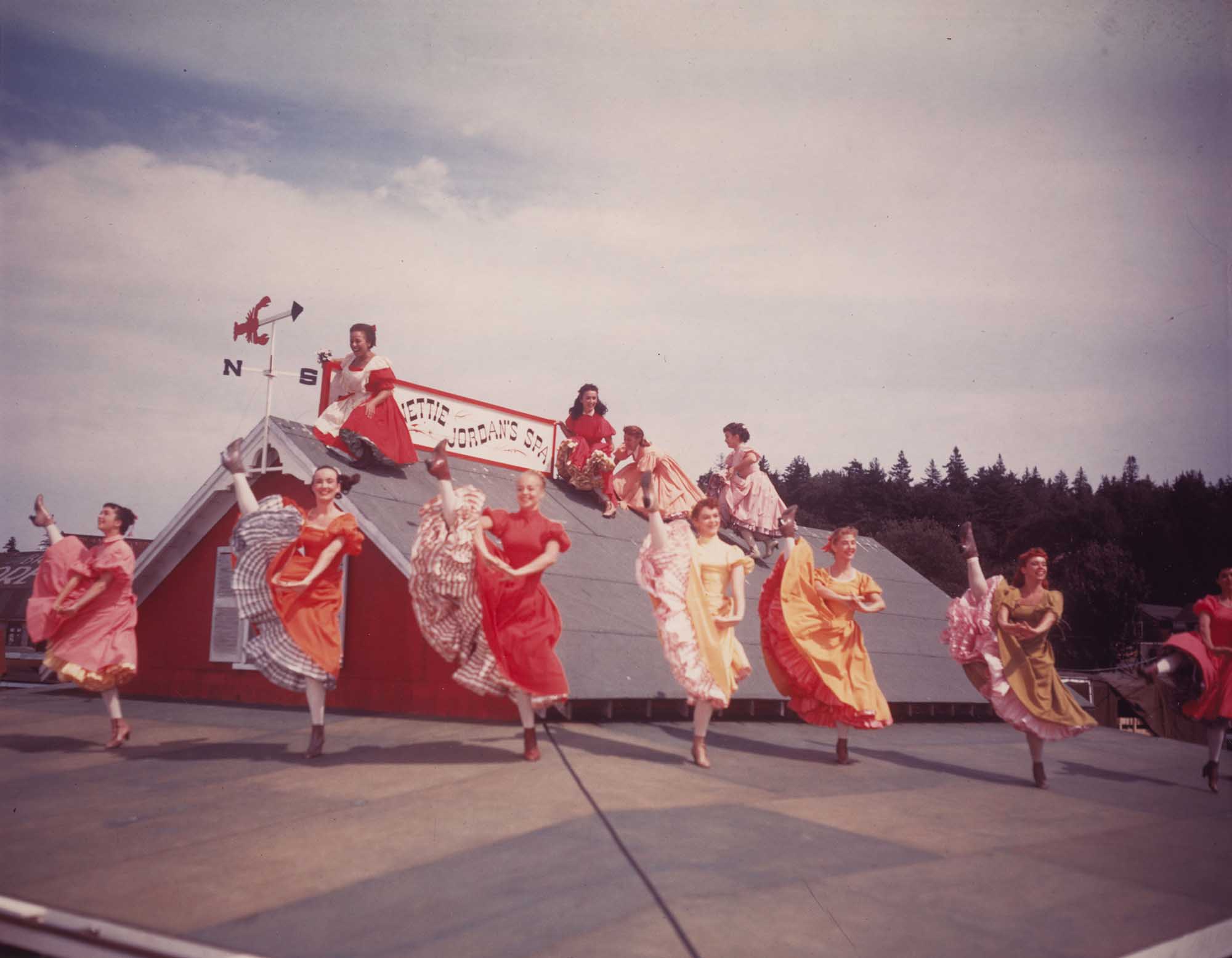
It’s colorful with gorgeous music and a lovely, sad story about love and loss. The dances, such as “June is Bustin’ Out All Over” and the ballet with Julie’s daughter, Louise (Luckey), are wonderful. I loved seeing Jacques D’Amboise perform. I also wondered if “Real Good Clambake” the only song that mentions melted butter.
But I can’t write about LILIOM, the “Carousel” stage production or the 1956 film adaptation without acknowledging the glaring issue in all three: the aspect of abuse. I remembered it being more prominent than it is, and I was glad that the people around Billy and Julie did not approve of his abuse, including Cousin Nettie who speaks out about and an agent from Heaven who scolds Billy for it. The problem is, Julie does.
We were doing alright in the film until six minutes are left and Louise asks, “Is it possible for someone to hit you, hit you hard, and it to not hurt at all?” Julie says, “Yes.” (Take note – this is the wrong answer if your child ever asks this). This line isn’t isolated to the CAROUSEL film, but also the play, and LILIOM notes that “he kissed me and it felt like a kiss.”
Outside of this, CAROUSEL has really beautiful music, especially the “Carousel Waltz.” The on location filming in Maine wanted me to travel up there next summer. I’m also a sucker for merry-go-rounds.
I also have to note: Before seeing this movie, I knew the famous song “If I Loved You,” thanks to my favorite singing duo, Chad & Jeremy. Their rendition may be my favorite.
Other places you can follow Comet Over Hollywood:
- Letterboxd
- X at @HollywoodComet
- BlueSky
- Or e-mail us at cometoverhollywood@gmail.com
 Comet Over Hollywood
I’d have cast Elvis Presley as Billy. I didn’t care for the revival at Regents Park in 2021 – bit too PC and Geordie accents. I also had the idea of casting the show from Birds of a Feather in the early 90s.
LikeLike
Hi, I enjoyed learning more about Carousel from this post, but I’m surprised you did not mention the song “If I Loved You.” It presents the true feelings of Billy and Julie in such a lovely, uniquely subtle way. I used the words in a card to my boyfriend once. I heard it in an episode of “Cheers” once! Also, I think the song “People Will Say We’re in Love” was sung by MacCrae and Jones in Oklahoma, not Carousel. They do sing wonderfully together! The Rodgers & Hammerstein Collection—a boxed set of DVDs—contains the film Liliom starring Charles Boyer. If I’m correct (I haven’t watched this in a long time), there’s a scene where, in heaven, Billy is forced to watch an incident from his past and hear the thoughts he had while he was being mean to Julie: they were full of tenderness toward her and disgust with himself. He felt humiliated by others knowing this! It seemed to bring home the point that if Billy had been raised within a different culture (and was able to find a decent job), he could have acted according to his true feelings rather than how he was led to believe men should act.
Thanks for all your interesting posts! Jeanette Briggs P.S. I was unable to post this as a comment.
LikeLike
Hey Jeanette! Thank you for stopping by and reading. Your comment came through, but I just approve them 🙂 You’re right, I did forget to mention “If I Loved You,” which is probably my favorite song in the musical, though I did note in the “notable songs” list and that I love the Chad & Jeremy cover – ha! LILIOM is beautiful, just a bit darker.
LikeLike