
It’s no secret that the Hollywood Comet loves musicals.
In 2010, I revealed I had seen 400 movie musicals over the course of eight years. Now that number is over 600. To celebrate and share this musical love, here is my weekly feature about musicals.
 This week’s musical:
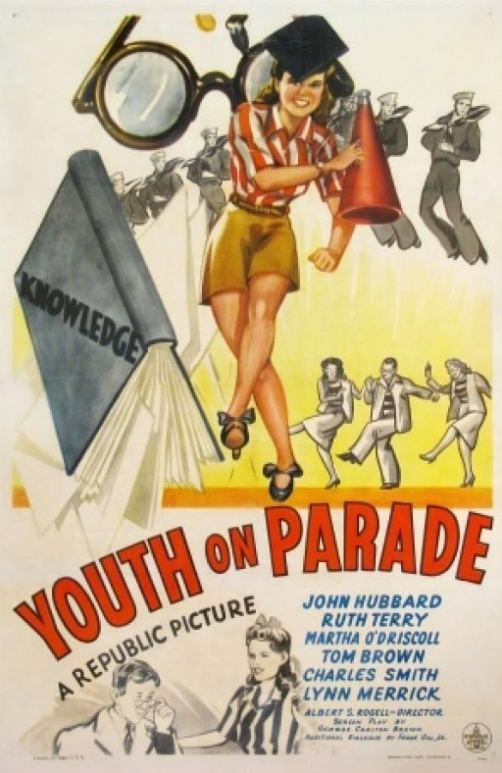
Youth on Parade (1942) – Musical #820
Studio:
Republic Pictures
Director:
Albert S. Rogell
Starring:
John Hubbard, Ruth Terry, Martha O’Driscoll, Tom Brown, Charles Smith, Lynn Merrick, Nana Bryant, Ivan F. Simpson, Chick Chandler, Richard Beavers (billed as Bruce Langley), Marlyn Schild, Betty Atkinson (uncredited), Ruth Day (uncredited), Yvonne De Carlo (uncredited), Paul Fix (uncredited)
Specialty Dancers: Bud Mercer, Jim Mercer
Plot:
Students at Cotchatootamee College have been under an experiment by Professor Payne (Hubbard). They aren’t allowed to go on dates or go to parties to see if it positively impacts their grades. They are all also assigned numbers to eliminate bias and favoritism. In retaliation, the students create a fictional genius, Patty Flynn, who passing every class with flying colors. When the dean (Simpson) wants to meet the star student, student Bingo Brown (Brown) searches for someone to as Patty. He finds singer Betty Reilly (Terry), who fits the bill, especially as she needs to hide out due to a racing debt she owes.
Trivia:
• The song “I’ve Heard that Song Before” was introduced in this film. It was further popularized by Harry James’s band and Helen Forrest.
• Margaret Whiting dubbed the singing voice of Martha O’Driscoll
• Working titles included “Broadway Goes to College,” “Say It with Music” and “Chatterbox.”
• Mary Lee was originally set to star in the film. The cast was originally supposed to feature teen stars all under age 18, according to the Hollywood Reporter.
• Martha O’Driscoll and Charlie Smith were borrowed from Paramount for the production.
• After a test screening, Ruth Terry’s role was built up further, according to a Sept.
• The song “You’ve Got to Study Buddy” was written to encourage college students to finish their studies before enlisting, according to Motion Picture Herald.
• “I’ve Heard that Song Before” was nominated for an Academy Award for Best Song. It lost to “White Christmas” by HOLIDAY INN.
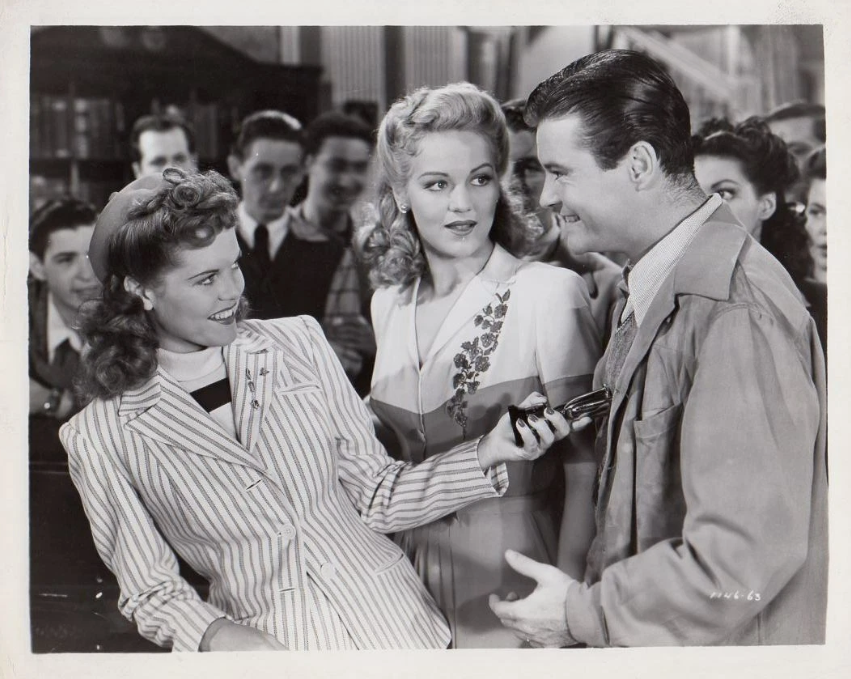
Ruth Terry, Martha O’Driscoll, Tom Brown
Highlights:
• The musical numbers
Notable Songs:
• “I’ve Heard That Song Before” performed by Martha O’Driscoll, dubbed by Margaret Whiting
• “If It’s Love” performed by Ruth Terry
• “You Gotta Study, Buddy” performed by Tom Brown (dubbed), Martha O’Discoll (dubbed by Margaret Whiting) and the chorus
My review:
Youth culture is often attributed to post-war. The “Teen Ager” musical films were released at the end of the war, coining the phrase “teenager.” But this week’s Musical Monday was specifically made for World War II-era college students.
In the film, students at Cotchatootamee College have been under an experiment by Professor Payne (Hubbard). They aren’t allowed to go on dates or go to parties to see if it positively impacts their grades. They are all also assigned numbers to eliminate bias and favoritism. In retaliation, the students create a fictional genius, Patty Flynn, who passing every class with flying colors. When the dean (Simpson) wants to meet the star student, student Bingo Brown (Brown) searches for someone to as Patty. He finds singer Betty Reilly (Terry), who fits the bill, especially as she needs to hide out due to a racing debt she owes.
This movie is a bit zany, especially once Ruth Terry shows up on the scene. Her character is a fast talking dame who spit out slang and sings hit song – she’s supposed to seem like a far cry from the collegiate genius that she’s playing.
But while it’s a goofy film, it’s also an interesting film, because it ends with a message for war-era college students. The goal of the film was to encourage students to finish their college education before enlisting, according to musical historian Sean Griffin.
Towards the end of the film, Tom Brown’s character laments that it feels pointless to stay in school while other people are overseas fighting in the war. John Hubbard’s professor character gives a speech to the students that this war isn’t just about muscle and brawn, that you have to have knowledge and brains to win the war. He notes the precision of the bomb sites and knowing languages, encouraging them to get knowledge before considering to go overseas. The film ends with the song, “You Gotta Study, Buddy,” as the performers are dressed first in college clothing and then uniforms.
This effort was due to students leaving college after the United States entered the war in Dec. 1941. Students, especially men, began to join the military. For example, Clemson College (now University) which was a military college at the time dropped from 1,700 students to an enrollment of 750 during the war.
In the spring of 1942, enrollment in colleges across the country dropped. For example, the University of Texas and the University of Chicago both lost 15% of their student population to the war effort.
This shift in tone for this zany movie was interesting to me. Another tidbit that was interesting is that this slight, low budget film produced the hit song “I’ve Heard That Song Before,” further popularized later by Harry James and Helen Forrest.
The film iis fun because it’s youth culture and collegiate feel. It begins with a great college song, complete with a baton twirler.
It was fun to see Tom Brown, though he’s certainly not singing in this movie. I have a soft spot for Brown, so I love to see him in anything.
Though Ruth Terry’s role was a bit too much for me in this film, her role was made bigger after test audiences saw the film and wanted to see more of her. Martha O’Discoll (who I confuse with other actresses named Martha) is pretty and pleasant in the film but doesn’t have much to do.
Charles Smith has a brief but humorous role of the student insulted that he’s not actually the intellectual genius of the school.
But for me the true standout was Nana Bryant, as the professor’s secretary named Frosty. I always love to see Bryant in any film, but she’s especially fun here. She plays the go-between for the students and the professor, helping them through their predicament.
While this movie is a bit goofy, it’s fun and interesting about how it fits into the culture and history of World War II.
Other places you can follow Comet Over Hollywood:
- Letterboxd
- X at @HollywoodComet
- BlueSky
- Or e-mail us at cometoverhollywood@gmail.com
 Comet Over Hollywood