
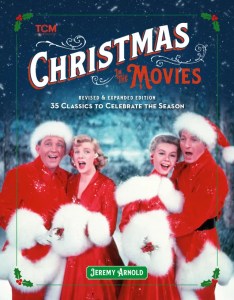
 Today when the term “Christmas movie” is thrown out, we have mental images of cozy holiday films, family dramas set during the Christmas season, or formulaic TV movies on Hallmark.
But the genre of “Christmas movie” didn’t always exist, according to Jeremy Arnold, film historian and author of “Christmas in the Movies: 35 Classics to Celebrate the Season.”
“They were not making Christmas movies. The term didn’t exist in the 1940s. Frank Capra never said, ‘I’m going to make a Christmas movie with Jimmy Stewart,’” Arnold said. “They were dramas. They were musicals. They were romantic comedies. Westerns, even, and the whole idea of a Christmas movie as a thing and eventually a genre, didn’t come till decades later.”
Despite that, the rise of holiday storytelling came with World War II.
“It’s that the war is starting, so this idea of family is really coming to the fore,” Arnold said. “Christmas movies take the idea of the family unit and link the stories to the holiday somehow. Christmas pops up in all kinds of movies in many different genres. They were often released throughout the year, not just during the Christmas season. Hollywood, screenwriters and producers were thinking of the Christmas season as a storytelling device and a way to really inject meaning.”
For example, MIRACLE ON 34TH STREET (1947) was released in June, not during the holiday season as it would be now. It was also released in a prolific year for holiday films. The year was two years after the end of World War II, a war that affected families across the world.
“The second half of the decade was about families trying to reconstitute themselves, sometimes without the return of those loved ones,” Arnold said. The ones that did return sometimes had great psychological troubles. That’s one of the origins of film noir.”
Both Christmas movies and film noir were both influenced by the effects of World War II, Arnold said, comparing the storytelling of the holidays and film noir genre as the flipside of each other.
“Film noir pulls characters down into the underbelly of their psyches and of society, and Christmas movies tend to lift characters up,” he said.
Christmas movies released during 1947 include: MIRACLE ON 34TH STREET, THE BISHOP’S WIFE and IT HAPPENED ON FIFTH AVENUE. IT’S A WONDERFUL LIFE (1946) and 3 GODFATHERS (1948) also flank this prolific year of holiday films.
While writing his book, Arnold worked to create a strict definition in order to narrow down the films he highlighted. His definition?
“Christmas has to be important to the story,” Arnold said. “It can’t just be a setting, can’t just be a background. Although I will say that any movie with Christmas in it is fun to watch at Christmas time. I just don’t consider them all to be Christmas movies.”
Listen to the video below for the full interview on holiday films and under-the-radar Christmas films Jeremy Arnold recommends:
In the D.C. area? Jeremy Arnold will be introducing holiday films from Dec. 21 – 25 at the AFI Silver Theater. Find the full schedule here.
Other places you can follow Comet Over Hollywood:
- Letterboxd
- X at @HollywoodComet
- BlueSky
- Or e-mail us at cometoverhollywood@gmail.com
 Comet Over Hollywood