
It’s no secret that the Hollywood Comet loves musicals.
In 2010, I revealed I had seen 400 movie musicals over the course of eight years. Now that number is over 600. To celebrate and share this musical love, here is my weekly feature about musicals.
 This week’s musical:
Oklahoma (1955) – Musical #67
Studio:
RKO Radio Pictures
Director:
Fred Zinnemann
Starring:
Gordon MacRae, Shirley Jones, Gloria Grahame, Gene Nelson, Charlotte Greenwood, Eddie Albert, James Whitmore, Rod Steiger, Barbara Lawrence, Jay C. Flippen, Roy Barcroft, James Mitchell, Bambi Linn, Marc Platt, Russell Simpson (uncredited)
Plot:
The story is set in the early 1900s before Oklahoma became a state. Curly (MacRae) is a happy-go-lucky rancher who is in love with Laurey (Jones), who returns the feelings but refuses to show it. Jud (Steiger) is the farmhand on Laurey and her Aunt Eller’s (Greenwood) farm, and he also lusts after Laurey. To make Curly jealous, Laurey agrees to attend a party at the Skidmore Ranch with Judy, but quickly realizes it’s a dangerous mistake. In a secondary romantic plot, Will Parker (Nelson) returns to town from a rodeo, prepared to marry his girlfriend Ado Annie (Graham). However, Ado Annie has recently filled out and is enjoying the attentions of various men, including a peddler, Ali Hackim (Albert). In addition to all of this, there is tension between farmers — who want land for farming — and ranchers — who take issue with fences closing off the land.
Trivia:
• Shirley Jones’s first feature film.
• Based on the 1943 Broadway musical with music by Richard Rodgers and Oscar Hammerstein. The musical is based on the 1931 play “Green Grow the Liliacs” by Lynn Riggs.
• This was the first feature film shot in Todd-AO 70 mm, and was shot at the same time in Cinemascope. Todd-AO, CinemaScope and standard 35mm prints because few theaters could afford to retrofit for the Todd-AO projectors and extended, curved screens. Todd-AO was only shown in approximately 40 retro-fitted theaters.
• Director Fred Zinnemann’s first musical feature film.
• James Mitchell and Bambi Linn danced as Dream Curly and Dream Laurey in the ballet dream sequence.
• Filmed in Arizona. Three months before filming began, crew went to plant corn, wheat and peach trees for the production. They also built a barn, silo, windmill and farmhouse, according to Shirley Jones’s memoir.
• Only two songs from the original Broadway musical were eliminated from the film version of the musical, Jud’s song “Lonely Room” and Ali Hakim’s song “It’s a Scandal! It’s a Outrage!”
• Bambi Lin is the only actor or dancer who appeared in the original Broadway show, but she played a small role of Aggie.
• James Dean auditioned for the role of Jud, and Richard Burton was considered for the role.
• Shirley MacLaine wanted the role of Ado Annie, according to Shirley Jones’s memoir.
• Oklahoma Representative Victor Wickersham protested to the producers and publicly in the House of Representatives in Washington, D.C. that the film wasn’t going to be filmed in Oklahoma.
Awards and Nominations:
• Robert Surtees was nominated for an Academy Award for Best Cinematography, Color
• Fred Hynes, of the Todd-AO Sound Dept., won an Academy Award for Best Sound, Recording
• Gene Ruggiero and George Boemler were nominated for an Academy Award for Best Film Editing
• Robert Russell Bennett, Jay Blackton, and Adolph Deutsch won an Academy Award for Best Music, Scoring a Musical Picture.
• Added to the National Film Registry in 2007
Highlights:
• The music
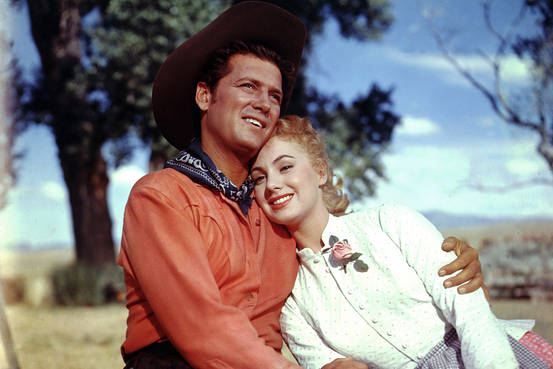
• Gordon MacRae
• The vibrant cinematography
• The dancing
Notable Songs:
• “Oh, What a Beautiful Mornin’” performed by Gordon MacRae
• “The Surrey with the Fringe On Top” performed by Gordon MacRae, Shirley Jones and Charlotte Greenwood
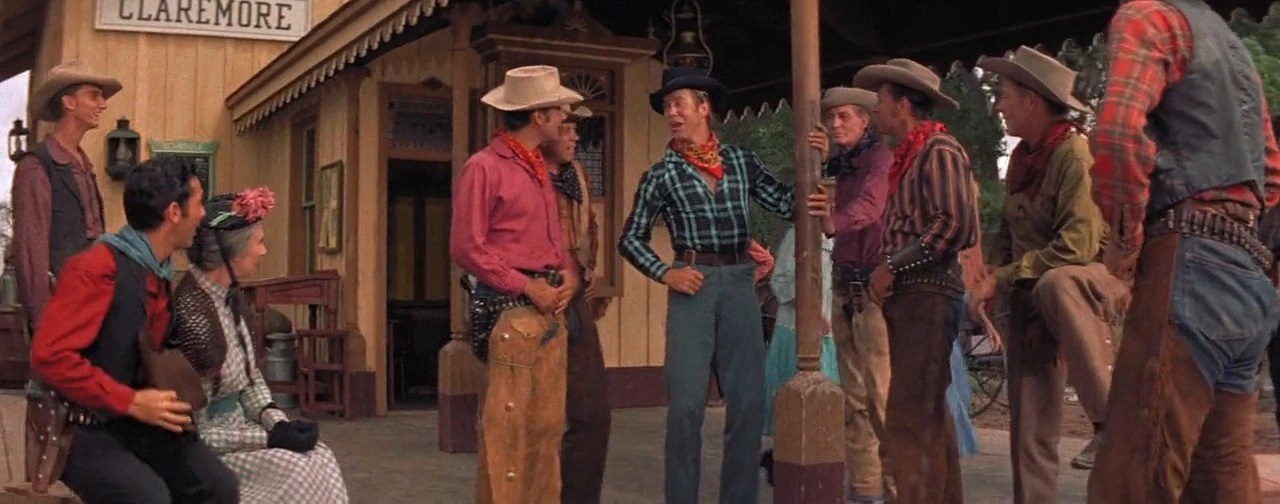
• “Kansas City” performed by Gene Nelson, Charlotte Greenwood, the chorus
• “I Cain’t Say No” performed by Gloria Grahame
• “Many a New Day” performed by Shirley Jones
• “People Will Say We’re In Love” performed by Gordon MacRae and Shirley Jones
• “The Farmer and the Cowman” performed by Gordon MacRae, Charlotte Greenwood, Gene Nelson, Jay C. Flippen, James Whitmore, Gloria Grahame, chorus
• “All ‘Er Nothin’” performed by Gloria Grahame and Gene Nelson
• “Oklahoma!” performed by the full cast

My review:
There’s something about the start of OKLAHOMA! that gets me chocked up.
The twinkling anticipatory music, the camera going through a field of corn, and there he is: Gordon MacRea, riding on a horse in a bright red shirt set against a glorious blue sky singing “Oh, What a Beautiful Mornin’.”
Not to be dramatic, but Gordon MacRae has the best male singing voices on screen. Yes, singers like Nelson Eddy and Howard Keel (and even Mario Lanza) are great, but MacRae possesses a warmth in his voice and persona that the others don’t. He looks like someone you could sit down and have a conversation with and be listened to with earnestness.
And he’s perfect for the male lead role of Curly in OKLAHOMA!
Thinking back to the first time I watched OKLAHOMA! as a teen, I remember feeling lukewarm about it. But then I saw a stage production of it in 2005 and was hooked. In 2013, I performed in a local theater performance of it as Ado Annie and I’ve been hooked ever since.
With its music, new talent and groundbreaking filming process of Todd-AO, the film version of Rodgers and Hammerstein’s OKLAHOMA! (1954) is a glorious spectacle. Rodgers and Hammerstein oversaw every detail of the film, according to Shirley Jones’s memoir.
A film adaptation of the Richard Rodgers and Oscar Hammerstein 1943 Broadway musical, OKLAHOMA tells the story of the romance of Curly (MacRae) and Laurey (Jones) — Laurey is in love with Curly but resists as he tries in earnest to move forward with their relationship (I’m honestly, still not sure why). In the secondary leading romantic roles are Will Parker (Nelson) and Ado Annie (Grahame) — who also is interested in the traveling salesman Ali Hackim (Albert). Then there’s the farm hand Jud (Steiger), who lusts for Laurey and threatens violence if he doesn’t get his way. The stories are set against the conflict of the land struggle between farmers and cattle ranchers before Oklahoma became a formal state.
Beautiful and catchy songs (that will get stuck in your head for days to come!) tell the story of OKLAHOMA! It’s difficult to pick a favorite song in this film, because they are all wonderful. But how can you go wrong with the cheerful, wistful “Oh, What a Beautiful Mornin.’”
The story is quite simple while generally bright and happy, it’s also rather dark. Jud is a brooding, dangerous character who confesses to Curly about a disturbing crime he committed, and watches Laurey through windows in her home. A duet performed by Curly and Jud, “Poor Jud is Dead,” is Curly trying to convince Jud to hang himself, because everyone will appreciate him more after he’s gone. Dark stuff!
The film version has a star-studded and almost-perfect cast.
I’ve already sung my praises about Gordon MacRae. But to reiterate, he is simply wonderful in OKLAHOMA! It’s like the role of Curly was made for him.
At age 19, OKLAHOMA was actress and singer Shirley Jones’s first feature film, which to me is incredible. She was discovered by Rodgers and Hammerstein during an audition for a stage production of “South Pacific,” she wrote in her memoir. With a Cinderella-like story, Jones wrote that getting the role of Laurey was both a dream come true but also a nightmare. She wasn’t used to the sudden attention, and the filming was strenuous. The crew filmed on location in Arizona for nine months, shooting daily for 14-hour days. However, Jones loved the project and her co-star, MacRae (which I was so happy to read).
“I loved the script and adored the songs, and working with Gordon MacRae was heaven,” Jones wrote in her memoir. “I adored him at first sight and even developed a mild crush on him as filming went on, but took great pain to fight it.”
Director, Fred Zinnemann told her she was a natural actress, even though she had never acted prior to this film. It is incredible to think this was Jones’s first film role, because she’s perfect for the role of Laurey. She’s a great actress and, of course, has that gorgeous operatic singing voice.
I also LOVE seeing Gene Nelson in this film as Will Parker. Nelson is an underrated dancer, and unfortunately, we only get to see his incredible dancing once, in “Kansas City.” Whenever he jumps or swings around a column, he looks as light as a feather and like it’s so easy.
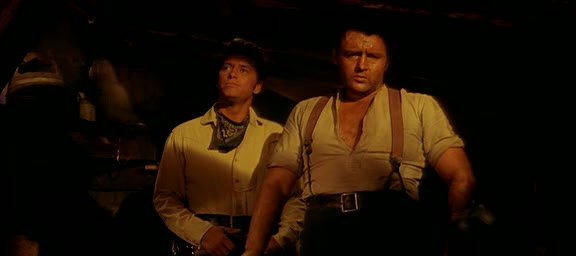
Rod Steiger is excellent at playing creepy Jud, and Eddie Albert is fun at playing phony Ali Hakim. The film omits solos from both Jud and Ali Hakim, but honestly, I don’t feel they are all that necessary. The supporting cast in this film is also excellent, with Charlotte Greenwood and James Whitmore delivering some great lines.
To me, the only miscast is Gloria Grahame as Ado Annie. In an era ripe with musical actresses, she was a strange person to cast. I know Ado Annie is a comedic role, but having someone who could sing and dance may have been better. Though it is impressive that both Grahame and Steiger did their own singing!
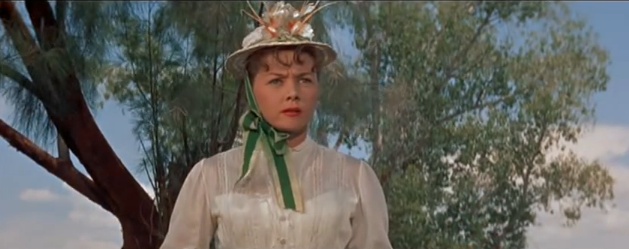
One interesting bit of casting is Marc Platt as one of the dancers, who gets a few lines. In the 1940s, Platt was built up to be a new dancing star, performing similar numbers to Gene Nelson does here. It’s a bit sad to see how he fell to this bit part role, though he has more lines and screen time than the other dancers.
Filming Innovations
OKLAHOMA is also amazing for the filming innovation that it introduced. It’s the first film to be filmed using the Todd-AO production. A process developed by Mike Todd, Todd-AO is a 70mm filming process. While similar to Cinerama, the “seams” that would appear on screen wouldn’t occur, as the picture was projected from one lens, rather than three. The screen required for a Todd-AO film had to be curved, so OKLAHOMA was only shown in approximately 40 theaters, because the process required retrofitting, according to the featurette.
However, while OKLAHOMA was filmed in Todd-AO, it was also filmed in Cinemascope at the same time. In a featurette on the process, curator Martin Hart said it’s not like the could shot with the cameras side-by-side. Each scene had to be shot twice, according to Hart.

Interestingly, the Cinemascope and Todd-AO versions of the film have different openings. With Todd-AO, the credits have a black backdrop and the film opens in the cornfield. In the Cinemascope version, the credits are on a scenic backdrop with Curly riding up on a horse.
In his autobiography, director Fred Zinnemann noted that using both Todd-AO and CinemaScope was a precautionary measure, as Todd-AO was still in the testing stages and only one bug-eye lens existed at the time.
This was also director Zinnemann’s first musical, and for a director who isn’t experienced in musicals, he does a great job. Though Zinnemann didn’t agree.
“Much as I love musicals, I’d rather watch them than make them,” Zinnemann said. “I did have a marvelous time making Oklahoma, but thinking back on it, I feel I didn’t get the best out of the material, a man who really understands musical comedy could have done better.”
OKLAHOMA! is visually stunning, though I desperately need to upgrade my 1999 DVD — I have a Blu-Ray on order as I type.
Vibrant Dances
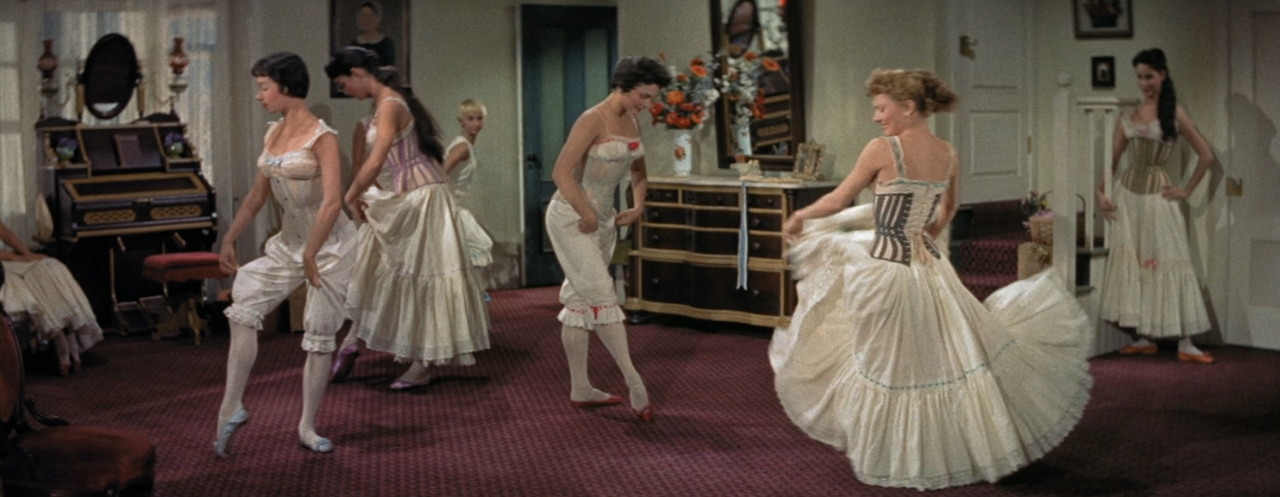
In the stage production, the goal was to further the plot and develop characters through the songs and dances, which is also reflected in the movie. For example, I love in the “Many a New Day” ballet as the dancing serves as way to show the personalities and relationships between the women. As a teen, I used to fast-forward through the dream ballet sequence (oops) and when I rewatched this for the first time in years, I actually watched it. I love seeing James Mitchell and Bambi Linn dance together — especially because I grew up watching Mitchell on my mom’s soap opera, “All My Children.”

Outside of the casting of Ado Annie, the only other real complaint I have is that in some shots of “Kansas City” and “Many a New Day,” the feet are cut off in the shot and that bugs me.
I hadn’t watched OKLAHOMA! in many years and had a wonderful time revisiting it (as you maybe can tell from this review!). The stunning music, the beautiful singing, the exciting dancing — watching it makes you feel a warm glow. And be prepared to be humming and singing the songs for days after.
Check out the Comet Over Hollywood Facebook page, follow on Twitter at @HollywoodComet, follow on Instagram or e-mail at cometoverhollywood@gmail.com
 Comet Over Hollywood