
It’s no secret that the Hollywood Comet loves musicals.
In 2010, I revealed I had seen 400 movie musicals over the course of eight years. Now that number is over 600. To celebrate and share this musical love, here is my weekly feature about musicals.
 This week’s musical:
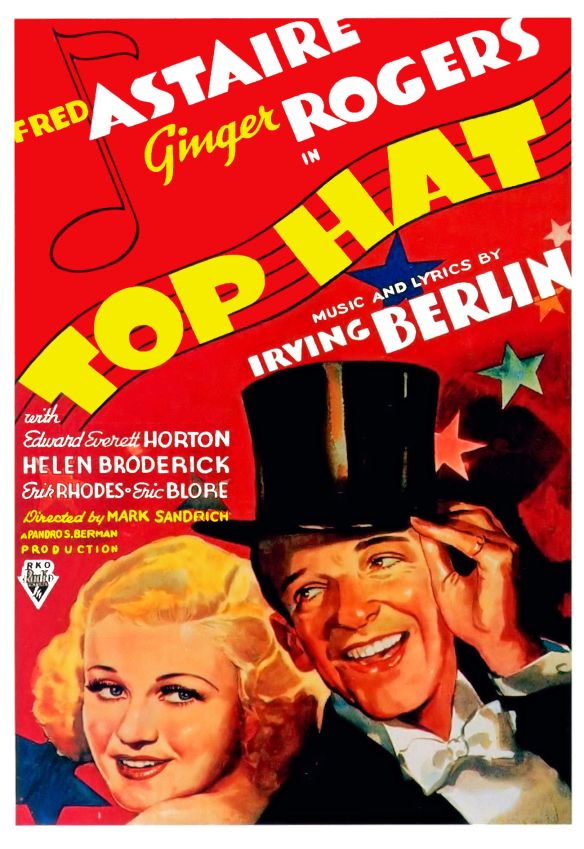
Top Hat (1935) – Musical #99
Studio:
RKO Radio Pictures
Director:
Mark Sandrich
Starring:
Fred Astaire, Ginger Rogers, Edward Everett Horton, Erik Rhodes, Eric Blore, Helen Broderick, Lucille Ball (uncredited), Dennis O’Keefe (uncredited)
Plot:
Jerry Travers (Astaire) is a dancer preparing for a show in England with his producer, Horace Hardwick (Horton). While in England, Horace invites Jerry to Venice, where his wife Madge (Broderick) is staying. Horace and Madge want Jerry to meet their friend, Dale Tremont (Rogers). Unbeknownst to them, Jerry and Dale have already met and are smitten, but Dale mistakenly thinks that Jerry is Horace — believing that she’s in love with a married man.
Trivia:
• Based on the 1911 play, “A Scandal in Budapest.”
• Future director Robert Wise was a sound effects editor for the film.
• Top Hat was the fourth time Bernard Newman dressed Ginger Rogers for a film. The others include Rafter Romance, Roberta, The Gay Divorcee and Star of Midnight.
• TOP HAT was the first film with music by Irving Berlin starring Fred Astaire and Ginger Rogers. They worked on two others: FOLLOW THE FLEET (1936) and CAREFREE (1938).
• Fred Astaire is attributed with coming up with the title, TOP HAT, for the film, according to Berlin’s biographer.
• “Isn’t This a Lovely Day?” was a song added at the last minute when Astaire and Hermes Pan realized they need another dance number.
• Ginger Rogers’s costume from “The Piccolino” number was donated to the Smithsonian in 1984.
• Because of all the spinning in “The Piccolino,” Hermes Pan told his dancers no candy, cigarettes or rich foods.
• The dress Ginger Rogers wears during the “Cheek to Cheek” number shed feathers, which frustrated Fred Astaire. After the film, Astaire nicknamed Rogers “Feathers,” according to Rogers’s memoir.
Highlights:
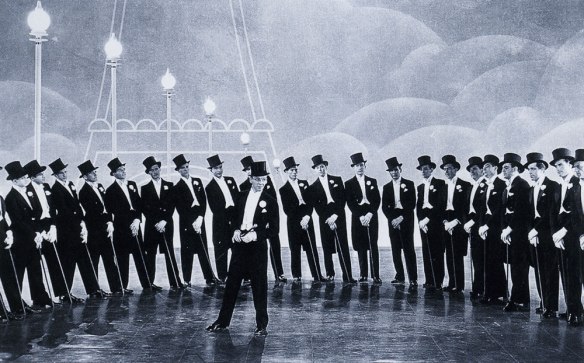
• Fred Astaire’s dance “Top Hat, White Tie and Tails”
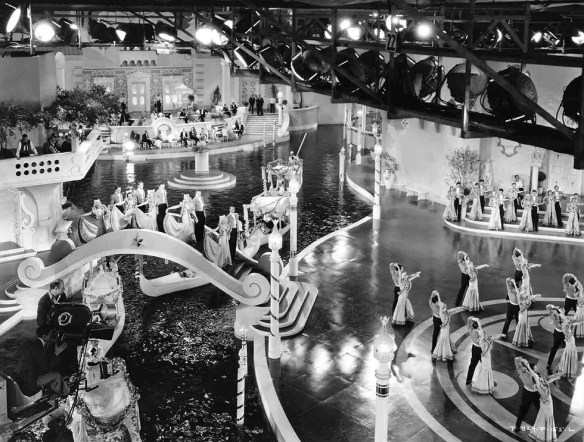
• “The Piccolino” number
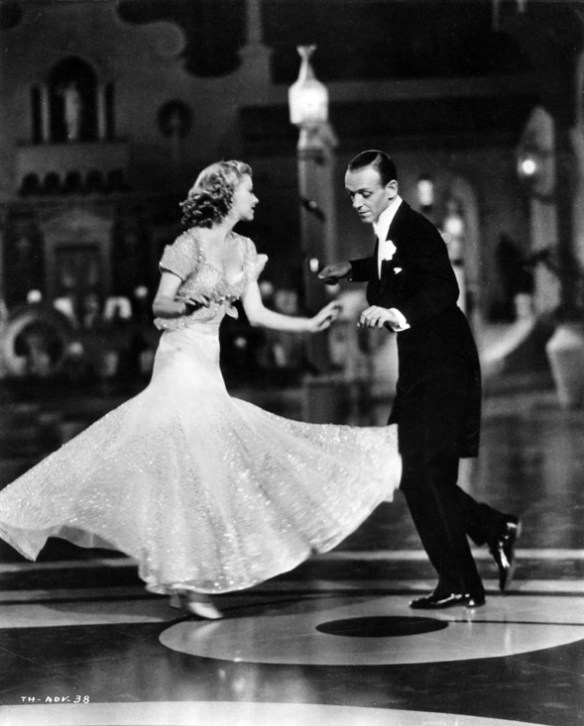
• The feather dress dance with Ginger Rogers and Fred Astaire
Notable Songs:
• “No Strings (I’m Fancy Free)” performed by Fred Astaire
• “Isn’t This a Lovely Day (to be Caught in the Rain)” performed by Fred Astaire and Ginger Rogers
• “Top Hat, White Tie and Tails” performed by Fred Astaire
• “Cheek to Cheek” performed by Fred Astaire
• “The Piccolino” performed by Ginger Rogers and Fred Astaire
My review:
My goodness, there is much to dive into with TOP HAT (1935). When I saw this movie years ago for the first time as a teen, I likely checked it out from the library like I did many Fred Astaire and Ginger Rogers films.
The plot is a bit silly, but perhaps a bit more coherent than their other films:
Dancer Jerry Travers (Fred Astaire) is preparing for a show in England with his producer, Horace Hardwick (Edward Everett Horton). While in England, Horace invites Jerry to Venice, where his wife Madge (Broderick) is staying. Horace and Madge want Jerry to meet their friend, Dale Tremont (Ginger Rogers). Unbeknownst to them, Jerry and Dale have already met and are smitten, but Dale mistakenly thinks that Jerry is Horace — believing that she’s in love with a married man.
Music
While (to me) several of the plots of Astaire and Rogers films are similar from film-to-film, the films served to introduce famous popular songs. Notably, TOP HAT features songs written by Irving Berlin. His music for TOP HAT created popular standards in the American Songbook that are still revered today, such as “Top Hat, White Tie and Tails” and “Cheek to Cheek.” In total, the film features five Berlin songs — 30 minutes of the 100 minute film are Berlin’s music.
Following the format of other Astaire and Rogers films, the film featured a lively dance song. In other films, it was “The Carioca” and “The Continental.” In TOP HAT, it’s “The Piccolino,” which Berlin had the most difficulty writing, according to his biographer.
However, Berlin was easy for all to work with, and while filming he formed a lifelong friendship with Fred Astaire. Producer Pandro S. Berman later said hiring Irving Berlin made his life easy.
“There wasn’t anything I needed to do,” Berman said. “Nothing more you had to do than hire him and let him alone.”
Dancing
As with all Astaire-Rogers films, TOP HAT is filled with fantastic dances. The film was the first time Hermes Pan was credited as a dance director, and not an assistance, according to his biographer.
“When we use a song, we try to offer something more than just a hit by a famous composer,” said director Mark Sandrich. “We illustrate the song with action and background at the same time that the lyrics of the song give the dialogue of our characters.”
While creating a dance, Fred Astaire and Hermes Pan would work on how to start a dance number without it being jarring, “because people were beginning to be horrified at the idea of somebody bursting into song or dance without a reason,” Pan said in 1983.
As Astaire and Pan collaborated on dances, they always tried to improve on dances from picture-to-picture.
“Each new picture has to have better dances since people make comparisons,” Pan told the LA Times in a 1935 interview.
As an interesting fact, because of all the spinning in “The Piccolino” number, Hermes Pan told his dancers no candy, cigarettes or rich foods.
Something about feathers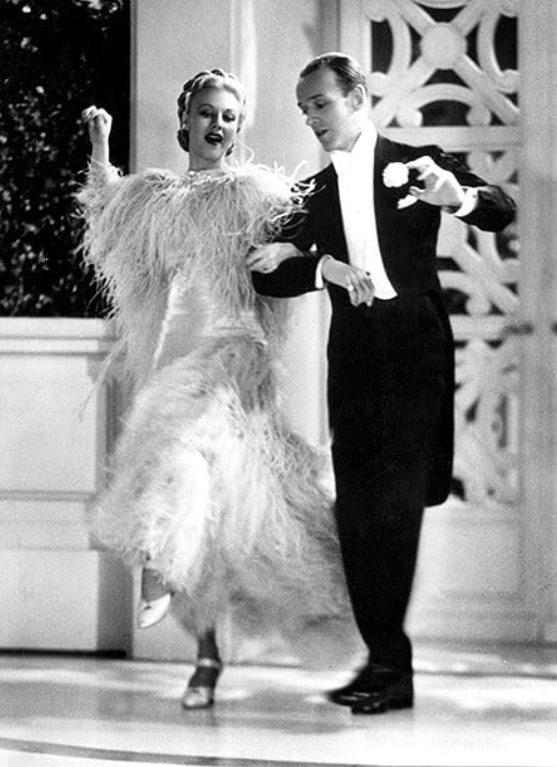 I think it’s impossible to write about TOP HAT without mentioning the feather dress, designed by Bernard Newman, for the “Cheek to Cheek” dance number performed by Fred Astaire and Ginger Rogers.
To summarize, satin dress was donned with ostrich feathers that came off the dress as Astaire and Rogers performed their dance. Dance director Hermes Pan thought the feathers would distract the dancers and director Mark Sandrich was concerned how they would appear on the Bakelite floor, according to Pan’s biographer.
For a balanced approach, I wanted to share the perspective of both Astaire and Rogers from their autobiographies:
Fred Astaire from his 1959 autobiography “Steps in Time”
“The dancing dresses of my partners have, for years, been a working problem, and in TOP HAT, I date say it reached its dizzy peak,” Astaire wrote. “I seldom discuss the style of a dress, but I am concerned with how it will dance, or rather, (the dance will) react to the dress.”
In his autobiography, Astaire said Newman’s design was a lovely dress. However, the dress wasn’t ready for rehearsal and wasn’t ready until it was time to shoot, so no one saw how it would react to the “Cheek to “Cheek” choreography.
“Everything went well through the song, but when we did the first movement of the dance, feathers started to fly as if a chicken had been attached by a coyote,” Astaire wrote (this made me laugh).
While filming, even the cameraman stopped them during the dance, saying he couldn’t photograph the number because the floor was covered with feathers, Astaire wrote.
There was much troubleshooting. Rogers’s mother Lela tried to help, the wardrobe department tried to shake out the dress, the feathers swept up and — as news traveled across the lot — onlookers came to see “that there was a blizzard on the Top Hat Set.” Astaire said it got to be funny after awhile.
After awhile, the cameramen decided they were finally able to try shooting again. Astaire concluded good-naturedly that the rushes looked good, and that the feathers weren’t obvious on film. Astaire said that they laughed about it for weeks, and it became a running gag with Astaire nicknaming Rogers “Feathers.”
Ginger Rogers in her 1991 autobiography, “Ginger: My Story”
Ginger Rogers said she discussed her costumes with designer Bernard Newman and said of the “Check to Check” dress: “I want a blue dress. A pure blue with no green in it at all Like the blue you find in the paintings of Monet. I would love the dress to be made of satin with myriads of ostrich feathers, love in the back and high in the front.”
Rogers acknowledges that she knows it seems silly to mention color in a black-and-white film, but it dealt with the tones.
Rogers also noted that the dress was not ready during rehearsals, and on the day of filming, the wardrobe department carried it to Rogers’s dressing room.
After the crew noticed the dress, director Mark Sandrich asked to speak to Ginger Rogers alone, recommending she wore a dress she previously wore in THE GAY DIVORCEE. He finally confessed the cameramen didn’t like the dress and Rogers was hurt and angry. She was prepared to walk off the set with her mother, Lela, Rogers wrote.
From her perspective, Astaire hated her dress as it was written on his face.
“It’s true, some of the feathers did flutter,” she wrote. “… I was determined to wear this dress come hell or high water. And why not? It moved beautifully.”
After the take, Rogers felt a coolness from Sandrich, Astaire and other crew members.
“I was sad they didn’t see that lovely dress would add to the number,” she wrote.
However, Rogers was enthusiastic that the scene looked great in the rushes. A few days later, Astaire sent her a feather charm for her bracelet with the note, “I love ya, Feathers!”
My perspective
As a viewer (and someone enthusiastic about dance and tap dances myself), I feel the dress masks Rogers’s moves in a way her other costumes don’t. If you watch closely, you can see the feathers in the air and on the floor.
Both Astaire and Rogers remember the incident quite differently. Astaire with humor and Rogers with hurt. I’m sure the truth is somewhere in the middle. In fact, after the incident, Pan and Astaire sang a parody of “Cheek to Cheek,” adapting the lyrics to “feathers” to sing to Rogers to help ease any tensions, according to Pan’s biographer.
However, I don’t feel it’s unreasonable for a ballroom dancing partner to be critical of how a costume would affect a dance, nor do I feel it unreasonable for a camera crew to speculate how it will appear on camera. If anyone should be upset, it would be costume designer Bernard Newman and the seamstresses for doing all that work for it to potentially not be used. However, there’s not much point in debating a costume worn 89 years ago, is there?
Overall, I think it’s valid to consider TOP HAT one of the best Astaire and Rogers films, with excellent and memorable songs and wonderful dance numbers. The plot is a bit screwy but as always, the supporting cast is quite funny. The film is quite fun, despite the feathers debacle.
Check out the Comet Over Hollywood Facebook page, follow on Twitter at @HollywoodComet, follow on Instagram or e-mail at cometoverhollywood@gmail.com
 Comet Over Hollywood