
It’s no secret that the Hollywood Comet loves musicals.
In 2010, I revealed I had seen 400 movie musicals over the course of eight years. Now that number is over 600. To celebrate and share this musical love, here is my weekly feature about musicals.
 This week’s musical:
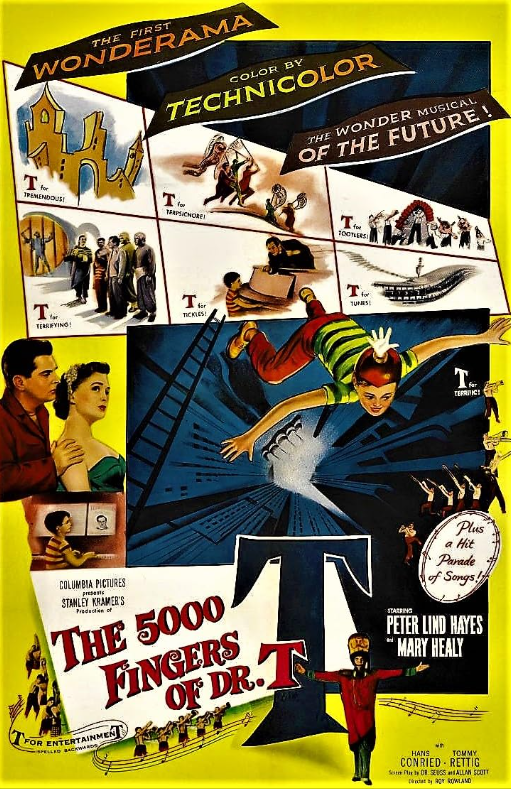
The 5,000 Fingers of Dr. T (1953) – Musical #783
Studio:
Columbia Pictures
Director:
Roy Rowland
Starring:
Tommy Rettig, Hans Conried, Peter Lind Hayes, Mary Healy, Jack Heasley, Robert Heasley, Noel Cravat, George Chakiris (uncredited)
Plot:
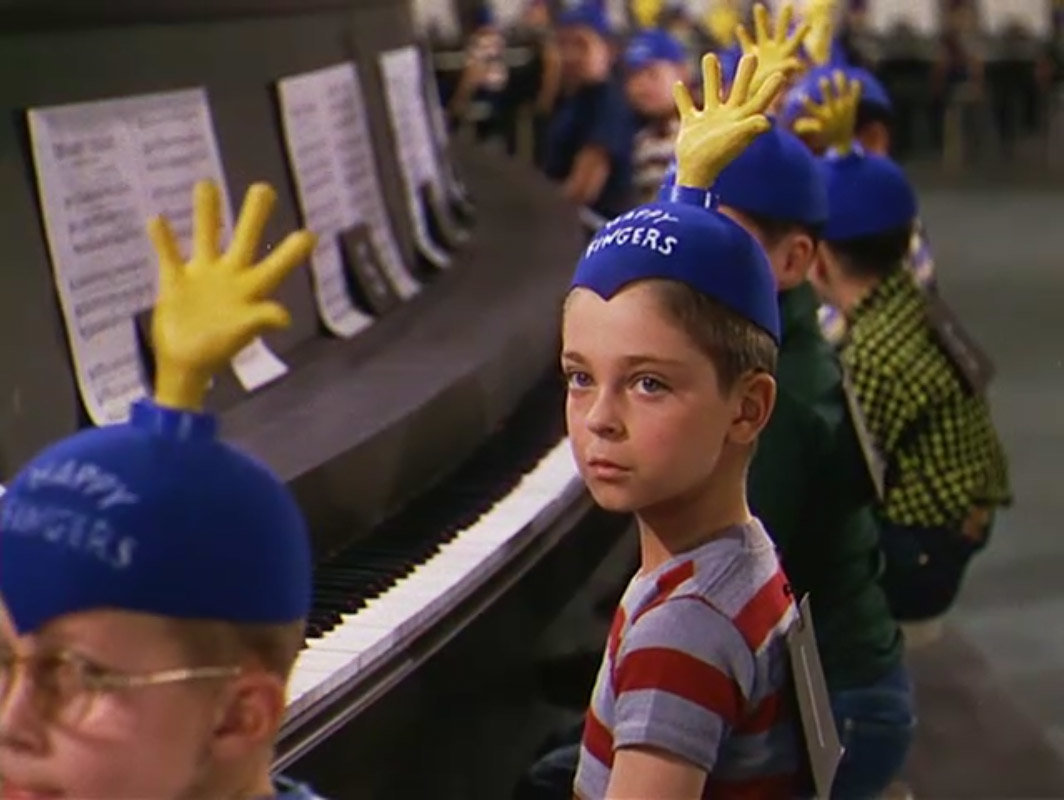
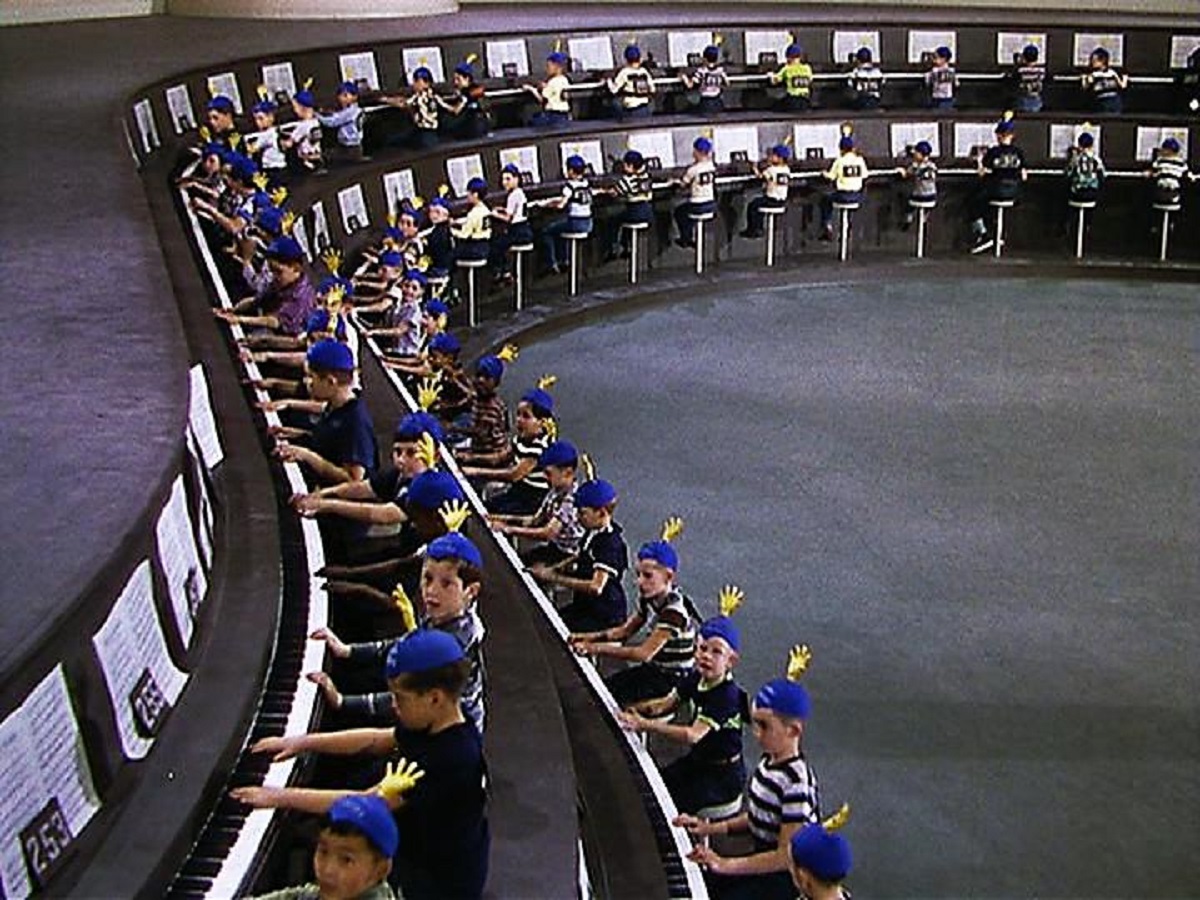
While 10-year-old Bart Collins (Rettig) hates piano lessons from his strict instructor Dr. Terwilliker (Conried), but his mother (Healy) loves the piano. While Bart is practicing his piano, he dozes off and has a terrible, surreal dream where Dr. Terwilliker is running a prison-like school where he wants 500 boys (hence: the 5,000 fingers) to play a giant piano at the same time. All the while, Bart’s mother is kept under a trance. In his dream, Bart enlists the help of kindly plumber August Zabladowski (Hayes) to help Bart, his mother and all the students to escape.
Trivia:
• The story and concept for the film were by Dr. Seuss
• Co-stars Peter Lind Hayes and Mary Healy were married in real life. The two were married from 1940 until Hayes’s death in 1998.
• Tommy Butala dubbed the singing voice of Tommy Rettig
• Jack Heasley and Robert Heasley are twin skating performers. This was their final film.
• Producer Stanley Kramer originally wanted Danny Kaye as Dr. Terwilliker and Bing Crosby as Mr. Zabladowski but actors turned down the roles.
• Nominated for an Academy Award for Best Musical Score.
• Reissued with the title “Crazy Music”
• Dr. Seuss insisted on actor Hans Conried in the role of Dr. Terwilliker, according to Hans Conried’s biographer.
• When the film was released, it was one of the most expensive films ever made, according to Conried’s biographer.
• Eleven numbers were cut from the film, according to Conried’s biographer.
Highlights:
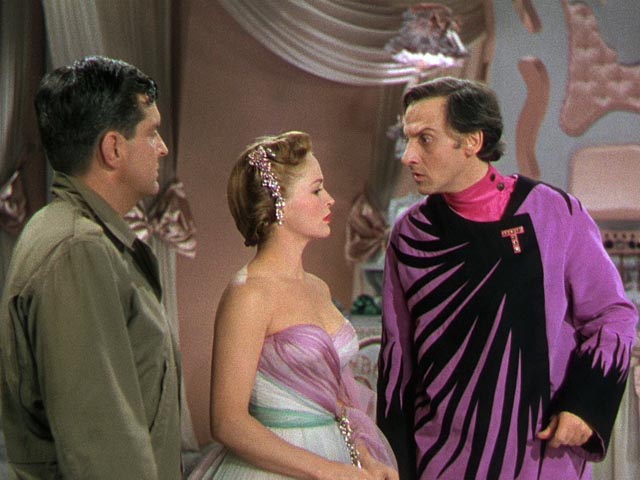
• Mary Healy’s costumes designed by Jean Louis
• The dancing fight between Hans Conreid and Peter Lind Hayes
Notable Songs:
• “Ten Happy Fingers” performed by Tommy Rettig, dubbed by Tony Butala, and Mary Healy
• “Dream Stuff” performed by Peter Lind Hayes and Tommy Rettig, dubbed by Tony Butala
• “Get-Together Weather” performed by Han Conried, Peter Lind Hayes and Mary Healy
• “Because We’re Kids” performed by Tommy Retting, dubbed by Tony Butala
My review:
It’s hard to put my thoughts down about THE 5,000 FINGERS OF DR. T (1953). It wasn’t bad — in fact I liked it better than I expected I would. However, at the same time, I think this would have been better suited as an hour long television special than a 90 minute feature film.
The plot was devised by no other than Theodor Seuss Geisel, aka Dr. Seuss. The plot follows 10-year-old Bart Collins (Rettig), who hates piano lessons and even more, dislikes his strict instructor Dr. Terwilliker (Conried). Bart’s mother (Healy) is no help, because she loves the piano and their kindly plumber, August Zabladowski (Hayes), can’t help him out of his lessons either. One day, while Bart is practicing his piano, he dozes off and has a terrible, surreal dream where Dr. Terwilliker is running a prison-like school where he wants 500 boys to play a giant piano at the same time. Also in the dream, Bart’s mother is kept under a trance, and Bart tries to enlist August to help Bart, his mother and all the students to escape.
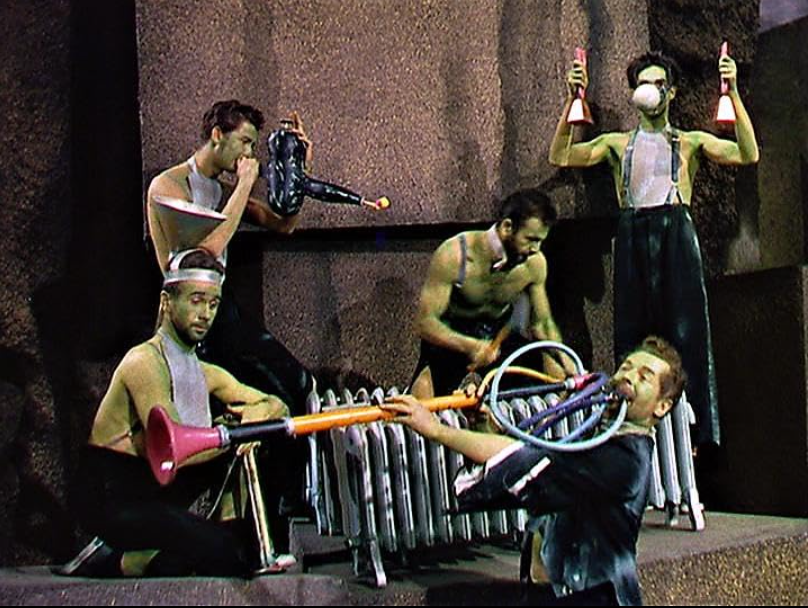
While in the dream, Bart sees his mother (in lavish Jean Louis costumes) held in a trance and kept from her son, Dr. Terwilliker acting like a king, and non-piano playing musicians (from trombone to triangle) in a dungeon — the piano is in ONLY instrument in Dr. T’s mind.
The story is told with wild, colorful visuals, which feel like you’re watching a Salvador Dali painting come to life. The dungeon ballet is a highlight — George Chakiris is somewhere in the dancers but I wasn’t able to spot him.
It should come as no surprise that this movie didn’t do well in 1953. It’s visually and musically interesting, but a bit conceptually advanced for this era.
Seuss was disappointed in the dismal audience reaction to the film. There was one incident on set where one boy (out of the hundreds hired for the giant piano scene) threw up, which started a chain reaction of the boys throwing up. Seuss later tied that to the outcome of the film.
“When the picture was finally released, the critics reacted in the same manner,” Seuss said.
Though Seuss went on record to give his disdain for the film, Tommy Rettig later said that he heard Seuss had fond memories of the film, according to Seuss’s biographer.
Another disappointed party was actor Hans Conried, who was undisputedly the highlight of the film with his hilarious and over-the-top performance.
“That was the film that might have changed my life,” Conried was quoted as saying. “I had never had any such part before, never have since and probably never will again. We rehearsed for eight weeks before I was engaged to shoot for eight weeks, an extravagance that I as a bit player had never known. If it had been a success, with my prominent part in the title role, it would have changed my life.”
Conried and the other stars blame a “hatchet job” of editing the film, but the film was edited down after people were leaving a preview screening so quickly they “thought a fire alarm went off,” according to Conried’s biographer.
While Conried is perfectly cast, I wondered if other stars would have been better. Real-life married couple Peter Lind Hayes and Mary Healy are charming, but not interesting enough to make you want to watch the film. Bing Crosby was approached the for role of the kindly plumber, and while I’m not certain he would have been a perfect fit, I think he would have been more interesting. I even felt Hayes acted a bit like Crosby.
A better child actor than Tommy Rettig also would be preferable. I actually think this could have been a great film for Billy Gray.
None of my dream casting matters now, after all these years later, but it is fun to theorize how this could have been improved.
With its wild, fantasy sets, the movie is a vision. It was an interesting film that feels experimental. I didn’t dislike it at all, but also wasn’t sorry to see the credits roll.
Check out the Comet Over Hollywood Facebook page, follow on Twitter at @HollywoodComet, follow on Instagram or e-mail at cometoverhollywood@gmail.com
 Comet Over Hollywood