
It’s no secret that the Hollywood Comet loves musicals.
In 2010, I revealed I had seen 400 movie musicals over the course of eight years. Now that number is over 600. To celebrate and share this musical love, here is my weekly feature about musicals.
This week’s musical:
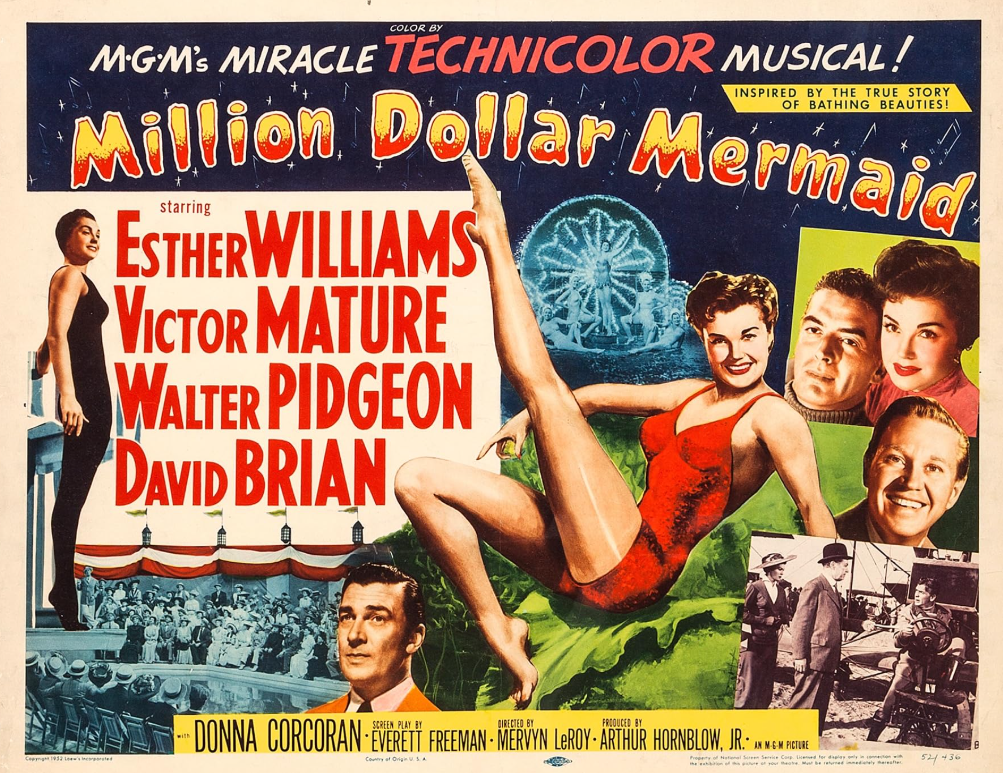
Million Dollar Mermaid (1952) – Musical #799
Studio:
Metro-Goldwyn-Mayer
Director:
Mervyn LeRoy
Starring:
Esther Williams, Victor Mature, Walter Pidgeon, David Brian, Donna Corcoran, Jesse White, Howard Freeman, Maria Tallchief, Charles Watts, Wilton Graff, Frank Ferguson, James Bell, James Flavin, Willis Bouchey, Paul Frees (uncredited), Dabbs Greer (uncredited), Creighton Hall (uncredited), Betty Lynn (uncredited)
Plot:
Biographical film about Australian swimmer Annette Kellerman (Corcoran as child, Williams as adult). As a child, Annette had polio and strengthened her legs with swimming. The daughter of a musician, Frederick Kellerman (Pidgeon), Annette had ambitions of becoming a ballerina and the Kellermans travel to England to find work in the arts. When Mr. Kellerman’s job falls through, Annette links up with promoter, James Sullivan (Mature). James builds Annette up through a series of publicity stunts, and she eventually finds fame performing at the Hippodrome Theater in New York City.
Trivia:
• The swimming numbers were choreographed and directed by Busby Berkeley.
• While filming the “Fountain” number, Esther Williams was severely injured and couldn’t film for six months. Dressed in the gold sequined body suit with a crown made of aluminum, she realized as she began diving from a platform 45 feet above the water, she realized that the crown was too heavy. When she hit the water, she snapped three vertebras in her neck and was in a body cast for six months, according to Williams autobiography and Busby Berkeley’s biography.
• The only film where ballerina Maria Tallchief appeared in an acting role. She plays Pavlova in the film. She made several television appearances during her career as herself.
• Footage used from “Bathing Beauty” during a montage of the Hippodrome.
• George J. Folsey was nominated for an Academy Award for Best Cinematography, Color.
• Working title was “The One Piece Bathing Suit”
• Annette Kellerman and Esther Williams both made films titled “Neptune’s Daughter”
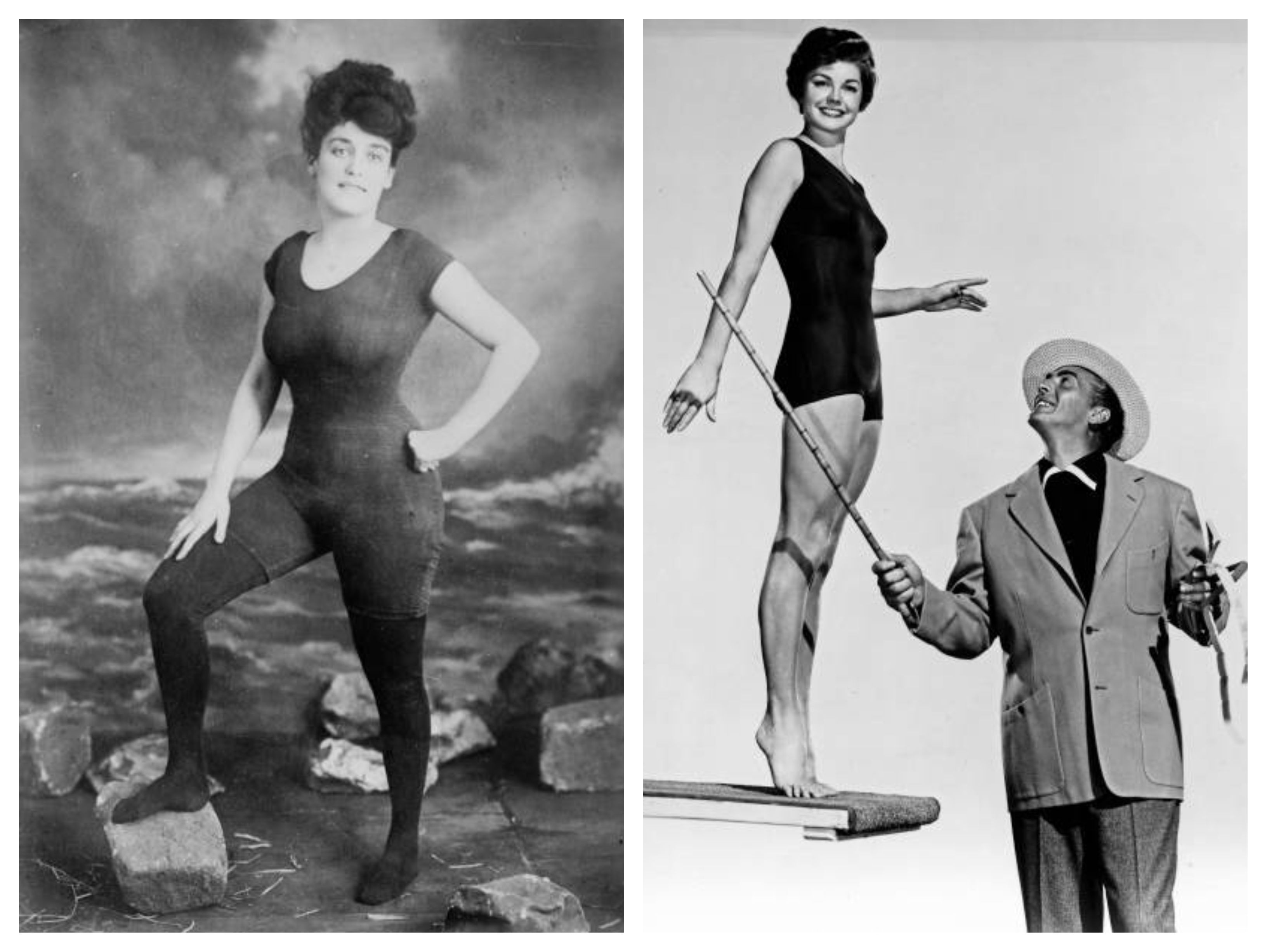
Annette Kellerman and Esther Williams (with Victor Mature) as Annette Kellerman
Highlights:
• Walter Pidgeon, especially the beginning sequence with Pidgeon and Donna Corcoran.
• Prima ballerina Maria Tallchief
• The Hippodrome water ballet numbers
Notable Songs:
• “The Dance of the Flowers” water ballet performed by Esther Williams
• “Fountain” water ballet performed by Esther Williams
• “Smoke” water ballet performed by Esther Williams
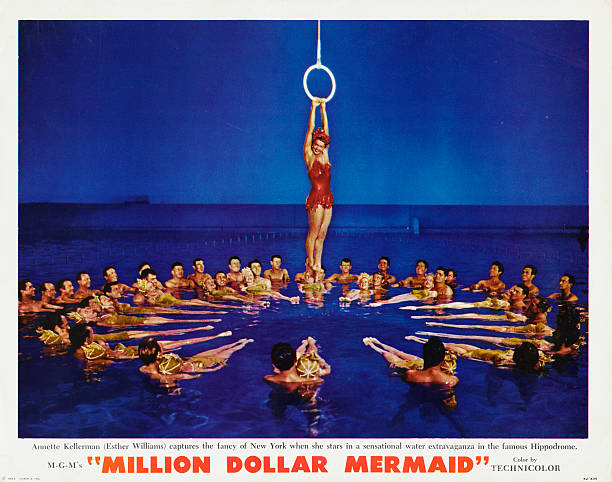
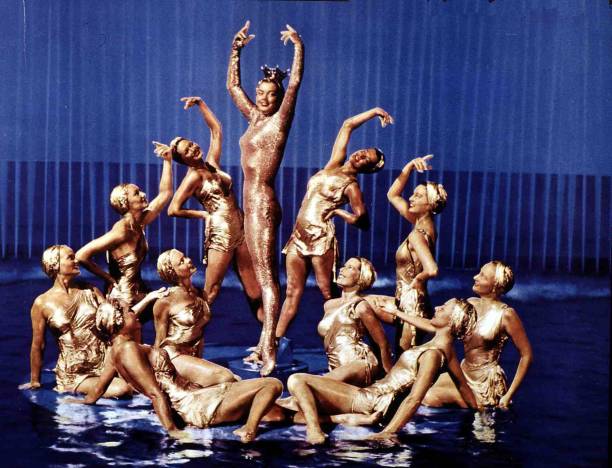
Esther Williams, portraying Australian swimmer Annette Kellerman, hangs from a ring above a circle of synchronized swimmers. (Photo by �� John Springer Collection/CORBIS/Corbis via Getty Images)
My review:
This week’s Musical Monday doesn’t feature tap dancing or even singing, and while non-traditional, MILLION DOLLAR MERMAID (1952) is a musical. Instead of those traditional musical elements, the film features large scale water ballets with swimming star, Esther Williams. And they are stunning!
MILLION DOLLAR MERMAID (1952) is a film tailor made for Williams. And in some ways, their careers held some parallels.
The Plot
In this biographical film, Williams plays Australian swimming star, Annette Kellerman. As a child (played by Donna Corcoran), Annette wore braces on her legs as they were weakened from polio. Annette’s father Frederick (Walter Pidgeon) was a musician who ran a music school, and Annette had ambitions to become a dancer. Through swimming, she’s able to strengthen her leg muscles and becomes a champion swimmer in Australia. As an adult (Esther Williams), Annette wants to become a ballet dancer. Business has declined at his music school, so the Kellermans travel to England, where her father can find work at a music school and Annette can begin her dancing career. On the boat from Australia to England, the Kellermans meet promoter, James Sullivan (Victor Mature), who would like to make Annette a swimming star, but she declines. However, once the Kellermans arrive in England, jobs aren’t as readably available.
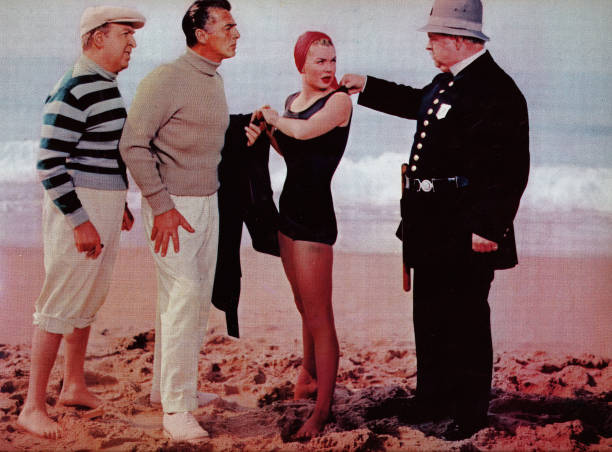
Annette contacts James and the two hatch a publicity stunts, such as Annette swimming 26 miles, and wearing a one piece bathing suit, which gets her arrested. The publicity helps them create a successful circus act. Annette’s fame finally lands her at the famous Hippodrome Theater in New York City, where she performs water ballets, and later to Hollywood where she appears in films during the early days of cinema.
Behind the Scenes
Earlier I mentioned that Kellerman and Williams had a few career parallels, which included both being champion swimmers and finding stardom through their swimming prowess.
Of all of Esther Williams’s films, MILLION DOLLAR MERMAID (1952) is the most natural fit with her talents.
“For once, swimming was really part of the story and didn’t have to be shoehorned into the rest of the plot,” Esther Williams wrote in her autobiography. “I loved the idea of playing Annette Kellerman, a real person, rather than a superficial character created to give me an excuse to swim.”
During the filming, Esther Williams met the real Annette Kellerman, who was 65 at the time. She mentioned that the Hippodrome set looked exactly like the backstage of the real location. However, she also expressed disappointment that Williams wasn’t Australian like herself, Williams wrote in her autobiography.
Much of the film is more of a biographical picture and doesn’t include traditional musical numbers, But once the story turns to Kellerman’s performances at the Hippodrome, MILLION DOLLAR MERMAID becomes a full Metro-Goldwyn-Mayer musical dream.
With swimming numbers staged by famed dance director Busby Berkeley, water ballets are performed that leave you wondering “How would a theater audience see this?” Nevertheless, they are stunning — and evidently Kellerman did somehow perform at the Hippodrome Theater in a glass tank.
Known as “The Fountain” number, Esther Williams is a vision dressed in a shimmering gold long-sleeved, long-pants unitard sequined swimsuit, and she swan dives into the water. The whole ballet is stunning, as she swims around fountains, dives a second time from a high platform covered in fountains and then emerges once more on a platform with other bathing beauties dressed in gold.
In a second breathtaking number, known as “The Smoke” number, Berkeley truly pulls out all the stops. Swimmers are first propelled down a waterslide into the water—some even standing as they go down the slide! I had to wonder how many hours of practice this took before the performers didn’t fall down going down the slide! Then, the stage is filled with billowing red, blue and yellow smoke. Swimmers swing out on trapeze and dive into the water, until performing an elaborate ballet, which includes Esther Williams dropping from a ring into the center of the swimmers, forming a circle around them.
These numbers are so beautiful and are truly movie magic. The stuff that dreams are made of. Even grumpy New York Times critic Bosley Crowther wrote favorably about the water ballet numbers.
They are so beautiful and mesmerizing, but these numbers didn’t come without danger and injury. The Smoke number was filmed first, and the swimmers knew when to dive only by Berkeley firing a pistol in the studio to signal the dive. Esther Williams, who was very nearsighted, didn’t enjoy the number because the smoke made it hard to tell if you were swinging over water or cement. She broke a toe from how hard she gripped the trapeze swing.
A broken toe is nothing though, compared to what Williams endured in “The Fountain” number, which was filmed after.
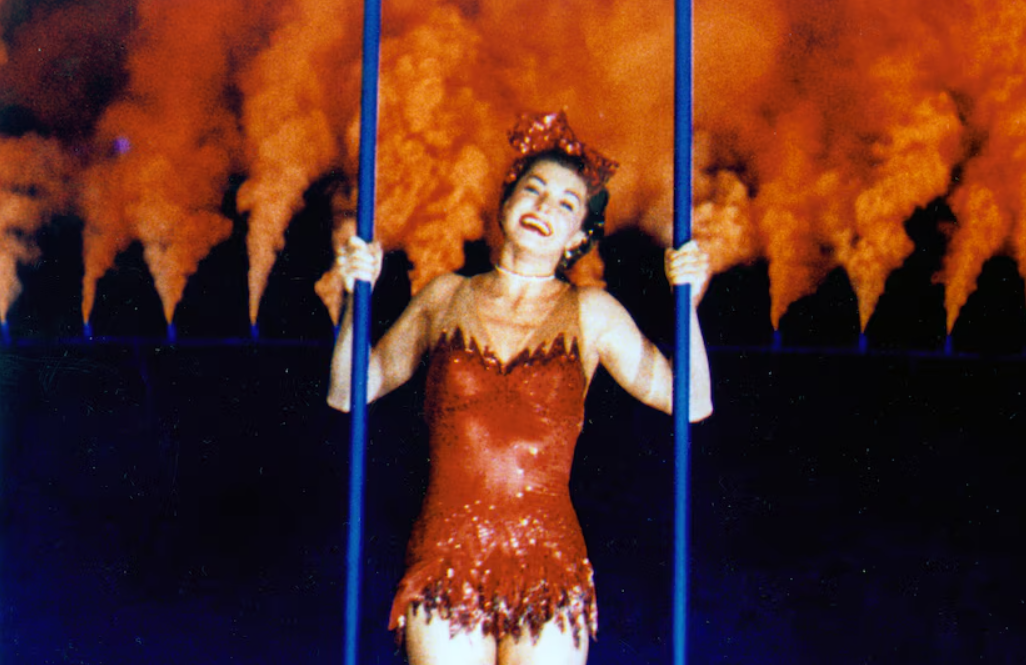
Williams in the “Smoke” number
While she is dressed in the gold sequined costume, the crown she wears was originally made of light aluminum material. As she dove into the water, her neck snapped, breaking three vertebras in her neck and back; coming close to snapping her spinal cord, Williams wrote in her autobiography. The injury left her in a body cast for six months. Since much of the film was already in the can, they filmed around her until she was able to return to work. Williams wrote, however, that she took responsibility for the incident, because she should have known the crown was too heavy, and that she was the only one who understood what was needed for her unique type of entertainment.
In addition to the Berkeley numbers, another scene directed by Mervyn LeRoy almost proved fatal. By the end of a day of filming, Williams wrote that she could stay under water longer and longer. In a scene where Kellerman swims to a giant underwater pearl, Williams began to rest her head on it and nearly fell asleep, because she had been under water too long. The only thing that saved her was LeRoy shouting over a loud speaker asking what she was doing, according to her autobiography.
I do have to note here, while we know Williams could perform a beautiful swan dive, I wasn’t sure if the other fancy diving in the film was actually performed by Williams, though I can’t find that otherwise noted.
Outside of the water ballets, I personally am an Esther Williams fan and think she does a wonderful job in this film. It’s fun to see her in a film that, while it focuses on swimming, allows Williams to flex her acting muscles and dress in turn-of-the-century costumes. It’s true that she swims less and dresses in period costumes in TAKE ME OUT TO THE BALLGAME, but this film is worlds better than that one.
Outside of Williams, the rest of the cast is great too. Victor Mature is an adequate leading man as James Sullivan, who for once, is a real life person — so many times in these biopics, the romantic characters are fictionalized. Kellerman and Sullivan were married in real life until his death in 1974!
I liked David Brian in this film, and honestly wanted Kellerman to end up with his character, Alfred Harper.
But the performance I really loved was Walter Pidgeon, as Frederick Kellerman, who was so sweet and broke my heart. Donna Corcoran as young Annette, also gave a lovely performance.
It was a small role, but I also appreciated James Bell as a judge in the scene where Kellerman stands trial following her arrest for indecent exposure.
Another special performance was danced by prima ballerina Maria Tallchief, as the famed Pavlova. Her dance for “Swan Lake” is lovely.
Overall, MILLION DOLLAR MERMAID is just a great time. Like most biopics, it embellishes some of Kellerman’s story, but while researching Kellerman’s life for this review, much of what is reflected in the film is true to life.
It has so many fun scenes, like the arrest for indecent exposure and Kellerman swimming 26 miles down the Thames River. By the end, you feel you really know Kellerman and are invested in her story.
MILLION DOLLAR MERMAID is fun, stunning and will leave you wanting to jump in a swimming pool to practice your swimming too. In my opinion, this is a “must see” film.
Check out the Comet Over Hollywood Facebook page, follow on Twitter at @HollywoodComet or e-mail at cometoverhollywood@gmail.com
 Comet Over Hollywood
I’m excited to say that I’ve actually seen — and enjoyed!! — one of the musicals you’ve covered. I never thought much about Esther Williams until I read her autobiography, which made me interested in checking out her films. This one was my favorite, and also sparked my interest in Annette Kellerman. I enjoyed reading your write-up about the film, and especially the behind-the-scenes stuff.
Karen
LikeLike