
It’s no secret that the Hollywood Comet loves musicals.
In 2010, I revealed I had seen 400 movie musicals over the course of eight years. Now that number is over 600. To celebrate and share this musical love, here is my weekly feature about musicals.
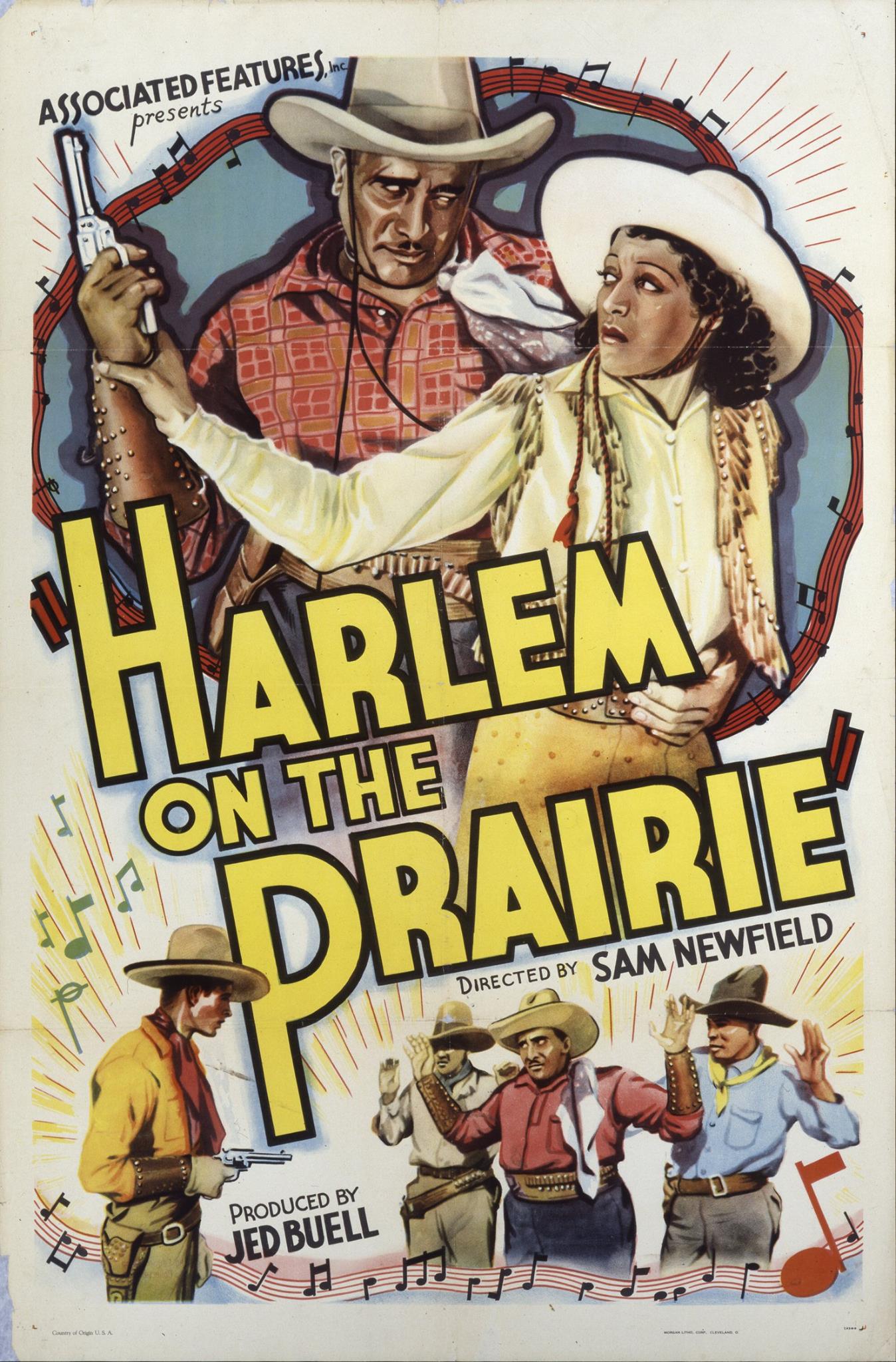 This week’s musical:
Harlem on the Prairie (1937) – Musical #805
Studio:
Associated Features
Director:
Sam Newfield
Starring:
Herb Jeffries (billed as Herbert Jeffrey), F.E. Miller (billed as Flournoy Miller), Mantan Moreland, Consuelo Harris (billed as Connie Harris), Maceo Bruce Sheffield, Spencer Williams, George Randol, Nathan Curry
The Four Tones singers: Lucius Books, Rudolph Hunter, Leon Buck, Ira Hardin
Plot:
Doc Clayburn (Williams) returns home with his daughter Carolina (Harris) after 20 years. Upon arrival, Carolina learns that her father was part of a gold heist 20 years prior, and he wanted to return the gold. When Doc is killed by outlaw Wolf Cain (Sheffield) and his team of outlaws, Wolf puts pressure on Carolina for the gold. Jeff Kincaid (Jeffries), his team and friends Mistletoe (Moreland) and Crawfish (Miller) help Carolina get the gold to its rightful owners.
Trivia:
• In addition to acting in the film, Maceo Bruce Sheffield also served as production supervisor. Sheffield helped cast the film as well, according to an interview with Herb Jeffries in 1998.
• A 1940 article published in the New York Age newspaper noted that HARLEM OF THE PRAIRE (1937) was the most profitable race film at this point.
• Filmed in Victorville, California, at a Black-owned ranch of Apple Valley, owned by N.B. Murray, according to the Academy of Motion Picture Arts and Sciences.
• Advertised as the first all-Black musical western, according to the Academy of Motion Picture Arts and Sciences.
• The film was made in a week, according to an interview with Jeffries.
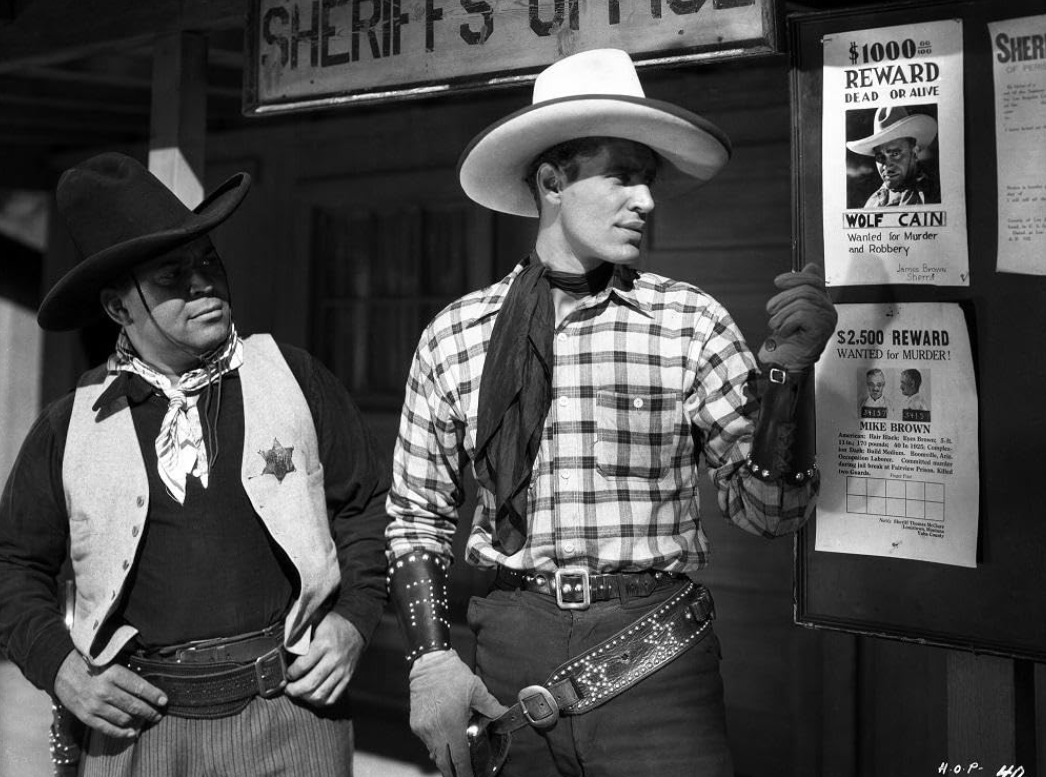
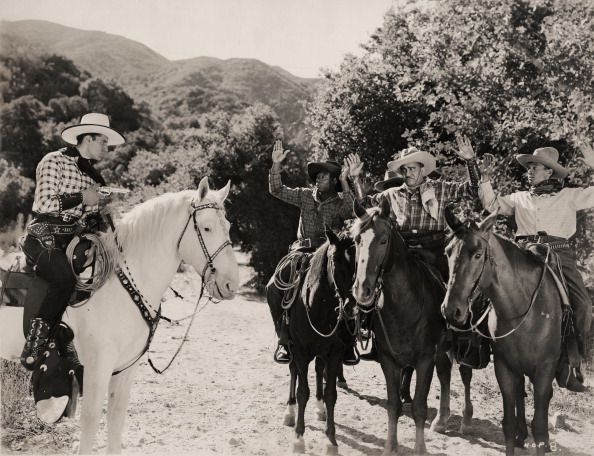
Publicity still portrait of American actors Herb Jeffries (Herbert Jeffrey) in the film ‘Harlem on the Prairie,’ 1937. (Photo by John D. Kisch/Separate Cinema Archive/Getty Images)
Highlights:
• Herb Jeffries singing
Notable Songs:
• “Harlem on the Prairie” performed by Herb Jeffries and the Four Tones
• “Palkadoo” performed by The Four Tones
• “Albuquerque” performed by The Four Tones
• “A New Range in Heaven” performed by Herb Jeffries, The Four Tones, The Four Blackbirds
• “Romance in the Rain” performed by Herb Jeffries, The Four Tones, The Four Blackbirds
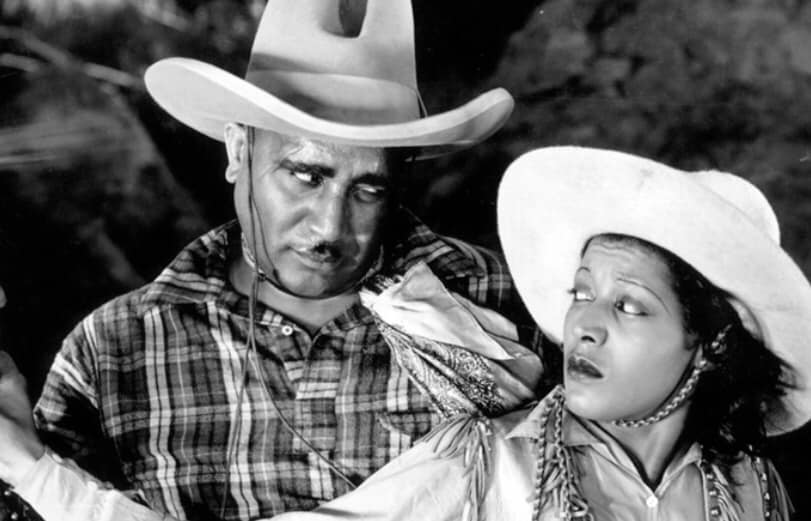
Maceo Bruce Sheffield and Connie Harris
My review:
Over the past year, much has been written and published in the news about Western and country music performed by Black singers. In the 1930s, Herb Jeffries paved the way for albums, like Beyonce’s “Cowboy Carter,” when Jeffries said Western films should feature Black actors and was instrumental in getting the first musical western film with a cast of all-Black actors.
Jeffries started as a singer, and while on tour, he was angered that movie theaters were segregated to watch westerns starring white actors.
“I said, wait a minute. Here’s a chance to take something bad and make something good out of it,” Jeffries said in a 1998 interview. “Let me see if I can find someone that’ll finance an All-Black cowboy picture. And it took me two years to find the backing to make the first Black western.”
He approached many people to help finance a film until he found producer Jed Buell and presented him with the idea. Jeffries felt Black westerns would be a positive role model for young people. Buell agreed to make a western, and Jeffries starred in four singing cowboy westerns, starting with HARLEM ON THE PRAIRIE (1937) — which was promoted as the first all-Black musical western film, according to the Academy of Motion Picture Arts and Sciences.
In the film, Doc Clayburn (Williams) returns home with his daughter Carolina (Harris) after 20 years. Upon arrival, Carolina learns that her father was part of a gold heist 20 years prior, and he wants to return the gold. When Doc is killed by outlaw Wolf Cain (Sheffield) and his team of outlaws, Wolf pressures Carolina for the gold. Jeff Kincaid (Jeffries), his team, and friends Mistletoe (Moreland) and Crawfish (Miller) help Carolina get the gold to its rightful owners.
“It was my tenacity — and then I should say my anger — that made that dream happen,” Jeffries said in the 1998 interview.
It’s particularly a treat to have the opportunity to review HARLEM ON THE PRAIRIE (1937), because this film was thought to be lost for many years until it was recently found and restored, with a special presentation in 2022 by the Academy of Motion Picture Arts and Sciences.
HARLEM ON THE PRAIRIE is a “race film,” meaning the film stars an all-Black cast for segregated audiences. Race films were made between the dawn of cinema through the early 1950s and produced outside major Hollywood studios.
“The film is a contrast to the inaccurate but popular Hollywood images of an all-white American frontier,” said the Smithsonian National Museum of American History
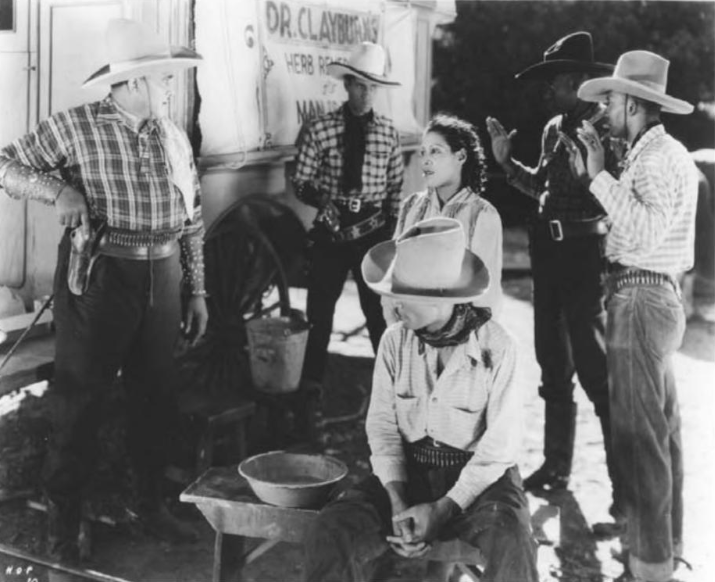
HARLEM ON THE PRAIRIE is a brisk 58 minutes, featuring several wonderful Western songs. Jeffries has such a smooth, beautiful voice and the blend of his voice with the Four Tones Quartet is gorgeous. Jeffries loved westerns, and his love of the genre shines through. His childhood idols were Tom Mix and Buck Jones, and he learned how to ride horses at his uncle’s farm in Ohio, Jeffries said in the 1998 interview.
Unfortunately, this movie has some racial stereotypes, like Crawfish, played by F.E. Miller, being so lazy that he smokes his cigarette off the ground while stretched out in the grass.
Miller helped write additional dialogue and asked critics to look kindly at race films, like HARLEM ON THE PRAIRIE, because they were experimental in the 1930s and lacked capital investment.
“I think that criticism of these pictures should be constructive rather than destructive,” Miller said. “Major studios flatly refuse to give colored people a decent part or to produce a first-class colored picture.”
In addition to Jeffries in the film, it’s a treat to see comedian Mantan Moreland, who appeared in many Hollywood films. Spencer Williams in the film, was also important as a film pioneer, as one of the early Black film directors. It’s also an interesting juxtaposition that the outlaw in the film, Maceo Bruce Sheffield, was instrumental in the production with assisting with casting and choreographing fights. When the film was made, Sheffield was also a police officer, according to Jeffrie’s interview.
At one point, this film was considered to be lost, according to a 2018 article by The Department of Afro-American Research Arts and Culture. It was recently restored and shown at the Academy Museum in 2022. Thankfully, this film is easy to find and accessible to enjoy now!
My only complaint with this film or any of Jeffries’s singing cowboy westerns is that we only got four. The other westerns Jeffries made include: Two Gun Man from Harlem (1938), The Bronze Buckaroo (1939) and Harlem Rides the Range (1939). By 1940, Jeffries returned to singing with jazz bands, including Duke Ellington’s band.
However, Jeffries always considered himself a cowboy, and he was even inducted into the International Western Music Association in 1997.
“I’ve always been a cowboy,” Jeffries said in 1996. “I will die being a cowboy.”
Check out the Comet Over Hollywood Facebook page, follow on Twitter at @HollywoodComet, follow on Instagram or e-mail at cometoverhollywood@gmail.com


This film showcases the rich contributions of African American artists to the musical landscape of the time. It’s a reminder of the importance of preserving and celebrating diverse artistic expressions in cinema. A must-watch!
LikeLike