
It’s no secret that the Hollywood Comet loves musicals.
In 2010, I revealed I had seen 400 movie musicals over the course of eight years. Now that number is over 600. To celebrate and share this musical love, here is my weekly feature about musicals.
This week’s musical:
Evergreen (1934) – Musical #529
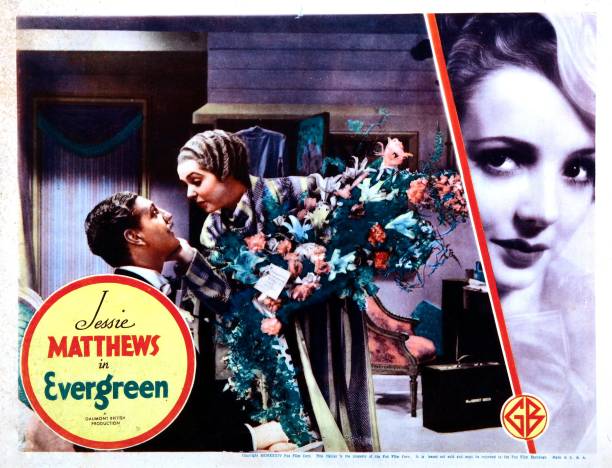
Studio:
Gaumont-British Pictures
Director:
Victor Saville
Starring:
Jessie Matthews, Sonnie Hale, Betty Balfour, Barry MacKay, Ivor McLaren, Harley Power, Patrick Ludlow, Betty Shale, Marjorie Brooks, Stewart Granger (uncredited)
Plot:
In the early 1900s, popular stage performer Harriett Green (Matthews) says goodbye to her audiences, as she plans to retire to get married. But on the eve of her wedding, her past shows up and she disappears. Thirty years later, her daughter—also named Harriett (also Matthews)—is wearily looking for a job in a musical show. A down-on-his-luck publicity man Tommy Thompson (MacKay) makes the connection between Harriett and her mother. With the help of performers who knew Harriett in the old days (Hale, Balfour), Tommy hatches a plan to have young Harriett pose as her mother returning to the stage.
Trivia:
• Based on the 1930 stage musical “Ever Green,” starring Jessie Matthews and Sonnie Hale. In the stage show, the plot was slightly different where Matthews’s is an older woman trying to appear young. In the film it’s the opposite, according to Turner Classic Movies host, Dave Karger.
• First feature film of Barry MacKay
• Gaumont British Pictures wanted Fred Astaire as the leading man for EVERGREEN, however, they couldn’t work out a deal with RKO Pictures, according to Turner Classic Movies host Dave Karger.
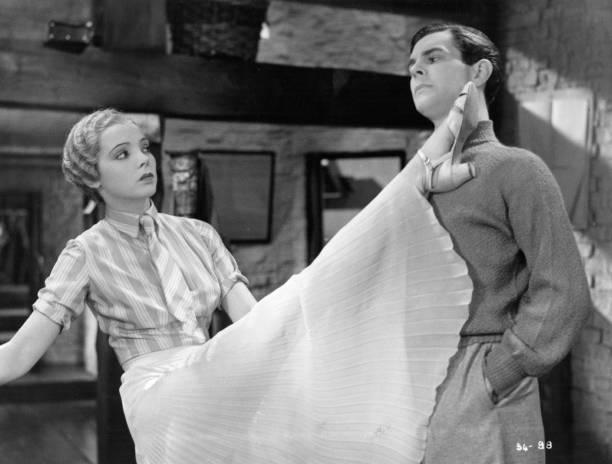
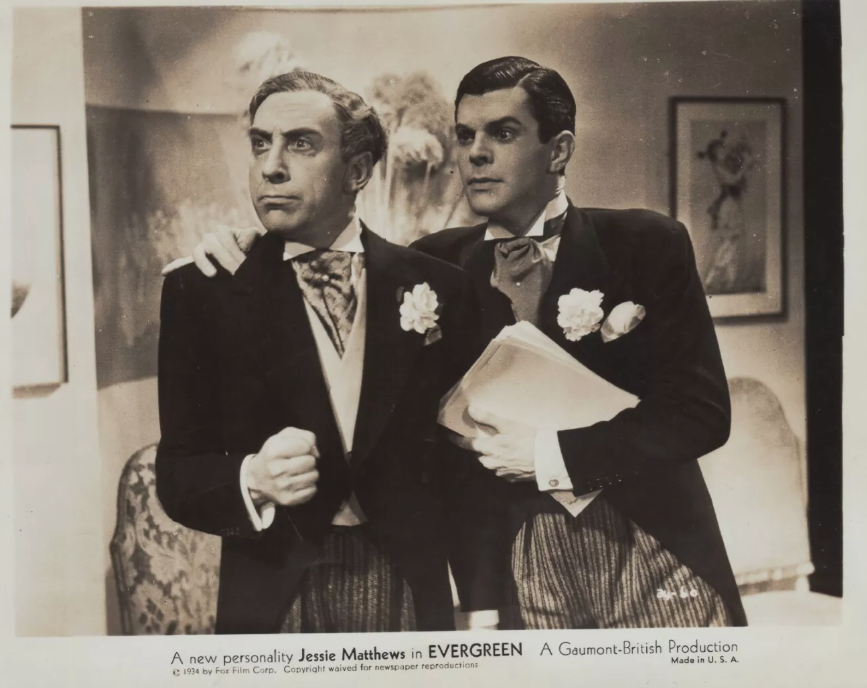
Sonnie Hale and Barry MacKay
Highlights:
• The dance numbers
Notable Songs:
• “Daddy Wouldn’t Buy Me a Bow-Wow” performed by Jessie Matthews
• “I Wouldn’t Leave My Little Wooden Hut for You” performed by Jessie Matthews and Betty Balfour
• “When You’ve Got a Little Springtime in Your Heart” performed by Jessie Matthews
• “Tinkle, Tinkle, Tinkle” performed by Sonnie Hale
• “Dancing on the Ceiling” performed by Jessie Matthews
• “Over My Shoulder” performed by Jessie Matthews
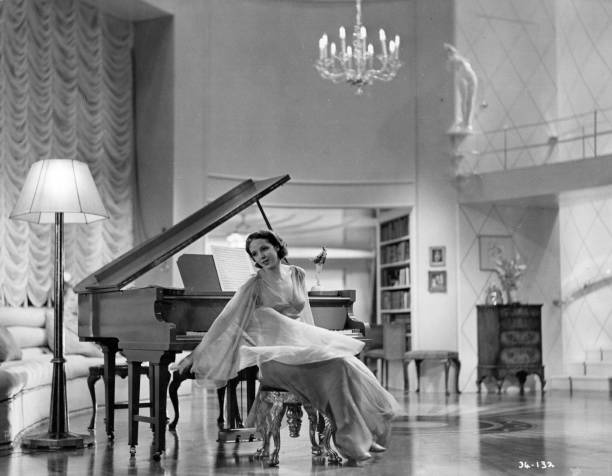
Jessie Matthews performing “Dancing on the Ceiling”
My review:
If you aren’t familiar with British musical star Jessie Matthews, I encourage you to promptly seek out her films after you read this review. Each one is a delight. Matthews with her singing and dancing is like a bubbling glass of champagne (or La Croix, if you prefer).
While Matthew’s was dubbed the “British Ginger Rogers,” she arguably was much more than that. Matthews could carry a film on her own and most of her dances were solo, featuring high kicks, tap dancing and quick spins.
Matthew’s charisma, charm and fantastic dancing are on full display in the glittering musical, EVERGREEN (1934), a film Criterion calls the best British musical ever made.
EVERGREEN begins in the early 1900s as popular stage performer Harriett Green (Matthews) is giving a farewell performance. She plans to retire from the stage to be married and so that she’s remembered as young — or evergreen. On the eve of her the wedding, she learns that her past has caught up with her and she leaves her friends and fiancé (McLaren) with little explanation; disappearing.
Thirty years later, Harriett Green’s daughter — also named Harriett (also Matthews) — is wearily looking for a job in a musical show. A down-on-his-luck publicity man Tommy Thompson (MacKay) makes the connection between Harriett and her mother. With the help of performers who knew Harriett in the old days (Hale, Balfour), Tommy hatches a plan to have young Harriett pose as her mother returning to the stage. Complications arise when Tommy and Harriett fall in love, but the press assumes he’s Harriett’s son. Further complications arise when the elder Harriett’s former husband and fiancé both seek her out.
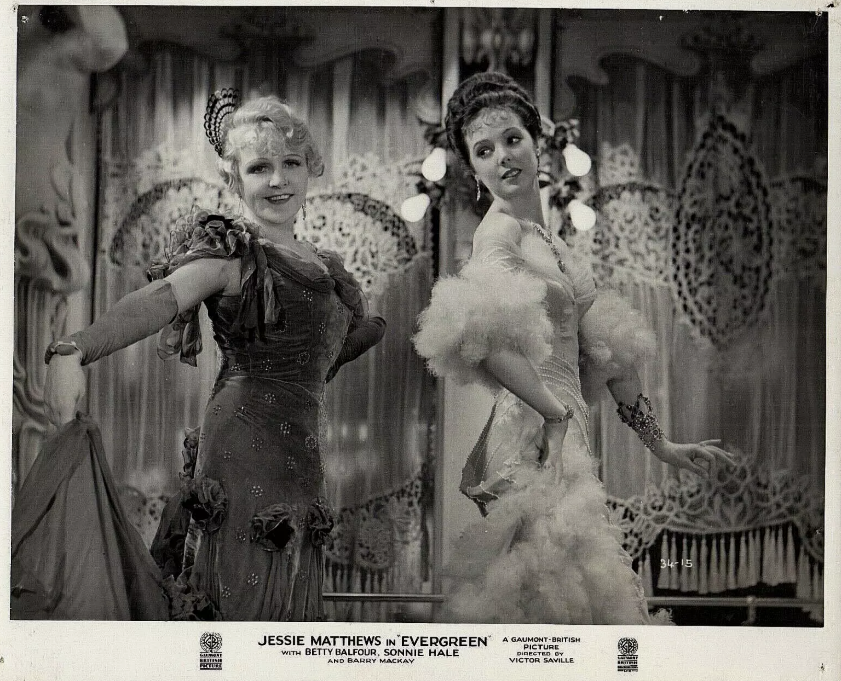
Betty Balfour and Jessie Matthews
EVERGREEN (1934) is a delight from start to finish, and also has a bit of a nostalgic as the contemporary actors connect with their past. It’s filled with wonderful songs, such as “Dancing on the Ceiling;” “Dear, Dear;” “Tinkle, Tinkle, Tinkle” and “Over My Shoulder” —which became Matthews’s theme songs.
With dances arranged by Buddy Bradley, the numbers have a feel of what you may see in a Hollywood number created by Busby Berkeley. One particular number goes back in time from 1934 to 1924 to 1914 and ends at 1904, during Harriett Green’s heyday. The number is fascinating, but the 1914, World War I theme is wild and METROPOLIS-like, as women in chiffon are transformed into wearing knight-like armor.
The film was a full-circle moment for Matthews, as she starred in the original 1930 stage musical that the film is based on. However, the film version of the musical does not include all of the songs written by Lorenz Hart and Richard Rodgers. Sonnie Hale, who also was Matthews’s husband from 1931 to 1944.
Gaumont-British Pictures originally wanted Fred Astaire to play the male lead, as he was fresh off FLYING DOWN TO RIO. The studio was eager to a Hollywood crossover for Matthews, according to Matthews’s autobiography and Turner Classic Movies host, Dave Karger.
“I was delighted, who wouldn’t be at the prospect of dancing with Fred Astaire?” Matthews wrote in her book.
However, Gaumont-British Pictures wasn’t able to work out a deal with RKO to cast Astaire. Matthews recommended Sonnie Hale as the male lead, which he played on the stage. However, director Victor Saville didn’t see Hale as the romantic type and cast him instead as an older producer and in a comedic role, according to Matthews’s autobiography.
Instead, newcomer Barry MacKay is cast as the male lead. If you aren’t as familiar with MacKay, you may recognize him as the character of Fred from the 1938 MGM version of A CHRISTMAS CAROL. This was his first film role, and I always love to see actors in a leading role in their first film. MacKay is charming and it’s fun to see him turn a few steps with Matthews.
While this film is glittering, fun and hilarious, I will admit it does get a little weird when Tommy is mistaken for Harriett’s son and they are kissing. We know the truth of course. There’s a scene where the two have to share a flat as mother and son, and it made me think of both pre-code films and also a 1960s sex comedy, like Doris Day and Rock Hudson.
There are also a few very sweet scenes, like a discussion Harriett has with her mother’s former fiancé, or when the real Harriett Green’s friends cry, hearing their friends daughter sing with a record of her mother’s voice.
While EVERGREEN is a joy for the viewer, it unfortunately wasn’t a happy time for Matthews. When director Victor Saville asked Matthews to attend a screening of the film in the 1960s, she was sent into a tailspin and attempted suicide, remembering making the film, according to her autobiography.
During the making of EVERGREEN, Matthews first broke out into hives and then had a nervous breakdown as she worried about an upcoming film contract, and was also overworked and exhausted. She called it “some of the greatest misery of her life” in her autobiography.
However, Matthews was thankful that Saville handled her delicately throughout the film.
When EVERGREEN was released, a review in Variety said this film was almost as good as any Hollywood musical. In my opinion, it’s just as good—if not better—than most Hollywood musicals. Now, I hope all of you complete your homework assignment and find a Jessie Matthews film to watch. You won’t be disappointed.
Other places you can follow Comet Over Hollywood:
- Letterboxd
- X at @HollywoodComet
- BlueSky
- Or e-mail us at cometoverhollywood@gmail.com


I was excited to see that you were reviewing Evergreen, Jessica, as it’s one of the few musicals that I’ve seen! I wrote about Jessie Matthews last year (before that, I’d never heard of her!) and it was a pleasure to discover her films, especially Evergreen. She has one of the biggest “what if” stories I can think of — who knows what her career would have been like if she’d been able to team up with Fred Astaire! Really enjoyed reading your thoughts of the film.
Karen
LikeLike