
It’s no secret that the Hollywood Comet loves musicals.
In 2010, I revealed I had seen 400 movie musicals over the course of eight years. Now that number is over 600. To celebrate and share this musical love, here is my weekly feature about musicals.
 This week’s musical:
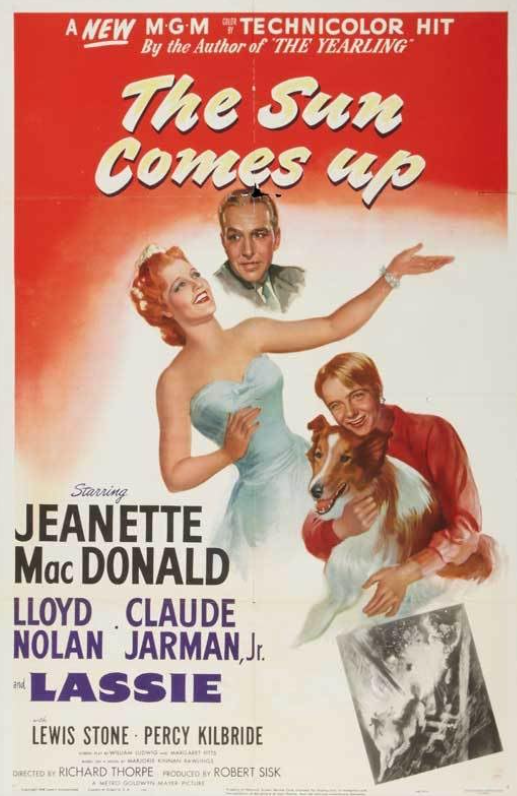
The Sun Comes Up (1949) – Musical #810
Studio:
Metro-Goldwyn-Mayer
Director:
Richard Thorpe
Starring:
Jeanette MacDonald, Pal the Dog, Claude Jarman Jr., Lloyd Nolan, Percy Kilbride, Margaret Hamilton, Lewis Stone, Nicholas Joy, Dwayne Hickman (uncredited)
Plot:
After experiencing tragedy in her household, singer Helen Winter (MacDonald) takes a trip to the Blue Ridge Mountains of North Carolina to be alone. She begrudgingly takes the family dog Lassie (Pal), though she blames the dog for the accident. While she spends time like a recluse, she is softened by a young boy Jerry (Jarman), who helps her around the rented house.
Trivia:
• Jeanette MacDonald’s final film.
• The film was based on a story by Marjorie Kinnan Rawlings and it was serialized in The Saturday Evening Post from April 26, 1947, to May 31, 1947. Rawlings also wrote “The Yearling.”
• The film had several working titles, including “A Family for Jock,” “Mountain Prelude,” and “Sun in the Morning.”
• Elizabeth Taylor was originally announced to star in the film in a Jan. 1947 Daily Variety article.
• The film was scored by Andre Previn, who received his first on-screen credit as composer in the film.
• Filmed in the Santa Cruz, California mountains.
Highlights:
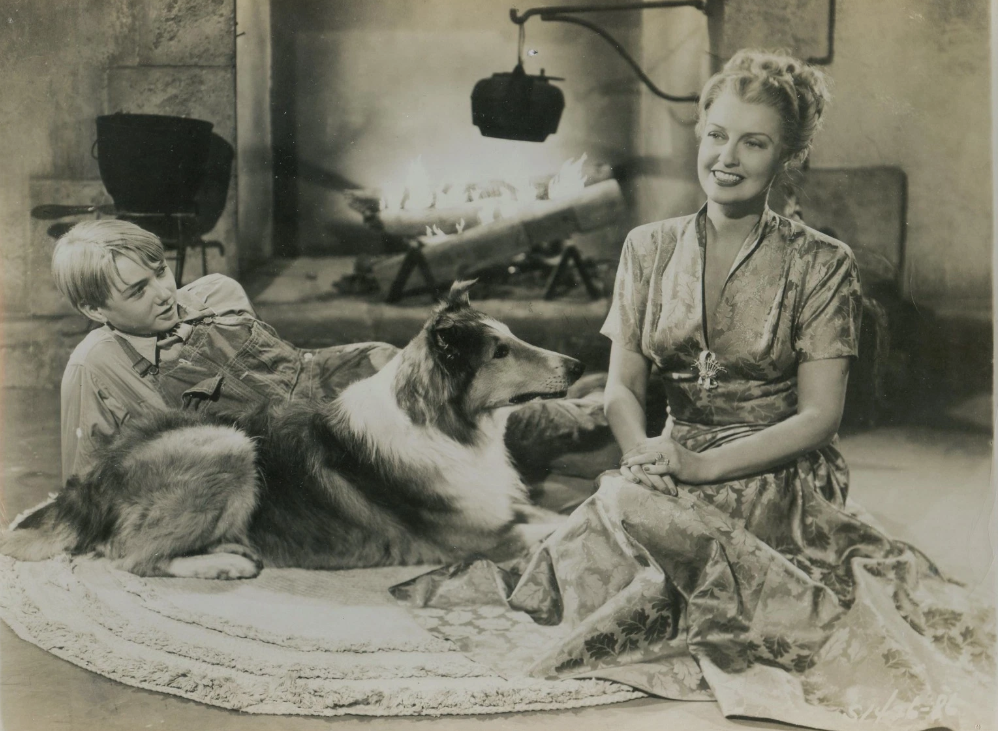
• The Technicolor cinematography
Notable Songs:
• “Un Bel Di” performed by Jeanette MacDonald
• “Songs My Mother Taught Me” performed by Jeanette MacDonald
• “Tes Yeux” performed by Jeanette MacDonald
• “If You Were Mine” performed by Jeanette MacDonald
My review:
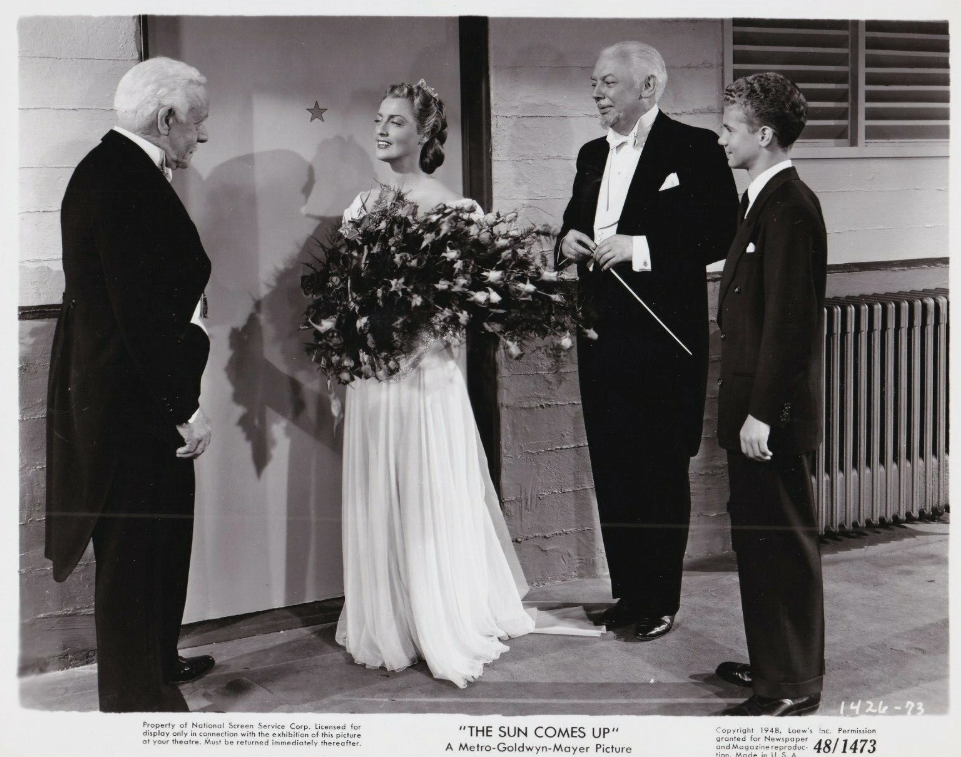
Jeanette MacDonald was one of the most glamorous stars of the 1930s, who helped popularize opera on the silver screen.
At the start of her career, she was cast in sophisticated Ernest Lubitsch romantic comedies. When she signed on with Metro-Goldwyn-Mayer, she was one of the studio’s top stars of the 1930s as she and Nelson Eddy shared the screen as an opera singing duo. During this period, studio head Louis B. Mayer wanted his films to have culture, and MacDonald and Eddy oozed sophistication as they sang arias and duets.
But by the 1940s, their popularity was waning. Aside from a brief appearance in FOLLOW THE BOYS (1944), Jeanette MacDonald did not star in any feature films between 1942 to 1948, until producer Joe Pasternak convinced her to come out of retirement. She starred as the mother of three daughters in THREE DARING DAUGHTERS (1948) and then her final film, THE SUN COMES UP (1949), a Lassie film.
In the film, MacDonald plays singer Helen Winter. After experiencing tragedy in her household, she takes a trip to the Blue Ridge Mountains of North Carolina to be alone. She begrudgingly takes the family dog Lassie (Pal), though she blames the dog for the accident. While she spends time like a recluse, she is softened by a young boy Jerry (Jarman), who helps her around the rented house.
It’s true, this isn’t your usual musical, and I was uncertain if this appropriate for a Musical Monday. But truly it has enough songs, and I wanted to pay homage to the end of MacDonald’s feature film career.
Co-starring with young star Claude Jarman, Jr., whose career started with THE YEARLING (1946), said the film was a let down for the whole cast.
“Everyone got along fine, but none of the cast seemed especially enthusiastic about the project,” Jarman wrote in his memoir. “I don’t know which of my costars was more disgruntled – Lassie or Jeanette MacDonald.”
Even MacDonald told wardrobe test cinematographer Charles Schoenbaum: “I’ve come to this. Working with a dog.”
Every morning, the makeup man Lee Stanfield would makeup the dog, Pal, who played Lassie – adding extra fur to disguise that Lassie was a boy dog and not a girl. Stanfield, would then make up MacDonald, who wasn’t pleased, according to Jarman’s memoir.
“This woman, who had been pampered like a diva for years, was now second in line to a trained collie,” he wrote. “She smiled and did her best, but dissatisfaction seeped through the cracks in her professional exterior.”
Jarman also had an unsavory run in with Lassie.
While Jarman and Lassie got along well during rehearsal, when he went to do a scene, Lassie bit him on the side of his face. Thankfully it wasn’t severe and he was able to start filming the next day, according to Jarman. Jarman worried how he could go from THE YEARLING to THE SUN COMES UP, and how he thrived better under a good director.
Despite these things, Jarman, Dwayne Hickman (who has a small role in the film) and composer Andre Previn, all remembered MacDonald as being lovely and kind.
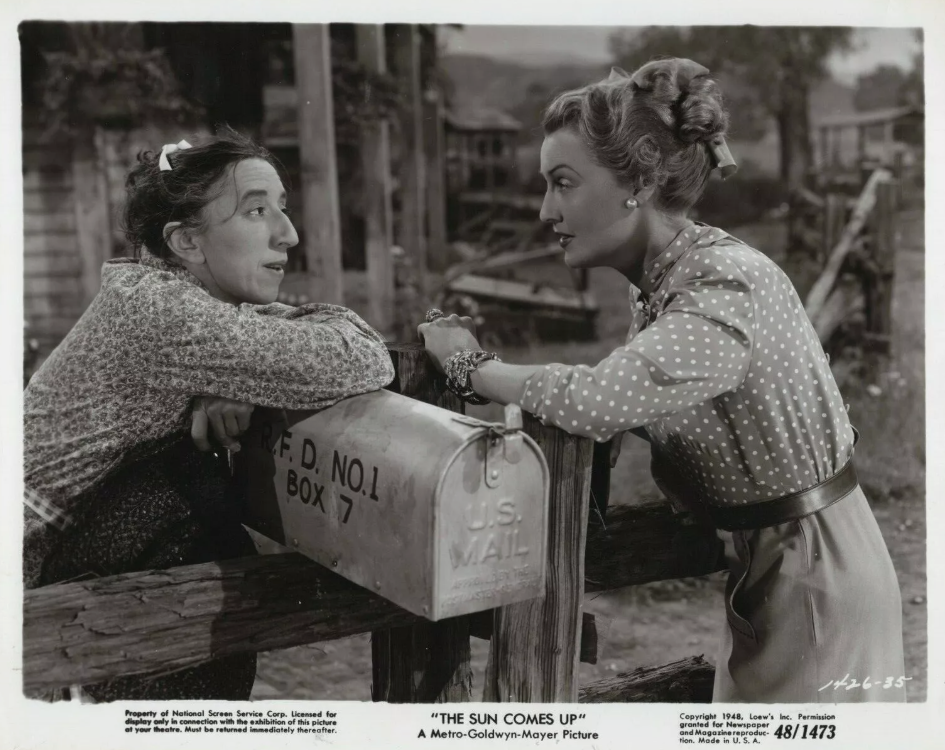
Despite THE SUN COMES UP (1949) being a professional failure for its stars, the film is quite heartwarming and lovely. MacDonald is wonderful and shows her range, from exhibiting deep grief to comedic moments. One particularly funny moment is when she’s offering snuff to Margaret Hamilton.
The only part that frustrated me is how the tragedy at the start of the film could have easily been avoided.
Claude Jarman, Jr. is precious and sweet, per usual. It’s hard to judge Lloyd Nolan’s performance, because he shows up towards the end of the film and doesn’t have much to do. Percy Kilbride is humorous as the small town store owner, who is judgmental towards MacDonald and her big city ways. Lewis Stone receives high billing in the film, but is barely in the movie.
It’s true, THE SUN COMES UP can be seen as a disappointing end to a lush career. MacDonald’s first film was directed by Ernest Lubitsch and her last co-star film, she co-stars with Lassie the dog star. However, MacDonald still is stunning in this Technicolor film. Following this film, her career continued on the stage as she sang in musical plays and in concerts.
Truthfully, I find this to be a cozy and warm film, though perhaps not a fitting end to a lustrous career.
Other places you can follow Comet Over Hollywood:
- Letterboxd
- X at @HollywoodComet
- BlueSky
- Or e-mail us at cometoverhollywood@gmail.com
 Comet Over Hollywood