
It’s no secret that the Hollywood Comet loves musicals.
In 2010, I revealed I had seen 400 movie musicals over the course of eight years. Now that number is over 600. To celebrate and share this musical love, here is my weekly feature about musicals.
This week’s musical:
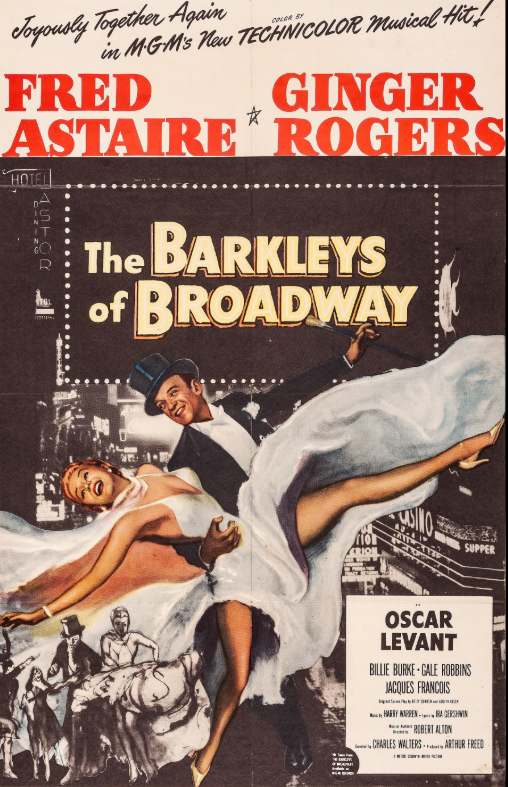 The Barkleys of Broadway (1949) – Musical #73
Studio:
Metro-Goldwyn-Mayer
Director:
Charles Walters
Starring:
Fred Astaire, Ginger Rogers, Oscar Levant, Billie Burke, Gale Robbins, Jacques François, George Zucco, Clinton Sundberg, Inez Cooper, Carol Brewster, Wilson Wood, Hans Conried (uncredited), Dee Turnell (uncredited)
Plot:
Husband-and-wife performers Josh (Astaire) and Dinah Barkley (Rogers) are successful Broadway musicals stars. Dinah becomes restless with lighter musical theater and is convinced by producer Jacques Pierre Barredout (François) that she should try her hand at dramatic theater. The decision breaks up the Barkley marriage. However, while Dinah struggles with the new play, Josh watches from afar and finds a way to help.
Trivia:
• Last film that co-starred Fred Astaire and Ginger Rogers. It was also the first time they had co-starred since 1939. This was also their only film made together at Metro-Goldwyn-Mayer.
• Judy Garland was originally going to be cast in the lead role of Dinah Barkley, because of the successful pairing of Garland and Astaire in EASTER PARADE, according to a Turner Classic Movies article. She was replaced by Ginger Rogers when Garland had to drop out due to a nervous breakdown.
• “They Can’t Take That Away From Me” was also performed in the Rogers and Astaire film “Shall We Dance”
• Harry Stradling Sr. was nominated for an Academy Award for Best Cinematography, Color.
• This was Jacques François’s first Hollywood/English speaking film.
• Working title, “You Made Me Love Me.”
• Songs were written for the film but dropped from the film, including “Natchez on the Mississippi,’” “The Courtin’ of Elmer and Ella,” “Poetry in Motion” and “These Days.”
Highlights:
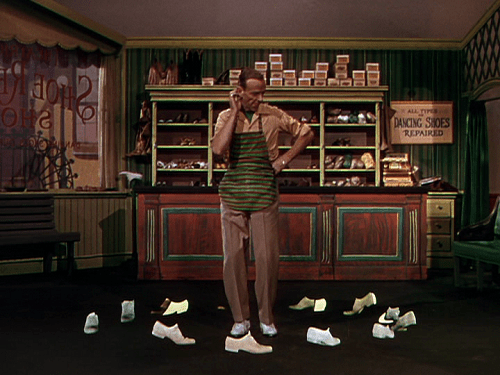
• The “Shoes with Wing On,” an incredibly innovative number with Fred Astaire
• The “Bouncin’ the Blues” tap dance, which may be Rogers and Astaire’s best dance
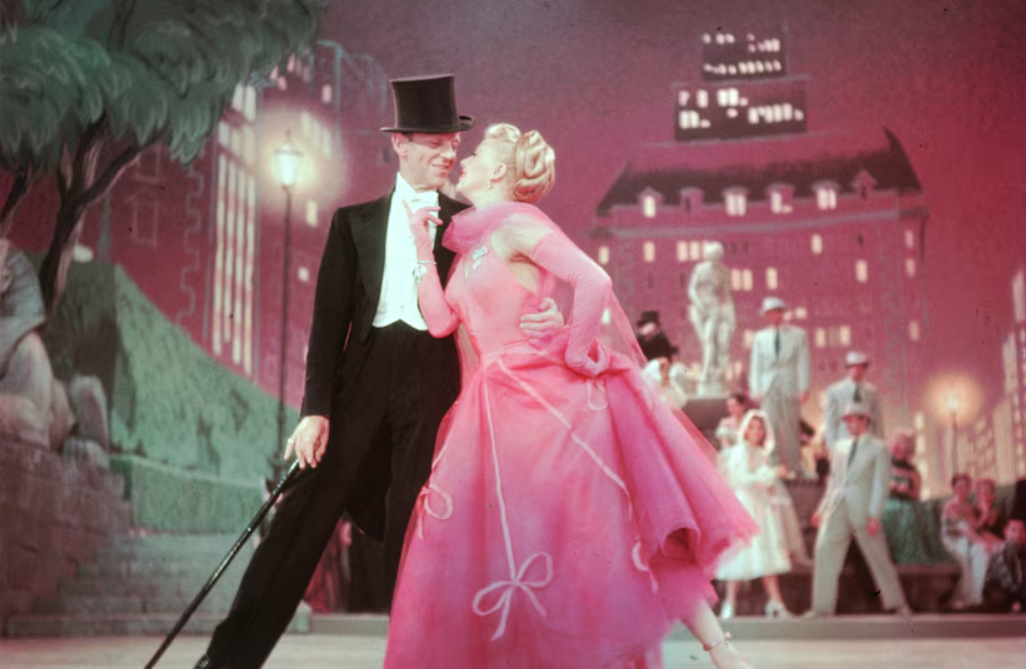
• Irene’s costumes
Notable Songs:
• “Bouncin’ the Blues” danced by Fred Astaire and Ginger Rogers
• “Sabre Dance” performed by Oscar Levant
• “Shoes with Wings On” performed by Fred Astaire
• “They Can’t Take that Away From Me” performed by Fred Astaire and Ginger Rogers
• “Swing Trot” danced by Fred Astaire and Ginger Rogers
My review:
When people think of the dancing duo Fred Astaire and Ginger Rogers, they likely envision a rich black-and-white film with an Art Deco set design as the two spin and twirl across sleek marble floors.
Astaire and Rogers made nine films together at RKO Pictures. Their final film during this period was THE STORY OF IRENE AND VERNON CASTLE (1939). After that film, Astaire and Rogers went off in separate directions. Astaire stuck to musical films and dancing with various actresses, including Rita Hayworth, Paulette Goddard and Eleanor Powell. Rogers largely drifted away from musicals and sunk her teeth into comedic and dramatic roles, winning an Academy Award for Best Actress in a Leading Role in KITTY FOYLE (1940).
But 10 years after their last film together, the two were reunited in 1949 in their final partnership, THE BARKLEYS OF BROADWAY (1949).
In the film, Fred Astaire and Ginger Roger play husband-and-wife performers Josh and Dinah Barkley, successful Broadway musical stars. Dinah becomes restless with lighter musical theater and is convinced by producer Jacques Pierre Barredout (Jacques François) that she should try her hand at dramatic theater. The decision breaks up the Barkley marriage. However, while Dinah struggles with the new play, Josh watches from afar and finds a way to help.
THE BARKLEYS OF BROADWAY (1949) has a very different look and feel since the last time audiences saw Astaire and Rogers together in 1939. Each major Hollywood studio had a distinct flavor. Where the two were previously in a sleek Art Deco feel at RKO Pictures, they now received the Metro-Goldwyn-Mayer treatment, a studio that boasted having “more stars than there are in the heavens.” Astaire and Rogers are filmed in lush Technicolor for their first time together – though they had been filmed separately in color. While the RKO Rogers and Astaire films all seem to have similar plot lines (except for IRENE AND VERNON CASTLE), the plot of this MGM film is less convoluted and different than their other films.
While THE BARKLEYS OF BROADWAY is significant to Hollywood history since it reteamed this legendary screen team, Ginger Rogers was not originally set to lead in this film. To continue the momentum of the success of EASTER PARADE (1946), BARKLEYS was supposed to reteam Judy Garland and Fred Astaire. However, when Garland had to drop out of BARKLEYS, producer Arthur Freed hatched the idea of reteaming Astaire and Rogers for the film.
The film’s director, Charles Walters, a major musical fan, said he cried when Rogers first came on set, and he watched the two actors embrace.
“I couldn’t believe I would be directing them,” Walters is quoted by his biographer.
Walters also later said Rogers was much better suited for the film than Garland, as it was a more mature and sophisticated role.
“The fortunate thing, as Fred was so much righter for EASTER PARADE than Gene (Kelly), also Ginger was so much righter for The Barkleys of Broadway,” Walters said.
As noted in my other reviews of Astaire/Rogers films, the pair have different memories of their times together:
In his 1959 memoir “Steps in Time,” Astaire fondly remembers their reteaming, noting that he and Ginger never really felt that their collaboration was never truly over. He had always thought they would work together again.
Rogers remembers things a bit differently. In her 1991 memoir, “Ginger: My Story,” she recalled being angry when Arthur Freed asked her, “Would you object to appearing opposite again (with Fred Astaire)?” This was poorly worded and received by Rogers, who was angry that it implied she wouldn’t want to work with Astaire with whom she “maintained a cordial, if distant, friendship.”
Walters remembered Rogers feeling nervous when Judy Garland visited the set as well. In addition to Garland not starring in the film, a hillbilly number was also cut from the movie. Thank goodness.
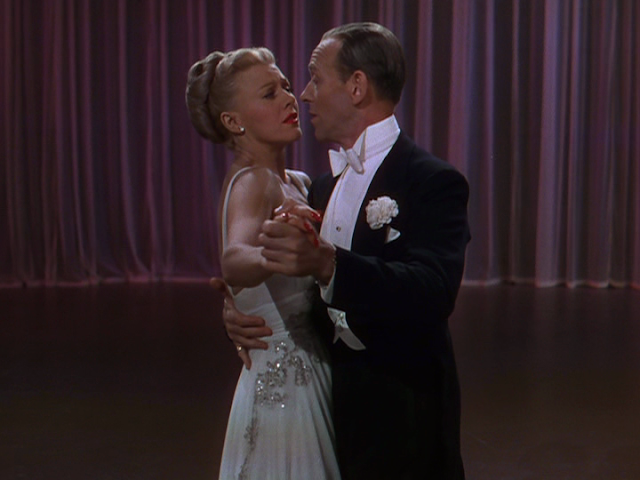
However, despite their differing memories, the overall outcome of the film is colorful and fun. The film captures their famous ballroom dancing style in “They Can’t Take That Away From Me,” a number they previously performed together in SHALL WE DANCE (1937).
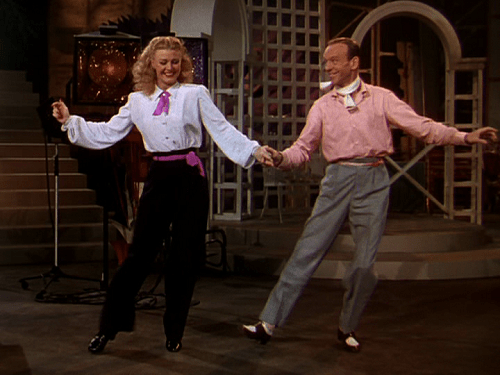
However, I think “Bouncin’ the Blues” is Fred Astaire and Ginger Rogers’s best dancing performance on screen together. They tap side-by-side and are just two hoofers dancing. Rogers wears pants, allowing you to better see her movements. The number makes the two look more like equal dancers.
And this is where I have to go on a tangent. While “Bouncin’ the Blues” sets Rogers and Astaire up as equal dancers, performing side-by-side, it also highlights that they aren’t equally skilled as dancers. It has to be said that while they were a lovely dancing pair in films, Fred Astaire was a dancing genius and a better dancer.
And this is as good a time as ever to pick a bone with Bob Thaves, the creator of the comic strip “Frank and Ernest.” In 1982, it was in a comic strip of “Frank and Ernest” that stated: “Sure he (Astaire) was great, but don’t forget that Ginger Rogers did everything he did, backwards… and in high heels.”
Since then, this phrase has been used in political campaigns and scholarly articles, all implying that Rogers was a more skilled dancer. But to me, those saying it have never actually watched a Rogers and Astaire film.
For starters, they often dance side-by-side so they are both facing the camera. Secondly, Astaire … also went backwards. Lastly, Astaire was a dancing genius and every number he created after their partnership was athletic and genius.
A great example of this is the BARKLEYS number “Shoes with Wings On.” It’s an innovative number by Fred Astaire, where he puts on a pair of dancing shoes that take over. He does a great job dancing as if the shoes have taken control over his feet, and then through cinema magic; shoes dance alone around him.
I’m not implying that Rogers wasn’t a good dancer. And numbers with Rogers and Astaire are truly movie magic. What I’m saying is that those who like to quote this 1982 comic strip are ill-informed about their musical films.
While overall this reteaming of Astaire and Rogers is wonderful, there is only one downside. The performance in the Sarah Bernhardt play. Was that supposed to be good?
One highlight of these two back together is that they are also both comedians, which is highlighted well here. Even the notoriously grumpy New York Times critic Bosley Crowther was happy to see the screen team reunited. He wrote in his May 5, 1949 review:
Next to the patching of relations between Russia and the United States, there is probably no rapprochement that has been more universally desired than the bringing back together of Ginger Rogers and Fred Astaire. For ten years, we missed the charm and magic of this most happily matched dancing team.
THE BARKLEYS OF BROADWAY is a magical and frothy finale to the partnership of Fred Astaire and Ginger Rogers, despite my irritation with a 1982 comic strip that is not directed toward this film. It’s wonderful to see them together in an MGM musical and performing side-by-side once again.
Other places you can follow Comet Over Hollywood:
- Letterboxd
- X at @HollywoodComet
- BlueSky
- Or e-mail us at cometoverhollywood@gmail.com


And Oscar Levant is hilarious as usual. Great movie!
LikeLike
I never knew that the famous quote that “Ginger Rogers did everything he did, backwards… and in high heels.” came from a comic strip!
LikeLike