
It’s no secret that the Hollywood Comet loves musicals.
In 2010, I revealed I had seen 400 movie musicals over the course of eight years. Now that number is over 600. To celebrate and share this musical love, here is my weekly feature about musicals.
 This week’s musical:
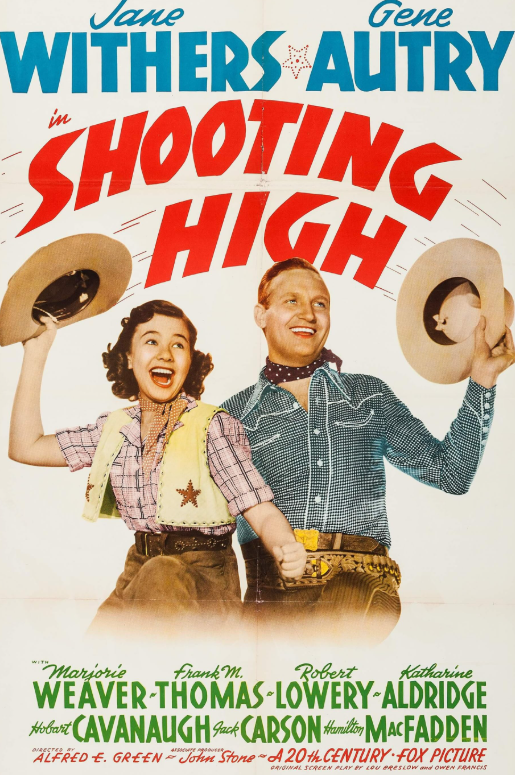
Shooting High(1940) – Musical #816
Studio:
20th Century Fox
Director:
Alfred E. Green
Starring:
Jane Withers, Gene Autry, Champion the Horse, Marjorie Weaver, Jack Carson, Frank M. Thomas, Robert Lowery, Kay Aldridge, Hobart Cavanaugh, Hamilton MacFadden, Charles Middleton, Ed Brady, Tom London, Eddie Acuff, Pat O’Malley, George Chandler
Plot:
In Carson Corners, there are two families who have been at odds for decades: The Carsons and the Pritchards. Will Carson (Autry) is the grandson of the town’s hero and namesake, Wild Bill Carson. But the Pritchards believe that Wild Bill was a no account. To complicate matters, Will and Marjorie Pritchard (Weaver) are sweethearts, and her scheming father, Mayor Pritchard (Thomas), is using the romance to his advantage. Mayor Pritchard is planning to build a highway through Carson’s private land. When Will finds out, he accuses Marjorie of conspiring with her father, which breaks up their romance.
Around this time, a Hollywood producer (Carson), arrives wanting to make a movie in Carson Corners about Wild Bill Carson. The Pritchards try to influence the script, and Will is jealous as Marjorie cozies up to the lead actor (Lowery). Marjorie’s little sister, Jane Pritchard (Withers) helps Will throughout the story to get the two together.
Trivia:
• Jane Withers wanted to make a film with Gene Autry. She spoke with 20th Century Fox executive Joseph M. Schenck, who said Republic would never loan Autry and he wouldn’t loan Withers to Republic. Withers called Republic studio head, Herbert Yates. Withers and Yates met and developed the idea to exchange three 20th Century Fox stars for Gene Autry, and Schenck agreed, according to an interview with Withers and Michael G. Fitzgerald and Boyd Magers.
• 20th Century Fox originally announced in a press release that Tony Martin and Joan Davis would appear in the cast. Davis said in a Jan. 1939 interview that she would be in the film. Binnie Barnes was also announced as appearing in the film in a Jan. 9, 1939, news brief. They didn’t appear in the final film.
• The working title was “Jubilo.”
• Gene Autry’s first film not released by Republic.
• In most of his early films, Gene Autry’s character name was also called “Gene.” This is one of few films between 1934 and 1940 that his character’s name was something different.
• Gene Autry refused to kiss leading lady, Marjorie Weaver, because the children who predominately watched his films don’t like it, according to Nov. 1939, news briefs.
Highlights:
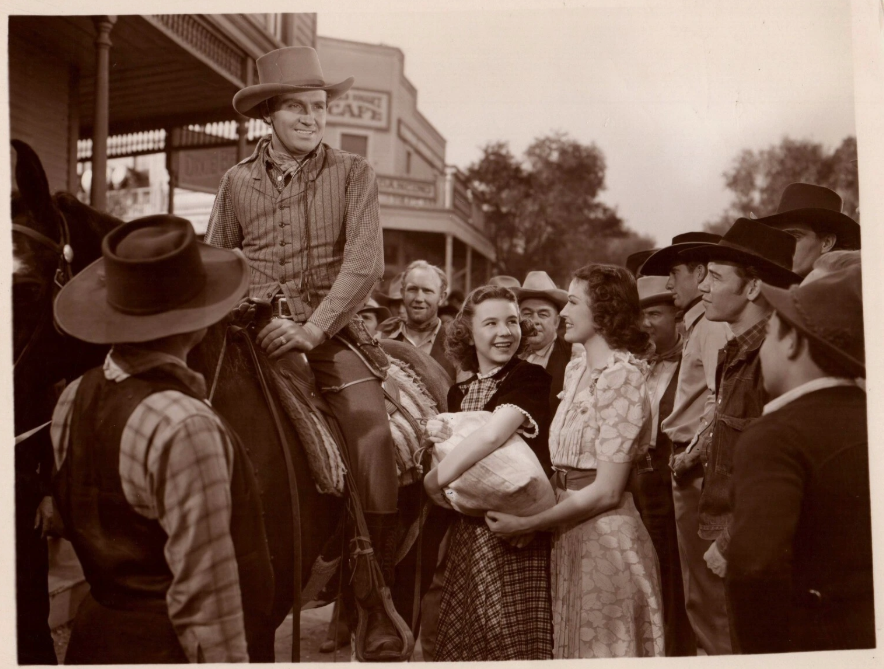
• Gene Autry and Jane Withers singing duets
Notable Songs:
• “Shanty of Dreams” performed by Jane Withers and Gene Autry
• “Wanderers” performed by Jane Withers and Gene Autry
• “Little Old Band of Gold” performed by Gene Autry
• “Only One Love in a Lifetime” performed by Gene Autry
My review:
It was a 13-year-old child who was responsible for this week’s Musical Monday, SHOOTING HIGH (1940).
Child star Jane Withers was one of 20th Century Fox’s top stars. She was eager to make a film with Republic’s top star, Gene Autry, so she took matters into her own hands.
First, Withers went to 20th Century Fox executive, Joseph M. Schenck.
“He told me Gene was Republic’s biggest star and they’d never loan him to Fox. So, I asked if he’d loan me to Republic, but he told me I was the number six box office draw in the country, and Fox would never loan me,” Withers said in an interview with Michael G. Fitzgerald and Boyd Magers. “He did agree it was a great idea, it would be box office dynamite.”
Withers said she just had to be in a movie with Gene Autry, so she continued to work on her goal. Next, Withers went to Herbert Yates, head of Republic studios. Not knowing his name, she called Republic and asked to speak to the studio head. When the switchboard told her, “little girl, Mr. Yates is a very busy man,” Withers shocked her with her reply.
“I told her, ‘Well I’m a busy girl. My name is Jane Withers, and could you please connect me?’ The operator screamed, ‘The Jane Withers?,” Withers said in her interview.
The operator said she knew Mr. Yates would want to speak with her. When he spoke with Withers, they scheduled a meeting and developed the idea to exchange three 20th Century Fox stars for Gene Autry, and Schenck agreed, according to an interview with Withers and Michael G. Fitzgerald and Boyd Magers.
“I wouldn’t take no for an answer. Not when I knew when I knew it would be good for everyone concerned. I was afraid Mr. Schneck would be mad at me, but he wasn’t. He thought it was a wonderful idea. Mr. Yates told him he had a very determined young lady with a credible idea,” Withers said.
Withers’s idea paid off and SHOOTING HIGH (1940) was one of the box office hits of the year.
In the film, the town of Carson Corners has their own “Hatfield and McCoy”-like feud, between the Carsons and the Pritchards.
Will Carson (Gene Autry) is the grandson of the town’s hero and namesake, Wild Bill Carson. But the Pritchards believe that Wild Bill was a no account. To complicate matters, Will and Marjorie Pritchard (Marjorie Weaver) are sweethearts, and her younger sister, Jane (Jane Withers) is trying to help get them together. But Jane and Marjorie’s father, Mayor Pritchard (Frank M. Thomas) is planning to build a highway through Carson’s private land. When Will finds out, he accuses Marjorie of conspiring with her father, which breaks up their romance.
Around this time, a Hollywood producer (Carson), arrives wanting to make a movie in Carson Corners about Wild Bill Carson. The Pritchards try to influence the script, and Will is jealous as Marjorie cozies up to the lead actor (Lowery). Marjorie’s little sister, Jane Pritchard (Withers) helps Will throughout the story to get the two together.
SHOOTING HIGH (1940) is only 69-minutes and is delightful. Jane Withers and Gene Autry are a fun pair, and get to sing a few duets together. Withers, Autry, Jack Carson and Hobart Cavanaugh are the strongest performers in the film.
The other main actors, Marjorie Weaver, Frank M. Thomas, Robert Lowery and Kay Aldridge, are all just fine, but largely window dressing.
The script originally called for a kiss between Gene Autry and Marjorie Weaver. This kiss made headlines, because Autry refused to do the kiss. It was nothing against Weaver, but that his youthful audiences didn’t like to see Autry kissing in his films, according to Nov. 1939, news briefs.
“Autry is willing to 1. Sing underneath her window 2. Ride with her in the moonlight 3. Put his arms around her and even 4. Sip the same soda out of two straws. But kissing is out,” in the Nov. 10, 1939, article “Film Star Balks at Movie Kiss.” I thought this was interesting since Roy Rogers had similar issues in his films.
I never really believed the chemistry between Autry and Weaver, but the pal chemistry between Autry and Withers is what counts here. They even remained friends after the filming, Withers said in her interview.
This song is filled with great songs. I also love the movie tie in, which is when it feels like the film picks up. The only part I didn’t care for in the film is a bank robbery in the last 10 minutes, because it felt thrown in. Though I understand the point of it. There are some funny moments in the film, especially those that features Jane Withers. I also thought it was funny that a small town like Carson Corners had a gossip column.
What I also like about SHOOTING HIGH it’s a higher quality Autry film, since it was released by 20th Century Fox rather than Republic.
What I also like about Gene Autry’s films is that his estate has worked to restore them in partnership with UCLA. I wish the films of Roy Rogers, Tex Ritter and the others would receive the same treatment.
Overall, this is a good time, and we have Jane Withers to thank that it even exists.
Other places you can follow Comet Over Hollywood:
- Letterboxd
- X at @HollywoodComet
- BlueSky
- Or e-mail us at cometoverhollywood@gmail.com
 Comet Over Hollywood