
It’s no secret that the Hollywood Comet loves musicals.
In 2010, I revealed I had seen 400 movie musicals over the course of eight years. Now that number is over 600. To celebrate and share this musical love, here is my weekly feature about musicals.
This week’s musical:
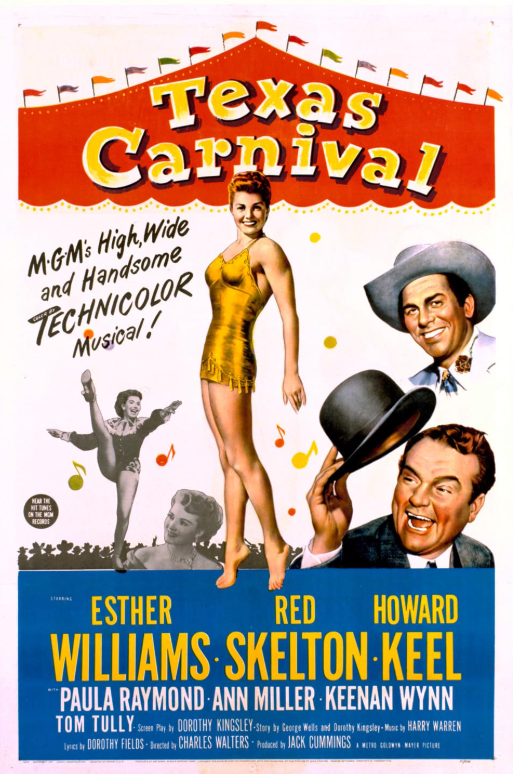
Texas Carnival (1951) – Musical #68
Studio:
Metro-Goldwyn-Mayer
Director:
Charles Walters
Starring:
Esther Williams, Red Skelton, Howard Keel, Ann Miller, Paula Raymond, Keenan Wynn, Tom Tully, Glenn Strange, Dick Wessel, Donald MacBride, Marjorie Wood, Hans Conried, Thurston Hall, Duke Johnson, Wilson Wood, Gene Coogan (uncredited), Bess Flowers (uncredited), Beatrice Hagen (uncredited), Alex Romero (uncredited)
Themselves: Foy Willing and His Orchestra, Red Norvo Trio,
Plot:
Cornie (Skelton) and Debbie Telford (Williams) work together in a dunk tank sideshow. They aren’t doing well financially, and Debbie wants a well-balanced meal. While in Texas, Cornie is mistaken for a cattle barron, Dan Sabinas (Wynn), when Cornie drives his car back to the hotel. They think Debbie is Marilla Sabinas (Raymond). Unable to untangle the misunderstanding, Cornie and Debbie wait for the real Dan Sabinas to return to the hotel. The mistaken identity leads to high gambling debts and romances. The sheriff’s daughter (Miller), Sunshine, falls for Cornie, while Sabinas’s ranch hand Slim Shelby (Howard), knows they are phonies, but plays along.
Trivia:
• Portions of the film were filmed at Beverly Wilshire Hotel in Beverly Hills.
• Third and final film co-starring Esther Williams and Red Skelton. The others were BATHING BEAUTY (1944) and NEPTUNE’S DAUGHTER (1948).
• Esther Williams and Howard Keel’s second film together. Their first film was in PAGAN LOVE SONG. They co-starred in one more film after this, JUPITER’S DARLING.
• In the announcement of Esther Williams and Red Skelton in a new picture together, Louella Parsons said there was a good chance for Gene Autry to appear in the film, according to a Nov. 1950, news brief by Parsons. Autry didn’t appear in the picture.
• The filming of the bar scene with Red Skelton and Keenan Wynn took all day to film, because of people on set laughing at Skelton’s comedic routine. They eventually had to close down the set to complete filming, according to Howard Keel’s autobiography.
• Originally considered as a film for Betty Hutton.
• Filming was delayed because of Esther Williams’s pregnancy. She made the film six weeks after giving birth to her son, Kimball Austin, according to Williams’s autobiography.
• Working title was “Carnival Story.”
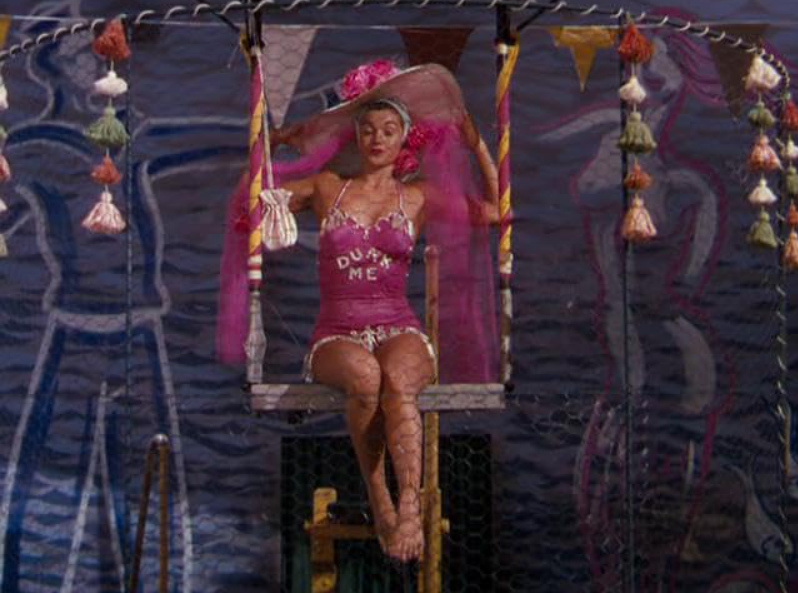
Esther Williams
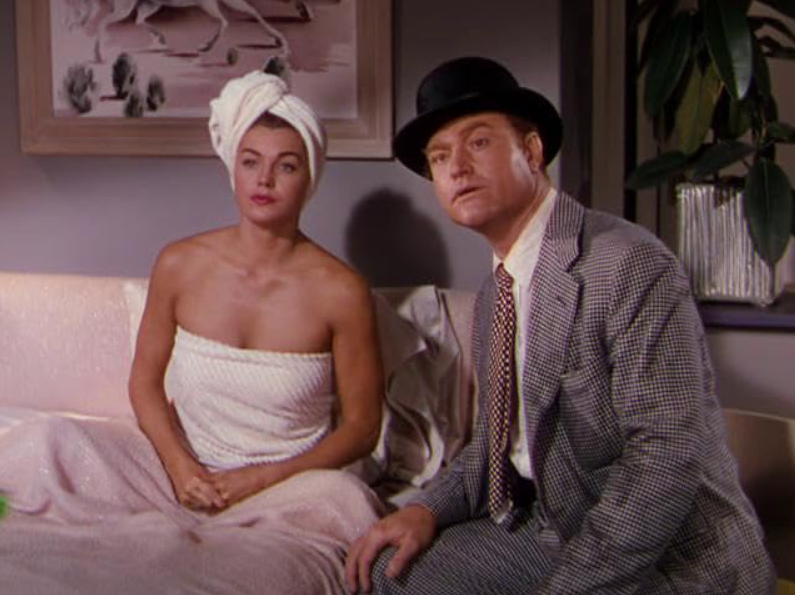
Esther Williams and Red Skelton
Highlights:
• Incredible cast
• Ann Miller tap dancing on a giant xylophone
• The stunning Technicolor
• “Deep in the Heart of Texas” number
Notable Songs:
• “Carnie’s Pitch” performed by Red Skelton
• “Whoa, Emma” performed by Howard Keel
• “It’s Dynamite” performed by Ann Miller
• “Deep in the Heart of Texas” performed by Howard Keel and the cast
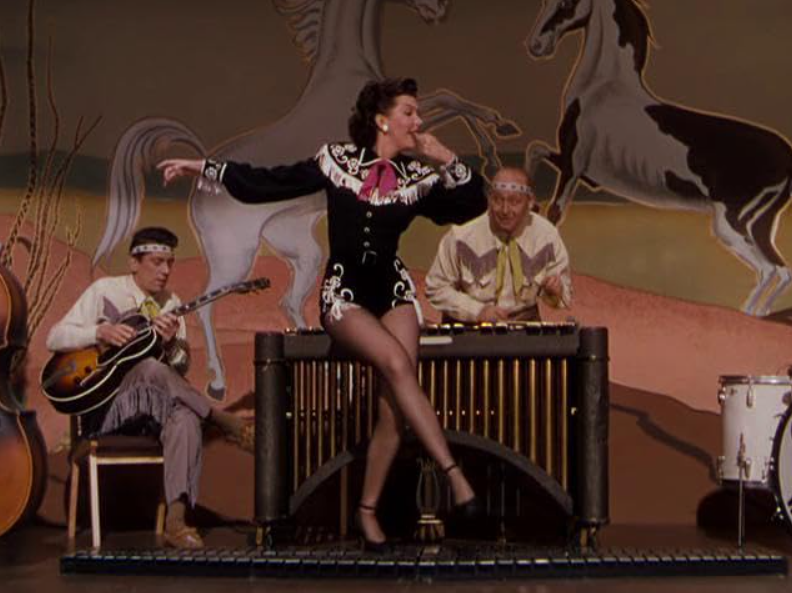
Ann Miller
My review:
This week’s Musical Monday is a strange one. While watching I thought, what’s the point? But somehow it’s also an excellent time.
TEXAS CARNIVAL (1951) has what Howard Keel called, “a hoot of a cast,” including MGM’s top stars of 1951: Red Skelton, Esther Williams, Ann Miller and Howard Keel. It’s filmed in lush Technicolor with costuming by Helen Rose, dances by Hermes Pan and directed by choreographer turned director Charles Walters.
With a pedigree like that, then why is TEXAS CARNIVAL not very good and sort of weird? I think it’s because it was paired with the wrong script.
In the film, carnival sideshow performers, Cornie (Red Skelton) and Debbie Telford (Williams) work together in a dunk tank sideshow, and are down on their luck. They aren’t doing well financially, and Debbie is starving for a well-balanced meal. While performing in Texas, Cornie is mistaken for a cattle barron, Dan Sabinas (Wynn), when Cornie drives Sabinas’s car back to the hotel. They think Debbie is Marilla Sabinas (Raymond). Unable to untangle the misunderstanding, Cornie and Debbie wait for the real Dan Sabinas to return to the hotel. The mistaken identity leads to high gambling debts and romances. The sheriff’s daughter (Miller), Sunshine, falls for Cornie, while Sabinas’s ranch hand Slim Shelby (Howard), knows they are phonies, but plays along.
For a cast of this caliber, the story feels a bit pointless and the runtime is only 77-minutes, which was one of the shortest of MGM’s “A” budget films.
But even still … I really enjoyed this quirky, strange film. It’s colorful and charming in its own way.
Esther Williams plays a character different than many of her other film roles. In fact, she feels relatable and is funny. She’s starving the first half of the film, saying all she wants in life is a steak dinner. She’s also somehow underdressed for the first half, in a bathing suit and then a towel. It’s incredible that she’s only six-weeks postpartum while making this film. She wrote in her autobiography that she was exhausted during the filming, and wanted to spend more time with her newborn baby.
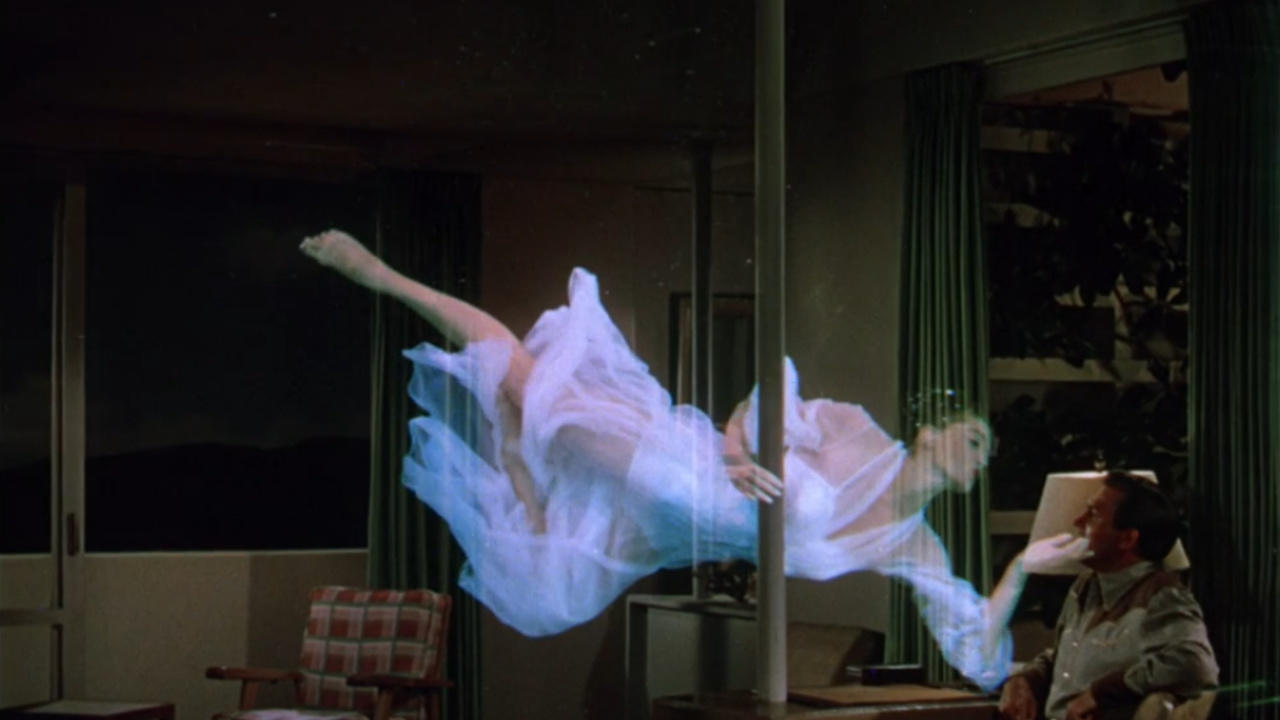
Williams only has one major swim sequence in the film, which is a dream sequence. As Howard Keel daydreams in his room, Williams comes swimming into his bedroom in a negligee. Williams described the number as “daring” in her autobiography, saying it’s a wonder they got it passed the censors.
“We got away with it (the dream sequence, because I was wet,” Williams wrote in her autobiography. “Dry, I never would’ve been allowed anywhere near a man’s bed in that state of undress.”
The number was also dangerous, as many of her stunts had the tendency to be. The swimming set was a replica of Keel’s bedroom set, complete with furniture and a ceiling that had only a trap door. The set was so dark that when it was time for Williams to go up for air, she couldn’t find the trap door. No one noticed she was in distress until a prop man named Pete dove down and got her. The next day, the ceiling was taken off the set, Williams wrote in her autobiography.
The only other time Williams is in the water is when she falls in a dunking tank and dips in a pool to hide her “dunk me” swim suit. We also get to see Williams dance a bit during a square dance number for “Deep in the Heart of Texas.”
Red Skelton’s role is similar to his other roles, where he is both sweet and endearing and also goofy. One thing that’s unique is that the film begins with Skelton singing a song, “Carnie’s Pitch.” It’s not unusual for Skelton to sing in a musical, but to open the film in song? That’s unusual. Skelton’s scene with Keenan Wynn in a bar is quite funny, especially in one part where you can tell Wynn is trying to keep from laughing in the shot. It took a whole day to film this bar scene, because laughter at Skelton’s antics made people keep laughing, according to Keel’s autobiography and Skelton’s biographers. The film ends with a true Skelton antic, as he drunkenly drives a covered wagon that is falling apart around him.
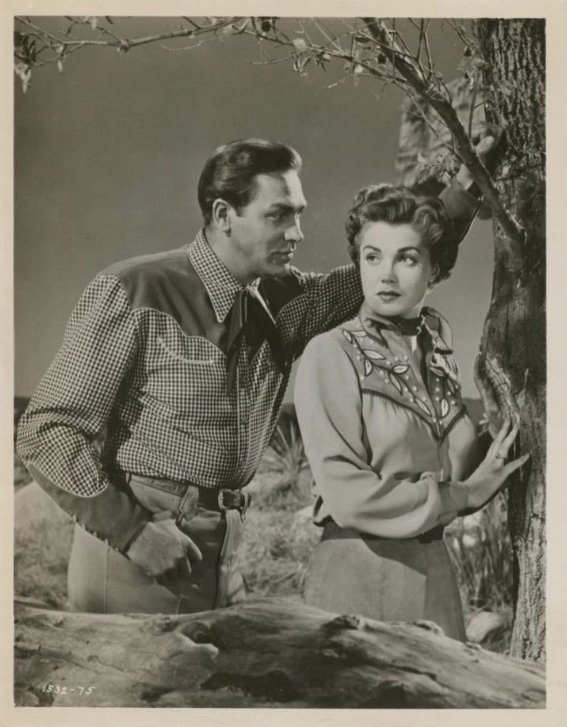
Howard Keel also plays a different type of character. He’s less brash than the usual characters he plays. He’s more of a simple, ranch hand and is kinda cute. At one point he has to dive in the pool to save Esther Williams, which was a fun scene.
Howard Keel and Esther Williams
For Ann Miller, her character of an energetic, man-crazy sheriff’s daughter is hilarious. Miller performs some of her most innovative dance numbers in TEXAS CARNIVAL (1951). One is where she tap dances to “It’s Dynamite” on a xylophone. Her dance solo in “Deep in the Heart of Texas” number feels different compared to her other numbers, as she leaps similar to a horse-like gallop.
While the dance numbers are great, the songs are some of the worst songs I’ve ever heard in a top-tier MGM film. Howard Keel’s main song, “Whoa, Emma” is a song to his horse.
So while the lead performers are excellent, then what’s wrong with TEXAS CARNIVAL?
For a larger budget MGM film, the script is weak and it’s much too short than most A-budget MGM films. At the end of the film, you can tell they were rushing to the final credits.
I also was unhappy that there was too little of both Keenan Wynn and Paula Raymond in the film.
Screenwriter Dorothy Kingsley tried to blame the film’s weakness on director Charles Walters for not getting close ups of Red Skelton during key comedic scenes, according to Walters’s biographer. This doesn’t seem fair to me and I disagree. The story is the weak spot of this movie. However, Walters himself said the film, “never really came alive,” according to his biographer.
However, Williams was complimentary of Walters, saying it was the first time a director helped her with her acting and that it was wonderful working with him. Reporter Erskine Johnson noted Williams’s happiness on set due to working with Walters.
Frankly, I was hesitant to revisit TEXAS CARNIVAL, because I remembered it being just okay. However, I had a wonderful time revisiting this musical. While it’s not the same high quality as other MGM musicals of this era, it’s still a good time.
Other places you can follow Comet Over Hollywood:
- Letterboxd
- X at @HollywoodComet
- BlueSky
- Or e-mail us at cometoverhollywood@gmail.com
 Comet Over Hollywood