
It’s no secret that the Hollywood Comet loves musicals.
In 2010, I revealed I had seen 400 movie musicals over the course of eight years. Now that number is over 600. To celebrate and share this musical love, here is my weekly feature about musicals.
This week’s musical:
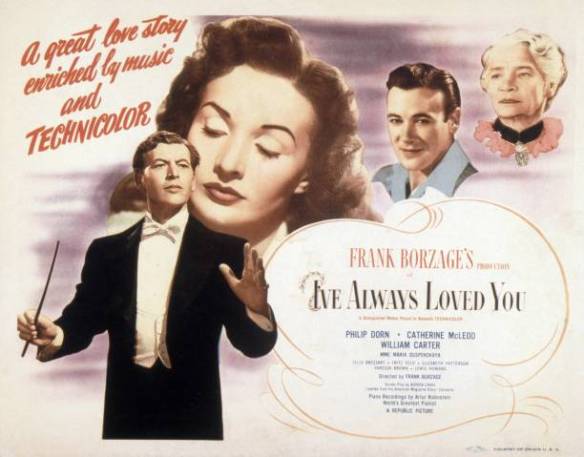
I’ve Always Loved You (1946) – Musical #838
Studio:
Republic Pictures
Director:
Frank Borzage
Starring:
Phillip Dorn, Catherine McLeod, Bill Carter, Maria Ouspenskaya, Felix Bressart, Elizabeth Patterson, Vanessa Brown, Lewis Howard, Adele Mara, Gloria Donovan, Cora Witherspoon, Fritz Feld
Plot:
Leopold Goronoff (Dorn) is a world famous maestro and concert pianist. He meets Myra Hassman (McLeod), the daughter of his former colleague, Frederick Hassman (Bressart) who is hopeful to become a pianist. Leopold takes Myra on as his protégé, and she travels the world with him and his mother (Ouspenskaya), learning and participating in concerts. Myra falls in love with Leopold, which is unrequited, and she goes home after Leopold ruins her debut performance at Carnegie Hall. She marries farmer George Sampter (Carter), but George always wonders if she’s still in love with Leopold.
Trivia:
• Republic Studio’s first Technicolor film.
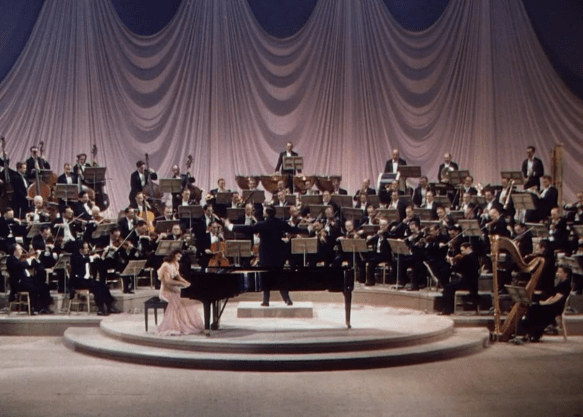
• Piano recordings were played by Artur Rubinstein.
• Based on the story “Concerto” by Borden Chase, which was based on the experiences of his wife.
• Bill Carter’s final film until 1961.
• Performed on the Lux Radio Theater on CBS on Nov. 4, 1946, starring Joseph Cotten and Catherine McLeod.
• Restored by Paramount Pictures, the Film Foundation and Martin Scorsese
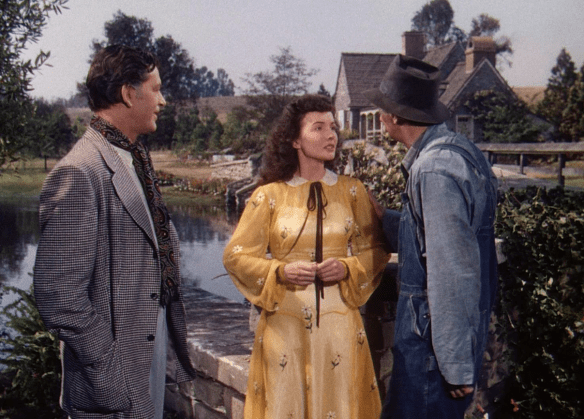
Phillip Dorn, Catherine McLeod, Felix Bressart
Highlights:
• Stunning Technicolor cinematography
• Costumes by Eleanor Behm
Notable Songs:
• “Piano Concerto No. 2 in C minor”
• “Prelude in C-sharp minor”
• “Piano Sonata No. 23 in F minor Op. 57 ‘Appassionata’”
• “Nocturne No. 5 in F-sharp major”
My review:
I hope you enjoy Rachmaninoff if you’re about to watch this week’s Musical Monday, because you will hear a lot of it!
I’VE ALWAYS LOVED YOU (1946), directed by Frank Borzage, is a unique film. It’s not unique due to the story or actors, but it’s budget.
The film is produced by Republic Pictures, which was known for low budget, poverty row pictures. But I’VE ALWAYS LOVED YOU is a polished, stunning film, with vibrant Technicolor and a high caliber director like Borzage, it has all the earmarkings of a high dollar production from a studio like Paramount Pictures or 20th Century Fox.
In the film, Phillip Dorn plays Leopold Goronoff, who is a world famous maestro and concert pianist. He meets Myra Hassman (Catherine McLeod), who is the daughter of his former colleague and musician Frederick Hassman (Bressart). Mayra is hopeful to become a pianist. Leopold takes Myra on as his protégé, and she travels the world with him and his mother (Ouspenskaya), learning and participating in concerts. Myra falls in love with Leopold, who seems to care for her but continues to philander with other women. When it’s finally time for Myra’s review, it’s clear that she may be a better pianist than Leopold. He becomes jealous and he humiliates her during her debut performance at Carnegie Hall. Leaving Leopold, Mayra marries farmer George Sampter (Carter), who has always loved Mayra. As the two build a life together and have a daughter, Porgy (Vanessa Brown), George is never sure Mayra really loves him and wonders if she’s still in love with Leopold. Porgy follows in her mother’s footsteps of becoming a concert pianist, bringing Mayra and Leopold back together.
French film critic Jean-Pierre Coursodon criticized this film, calling it unreal and idiotic trash. The irony of it being called “unreal” is that writer Borden Chase based the story on the experiences of his first wife, Lee Keith, who was a concert pianist. As an aside, the two are the parents of dancer Barrie Chase (who you may know from WHITE CHRISTMAS and her famous line “kiss my foot, or have an apple).
Reviews from 1946 were no less complementary to the film.
“I’ve Always Loved You …. released by Republic Pictures as the most elaborate musical film in its history, is so preoccupied proving that it is an important motion picture that it becomes a bore,” wrote Herbert Cohn of the Brooklyn Eagle in his Sept. 7, 1946 review.
Bosley Crowther equally thumbs his nose at the film noting that it what happened after the finale concert would have been more interesting. He also mentions that filmgoers may tire of Rachmaninoff’s Second Piano Concerto, because it had also been recently highlighted in HOLIDAY IN MEXICO and BRIEF ENCOUNTER that same year.
Rather than unreal or idiotic, the film’s story made me furious, with Phillip Dorn’s behavior in the film, which I guess means he did a good job. Jeanine Basinger wrote that several critics have dismissed this film as a sentimental women’s picture in the career of Borzage.
Leopold’s treatment of Mayra made me angry, the way he ruined her career, and I desperately did not want Mayra to end up with Leopold – I was prepared to march in the streets and riot if so.
Dorn, who truly is an underrated actor, does a good job at playing the domineering maestro. Catherine McLeod, who plays Mayra, is called a “newcomer” in publicity materials, though she had been in four films prior. However, this is her first starring role. McLeod is fresh faced and pretty, and carries the film well.
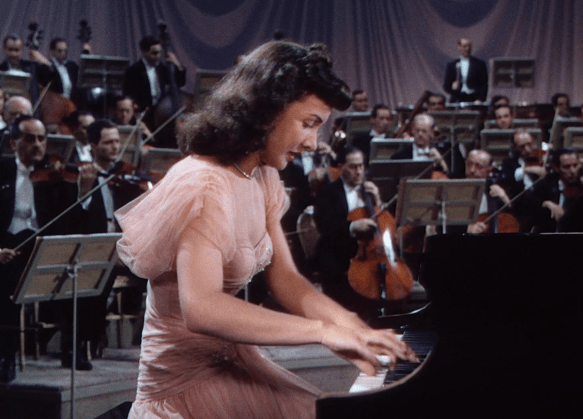
Catherine McLeod
The unsung hero for me was Bill Carter, in his only starring role, as poor George who loves Mayra. He was an unknown hottie. He wasn’t the best actor, but he’s endearing in the role.
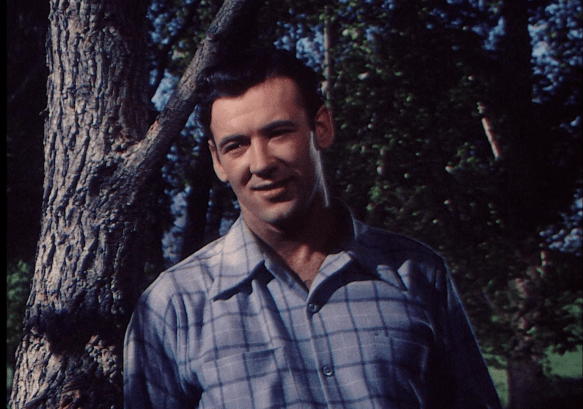
Bill Carter
It goes without saying that Maria Ouspenskaya is good in everything.
This isn’t your typical song and dance musical, but is filled with classical music. The music is performed via recordings of pianist Artur Rubinstein, who received the most praise from critics. Outside of the story, my biggest takeaway is that this film is visually stunning with vibrant color and excellent costumes.
While my feeling towards the film isn’t as harsh as 1946 critics, I do feel that this film feels overly long. I agree with Herbert Cohn’s assessment:
“It takes I’VE ALWAYS LOVED YOU a long time to build up to the point of stating this tomyrot. It takes a long time, too, to break it down.”
The film went to a place I wasn’t expecting, because of how it built up to this point. I feel the first half of the film could have been shortened. We quickly understood the maestro was an egotistical slim.
However, while this isn’t the best film directed by Frank Borzage, it is an interesting curio to see what a Republic Picture can look like with a little more cash behind it.
Other places you can follow Comet Over Hollywood:
- Letterboxd
- X at @HollywoodComet
- BlueSky
- Or e-mail us at cometoverhollywood@gmail.com
 Comet Over Hollywood