
It’s no secret that the Hollywood Comet loves musicals.
In 2010, I revealed I had seen 400 movie musicals over the course of eight years. Now that number is over 600. To celebrate and share this musical love, here is my weekly feature about musicals.
 This week’s musical:
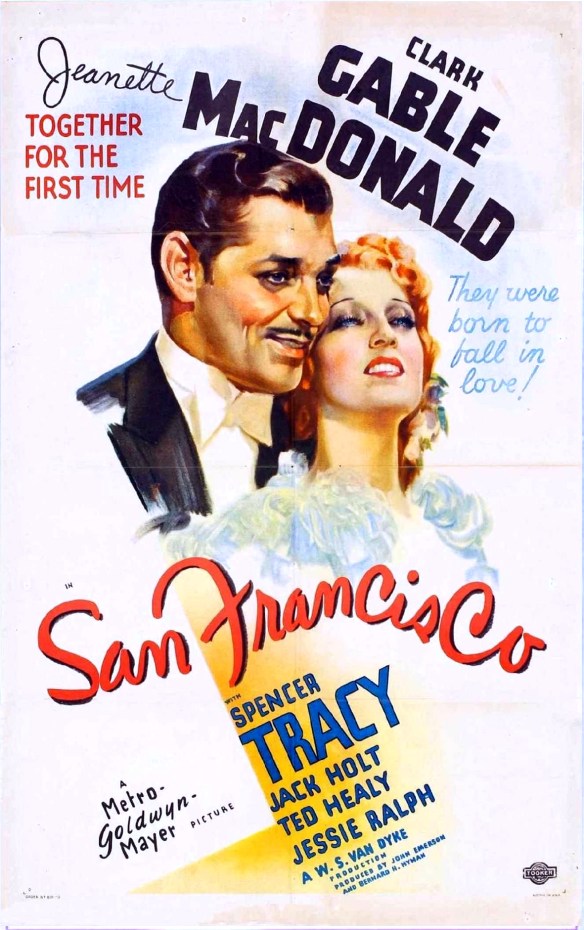
San Francisco (1936) – Musical #220
Studio
Metro-Goldwyn-Mayer
Director
W.S. Van Dyke
Starring
Clark Gable, Jeanette MacDonald, Spencer Tracy, Jack Holt, Jessie Ralph, Ted Healy, Shirley Ross, Harold Huber, Irving Bacon (uncredited), Dennis O’Keefe (uncredited), Jason Robards Sr. (uncredited)
Plot:
After her tenement building is destroyed in a fire, Mary (MacDonald) needs work. She finds a job as a singer for Barbary Coast saloon owner, Blackie (Gable). When Mary is offered a chance to sing grand opera, which is her dream, Blackie is reluctant to let her leave.
Trivia:
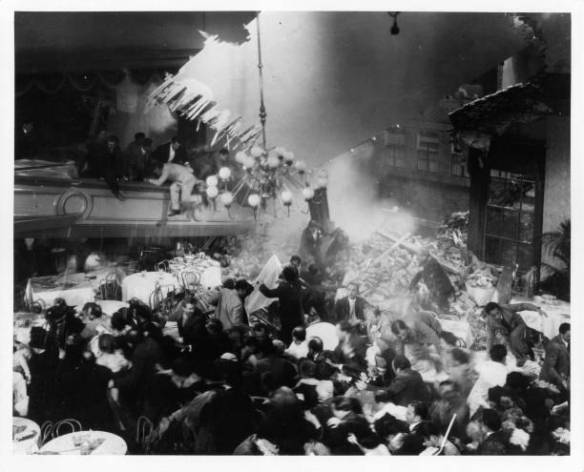
• The climax of the film is the historic San Francisco, Calif. Earthquake that happened on April 18, 1906, that destroyed the city.
• The special effects for the earthquake were created by A. Arnold Gillespie and James Basevi. They used hydraulic platforms pulled apart by cables, with hoses underneath gushing water to simulate broken mains. Sound engineer Douglas Shearer used monophonic amplification systems to shake theaters.
• The song “San Francisco” was written by Gus Kahn and music by Bronislaw Kaper and Walter Jurmann for this film and introduced by Jeanette MacDonald.
• Bruce Cabot tested for the role of Blackie.
• Brothers Sonny Bupp and Tommy Bupp appear together in the movie
• Jeanette MacDonald wanted Clark Gable for the role of Blackie Norton
• The character of Blackie Norton was based on adventurer Wilson Mizner
Highlights:
• The April 18, 1906 San Francisco earthquake scene
Notable Songs:
• “San Francisco” performed by Jeanette MacDonald
• “Would You?” performed by Jeanette MacDonald
• “La Traviata: Sempre Libera” performed by Jeanette MacDonald
My review:
With CGI and computer graphics, today’s movie view likes to scoff at the special effects in classic films. However, I’d like to point them to SAN FRANCISCO (1936), that features an earthquake sequence that still stuns today.
The historic San Francisco earthquake of 1906 serves as a climax for this film that highlights the rough and tumble Barbary Coast with the upper crust of Knob Hill.
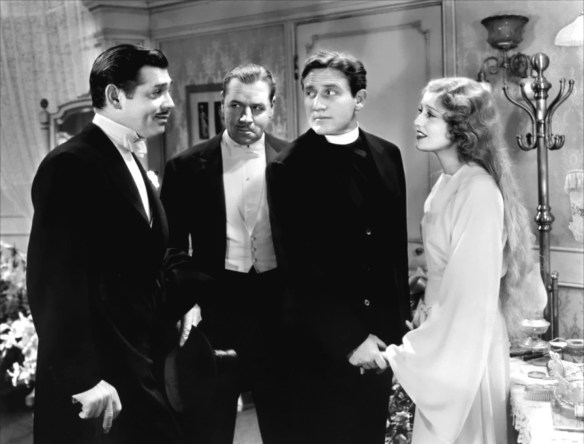
In the film, Blackie Norton (Clark Gable) is a brash saloon owner of the Paradise, who also is running for San Francisco Board of Supervisors. After her tenement apartment burns down, Mary Blake (Jeanette MacDonald) seeks out work at the Paradise. After earning the job, impresario and wealthy Jack Burley (Holt) of Tivoli Opera House hear Mary sing and want her to perform with them, but Blackie is reluctant to let her contract go. Along the way, Blackie’s childhood friend, Father Tim Mullin (Tracy) butt heads over Blackie’s dealings around town, though Blackie continues to help Father Mullin.
The story is the age old tale of “I helped you and now I won’t let you go.”
It was such a delight revisiting this adventure-drama-musical. It’s one of my favorites. Sometimes it’s soothing to watch a good ole Metro-Goldwyn-Mayer (MGM) movie.
SAN FRANCISCO (1936) is a perfect example of peak 1930s MGM filmmaking – tremendous star power with the lead actors, lavish sets and costumes, outstanding original songs, and unbelievable special effects.
The entire production is extravagant and breathtaking.
The cast is excellent. Jeanette MacDonald is in wonderful voice, per usual, and we are treated to hearing her perform several arias throughout the film. I also had no idea that the song “San Francisco” was written for this film.
The film feels like peak roles for Clark Gable and Spencer Tracy, who both play characters they excelled at throughout their careers. Gable, as the hood with a heart of gold. I was almost surprised to see he only played characters named Blackie twice in his career. The last 20 minutes of the film is Gable walking around looking handsome and disheveled.
Tracy is always excellent as a priest. This was his first time playing a character with “Father” in front of his name, but he became famous for this type of role with films like BOY’S TOWN.
The film is also filled with an excellent supporting cast. Jack Holt as a villain-like character, though he’s not really all that bad. It’s always a delight to see Jessie Ralph in anything. And I always love to see Ted Healy and Harold Huber. A highlight of the film is seeing Huber, as a hood, saying “That’s kinda pretty” while listening to grand opera.
But the best performance is that of the recreation of the 1906 San Francisco earthquake. The special effects created by A. Arnold Gillespie and James Basevi are jaw dropping and some of my favorite moments in cinema. The whole moment takes place between an hour 33 minutes and one hour and 35 minutes into the film – just two minutes followed by some after shocks and explosions. The entire earthquake sequence with its quick shots and frightened expressions feels almost like silent cinema. It’s stunning.
The San Francisco earthquake in this films and the flood in THE RAINS CAME (1939) are my two favorite moments in cinema.
I could go on and on about this film, but it’s simply stunning. If you aren’t into the opera or story, stick around for the last 20 minutes. It’s a treat.
Other places you can follow Comet Over Hollywood:
- Letterboxd
- X at @HollywoodComet
- BlueSky
- Or e-mail us at cometoverhollywood@gmail.com
 Comet Over Hollywood