
It’s no secret that the Hollywood Comet loves musicals.
In 2010, I revealed I had seen 400 movie musicals over the course of eight years. Now that number is over 600. To celebrate and share this musical love, here is my weekly feature about musicals.
 This week’s musical:
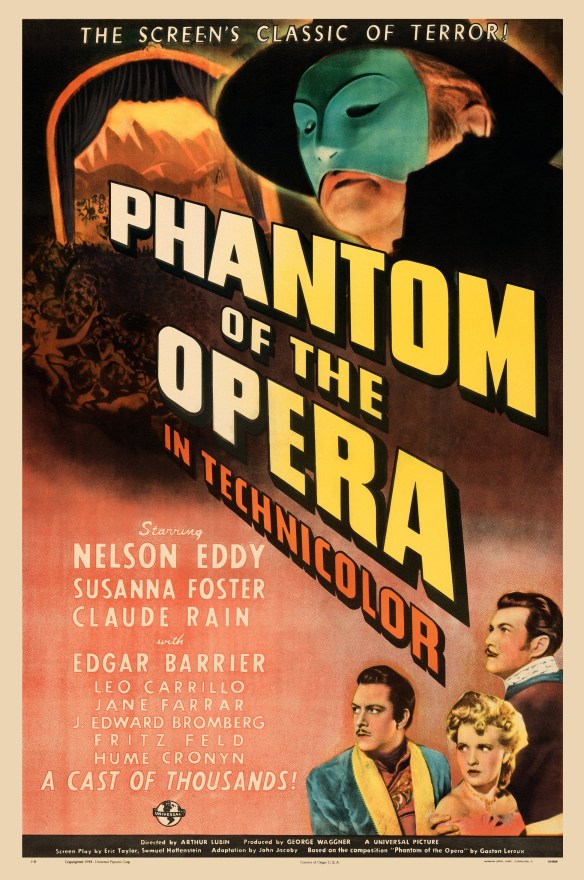
Phantom of the Opera (1943) – Musical #816
Studio:
Universal Pictures
Director:
Arthur Lubin
Starring:
Claude Rains, Nelson Eddy, Susanna Foster, Edgar Barrier, Leo Carrillo, Jane Farrar, J. Edward Brombeg, Fritz Feld, Hume Cronyn, Nicki Andre
Plot:
Composer Erique Claudin (Raines) is failing in his career. He is a violinist with the Paris Opera, but his career is declining due to an ailment in his hand that’s affecting his work, and he is unable to sell a manuscript he composed. When he’s fired, he is also broke as he has spent all of his earnings to anonymously fund the singing lessons of Christine DBois (Foster), who is the understudy to the primadonna (Farrar). While Erique is smitten with Christine, she has also captured the attention of police detective Raoul Daubert (Barrier) and Paris Opera baritone, Anatole Garron (Eddy). When Erique suffers from an affliction to the face, he hides in the sewers of the Paris Opera House and works to ensure Christine’s success, even if it means murder.
Trivia:
• Nelson Eddy’s first film after leaving Metro-Goldwyn-Mayer, where he had been under contract since the 1930s.
• Universal used the 1925 film set to produce this 1943 version of the story, according to the American Film Institute
• In 1940, this new “Phantom of the Opera” version was originally set to star Deanna Durbin and Broderick Crawford.
• In 1942, it was considered to rework the story as comedy with comedians Bud Abbott and Lou Costello and Lon Chaney Jr. as the phantom.
• Jane Farrar was dubbed by Sally Sweetland
• Only film credit of Nicki Andre, who plays the fill in opera singer during the “Le Prince Masque Du Caucasus” number.
• A sequel to “Phantom of the Opera” was planned and would star Nelson Eddy and Susanna Foster. It was never written by Curt Siodmak, as planned, but elements of the production were included in the film, THE CLIMAX (1944).
• Won two Academy Awards for Best Cinematography, Color by Hal Mohr and W. Howard Greene; and Best Art Direction-Interior Decoration, Color by Alexander Golitzen, John B. Goodman, Russell A. Gausman and Ira Webb.
• Nominated for Academy Awards for Best Sound, Recording and Best Music, Scoring of a Musical Picture
Highlights:
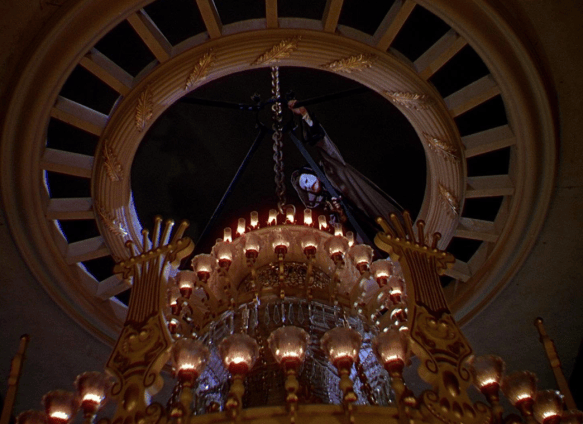
• Vibrant Technicolor
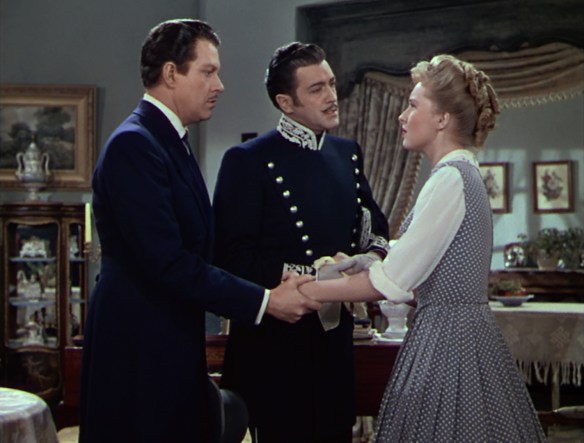
• The rivalry between Nelson Eddy and Edgar Barrier
• The concerto theme that runs throughout the film
Notable Songs:
• “Lullaby of the Bells” performed by Susanna Foster and Nelson Eddy
• “Martha” performed by Nelson Eddy, Jane Farrar (dubbed by Sally Sweetland), Susanna Foster
• “Amour Et Gloire” performed by Nelson Eddy, Jane Farrar (dubbed by Sally Sweetland), Susanna Foster
• “Le Prince Masque Du Caucasus” performed by Nelson Eddy and Nicki Andre
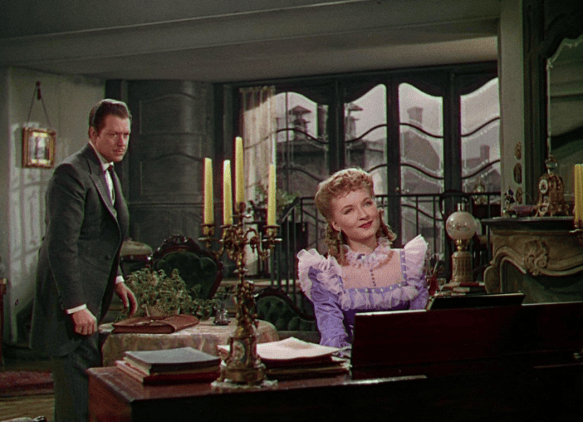
My review:
No, this isn’t your Andrew Loyd Webber production of PHANTOM OF THE OPERA. But with all the opera music in this film, this is a musical in my book.
This film had quite the production story: First with Deanna Durbin and Broderick Crawford in the cast, and then it was going to be revisited for Abbott and Costello. Then the dramatic story was back on with Lon Chaney, Jr.; Jon Hall and Deanna Durbin. Durbin was then replaced by Susanna Foster and the rest of the cast was adjusted accordingly.
All this to say, Foster is great, but I do mourn the fact that we couldn’t have had this Technicolor spectacle with Deanna Durbin. It also would have been neat to see Chaney Jr. to reprise a role his father played.
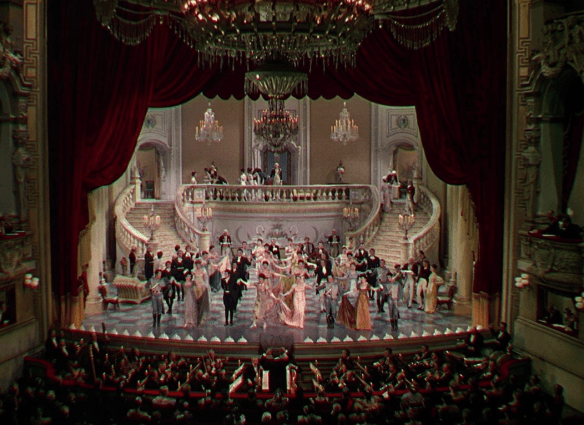
Going into this film, you should know it is filled with singing and opera numbers, since after all, “Phantom of the Opera” does have a plot that revolves around an opera and the success of singer, Christine.
In this version of PHANTOM OF THE OPERA, the Phantom seems a little bit more sympathetic than Lon Chaney’s in the earlier silent version.
In the film, Erique Claudin (Rains) is a violinist with the Paris Opera, but his career is declining due to an ailment in his hand that’s affecting his work. When he’s fired, he is also broke as he has spent all of his earnings to anonymously fund the singing lessons of Christine DuBois (Foster), who is the understudy to the primadonna (Farrar). While Erique is smitten with Christine, she has also captured the attention of police detective Raoul Daubert (Barrier) and Paris Opera baritone, Anatole Garron (Eddy). When Erique suffers from an affliction to the face, he hides in the sewers of the Paris Opera House and works to ensure Christine’s success, even if it means murder.
Outside of the stunning Technicolor and lavish opera performances, this version of differs from others because we get a glimpse of the Phantom character’s life prior to his facial affliction.
Rains plays the role well, but is even rather sympathetic. His character is pathetic, down-on-his-luck character whose misfortune drives him over the edge and to murder. Director Arthur Lubin said Claude Rains was his only pick for the role. Always the perfectionist, Rains prepared for the role by practicing the violin and the piano, according to his biographer.
Actress Susanna Foster said she enjoyed working with Rains.
“I thought Rains was wonderful,” Susanna Foster said in an interview. “He was a little reserved but had a vicious little twinkle in his eye that was so cute. You got so much back from working with him.
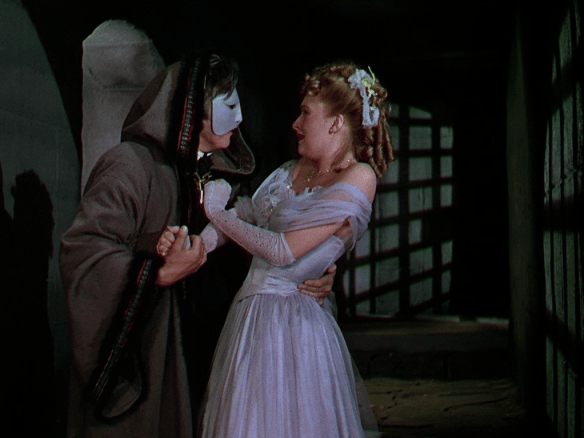
Foster is lovely in the film as Christine, who isn’t a helpless leading lady. She’s driven by her work, unapologetically enjoys the attentions of Anatole and Raoul, and when she finally becomes a successful primadonna, the film doesn’t end in the traditional way that one would think, which is quite satisfying.
Foster has a beautiful operatic singing voice. However, I can’t deny, that I left this film with a “what if” feeling; knowing that Deanna Durbin was originally set to star. It would have been so fun to see Deanna Durbin in this Technicolor spectacular, and I think she would have been wonderful in it. Oh well, I guess we can just dream of that production.
This film came in an interesting time for Nelson Eddy. Since 1935, Eddy was under contract to Metro-Goldwyn-Mayer (MGM) and primarily co-starred with Jeannette MacDonald, creating a stunning operatic screenteam. PHANTOM OF THE OPERA (1943) was Eddy’s first film after leaving MGM. Following this film, he only made three more feature films, sang on a couple of cartoon shorts and made television appearances. Eddy looks slightly different in this film with darker hair, something he wasn’t pleased about. He also is in excellent voice and his performances are a highlight.
Film historians often site that Eddy is “wooden” and dull, but I quite like him and feel he is skilled at comedy, which he’s not often given credit for. Nelson Eddy and Edgar Barrier, who plays Raoul, make a fun comedic pair, as they compete for Christine’s affections. They would have been a fun buddy duo. I enjoy how they end up enjoying both being jilted at the end, nearly walking out arm-in-arm a la CASABLANCA, citing the start of a beautiful friendship.
Outside of the music, another criticism I see for this film is that it’s too silly and features too much humor. I personally enjoy it, especially with Eddy and Barrier.
For those who criticize how light hearted this film is in certain aspect, one must also remember, PHANTOM OF THE OPERA (1943) was released in the middle of World War II, as audiences sought escapism. The opulent opera numbers, lavish costumes and vibrant color played well into that.
This film may not meet the expectations of Universal monster film fans, however, I feel the levity of certain aspects of this film may make them forget that certain scenes are alarming. The scene where acid is thrown in Claude Rains’s face and his subsequent reaction is quite gruesome. The murder of the primadonna is also quite alarming.
The last time I saw this was in 2017 at the Nitrate Picture Show, so to see this stunner on the big screen was really neat.
I know not everyone cares for this film, but I think it’s a good one. I would say give it a chance, even if opera isn’t your cup of tea. However, if you vehemently hate opera, this film may not be for you.
Other places you can follow Comet Over Hollywood:
- Letterboxd
- X at @HollywoodComet
- BlueSky
- Or e-mail us at cometoverhollywood@gmail.com

