
It’s no secret that the Hollywood Comet loves musicals.
In 2010, I revealed I had seen 400 movie musicals over the course of eight years. Now that number is over 600. To celebrate and share this musical love, here is my weekly feature about musicals.
 This week’s musical:
Star! (1968) – Musical #240
Studio:
20th Century Fox
Director:
Robert Wise
Starring:
Julie Andrews, Richard Crenna, Michael Craig, Daniel Massey, Robert Reed, Bruce Forsythe, Beryl Reid, John Collin, Alan Oppenheimer, Richard Karlan, Garrett Lewis, Anna Lee (uncredited), Grady Sutton (uncredited), Jenny Agutter (uncredited)
Plot:
Biographical film on stage actress Gertrude Lawrence (Andrews).
Trivia:
• After its release, the film was withdrawn and reissued in October 1969 under the title “Those Were the Happy Times” with a run time cut from three hours to two hours.
• Robert Wise was so involved with the film, it is predicted that he personally hired 75% of the 12,000 film extras, according to the film’s DVD features.
• Actress Beatrice Lillie was to be portrayed in the film, since she and Lawrence were friends. After Robert Wise’s team met with Lillie and her agent, she wanted to play herself in the film and also be a significant part of the script. Wise and his team abandoned the idea of including her in the story after these discussions, according to the book “Road-Show: The Fall of Film Musicals in the 1960s” by Matthew Kennedy.
• Costume designer Donald Brooks designed 3,040 costume for the film. Julie Andrews wears 125 different costumes in the film, according to the film’s DVD features.
• While Lawrence’s friend Noel Coward assisted with the film, he later wrote that he disapproved of the film and didn’t see any real significance why Gertrude Lawrence’s life needed to told on film, noting it wasn’t very remarkable, according to Kennedy’s book.
• Though most of the songs performed in the film were already popular standards—made popular by Gertrude Lawrence in her day—two songs were written for the film: The title song of “Star!” and “In My Garden of Joy,” which is performed as a comedic number as Lawrence is performing in the chorus, according to the DVD’s features.
• Julie Andrews was unable to attend the July 1968 UK premiere of the film, as she was flying to begin filming on DARLING LILI, according to Kennedy’s book.
• STAR! was nominated for seven Academy Awards including: Daniel Massey for Best Supporting Actor; Ernest Laszlo for Best Cinematography; Boris Leven, Walter M. Scott and Howard Bristol for Best Art Direction – Set Decoration; Donald Brooks for Best Costume; Best Sound; Jimmy Van Heusen and Sammy Cahn for Best Music, Original Song for the song “Star!”; and Lennie Hayton for Best Music, Score for a Musical Picture. The film did not win any Academy Awards.
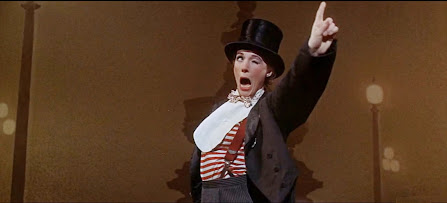
Andrews performing “Burlington Bertie”
Highlights:
• The opening credits designed to look like a 1940s film.
• Amazing costumes by Donald Books
• The “news reel”-like method of storytelling throughout the film.
• Michael Kidd’s choreography
Notable Songs:
• “Star!” performed by Julie Andrews
• “Someone to Watch Over Me” performed by Julie Andrews
• “Burlington Bertie from Bow” performed by Julie Andrews
• “Do, Do, Do” performed by Julie Andrews
• “Saga of Jenny” performed by Julie Andrews
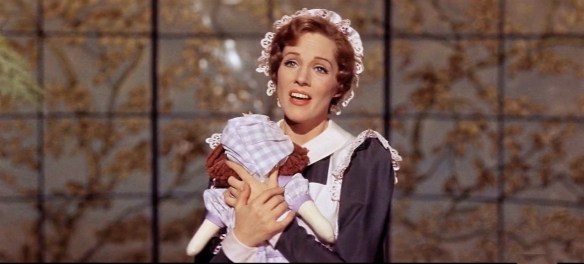
Andrews performing “Someone to Watch Over Me”
Review:
I vividly remember the first time I watched STAR! (1968). It was 2003, I was 14 and seeking out every classic movie musical I could find. My mom and I would make many trips to the library, especially over the summer, and I checked out as many films as they allowed: Doris Day and Gordon MacRae musicals, CAMELOT (1968), Fred Astaire and Ginger Rogers movies, and of course, STAR!
One night, while my dad was traveling on business, Mom and I geared up to watch this 3-hour extravaganza. When the film ended, I was disappointed, though I’m not sure what I expected going into the film.
For this review, I revisited this film for the first time in over 20 years. I pressed play on the DVD with hesitancy and low expectations.
I walked away from this revisit with positive feelings about some aspects of the film, but I didn’t care for others.
Behind-the-Scenes of the making of the film
To preface, STAR! (1968) is a musical biographical film about British stage and film star Gertrude Lawrence. During Lawrence’s career, which spanned pre-World War I until she died in 1952, Lawrence made several songs famous, such as “Someone to Watch Over Me,” and was in the original stage casts of many well-known shows, such as “The King and I,” “Private Lives” and “Lady in the Dark.” The film details her struggles of finding stage roles, her rise to fame, her friendship with Noel Coward, and her romances, which often took a back seat to her career and fame.
The project came about as an idea while Julie Andrews, director Robert Wise and producer Saul Chaplin worked together on THE SOUND OF MUSIC (1965). Wise and Chaplin loved working with Andrews so much that they knew they wanted to make another film with her.
“I was crazy about working with Julie,” Wise said in an interview in a featurette on the 2004 DVD.
Because Andrews was committed to 20th Century Fox for another picture, Wise asked his story editor, Max Lamb, to look for a story that would work for Andrews. Lamb suggested the life of Gertrude Lawrence, but initially, Andrews wasn’t interested in the role, according to the DVD featurette.
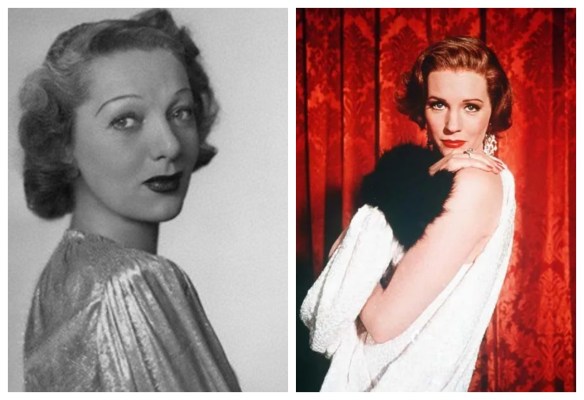
“This lady (Lawrence) crossed my path many, many times, and I had been asked to consider doing something similar a couple of times before,” Andrews said in an interview on the DVD. “But never had it sounded so appealing as when Bob (Wise) or Saul Chaplin talked to me about it.”
Andrews also felt daunted by playing someone as famous as Lawrence but was intrigued by the challenge of playing someone more “heavy and real. This lady had an awful lot of dimensions to her,” Andrews said. She also changed her mind because the film would show backstage theater life and not just be about glamour.
Max Lamb interviewed Lawrence’s friends and coworkers, and screenwriter William Fairchild interviewed Noel Coward and wrote the final script.
As a way for the story to flow smoothly, the news reels help bridge different periods of Lawrence’s career and changing time periods, such as the Great Depression to World War II.
It was also difficult to narrow down what songs would be performed, which Saul Chaplin said was the most challenging part because Lawrence was associated with so many hits. Chaplin felt strongly that the film had to include “Someone to Watching Over,” “Someday I’ll Find You,” “Do, Do, Do,” and “Limehouse Blues.”
My review
The finished product was 3 hours and included 18 songs (16 performed by Julie Andrews) and over 100 costume changes for Andrews designed by Donald Brooks.
STAR! (1968) is a dazzling spectacle, visually stunning, and well-shot by director Robert Wise. Revisiting this after 20 years, I enjoyed much of the film more than I anticipated.
We all know Julie Andrews is immensely talented with a lovely singing voice. In the role of Gertrude Lawrence, Andrews plays a character different from those she played in SOUND OF MUSIC, MARY POPPINS and THOROUGHLY MODERN MILLIE. Rather than simply being sweet, in STAR!, Andrews has the opportunity to play a funny, complicated, selfish, flighty character who is not always likable.
Costumed as Lawrence, Andrews may be at her most beautiful. The costumes and hairstyles she wears in this film are gorgeous, and those 1930s finger-wave hairstyles look so good on her.
Most of us (including myself) think of Andrews as a singer, not necessarily a dancer. However, she performs Michael Kidd’s choreography expertly. Kidd staged the dances for films like SEVEN BRIDES FOR SEVEN BROTHERS, and IT’S ALWAYS FAIR WEATHER, as an example of his complex choreography. In the “Saga of Jenny” number, Andrews is singing while simultaneously being tossed by circus performers. It’s impressive. With the rigorous schedule while making this film, Andrews said she felt she was in training (according to the book “Road-Show: The Fall of Film Musicals in the 1960s” by Matthew Kennedy), and watching these numbers, you can see why.
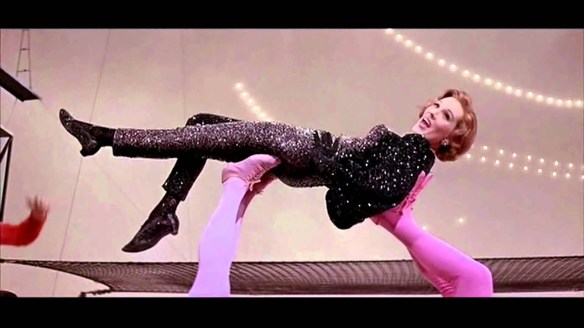
Andrews singing the “Saga of Jenny” while being tossed on the feet of acrobats
In a DVD featurette, Andrews said she didn’t consider herself a dancer, and Kidd disagreed.
“She has a tendency to underestimate her own abilities,” Kidd said. “But once she tries it, she works very hard at it and she’s superb.”
Truly, Andrews is the highlight of this film. The supporting cast is where my qualms come in. While Lawrence has several romantic partners throughout the film, our secondary lead is actor, playwright, and friend of Lawrence’s, Noel Coward, played in a cringey manner by Daniel Massey (also the son of actor Raymond Massey).
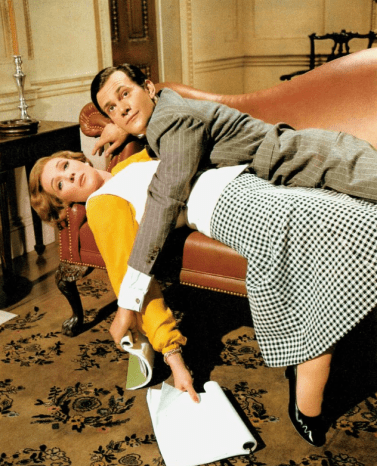 As Coward, Massey puts on an exaggerated, tongue-rolling way of speaking that comes across as mocking to me. As you can see in films, Coward did have a unique way of speaking, but it wasn’t this. I even looked up interviews with Daniel Massey to see if this was the way he spoke, and it wasn’t. I don’t know why there was a need to put on such a ridiculous and irritating way of speaking. I found myself dreading every time Massey was on screen. Coward had a droll, sophisticated wit, which isn’t captured here.
The performers who played Lawrence’s romantic interests were also just okay. Michael Craig, John Collin and Robert Reed are all just fine, but they are nothing to write home about. Richard Crenna, who plays Lawrence’s last husband, Richard Aldrich, is wonderful per usual … but he doesn’t appear on screen until an hour and 47 minutes into the film and doesn’t appear again until the film is nearly over.
When Saul Chaplin said he had difficulty narrowing down which songs to use, I felt he could have eliminated a few more. Andrews sings many great songs, but “Limehouse Blues” and “The Physician” were just okay and felt a little old-fashioned for a 1968 musical. “Limehouse Blues” felt like a mix of “Shanghai Lil” from FOOTLIGHT PARADE (1933) and “Slaughter on Tenth Avenue” from WORDS AND MUSIC (1948).
While lengthy, this movie moves at a breathtaking pace (while still feeling long) that it’s almost exhausting. While watching, I thought, “I have watched so much, I must be 90 minutes in!” and it hadn’t even been an hour. There is little downtime as the film is filled with songs, action, conflict and laughs. However, I never want to complain about the film’s length, but this film feels very long.
As with most musical biopics, there are some factual inaccuracies, but that doesn’t bother me as much. For example, her first husband in the film is named Jack, but in real life was named Francis Howley.
Unfortunately, I am not alone with my critiques of STAR! (1968) as it did not perform well at the box office. British star Gertrude Lawrence wasn’t well known in the United States. In addition, long before “Barbieheimer” of 2023, STAR! (1968) and another biopic, FUNNY GIRL (1968), starring Barbra Streisand as Fanny Brice, were in production simultaneously and released in the United States a month apart. (STAR! Was released in the UK in July 1968 and Oct. 1968 in the U.S., while FUNNY GIRL was released in the U.S. in Sept. 1968.)
“Unless release schedules are changed, the fall of 1968 is shaping as a ‘Battle of the Girls,'” Variety wrote. As history has shown, FUNNY GIRL is the better-remembered film of these two.
While the film started well in London, viewership began to plateau, with the London Times asking, “How many of its potential audience know, or care, anything much about the real Gertrude Lawrence?” echoing a previous sentiment of Noel Coward, according to Kennedy’s book.
When the film premiered months later in the U.S., the American press was less favorable than the UK press, calling it “The H-bomb of musicals” from Newsweek, according to Kennedy’s book.
While this may seem unfair, overly long musicals like STAR! contributed to the demise of the movie musical genre, which Kennedy’s book details throughout.
I feel wishy-washy about how I feel about this film because while I really enjoyed some aspects, the flaws Noel Coward, critics, and film historians pointed out are valid. While Gertrude Lawrence was a great star and an interesting role for Andrews, why did she need a biopic? I wonder this same thing about most new biopics that are announced. While they are interesting, is it necessary?
The sets and costumes are stunning, Julie Andrews is stupendous, and I generally like director Robert Wise. But sadly, this will not be high on my rewatch list.
Julie Andrews said that though the film did poorly, she’s proud of her work, according to her autobiography “Home.” In an interview in the 2000s, Wise said he was disappointed by the failure of this film.
“I made 39 films over the years,” he said in the 2004 DVD featurette. “If I have one major regret connected with any of the films, it’s the fact that STAR didn’t really take off and wasn’t recognized for what it is when it first came out.”
Check out the Comet Over Hollywood Facebook page, follow on Twitter at @HollywoodComet, follow on Instagram or e-mail at cometoverhollywood@gmail.com
 Comet Over Hollywood