
It’s no secret that the Hollywood Comet loves musicals.
In 2010, I revealed I had seen 400 movie musicals over the course of eight years. Now that number is over 600. To celebrate and share this musical love, here is my weekly feature about musicals.
 This week’s musical:
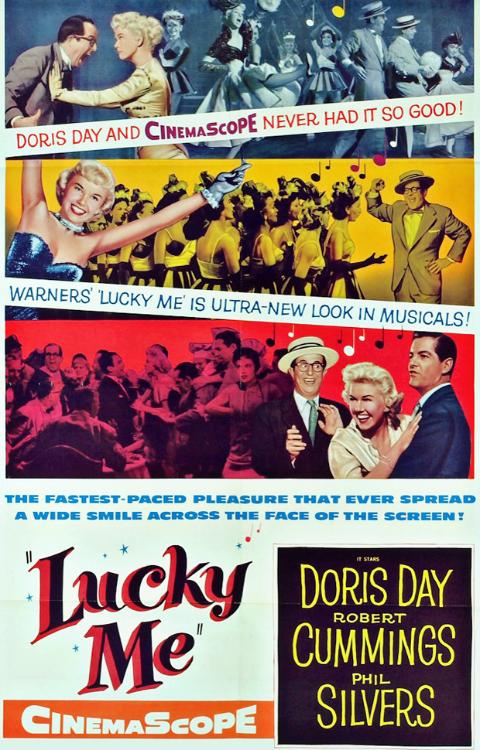
Lucky Me (1954) – Musical #184
Studio:
Warner Bros.
Director:
Jack Donohue
Starring:
Doris Day, Robert Cummings, Phil Silvers, Martha Hyer, Eddie Foy Jr., Nancy Walker, Bill Goodwin, Marcel Dalio, Hayden Rorke, James Burke, John Alvin (uncredited), Angie Dickinson (uncredited), Dabbs Greer (uncredited)
Plot:
Candy Williams (Day) is incredibly superstitious. She’s also part of an unsuccessful acting troupe, led by Hap Schneider (Silvers). When they wrap up a stint in a movie house, the group doesn’t know where to go next since they are out of money. When the group enjoys an expensive dinner in a Miami hotel with no way to pay for it, they all get jobs at the hotel to pay for their debt. While there, they meet successful songwriter Dick Carson (Cummings), who tries to work them into his show. The only problem is that the show is financed by the father of Lorraine Thayer (Hyer), who carries the torch for Dick.
Trivia:
• Robert Cummings’s singing voice is dubbed by Hal Derwin.
• Angie Dickinson’s first feature film. She won the role from a television contest, the T-Venus Beauty Contest.
• Gordon MacRae was originally supposed to star in this film, but was replaced by Robert Cummings.
• Nancy Walker’s final feature film until 1972.
• Twenty-four pies were baked for the pie throwing scene in the film, according to a January 1954 article in the Los Angeles Daily News.
• The first musical film to be shot in CinemaScope.
Highlights:
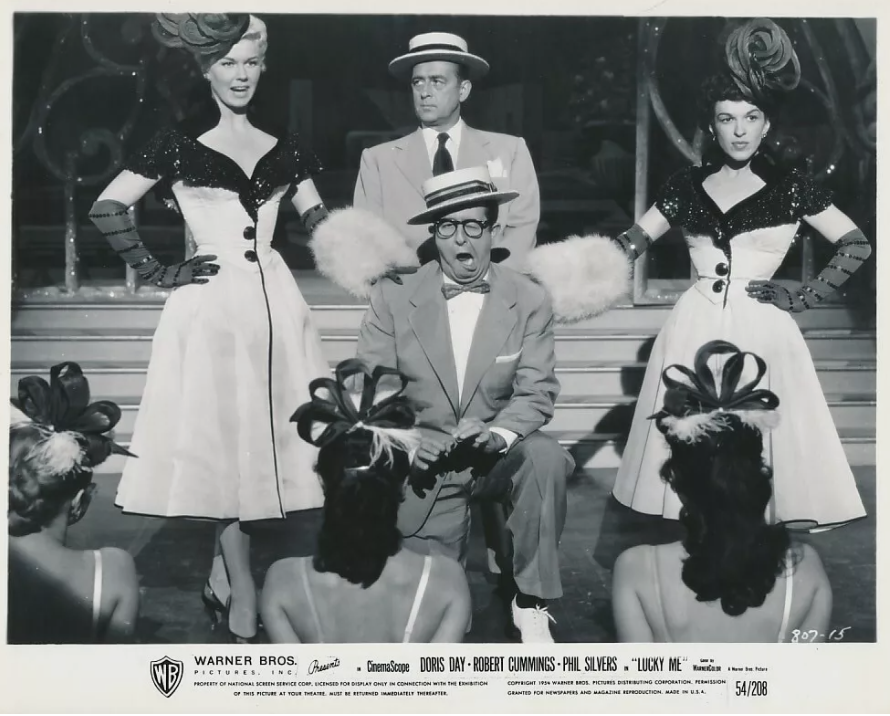
• Doris Day’s costumes by Moss Mabry
• When it ended
Notable Songs:
• “I Speak to the Stars” performed by Doris Day
My review:
Oh, why did it have to be Phil Silvers! But I can’t blame my dislike of LUCKY ME (1954) on Silvers—it’s frankly all bad.
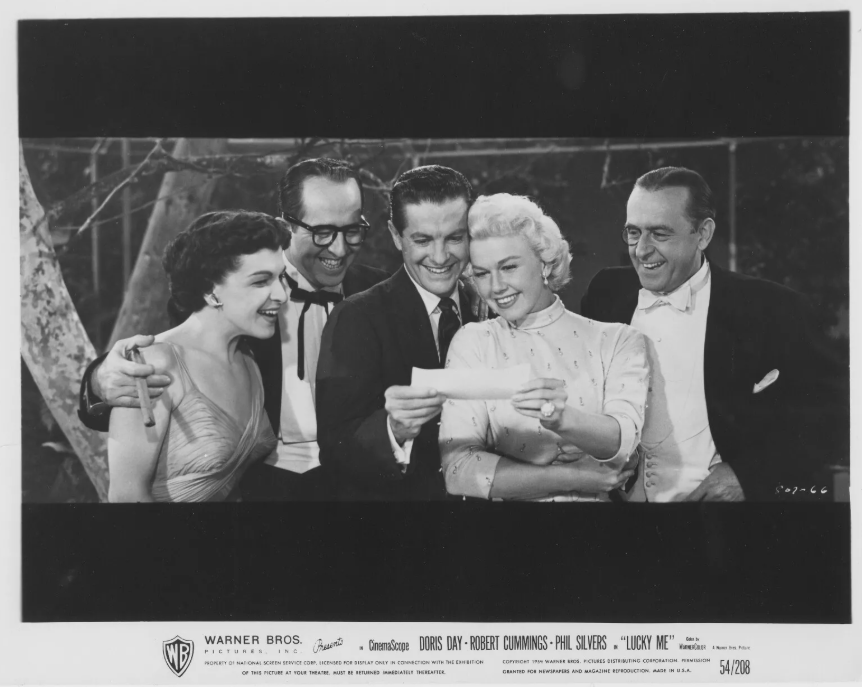
In the film, Doris Day plays Candy Williams, a singer whose superstitions rule her life. For example, she almost walks out on a performance when she realized 13 people are in the crowd. Candy is part of a musical theater troupe rounded out by Hap Schneider (Silvers), Duke McGee (Eddie Foy, Jr.) and Nancy Walker (Flo Neely). When they close their performance, they have nowhere to go and no money. Hap decides they will eat at a fancy meal with no money to pay for it. When his plan to get out of the restaurant backfires, the crew works in the hotel to pay off their $92 dinner. While working in the hotel, Flo realizes that famous Broadway songwriter Dick Carson (Cummings) is staying there. When Dick meets Candy, he wants her to star in a show he’s writing music for. However, Lorraine Thayer (Hyer) is the daughter of a Broadway financier, and carries the torch for Dick, who barely knows she’s alive.
“Robert Cummings, Phil Silvers, Nancy Walker, and Eddie Foy, Jr. were all talented, funny people,” Doris Day said. “But I knew by now that no amount of talent can overcome an inferior script, especially if it is a comedy.”
Day is one of my all-time favorite actresses, and she was right about this film. Despite a decent cast, all of the songs are terrible except for “I Speak to the Stars,” which became a hit. The plot in general is stupid and Day’s superstitions are ridiculous. Foy and Walker, who I generally like, have little to do. Silvers’s role (of course) takes over in his irritating form of comedy, which is usually screwing everything up.
I also didn’t like that Martha Hyer’s character, Loraine, was overall sympathetic for most of the film but is suddenly a villain in the last 30 minutes. Sure, she was jealous when she saw Candy and Dick together, but when she’s suddenly the bad guy at the end, it was sort of stupid — especially when Candy in disguise is making Loraine chase her around the party and Loraine is pushed in the pool. I didn’t feel Loraine deserved that, especially because Dick largely ignored her the whole film.
The only good parts of the film are:
– The vibrant color
– The second unit photography of 1954 Miami
– Doris Day’s wardrobe, designed by Moss Mabry
Also during this time, Doris Day as not well and was not will during the filming due to exhaustion and depression, according to her autobiography. However, despite this, Martha Hyer remembered Day fondly in her autobiography.
“Doris Day was not feeling well during the filming of Lucky Me but never showed it. She was always smiling and had the rare quality of making people feel good just by being near her,” Hyer wrote.
Until revisiting LUCKY ME (1954) for this review, I had only seen it once. I was 14 or 15 years old, at the height of my Doris Day obsession and film discovering. I already knew the song “I Speak to the Stars” from a Doris Day anthology CD I owned. Loving the song, I couldn’t wait to see the movie. At the time in 2004, I checked it out from the library, and I remember feeling disappointed when it ended.
When I rewatched this, I was really hoping I would enjoy it more this time. That maybe my disappointment 20 years ago was a case of being overly excited. Unfortunately, I still found this movie just as terrible and egregious.
I’m just as sorry as you, dear reader, that this wasn’t very good. I was hoping it was an instance of being too excited as a teen, but alas, this is a stinker. At least it’s visually stunning.
Other places you can follow Comet Over Hollywood:
- Letterboxd
- X at @HollywoodComet
- BlueSky
- Or e-mail us at cometoverhollywood@gmail.com
 Comet Over Hollywood
Well, I’ll certainly be steering clear of this one! I guess there’s a reason why I’ve never even heard of it. I greatly enjoyed reading your review, though — you had me at “When it ended.” Ha!
Karen
LikeLike