It’s no secret that the Hollywood Comet loves musicals. In 2010, I revealed I had seen 400 movie musicals over the course of eight years. Now that number is over 500. To celebrate and share this musical love, here is my weekly feature about musicals.
Starring:
Doris Day, Danny Thomas, Frank Lovejoy, Patrice Wymore, James Gleason, Mary Wickes, Jim Backus, Hans Conreid (uncredited)
Plot:
A biographical film about lyricist Gus Khan (Thomas) who wrote several popular songs such as “It Had To Be You,” “Pretty Baby,” “San Francisco,” “The Carioca” and “Tootise” just to name a few. The film Khan as he meets his composing partner Grace (Day) who he eventually marries.
Grace is a song plugger and Gus wanted her help publishing songs. She gave him advice to write a love song:
“Do you know why you write a popular song? Boys and girls don’t know how to say I love you, so you help them with 32 bars of music.”
The film shows the songwriter’s ups and downs in his career from getting started and having his songs in the Ziegfeld Follies to losing everything in the 1929 stock market crash and moving to Hollywood and rebuilding his career. The whole way, his wife is there helping him make the next move in his career. The film starts in 1908 and ends in the 1930s.
Gus (Thomas) missed the birth of his child because he was writing “It Had to Be You.” Day wrote this scene made her emotional because of her life experiences.
Trivia:
-When Danny Thomas sings to Doris Day at her maternity bedside in the film, Day got very emotional thinking about how her first husband, Al Jordan was not present when her son Terry was born, she wrote in her autobiography, Doris Day: Her Own Story.
“In the way Danny played the scene, there was a sense of his remorse in having not been with me when the baby came (in the movie. His character was writing a song and lost track of time.),” she wrote. “When Danny started his song, I couldn’t help but cry, for what came to mind was the birth of my own baby, how Al Jorden had not been with me, and how alone and unfulfilled I felt.”
-Gordon MacRea was director Michael Curtiz’s first choice to play Gus Kahn, according to Robertson’s book.
The real Gus Kahn (left) with composer Arthur Johnson in 1935 at MGM.
-Grace LeBoy Kahn, who Doris Day portrayed, was still alive when the film was made. Gus Kahn, played by Danny Thomas, died in 1941. The two were married in 1916 until his death. Grace died in 1983.
-“I’ll See You in My Dreams” was Warner Brother’s second top grossing film for 1952 and was Curtiz’s last financial success for the studio, according to Robertson’s book.
-The album soundtrack from this film reached number one on the Billboard charts.
Notable Songs:
-“Gee, I Wish That I Had a Girl” sung by Doris Day
-“My Buddy” sung by Doris Day
-“Pretty Baby” sung by Danny Thomas
-“She’s Nobody’s Sweetheart Now” sung by Doris Day
-“The One I Love (Belongs to Somebody Else) sung by Doris Day
-“It Had to Be You” sung by Danny Thomas
-“Makin’ Whoopee” sung by Doris Day and Danny Thomas
-“Ain’t We Got Fun” played on a record but sung as a duet by Day and Thomas on the album
Review:
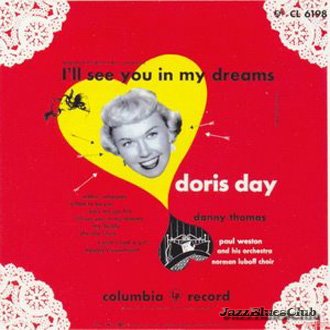
The record my Mom and I nearly wore out.
I knew all the songs before I saw this movie.
When Mom was in middle school, her father (my grandfather) had a 78 record of the “I’ll See You in My Dreams” soundtrack. He was going to throw it away, so she asked to keep when she saw Doris Day on the album cover. When I began getting interested in Doris Day when I was 13, my mom pulled out the record and I listened to it constantly.
When I first saw this movie back in 2005, Mom and I both knew all the words to the songs Kahn made popular because of that 78 but neither of us had ever seen the movie before.
When Mom and I rewatched this movie on Sunday, we both softly sang along to all of his hit tunes.
Clearly this movie has a special place in my heart.
Sentimentality aside, I love the cast and the music. Mary Wickes is always hilarious and Day and Thomas are wonderful.
Though it is questionable about how accurate biographical films are, this one is still a lot of fun with an excellent score to accompany a fairly touching story.
When I was in fourth grade I cut six inches off my long hair.
I was doing a book report on Shirley Temple and wanted short, curly hair like America’s Sweetheart for my presentation.
In 2000, before Internet shopping was common place, my parents searched all over to get me a Shirley Temple doll for Christmas. They eventually found one from a store in Connecticut.
Later as a high school senior I even dressed up as Shirley Temple for Halloween.
While my classic film love escalated to obsession in 2004, Temple was my first favorite movie star.
The first movie I saw with Shirley Temple was “Rebecca of Sunnybrook Farm’ (1938). It was a Christmas gift from my Grandmother. I was hooked as Temple sang about wearing an old straw hat, a pair of overalls and a worn out pair of shoes.
Years after she brought happiness to Americans during the Great Depression in the 1930s, the curly headed child star was still influencing and bringing happiness to a young girl in South Carolina.
The dimple faced, curly topped child star was the top box office draw of the 1930s.
The story told is that Temple was discovered in her dance class at age 3, hiding under a piano.
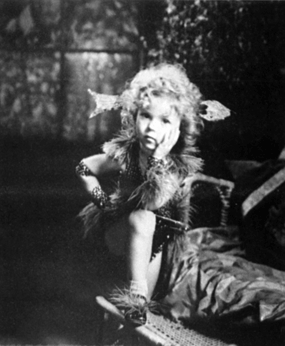
Shirley Temple dressed as Marlene Dietrich in the Baby Burlesk short “Kid N Hollywood.”
From 1932 until 1933, many of her films were shorts. Some were called Baby Burlesks, involving child actors like Temple dressing up like popular stars such as Mae West and Marlene Dietrich.
With her 56 pin-curls and song-and-dance films, President Franklin Roosevelt once said the United States couldn’t have made it through the Depression without her.
She also saved 20th Century Fox studio from bankruptcy, according to her obituary in the Los Angles Times.
She made 40 movies before she turned 12, and eight of those were in 1934.
Temple was the first child star to carry a full weight picture on her own; not as a secondary actor, according to Dickie Moore’s book “Twinkle, Twinkle Little Star (and don’t have sex or take the car). Her co-stars included top Hollywood names such as Carole Lombard, Gary Cooper, Joel McCrea, Alice Faye, Adolphe Monjou, Victor McLaglen and Lionel Barrymore.
She loved dancing with her friend Bill “Bojangles” Robinson and was didn’t understand why he was treated differently because he was black.
Shirley with J. Edgar Hoover in 1938.
She met important figures such as President Franklin Roosevelt, head of FBI J. Edgar Hoover and Amelia Earhart.
Temple knew her lines and everyone else’s, frequently correcting the adult actors to their chagrin.
“She was a nice kid, with a really wonderful mother and father. We all liked her,” said actress Alice Faye who starred in “Poor Little Rich Girl” (1936) with Temple. “But she was brilliant. She knew everyone’s dialogue and, if you forgot a line, she gave it to you. We all hated her for that.”
Because of Temple, other parents hoped to get their children in films, so their children would be the breadwinners while the parents couldn’t find work during the Depression.
Temple was treated like a princess. She had a bowling alley and a life sized play house in her backyard.
Shirley with top stars Carole Lombard and Gary Cooper in “Now and Forever” (1934)
However, even Hollywood’s greatest star faced difficulties.
Temple’s father had a hard time finding work, because employers assumed he had enough money because of Shirley’s films, according Moore’s book.
Temple was isolated from the other children. Many parents of child stars did this, because they didn’t want their children fraternizing with a child who may be competing for the same role.
However, publicity departments made it look like Temple had lots of friends. Each year she would have three birthday parties: one with other child actors, one on set with the crew and one with her family.
Shirley Temple cutting the cake at her birthday party in 1935.
“The parties were endless…Fox would have one for a large number of people I didn’t know, a lot of children I’d never seen in my life and would never see again,” Temple told Moore. “And I was the hostess. It was kind of strange. I figured it was part of my job.”
Moore said Temple was sweet; the real problem was her stage mother Gertrude Temple. Gertrude was responsible for making sure Temple had the maximum amount of screen time. This included demanding a touching scene with child star Sybil Jason being cut from “Blue Bird” (1940).
Temple also faced the same fate as child star Jackie Coogan: her parents spent all of her money.
After marrying Charles Black, the couple looked at her finances that much of her money had been spent to support her family-what was left belonged to her parents. There should have been $356,000 in her account, but her father, George, disobeyed court orders and kept the money, according to BBC.
Shirley Temple with Monty Wooley and Soda the dog in my favorite movie, “Since You Went Away”
The transition from child star to teenager was difficult for Temple as it is with other stars.
However, Temple starred in several charming films as a teenager such as “Kathleen” (1941), “That Hagen Girl” (1947) and my all-time favorite film “Since You Went Away” (1944).
Though I was sad when I heard the news of Shirley Temple’s death at age 85 on February 10, I remembered she had a long life.
After leaving her film career behind at age 22, Temple went into politics.
In 1968, she was a delegate to the United Nations and in 1974 was an ambassador to Ghana, according to Temple’s USA Today obituary.
After divorcing John Agar, her husband of five years, Temple was married to Charles Black for 55 years until his death in 2005.
Actress Shirley Temple and her husband, Charles G. Black at the Stork Club in 1953.
She said in her autobiography that in her adult life, the child actress seems more like a dream or a younger sister to her.
Though she is gone, Temple will continue to bring happiness to film fans as she has continued to do for the last 80 years.
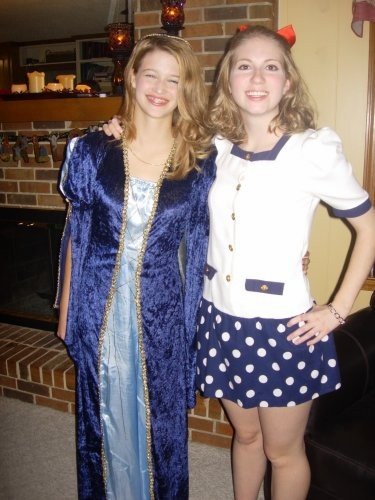
Added bonus: Me in high school as Shirley with “Juliet”
It’s no secret that the Hollywood Comet loves musicals. In 2010, I revealed I had seen 400 movie musicals over the course of eight years. Now that number is over 500. To celebrate and share this musical love, here is my weekly feature about musicals.
Starring:
Alice Faye, John Payne, Cesar Romero, Carmen Miranda, Cobina Wright, Leonid Kinskey, George Barbier
Plot:
Macy’s shop girl Nan Spencer (Faye) saves up her money to go on her first cruise to Havana. The only problem is, the ship hits a sandbar in Florida and the ship company has to reimburse everyone and offer them another trip. When ship employee Jay Williams (Payne)-who is also engaged to the boss’s daughter- is sent to reimburse the passengers and have them sign waivers, Nan isn’t satisfied with a check. She saved for years for this trip and also knows what the captain was doing when the ship crashed, which could threaten a lawsuit for the company.
Jay’s company sends Nan on an all expenses paid trip to Havana so she will sign the company’s waiver. Jay has to go along-postponing his wedding- to make sure Nan has a good time. Along the way she falls for Monte Blanca (Romero), who is the boyfriend/manager of Rosita Rivas (Miranda). Monte thinks Nan is wealthy and thinks he is using her to pay off his gambling debts.
Trivia:
-This is one of many films made in the 1940s with a “good neighbor” feel to it. Several films visited Latin American countries such as Cuba, Argentina or Brazil to showcase these countries and strengthen United States relations with Latin American government.
-Carmen Miranda’s second film.
-This was the second of three films Miranda and Faye made together. The other two films were “That Night in Rio” (1941) and “The Gang is All Here” (1943).
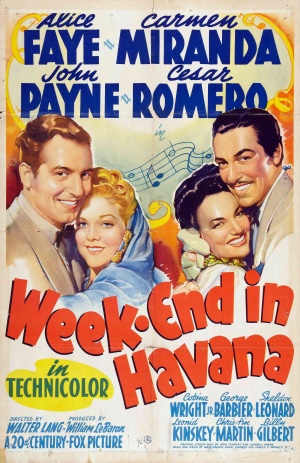
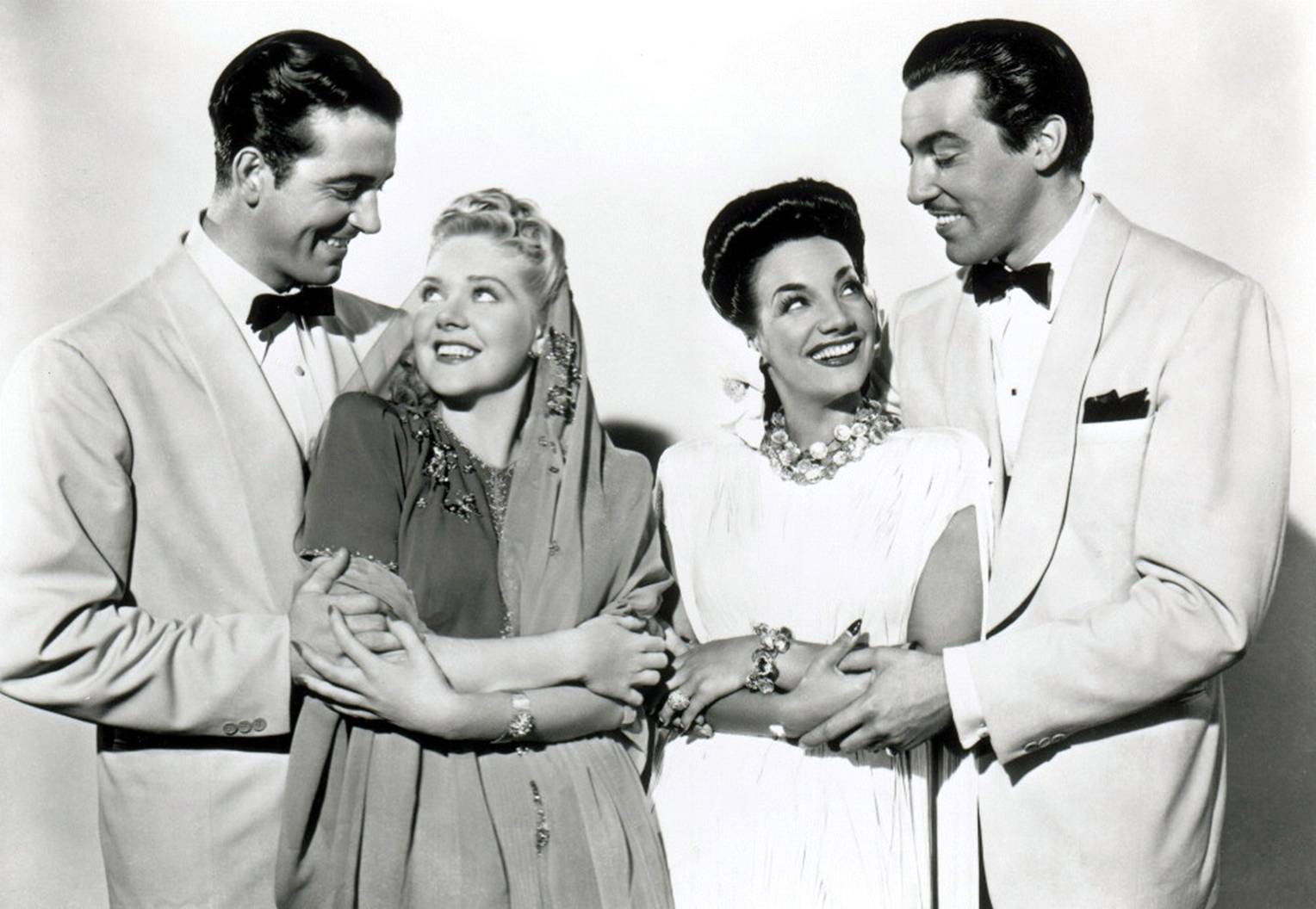
John Payne, Alice Faye, Carmen Miranda and Cesar Romero in “Week-End in Havana.”
Highlights:
-Every colorful Carmen Miranda performance
-Alice Faye and Cesar Romero dancing to “Romance and Rhumba.” It gives the audience an opportunity to see Romero’s smooth dance moves.
Notable Songs:
-Tropical Magic sung by Alice Faye and John Payne
-Rebola a Bola sung by Carmen Miranda
-The Ñango sung by Carmen Miranda complete with a lavish dance number
-Romance and Rhumba sung by Alice Faye and Cesar Romero
Review:
Alice Faye once said her singing voice was deeper than the plots of the films she made.
This may be the case with “Week-End in Havana,” but this film is a lot of fun. The colorful costumes and scenery are gorgeous in Technicolor, Carmen Miranda and Alice Faye are equipped with catchy songs and the two leading men are nice to look at.
The four leads seem to have fairly equal screen time- each delivering witty lines and offering scenes filled with charm.
“Week-End in Havana” is a lighthearted 1940s “good neighbor” film, that is full of color and fun.
Love comes in many forms and opposites attract- Paula Abdul even said so in her music video with the singing cat.
However, sometimes people marry who just don’t quite seem to fit.
Here are a few examples of some odd Hollywood couples. Apparently, these celebrities agree that the puzzle pieces didn’t quite fit since all of these marriages ended in divorce.
These prove that Neil Simon doesn’t have the market cornered on odd couples.
Ernest Borgnine and Ethel Merman (June 26, 1964 – July 28, 1964)
Ethel Merman and Ernest Borgnine on their wedding day in 1964.
Borgnine was the gruff working man in films and Merman was the glamorous Broadway diva. The two met in November of 1963, the same year Borgnine divorced from his wife, Mexican actress Katy Jurado.
Merman was nine years older than Borgnine. After they met, Borgnine started courting Merman.
“I’ve never been in love, really in love, before,” Merman told reporters according to Ethel Merman: A Life by Brian Kellow. “For the first time in my life I feel protected.”
After a six month courtship, the two were married.
“Everyone thinks she’s loud and brash. But she’s the opposite,” Borgnine was quoted in Brass Diva: The Life and Legends of Ethel Merman by Caryl Flinn. “She’s soft, gentle and shy. And you know me, I’m ‘Marty.’”
The two married on June 26, 1964 and were divorced 32 days later on July 28, 1964.
Merman never gave reasons for the divorce and Borgnine said in interviews it’s because more people knew him than her on their honeymoon.
“Everybody knew me, but they didn’t know Ethel overseas,” Borgnine said in an interview. “The more they recognised me, the madder she got. That’s what hurt her, so she started taking it out on me.
After the divorce, Merman referred to the marriage as “That thing.” In her autobiography, the chapter “My Marriage to Ernest Borgnine” is one blank page.
Ava Gardner and Mickey Rooney (Jan. 10 1942 – May 21, 1943)
Mickey Rooney and Ava Gardner in 1941.
Newcomer to MGM Ava Gardner met star Mickey Rooney when he was dressed as Carmen Miranda for “Babes on Broadway.” While dressed as the Brazilian Bombshell, Rooney asked Gardner for her number.
North Carolinian, inexperienced Gardner had just arrived to Hollywood and Rooney was a well-known playboy.
“I married him because he wanted to get in my britches,” Gardner once said. “And I wasn’t going to let him until we were married.”
MGM studio head Louis B. Mayer and Rooney’s parents were not pleased with the couple’s marriage.
“I fell madly in love with Ava the first night I went out with her,” Rooney once said. “And later when I asked her to marry me, she wouldn’t have any part of it, like the problem I had getting her number, until I wore her down.”
Rooney spoke fondly of his brief marriage to Gardner in a documentary on her life. The documentary said Gardner thought their marriage would be like her parents: cooking for Rooney and having children. Rooney preferred the night life.
Gloria Swanson and Wallace Beery (March 27, 1916 – March 1, 1919)
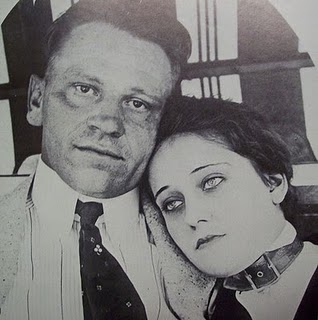
Wallace Beery and Gloria Swanson
“Two of the more trivial topics I never discuss are my marriage to Wallace Beery and those frozen dinners which have become famous with my name on them,” Gloria Swanson said.
The two were married after they starred in “Speedie Goes to College” in 1915.
Swanson was a glamorous leading lady and Beery was a gruff, burly man who was notoriously difficult to work with.
Swanson writes in her autobiography “Swanson on Swanson” that Wallace Beery made many forceful advances on their wedding night, leaving her bleeding and in pain.
Swanson also wrote he would pick up her salary for her at the studio and spend it before she saw it.
Beery cheated on Swanson and was abusive. In her autobiography, she writes that he gave her pills when he found out she was pregnant, and implies Beery made her get an abortion.
She woke up in the hospital and a nurse told, “You have nothing to be down in the mouth about, honey. You’re young. You’re pretty. You’ve got all the time in the world to have another baby.”
The couple separated and divorced two years later.
Richard Ney and Greer Garson (July 24, 1943 – Sept. 25, 1947)
Greer Garson and Richard Ney
Ney met Garson while he was playing her son in the film “Mrs. Miniver.”
He was 12 years younger than the Academy Award winning actress.
Ney asked Garson out for dinner and dancing, and she accepted, but she remained distant from her on-screen son during the remainder of the filming for “Mrs. Miniver.”
“I went dancing with Mr. Ney and I had the most beautiful time,” Garson was quoted in her biography.
MGM studio head Louis B. Mayer disapproved of their relationship and it would be unfavorable publicity for an on-screen mother and son to date, according to Garson’s biographer.
They kept their romance secret until “Mrs. Miniver” premiered, and Mayer was right- the couple received unfavorable publicity. Garson told reporters she wanted to marry Ney because he made her feel younger, according to Garson’s biographer.
However, gossip columns began talking about their unraveling marriage.
In the second Miniver film, “The Miniver Story,” Ney’s character was recast.
Linda Darnell and J. Peverell Marley (April 18, 1943 – Feb. 20, 1951)
Pev Marley and Linda Darnell on their wedding day.
Darnell was 20 when she married 42 year old Marley.
Darnell started in Hollywood as a teenager and didn’t have a father figure growing up. The cinematographer was sort of a mentor to the young girl, according to the Biography documentary, “Fallen Angel.”
Marley was a close friend of Darnell’s frequent leading man Tyrone Power. Marley helped sculpt Darnell’s Hollywood image, according to the book Hollywood Beauty: Linda Darnell and the American Dream by Ronald L. Davis.
Marley and Darnell would occasionally frequent night clubs but the press dismissed him as an old friend and escort, according to Davis’s book.
While Pev Marley remained a constant form of strength, the two eloped to Las Vegas. Fox studio head Darryl F. Zanuck was furious, saying it would ruin her image. No one had seen the two as more than friends.
“I like him and age doesn’t matter,” Darnell wrote in fan magazines. “I feel people meant well when they busy bodied about me marrying Pev. It’s just they couldn’t know the truth.”
Darnell announced the two separated while filming “My Darling Clementine” (1946), but then the two began seeing each other while she was filming “Forever Amber” (1947). The two then adopted Charlotte, nicknamed “Lola.” They separated again in 1948 and finally divorced in 1952.
Lupe Velez and Johnny Weissmuller (Oct. 8 1933 – 1939)
Lupe Velez and Johnny Weissmuller in 1935.
Velez’s relationship had recently ended with Gary Cooper when she met Weissmuller.
She was known as the “Mexican Spitfire” and Weissmuller was Hollywood’s Tarzan.
Velez and Weissmuller were staying in the same hotel one night. She called up his room to ask him down for a drink. He hung up on her because he thought it was someone joking. Velez called back and was furious. He apologized and went down to her room, according to the book Tarzan, My Father by Johnny Weissmuller.
Weissmuller was already married to Bobbe Arnst when he started his relationship with Lupe in 1932.
Weissmuller’s son wrote that Velez was good for Johnny, because she was funny and made him laugh. However, she was also supposedly a manic depressive and had low times and also had a very bad temper.
“Dad just couldn’t handle her,” Weissmuller, Jr. wrote.
Once they were married, the two realized they were opposites. Velez went to bed late and woke up late and Weissmuller went to bed early and woke up early. Lupe was spontaneous and Weissmuller wasn’t. She once said in 1934 she felt they would go on quarreling forever, according to the book Lupe Velez: The Life and Career of Hollywood’s “Mexican Spitfire” by Michelle Vogel.
The two separated several times and Velez had several affairs, Weissmuller, Jr. wrote.
But the couples split was supposedly over a dog, according to both Vogel and Weissmuller, Jr.
Weissmuller came home and his dog Otto didn’t great him. When he asked Velez where he was, she said a stranger came in and killed him. Weissmuller said she was lying, packed his bags and never returned.
Arthur Miller and Marilyn Monroe (June 29, 1956 – Jan. 20, 1961)
Play write Arthur Miller and Marilyn Monroe in 1956.
Though Joe DiMaggio and Marilyn Monroe were an odd couple, they seem normal in comparison to Monroe and play wright Arthur Miller.
Monroe’s glittering screen persona better matched DiMaggio’s baseball fame better than Miller’s literary standing.
Miller liked how Monroe listened to his ideas. Monroe liked how intelligent he was and how he supported her career and ambitions, unlike DiMaggio, according to the book The Secret Life of Marilyn Monroe by J. Randy Taraborrelli.
When they married, Miller told the press that Monroe would make one film every 18 months, lasting eight weeks shooting time, and be a wife when she wasn’t making films, according to BBC.
Their relationship supposedly started to decline during the filming of “Let’s Make Love” (1960). Monroe had an affair with Yves Montand, who was also friends with Miller, according to Arthur Miller: His Life and Work by Martin Gottfried.
Supposedly their divorce was over their different lifestyles. At the time of their divorce, Miller was working the script for Monroe’s film, “The Misfits” but it was said they barely spoke on set, according to the BBC.
Monroe died nearly a year later after their divorce.
Apparently Miller was “haunted by Monroe” because he “never resolved their relationship or understood his role in the public’s ongoing obsession with her,” according Gottfried’s book.
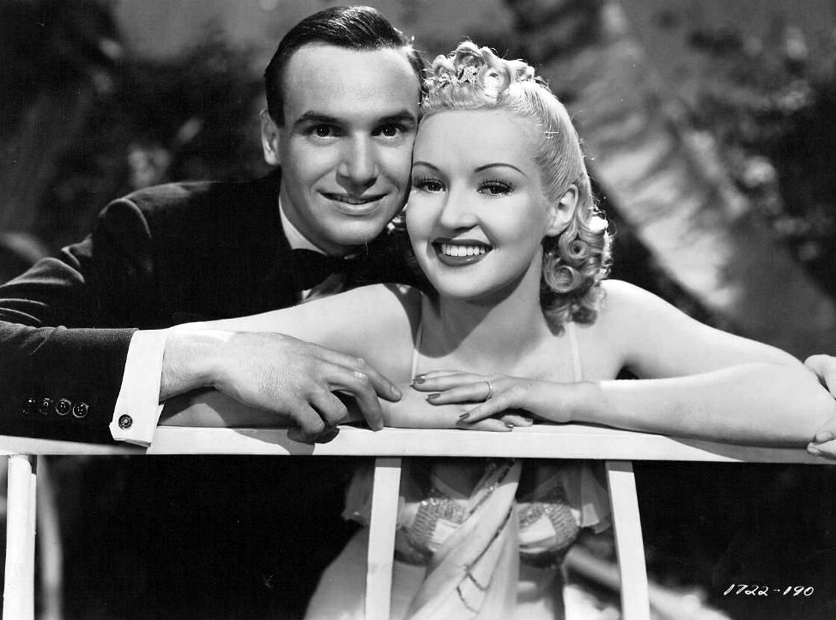
Jackie Coogan and Betty Grable in “College Swing” (1938)
The glamour girl marries the former child star turned comedian.
The couple had a long engagement and Grable’s contract didn’t allow her marry before she was 21, according to Notable American Women: A Biographical Dictionary.
Grable and Coogan were married while he was fighting his lawsuit over misappropriation of the salary he earned as a child star. Part of the reason their marriage dissolved was over the stress of Coogan’s trial trying to get his money back, according to Dickie Moore’s book no child stars ““Twinkle, Twinkle, Little Star (but don’t have sex or take the car).”
“Betty was working hard on her career getting nowhere (her career didn’t take hold until 1939), and she was paying all the bills,” according to Jackie Coogan: The World’s Boy King by Diana Serra Cary.
Once the lawsuit was finally settled, Grable came home from the studio to find all of their wedding gifts gone and Coogan had sold them. The only thing left in the house where the stove, refrigerator and beds, according to Cary’s book.
Coogan also started heavily drinking. For the millions of dollars squandered by his mother and stepfather, he received $80,000 in the settlement.
After Grable signed with Fox, she filed for divorce. In 1940, she became a star with “Down Argentine Way” and Coogan, who at one time had been on top, was struggling. His time spent fighting in World War II was what helped him straighten out, Coogan told Moore in his book.
Rita Hayworth and Orson Welles sign their marriage license in 1943.
Rita Hayworth was Hollywood’s love goddess, though rather down to Earth in real life. Orson Welles was the controversial intellectual, scaring the Americans with the “War of the Worlds” broadcast and getting his film “Citizen Kane” banned from mainstream movie houses.
They were labeled the Beauty and the Brain.
But of her five husbands, Hayworth is said to have cared for Welles the most and called him the love of her life, according to The Hollywood Book of Breakups by James Robert Parish.
Hayworth was dating Victor Mature when Welles met her and Mature went to fight in World War II. Hayworth turned him down many time but Welles said he “persevered” and he won her over.
“It took me five weeks to get Rita to answer the phone,” Welles once said. “But once she did, we were out that night.”
Her shyness is what attracted Welles, according to Orson Welles: A Biography by Barbara Leaming.
Under Welles’ influence, Hayworth read more literature. He even transformed her sexy redhead image by making her an icy blond for his noir film “The Lady from Shanghai” (1947). The public was not pleased.
“Orson Welles was trying something new with me on The Lady from Shanghai (1947) but Harry Cohn wanted The Image — The Image he was going to make me until I was 90,” Hayworth once said.
Their marriage was disintegrating after “The Lady from Shanghai” was completed. Hayworth accused him of being with other women and Welles didn’t understand her jealousy. Though they tried to reconcile, Hayworth eventually filed for divorce, according to Leaming’s book.
“I can’t take his genius anymore,” Hayworth said when they divorced.
Who are some Hollywood couples you always thought were interesting matches? Comment below and tell us who and why!
It’s no secret that the Hollywood Comet loves musicals. In 2010, I revealed I had seen 400 movie musicals over the course of eight years. Now that number is over 500. To celebrate and share this musical love, here is my weekly feature about musicals.
Starring:
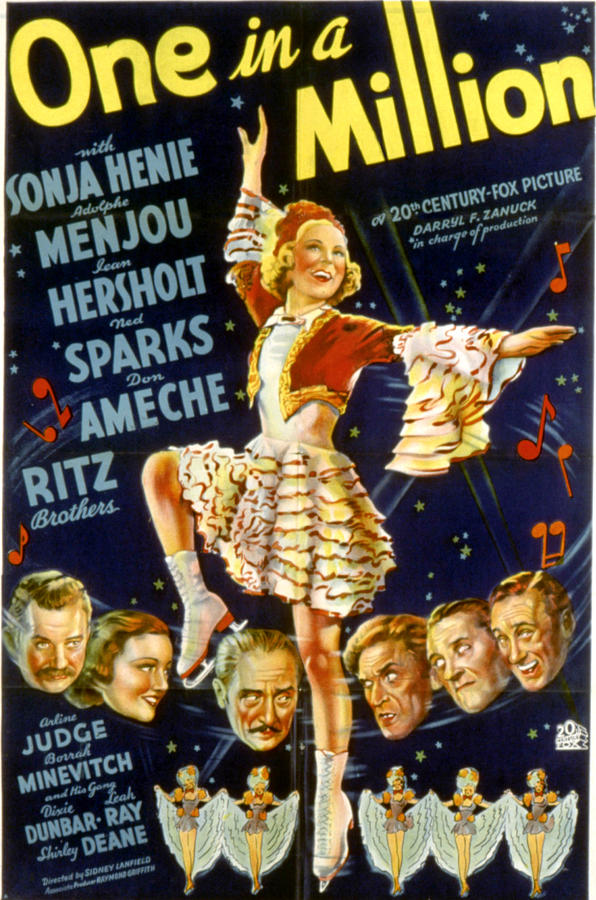
Sonja Henie, Don Ameche, Adolph Menjou, Jean Hersholt, Ned Sparks, June Wilkins, the Ritz Brothers
Plot:
Tad Spencer (Menjou) is broke and takes his female band (including his wife) to the Swiss Alps. They come to an inn run by Henriech Muller (Hersholt) and his daughter Greta (Henie). Greta is a figure skater training for the Winter Olympics. Henriech lost out on a figure skating medal in 1908 and has been training his daughter as a skater. Tad sees dollar signs when he see her skate and wants him in her act. The only problem is Greta is being paid for a nightclub act would hurt her amateur standing in the games. Bob Harris (Ameche) and his photographer Danny Simpson (Sparks), also arrives at the hotel to investigate a fire that may have been an assassination attempt.
It’s no secret that the Hollywood Comet loves musicals. In 2010, I revealed I had seen 400 movie musicals over the course of eight years. Now that number is over 500. To celebrate and share this musical love, here is my weekly feature about musicals.
Director:
W.S. Van Dyke Starring:
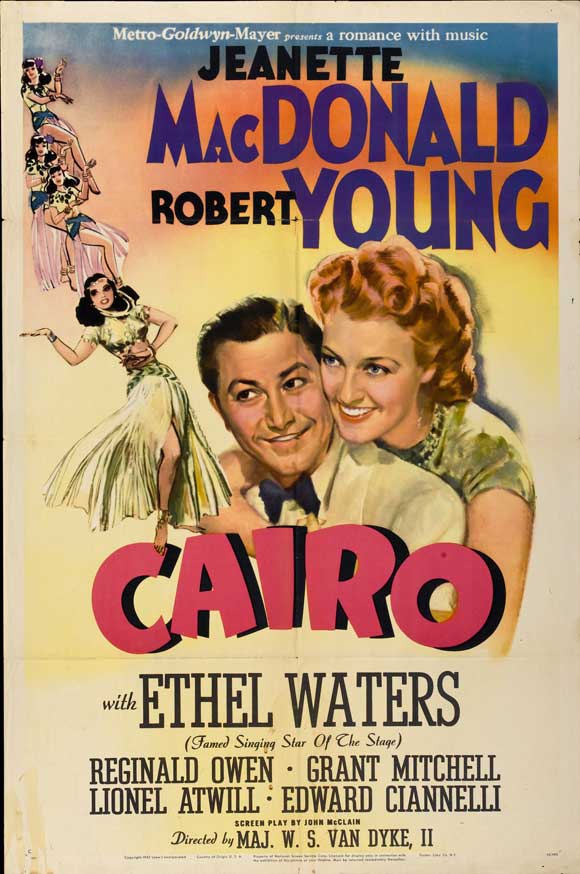
Jeannette MacDonald, Robert Young, Ethel Waters, Reginald Owen, Grant Mitchell, Lionell Atwill, Rhys Williams, MonaBarrie
Plot:
Small town reporter Homer Smith (Young) is picked to travel abroad to cover the war after his newspaper is chosen as “America’s Typical Small Town Newspaper.” On his way to Cairo, his ship sinks and he floats along the ocean with another survivor (Owen) who gives him a message to deliver if they both survive. Hence, Homer gets mixed up in a spy ring. Once the message is delivered, Homer becomes convinced that singer and movie star Marcia Warren (MacDonald) is also a spy and begins working as her butler so he can investigate her. Marcia also believes Homer is a spy. While they investigate each other, the real spy ring is working to explode an Allied convoy.
Trivia:
-Director W.S. Van Dyke is credited as “Maj. W.S. Van Dyke.” Dyke was promoted to Major prior to World War II and set up a Marine Corps recruiting center in his MGM office. He convinced several actor to join up.
-The movie was originally to be shot in Technicolor but was switched to black and white, according to TThe Espionage Filmography by Paul Mavis.
-Jeannette MacDonald’s film that she was fully the star.
-One of Jeanette MacDonald’s least popular films, according to The Hollywood Musical Goes to War by Allen Woll. (Even more than I Married an Angel?)
-Jeannette MacDonald singing “Les Filles de Cadiz” in the credits and on the movie screen is edited footage from the 1937 film “Maytime.”
Jeanette MacDonald is worried Robert Young has fallen into hands of spies. Also pictured- Ethel Waters and Rhys Williams.
Highlights:
-Ethel Waters sings operatically in response to Jeanette’s singing.
-Robert Young’s hilarious fake English accent he uses to get a job as MacDonald’s butler.
Funny quotes such as:
-Robert: Have you ever been in San Francisco?
Jeanette MacDonald: Yes. Once with Gable and Tracey and the joint fell apart.
Notable Songs:
-Buds Won’t Bud sung by Ethel Waters and Dooley Wilson
-Waiting for Robert E. Lee sung by Jeanette MacDonald and Ethel Waters (notable for the fact that MacDonald lets loose and isn’t singing in an opera voice)
-Les Filles de Cadix sung by Jeanette MacDonald. (We only hear this song over the credits and see footage of MacDonald singing it in “Maytime,” but I love this song and had to add it).
-“Il Bacio” sung by Jeanette MacDonald in a bathtub and Ethel Waters echoing back in a faux opera voice. Hilarious.
-From the Land of the Sky-Blue Water sung by Jeanette MacDonald
-Beautiful Ohio sung by Jeanette MacDonald
Review:
This is not your typical Jeanette MacDonald musical where she is singing with Nelson Eddy as a princess, opera singer or duchess. In fact, this is a lot more fun. Really, this is more an MGM comedy with a few songs added in for MacDonald and Ethel Waters.
I really enjoyed seeing MacDonald in a comedic role. She was funny, down to Earth, had great comedic delivery and I wish she made movies like this. There are even jokes in the film picking fun of MacDonald’s films such as “San Francisco.” The ever underrated Robert Young is also a delight, as always. Waters is hilarious as well and we get the opportunity to hear her sing.
Plain and simple, I loved this film. No, there is real no message or heartfelt moment and it is one of Jeanette MacDonald’s least popular films but….I found it enjoyable. There is just something about a W.S. Van Dyke directed film. It had several laugh out loud moments and I plan on buying it on DVD very soon.
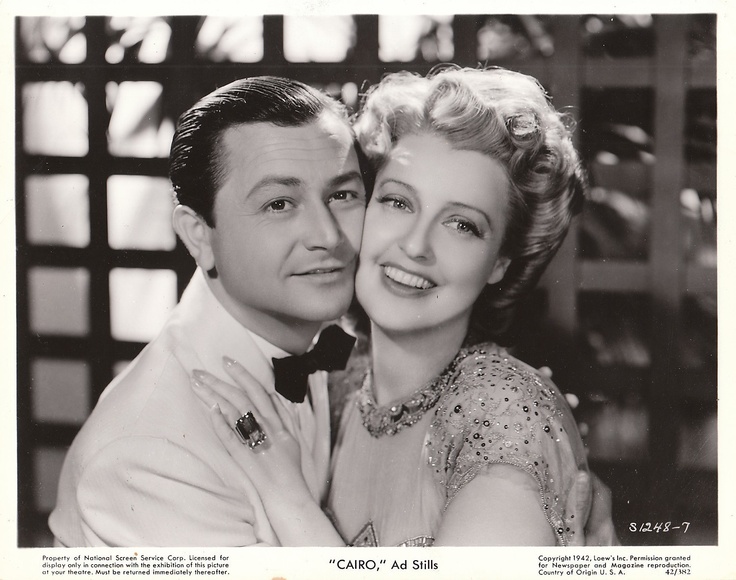
Publicity photo of Robert Young and Jeanette MacDonald for “Cairo.”

 This week’s musical:










 Comet Over Hollywood