
It’s no secret that the Hollywood Comet loves musicals.
In 2010, I revealed I had seen 400 movie musicals over the course of eight years. Now that number is over 600. To celebrate and share this musical love, here is my weekly feature about musicals.
This week’s musical:
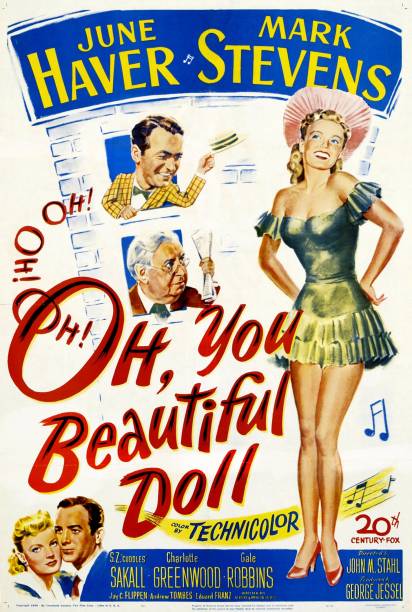
Oh, You Beautiful Doll (1949) – Musical #798
Studio:
20th Century Fox
Director:
John M. Stahl
Starring:
Mark Stevens, June Haver, S.Z. Sakall, Charlotte Greenwood, Gale Robbins, Jay C. Flippen, Andrew Tombes, Eduad Franz, Robert Gist (uncredited), Ray Walker (uncredited), Victor Sen Yung (uncredited)
Plot:
A biographical film about composer Alfred Breitenbach (Sakall), who became known as Fred Fisher for his Tin Pan Alley songs. In the film, Alfred has ambitions of composing great music, such as an opera. However, he and his family — wife Anna (Greenwood) and daughter Doris (Fisher) — are very poor. Song plugger Larry Kelly (Stevens) meets Alfred by accident and hears some of his music. Larry jazzes up portions of Alfred’s opera and writes lyrics to it, making Alfred’s music a success with mainstream music, where he is credited as Fred Fisher. Alfred struggles with being known and becoming famous off music he doesn’t like, though he and his family are living more comfortably. Outside of this, Larry and Doris are also falling in love.
Trivia:
• Mark Stevens’s singing voice was dubbed by Bill Shirley.
• June Haver’s singing voice was dubbed by Bonnie Lou Williams. Williams also dubbed Haver in Look for the Silver Lining (1949).
• First musical of director John M. Stahl, and his last feature film directing project. Stahl died in January 1950.
• June Haver played the piano as a child, and this was the first time she played the piano in a film.
• Producer George Jessel arranged for Al Jolson to record his own voice for a telephone conversation in the film.
• The title song “Oh, You Beautiful Doll” was not written by Fred Fisher.
• Reprised on the “Lux Radio Theater,” which aired on CBS Radio on April 16, 1951, starring Joan Caulfield, George Jessel and Bing Crosby.
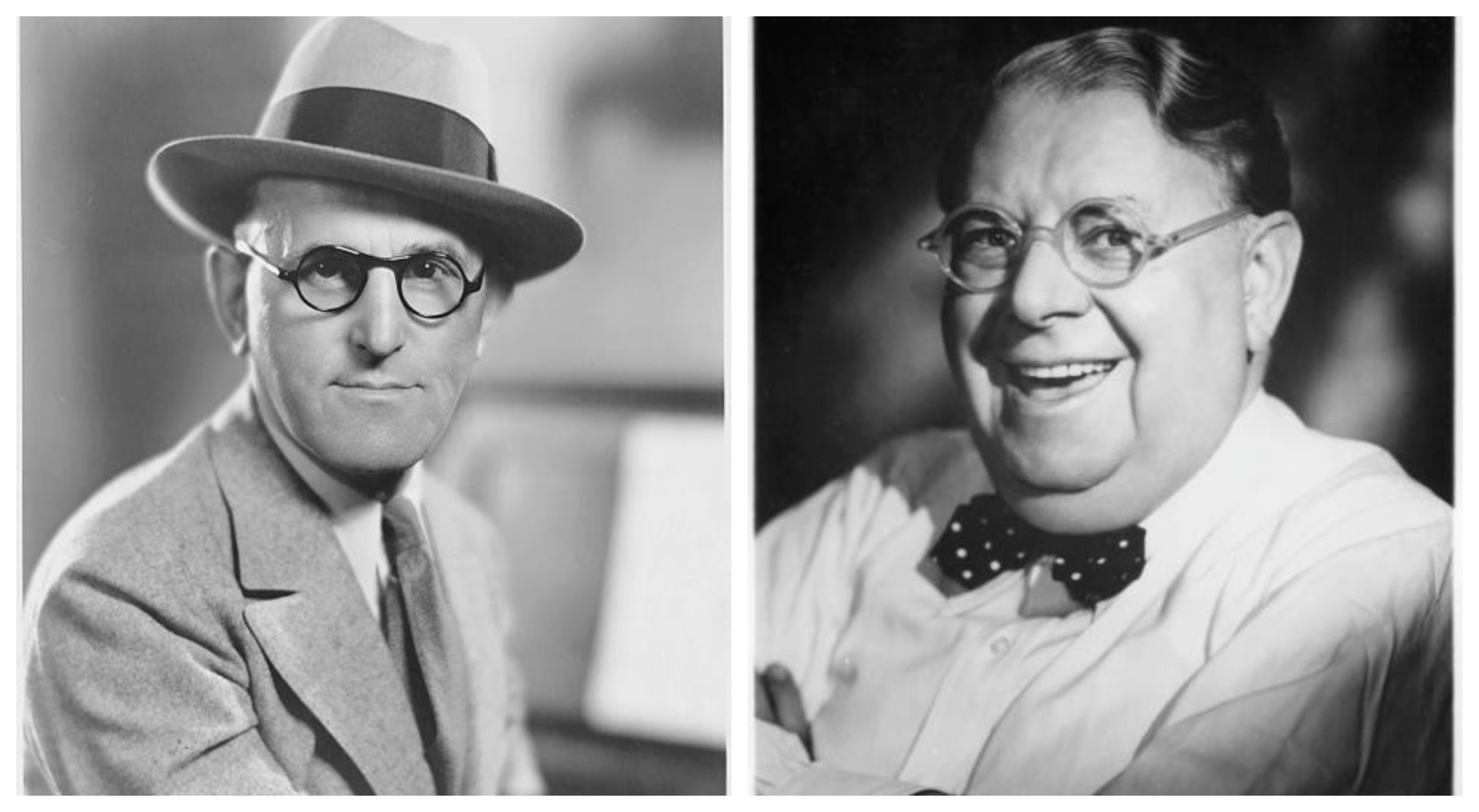
Fred Fisher and S.Z. Sakall
Highlights:
• S.Z. Sakall in a leading role
• The duet by Myrtle Anderson and Victor Sen Yung
Notable Songs:
• “Oh! You Beautiful Doll” performed by Gale Robbins
• “Come Josephine in My Flying Machine” performed by Mark Stevens, dubbed by Bill Shirley, and June Haver, dubbed by Bonnie Lou Williams
• “Ireland Must Be Heaven for My Mother Came from There” performed by Myrtle Anderson and Victor Sen Yung
• “Peg O’ My Heart” performed by Mark Stevens, dubbed by Bill Shirley, and June Haver, dubbed by Bonnie Lou Williams
• “When I Get You Alone Tonight” performed by Mark Stevens, dubbed by Bill Shirley, and Gale Robbins
• “Dardanella” performed by the chorus
• “Chicago” performed by Mark Stevens, dubbed by Bill Shirley, and June Haver, dubbed by Bonnie Lou Williams
• “I Want You to Want Me” performed by Mark Stevens, dubbed by Bill Shirley
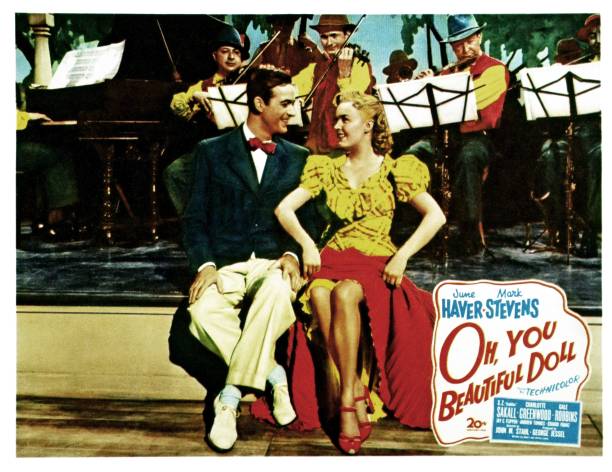
Mark Stevens and June Haver
My review:
With his chubby cheeks and humorous exclamations, S.Z. “Cuddles” Sakall is a welcome site in any classic film, from CHRISTMAS IN CONNECTICUT to TEA FOR TWO. However, Sakall is usually a secondary character with only a few key, comedic scenes.
That’s why OH, YOU BEAUTIFUL DOLL (1949) is such a treat, making Sakall the main character in a biographical film on songwriter Fred Fisher.
In the film, Sakall plays composer Alfred Breitenbach, who has written an opera but is also having hard times. His wife sews for a rich woman and Alfred smuggles food out of a luncheon. Alfred gets mixed up with Tin Pan Alley song plugger, Larry Kelly (Mark Stevens), who proposes bringing up the tempo on Alfred’s opera arias and setting them to jazzy lyrics. Ashamed, Alfred signs the pen name to the songs, Fred Fisher, because he wants to keep his identity a secret. The songs become hits, which helps the Breitenbachs financially, but Alfred is ashamed to be making money off of mainstream music. Along the way, Alfred’s daughter, Doris (June Haver) and Larry fall in love. Finally, Alfred has enough of having his music turned into songs he hates and takes matters into his own hands.
I’ll take a moment here to pause and define “Tin Pan Alley” for anyone who doesn’t live in classic films like I do. Tin Pan Alley is a nickname for the location in New York City, which is credited for being the birth location of American music. Between the late 1800s to the 1920s — though the physical location of Tin Pan Alley changed over the years — it was a place where songwriters would demonstrate their tunes to publishers. It also was responsible for making sheet music more common place in homes.
From the 1940s to the 1950s, movie musicals leaned into nostalgic Tin Pan Alley stories, such as OH, YOU BEAUTIFUL DOLL (1949). These musicals are filled with the hits of the past which received new life with films like this. Even the New York Times review concurred:
“with a dozen or so flavorsome old songs and Technicolor to help evoke a soft, nostalgic mood they can turn out a mighty pleasant entertainment”
The review goes on to remind readers that everything old is new — noting that “Peg O’ My Heart” was a recent hit, but was 35 years old at the time this film was released.
OH, YOU BEAUTIFUL DOLL is chockful of classic songs, but interestingly, while the film is based on the life of Alfred Breitenbach/Fred Fisher, the title song isn’t written by Fisher!
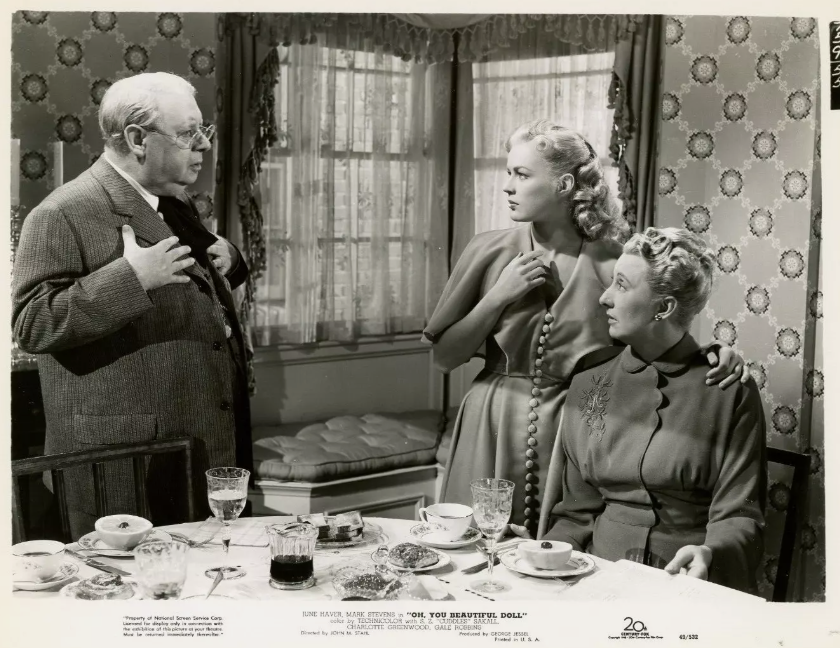
While this film is largely fictional, if the real Breitenbach truly had qualms about writing mainstream music, it appears he relented, as he eventually formed his own song publishing company. He also wrote scores for silent films and songs for talking pictures, according to the Songwriters Hall of Fame. Fisher, who died in 1942, said in an interview that most popular songwriters struggled, because they didn’t know enough classical music.
It really is a delight to S.K. Sakall as the main character of this role. In many films, he is a sidekick or secondary character who gets to deliver comedic lines. Especially in CHRISTMAS IN CONNECTICUT (1945), Sakall practically creates catchphrases like “Let’s flip flop the flop flips” and “Honkey Donkey.” But here, we get to see a more dramatic side of Sakall. There is a very tender moment at the beginning of the film that illustrates how his character is broke. Sakall’s character sneaks out of a luncheon when everyone is asked to turn out their pockets, and he leaves so he isn’t embarrassed to show that he filled his pockets with food. I always knew Sakall was a great actor, but I feel like here he gets to prove it.
Charlotte Greenwood, who also usually plays a comedic character with high kicks, plays a much more subdued character here. There is nary a high kick in this film! Greenwood plays Mrs. Breitenbach, and while she doesn’t have much screen time, it’s interesting to see her in this type of role.
While Sakall is the main character of this film, it does feel that much of the plot belongs to June Haver and Mark Stevens, who have wonderful chemistry. I have recently been seeing more of Stevens’s filmography and I have come to adore him. I hadn’t watched him in a musical yet, so I was delighted and downright impressed to see how well he danced. Though his singing voice is dubbed (a standard practice of the day), Bill Shirley’s singing voice matched Stevens well.
June Haver is pleasant, but let me tell you that I was downright bamboozled to learn her singing voice was dubbed in this film and several others! It’s very curious, because 20th Century Fox originally signed Haver as “the next Betty Grable.” In her early films, such as THE DOLLY SISTERS (1945), IRISH EYES ARE SMILING (1944) and WAKE UP AND DREAM (1946), Haver sings with her own voice, but starting in 1947, 20th Century Fox or when she was on loan to Warner Bros., her singing was occasionally dubbed.
Very curious, and columnist Edith Gwynn thought so too. In Gywnn’s “Hollywood” column dated, Jan. 24, 1949, she wrote:
“June Haver was originally signed at 20th-Fox because she was a singer and a looker. She did her own warbling in ‘The Dolly Sisters’ (with Betty Grable) and other pictures at that studio. So what happens? Fox lends her to Warners … and the latter studio hired one Bonnie Lou Williams to dub in June’s singing voice for these films!”
I thought it was interesting that Gwynn noted Bonnie Lou Williams or that Haver was dubbed at all, because the general belief is that these were secrets kept from audiences to keep the dreamy film illusion. Not to go long on Haver being dubbed, but I was so flabbergasted, because I was fooled, believing it was Haver’s own voice in LOOK FOR THE SILVER LINING (1949), among others. However, Bonnie Lou Williams was great vocal casting because their voices blend very well.
However, I can note one area Haver’s talents weren’t dubbed in OH, YOU BEAUTIFUL DOLL. When we see June Haver playing the piano in this film, she really is, according to 20th Century Fox publicity materials. Haver was an accomplished pianist and gets to show that off in this film.
I’m sorry to share that while OH, YOU BEAUTIFUL DOLL is an extremely pleasant nostalgic romp, it’s not terribly easy to find. But there is one version uploaded online if you care to search for it before it is taken down (by the studio that doesn’t deem it important enough for a DVD release).
With a bevvy of nostalgic tunes and a story that revolves around dear S.Z. Sakall, this is a pleasant and comforting watch.
Check out the Comet Over Hollywood Facebook page, follow on Twitter at @HollywoodComet, follow on Instagram or e-mail at cometoverhollywood@gmail.com
 Comet Over Hollywood