Best in Hollywood: An interview (and meal) with James Best

James Best in The Cimarron Kid (1952). He said he always died in his movies.

James Best in The Cimarron Kid (1952). He said he always died in his movies.

Known for his role as Roscoe P. Coltrane on “Dukes of Hazzard,” I interviewed actor James Best last week about his Hollywood career.

Best came to Shelby, NC last week to the Don Gibson Theatre with his one man show, “Best in Hollywood,” where he tells anecdotes about his career. I interviewed Best, 87, for a preview story about the show for The Shelby Star newspaper.

I ended up going to the show and later eating at Denny’s with Mr. Best and his wife.

Before Best starred in “Hazzard,” he acted in films with James Stewart, Ann Sheridan, Maureen O’Hara, Audie Murphy, Rock Hudson, Randolph Scott, Charlton Heston, Susan Hayward, Paul Newman, Humphrey Bogart and Jerry Lewis.

“I got into acting overseas after World War II while I was in the service,” Best told The Star during a phone interview Wednesday. “I was in the play ‘My Sister Eileen’ that the GIs did. When I got back I decided to take acting up permanently and hitchhiked to New York.”

During the show, Best called himself a “dumb country boy” –born in Kentucky and raised in Indiana– asking the cab driver to drop him on Broadway, because he was going to be an actor.

In New York, Best did winter and summer stock plays and was in a show on Broadway before heading to Hollywood.

“I was put under contract in 1949 to Universal Studios and then I freelanced,” Best said. “I have made 87 feature films and made 600 TV show appearances.”

In his show, Best shows clips from several movies and tells a story about each one. He joked he always died or was injured in all of his films.

Rock Hudson and James Best on the set of "Seminole" (1953)

Rock Hudson and James Best on the set of “Seminole” (1953)

He laughed at the script writing for “Seminole” (1953), starring Rock Hudson, when his character is drowning in quicksand, made of cork.

“Those script writers were so stupid! We are sneaking up on Indians and the soldiers are taking a cannon through quicksand,” Best laughed on stage. “I was injured, riding on the cannon and Rock Hudson had to dive in the quicksand to save me.”

He told how it took several takes to get the scene right. He was supposed to breathe through an air tube underwater. One take there was no air, another time too much air causing him to float and the third he came up laughing because Rock Hudson grabbed him awkwardly.

In the 1950s and 1960s, Best was in several westerns, including five movies with James Stewart such as “Firecreek,” “Shenandoah” and “Winchester ’73.”

“Jimmy Stewart was my icon,” he said in the interview. “I was good friends with Paul Newman, and I was in five films with Audie Murphy. Randolph Scott was a lovely man.”

James Best (far right) with Paul Newman in "Left Handed Gun" (1958)

James Best with Paul Newman in “Left Handed Gun” (1958)

Though Best worked with some of Hollywood’s top stars, he says he was never star struck.

“When I started acting in Hollywood, I was doing one show after another and you work with nearly every movie star that existed,” Best told the Star. “It’s a job. It’s different than most people’s job, but it’s a job. You work four to five days on one project and then move on to the next.”

After playing everything from cowboys to murderers, Best was in his first comedy in 1966 called “Three on a Couch” with Jerry Lewis and Janet Leigh.

Though Best had already acted in nearly 100 films before 1966, the opening credits said “Introducing James Best.”

“I asked Jerry Lewis why he did that. I said ‘What do you mean introducing; I have already been in 100 movies.’ Jerry said this was introducing me to doing comedy,” Best said with a laugh. “I had played so many murderers and been on ‘Alfred Hitchcock Presents,’ but I hadn’t done much comedy.”

Best learned the comedy skills he used on “Dukes of Hazzard” from Lewis.

James Best with Flash in "Dukes of Hazzard." He said he never got the girl, so he got a dog.

James Best with Flash in “Dukes of Hazzard.” He said he never got the girl, so he got a dog.

“I loved Jerry Lewis. I once told him he was five different people, and I hated three of them,” Best said. “I learned a lot from Jerry and I thank him for that.”

Most of the comedy for Roscoe P. Coltrane was improvised before the scene began.

“I didn’t want Roscoe to be mean, so I played him like a 12-year-old buffoon,” Best said. “Ninety-percent of it was improvised and it just came off the top of my head.”

After the series, Best and his wife Dorothy formed their own independent film company. At 87, he hasn’t stopped acting. He recently acted with his wife Dorothy in the play “On Golden Pond” in Hickory, NC, where he currently lives.

“Hollywood has changed so much,” he told me on the phone. “It has lost its glamour and they have given away all the secrets that made it so glamorous. It’s all reality stars now. None of them are trained actors. When I was working with Bogart, Newman and Stewart, those were actors.”

After his show on Friday, I was able to introduce myself and thank him for the interview. James Best is just your average, elderly gentlemen and is very kind.

After the show, I was searching for a place to eat and ended up at Denny’s.

My close friend who works at the Don Gibson Theater happened to already be at the restaurant and urged me to sit with her group. James Best and his wife happened to be part part of the group.

I talked with Dorothy about what plays she had acted in with the Hickory theater and James Best taught the table the proper way to eat pancakes. (If you are curious, he cut the center out and poured the syrup into the center. “That way your syrup doesn’t run all over your eggs,” he said.)

When he was ready to return to his hotel he turned to his wife and said, “Are you ready to go sweetie tootie?”

Again, we shook his hand and he smiled warmly. A class act.

“From the time I was adopted when I was 4 years old up to now, my life has been like a roller coaster,” Best told the Star. “There have been more ups than downs and I have been enjoying everything. I thank God every day for it.”

Check out the Comet Over Hollywood Facebook page, follow on Twitter at @HollywoodComet or e-mail at cometoverhollywood@gmail.com

Interview and review: “Vivien Leigh: An Intimate Portrait”

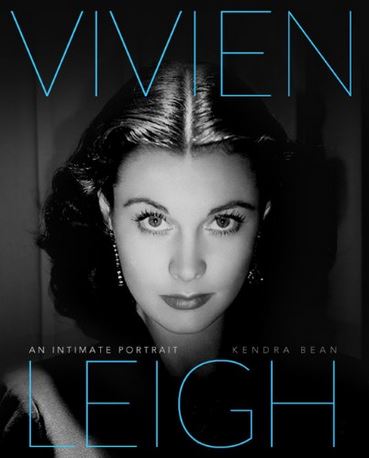
vivien leigh book coverAfter 75 years, her fresh portrayal as Scarlett O’Hara is one of the most memorable screen performances of all time.

Last November, the “Gone with the Wind” actress celebrated her 100th birthday. And to help celebrate, film historian Kendra Bean published a biography on Vivien Leigh, “Vivien Leigh: An Intimate Portrait.” Bean’s book is also the first book written about Leigh in 25 years.

Leigh won two Academy Awards for Best Actress during her short, 18 film career for playing two iconic Southern belles: O’Hara in “Gone with the Wind” (1939) and Blanche DuBois in “A Streetcar Named Desire” (1951)

“An Intimate Portrait” tenderly chronicles Leigh’s life, from her childhood in India through her marriage and divorce to Laurence Olivier to Leigh’s early death at age 51. The book is well-researched, unbiased, beautiful and heartbreaking.

Through her writing, Bean shows her passion for the subject and allows the reader to connect with the English actress. Leigh feels relatable and human compared to the unreachable and ethereal portrait that usually seems to be painted of the mysterious beauty.

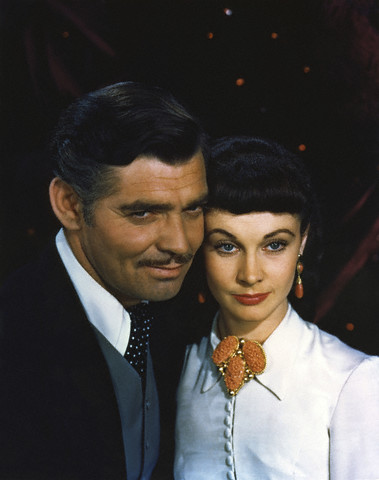
A publicity photo of Clark Gable and Vivien Leigh for "Gone with the Wind" (1939). This photo also appears in Bean's book.

A publicity photo of Clark Gable and Vivien Leigh for “Gone with the Wind” (1939). This photo also appears in Bean’s book.

Reading the page-turning biography is almost like reading “Romeo and Juliet.” Similar to the Shakespeare story that ends in tragedy, you are aware of the impending heartbreak in Leigh’s life. While reading about her successful career and marriage to Laurence Olivier, most readers know the whole time of her heartbreaking divorce, bouts with depression, tuberculosis and Leigh’s early death.

Bean chronicles these events sensitively and through extensive research, quoting interviews throughout the book. She is also the first author to delve into Laurence Olivier’s files. The 272 page book is also filled with gorgeous and rare photos of Leigh.

Bean started her Leigh and Olivier research on her website, VivandLarry.com, before moving from California to England to do more in-depth studying of Leigh’s life and romance with Olivier.

In December, she was kind enough to answer several interview questions for Comet Over Hollywood: 

Comet Over Hollywood: When did your love for Vivien Leigh begin? What started it?
Kendra Bean: I saw Gone With the Wind as a teenager and began reading everything I could get my hands on that would tell me more about the film, including biographies of the stars. The more I read about Vivien, the more interesting she became in my eyes. That’s really what started it. Having a website and online community centered on her and Laurence Olivier has definitely helped keep my interest alive over the years.

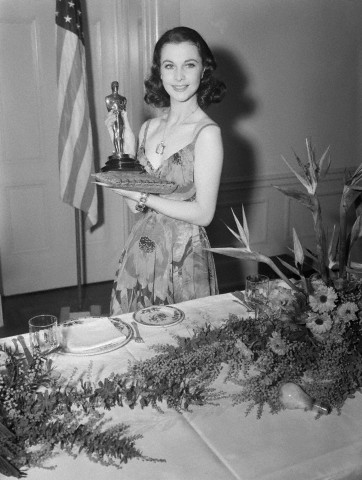
Vivien Leigh proudly holds her Best Actress Oscar on March 2. 1940. She was recognized for her portrayal of Scarlett O'Hara in Gone With the Wind.

Vivien Leigh proudly holds her Best Actress Oscar on March 2. 1940. She was recognized for her portrayal of Scarlett O’Hara in Gone With the Wind.

COH: I have always understood that you moved to England to better study Olivier and Leigh. Is that correct? How difficult of a decision was that? What was that transition like to study something you love?
KB: That was only part of the reason. I actually moved to London for graduate school. I did my BA in Film and Media Studies back in California and then spent the next four years working. But I knew I wanted to be a film historian and to do that, I felt I needed to get a further degree. I wasn’t really satisfied with what I was doing back home, and just felt like I needed a change if I was ever going to actually pursue these interests. I always wanted to live in London for at least a year, so I applied to the Film Studies graduate program at King’s College London. Luckily, they accepted me and offered a couple of scholarships, so off I went!
It was a big change, but I knew some people here already and knew my way around the city. I also made some great friends through the program who I still keep in touch with today. I think the most difficult period was the transition from graduation to whatever was going to happen next. I was determined to make this book project work, but the process of actually getting a publisher was a long one. It was a very stressful period because being on a visa kind of limits things. There were several times when I thought I might well have to move back to the US and that the book would never happen.

COH: You have been working on the book for five years. What all goes into the research that you had to do?
KB: There were two parts to my research: constructing the book and getting it published. Because it’s a coffee table book, a good deal of the process involved locating, sourcing, and licensing photographs (I don’t think a lot of people realize what a lengthy and involved process that is). I also spent a good deal of time in various archives in the UK and in Los Angeles looking for interesting information (fellow fans/research assistants sent me information from New York and Australia, as well), reading through various biographies, tracking down and interviewing people who knew and worked with Vivien, and seeking permission from various estates to quote from letters.
When I first started this project, I had no idea how to get a book published. So, I also had to do a fair bit of research into the actual publication process: how to get an agent, possible marketing angles, crafting a proposal, etc. It was a lot of work, but very much worth it in the end!

COH: What was a misconception you had that came to light during your research?
KB: I think there have been a lot of misconceptions about Vivien’s battle with manic depression (bipolar disorder) and her relationship with Laurence Olivier, in general. One major grey area has always been the infamous 1953 incident, when Vivien had nervous breakdown whilst filming Elephant Walk in 1953. She was flown back to England, legally sectioned, and committed to a mental asylum. The picture I had in my mind from reading previous Leigh biographies was something akin to Frances Farmer getting hauled off to the state institution.
There were also a lot of rumors surrounding this event, including the suggestion that Olivier was having a long affair with actor Danny Kaye and that this set Vivien off. I found no evidence to support any of that. Rather, there was plenty to support the fact that Vivien had been headed toward a mental health crisis for a long time and previous attempts at intervention in 1951/52 were refused by her. Although this was not surprising given the stigma surrounding mental illness in the 1950s, it was still sad to learn that there’s a chance that this particular incident might have been avoided. I was given access to some files pertaining to this incident that hadn’t been by previous biographers (of Leigh or Olivier). What emerged was a clearer picture not only of the harrowing experience that Vivien went through, but also how that experience affected those closest to her – particularly Olivier. It was a very stressful and frightening time for all involved.
Today it seems fashionable to focus on their interpersonal problems; specifically how horrible Olivier was to Vivien. Through moderating vivandlarry.com and the accompanying Facebook page over the years, it seems to me that there’s a tendency to view their relationship in black and white terms. In fact, it was very complicated. How could it not be? They were together for nearly 25 years and she remained obsessed with him for the rest of her life. Their marriage did turn very sour in the 1950s but before that, and I think sometimes during that period, there was actually a lot of love, respect, and camaraderie between them. That notion was reinforced when going through Olivier’s papers, and those of other people who knew them.

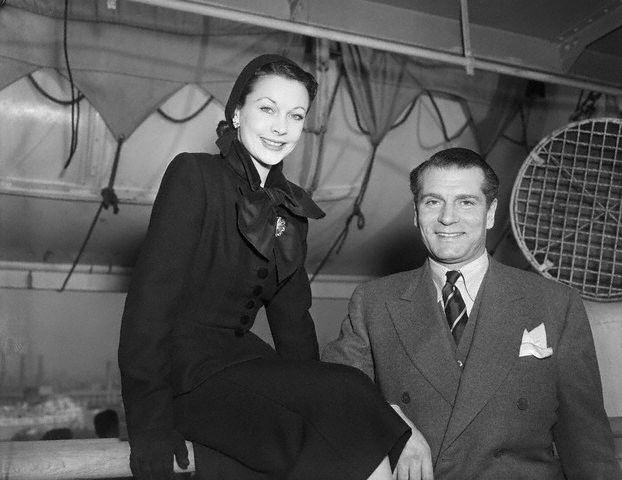
Arriving in New York by boat in 1951.

Arriving in New York by boat in 1951.

COH: Why is it important to study actors like Leigh and Olivier and their relationship?
KB: Because they both made significant contributions to 20th century popular culture. They considered themselves artists and their work deserves to be remembered and reappraised. Unfortunately, their stage work was very ephemeral but luckily their films still remain to be enjoyed and discussed by fans and casual viewers alike. On top of that, they lead interesting lives.

COH: Was there anything you learned that didn’t make it into the book and why?
KB: One of the main tasks of an author is to decide what is important and what isn’t for the story he or she wants to tell. Coffee table books require even more editorializing than standard biographies because they rely just as much – sometimes even more – on visuals as they do text. A couple of examples of things that were left out of Vivien Leigh: An Intimate Portrait: I was told some stories during interviews that I felt were interesting but they ended up being more about the interviewee than Vivien, or I didn’t feel they added anything thematically that hadn’t been said already, so they were left out. I also didn’t spend much time talking about the films she made for Alexander Korda in the 1930s, instead opting to cut to the meat of her fame, which really took off with Gone With the Wind. I did write an essay about these films for the Vivien Leigh Anniversary Collection released in November by Cohen Films though, and that’s something I would definitely expand upon in a full biography.
leighOne of the challenges in writing a biography of a famous figure is that many materials are still in copyright and permission is required to publish them if they fall outside of fair use. This meant that, unfortunately, there were some letters and photos that I very much wanted to use, but couldn’t.

COH: Recently you have given several speeches and interviews. What has been your proudest moment since the book has been published?
KB: I think my proudest moment was actually getting the book published. It was such a long and often emotional journey and there were several instances where I worried it wouldn’t come to fruition.
I’m grateful for the opportunities that have arisen from being published. It’s been such a wonderful learning experience and I’ve met some very passionate and intelligent people because of it. I never thought I’d get to curate an exhibit at a major museum, for example, but Terence Pepper (who edited some of my favorite photo retrospectives) asked me to help curate the “Starring Vivien Leigh: A Centenary Celebration” exhibit that’s currently on at the National Portrait Gallery. I also gave my first-ever big lecture to a sold out audience at the NPG. Public speaking has always been one of my worst fears, but this went really well and has given me confidence for the lecture I’m giving at the V&A in February.

COH: Do you see another book in your future?
KB: Yes! Watch this space!

Check out the Comet Over Hollywood Facebook page, follow on Twitter at @HollywoodComet or e-mail at cometoverhollywood@gmail.com
Baby Take a Bow: Remembering Shirley Temple

shirleyWhen I was in fourth grade I cut six inches off my long hair.

I was doing a book report on Shirley Temple and wanted short, curly hair like America’s Sweetheart for my presentation.

In 2000, before Internet shopping was common place, my parents searched all over to get me a Shirley Temple doll for Christmas. They eventually found one from a store in Connecticut.

Later as a high school senior I even dressed up as Shirley Temple for Halloween.

While my classic film love escalated to obsession in 2004, Temple was my first favorite movie star.

The first movie I saw with Shirley Temple was “Rebecca of Sunnybrook Farm’ (1938). It was a Christmas gift from my Grandmother. I was hooked as Temple sang about wearing an old straw hat, a pair of overalls and a worn out pair of shoes.

Years after she brought happiness to Americans during the Great Depression in the 1930s, the curly headed child star was still influencing and bringing happiness to a young girl in South Carolina.

The dimple faced, curly topped child star was the top box office draw of the 1930s.
The story told is that Temple was discovered in her dance class at age 3, hiding under a piano.

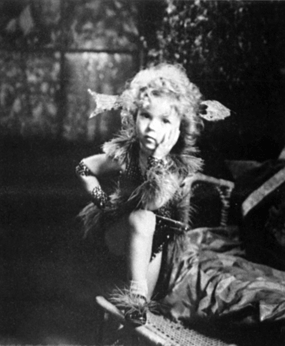
Shirley Temple dressed as Marlene Dietrich in the Baby Burlesk short "Kid N Hollywood."

Shirley Temple dressed as Marlene Dietrich in the Baby Burlesk short “Kid N Hollywood.”

From 1932 until 1933, many of her films were shorts. Some were called Baby Burlesks, involving child actors like Temple dressing up like popular stars such as Mae West and Marlene Dietrich.

With her 56 pin-curls and song-and-dance films, President Franklin Roosevelt once said the United States couldn’t have made it through the Depression without her.

She also saved 20th Century Fox studio from bankruptcy, according to her obituary in the Los Angles Times.

She made 40 movies before she turned 12, and eight of those were in 1934.

Temple was the first child star to carry a full weight picture on her own; not as a secondary actor, according to Dickie Moore’s book “Twinkle, Twinkle Little Star (and don’t have sex or take the car). Her co-stars included top Hollywood names such as Carole Lombard, Gary Cooper, Joel McCrea, Alice Faye, Adolphe Monjou, Victor McLaglen and Lionel Barrymore.

She loved dancing with her friend Bill “Bojangles” Robinson and was didn’t understand why he was treated differently because he was black.

Shirley with J. Edgar Hoover in 1938.

Shirley with J. Edgar Hoover in 1938.

She met important figures such as President Franklin Roosevelt, head of FBI J. Edgar Hoover and Amelia Earhart.

Temple knew her lines and everyone else’s, frequently correcting the adult actors to their chagrin.

“She was a nice kid, with a really wonderful mother and father. We all liked her,” said actress Alice Faye who starred in “Poor Little Rich Girl” (1936) with Temple. “But she was brilliant. She knew everyone’s dialogue and, if you forgot a line, she gave it to you. We all hated her for that.”

Because of Temple, other parents hoped to get their children in films, so their children would be the breadwinners while the parents couldn’t find work during the Depression.

Temple was treated like a princess. She had a bowling alley and a life sized play house in her backyard.

Shirley with top stars Carole Lombard and Gary Cooper in "Now and Forever" (1934)

Shirley with top stars Carole Lombard and Gary Cooper in “Now and Forever” (1934)

However, even Hollywood’s greatest star faced difficulties.

Temple’s father had a hard time finding work, because employers assumed he had enough money because of Shirley’s films, according Moore’s book.

Temple was isolated from the other children. Many parents of child stars did this, because they didn’t want their children fraternizing with a child who may be competing for the same role.

However, publicity departments made it look like Temple had lots of friends. Each year she would have three birthday parties: one with other child actors, one on set with the crew and one with her family.

Shirley Temple cutting the cake at her birthday party in 1935.

Shirley Temple cutting the cake at her birthday party in 1935.

“The parties were endless…Fox would have one for a large number of people I didn’t know, a lot of children I’d never seen in my life and would never see again,” Temple told Moore. “And I was the hostess. It was kind of strange. I figured it was part of my job.”

Moore said Temple was sweet; the real problem was her stage mother Gertrude Temple. Gertrude was responsible for making sure Temple had the maximum amount of screen time. This included demanding a touching scene with child star Sybil Jason being cut from “Blue Bird” (1940).

Temple also faced the same fate as child star Jackie Coogan: her parents spent all of her money.

After marrying Charles Black, the couple looked at her finances that much of her money had been spent to support her family-what was left belonged to her parents. There should have been $356,000 in her account, but her father, George, disobeyed court orders and kept the money, according to BBC.

Shirley Temple with Monty Wooley and Soda the dog in my favorite movie, "Since You Went Away"

Shirley Temple with Monty Wooley and Soda the dog in my favorite movie, “Since You Went Away”

The transition from child star to teenager was difficult for Temple as it is with other stars.
However, Temple starred in several charming films as a teenager such as “Kathleen” (1941), “That Hagen Girl” (1947) and my all-time favorite film “Since You Went Away” (1944).

Though I was sad when I heard the news of Shirley Temple’s death at age 85 on February 10, I remembered she had a long life.

After leaving her film career behind at age 22, Temple went into politics.

In 1968, she was a delegate to the United Nations and in 1974 was an ambassador to Ghana, according to Temple’s USA Today obituary.

After divorcing John Agar, her husband of five years, Temple was married to Charles Black for 55 years until his death in 2005.

Actress Shirley Temple and her husband, Charles G. Black at the Stork Club in 1953.

Actress Shirley Temple and her husband, Charles G. Black at the Stork Club in 1953.

She said in her autobiography that in her adult life, the child actress seems more like a dream or a younger sister to her.

Though she is gone, Temple will continue to bring happiness to film fans as she has continued to do for the last 80 years.

Added bonus: Me in high school as Shirley with "Juliet"

Added bonus: Me in high school as Shirley with “Juliet”

Check out the Comet Over Hollywood Facebook page, follow on Twitter at @HollywoodComet or e-mail at cometoverhollywood@gmail.com
Classics in the Carolinas: Remembering Alicia Rhett, India Wilkes in “Gone with the Wind”

COH Alicia Rhett2

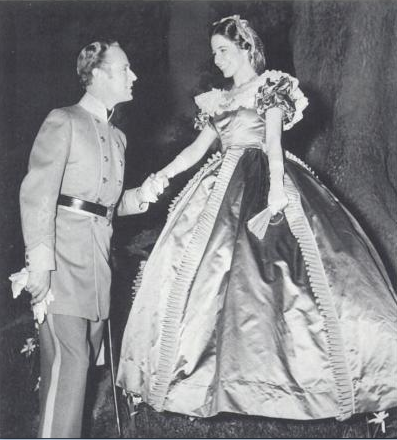
Leslie Howard with his on-screen sister Alicia Rhett.
(Scanned from “The Filming of Gone with the Wind”)

She was a true Southern lady.

Alicia Rhett was discovered on George Cukor’s Southern search for Scarlett O’Hara for the epic film “Gone with the Wind” (1939).

Rhett was cast as Ashley Wilkes’ sister, India Wilkes, in one of the biggest films of all time.

But Rhett’s art was more important to her than stardom.

“I enjoyed it (filming) immensely. I had the time of my life there (California). But when the film ended, I was happy to come home (to Charleston),” Rhett said in an interview in “The Rise of Charleston” by W. Thomas McQueene. “I liked to paint. It was what made me most happy. I really wasn’t interested in making more movies. I was interested in my art.”

Rhett was born in 1915 in Savannah, GA.   After her father was killed in World War I, her family moved to Charleston, SC, according to McQueene’s book.

Casting the role of Scarlett O’Hara for the 1939 movie wasn’t an easy. Hundreds of actresses were considered. Director George Cukor made a trip through Southern states, believing an unknown actress may be the answer to their problem.

Director George Cukor with interviews actresses to play the role of "Scarlet O'Hara": Louisa Robert, Atlanta; Susan Fallingant, Atlanta; Alicia Rhett, Charleston. (Scanned from "The Pictorial History of Gone with the Wind")

Director George Cukor with interviews actresses to play the role of “Scarlet O’Hara”: Louisa Robert, Atlanta; Susan Fallingant, Atlanta; Alicia Rhett, Charleston.
(Scanned from “The Pictorial History of Gone with the Wind”)

Hundreds of Southern women auditioned for the role of Scarlett, Melanie and Mammy, but only six women were considered for follow up auditions, according to “The Art of Gone with the Wind: The Making of a Legend,” by Judy Cameron and Paul J. Christman.

The auditions took place in 1937 in New York and the only Southerners who won roles were Alicia Rhett from Charleston, Mary Anderson who was cast as Maybelle Merriwether from Birmingham, AL and Marcella Martin of Shreveport, LA who was cast as Cathleen Calvert. Martin’s lines were dubbed because her accent wasn’t considered Southern enough, according to the Cameron and Christmas book.

“Alicia Rhett was an amateur actress. This young woman was so good,” Ann Rutherford is quoted by Cameron and Christman. Rutherford played the role of Careen, Scarlett’s younger sister. “She wasn’t Scarlett but Selznick cast her as India Wilkes. And she was excellent.”

During the filming of "Gone with the Wind," Alicia Rhett made sketches between takes. Here with Evelyn Keyes and Ann Rutherford. (Scanned from "The Filming of Gone with the Wind" by Herb Bridges)

During the filming of “Gone with the Wind,” Alicia Rhett made sketches between takes. Here with Evelyn Keyes and Ann Rutherford.
(Scanned from “The Filming of Gone with the Wind” by Herb Bridges)

The character of India Wilkes is the sister of Ashley Wilkes (Leslie Howard) and sister-in-law of Melanie Wilkes (Olivia De Havilland). In the film, India hates Scarlett O’Hara, because Scarlett marries the man India is in love with, Charles Hamilton. India never marries and Scarlett refers to her as an “old maid.”

Rhett was acting when Cukor found her in Charleston.

She was performing in the Oscar Wilde play “Lady Windermere’s Fan” at the Dock Street Theater. Her performance in the Wilde play had “style and élan,” said “Pictorial History of Gone with the Wind” by Gerald Gardner and Harriet Modell Gardner.

COH alicia rhett

Alicia Rhett visits with Mrs. John Woodbury from Louiseville, KY. Woodbury was the past-president-general of the United Daughters of the Confederacy. The Daughters dropped by to visit the filming of the Civil War film.
(Scanned from The Filming of Gone with the Wind by Herb Bridges)

“Gone with the Wind” novel author Margaret Mitchell liked Rhett for her name, according to the Gardner book.

As Rhett performed in the epic Technicolor film about the Civil War and the Reconstruction of the South, Rhett had her own family Civil War history.

Her great-grandfather was Robert Barnwell Rhett, a secessionist politician from South Carolina, according to “A Short History of Charleston” by Robert S. Rosen.

Robert Rhett became a member of the South Carolina legislature in 1826 and resigned from the United States Senate in 1852 when South Carolina seceded from the Union.

Though she was an unknown actress, Rhett enjoyed the company of her A-list co-stars.

She said Leslie Howard, who played her on-screen brother Ashley Wilkes, was “delightful” and Clark Gable, who played Rhett Butler was “charming,” she said in an interview with McQueene.

Rhett (bottom right) in a scene with Marjorie Reynolds, Evelyn Keyes and Olivia De Havilland.

Rhett (bottom right) in a scene with Marjorie Reynolds, Evelyn Keyes and Olivia De Havilland.

Rhett kept in touch with her on-screen sister-in-law Olivia De Havilland, who played Melanie Wilkes, for many years after filming. And she said Vivien Leigh was “just as pretty in person as she was on-screen,” McQueen quoted her.

But she returned to South Carolina after filming to embrace her first love: art.

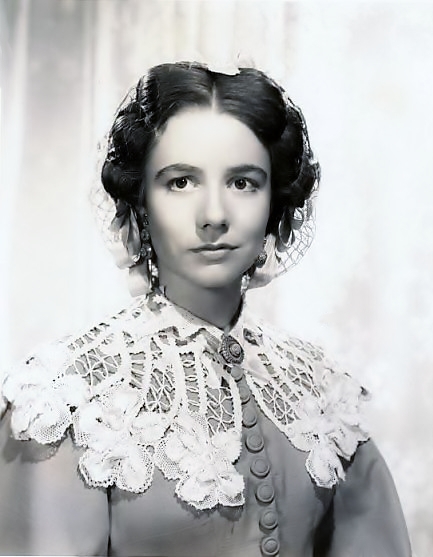
Alicia Rhett who played India Wilkes, sister of Ashley Wilkes, in "Gone with the Wind" (1939)

Alicia Rhett who played India Wilkes, sister of Ashley Wilkes, in “Gone with the Wind” (1939)

Rhett went on to be one of the most important artists in Charleston, specializing in children’s portraits and also having her work hung in the president’s office at The Citadel.

Rhett passed away on January 4, 2014 at the age of 98. She was the oldest surviving member of “Gone with the Wind.”

Still living from the cast includes Olivia De Havilland, Mickey Kuhn who played Beau Wilkes and Mary Anderson.

Check out the Comet Over Hollywood Facebook page, follow on Twitter at @HollywoodComet or e-mail at cometoverhollywood@gmail.com
Woman of a Thousand Faces: Remembering Eleanor Parker

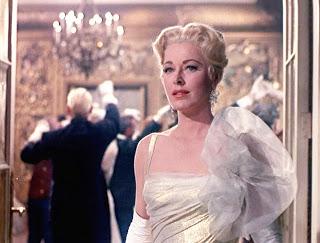
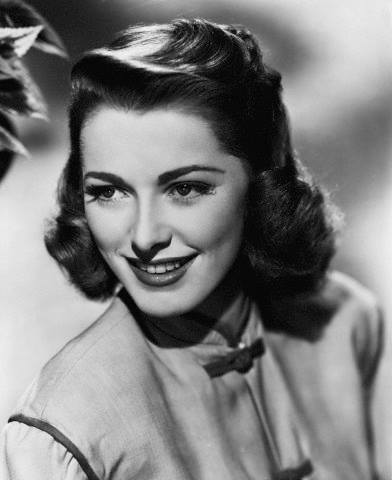
Eleanor Parker as the Baroness in "Sound of Music" (1965).

Eleanor Parker as the Baroness in “Sound of Music” (1965).

Today’s audiences know her as the Baroness; the mean blond who was Julie Andrews’ romantic rival in “The Sound of Music” (1965).

Though her role in the 1965 musical is memorable, the talents of Eleanor Parker are so much more than that.

Parker started out at Warner Brothers studios in the early 1940s. She was fresh faced, pretty and red-headed.

Born in Ohio, Parker moved to Hollywood in 1942 and was discovered while sitting in the audience at the Pasadena Community Playhouse by a Warner Brothers talent scout, according to Glamour Girls of the Silver Screen.

Parker’s first role was in 1941, a deleted scene in the Errol Flynn and Olivia De Havilland film “They Died With Their Boots On.” This role was followed by short films, bit parts and B-movies. One of these early jobs included a voice on a record to a soldier husband in the Cary Grant war film, “Destination Tokyo” (1943).

Eleanor Parker in the 1940s

Eleanor Parker in the 1940s

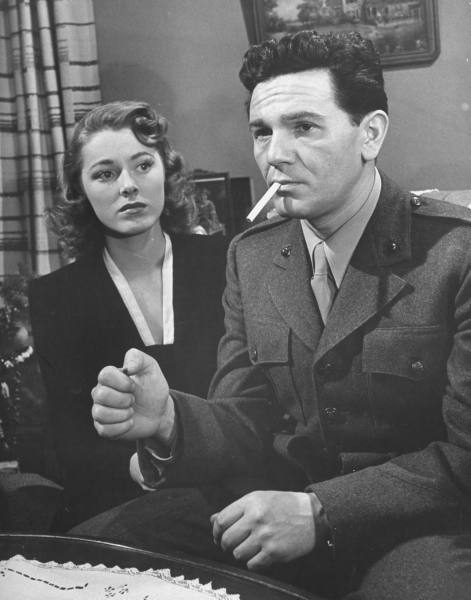
But her first major role with Warner Brothers was alongside John Garfield, Sydney Greenstreet and Paul Henried in “Between Two Worlds” (1944). The all-star cast is on a boat in the afterlife; waiting to see if they will go to heaven or hell.

Her next major role came in the romantic World War II drama, “The Very Thought Of You” (1944) with Dennis Morgan as her romantic co-star. Beulah Bondi and Henry Travers as Parker’s parents, who vehemently disapprove of her romance and eventual marriage to a soldier.

Parker showed her versatility as an actress from films like “Pride of the Marines” (1945), a drama about disabled war veterans co-starring John Garfield, to “Never Say Goodbye” (1946), a comedic romp set around Christmas with Errol Flynn.

She displays her acting abilities best in one of her top, and possibly most disturbing, roles in the prison drama “Caged!” (1950). Parker goes into jail as a naïve and innocent young woman and leaves hardened and cold. One horrifying scene includes Parker’s head getting shaved as a punishment. She was nominated for an Academy Award for Best Actress for her performance in “Caged” but lost to Judy Holliday for “Born Yesterday.”

A year later she was getting drunk on tequila and flirting with Fred MacMurray in the comedy “Millionaire For Christy” (1951).

It’s no wonder that Eleanor Parker has been dubbed “Woman of a Thousand Faces.”

John Garfield, Clark Gable, Stewart Granger, Kirk Douglas, Glenn Ford, Errol Flynn and Humphrey Bogart are just a few of the top leading men she acted with.

“You didn’t go to her films to see Miss Parker being Miss Parker in a different dress and locale,” wrote Doug McClelland in his book “Eleanor Parker: Woman of a Thousand Faces.” “You went to see what person she had created on film.”

Parker helps husband John Garfield adjust to living life without sight in "Pride of the Marines" (1945). (LIFE)

Parker helps husband John Garfield adjust to living life without sight in “Pride of the Marines” (1945). (LIFE)

Parker was nominated for an Academy Award for Best Actress two other times:

-“Detective Story” (1951) –Parker plays the wife of Kirk Douglas who was involved with and got pregnant from a racketeer before their marriage.

-“Interrupted Melody” (1956) –the biographical film about Australian opera singer Marjorie Lawrence who becomes paralyzed due to polio.

She also played a woman with multiple personality disorder in “Lizzie” (1957), the same year Joanne Woodward played a similar role in “The Three Faces Of Eve.” It was Woodward who won the Oscar that year.

In a 1988 interview, she said she was a character actress. That her roles were too diverse that her own personality never “emerged on screen,” according to an article from USA Today.

In her private life, she was shy and collected classical records, according to an April 30, 1945, LIFE article, “Eleanor Parker: Actress plays ‘Of Human Bondage,’ role that made Bette Davis famous.”

McClelland’s book suggests one reason Parker is forgotten today is because of her quiet, private life.

“I’ve prided myself on not dreaming up tales to see my name in print,” McClelland quotes her as saying in an interview.

Some of my personal favorite films of Parker’s include: “The Voice of the Turtle” (1947), “Woman in White” (1948), “Never Say Goodbye” (1946), “The Very Thought of You” (1945), “Pride of the Marines” (1945) and “Valley of the Kings” (1954).

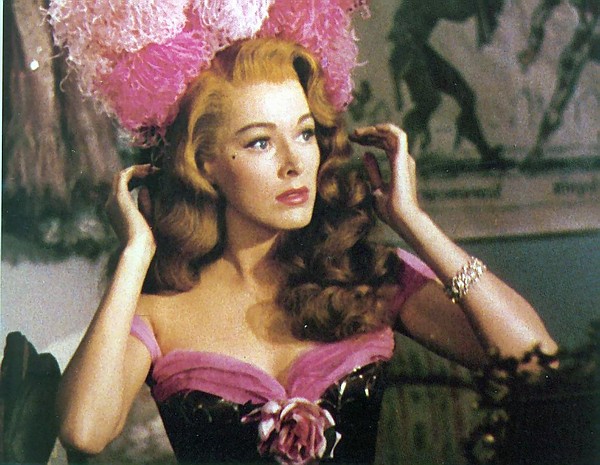
Parker plays a fiesty female in "Scaramouche" (1952)

Parker plays a fiesty female in “Scaramouche” (1952)

Eleanor Parker is one of those actresses that lights up the screen and makes the movie. The only films I remember not enjoying of Parker’s were the Rudolph Valentino biopic “Valentino” (1951) and “The Oscar” (1966). Neither of the films were bad because of Parker, but bad script writing.

Parker passed away today at the age of 91 due to complications from pneumonia, according to the Associated Press.

“Eleanor Parker was and is one of the most beautiful ladies I have ever known,” said “Sound of Music” co-star Christopher Plummer in Parker’s USA Today obituary. “Both as a person and as a beauty. I hardly believe the sad news for I was sure she was enchanted and would live forever.”

Goodbye to one of Warner Brothers’ brightest and most talented stars. “The Very Thought of You” will always make your fans smile.

Turner Classic Movies will be honoring Eleanor Parker on Tuesday, Dec. 17 (ET):
6 a.m. – The Very Thought of You (1944)
7:45 a.m. – Of Human Bondage (1946)
9:45 a.m – The Woman in White (1948)
11:45 p.m. – Caged (1950)
1:30 p.m. – Scaramouche (1952)
3:30 p.m. – Interrupted Melody (1955)
5:15 p.m. – Home from the Hill (1960)

Check out the Comet Over Hollywood Facebook page, follow on Twitter at @HollywoodComet or e-mail at cometoverhollywood@gmail.com
Olympics to Hollywood: Nat Pendleton

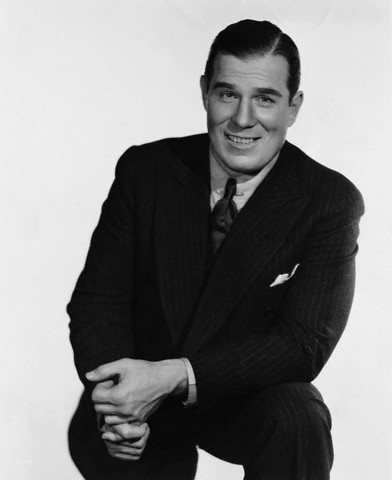
Nat Pendleton in 1935.

Nat Pendleton in 1935.

This November 2013 post was minimally edited on Aug. 2, 2016, for a series on Olympians who went on to be actors. This series coincides with the Rio 2016 Summer Olympics.

Whether he was an affable lug or a dangerous mobster, the face of the dark-haired 6 foot character actor is one film fans recognized in the 1930s and 1940s.

Character actor Nat Pendleton acted in uncredited and supporting roles from 1926 to 1947.

But before Pendleton performed as Sandow the Great in the biographical film “The Great Ziegfeld” (1936), he was flexing his muscles for different reasons.

Pendleton’s fame originally came in the form of an Olympic silver medal in the super heavyweight freestyle wrestling division at the 1920 Summer Olympics in Antwerp, Belgium. That year, the United States won 41 gold, 27 silver and 27 bronze medals — winning the most medals by any of the 29 nations attending. Born in Davenport, Iowa, Pendleton was Iowa’s first Olympic medal winner, according to the National Wrestling Hall of Fame.

Continue reading

He never met a man he didn’t like: A visit to the Will Rogers Museum

He never met a man he didn’t like.

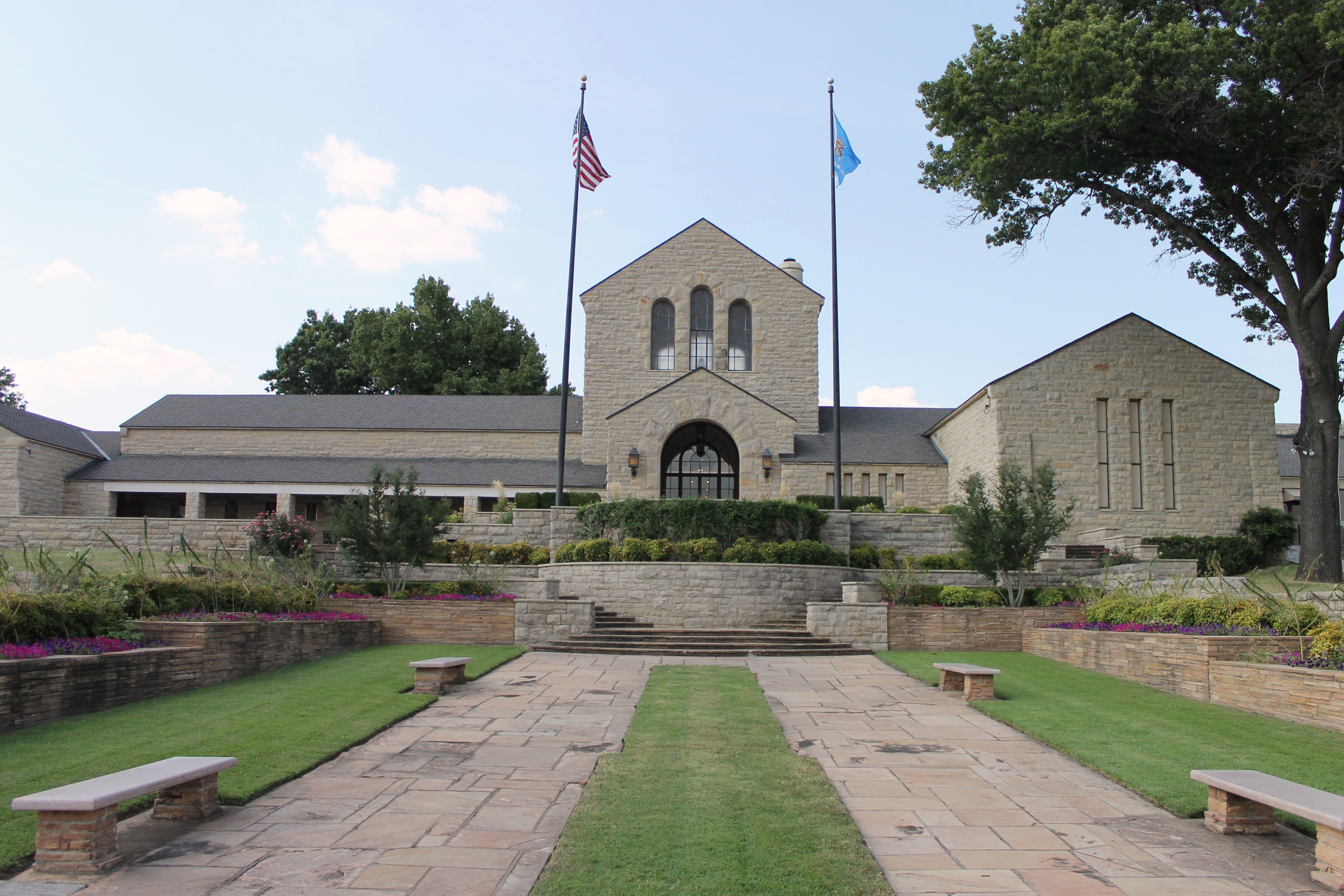
Will Rogers was born in Oologah, OK, and his final resting place is at the Will Rogers Memorial Museum in Claremore, OK.

Rogers made a name for himself in vaudeville as doing roping tricks, eventually making it to the Ziegfeld Follies. He then made silent films, talking pictures, wrote syndicated newspaper columns and broadcasted on the radio. Rogers was always on top of his communication game.
Rogers died in 1935 in a plane crash in Alaska.

Will Rogers statue near his tomb. (Comet Over Hollywood/Jessica P.)

Will Rogers statue near his tomb. (Comet Over Hollywood/Jessica P.)

“When commercial radio evolved, Rogers quickly migrated to the new format,” said an exhibit at the Will Rogers Memorial Museum. “If alive today, he probably would be blogging and tweeting.”

This past September, my co-worker Brittany Randolph and I went on a road trip to Oklahoma. She loves the plains and I was along for an adventure. I didn’t care where we went as long as we visited the Will Rogers Rogers Memorial Museum.

The museum includes:
-Rogers’s saddle collection such as Mongolian, French and Navajo saddles
-A gallery of portraits painted of Will Rogers
-A theater that shows “The Will Rogers Story” narrated that Bob Hope
-Rogers’s tiny saddle collection
-A smaller theater that shows Will Rogers films
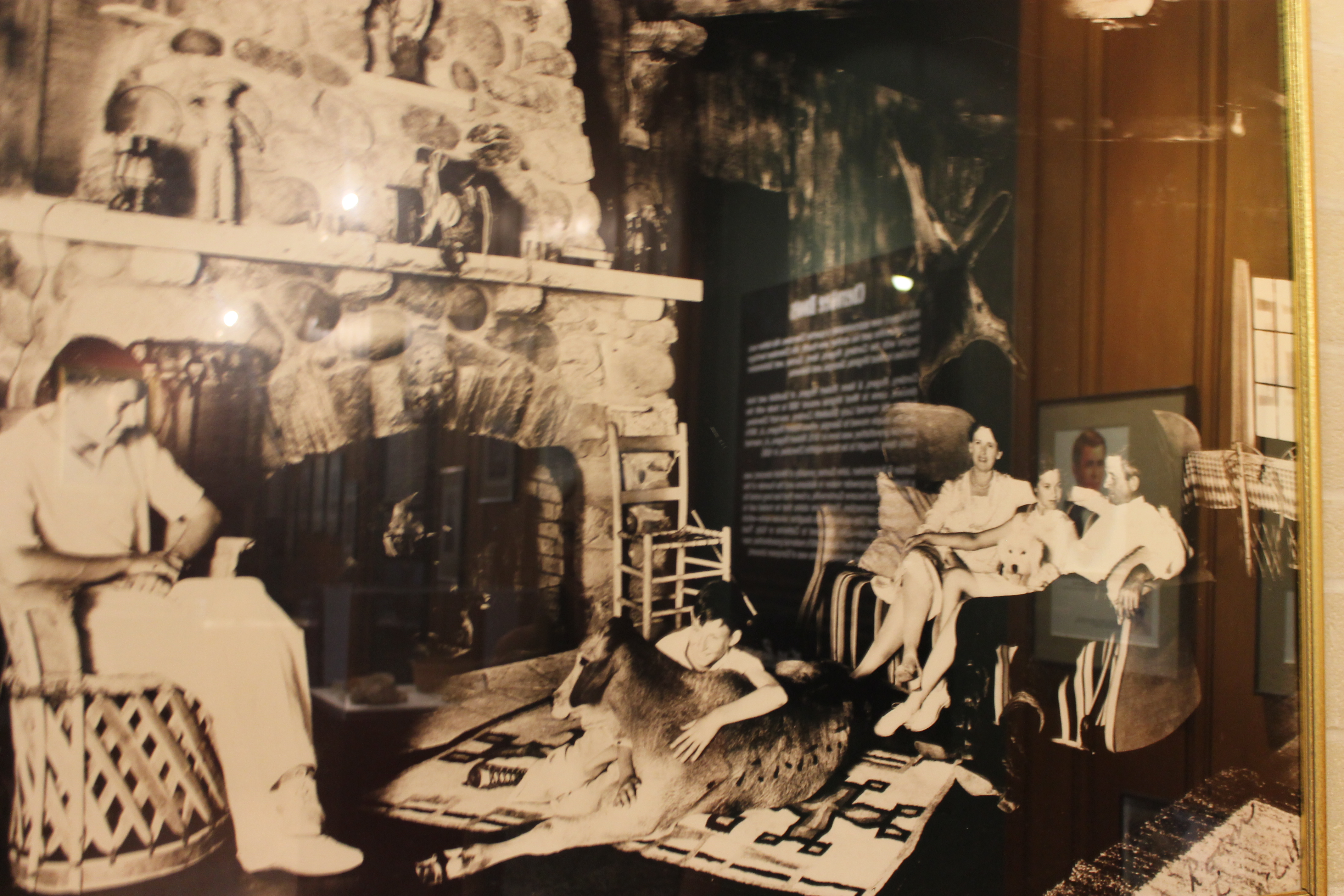
-A diorama on Will Rogers life
-Artifacts such as hats, scripts or costumes that belonged to Rogers
-History on Rogers’ family, dating back to his Native American heritage
-Rooms of the museum recreate rooms of Rogers’s home such as his study-modeled to make him think of ranch life
-Will Rogers’ grave site is in a garden outside the museum with a large statue of him on a horse.
-Samples of some of his radio broadcasts

Part of Rogers's tiny saddle collection

Part of Rogers’s tiny saddle collection

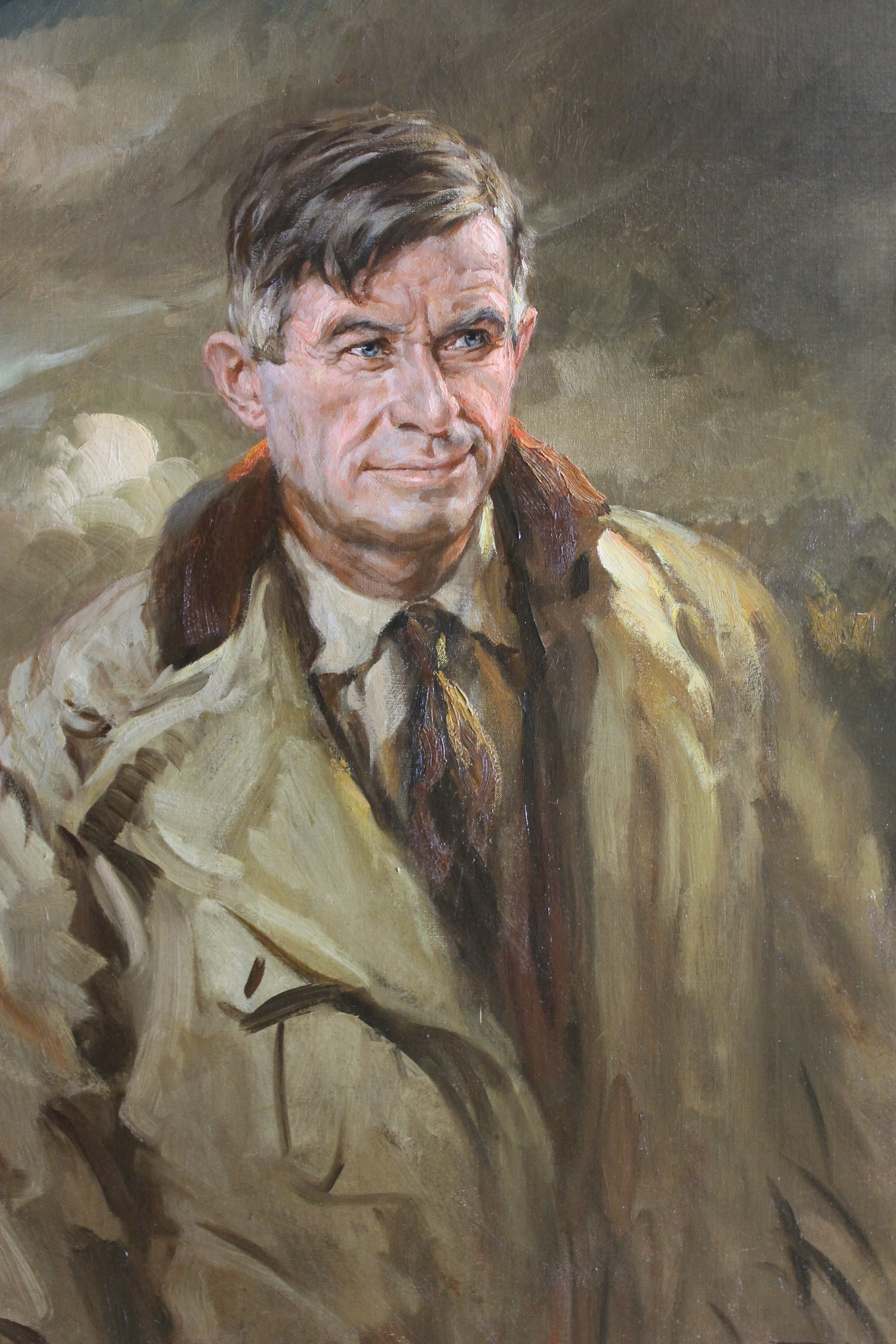
Portrait of Will Rogers

Portrait of Will Rogers

A hat of Will Rogers

A hat of Will Rogers

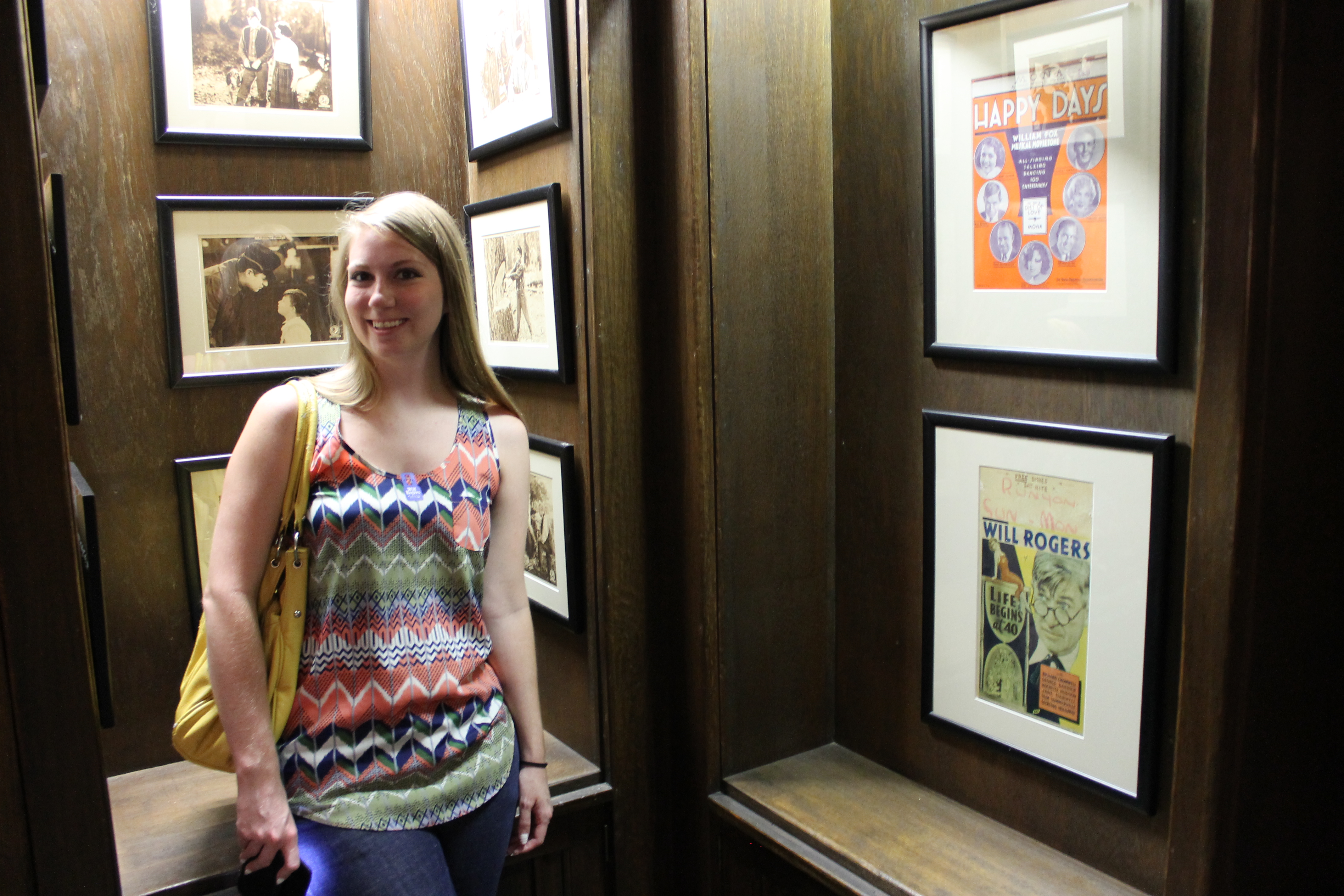
Me posing with Will Rogers lobby cards

Me posing with Will Rogers lobby cards

IMG_6495

Watching a Will Rogers film

Watching a Will Rogers film

Young Will Rogers

Young Will Rogers

Will Rogers's family had a pet cow that stayed in the house like a dog

Will Rogers’s family had a pet cow that stayed in the house like a dog

Gorgeous ceilings of the museum

Gorgeous ceilings of the museum

Portrait of Will Rogers

Portrait of Will Rogers

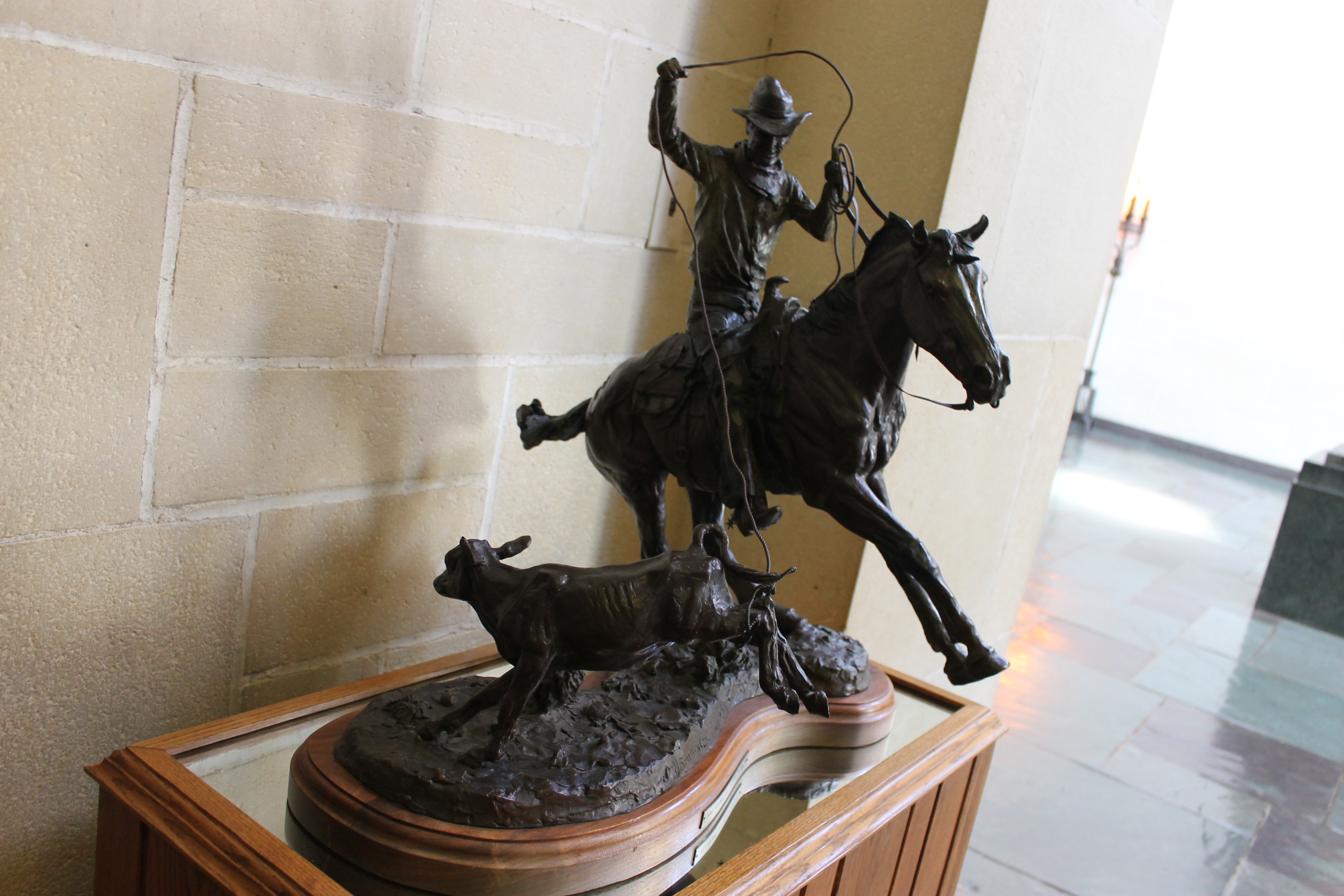
Small sculpture of Rogers roping a calf

Small sculpture of Rogers roping a calf

Part of Will Rogers saddle collection

Part of Will Rogers saddle collection

The back of the Will Rogers Museum

The back of the Will Rogers Museum

Will Rogers tomb

Will Rogers tomb

Posing with Will Rogers's statue

Posing with Will Rogers’s statue

The museum opened in 1938 and was dedicated on what would have been his 59th birthday. The land where the museum stands was purchased by Will and his wife Betty in 1911. Betty donated the land to the state in 1937, according to the Will Rogers Memorial Museum.

Along with Rogers, his wife Betty (d. 1944) and their four children: Fred Stone Rogers, 1918-1920; Mary Amelia Rogers Brooks, 1913-1989; and James Blake (­Jim) Rogers, 1915-2000; as well as Jim’s wife, Marguerite Astrea Kemmler Rogers, 1917-1987 lay to rest behind the museum.

If you are ever in the Claremore, OK area, I highly suggest visiting the Will Rogers Memorial Museum.

For someone who lives in the southeast with few historical film museums to offer, it was a treat to get to visit the Will Rogers Museum and his resting place.
It was peaceful and a beautiful tribute to a highly respected man.

IMG_6457

“Being a hero is about the shortest-lived profession on Earth.”

Check out the Comet Over Hollywood Facebook page, follow on Twitter at @HollywoodComet or e-mail at cometoverhollywood@gmail.com

Leaving Hollywood for a new habit: An interview with Dolores Hart

She gave Elvis his first on-screen kiss.

Roles in “The Courtship of Eddie’s Father” and “The Ticklish Affair” that later went to Shirley Jones were originally offered to her.

Her career began in 1957 with the film “Loving You” along side Elvis Presley and ended in 1963 with the film “Come Fly with Me.”

But at the height of her career in 1963, Dolores Hart left Hollywood to follow a vocational calling to become a nun.

Dolores Hart in the 1960s and now as Revered Mother Dolores today (Comet Over Hollywood/Jessica Pickens)

Dolores Hart in the 1960s and now as Reverend Mother Dolores today (Comet Over Hollywood/Jessica Pickens)

 “I am not leaving anyone or anything behind me. I am taking with me a full and grateful heart,” Hart left as a statement with her publicist.

The media frenzy that followed cited her broken engagement with her former fiancé Don Robinson. The National Enquirer headline read “Star Driven into Nunnery by her Love for Elvis.” Colleagues and friends were dumbfounded.

To Hollywood, family and friends, Hart’s decision to become a nun may have seemed rash. But her choice was a long road of exploration of her faith that was triggered by her first visit to the Abbey of Regina Laudis in 1958.

Hart published the book “The Ear of the Heart: An Actress’ Journey from Hollywood to Holy Vows” in May that explores her parent’s tumultuous marriage, why she became a Catholic, her career as a film star and her life as a nun.

Her parents had the desire to become Hollywood film stars. However, her father Bert Hicks mainly played bit roles. Her parents divorced while she was still young. While attending Catholic school, she decided to convert so she could have hot chocolate and cinnamon rolls with the other children.

She is often asked if her role as Saint Claire in “Francis of Assisi” (1961) is what influenced her decision to become a nun. The role had no effect but meeting Pope John XXIII while filming left an impact on the actress.

Saturday morning, I had the privilege to meet with Dolores Hart in Charlotte, NC before she spoke at the Charlotte Eucharist Convention. “Ear of the Heart” is one of the best celebrity autobiographies I have read. Rather than full of gossip and salacious rumors, it discusses her journey through life. I couldn’t help but feel calm and soothed every time I picked it up.

We met and spoke about her book as well as her time in Hollywood and at Regina Laudis.

Though she was a little older and was dressed in a nun’s habit and robe, her smile and sparkling clear blue eyes were the same ones you see in her films such as “Where the Boys Are.”

Revered Mother Dolores was warm, personable and an overall lovely woman.

IMG_6649

Reverend Mother Dolores and myself in Charlotte, NC on Sept. 14

 Q: Tell me about the Eucharist Conference you are in town for today.

I’m actually not that familiar with it because I have been in an enclosed monastery.  I don’t remember anything like this before I entered. It’s wonderful seeing the intensity of love for the sacrament…Not love in the usual form of the word but transcending love that can hold the passion of and sadness of life.

Q: What influenced you to write the book?

I think it’s because my old friend Dick DeNeut encouraged me to do it. He told me if I didn’t write it soon, I would forget everything. We started in 2003 and it has taken a long time to put it in its present form. I’m fortunate to have someone like Dick. He knows me so well and we were very close. We have had strong communication for decades. I think the beautiful part of the preparation is that he would always be frank with me. He wouldn’t say things that made me feel good but would be frank in order to awaken and receive an honest response.

Q: Which Catholic celebrities in Hollywood supported your decision?

Dolores Hart with George Hamilton in "Where he Boys Are"

Dolores Hart with George Hamilton in “Where he Boys Are”

Hart discusses in her book being friends with other Hollywood Catholics during her stardom such as Irene Dunne and Loretta Young. She once was invited to speak at a Jesuits’ Church of the Blessed Sacrament breakfast in 1958 that was attended by Catholic celebrities.

June Haver was one of the most faithful friends I had in Hollywood, and so was Patricia Neal. Others were complimentary. June would visit several times a year and try to find ways to help us. She loved visiting our dairy farm and working with the farm animals. Once she asked how the pigs reproduce. We told her we had a semen tank, but it was actually running low. She said that was how she would help us. Well, the local newspaper in town heard about it and came out with a story saying June Haver was buying nuns a semen tank. It was hysterical. But she would come to visit us on a yearly basis.

Q: How often were you compared to June Haver, who once entered as a nun and later left?

Dolores Hart with Elvis Presley in 1957 in a still for "Loving You"

Dolores Hart with Elvis Presley in 1957 in a still for “Loving You”

When I first started considering, Mother Benedict told me to take some time to put everything in order so I wouldn’t become another statistic. I didn’t know June at the time and I wasn’t aware of her personal struggles. She once entered as a nun herself and left. When we finally met I could perceive the depth of goodness and that she had struggled a great deal. She was very honest and never claimed what wasn’t true. She was a great lesson to me.

Q: How did Hollywood help or hurt you in a cloistered community?

I didn’t understand in the beginning how I could benefit from my Hollywood experiences. I accept the time in Hollwood as part of God’s will. I appreciate the goodness of the venture. I didn’t leave to reach for something better or a higher value.

People in the industry are so open. Producer Hal Wallis saw some sort of value in me to give me a seven year contract. He was furious when I left and told me not to bother coming back to work for him. I understood that because I was breaking professional expectation of truth. That was a profound step in his reality of life. But then after 15 years, he broke down and we became friends again. His wife Martha Hyer still sends us a basket of fruit every year.

My agent Harry Bernson sent me a note and asked if I had swallowed razor blades and said I had committed suicide. But then he eventually saw it was the right thing.

Those friendships shown to me by a number of actors showed me integrity of human values in every religion.

Q: If you hadn’t left Hollywood, how do you think your career would have ended up?

If I hadn’t left Hollywood, we probably wouldn’t be talking right now. The interest in me wouldn’t be there. People are interested because I became a nun.

I don’t think my career would have petered out, but then I have seen so many people come and go and you never see them again. Depending on roles, most women in Hollywood only work until their early 40s. You can’t bank on your career being a given.

My grandfather was a movie projectionist and had seen all the films. When I got older, I confessed to him that I wanted to become an actress. He told me he had seen them all and knew I would be the best at it. For a grandfather to say that was the best possible compliment.

Q: You also left Hollywood right before things began rapidly changing. Were you aware of the changes in Hollywood with the studio system?

Because I was still a member of the Academy, I still had an interest in what was happening with the studios, but I don’t remember judging it. People say that the film industry is what led the way to society changes. I could tell changes by the way people talked and dressed. There was a deeper sense of fear that life wasn’t worth much. I noticed people were dressing sort of in a dumpy way. I couldn’t believe a woman would wear jeans and high heels in the airport. That was really campy to me.

I think the film industry really reflected what was going on in society. They were always champions in exfoliating what was going on with people.

Hart with fan mail in 1960

Hart with fan mail in 1960

Q: How much fan mail do you receive each year?

It depends on what’s going on. As I have been on tour for the book, I have received a considerable amount. I usually receive two or three letters a day. By the end of the week it turns into a mountain of mail, so it’s a continuous obligation. When the documentary “God is Bigger than Elvis” came out two years ago, the situation changed. We did the film and it was my break through back into public life. I got so much fan mail after and I had to have some of the sisters help me stamp and address letters.

 Q: One last question, do you still watch any of your movies?

I have seen them so often that they bore me. I will watch them though if someone requests to watch a movie with me. Sometimes I discover something new by a question they present. The community doesn’t want to see my movies anymore, because they are tired of them.

For more on her kiss with Elvis and acting with Montgomery Clift stay tuned to Comet Over Hollywood in the coming days for a full book review.

Check out the Comet Over Hollywood Facebook page, follow on Twitter at @HollywoodComet or e-mail at cometoverhollywood@gmail.com
Doris Day: From Hollywood party to leading role
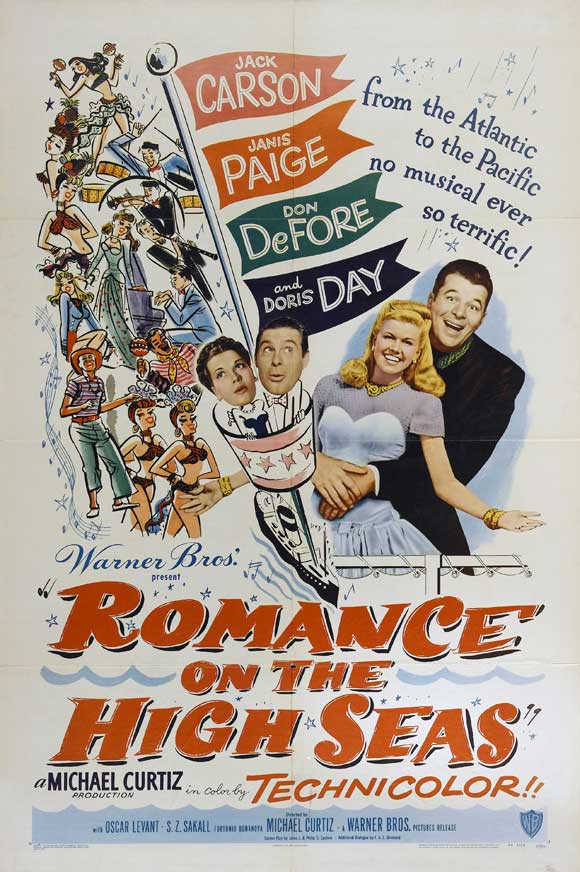
romance on the high seasGeorgia Garrett is a fast talking, cigarette smoking, flirtatious night club singer–and she is the character played by Doris Day in her very first film “Romance on the High Seas” (1948).

While other actresses worked their way up to stardom through bit parts and uncredited roles, Day starred in her first movie.

And she continued starring in all 41 of her films from 1948 to 1968.

In the film, newly married Elvira Kent (Janis Paige) and Michael Kent (Don DeFore) worry that the other spouse is having an affair.

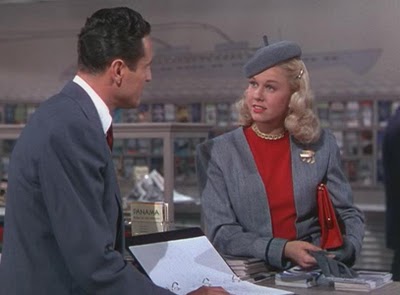
Georgia, a broke singer in a sleazy nightclub, frequents the travel agency and plans trips she never goes on and gets passport photos taken each time. Elvira meets Georgia in the travel agency while booking her trip to South America.

“But you have already had seven passport photos taken,” one travel agent says.

“But never as a blond,” Georgia coyly says.

Day as Georgia Garrett in the travel agency

Day as Georgia Garrett in the travel agency

On their third wedding anniversary, the Kents have to cancel a third anniversary trip due to business.  Michael tells Elvira to go without him.

Suspecting that Michael is going to fool around with his pretty new secretary, Elvira sends Georgia on the cruise in her place so she can stay behind and spy on her husband.

Also afraid that his wife is going to fool around on the cruise without him, Michael sends private detective Peter Virgil (Jack Carson) on the cruise to look after his wife.

Paige as Elvira instructing Day as Garrett

Paige as Elvira instructing Day as Garrett

Georgia, while posing as Elvira Kent, falls for Peter, and Peter thinks he is going to lose his job.

Romance on the High Seas” isn’t Doris Day’s most well-known film, but it’s my favorite.

While in the 1950s and 1960s Day was known for her squeaky clean, virginal persona, but her character in “Romance” has some sass.

Day started her career as a girl singer in 1939 for big band leaders such as Les Brown and Bob Crosby, brother of Bing Crosby.

By 1945, she had her first hit with “Sentimental Journey” which resonated with soldiers fighting over seas. More hits followed such as “My Dreams are Getting Better all the Time.”

“In a sense, ‘Sentimental Journey’ became the serviceman’s theme song,” Day wrote in her autobiography, “Doris Day: Her Own Story.

Before heading back East after a visit to Los Angeles, Day was convinced to attend a party at the home of Jule Styne, an American songwriter.

When everyone started performing songs at the party, Day began to get uneasy.

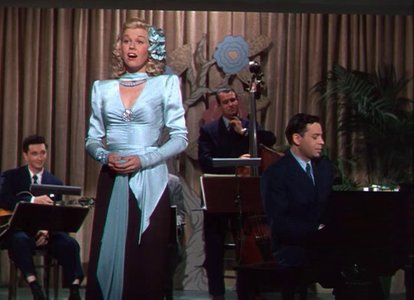
Day as a nightclub singer singing "I'm in Love"

Day as a nightclub singer singing “I’m in Love”

“These people loved singing for each other but I am painfully shy at parties, and particularly shy about performing impromptu,” she wrote.

Day was also going through a divorce at the time with child actress Virginia Weidler’s older brother, George.

She was asked to sing and was convinced to sing the chorus of “Embraceable You.”

The Gershwin tune landed Day her first film role, as the star of a musical comedy.

Styne wrote the score to the Warner Brothers film “Romance on the High Seas.” Judy Garland was originally slated to play Georgia Garrett, but the deal fell through.

Then Betty Hutton was set for the film, but she got pregnant and couldn’t be in the film, according to Day’s autobiography.

“Acting in films had never so much crossed my mind. I was a singer…” she wrote. “They kept telling me how lucky I was to be testing for the lead in a major musical and how many girls would die to be in my shoes, but I was sitting glumly looking out the window, only half listening.”

Her look was made to resemble Betty Hutton and she was encouraged to sing in Hutton’s signature energetic style during the test.

“But when we shot the scene, I did it my own way,” she wrote. “I instinctively understood something then that was to sustain with me through all the years that followed-to thine own self be true. Don’t imitate.”

Jack Carson and Doris Day meet on board the ship

Jack Carson and Doris Day meet on board the ship

Through being herself, Day gives a hilarious performance in the sparklingly musical, comedy which included one of her top hit songs, “It’s Magic.”

After the film became a hit, Day’s option was picked up for more Warner films. However, she wasn’t pleased with the movie. She dressed very casually and didn’t like the ultra glamorous look she had in the film.

Though Day wasn’t pleased with her first film appearance, “Romance on the High Seas” is my favorite Doris Day film—and I have seen all but two of her movies.

Along with the main cast of Jack Carson, Day, Don DeFore and Janis Paige—the movie has top notch character actors. Supporting actors include S.Z. “Cuddles” Sakall, Oscar Levant and Eric Blore.

Paige and Day would later star with each other again in “Please Don’t Eat the Daisies” (1960). Carson starred with Day in her next two films “It’s a Great Feeling” (1949) and “My Dream Is Yours” (1949).

“Romance on the High Seas” has it all: glamorous wardrobes, sparkling color, hilarious jokes and quality songs written by Sammy Kahn and Jules Styne.

Though Day is best known for her bedroom farce films such as “Pillow Talk” (1959) with Universal, her early Warner Brothers films are some of her best.

Fresh faced films, sunny and shining with Day’s smile.

This is part of the Summer Under the Stars blogathon. Check here for other posts on Doris Day.

Check out the Comet Over Hollywood Facebook page for the latest updates.

The All-American Aphrodite: Remembering Esther Williams

My cinema relationship with Esther Williams helped shape my film interests.

I didn’t full watch any of her films until 2003 when my film appetite craved musicals.

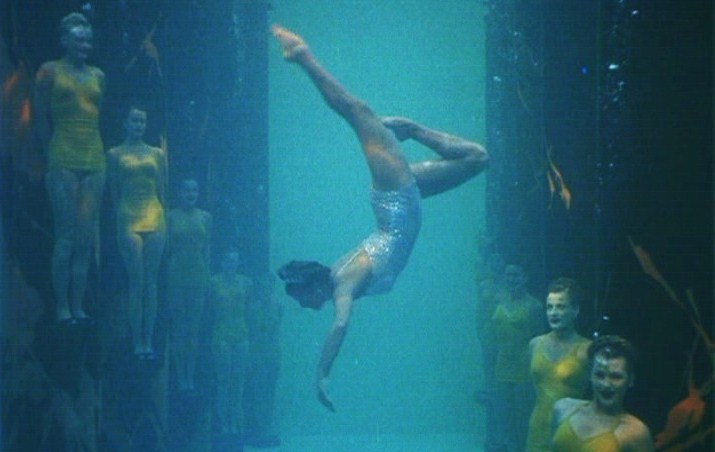
A swimming scene from "This Time for Keeps"

A swimming scene from “This Time for Keeps”

As I gorged on her candy-colored, aqua musical extravaganzas, I couldn’t wait until I could see another film. Each of her musicals brings back memories of spending weekends endlessly watching her movies.

When I was 15 I read her autobiography, “The Million Dollar Mermaid.” It’s my favorite film autobiography that I’ve read so far.

When I was 17, I bought one of her Esther Williams bathing suits.

Williams inspired me to practice swimming strokes and try to learn how to swim (I failed swimming lessons when I was five years old. How embarrassing).

I remember in 2004 when she was highlighted during TCM’s August Summer under the Stars series. I wasn’t looking forward to going back to school in August but my excitement of Esther Williams’ day out-weighed my dread.

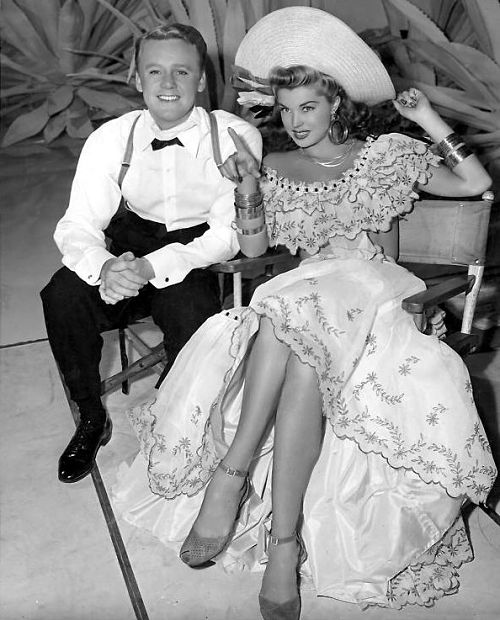
Esther Williams and frequent co-star Van Johnson in "Easy to Wed"

Esther Williams and frequent co-star Van Johnson in “Easy to Wed” dressed for the number “Bonecu de Pixe.” Carmen Miranda helped them with the Portuguese lyrics.

But it’s not just how she affected my every day actions, but my film knowledge that makes her important to me.

To date, I have seen all but two of Esther Williams’ films: “A Raw Wind in Eden” and “The Big Show.”

Esther Williams’s films are a textbook example of the mid-1940s to early 1950s MGM musicals: brightly colored, beautiful clothing and lavish musical numbers that may include Williams swimming, Xavier Cugat and his band shaking maracas or opera singer Lauritz Melchior belting a tune.

Her films also introduced me to my biggest film crush- Van Johnson.

Something I have always found appealing about Williams is that she is very attainable.

Her beauty is natural and girl-next-door like and her figure is athletic, rather than actress anorexic. In her 1996 Private Screenings Interview with Robert Osborne, she said becoming a star was all an accident.

Continue reading