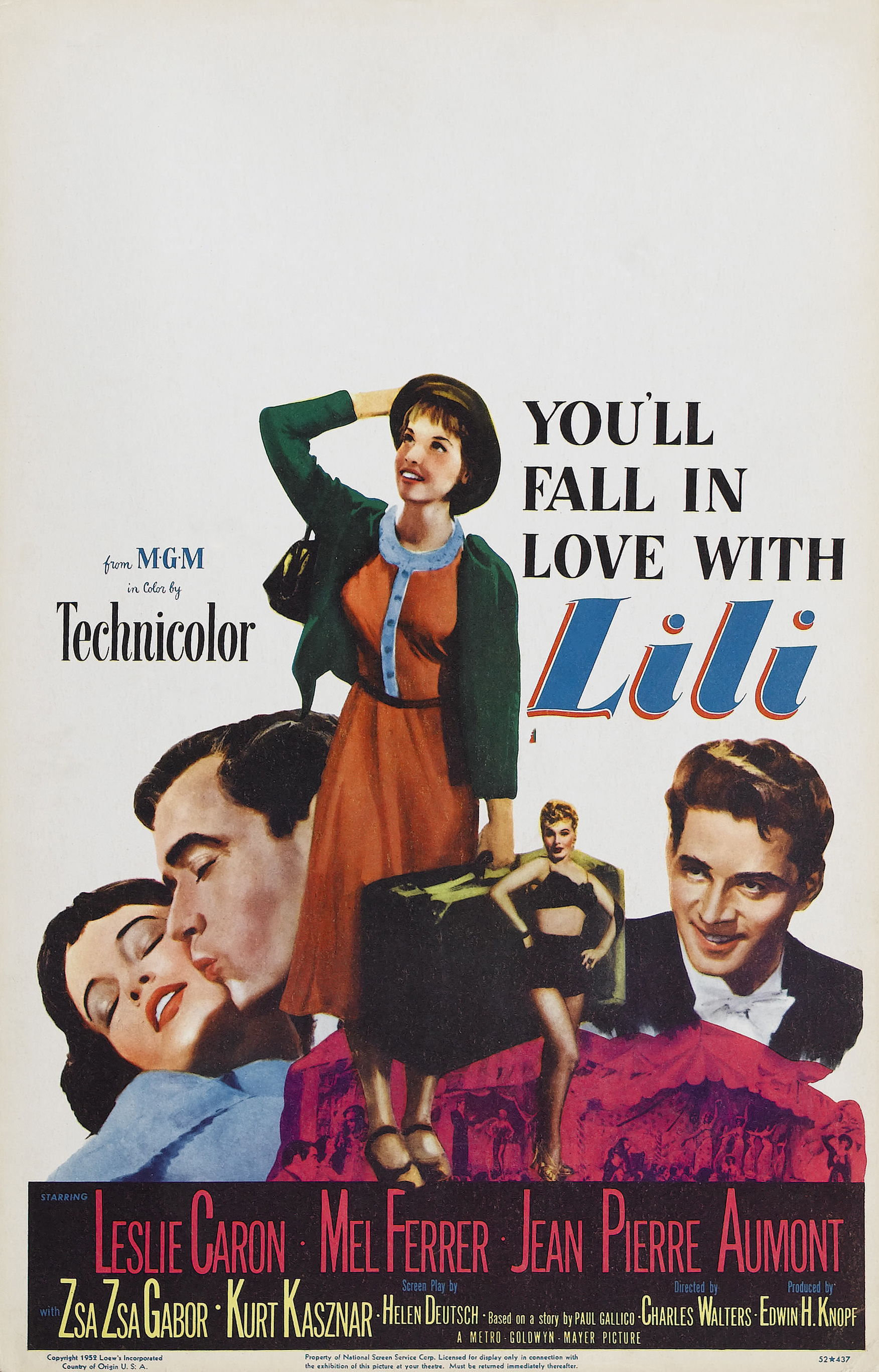
Musical Monday: “Lili” (1953)

It’s no secret that the Hollywood Comet loves musicals.
In 2010, I revealed I had seen 400 movie musicals over the course of eight years. Now that number is over 500. To celebrate and share this musical love, here is my weekly feature about musicals.

liliThis week’s musical:
Lili“– Musical #473

Studio:
MGM

Director:
Charles Walters

Starring:
Leslie Caron, Mel Ferrer, Jean-Pierre Aumont, Zsa Zsa Gabor, Kurt Kasznar

Plot:
An orphan young girl named Lili (Caron) goes to work for a baker who has already died. She is taken in by a carnival group and develops a crush on the lecherous magician Marc (Aumont). After she loses a waitressing job in the carnival, she doesn’t know who to turn to. Just as she considers taking her life, a puppet calls to her from the puppet booth (with Mel Ferrer behind the curtain). Lili sings and jokes with the puppets, and a crowd grows behind her. The angry Paul (Ferrer) sees the crowd and stars an act with Lili. The whole time, Lili is still infatuated with Marc, which angers Paul.

Trivia:
-Leslie Caron is supposed to play a 16 year old girl in the film. She really was 22 years old.
-Gower Champion directed a stage version on Broadway of the movie in 1961 called “Carnival.” The Leslie Caron role was played by Anna Marie Alberghetti.
-The song “Hi-Lilli Lo-Lilli” reached #30 on the charts
-Based on the Saturday Evening Post short story “The Man Who Hated People” by Paul Gallico. The story was based on the puppet show “Kukla, Fran and Ollie”.
-Bronislau Kaper won an Academy Award for Best Music Scoring
-Other Academy Award Nominations: Leslie Caron was Best Actress, Best Art Direction for a Color film, Best Cinematography for a Color film, Charles Walters for Best Director, Helen Deutsch for Best Writing, Screenplay
-Cabaret puppeteers Walton and O’Rourke made the puppets for the film.
-Professional puppeteers worked the puppets of Carrot Top, Golo the Giant, Marguerite and Reynardo—not Mel Ferrer.

Leslie Caron as Lili talks with puppets

Leslie Caron as Lili talks with puppets

Highlights (and unintentional humorous scenes):
-Lecherous Aumont says about young Lili “The female soul is like a chestnut, it has to go through fire before it gets delicious”
-Mel Ferrer’s character used to be a great dancer, but his leg was injured in the war so he can no longer dance. And he’s bitter. At one point, he angrily shouts, “I shall now perform a double pirouette!” and then dramatically slams into a cabinet and says he no longer can dance. It’s hilariously awkward.
-During a dream sequence, Caron sort of dances with Aumont. She first wears a sexy waitress outfit and then is transformed into a slinky sequin dress that his assistant (Gabor) wears.
-Caron says that Carrot Top the puppet is her boyfriend.
-Ferrer walks in as Aumont is trying to seduce Caron. Ferrer basically calls her a whore, but a short time later is calling her sweet and as pure as a silver bell.
-After being hurt by both Ferrer and Aumont, Caron decides to leave. Ferrer convinces her to stay through the puppets. Caron hugs the puppets. Then Caron asks, “Why do you hide behind these puppets?” Ferrer yells, “I am the puppets!”
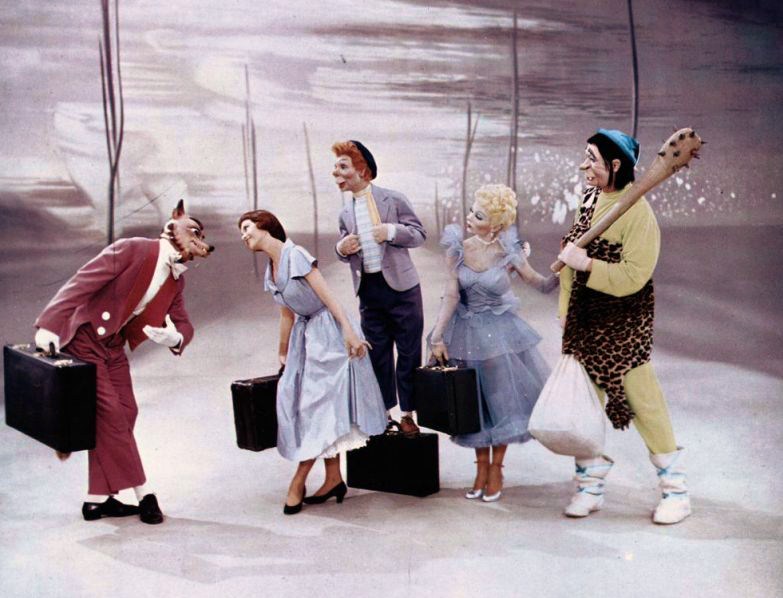
-Caron finally leaves town and has another dream sequence and has a dream sequence where she is walking with life sized versions of Ferrer’s puppets.

Lili dances with life size puppets during a dream sequence.

Lili dances with life size puppets during a dream sequence.

Notable Songs:
-Though this is said to be a musical, “Lili” only has one song that is sung multiple times: “Hi-Lilli, Lo-Lilli”

My Review:
Several reviews says that “Lili” is refreshing, charming and whimsical, but I can’t say that I was as enchanted. The premise of the story is fairly charming, but the puppets, the lecherous men and Mel Ferrer’s dramatic outbursts killed it for me.
The movie-dubbed a musical- was a huge waste of Leslie Caron’s immense talent as a ballet dancer. Caron’s film career started off with the extravaganza “An American in Paris” (1951) where she had elaborate dance scenes. Even in the dream sequences, Caron only made a few prances here and there, but nothing that showed off her professional dancing skills.
Following “Lili,” Caron once again got to show off her ballet skills in “The Glass Slipper” (1955) and “Daddy Long Legs” (1955).
All in all, I found “Lili” rather strange and couldn’t close my mouth from disbelief when the film ended.

Check back next week for Musical Monday.

Check out the Comet Over Hollywood Facebook page, follow on Twitter at @HollywoodComet or e-mail at cometoverhollywood@gmail.com

Musical Mondays: “Three Smart Girls” (1936)

It’s no secret that the Hollywood Comet loves musicals.

In 2010, I revealed I had seen 400 movie musicals over the course of eight years. Now that number is over 500. To celebrate and share this musical love, here is my weekly feature about musicals.

This week’s musical:
Three Smart Girls” (1936) Musical #132

Three_Smart_Girls_Poster

Studio:
Universal Pictures

Director:
Henry Koster

Starring:
Deanna Durbin, Ray Milland, Charles Winneger, Binnie Barnes, Alice Brady, Mischa Auer, Nan Grey, Barbara Read, Lucile Watson,

Plot:
Three sisters (Read, Gray, Durbin) living with their mother in Switzerland hear that their father (Winneger) is remarrying. The sisters travel to New York to see their father- who they haven’t seen in 10 years- to stop the wedding so their parents can get back together. The sisters scheme to make the new, gold-digging bride (Barnes) turn her attention to a wealthier fellow

Babara Read, Deanna Durbin and Nan Grey as sisters in "Three Smart Girls"

Barbara Read, Deanna Durbin and Nan Grey as sisters in “Three Smart Girls”

Trivia:
-Opera singing actress Deanna Durbin’s first film
-Louis B. Mayer had Durbin and Judy Garland both tested for MGM Studios. Garland was signed with MGM while Universal signed Durbin. Garland cried when she saw Universal had faith in Durbin to lead in her first films, and MGM was sticking Garland into supporting roles, according to the 2010 book “The Songs of Hollywood” by Philip Furia and Laurie Patterson.
-“Three Daring Daughters” (1948) is not officially said to be a remake, the movies are very similar. Opera singing Jane Powell is similar to the Deanna Durbin role and the daughters are trying to get their newly married mother back with their father. The films end differently, though.
-The plot can also be compared to the Hayley Mills Disney film, “The Parent Trap” (1961).
-Followed by “Three Smart Girls Grow Up” (1939) and “Hers To Hold” (1943)
-Nominated for an Academy Award for Best Picture of 1936 against films such as “The Great Ziegfeld,” “Libeled Lady,” “Anthony Adverse,” “Mr. Deeds Goes To Town,” “Romeo and Juliet” and “San Francisco.” “The Great Ziegfeld” was the Best Picture winner that year.
-The film was also nominated for an Academy Award for Best Sound Recording and Best Writing for Original Screenplay.

Notable songs:
None of the songs are terribly familiar or familiar, other than “Il Bacio,” but they all showcase Durbin’s beautiful voice. Aside from a brief song from Binnie Barnes, the four songs sung in the comedy are all by Durbin.

My review:

Young Ray Milland (Screencap by Michael Troutman at I Shoot the Pictures http://ishootthepictures.com/2011/12/15/my-deanna-durbin-punishment-part-i-three-smart-girls-1936-worth-a-look/)

Young Ray Milland (Screencap by I Shoot the Pictures)

Though I’m not sure how the movie was nominated for Best Picture, I really enjoy “Three Smart Girls” (1936).
The film would have catered to both adult and child audiences in 1936 with the adult and child stars in the film.
It’s also a joy to see young Ray Milland early in this film career. Though he started in films in the early 1930s, “Three Smart Girls” was around the time when he started playing credited roles.
This is not your average musical full of singing and dancing in the middle of the street. “Three Smart Girls” is a comedy serving as a vehicle for up and coming star Deanna Durbin. The plot tells that she is taking singing lessons to become an opera singer, and she will break into song when asked.

Check back next week for Musical Monday.

Check out the Comet Over Hollywood Facebook page, follow on Twitter at @HollywoodComet or e-mail at cometoverhollywood@gmail.com
1-Adam-12…1-Adam-12

During a time when law enforcement and the military weren’t popular in the United States, Officers Pete Malloy and Jim Reed patrolled the streets of Los Angeles.

Kent McCord as Jim Reed and Martin Milner as Pete Malloy in "Adam-12" (Source: KentMcCord.com)

Kent McCord as Jim Reed and Martin Milner as Pete Malloy in “Adam-12” (Source: KentMcCord.com)

From September 1968 to May 1975, the two officers arrested murderers, lectured motorcyclists and helped women in childbirth in the television show “Adam-12” starring Martin Milner (Malloy) and Kent McCord (Reed).
Produced by Jack Webb, who also created “Dragnet” and “Emergency,” the show portrays the professionalism of police officers and police departments. Webb made the shows so accurate that some police academies used the shows for training, according to IMDB.
To keep the accuracy, Reed’s badge was even changed from “Policeman” to “Police Officer,” according to Adam12Code3.com.
Pop culture
Adam-12 ” shows the military style of the police force while showing that Reed and Malloy were young, contemporary and had lives outside the force.
For example, Malloy was set up on blind dates and Reed and his wife have a baby. On their day’s off, Malloy can be seen driving muscle cars and both wear loud, floral shirts-fashionable at the time.
The show conveyed realistic issues relevant to the late-1960s and 1970s:
-Marijuana use and addiction to pills, heroin and other drugs
-Teenagers running away from home to travel to San Francisco
-Disrespect for law enforcement with use of terms such as “down with the pigs”
Guest stars
Popular celebrities of the time and old Hollywood stars frequently showed up on Adam-12, making the show an extra treat for current day pop culture fans. Some of these included:
-Child star Margaret O’Brien as a the mother to a delinquent child-Season Three, Episode 12

Child actress Margaret O'Brien plays mother to child delinquent Buddy Foster (brother of Jodie Foster) in the 1970 episode "Sign of the Twins" (Source: KentMcCord.com)

Child actress Margaret O’Brien plays mother to child delinquent Buddy Foster (brother of Jodie Foster) in the 1970 episode “Sign of the Twins” (Source: KentMcCord.com)

-Actor John Kerr as a priest- Season Two, episode 8
Leave it to Beaver actor Tony Dow as a ex-Marine who’s car is stolen by a girl-Season Three, episode 5
-Monkees singer Mickey Dolenz as a police hating motorcyclist- Season Five, episode 1

The Cross Over
Since Webb produced “Dragnet,” “Adam-12” and “Emergency” and all were set in Los Angeles—the shows overlap throughout the years.
Emergency” started in 1972, when “Adam-12” was in its fifth season. On “Emergency,” you will occasionally see the officers drop by Rampart Hospital, the hospital “Emergency!” paramedics report to, in episodes.

Milner and McCord with Julie London as Dixie McCall-an "Emergency!" character

Milner and McCord with Julie London as Dixie McCall-an “Emergency!” character

In season 5, episode 4 of “Adam-12” called “Lost and Found,” the police officers take a young boy to Rampart Hospital. There they run into “Emergency!” characters such as Nurse Dixie McCall (Julie London), Paramedic Roy DeSoto (Kevin Tighe), Paramedic Johnny Gage (Randolph Mantooth) and Dr. Kelly Brackett (Robert Fuller).
Supporting actors of “Adam-12” also can be seen in “Emergency!” Bing Crosby’s son, Gary Crosby plays a police officer in “Adam-12” and a paramedic in “Emergency!” In both shows, Crosby’s character is a bit of a show off, taking credit he doesn’t deserve.
Actor Marco Lopez can be seen as an officer in “Adam-12,” but has a larger role in “Emergency!” as Firefighter Marco Lopez.

What’s so special about Adam-12?
“Adam-12” was certainly not the only police show on television during the late 1960s and early 1970s. Others included:
-“The FBI” (1965 to 1974) starring Stephen Brooks and Efrem Zimbalist, Jr. telling different F.B.I. cases.
-“Hawaii Five-0” (1968 to 1980) starring Jack Lord and James McArthur about a detective who is the head of the special state police task force
-“Ironside” (1967 to 1975) starring Raymond Burr who is a paraplegic detective
– “Mannix” (1967 to 1975) starring Mike Connors who plays a private investigator
-“The Mod Squad” (1968 to 1973) starring Michael Cole, Clarence Williams III, Peggy Lipton, Tige Andrews who play “hippie” undercover cops.
Most of the crime shows on television during this time seemed to focus on daring detectives or spies, a popular topic due to the Cold War and films such as James Bond.
However, Adam-12 is one of the few TV series that showed the honest day-to-day approach of the men in blue. Reed and Malloy patrolled the streets, chased criminals through alleyways and sometimes found time to stop and eat a hamburger.

Milner, McCord and Bill Boyet. (Source: KentMcCord.com)

Milner, McCord and Bill Boyet. (Source: KentMcCord.com)

The television show doesn’t present their job in a glamorous but as a realistic and necessary job.
When “pig” was a popular term for police officers, Webb tried to present the police force fair. And on top of that, Reed and Malloy were attractive and pretty darn cool.
In my opinion, “Adam-12” is one of the best police shows ever made. It doesn’t clog the plot with pointless drama but keeps on target with the topic of officers keeping law and order.

This post is part of the MeTV blogathon. Check out more classic TV posts here.

metv

Check out the Comet Over Hollywood Facebook page for the latest updates or follow on Twitter at @HollywoodComet.

Musical Monday: “Summer Magic” (1963)

It’s no secret that the Hollywood Comet loves musicals.
In 2010, I revealed I had seen 400 movie musicals over the course of eight years. Now that number is over 500.
To celebrate and share this musical love, I’m starting a weekly feature about musicals.

This week’s musical:
Summer Magic (1964) — Musical Number 44

summer magic poster

Starring:
Hayley Mills, Burl Ives, Dorothy McGuire, Deborah Walley, Una Merkel, Peter Brown, James Stacey, Eddie Hodges, Jimmy Mathers

Director:
James Neilson

Studio:
Walt Disney Studios

Plot:
Set at the turn of the century, the Carey family finds themselves penniless after their father dies. The family moves from Boston, Mass. to Beulah, MN to a home Nancy (Mills) remembers the family admiring while they were on vacation. Once they arrive at the home, they find it run-down, but with the help of post master Osh Popham (Ives), the family fixes up the home. Surrounding the bustle of fixing up the home, the Carey’s snobby orphan cousin Julia (Walley) comes to live with them, and Julia and Nancy fall for the same boy (James Stacey).

Nancy (Mills) and Julia (Walley)

Nancy (Mills) and Julia (Walley)

Trivia:
-“Summer Magic” is based off the book “Mother Carey’s Chickens” by Kate Douglas Smith Wiggin
-The film is also a remake of the non-musical 1938 film “Mother Carey’s Chickens” starring Anne Shirley, Ruby Keeler, James Ellison, Walter Brennan, Fay Bainter, Virginia Weidler and Ralph Morgan.
-The movie was originally supposed to star Annette Funicello
-The song “On the Front Porch” is songwriter Robert Sherman’s personal favorite song from his own work, according to Sherman’s 1998 book “Walt’s Time: Before and Beyond”
-Walt Disney didn’t like the song “Ugly Bug Ball” sung by Burl Ives. Sherman persuaded Disney to keep the song and it went on to be a popular song from the film, according to Sherman’s book.
-The youngest brother, Peter Carey, is played by Jimmy Mathers—brother to Jerry Mather’s of “Leave It To Beaver” fame.
-Dorothy McGuire’s singing is dubbed by Marilyn Hooven

Osh (Burl Ives) sings “On the Front Porch”

Notable Songs:
-Most of the songs are silly and forgettable but are still pretty catchy, lighthearted and enjoyable. Some of my favorites include:
– Femininity- Nancy (Mills) and Julia (Walley) sing this song to Lallie Joy Popham (Wendy Turner) so that Nancy’s brother Gilly (Hodges) will notice her.
The song tells Lallie Joy to “hide the real you,” “men adore good listeners” and “don’t laugh too loud”
-Pink of Perfection- Gillie (Hodges) and Nancy (Mills) sing a song making fun of Julia saying she is a “dainty baboon,” has the “the charm of a moose” and has knock knees. The song is sung in their distain when they hear Julia is coming to stay with them.
-Ugly Bug Ball sung by Osh (Ives) and Peter (Mathers). It’s not personally my favorite song in the film and is mainly footage of different bugs crawling, but it’s catchy and cute.
-Flitterin’- sung by Mills, Hodges and McGuire (dubbed). The family sings it when they get a player piano as they are packing to Maine. It’s a brief little tune, but it’s catchy. Really, I enjoy it because I sang this song in the four times I have moved in the last two years.

My Review:
I’ll never forget the summer my mom introduced “Summer Magic” to my sisters and I. My dad was out of town on a business trip and she recorded it special off the Disney Channel for us to watch.

Since then, it has been a special favorite, filled with color, catchy Sherman brothers’ songs, and an outstanding cast. The turn-of-the-century costumes by Bill Thomas are also beautiful. Thomas dressed Deborah Walley in pink and Hayley Mills in yellow and it’s just gorgeous to see.

“Summer Magic” isn’t as well known as other Disney films such as “Old Yeller” or “The Parent Trap,” but it is a lot of fun and is a movie I grew up on.

If you like Hayley Mills films, you can’t go wrong with this one. But aside from Hayley, the supporting cast is gold! Dorothy McGuire as the mom and Burl Ives and Una Merkel are a hilarious treat as a quarreling married couple. Not to mention James Stacey and Peter Brown who round out the cast as handsome male leads (though Peter Brown disappointingly has very little screen time). You also see pre-Bonnie and Clyde Michael J. Pollard.

This is a remake of the 1938 film “Mother Carey’s Chickens,” starring Anne Shirley, Ruby Keeler, James Ellison, Frank Albertson, Fay Bainter and Donnie Dunagan (the voice of Bambi). While that is a fun (non-musical) film, I do prefer this one better. “Mother Carey’s Chickens” shows the audience when the father (Ralph Morgan) passes away. But I don’t feel like we get as deep into the romance aspect as “Summer Magic.” Also, Donnie Dunagan’s character is just annoying.

I would have loved to see what this movie would have been like had it really starred Annette Funicello, but it’s still pretty wonderful with Hayley Mills.

Even through it’s silly, forgettable songs and sometimes crazy plot, “Summer Magic” is one of my favorites. I’m fairly certain you will be “flitterin'” also.

Nancy (Mills) enters the Halloween party with handsome Tom Hamilton (Peter Brown) in “Summer Magic”

Check back next week for Musical Monday.

Check out the Comet Over Hollywood Facebook page for the latest updates or follow on Twitter at @HollywoodComet.

Classic in the Carolinas: Lost silent film based on Elkin, NC

Comet Over Hollywood is doing a mini-series of “Classics in the Carolinas.” I’ll be spotlighting classic movie related topics in South Carolina (my home state) and North Carolina (where I currently live and work).

Elkin, North Carolina is a small town of roughly 4,000 people.

It also is the setting of a silent film made in 1915, and the film is currently lost.

Clara Kimball Young in "Heart of the Blueridge"

Clara Kimball Young in “Heart of the Blueridge” scanned from the book the film was based on.

The film “Heart of the Blue Ridge” is based off a book written by Waldron Baily, a former Elkin mayor.

Baily, originally from Mount Kisco, N.Y., moved to Elkin in 1896 and started Baily Manufacturing Company, according to the history book “Elkin” by Elkin native Jason Couch.

“I called it ‘my Elkin,’ because we all came to love it so,” Baily said in his autobiography published posthumously in 1958.

Baily became mayor in the late 1890s until he moved back up North in 1903, Couch said

“And I, a Yankee…was elected with only two votes over the other fellow,” Baily wrote.

Baily wrote “Heart of the Blue Ridge” book in 1915 after he left Elkin. The book was based off the Stone Mountain and Elkin areas.

The silent film based on the book was released in October 1915 starring Clara Kimball Young as Plutina, Chester Barnett as Zeke and Robert Cummings as Dan Hodges.

Unfortunately, the film is currently lost.

“Like the overwhelming majority of silent features, it likely remains lost,” said Ihsan Amanatullah of the National Film Preservation Foundation in San Francisco, C.A.

Clara Kimball Young as Plutina in "Heart of the Blueridge." Photo scanned from the movie version of the book.

Clara Kimball Young as Plutina in “Heart of the Blueridge.” Photo scanned from the movie version of the book.

Though the film is about North Carolina it was filmed in the Blue Ridge Mountains of Virginia.

The story follows Zeke (Barnett) and his sweetheart Plutina (Young) and their life in the Blue Ridge Mountains. Zeke is a moonshiner who betrays other moonshiners, which angers the community; causing him to leave the mountains.

But when he hears Plutina is kidnapped, Zeke returns home to rescue her.

The film was re-released in 1917 under the name “Savage Instinct.”

“My characters were all from life with of course a fictional build-up,” Baily said. “It was made into a movie starring the beautiful Clara Kimball Young in the only rough part she ever played.”

Young was married to James Young, the director of “Heart of the Blue Ridge,” but the couple divorced in 1919.

“Heart of the Blue Ridge” was the last film Young made under the direction of her husband James Young, according to Stanford University.

Chester Barnett and Clara Kimball Young in "Heart of the Blue Ridge" scanned from the movie version of the book.

Chester Barnett and Clara Kimball Young in “Heart of the Blue Ridge” scanned from the movie version of the book.

Young was a popular star of the 1910s acting in films such as “Camille” (1915), “Eyes of Youth” (1919)—with Rudolph Valentino early in his career—and “Hearts in Exile” (1915). In 1914, she was polled more popular than Mary Pickford, according to Stanford University.

Young began in films in 1909 and her last movie was “Mr. Celebrity” in 1941 playing herself. She died in 1960 at the age of 70.

Barnett began in films in 1912 to 1920 and he died in 1947 at the age of 63.

Baily also wrote three other North Carolina based novels including “The Homeward Trail” in 1916 about Croatian Indians, “When the Cock Crows” in 1918 based on Beaufort, N.C. and “June Gold” in 1922 about Bogue Inlet.

“The story which I wrote (“Heart of the Blue Ridge”) will live on and on through the years,” Baily said.

*I originally a variation of this story wrote this in March 2012 while I was working for the Elkin Tribune in Elkin, NC.

Check out the Comet Over Hollywood Facebook page or follow on Twitter at @HollywoodComet

Musical Mondays: “Thank Your Lucky Stars” (1943)

It’s no secret that the Hollywood Comet loves musicals.
In 2010, I revealed I had seen 400 movie musicals over the course of eight years. Now that number is over 500.
To celebrate and share this musical love, I’m starting a weekly feature about musicals.

Poster - Thank Your Lucky Stars_01

This week’s musical:
Thank Your Lucky Stars (1943) –Musical Number 470

Starring:
All top Warner Brothers stars: Eddie Cantor, Humphrey Bogart, Bette Davis, Olivia De Havilland, Ida Lupino, Errol Flynn, Ann Sheridan, John Garfield, George Tobias, Dennis Morgan, Jack Carson, Dinah Shore, Alexis Smith, Joan Leslie, Alan Hale, S.Z. Sakall, Edward Everett Horton,

Director:
David Butler

Studio:
Warner Brothers Studios

Plot:
Thank Your Lucky Stars” is a movie with less of a plot and more musical numbers from the top stars of the 1940s.
The plot that runs between the musical numbers is about producers (played by S.Z Sakall and Edward Everett Horton) who want to put on a wartime charity event for soldiers. Egotistical Eddie Cantor, playing himself, takes over the production. Singer Tommy Randolph, played by Dennis Morgan, and his girlfriend Pat, played by Joan Leslie, try to get into the show and replace the real Cantor with a bus driver who looks just like Cantor (also played by Eddie Cantor). Zany comedic moments and confusion ensue as Eddie Cantor has to prove he is the real Eddie Cantor.
Stars who usually don’t appear in musicals perform in the film such as Bette Davis, Ida Lupino and Errol Flynn.

Dennis Morgan and Joan Leslie are one of the few stars in "Thank Your Lucky Stars" who don't play themselves.

Dennis Morgan and Joan Leslie are one of the few stars in “Thank Your Lucky Stars” who don’t play themselves.

Trivia:
-This is one of the few movies where Bette Davis sings- another film where she sings is “What Ever Happened to Baby Jane.” She performs the musical number “They’re Either Too Young or Too Old.”

-During Bette Davis’s musical number, she jitterbugs with champion jitterbugger Conrad Wiedell. Davis never rehearsed the dance with Wiedell, because she was afraid she could only get through the dance once, according to the book “The Girl Who Walked Home Alone” by Charlotte Chandler.
 “Look, I’m not a movie star. I’m just some dame you picked up at the dance hall,” she told him.
She hurt her leg during the dance, and you can see she is limping at the end of the dance and rubs her leg but completes the number. Davis didn’t want to spoil the take, because she didn’t think she could do the dance again, according to Chandler’s book.
-This is the last of nine movies Errol Flynn and Olivia De Havilland star in together.
-Though not dubbed in every movie, Joan Leslie is dubbed by Sally Sweetland.
-Olivia De Havilland is dubbed by Lynn Martin.
-All of the stars were paid $50,000 for the film which was donated to the Hollywood Canteen, according to “Errol Flynn: The Life and Career” by Thomas McNulty.
-Errol Flynn proposed singing as the cockney bar patron, because he wanted to do something different, according to McNulty’s book.

Notable Songs and Highlights:
Almost every song in the movie is worth noting because so many unique performances from stars you usually don’t get to hear singing:
-Errol Flynn sings “That’s What You Jolly Well Get” as a braggart Cockney. Flynn does an EXCELLENT job. He dances and sings with ease and sells the song well, while being humorous at the same time.
-John Garfield sings “Blues in the Night.” Garfield is no crooner and the song is a bit rough. However, he gives it his all-while telling a story between the lyrics-and is very entertaining.
-Ida Lupino, George Tobias and Olivia de Havilland sing “The Dreamer.” Lupino and De Havilland sings as gum chomping, jitterbugging dames and make a hilarious trio with Tobias.
My only disappointment is that de Havilland is dubbed and it’s obvious. Tobias and Lupino sing well but their unpolished voices don’t mix well with the de Havilland’s dubbed voice.

-Hattie McDaniel belts out sings “Ice Cold Katie
-Bette Davis sings “They’re Either Too Young or Too Old” and jitterbugs. The song was nominated for an Academy Award and became a hit because of Davis.
-Ann Sheridan sings “Love Isn’t Born” with a group of Warner Brothers starlets, including Joyce Reynolds. Her song is one of the best in the movie. Sheridan is a great singer was in a few musicals, though that isn’t what she’s known for.
My Review:
This movie is a delight!
If you are expecting a movie with a firm plot and a moral, this may not be for you. But if you want to laugh and smile, “Thank Your Lucky Stars” will do the trick. Every single musical performance brings a smile to my face, especially those performed by Errol Flynn, Bette Davis, Ann Sheridan and John Garfield.
Movies that were basically musical reviews were not rare in the 1940s. Several World War II films took on a canteen-style approach with thin plots and dominate musical numbers such as Hollywood Canteen (1944), Stage Door Canteen (1943), Two Girls and A Sailor (1944) and Thousands Cheer (1943). Warner Brothers made a similar, but less appealing, musical review in the 1950s for the Korean War called “Starlift.”
Thank Your Lucky Stars ” also gives you an education of who the top actors and actresses were at Warner Brothers Studios during the 1940s.
I own this movie via the Warner Brothers Homefront Collection which includes “This is the Army” and “Hollywood Canteen” released in 2008. If you don’t own it, I highly suggest it.

Eddie Cantor in the "Thank Your Lucky Stars" finale

Eddie Cantor in the “Thank Your Lucky Stars” finale

Check back next week for Musical Monday.

Check out the Comet Over Hollywood Facebook page for the latest updates or follow on Twitter at @HollywoodComet.

Movies in music videos: 1983 by Neon Trees

This is June’s edition of Comet Over Hollywood’s film references in music videos.

In the film “Big,” a 12-year-old boy makes a wish on a Zoltar fortune teller machine at the fair to be grown up. The next day, he is a 30-year-old man in the form of Tom Hanks.

Twelve-year-old Josh wishes to be older in "Big" (1988).

Twelve-year-old Josh wishes to be older in “Big” (1988).

Neon Trees lead singer Tyler Glenn channels the 1988 movie in his 2010 music video “1983.” However, Glenn does the opposite.

In the music video, Glenn goes to the fairground as an adult in a suit and makes a wish on a Zodiac fortune teller machine. He is transported to younger days, dressed in 1980s punk clothing and hanging out with his friends at the fair.

Big” may not fit into the definition of a classic film, but it is great movie and notable that it is well enough remembered to be in a contemporary music video.

Check back next month for July’s classic film in music videos.

Check out the Comet Over Hollywood Facebook page for the latest updates.

Musical Mondays: Something for the Boys (1944)

It’s no secret that the Hollywood Comet loves musicals.
In 2010, I revealed I had seen 400 movie musicals over the course of eight years. Now that number is over 500.
To celebrate and share this musical love, I’m starting a weekly feature about musicals.

something for the boysThis week’s musical:
Something for the Boys (1944) – Musical number #469

Starring:
Vivian Blaine, Carmen Miranda, Phil Silvers, Michael O’Shea, Perry Como, Shelia O’Ryan

Director:
Peter Seiler

Studio:
Twentieth Century Fox

Plot:
Three cousins find they are heirs to a southern plantation in Georgia. The cousins couldn’t be more different: singer Blossom Hart (Blaine), defense worker Chaquita Hart (Miranda) and con man Harry Hart (Silvers). The mansion isn’t quite what they expected and they turn it into a home for the wives of soldiers who are stationed at a nearby Army base. To help raise money for the home, they put on a show and Blossom meets and falls in love with soldiers Rocky Fulton (O’Shea).

Trivia:
-Ethel Merman starred in the original Broadway production that opened on Jan. 7, 1943 and ran for 422 performances.
-Judy Holliday can be spotted in a brief role six minutes into the film. This is her third film.

Judy Holliday in a brief role in "Something for the Boys" (Comet Over Hollywood/ Screen Cap by Jessica P.)

Judy Holliday in a brief role in “Something for the Boys” (Comet Over Hollywood/ Screen Cap by Jessica P.)

-“Something for the Boys” is one of four films Vivian Blaine and Carmen Miranda were in together. The other films included “If I’m Lucky” (1946), “Doll Face” (1945) and “Greenwich Village” (1944).

Notable Songs:
-Carmen Miranda sings “Batuca Nega” and “Samba-Boogie.” Any Miranda performance in a film is notable for her energy and colorful outfits.
-Phil Silvers performs the song “Southland.” Though he’s from New York, it seems to be a running tradition in Silvers’s films to sing songs about the South. His songs are similar to songs Al Jolson would sing.
-We get to hear songs from popular 1940s singer Perry Como, who performs “In the Middle of Nowhere” and “I Wish We Didn’t Have to Say Goodnight.”

Perry Como singing "I Wish I Didn't Have to Say Goodnight" to Cara Williams. (Comet Over Hollywood/ Screen cap by Jessica P.)

Perry Como singing “I Wish I Didn’t Have to Say Goodnight” to Cara Williams. (Comet Over Hollywood/ Screen cap by Jessica P.)

Highlights:
-A running joke in the movie is that Carmen Miranda has carborundum in her tooth filling from working as a machinist. Because of this, she always hears the radio, whether it is on or off. It’s pretty silly but a unique joke. At one point in the film, they use her to send Morse Code.

Due to Carmen Miranda's short wave radio tooth-she is being used to send Morse Code. Also pictured-Michael O'Shea, Vivian Blaine, Phil Silvers. (Comet Over Hollywood/Screen cap by Jessica P.)

Due to Carmen Miranda’s short wave radio tooth-she is being used to send Morse Code. Also pictured-Michael O’Shea, Vivian Blaine, Phil Silvers. (Comet Over Hollywood/Screen cap by Jessica P.)

-Judy Holliday says one line six minutes into the movie. Her line explains the problem Miranda may be having with carborundum in her teeth.
-Seeing Vivian Blaine star in the film. Blaine is an energetic, beautiful and talented performer who I enjoying seeing in any film. It’s a shame she is not as well remembered as other 20th Century Fox actresses.
-Jimmie Dodd of Mickey Mouse Club fame can be spotted 51 minutes into the film as a “gambling soldier.”

Vivian Blaine singing "Eighty Miles Outside of Atlanta" (Comet Over Hollywood/ Screen cap by Jessica P.)

Vivian Blaine singing “Eighty Miles Outside of Atlanta” (Comet Over Hollywood/ Screen cap by Jessica P.)

My review:
Something for the Boys” is a light but fun musical filmed during World War II. It is in color, has catchy songs and gorgeous costumes, but it somehow falls short of other Fox musicals that starred Betty Grable or Rita Hayworth.
There are some very silly jokes such as Carmen Miranda’s short-wave-radio-tooth, but it’s entertaining nonetheless. My only complaint is that I find Phil Silvers annoying and Michael O’Shea to be a weak leading man.
It’s not a well-known film with a cast of stars who are fairly forgotten today, with the exception of Carmen Miranda and Phil Silvers.
However, it’s a glittering and colorful musical comedy that will brighten a lazy afternoon.

Carmen Miranda performing "Samba-Boogie" (Comet Over Hollywood/Screen cap by Jessica P.)

Carmen Miranda performing “Samba-Boogie” (Comet Over Hollywood/Screen cap by Jessica P.)

Check back next week for Musical Monday.

Check out the Comet Over Hollywood Facebook page for the latest updates or follow on Twitter at @HollywoodComet.

Musical Mondays: “Second Chorus” (1940)

It’s no secret that the Hollywood Comet loves musicals.
In 2010, I revealed I had seen 400 movie musicals over the course of eight years. Now that number is over 500.
To celebrate and share this musical love, I’m starting a weekly feature about musicals.

second chorusThis week’s musical: 
Second Chorus” (1940) – Musical #169

Starring:
Paulette Goddard, Fred Astaire, Artie Shaw, Burgess Meredith, Charles Butterworth

Director:
H.C. Potter

Studio:
Paramount Pictures

Plot:
Danny O’Neill (Astaire) and Hank Taylor (Meredith) are seventh year college students who flunk on purpose to continue playing the trumpet in their college jazz band.
They meet Ellen Miller (Goddard) who becomes their manager for the band. And when band leader Artie Shaw (as himself) hires Ellen, Danny and Hank scheme and double cross each other to get into Shaw’s band.

Trivia:
-Astaire and Meredith are both supposed to be college students. Though they were supposed to be in college for seven years, they were both much too old to be students. Astaire was 41 and Meredith was 33.
-Meredith and Goddard were married at one time, but no during this film. The two actors didn’t get married until 1944.
-Billy Butterfield dubbed Meredith’s trumpet playing and Bobby Hackett dubbed Astaire’s. If you play a musical instrument or were ever in band, it’s pretty obvious that neither is playing. They are pretty terrible at faking it.

Artie Shaw and his band performing in "Second Chorus."

Artie Shaw and his band performing in “Second Chorus.”

Notable Songs:
-No song really stands out, though you do get to hear Artie Shaw and his band perform several time. This is another example of having the opportunity to hear a popular band leader of that time period.

Highlights:
-Goddard and Astaire dance together in the song “Dig It.”


-A good comedic moment for Goddard is when she talks to varying groups of people to sell the Astaire and Meredith’s bands. She talks to proper old women, thugs and teenagers-acting like she is one of them with each.

-Astaire works in a Russian restaurant and plays in the restaurant band, dressed as a Cossack. He does the Cossack dance while (pretending) to play the trumpet.

Astaire, dressed as a Cossack, does the Cossack dance while playing the trumpet. (Comet Over Hollywood/ Screencap by Jessica Pickens)

Astaire, dressed as a Cossack, does the Cossack dance while playing the trumpet. (Comet Over Hollywood/ Screencap by Jessica Pickens)

-The finale includes Astaire directing a band while tap dancing and eventually while tap dancing and playing the trumpet. Far-fetched but fairly entertaining.

Astaire leaps while directing Artie Shaws band and tap dancing in the finale of "Second Chorus." (Comet Over Hollywood/Screen cap by Jessica Pickens)

Astaire leaps while directing Artie Shaws band and tap dancing in the finale of “Second Chorus.” (Comet Over Hollywood/Screen cap by Jessica Pickens)


My Review:
This is a fairly enjoyable film but one of Fred Astaire’s more forgettable movies. However, I would rank it better than the Astaire and Joan Fontaine musical, “A Damsel In Distress.”
Also, for a Fred Astaire musical, he had far fewer musical numbers than usual and the film seemed more like a vehicle to highlight Artie Shaw and his band.
The thing that bugged me the most were how badly Meredith and Astaire faked playing the trumpet. Bad form, puffing of cheeks, one hand playing. I guess that comes from being in the band for several years.
Also, though Astaire and Meredith are good actors, I would say Paulette Goddard acted circles around them both and was the best part of the movie.

Astaire, Goddard and Meredith in "Second Chorus"

Astaire, Goddard and Meredith in “Second Chorus”

Check back next week for Musical Monday.

Check out the Comet Over Hollywood Facebook page for the latest updates or follow on Twitter at @HollywoodComet.

My dad, the practical movie watcher

My dad, Bill Pickens, is a practical movie watcher.

When the Wicked Witch of the West cries “I’m melting!” after water is thrown on her in “The Wizard of Oz” (1939) he says, “Water wouldn’t make her melt. She would dissolve.”

James Stewart as George Bailey asks Thomas Mitchell as Uncle Billy how he lost the money in "It's a Wonderful Life."

James Stewart as George Bailey asks Thomas Mitchell as Uncle Billy how he lost the money in “It’s a Wonderful Life.”

When Uncle Billy in “It’s A Wonderful Life” (1946) loses the check that would save George Bailey’s bank, my financially responsible father is furious.

In mystery films, he is always trying to figure out the plot twist or who-done-it before the movie is over.

Maybe it’s because he’s an engineer.

But along with teaching me to drive, helping me with long nights of math homework and moving me into new apartments in college and for jobs, my dad has always been supportive of my classic film watching.

Classic films are what my parents grew up on and in return, showed my sisters and me when we were young.

It was even my dad who suggested that I watch “West Side Story” (1961) in 2003 since I was starting to show an interest in musicals.

When I became obsessed with the movie, trying to learn the dances and listening to the soundtrack every day my dad later said he “created a monster.”

But without my dad suggesting that film, I wouldn’t have gone on to see 502 musicals.

Whenever I’m home, my mom, dad and I pick out a classic movie to watch together in the evening. I try to pick out one I didn’t want to watch without them or that I feel everyone would enjoy.

Doris Day as a sheep raising suffragette in "The Ballad of Jose" (1967)

Doris Day as a sheep raising suffragette in “The Ballad of Jose” (1967)

My dad has been a pretty good sport over the last 10 years with my selections. He has sat through frothy musicals such as “Luxury Liner” (1948) starring Jane Powell and even sat through Doris Day’s last and probably worst film “The Ballad of Josie” (1967).

Another time my mom and I had him watch the smutty 1950s film “A Summer Place” (1959) starring Sandra Dee and Troy Donahue.

We chuckled as Dad shouted things about Sandra Dee’s crazy mother in the film. He made jokes like “Whatever you do that woman shoots dogs, I wouldn’t trust her” about Dorothy McGuire who was also in “Old Yeller.”

Doris Day singing "Deadwood Stage" in "Calamity Jane" (1953)

Doris Day singing “Deadwood Stage” in “Calamity Jane” (1953)

One of the only movies he has ever snuck out on and never returned was “Calamity Jane” (1953). I think it was the rather long song “The Deadwood Stage” that starts as soon as the movie begins that drove him from the room. I guess I don’t blame him.

But my favorite movies to watch with my parents are World War II films and thrillers. We all seem to enjoy those.

Films like “Battleground” (1949), “The Longest Day” (1962), “Thirty Seconds Over Tokyo” (1944) and “Objective Burma” (1945) are some of our favorite war films.

Alfred Hitchcock, John Wayne movies and live action Disney films are more of our favorites.

Some of dad’s other favorite films are “Lawrence of Arabia” (1962), “TThe King and I” (1956) and “To Kill a Mockingbird” (1962).

I guess I’m a pretty terrible daughter. After my dad has watched everything down to “Gold Diggers of 1935” (1935) and “Rose Marie” (1936), I have never seen “Lawrence of Arabia.” I guess well have to watch that sometime.

Peter O'Toole in "Lawrence of Arabia" (1962)

Peter O’Toole in “Lawrence of Arabia” (1962)

I call my mom the agent of my blog Comet Over Hollywood, because she proof reads everything and listens to my ideas.

But my dad has helped out with my film interest as well.

In 2006 we went on a family vacation to Hollywood to tour studios such as Paramount and take pictures of the hand prints in the cement outside of Grauman’s Chinese Theater.

Recently when I was traveling again to Hollywood for the Turner Classic Movies Film Festival, my parents drove me two hours to the Atlanta airport. Atlanta was a straight flight to Los Angeles and they worried about their youngest child making a connecting flight.

When I was a child, I don’t think my parents had any idea what sort of film fanatic they were creating as they introduced us to old movies, but I don’t think they mind.

Happy Father’s Day!

2007 at Disney World with dad

2007 at Disney World with Dad

Check out the Comet Over Hollywood Facebook page for the latest updates or follow on Twitter at @HollywoodComet.