It’s no secret that the Hollywood Comet loves musicals.
In 2010, I revealed I had seen 400 movie musicals over the course of eight years. Now that number is over 500. To celebrate and share this musical love, here is my weekly feature about musicals.
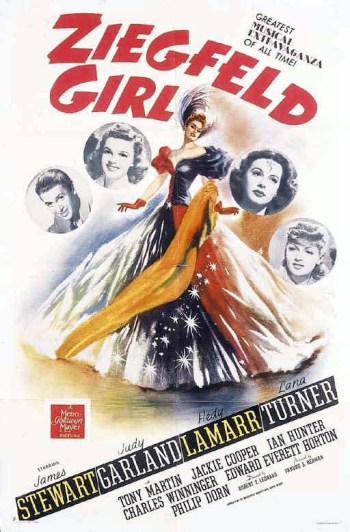 This week’s musical:
“Ziegfeld Girl ” (1941) Musical #126
Studio:
Metro-Goldwyn-Mayer
Director:
Robert Z. Leonard, Busby Berkeley
Starring:
Lana Turner, Judy Garland, Hedy Lamarr, James Stewart, Jackie Cooper, Charles Winninger, Tony Martin, Ian Hunter, Eve Arden, Philip Dorn, Al Shean, Edward Everett Horton, Dan Daily, Fay Holden, Felix Bressart, Rose Hobart, Leslie Brooks (uncredited), Georgia Carroll (uncredited), Joyce Compton (uncredited), Patricia Dane (uncredited), Myrna Dell (uncredited), Jean Wallace (uncredited)
Plot:
Three girls are selected to be in the latest Broadway production of Florenz Ziegfeld:
• Sheila (Turner), a Brooklyn native who is discovered while working on an elevator in a department store
• Susie (Garland), a performer in an act on vaudeville with her father. The only problem is Mr. Ziegfeld only wants Susie and not her dad (Winninger)
• Sandra (Lamarr), who is discovered while she is with her violinist husband (Dorn), who is auditioning for the orchestra.
The film follows the girls as they rise to fame and the trials they face on their way up: alcohol, wooing men who try to take them away from husbands and boyfriends and getting accustomed to more money. They all learn that fame has a great price.
Trivia:
-Florenz Ziegfeld was a famous Broadway producer who died in 1932. He was known for his lavish sets and elaborate costumes that “glorified the American girl.” Ziegfeld is a God-like figure in this film: he is discussed but never seen.
-“Ziegfeld Girl” is one of three films MGM dedicated to Florenz Ziegfeld. This film is a follow up to “The Great Ziegfeld ” (1936), a biopic of Ziegfeld starring William Powell as the impresario. “Ziegfeld Girl” is a sequel which shows the life of the Ziegfeld Girls. The third film was “Ziegfeld Follies
 ” (1946), which just showed multiple Ziegfeld-like acts.
-Hedy Lamarr requested to be in this film as a change of pace from her other dramatic roles, according to historian John Fricke.
-Two of the actors in the film were in original Florenz Ziegfeld produced films: Charles Winneger, who was in the original stage production of Show Boat, and Al Shean, who was part of the act Gallagher and Shean. Winninger and Shean recreate one of the Gallagher and Shean numbers in the film.
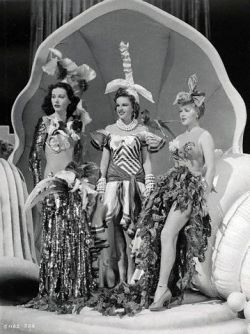
Hedy Lamarr, Judy Garland and Lana Turner in costume for the “Minnie from Trinidad” number
-The production of this film was originally announced in 1938 and was to star Eleanor Powell, Joan Crawford, Margaret Sullivan and Virginia Bruce (who was in The Great Ziegfeld). It was several years before the script was developed and the film was recast with newer talent, according to film historian John Fricke.
-James Stewart’s last film before joining the military to fight in World War II. His next film was “It’s a Wonderful Life” in 1946.
-The finale of “Ziegfeld Girl” edits in multiple numbers from “The Great Ziegfeld.” Judy Garland’s character is dressed in a costume which recreates the “Pretty Girl” number from the 1936 film, on top of the large tower.
-Busby Berkely choreographed the numbers in the film.
-The original finale was going to be “We Must Have Music” with Judy Garland, but it was deleted.
-Judy Garland felt a little inferior to her co-stars. A frequent story she shared was: When Lana Turner came onset, the technicians would whistle. When Hedy would pass through, they would sigh. When Judy came on set they would tell her hello, according to “Beautiful: The Life of Hedy Lamarr ” by Stephen Michael Shearer.
-“Ziegfeld Girl” was the game changer in Lana Turner’s career, and it led to more serious, dramatic and adult roles. The role was even expanded for Turner during filming.
-Lana Turner was originally supposed to die at the end of the film, according to TCM film historian Robert Osborne. Her death had negative reactions from preview audiences and is now cut to be left ambiguous.
-Model and later wife of Kay Kyser, Georgia Carroll, said in 2008 that Hedy Lamarr was shy and private during the filming. Hedy Lamarr and Judy Garland were friends and Lamarr and Lana Turner were cordial, according to “Beautiful: The life of Hedy Lamarr” by Stephen Michael Shearer.
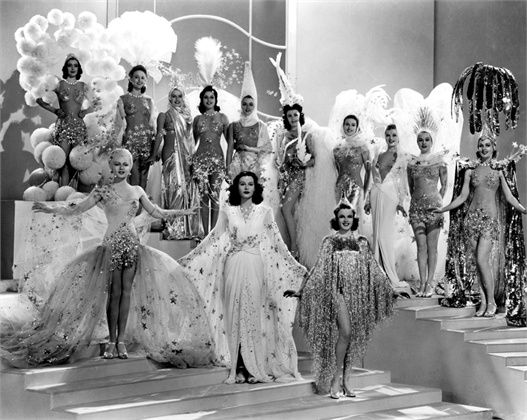
Publicity still of the costumes from the “You’ve Stepped Out of a Dream” number
Highlights:
-Elaborate costumes by Adrian
-Eve Arden’s sassy character
Notable Songs:
-“You Stepped Out of a Dream” performed by Tony Martin
-“Minnie from Trinidad” performed by Judy Garland
-“You Never Looked So Beautiful” performed by the chorus, borrowed by the 1936 film
-“I’m Always Chasing Rainbows” performed by Judy Garland
-“Laugh? I Thought I’d Split My Sides” performed by Judy Garland and Charles Winninger
-“Caribbean Love Song” performed by Tony Martin
-“Mr. Gallagher and Mr. Shean” performed by Charles Winninger and Al Shean
My review:
In the grand scheme of film history, “Ziegfeld Girl” (1941) may not be very important. It is notable because it gave Lana Turner’s career the boost it needed, landing her in more sophisticated and adult roles. But when it comes to Metro-Goldwyn-Mayer movie musicals, this one isn’t even listed in the top 10.
But I love it. “Ziegfeld Girl” may be overly long (with a run time of 2 hours and 12 minutes) and the plot may be rather fluffy, but I think it’s a great example of the lavish luxury that was a Metro-Goldwyn-Mayer film.
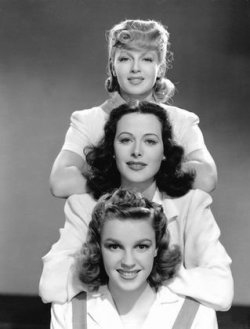
Publicity still of Lana Turner, Hedy Lamarr and Judy Garland
With the Adrian gowns and themes of fame and newly found wealth, “Ziegfeld Girl” oozes glamour, sophistication and the jewel-encrusted style many people dream about. For some reason, for me, this film holds the definition of MGM glamour more than other well-known MGM films like “Singin’ in the Rain” (1952), “The Women” (1939) or “Grand Hotel” (1932).
I think one major reason for this is the “You Stepped Out of a Dream” number where Tony Martin sings as women in elaborate (yet eccentric) costumes walk up and down stairs like goddesses.
After it’s release, Hedda Hopper said that the film is so beautiful that it “makes you ill that it’s not in color.” I can’t say I agree though. While Technicolor would have made “Ziegfeld Girl” even more glorious, I somehow think that black-and-white suits it and glitters more than color would. Color would have almost been too distracting.
The cast of this film is also bursting at the seams. Not only are the leading ladies three of MGM’s most well-known and top stars, the character actors seemingly just keep coming out of the woodwork through the film.
The only thing I don’t love about this film is the finale. Pasting together “Great Ziegfeld” (1936) feels off, though you could look at it as tying it back to the original film and making “Ziegfeld Girl” a true sequel. But that’s a bit of a stretch. It really comes off as lazy, and costume and dance styles had changed so much in five years that it doesn’t fit. However, the originally planned “We Must Have Music” finale is also weak (it’s included on the DVD special features). They would have been better off ending with “Minnie from Trinidad.”
I do also enjoy that two original Ziegfeld players- Charles Winninger and Al Shean- are included in the film.
I first saw “Ziegfeld Girl” in 2004 or 2005 and I fell in love with it and I still really love this movie. I loved it so much that “ziegfeldgirl1941” was part of my e-mail address at the time. I even tried to convince my mom to play “You Stepped Out of a Dream” when I walked downstairs to my prom date (she refused so this didn’t happen).
If the glamour of this film was a soap or a perfume, I would buy it and wear it. But since it’s not, I did the next best thing. I created Hedy Lamarr’s “Stepped out of a Dream” costume designed by Adrian for this Halloween. I bought the sleeveless white dress but made the rest of the costume- sewing on sleeves, cutting out and gluing silver stars and sequins, using 12 glue sticks to attach the wire with stars on a board on my back (Adrian also used a board on Hedy’s back.) If this 20-hour project doesn’t describe my love for “Ziegfeld Girl,” I’m not sure what does.
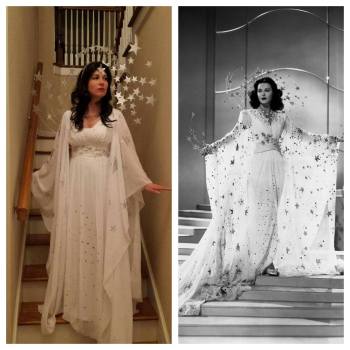
My version of Hedy Lamarr’s “Dream” costume
If you love MGM glamour and musicals, I would give this one a watch. I’ll give you fair warning that it’s a bit dramatic in parts, like when Lana Turner’s luck starts to change, but it’s such a fabulous look at MGM in it’s prime.
Check out the Comet Over Hollywood Facebook page, follow on Twitter at @HollywoodComet or e-mail at cometoverhollywood@gmail.com
Love what you read? Share it:

 This week’s musical:


 (1943) – Musical #563