
It’s no secret that the Hollywood Comet loves musicals.
In 2010, I revealed I had seen 400 movie musicals over the course of eight years. Now that number is over 600. To celebrate and share this musical love, here is my weekly feature about musicals.
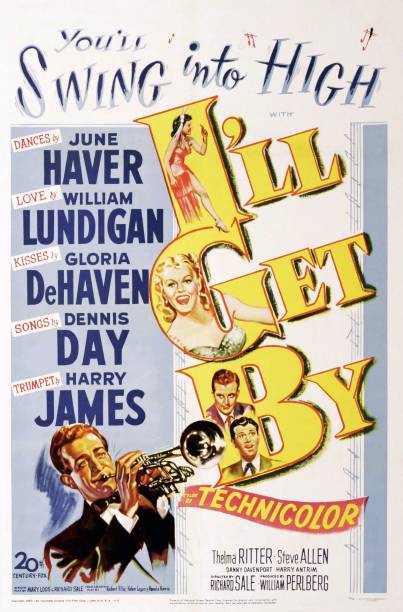 This week’s musical:
I’ll Get By (1950) – Musical #843
Studio:
20th Century Fox
Director:
Richard Sale
Starring:
June Haver, William Lundigan, Gloria DeHaven, Dennis Day, Thelma Ritter, Steve Allen, Danny Davenport, Harry Antrim
Himself: Harry James
Cameos: Jeanne Crain, Dan Dailey, Reginald Gardiner, Victor Mature
Plot:
William Spencer (Lundigan) is a song plugger with aspirations of getting into the publishing business. When he runs across songwriters Freddy Lee (Day) and Chester Dooley (Davenport), they buy into his business. They realize they need to promote their music with singers. They meet singing duo, Liza Martin (Haver) and Terry Martin (DeHaven), who agree to sing thor songs. As Spencer and Lee rise to fame a song publishers, Liza and Terry feel they are more career driven than caring about anything else.
Trivia:
• A loose remake of “Tin Pan Alley” (1940), which starred Betty Grable and Alice Faye.
• All of the songs in the film were already famous and published:
“I’ve Got a Gal in Kalamazoo” was released in 1942, written by Harry Warren and Mack Gordon and made famous by Glenn Miller and His Orchestra
“I’ll Get By” was published in 1928 by Fred E. Ahlert and Roy Turk and originally popularized by Ruth Etting. It was made popular again in 1944 by Harry James and His Orchestra
“Yankee Doodle Blues” was written in 1922.
• Steve Allen’s first film.
• Victor Mature’s cameo replaced Clifton Webb
• Several popular songs were used as background music including: “I Know Why,” “The More I See You,” “I Wish I Knew,” “I Had the Craziest Dream,” “People Like You and Me” and “You’ll Never Know.”
• Danny Davenport’s second film and first credited role.
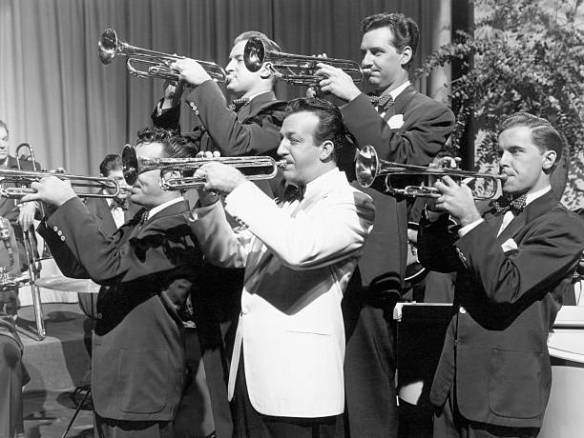
Harry James and his band
Highlights:
• William Lundigan
• The cameos from Jeanne Crain, Victor Mature and Dan Dailey
• “I once knew a fellow who got a splinter from his stubble from dragging his chin that low”
• Ends with a list of the songs, thor composers and publishers
Notable Songs:
• “I’ve Got a Gal in Kalamazoo” performed by Harry James and His Orchestra
• “Here I Go Again” performed by Gloria DeHaven and June Haver
• “I’ll Get By” performed by June Haver
• “It’s Been a Long, Long Time” performed by Dan Dailey, June Haver and Gloria DeHave
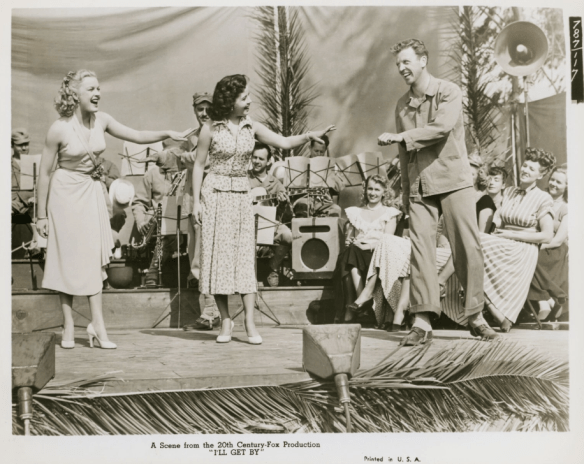
June Haver, Gloria DeHaven and Dan Dailey
My review:
Well some musicals feel the start off with great potential and fun, but devolve as the story continues. This week’s Musical Monday is sadly one of those.
With great music, vibrant Technicolor and a star-studded cast, how could you lose? But somehow this one does – a rare time that I agree with the IMDB star rating (5.9 stars for this one).
In the film, William Spencer (Lundigan) is a song plugger with aspirations of getting into the publishing business. When he runs across songwriters Freddy Lee (Day) and Chester Dooley (Davenport), they buy into his business. They realize they need to promote their music with singers. They meet singing duo, Liza Martin (Haver) and Terry Martin (DeHaven), who agree to sing thor songs. As Spencer and Lee rise to fame a song publishers, Liza and Terry feel they are more career driven than caring about anything else.
This film is a loose remake of another 20th Century Fox film, TIN PAN ALLEY (1940), which starred Alice Faye and Betty Grable. Rather than the turn-of-the-century, I’LL GET BY (1950) begins in 1939 and runs through 1945, ending with Germany’s surrender in World War II. Rather than the All-American song book, the songs in this film are largely pop standards and big band hits, like I’VE GOT A GAL IN KALAMZAOO.
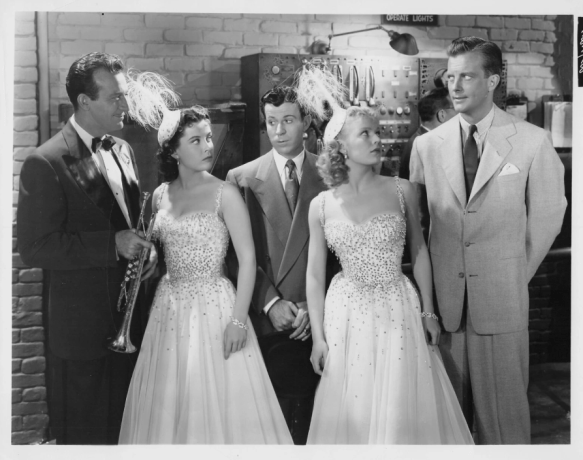
Harry James, Gloria DeHaven, Dennis Day, June Haver and William Lundigan
The film starts with great promise: Trumpet player Harry James performing. I adore James, and he’s terribly under utilized in film. It feels like there could have been more big band hits in the film that James could have performed, especially since his hit “I Had the Craziest Dream” played in the background at one point in the film.
William Lundigan also offers promise, because I love him in most of his film roles. He does a good job with what he’s offered in the film. I’m not sure if he’s supposed to be unlikeable or not, because Gloria DeHaven’s character treats him like he’s a rotten guy, but he’s not.
But as more characters are introduced, the film goes downhill. First, we see Dennis Day (insert groan from me). Why did it have to be Day? He admittedly has a beautiful singing voice, but he’s so annoying; playing the same boyish character he played on “The Jack Benny Show” for his whole entire career. His song “MacNamara’s Band” brings the film to a grinding halt, and he does a cringey houseboy Chinese impression.
Gloria DeHaven and June Haver play a sister singing act, though they aren’t actually sisters. I love DeHaven, but neither female character is terribly likeable. Both are quite prickly and I swear, in every film, June Haver’s character is written to fly off the handle about something stupid. This time it’s about … William Lundigan’s character … working (hence, earning a living). At first, I thought the sister act was reminiscent of TWO GIRLS AND A SAILOR (1944), since DeHaven and James starred in both. Unfortunately, it’s not as fun or sweet.
But the cast did offer a few well written roles. For starters, we see Steve Allen in his first film role. It’s a brief role as a disc jockey, but he is hilarious in each scene.
The other highlight are the cameos of Jeanne Craine, Dan Dailey, Reginald Gardiner and Victor Mature. But that’s also where part of my problem with this film lies.
Since this film is supposed to be set between 1939 and 1945, Craine, Mature and Dailey were not yet stars in Hollywood. Even though Dan Dailey’s song and dance was my favorite part of the film, it wasn’t accurate. I know, “Who cares?” and I know they wanted some of Fox’s big stars there in the film, but it still bothered me.
I feel similarly about the songs performed in the film. I can forgive a “Gal from Kalamazoo” reference in 1939 when it was really released in 1944. But talking about Gershwin and his 1922 song “Yankee Doodle Blues” in a 1941 scene felt unforgivable. I hope they meant Ira Gerswhin, since George Gershwin died in 1937. Hollywood assumed audiences were forgetful, but I don’t think they would so quickly forget the death of Geroge Gershwin.
Musically, the film also starts off great with big band standards and begins to go downhill. I would’ve loved to hear some of the background songs performed, like “I’ve Had the Craziest Dream” instead of “Yankee Doodle Blues.”
There some odd connections and observations I made in this film, specifically around Harry James:
Harry James co-stars with June Haver. James was married to actress Betty Grable and Haver was signed to 20th Century Fox, set to be the next Grable.
Harry James was in Glenn Miller’s Orchestra before creating his own band. And then in this film he plays “I’ve Got a Gal in Kalamazoo,” a song made popular than Miller.
Of note, the tune the film is titled for was a song that James made a hit in 1944.
These comparisons may not matter to anyone else, but they were interesting coincidences to me.
Truthfully, the most interesting aspect of I’LL GET BY (1950) is the plot point of the 1941 radio ban. I didn’t know this part of history before. The ban lasted from January to October of 1941 when radio broadcasters boycotted music licensed by the American Society of Composer, Authors and Publishers (ASCAP), because broadcasters were unhappy to their licensing fees. This meant that no music by popular composers, including Irving Berlin, the Gershwin Brothers, etc. The only songs played on the radio could be in public domain, which included “I Dream of Jeannie with the Light Brown Hair.”
Also interesting is that before the end credits, the film ends with a list of the songs featured in the film and including the song’s composers and publishers, which was an unusual practice for the time. At least, I haven’t seen that in the other 800 musicals I’ve watched. You sometimes will see the songs listed at the start of the film, but not paying homage to the original composers and publishers at the end like this.
The film does feel like it ends rather abruptly, which was okay in my book. By the end of the film, the plot and story felt a bit aimless.
I didn’t really go into this film with any expectations and didn’t even know the plot. Unfortunately, this one is just okay.
Other places you can follow Comet Over Hollywood:
- Letterboxd
- X at @HollywoodComet
- BlueSky
- Or e-mail us at cometoverhollywood@gmail.com

