
On June 6, 1944, one of the most critical events in history took place — D-Day, the Allied invasion of Normandy, France, which was the catalyst to the eventual end of World War II.
Various films have told the story of this event, but one of the best accounts of the day is the film THE LONGEST DAY (1962).

A scene from THE LONGEST DAY
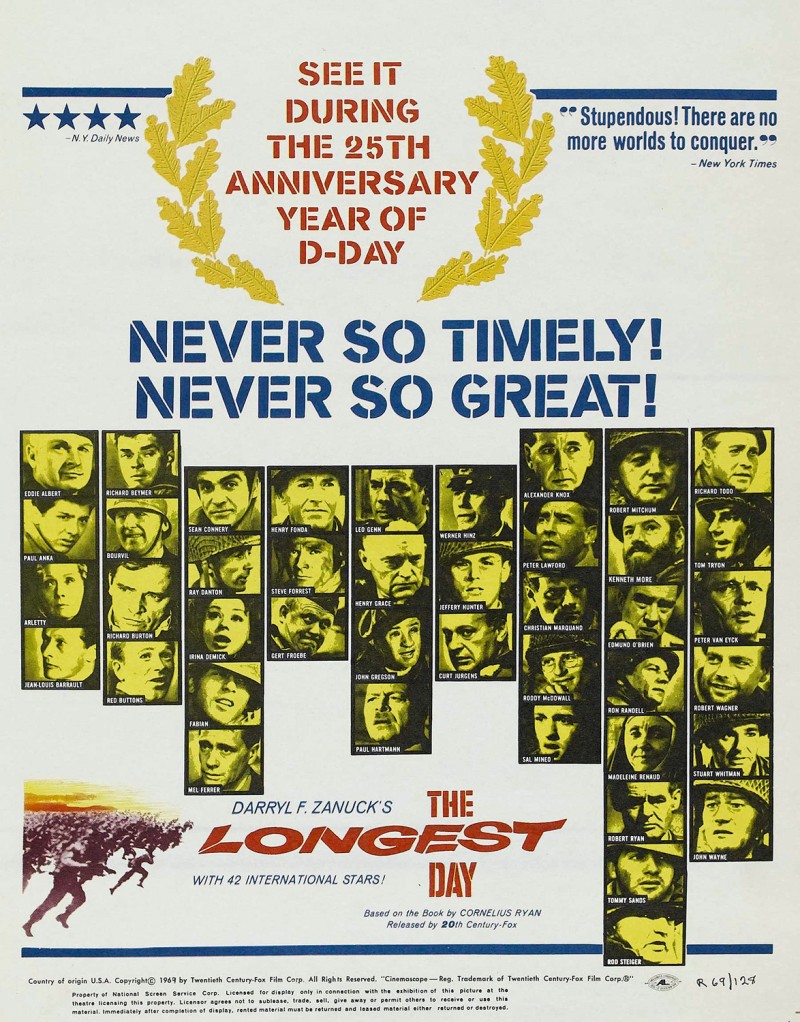
Based on a book by former war correspondent Cornelius Ryan, the film stars nearly every top male star of the early 1960s (43 of them, to be exact), from Henry Fonda to Fabian. But while some actors have key scenes, there is no one star.
The idea behind Ryan’s book was to focus on the everyman, not just the heroes or generals. He wanted to include the experiences of all sides, including the Germans, according to the documentary on the making of THE LONGEST DAY. To do this, Ryan put an ad in the paper soliciting war stories of people who took part in the events, “History Through the Lens: The Longest Day.”
The goal of Ryan’s 1959 book is transcended onto the screen for the 1962 film, as these real-life stories are detailed throughout the film.
Former 20th Century Fox studio head Darryl F. Zanuck saw this film as a way to revitalize his career and planned to produce it independently. The goal of the film was realism, and his crew searched the globe for uniforms and military equipment to recreate the invasion.

American actor Robert Mitchum (1917 – 1997, left) with producer and director Darryl F Zanuck (1902 – 1979) on the set of ‘ The Longest Day’, 1962. (Photo by Silver Screen Collection/Getty Images)
The idea for the film was to feel like a documentary, and it was filmed in black and white to appear like a newsreel. Like other war films of the time, there aren’t any romantic scenes or side stories — it’s all a detailed minute-by-minute account of the events leading up to D-Day, the storming of Omaha Beach, the disastrous parachute jump into France and the moments after the invasion is over.
Each side of the story is told using subtitles for the German and French actors, and Zanuck worked with the government of each country depicted in the film for accuracy, according film historian, Peter Lev.
In addition, four directors working on the film—Ken Annakin filming the British scenes, Andrew Marton filming the Americans, Gerd Oswald filming the French, and Bernhard Wicki filming the Germans — often filming at the same time in different areas. As they filmed, Annakin even performed research, seeking out former British and French resistance workers, according to a “Backstory” featurette produced in 2000.
Further realism was added when Zanuck cast actor Richard Todd, who actually took part in the invasion. Todd was cast as Major John Howard, who led Todd’s battalion and was his friend.
In addition, Red Buttons, who served in the U.S. Army Air Corps during World War II, portrayed a real person, paratrooper Private John Steele. Steele was among the ill-fated paratroopers who landed in the town square of Sainte-Mère-Église. Steele was caught in a church tower and watched as his peers were killed below.

Richard Todd (right) in THE LONGEST DAY

Red Buttons in THE LONGEST DAY
Some scenes were too real for censors. The Department of Defense in the United States wanted scenes removed, such as when a German soldiers shout, “Bitte! Bitte!” (Please, Please) and a solider (played by Tommy Sands) shoots them, saying, “I wonder what bitte bitte means?”, according to Zanuck’s biographer. The scene remained in the film.
While much of the film is realistic, when it was released, it did face backlash from civil rights groups, as no Black actors appear in the film. Segregated units were part of the Normandy invasion, according to a TIME magazine article.
While Zanuck was essentially trying to recreate the D-Day invasion and film in France, another hurdle was the threat of being shut down. THE LONGEST DAY was filmed at the same time as CLEOPATRA (1963) — which co-starred two The Longest Day stars, Roddy McDowall and Richard Burton. CLEOPATRA was expensive and over budget, with costs that swelled to $40 million. The 20th Century Fox board of directors were desperate to find revenue and sell off assets, and also threatened to shut down production of THE LONGEST DAY to help keep the studio afloat financially, according to the “AMC Backstory” documentary.
The Omaha Beach scene alone included 3,000 extras and had $3 million worth of people and military equipment, according to the documentary. As they began filming the invasion, Zanuck told Kenneth Anakin, “Let’s make sure we see it all, Ken.”
To help recoup losses, Fox then looked to THE LONGEST DAY release for revenue. Not only did the film do well, but it spoke to World War II veterans. Actor Red Buttons calls the film “the definitive World War II movie,” quoted in the AMC Backstory documentary.
In addition to the 43 international stars, the film features fascinating depictions of near-lookalikes of Gen. Dwight D. Eisenhower, played by set designer Henry Grace, and Gen. Sir Bernard L. Montgomery, played by actor Trevor Reid.
It also includes music and a theme composed by Paul Anka, who appears in the film. If you look away for one moment in the film, you might miss an appearance from one of the many stars, including Tommy Sands, Mel Ferrer, Ray Danton, Rod Steiger, Alexander Knox, or Robert Wagner. Key scenes are performed by Robert Mitchum, Richard Beymer, Richard Burton, Sal Mineo, Henry Fonda, John Wayne, Jeffrey Hunter and Red Buttons.
One of my favorite scenes is a moment between Richard Beymer and Richard Burton. While this two-hour and 58-minute epic war movie omits unnecessary subplots, comedic tropes, or romances, it still allows a few intimate moments with characters. The documentary reality makes it fascinating and gripping, but those moments are what make this movie special.
Check out the Comet Over Hollywood Facebook page, follow on Twitter at @HollywoodComet, follow on Instagram or e-mail at cometoverhollywood@gmail.com


 Comet Over Hollywood