Pages to Screen: Gidget Goes to Rome (1963)

20230914_155059

Which is worse: the book version of “Gidget Goes to Rome” or the feature film?

Well, it’s tough to say. Let me provide some background and break it down.

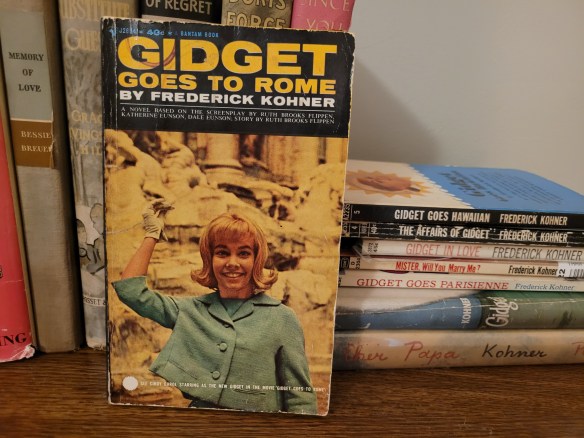
Similar to “Gidget Goes Hawaiian,” author and screenwriter Frederick Kohner wrote the novelization of the feature film “Gidget Goes to Rome” (1963). Kohner based his novel on the film’s screenplay by Ruth Brooks Flippen, Katherine Eunson and Dale Eunson. This was the last “Gidget” feature film, but not the last “Gidget” novel. In between “Gidget Goes Hawaiian” (1961) and “Gidget Goes to Rome” (1963), Kohner wrote another original Gidget story, “The Affairs of Gidget” in 1963.

The general “Gidget Goes to Rome” plot of both the book and film is that Gidget and her two female friends are eager to go to Italy with Moondoggie and his two male friends. The families of the three girls won’t let them go without a chaperone, so the guys dig up an eccentric aunt who joins them. The aunt also finds a pretty female tour guide, Daniella, whom Moondoggie is attracted to. Gidget meets an older Italian man (this differs in the stories) who escorts her around the city. Angry at Moondoggie for liking Daniella, Gidget throws herself into spending time with the Italian man.

That is where the similarities end. Below are the differences between the two:

The differences:
The “friend of her father”:
• In the film: To keep an eye on his daughter, Gidget’s dad (played by Don Porter) writes to an old friend in Italy, Paolo Cellini (played by Cesare Danova), to look after his daughter but in secret. Paolo is a magazine reporter who seeks Gidget out and makes up a story about interviewing her for an article on an American tourist. Gidget swoons for Paolo, who gives her a great deal of attention but doesn’t encourage her. When Gidget learns he’s married and has children, she is devastated.

• The book: In case she needs anything, Gidget’s father gives her the name of an old classmate who lives in Italy, Dr. Marcello Paladino. When Gidget falls ill, she calls Dr. Marcello Paladino … but there are two in the phone book. Dr. Paladino shows Gidget around the city and courts her, eventually admitting that he is married, but she is on holiday for Ferragosto, and men have a romantic rendezvous when their wives are out of town on holiday. The two are romantically involved (while Moondoggie sulks), and at the very end, we learn that he is the wrong Dr. Paladino.
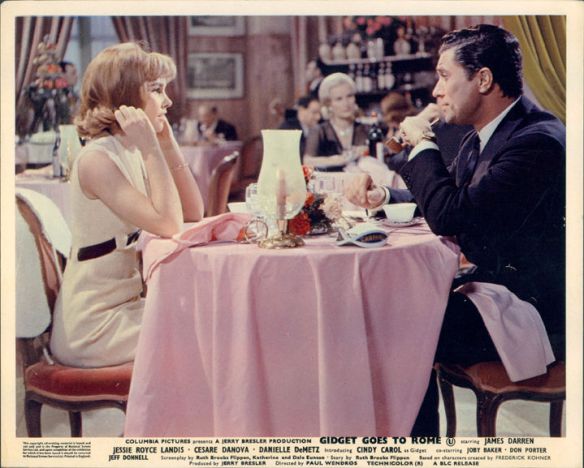
gidget-goes-to-rome-cesare-danova-cindy-carol-original-lobby-card

Gidget and Paolo.

Daniela, the tour guide:
• In the film: Daniela is a pretty tour guide whom Moondoggie/Jeff immediately flips for. Moondoggie kicks Gidget to the curb while romancing Daniela and eventually trying to propose and take her back to the States.
In the book: Jeff flirts with Daniela, who reciprocates, which angers Gidget. The two fight and agree to have a separate time. Gidget gets in deep with Dr. Paladino. Meanwhile, Daniela flirts with Jeff’s two friends, eventually tossing them all aside. Midway through the novel, Jeff is exploring the city alone.

• In the book, it’s that Gidget is the one having a romantic good time, unlike in the movie. I am sure this was reversed so as not to encourage young women from having European romantic escapades. It seems only boys can do that.

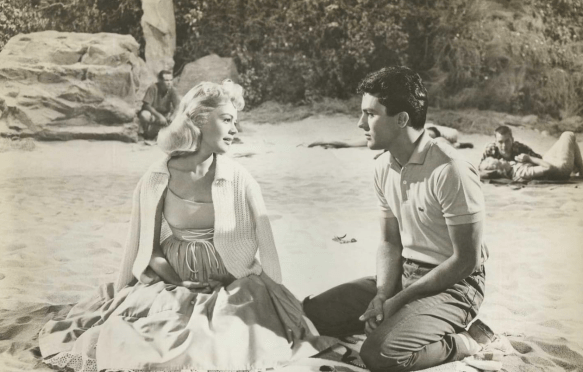
I lovingly call the film “Gidget Goes to Rome,” “The Gidget where Moondoggie is an asshole.” But while reading the book, I thought, “Is he more of a jerk in the book or the movie?” Well, it’s a toss-up. In the movie, Moondoggie cheats on her — they break up, but he’s shocked when she returns his pin while he’s romancing Daniela! At least in the book, he’s suffering while she’s with Dr. Paladino and isn’t with Daniela for long. In the book, Moondoggie is cold and distant, and the two have little time together and don’t even kiss (they note this). In the movie, they have some happy times together right when they arrive in Rome, but it is short-lived. I guess he’s equally a jerk in both.
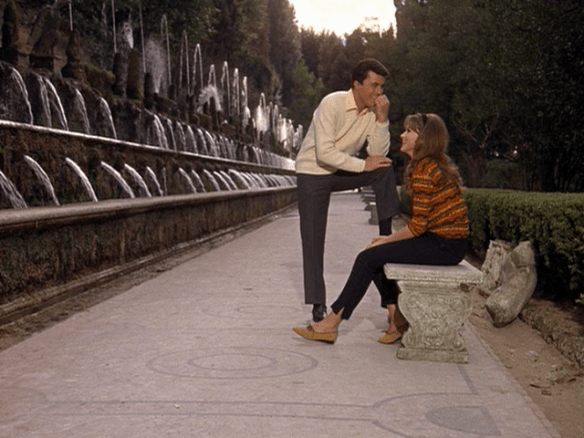
gidget goes to rome32

James Darren is smitten with Daniela the travel guide.

Now, to discuss why both the movie and the book stink:

The movie:
While the original “Gidget” (1959) film is 95 minutes, “Gidget Goes to Rome” runs at 106 minutes, and that extra 10 minutes feels very long, those minutes are filled with:
Dream sequences: Two dream sequences of Gidget imagining she is Cleopatra and another where she is a Christian martyr in the gladiator ring. These are not in the book.
• Several zany, shouty moments with Gidget:
– Gidget walks past a “do not enter” sign at a museum and is chased by museum staff and taken by police to the embassy. (Not in the book).
– Gidget throws her mother’s lucky coin into the Fontana di Trevi and jumps into the fountain to retrieve it. Police drag her out with lots of shouting. This does happen in the book, but instead, she’s trying to find Moondoggie’s fraternity pin that she threw into the fountain.
– Gidget is going to watch a fashion show with designs by Fontana, enters the back door, gets forcibly changed by fashion show helpers, and is pushed out onto the runway. This begins a chase from police, fashion members, etc. This does not happen in the book.
• Gidget pathetically and immaturely tries to get Jeff’s attention the whole time. Book Gidget is sort of dumb, but she at least goes out on her own and has a good time.
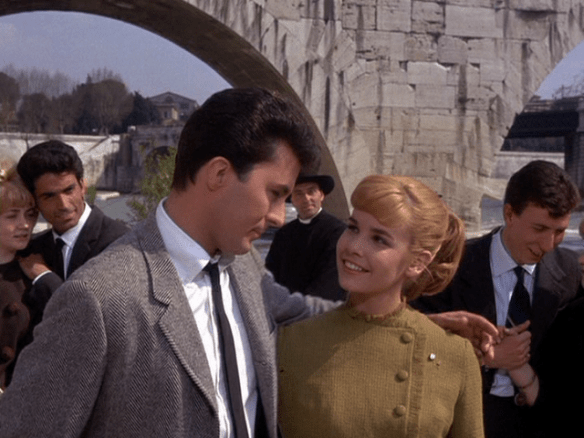
gidget goes to rome9

Gidget and Jeff/Moondoggie while they are still in love in Rome.

The book:
While the book eliminates the extra asinine parts (dream sequences, getting lost in the museum, the fashion show, etc.), it still has this stupid story. But I think that the book’s biggest crime is that it’s boring. The descriptions of the tourist sights are necessary but long-winded. The dialogue from Dr. Paladino is written in mixed English and Italian, making it a bit difficult to read. I looked up a few translations but eventually gave up and just used context clues.

I just imagined Frederick Kohner, who created this character, reading the screenplay and shaking his head thinking, “Well, I’ll do the best I can with this material.” Mercifully, the book ends at the wild party and is wrapped up neatly there, unlike the film, which continues after the party (which is a minor point) and goes on and on.

What I find frustrating about the 1961 and 1963 feature films with Deborah Walley and Cindy Carol films is that while Gidget is allowed to mature in the books, she still seems very young in the movie. Not only is she young, but she’s whiney and immature.

The film has some good points: the bright Technicolor, the fun clothes and Jessie Royce Landis is humorous. And in the book, I prefer that Gidget has been going out with a random older man who doesn’t know her father. Makes for a better plot point.

I see blame tossed at Cindy Carol for this film being a stinker, but honestly, I think it’s just a lousy storyline and script. Gidget got her own La Dolce Vita, but we suffered.

This article is part of the 2023 Classic Film Summer Reading Challenge hosted by Out of the Past.

Check out the Comet Over Hollywood Facebook page, follow on Twitter at @HollywoodComet, follow me on Letterboxd or e-mail at cometoverhollywood@gmail.com
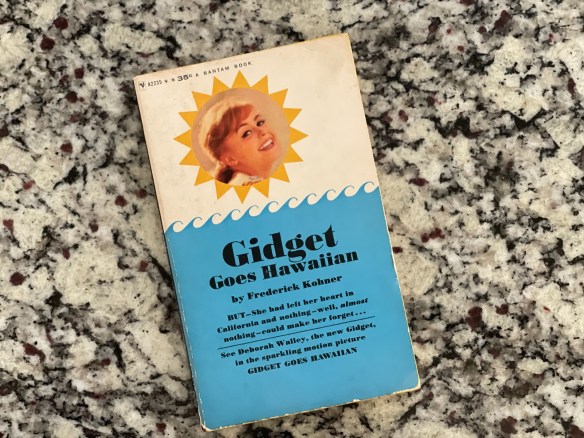
Page to Screen: Gidget Goes Hawaiian

“It’s not the same, down by the sea … since the Gidget came to Waikiki …” It’s especially not the same since in the second Gidget film, “Gidget Goes Hawaiian” (1961), the whole cast except for Moondoggie is different.

Thankfully, the book version of “Gidget Goes Hawaiian” is much better than the film.

gidget goes hawaiia

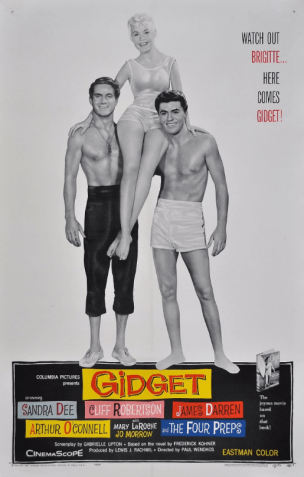
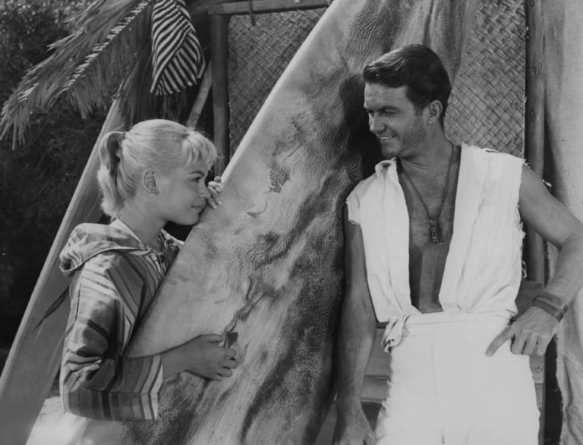
To recap: In 1957, screenwriter Frederick Kohner wrote the bestselling novel “Gidget: The Little Girl with Big Ideas,” which was based on the summer adventures of his daughter, Kathy. Gidget discovers surfing, hangs out with a college-aged male surfers at Malibu and has a crush on one in particular, named Moondoggie. The bestselling book was adapted into the hit film, “Gidget” (1959), starring Sandra Dee, James Darren and Cliff Robertson.

Continue reading

Pages to Screen: Gidget (1959)

From Frankie and Annette beach party films to the Beach Boys singing “Surfin’ U.S.A,”— it all started because of one book: Gidget by Frederick Kohner.

Published in 1957, Kohner based the book on the summer adventures of his daughter, Kathy.

gidget

Kohner was a Hollywood screenwriter who left his home of Austria-Hungary when the Nazis invaded. Some of his screenwriting credits include MAD ABOUT MUSIC (1938) and IT’S A DATE (1940). One day, while riding in the car with her father, Kathy said she wanted to write a story about her days at the beach, Kathy Kohner-Zuckerman told Comet Over Hollywood in a 2015 interview.

“I told him, ‘There is a guy who lives in a shack,’” Zuckerman said. “Dad said, ‘Well, you aren’t a writer, but I know you keep diaries, and I’ll write the story. Sounds like fun.’ I told my dad pretty much everything; I had a very good relationship with him. I still have those diary pages.”

kathy-and-fredrick

Screenwriter Frederick Kohner with his daughter Kathy, who served as inspiration for Gidget.

From her diary and conversations together, Frederick Kohner wrote the best-selling novel “Gidget: The Little Girl with Big Ideas.” The main character, Franzie, becomes interested in surfing and tries to break into a male-dominated sport. Because of her short stature, the guys nickname her Gidget, short for girl midget. As she learns to shoot the curl, Franzie has a crush on one of the surfers, Jeff, nicknamed Moondoggie.

The book is filled with surfer slang and nicknames and includes some truths. For example, while Kathy had a crush on one of the surfers, she never dated any of them, like Gidget and Moondoggie. The name Franzie was also inspired by Kathy’s mother, according to Comet’s 2015 interview with Kohner-Zuckerman.

“Most of our friends were shocked when we let Kathy go around with those surfers, and sometimes I was shocked too,” Frederick Kohner said in a 1957 LIFE magazine interview. “But she isn’t the sort of girl who can hide anything, and she would come home and tell us everything she had done. The more I heard, the more interested I became.”

While some of the book is primarily fiction, a good bit is based on actual events.

“There was someone who lived in a shack, I did have a big crush on one of the surfers, I did buy a board with a totem pole on it, I did learn how to surf, I did get tonsillitis a lot, I did bring food to the beach for the guys, I did try very hard to be liked,” she said in the 2015 interview. “But as for the big crush, I don’t know whether it was reciprocated or not. I think sometimes he did like me, and other times he thought I was a kid sister. There was no big romance, but I was definitely charged on Bill. That was his name.”

The book was an immediate success, and Kohner-Zuckerman worried what the other surfers would say. While Kathy received national attention, including a LIFE magazine article in the Oct. 28, 1957, issue, she never felt the success was hers.

“It was my father’s success,” she told Comet in 2015.

Gidget on screen
“Published this month, it already has been sold to the movies,” Life magazine said in the Oct. 28, 1957, article.

gidget2

The book was brought to the screen in 1959, starring Sandra Dee in the title role. While the film version of “Gidget” and the novel are similar, there are several differences. In general, Kohner’s Gidget is a bit more street savvy, clever, and a bit of a smart ass. Sandra Dee’s Gidget is sweet and demure. Here are other differences:
• The film begins with Gidget reluctantly going on a “manhunt” with her friends. There isn’t a manhunt in the book, just a division with her friends. She keeps surfing a secret from both her family and friends.
• The book Gidget is bright but not as academic as Sandra Dee.
• Surfing is a secret from her friends and family.
• In the book, Gidget’s parents aren’t home when she leaves for the luau. The luau plot is entirely different: Gidget attends alone, Moondoggie is mad about it, and there is a fire because the guys surf with torches.
• The Kahuna isn’t so sensitive in the book. He doesn’t have a bird and doesn’t become a pilot. Maybe this was because the movie didn’t encourage people to become surf bums.
• Moondoggie has a steady girlfriend.

Elements that are the same:
• Gidget does bring food for the other surfers, though more regularly, and legs of lamb are mentioned.
• Gidget does have tonsillitis.
• Gidget stays overnight in Kahuna’s shack after the luau, but it’s because she can’t get home after the fire. It doesn’t play out the same and is innocent.

Interestingly, other plot points in the book that aren’t used in the 1959 film are used in the 1965 Sally Field TV show. Like on the TV show, in the book, Gidget has a friend named LaRue who loves horses (there is a whole episode about her love of horses). Also, like on the TV show, Gidget has a sister and a psychologist brother-in-law named Larry in the novel.

While there are several differences, I think Cliff Robertson is well-cast as the easygoing Kahuna, and James Darren fits the bill for the moody Moondoggie.

gidget5

gidget4

While there are several differences, I love both the book and the film. This was my fourth time reading the book, and I enjoyed revisiting it every time. And both the book and the film were incredibly important to the surf craze.

Kohner-Zuckerman remembers meeting the cast and seeing the film.

“It’s odd being that person and watching the films about what Gidget does,” she told Comet in 2015. “Sandra Dee is Gidget. There’s me, the real person, but she was great as the character. In the Sally Field TV show- that wasn’t my life. She got involved in high school and the band and journalism. As cute as it was, that wasn’t me. I wanted to be one of the gang or one of the guys. I didn’t like high school. I wanted to be in Malibu.”

Most of all, Kohner-Zuckerman still loves the story because it’s about a young girl having the guts to buck societal standards and do what she wants.

“A large element of the Gidget story is having the attitude to pursue what you want.”

This article is part of the 2023 Classic Film Summer Reading Challenge hosted by Out of the Past.

Check out the Comet Over Hollywood Facebook page, follow on Twitter at @HollywoodComet, follow me on Letterboxd or e-mail at cometoverhollywood@gmail.com

“It was my father’s success”: An interview with the real “Gidget”

 Comet Over Hollywood has reviewed the three “Gidget” feature films this summer. To wrap up the series, Comet interviewed Kathy Kohner Zuckerman, the real Gidget whose summer story inspired her screenwriter father to write a book. The conversation was delightful. Ms. Zuckerman was down-to-Earth and it felt like talking and laughing with an old friend. 

(r) Kathy Kohner in 1957 in the photo that was used on the book cover. (L) Kohner Zuckerman pictured in 2014 at Duke's, where she works.

(r) Kathy Kohner in 1957 in the photo that was used on the book cover. (L) Kohner Zuckerman pictured in 2014 at Duke’s, where she works.

It was a different world for Kathy Kohner as she walked on the film set of “Gidget” in 1959.

“It was hard to understand that they were making a movie about me,” said Kathy Kohner Zuckerman, the real “Gidget,” in a phone interview with Comet Over Hollywood on Tuesday, Aug. 25. “They weren’t even filming at Malibu.”

The 1959 “Gidget” film that starred Sandra Dee, James Darren and Cliff Robertson spawned two more feature films, two television shows and several made-for-TV movies. And it all began with a 15-year-old girl telling her father that she wanted to write a story about her summer.

Continue reading