Musical Monday: Honolulu (1939)

It’s no secret that the Hollywood Comet loves musicals.
In 2010, I revealed I had seen 400 movie musicals over the course of eight years. Now that number is over 500. To celebrate and share this musical love, here is my weekly feature about musicals.

Honolulu_(1939)This week’s musical:
Honolulu” (1939)– Musical #172

Studio:
Metro-Goldwyn-Mayer

Director:
Edward Buzzell

Starring:
Eleanor Powell, Robert Young, George Burns, Gracie Allen, Rita Johnson, Willie Fung, Eddie ‘Rochester’ Anderson, Sig Ruman, Ruth Hussey, Phillip Terry
As Themselves: The Pied Pipers, Jo Stafford, The King’s Men, Andy Iona’s Orchestra

Plot:
Popular Hollywood star Brooks Mason (Young) has a lookalike George Smith (Young). To get a rest from his fans, Mason sends Smith to New York for a personal appearance tour and heads to Smith’s Hawaiian plantation for a rest, meeting dancer Dorothy March (Powell) on the way. Complications arise when Mason meets Smith’s girl Cecila (Johnson).

Trivia:
-George Burns and Gracie Allen’s last film appearance together. After this movie, George Burns wouldn’t appear again on screen until 1952.
-Eleanor Powell’s “Hola E Pae” number was re-edited and put in “I Dood It” (1943).
-Eleanor Powell’s tap dance number “I Got a Pair of New Shoes” was cut from the film and can be found here.
-From an April 26, 1939, “Hollywood Shots” column: “There’s a good reason why Eleanor Powell calls Honolulu her favorite films: its the only one that ever gave her a foot bruise costing her at least one toenail.”
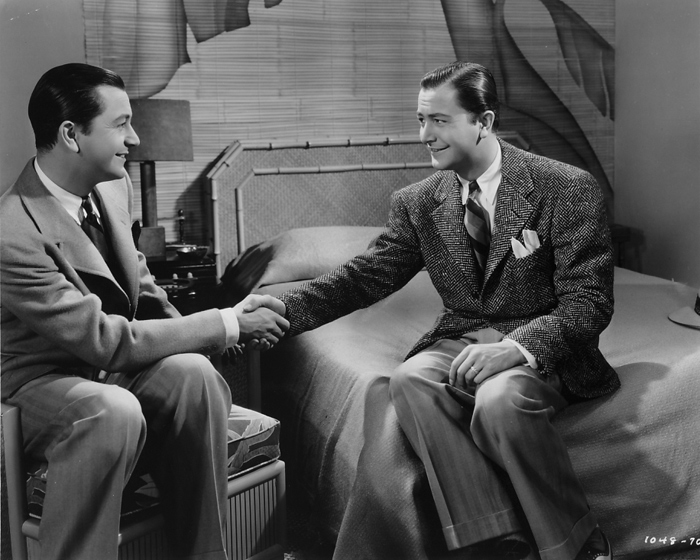
Robert Young plays a double role in

Robert Young plays a double role in “Honolulu”(1939)

Highlights:
-Eleanor Powell’s hula routine with a native tap dance routine
-Robert Young plays a double role
-Costume party featuring Bing Crosby impersonator and Gracie Allen as Mae West

Notable Songs:
-“Honolulu” performed by Gracie Allen, The Pied Pipers
-“The Leader Doesn’t Like Music” performed by Gracie Allen, The King’s Men
-“Hawaiian Medley” performed by The King’s Men, danced by Eleanor Powell
-“Hola E Pae” performed by Andy Iona’s Orchestra, danced by Eleanor Powell

My review:
“Honolulu” is not your usual MGM glittery musical, but it’s a lot of fun. Primarily, the movie is a comedy of lookalikes/mistaken identity with Robert Young. Eleanor Powell is merely a tap dancing backdrop.

Robert Young and Eleanor Powell in

Robert Young and Eleanor Powell in “Honolulu” (1939)

Since Powell does not sing, any songs are performed by Gracie Allen. The one that’s the most fun is “The Leader Doesn’t Like Music” as she is dressed like Mae West for a costume party and her backup singers are dressed like the Marx Brothers.

Married comedians Gracie Allen and George Burns have very little screen time together in their last film together.

The most notable dance number is the amazing hula/tap number that Eleanor Powell does. She starts off barefoot and in a grass skirt doing an impressive Hawaiian dance and then switches into tap shoes to mix tap dancing and hula steps. It’s truly the highlight of the film.

Gracie Allen even does a little tap dancing with Eleanor Powell at the start of the film.

The unfortunate part of this film is Eleanor Powell’s dance in blackface. This is off putting and takes away from Powell’s fantastic dancing, however, it was meant to be a tribute to Bill Robinson. Robinson was a close friend of Powell’s. She was not interested in tap dancing but knew it was the best form of dance to break into the business, and Bill Robinson served as her mentor. Robinson, along with Pearl Bailey, was also a godparent to her son Peter Ford. The two often performed together.

“Honolulu comes from the magical year of 1939 which hailed so many top notch films. It isn’t on the same level of “Mr. Smith Goes to Washington” or “Ninotchka,” but it does still hold a certain level of charm and glitter typical of other 1939 lower budget films.

While “Honolulu” isn’t the most inspiring MGM musical, it’s still a good slice of fun with some amazing tap dancing numbers.

Check out the Comet Over Hollywood Facebook page, follow on Twitter at @HollywoodComet or e-mail at cometoverhollywood@gmail.com
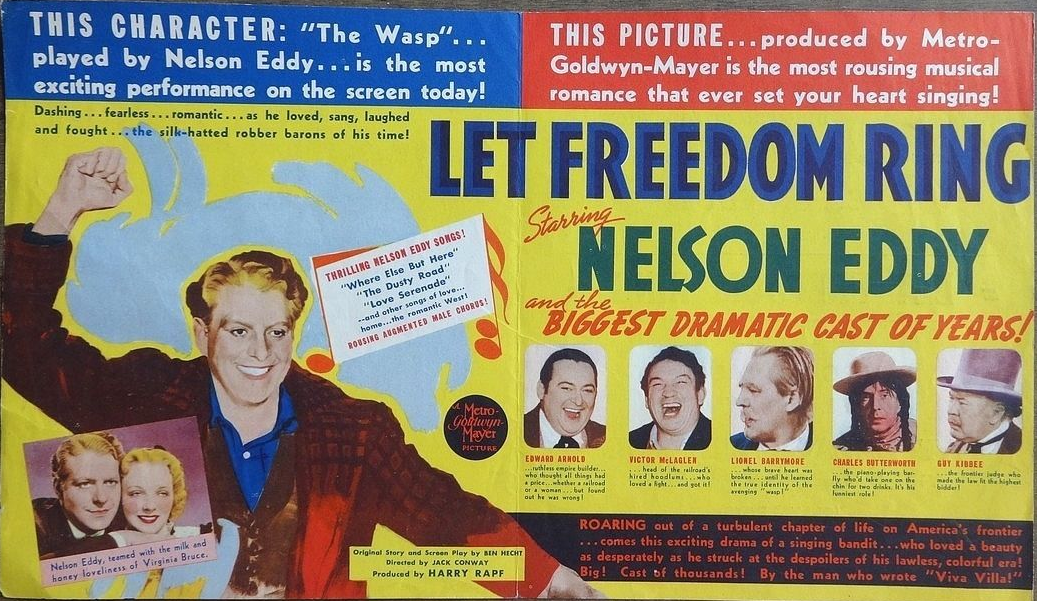
Musical Monday: “Let Freedom Ring” (1939)

It’s no secret that the Hollywood Comet loves musicals.
In 2010, I revealed I had seen 400 movie musicals over the course of eight years. Now that number is over 500. To celebrate and share this musical love, here is my weekly feature about musicals.

This week’s musical:
Let Freedom Ring” (1939)– Musical #354

let freedom ring

Studio:
Metro-Goldwyn-Mayer

Director:
Jack Conway

Starring:
Nelson Eddy, Virginia Bruce, Victor McLaglen, Lionel Barrymore, Edward Arnold, Guy Kibbee, Charles Butterworth, Gabby Hayes

Plot:
Steve Logan (Eddy) returns to his home back west after graduating from Harvard. Now a lawyer, he finds his town full of corruption being lead by Jim Knox (Arnold). Logan sets out to save his friends and family by disguising himself as “The Wasp” and uses the power of the press to break down Knox.

Trivia:
-Script by Ben Hecht

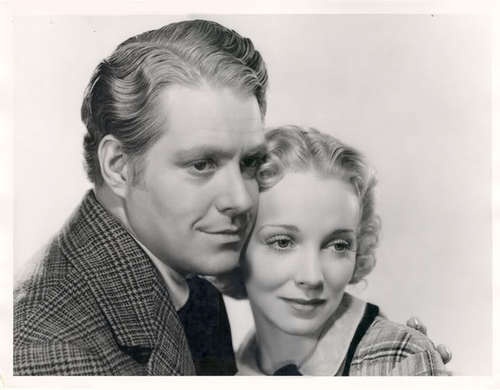
Nelson Eddy and Virginia Bruce in "Let Freedom Ring."

Nelson Eddy and Virginia Bruce in “Let Freedom Ring.”

Notable songs:
-Dusty Road performed by Nelson Eddy
-Love Serenade performed by Nelson Eddy
-Ten Thousand Cattle Straying performed by Nelson Eddy
-When Irish Eyes Are Smiling performed by Nelson Eddy
-America, My Country ‘Tis of Thee performed by Nelson Eddy and Virginia Bruce

My review:
“Let Freedom Ring,” is more of a western than a musical. Though Nelson Eddy sings three or four songs during the film, his beautiful voice isn’t the focus of the film.
Coming from the great year of 1939, this movie isn’t as well known as it’s contemporaries. However, this little western sparkles just as bright and continues to show that there was something in the water that year that made the majority of the films coming out of Hollywood great.
Along with some lovely songs performed by Eddy, we also have the treat of an excellent supporting cast of character actors. Guy Kibbee, Edward Arnold, Victor McLaglen, Charles Butterworth, Gabby Hayes. What more could you ask for than that?!
McLaglen and Butterworth have several particularly funny scenes.
Virginia Bruce also does well in the film, but unfortunately has very little screen time. Lionel Barrymore is also a treat (as always), but similarly has little screen time. In the film, Eddy actually seemed to have more energy and be less wooden without his frequent co-star Jeannette MacDonald.
This film is interesting if you think about what is going on around the world at this time. Much of Europe was being invaded by Germany and preparing for war. While the United States had not yet joined World War II, it was still at the forefront of their minds.
Nelson Eddy’s character gives several speeches, particularly about not being oppressed by tyranny. I’m fairly certain his lines were written with the European situation in mind.
Whether you are a fan of westerns or musicals, this little film is one you should catch. With great songs, humorous moments and rousing speeches, it’s a fun way to spend 90 minutes.

Nelson Eddy in "Let Freedom Ring."

Nelson Eddy in “Let Freedom Ring.”

Check out the Comet Over Hollywood Facebook page, follow on Twitter at @HollywoodComet or e-mail at cometoverhollywood@gmail.com
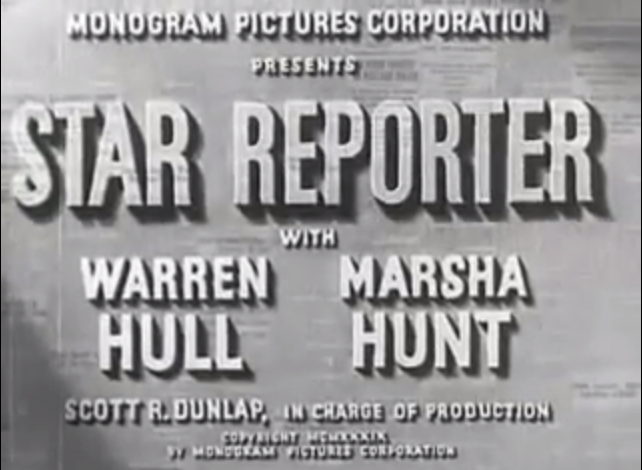
Review: Star Reporter (1939)

Often while discussing films we rank their importance with the alphabet.

An A film is a mainstream, high dollar movie. A B movie is a low-budget commercial film that may have a quality story line and actors, but is less publicized. These films would be the bottom half of the double feature — sort of like the song on the 45 record that wasn’t the hit single.

“Star Reporter” (1939) would most likely fall under the “B movie” category.

star

Distributed by “poverty row” studio Monogram Pictures, this hour long film revolves around newspapers and crime.

Reporter John Randolph, played by Warren Hull, works for the Star Tribune newspaper but is also a “star” on the job. Considered bright and brilliant, his father was the owner of the newspaper and was recently murdered. Randolph believes his father was killed because he had information that could bring down the “underworld” of the town.

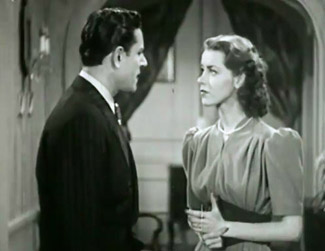
Randolph is also a big supporter of District Attorney William Burnette, played by Wallis Clark, and throws his support for the DA in each of his stories at the newspaper. Randolph happens to be engaged to the DA’s daughter, Barbara, played by Marsha Hunt.

But when a murder happens, secrets about Randolph and his mother Julia, played by Virginia Howell, are threatened to be dragged out.

It turns out that the deceased newspaper owner was not Randolph’s biological father. Mrs. Randolph was once married to Charlie Bennett, who disappeared and was believed dead. Bennett has now reappeared as the murderer using the name Joe Draper, played by Morgan Wallice.

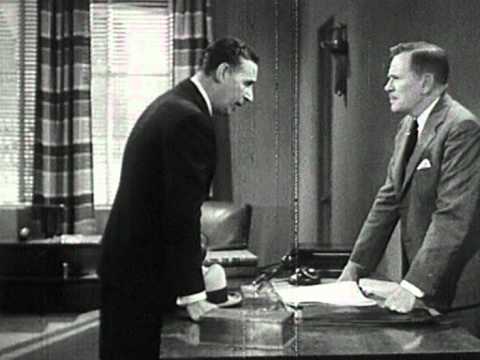
Lawyer Whitaker tries to bargain with the DA.

Lawyer Whitaker tries to bargain with the DA.

Dirty lawyer Whitaker, played by Clay Clement, is defending Draper.  Whitaker knows Mrs. Randolph’s secret and threatens to reveal it, if she and the DA do not cooperate and close the case.

Draper already signed a confession with the DA, but it is stolen by a thief named Clipper, played by actor Paul Fix in a very small role.

The DA decides not to prosecute to protect the Randolphs. John, not knowing the family secret, turns against  his father-in-law-to-be. Now rather than backing the DA, he works to get him thrown out of office, which was Whitaker’s goal.

For an hour long movie, this is an awfully complicated and mildly confusing plot.

Unlike most newspaper films of the 1930s and 1940s, the majority of the film does not involve a reporter playing detective or getting in fights with gangsters.

I was pleasantly surprised by this, until the end. At the end of the film Randolph is in the same house as the gangster/his biological father with a gun pointing at him. Though as a reporter, it’s not terribly accurate. I wasn’t surprised by this plot development. In my experience as a reporter, I have never gotten in fist fights with gangsters, but then maybe it was different in the 1930s.

Reporter Randolph is engaged to the DA's daughter, played by Marsha Hunt.

Reporter Randolph is engaged to the DA’s daughter, played by Marsha Hunt.

I did like how some of the lines showed just how busy reporters are and how they frequently are on call or away from home.

“After we’re married you can furnish the pressroom as living quarters. That way I can run in and see you between murders,” Randolph said to his new fiancée Barbara.

“Our wedding guests were kept waiting because of a special edition,” Mrs. Randolph told Barbara.

These lines made me chuckle because anyone in newspapers know the words day off, weekend or quiet evening are almost laughable.

I discovered “Star Reporter” shortly after I started working at The Shelby Star in October 2012.

Over the last two years of working at the newspaper, I felt a special connection to the title, because I was (Shelby) Star reporter Jessica Pickens.

Now as I wrap up my last week at the newspaper, I felt it appropriate to finally review the film I’ve been meaning to write about for two years.

Is “Star Reporter” a great movie? No. The biggest names in the film are Paul Fix, who later went on to be in several John Ford films, and Marsha Hunt. Both actors are in the film for less than 15 minutes.

But it is mildly entertaining, especially if you are looking for a very brief film to watch.

In a year that released “Gone with the Wind,” “Mr. Smith Goes to Washington” and “Wizard of Oz” –just to name a few of nearly 100 well received films- it is interesting to take a look at the B side of the year 1939.

In an age now where we only concentrate the blockbusters, these little hour long films are equally important to explore.

StarReporter1939

Check out the Comet Over Hollywood Facebook page, follow on Twitter at @HollywoodComet or e-mail at cometoverhollywood@gmail.com
 

1939: Watching a year in films

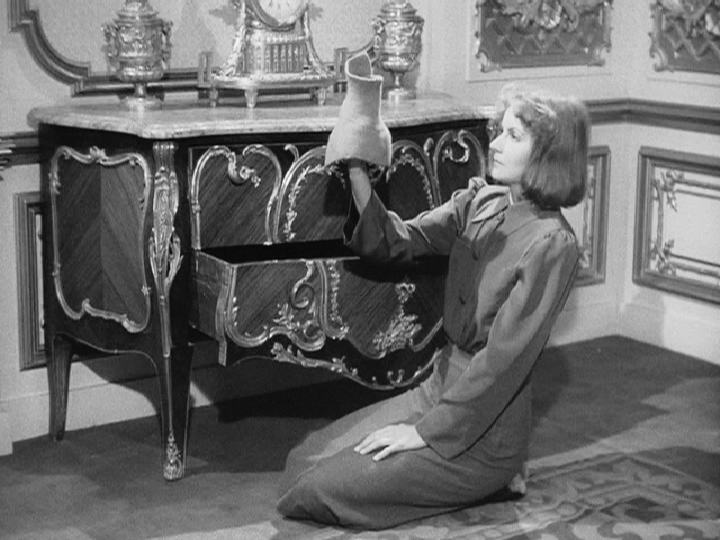
Greta Garbo in “Ninotchka” (1939)

1939.

To most, it’s just a year that occurred a long time ago.

To the Polish, it’s when the Germans took over the country with a Blitzkrieg.

To classic movie fans, it’s a year like no other.

Sure, there are several great films that came out from the 1920s to the 1950s. “Casablanca” came out in 1942. “White Christmas” lit up the screens in 1954. But neither of those years have a plethora of unforgettable movies that have a certain extra something added to them.

Gone with the Wind,” “The Wizard of Oz,” “Mr. Smith Goes To Washington” and “Ninotchka” are all givens when listing off excellent, flawless 1939 films.

But what about the other 515 American films put out in that same year?  Were they just as good?  I decided to find out.

In a crazed moment last summer, I decided to try to see every movie made in 1939. I had two criteria to make it a little easier to find the movies: They must be full-length movies, no short films; they must be American and they cannot be from television (despite being early in TV’s history, there were already experiments with made for TV movies in 1939).

I went on IMDB and got a full list of all the films from 1939. I clicked on each one, made sure it followed my requirements and then typed the title in alphabetical order into a table on Word. It took me several days to make my list due to my inefficient method.

 I was surprised to find that I had already seen 90 of the 515 movies. So far I have seen 106 and counting; this project won’t be completed any time soon.

 Through this process, I have discovered several gems during 1939 that are sometimes overshadowed by larger budget films.

 Some things I’ve discovered:

•Non-MGM films are overlooked:

-“The Rains Came” has a fantastic scene during the flood when the whole city crashes down.

-“Drums Along the Mohawk” gives Claudette Colbert the chance to be in a period film on the frontier and play alongside Henry Fonda. The movie looks fabulous in color.

High quality B movies:

-“Everybody’s Hobby” is a lot of fun with Henry O’Neil being driven crazy by his family’s hobbies.

-Freda Inescort gets the change to play a nice woman in “Beauty for Asking” with a young Lucille Ball.

Contributions to series films:

            –The first “Maisie ” movie starring Ann Sothern premiered. I adore Maisie Revere and her adventures. They are hilarious but also usually have a good moral to them. Jean Harlow was originally supposed to be Maisie before her death. I could definitely see this, but love the spark that Ann offers.

            -Two Dr. Kildare movies come out this year. “Calling Dr. Kildare” and “The Secret of Dr. Kildare,” which were the 3rd and 4th films in the series.  Laraine Day as Nurse Mary Lamont hops on board as a love interest to  Jimmy Kildare.

            -Glenda Farrell and Jane Wyman finish off the “Torchy Blane” series with the last three films.

            –Andy Hardy chases girls and has “man to man” talks with Judge Hardy in three films: “Andy Hardy Gets Spring Fever,” “The Hardy’s Ride High” and “Judge Hardy and  Son.”

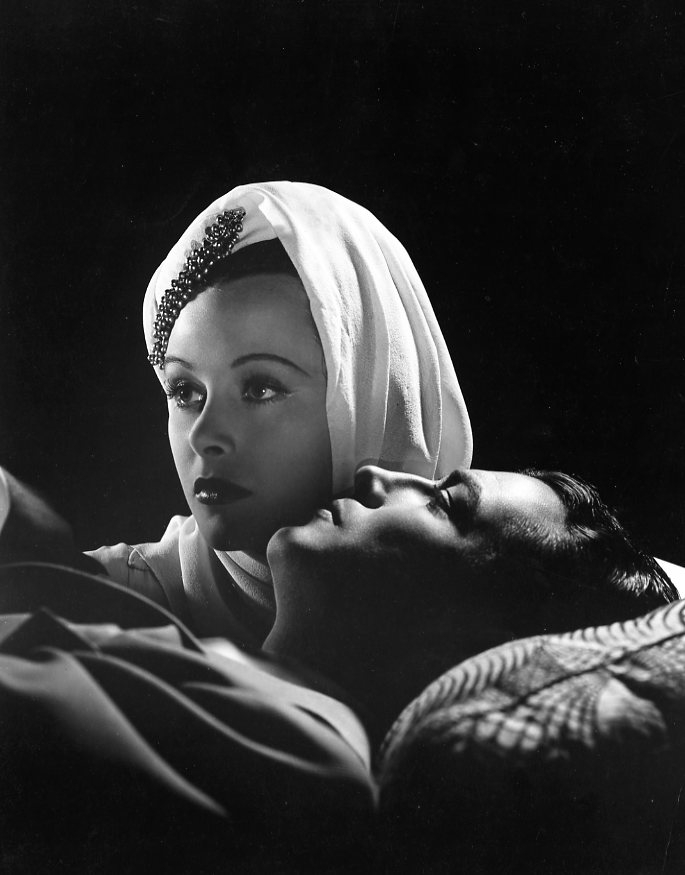
Hedy Lamarr and Robert Taylor in “Lady of the Tropics” (1939)

Stars get their first big break:

            –Fresh from “Algiers,” Hedy Lamarr was playing a love interest to Robert Taylor in her first MGM movie “Lady of the Tropics”

            -Greer Garson graced the screen in her first two films “Goodbye, Mr. Chips” and “Remember?”

            -Lana Turner is moving away from being Cynthia Potter on Andy Hardy and making a name for herself in “Dancing Co-eds” and “Calling Dr. Kildare.”

            -Olivia De Havilland finally gets the big break she was looking for in “Gone with the Wind.”

            -Jimmy Stewart had already made waves in “Of Human Hearts” but he really showed he had leading man power in “Mr. Smith Goes To Washington” and three other films that year.

Deanna Durbin is all grown up as she receives her first kiss from Robert Stack in “First Love.”

Joan Crawford is in color for the first time in “Ice Follies of 1939”

I could go on forever of the excellent movies (like Beau Geste, Of Mice and Men, and Real Glory) but no one wants to read 2000 words on a blog.

 All these movies had a certain magic and allowed several of our best stars to emerge. Where did it come from?

 According to the Turner Classic Movie documentary “1939,” 1939 was prolific for the United States in general. Roosevelt was helping the country work its way out of the Depression, and movies showed off this new wealth with stellar films. The industry began to take off for the next two years and then Pearl Harbor was attacked.

 World War II began for the United States and the growth Hollywood was once experiencing halted. The heyday of movies was forgotten as rationing and blackouts became a concern for the world.

After the war the movie industry would never return to the heights achieved in 1939 and American film tastes would change dramatically over the coming decades.

 I hope to discover more about the magic, and maybe see exactly what its source is when I complete all 515 films. It may be a large undertaking, but I don’t think it will be an unpleasant one.

Check out the Comet Over Hollywood Facebook page for the latest updates.