And who knew what yare meant before Katharine Hepburn used the word?
My fourth grade education was enhanced when I learned the meaning of those words the first time I saw “The Philadelphia Story” (1940) in 1998.
Katharine Hepburn as Tracy Lord with too many men after her
My dad was out of town one summer evening and my mother, sister and I picked a movie to watch. We loved it.
“Why did she shield her eyes from the sun like that?” I asked my mom. She explained the consequences people face the next morning after drinking too much.
For years after, I even tried to imitate Hepburn’s silly little laugh she does in the film.
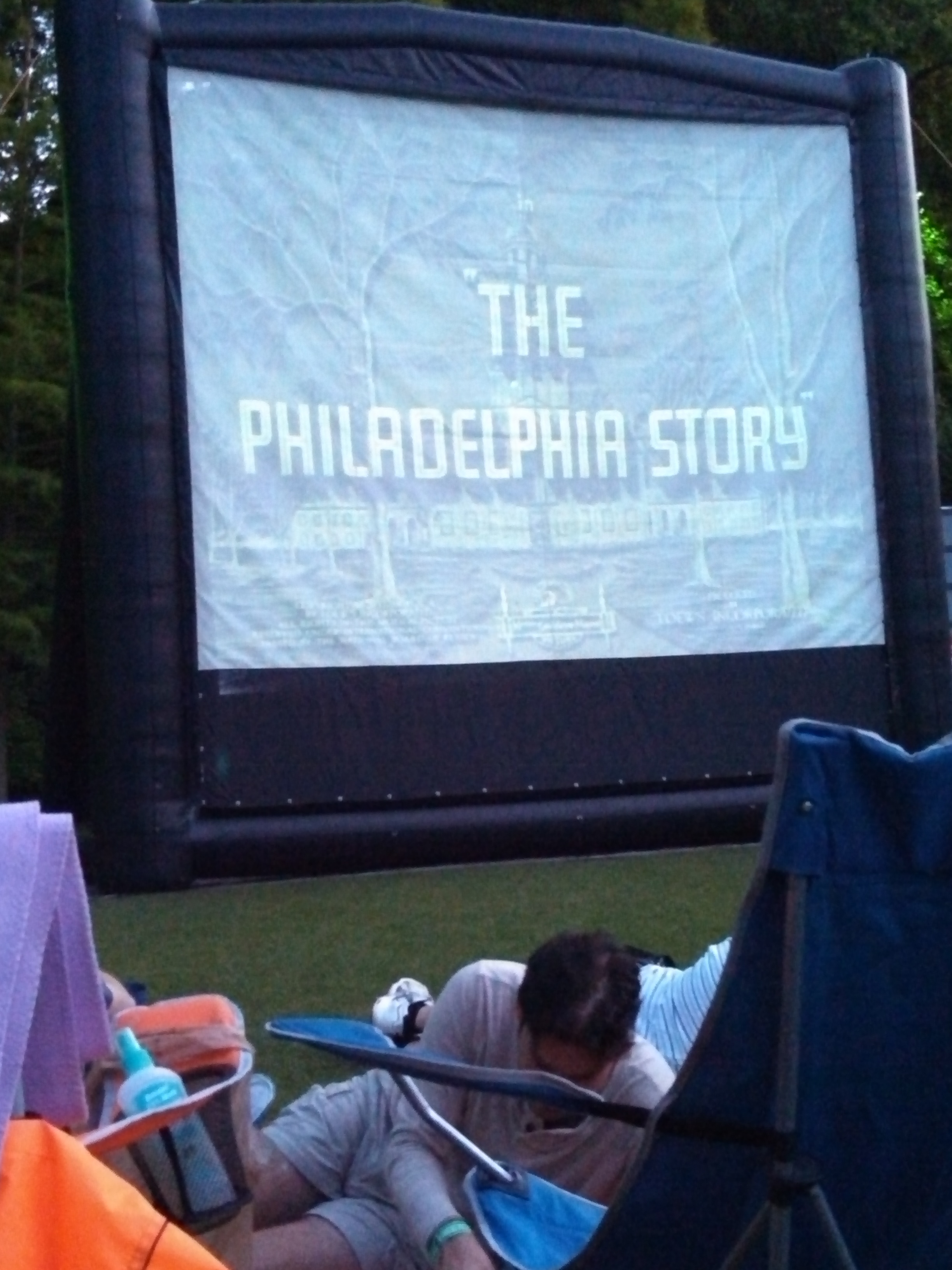
I had forgotten not only about my new vocabulary words the first time I saw the film but many of the charming scenes in “The Philadelphia Story” until I saw it last night for the first time on the big screen.
Moonlight Movies at Falls Park in Greenville, SC
I drove an hour to my hometown of Greenville, SC where outdoor classic films are shown every week in May at the Reedy River Falls Park.
Classic film screenings are a treat for me. Where I live, viewing movies on the big screen is rare.
It had been several years since I had seen this movie. Though I knew it was good- boasting a cast of Katharine Hepburn, Cary Grant, James Stewart, Ruth Hussey, Virginia Weidler and Roland Young-I forgot how wonderful it really was.
The leads are perfect in nearly every film but Virginia Weidler steals the show.
On paper, the film sound dizzy: A divorced woman is remarrying, the ex-husband pops back in the picture and then a reporter-who already has a girlfriend-becomes a potential romantic partner. It’s a love pentagon.
But somehow the story works when it’s acted out.
The only time it doesn’t work is in the horrible Grace Kelly remake, “High Society.”
The script of The Philadelphia Story was written specifically for Katharine Hepburn who originated the role on Broadway and reprised her role as Tracy Lord on screen. The film helped rid Hepburn of her box office poison status.
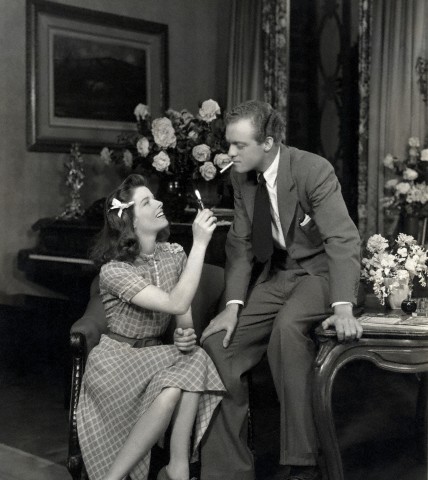
Katharine Hepburn with Van Heflin in the stage version of The Philadelphia story
In the play, Joseph Cotten played C. K. Dexter Haven (played by Cary Grant in the film version) and Macaulay Connor was played by Van Heflin (played by James Stewart). While watching the movie last night I couldn’t help picture those two performing those roles.
I have only been to one other Moonlight Movie series in Greenville back in 2011 to see Strangers on a Train. It wasn’t a pleasant experience due to people talking and continuously getting up and down during the film.
However, last night was much more relaxing and everyone was respectful of the movie.
The only disappointing thing is no one applauded when the film started or when actors entered their first scene like at the Turner Classic Film Festival, however I heard several people around me say they had never seen the movie again.
Revisiting “The Philadelphia Story” was fun and I reminded me how great a movie it was. I’m discovering seeing movies on the big screen is a very special experience.
He can be seen playing alongside Bette Davis as a boxer in “Kid Galahad” (1937) or a cadet running amok at the Virginia Military Institute in “Brother Rat.”
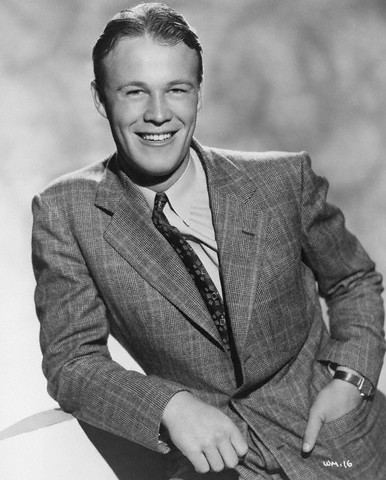
Wayne Morris may not be a name you’re familiar with but you have most likely seen the husky, affable blond in Warner Brothers 1930s and 1940s films.
But you may not be familiar with Morris’ war time record.
We frequently hear about Hollywood actors such as James Stewart, Clark Gable and Mickey Rooney who enlisted and were decorated for their bravery during World War II.
However, Morris is rarely recognized for his service and was one of World War II’s first flying aces.
His interest in flying started in Hollywood.
While filming “Flying Angles” (1940) with Jane Wyman and Dennis Morgan, Morris learned how to fly a plane.
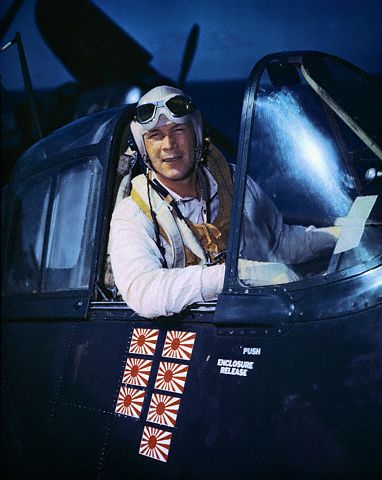
Morris in 1944 in his plane “Meatball.” The decals show how many Japanese planes he shot down.
Once World War II began, Morris joined the Naval Reserve and became a Naval flier in 1942 on the U.S.S. Essex. He put his career on hold to fight. The same year he was married to Olympic swimmer Patricia O’Rourke.
“Every time they showed a picture aboard the Essex, I was scared to death it would be one of mine,” Morris said. “That’s something I could never have lived down.”
Morris flew 57 missions-while some actors only flew 20 or less- and made seven kills, which qualified him as an ace. He also helped sink five enemy ships.
He originally was told he was too big to fly fighter planes until he went to his uncle-in-law, Cdr. David McCampbell who wrote him a letter, allowing him to fly the VF-15, according to “McCampbell’s Heroes: the Story of the U.S. Navy’s Most Celebrated Carrier Fighter of the Pacific”, Edwin P. Hoyt.
Three of his planes were so badly damaged by enemy fire that they were deemed unfit to fly and were dumped in the ocean, according to IMDB.
“As to what a fellow thinks when he’s scared, I guess it’s the same with anyone. You get fleeting glimpses in your mind of your home, your wife, the baby you want to see,” Morris said. “You see so clearly all the mistakes you made. You want another chance to correct those mistakes. You wonder how you could have attached so much importance to ridiculous, meaningless things in your life. But before you get to thinking too much, you’re off into action and everything else is forgotten.”
For his duty, Morris was honored with four Distinguished Flying Crosses and two Air Medals.
When he returned to Hollywood after four year at war, his once promising career floundered and Warner Brothers did not allow him to act for a year.
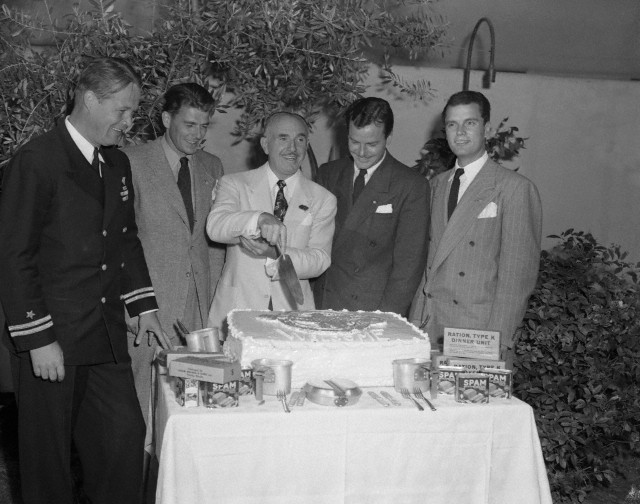
Jack Warner welcoming actors home from the war in 1945 including Wayne Morris, Ronald Reagan, Army Air Forces; Jack Warner; Gig Young, Coast Guard; and Harry Lewis, Army.
At the age of 45, Morris passed away in 1959 from a massive heart attack.
But his service to his country was not forgotten. Morris is buried in Arlington Cemetery and was given full military honors at his funeral.
Morris with his wife Patricia and daughter Pamela in 1946.
Though I am thankful for all men and women who serve our country, I wanted to recognize Wayne Morris.
For years I saw Wayne Morris in films and knew nothing about him except that I liked him. He is one of those character actors that can make a movie special.
Morris seemed like a regular guy. Before he started out in Hollywood, he played football at Los Angeles Junior College and worked as a forest ranger.
After I researched him and discovered his war record, I wanted to honor his service and his work in films.
Thank you to Wayne Morris and men and women in the military for serving our country.
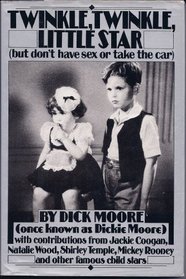
Dickie Moore with Pete the Pup in “Our Gang” in 1930. Moore said he didn’t enjoy the Hal Roach series because he didn’t feel he fit in
Dick Moore was searching for his “Rosebud.”
In “Citizen Kane,” a sled with the word “Rosebud” was the key to Charles Foster Kane’s lost childhood.
For Moore, early memories were a slew of movie scenes with James Cagney, Barbara Stanwyck and Paul Muni. He was the breadwinner for his out of work parents and went to school at a studio with other acting children.
His childhood was far a normal childhood of peanut butter and jelly sandwiches and playing at recess.
Some of these actors include Stymie of Our Gang, Roddy McDowall, Jane Powell, Jane Withers, Jackie Coogan, Edith Fellows, Natalie Wood, Jackie Cooper, Shirley Temple, Baby Peggy (Diana Serra Cary) and Peggy Ann Garner.
“All of us shared common lives and times, huge responsibilities and salaries that shriveled fathers’ egos,” Moore wrote
Some children wanted to go into show business, like Jane Withers. Others were pushed by their mothers (or saber-tooth tigers of the Hollywood jungle, according to Diana Cary), like Natalie Wood who sat on a director’s lap and sing him a song while a movie was location in Santa Rosa. And some happened by accident.
Moore was one of those accidents. A friend of a friend of his mother’s was a casting director who happened to stop by the Moore home. The studio pursued Mrs. Moore for Dickie to be in pictures. She said no, but finally gave in since Dickie’s father was out of work.
Dickie was 11 months old in his first film and playing John Barrymore as a baby.
Once Moore started acting, his father had an even more difficult time finding work. Employers assumed he made enough money and other parents brought their children to see Mr. Moore at work, hoping he could put them in films. Mr. Temple had the same problem.
The book explores how each child got into films, their home life, the affect on non-acting siblings and birthday parties.
Most of the young actors’ parties were opportunities for publicity and magazine photographers to put their faces in magazines.
“Everyone was posing. The whole business of publicity made parties seem synthetic. If you have a party, it’s supposed to just be with people,” said actor Gene Reynolds. “But most of our parties were stunt to get pictures in magazines so where is the fun in that?”
Shirley Temple cutting the cake at her birthday party in 1935.
Shirley Temple, the first child to carry a full weight picture on her own, would have three birthday parties each year: one with other child actors, one on set with the crew and one with her family.
“The parties were endless…Fox would have one for a large number of people I didn’t know, a lot of children I’d never seen in my life and would never seen again. And I was he hostess. It was kind of strange. I figured it was part of my job.”
Temple was also very isolated, as were many children. Moore’s parents allowed him freedom to play outside while others had no friends.
“Parents often discouraged their children from forming solid friendships because friends might tell each other about a part that was coming up and then, from the parents’ point of view, that wrong child would get the job,” Moore wrote.
Competition was high among child actors: Who could cry the best on cue, lying about ages to be younger and trying to look young, i.e. pigtails, short dresses.
Adult co-stars and their treatment to youngsters are discussed in the book. Marlene Dietrich was warm and friendly in “The Blue Angel,” Franchet Tone taught him how to play chess during “The Bride Wore Red” and Gary Cooper suggested what type of gun Moore should buy.
Moore with Barbara Stanwyck in “So Big”
But Moore’s favorite female adult star was Barbara Stanwyck was Moore’s favorite in “So Big.”
“Affectionate and demonstrative, she was easy to understand. She talked but didn’t fuss,” Moore wrote. “She was a direct and gracious woman, who seemed extremely interested in whatever interested me.”
Unanimously children liked working with Spencer Tracy because he would look right at you during a scene and listen to your lines.
Bobs Watson followed Tracy around during “Boys Town.”
“Often after a scene, he’d reach over and hug me and take me on his lap,” Watson said. “I felt like a little puppy. I would follow him around and stand close, hoping it would call me over and he often would.”
The two most disliked were W.C Fields and Wallace Beery.
“We did four long film together,” Jackie Cooper said about Beery. “They couldn’t find eight guys to carry his casket.”
Margaret O’Brien said he stole her lunch and Jane Powell said he would steal props off the set.
Two children got along with him: Darryl Hickman and Jackie Coogan.
Coogan’s father was a veteran in the business and it seems some of the tougher actors respected him because of this.
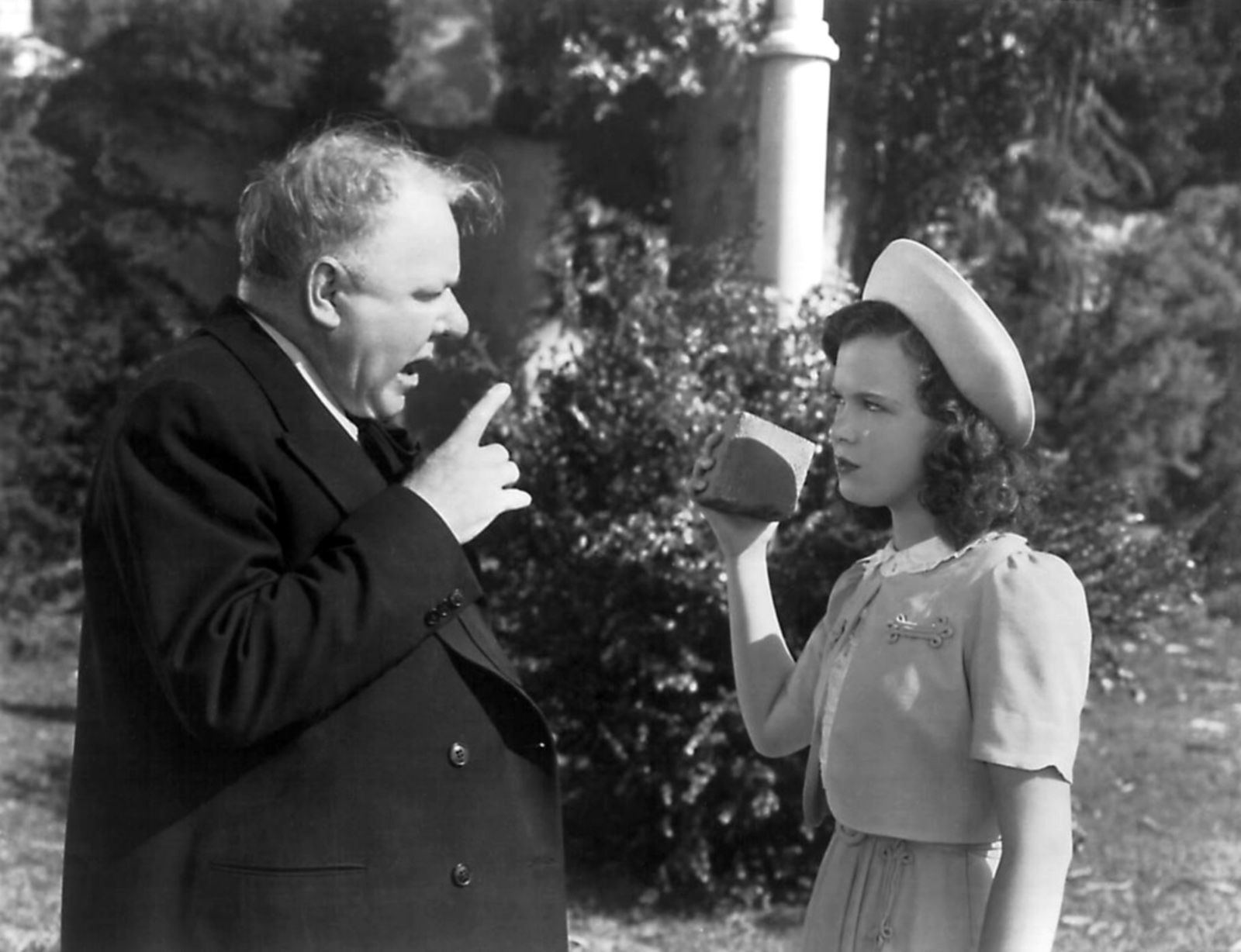
W.C. Fields and Gloria Jean in “Never Give a Sucker an Even Break.”
Fields notoriously disliked children and was known for getting drunk while filming. But Gloria Jean got along with him, because she tried to look out for him.
While the book tells some humorous and heartwarming stories, there is an underlying sadness. It’s like reading Romeo and Juliet and knowing the lovers die at the end of the play.
You know that for many of the child stars, their career would come to an end.
Children such as Jackie Coogan and Baby Peggy faced financial problems when their family member squandered or stole the millions they had earned for their family.
The biggest fear for a child star is to age, as many faded away when they got older. Moore was in magazines and on ice cream lids (similar to baseball cards) until he had scarlet fever and was away from the screen for a year, taking him back to the bottom.
Baby Peggy (Diana Serra Cary) and her fan mail.
Baby Peggy felt she was a has-been at five.
Others like Jackie Cooper, Natalie Wood and Roddy McDowall went on to have a successful adult life.
But many child stars, even Jane Withers who loved acting, did not wish for their children to go into the business-they wanted them to have a normal childhood.
“They were wrong,” Roddy McDowall told Moore. “They were wrong to take us children and do that to our lives, to twist our environment in that way and then leave it for us to sort out.”
“Twinkle Twinkle Little Star..” is one of the best classic Hollywood books I have ever read about one of the most complicated and fascinating subjects.
If you can find it for a decent price, I highly suggest it.
I have two huge classic Hollywood crushes, both highly underrated: Joseph Cotten and Joel McCrea.
But it is Cotten who we celebrate today at Comet, born on this day in 1905 in Virginia, making Mr. Cotten even more appealing to your southern writer.
But if his smooth voice, wavy hair and good looks aren’t enough for you, Cotten is a darn good actor.
He stars in two of my favorite films “Since You Went Away” (1944) and Alfred Hitchcock’s “Shadow of a Doubt” (1943) as well “Citizen Kane” (1940), which the American Film Institute has named the greatest film of all-time.
He was directed by Alfred Hitchcock and Orson Welles.
Some of his leading ladies include Bette Davis, Ingrid Bergman, Loretta Young, Claudette Colbert, Jennifer Jones, Ginger Rogers, Joan Fontaine and Barbara Stanwyck.
Before films, he performed in the stage version of “Philadelphia Story” with Katharine Hepburn.
Here are a few anecdotes from Cotten’s 1987 autobiography “Vanity Will Get You Somewhere.”
Orson Welles and Joseph Cotten in Citizen Kane
Citizen Kane (1940)
The film was originally set to open in Radio City Music Hall in February 1941, until Hearst stepped in, said Joseph Cotten, who played Jedediah Leland in the film.
“Of course I knew we’d been treading on thin ice with the obvious similarities between Kane and William Randolph Hearst. I also knew that Mr. Hearst was a powerful man. I was to discover just how powerful,” said Cotten. “The Radio City Music Hall turned down Citizen Kane because Louella Parsons, Hearst’s right hand, had threatened the theater.”
The executive producer, George Schaefer, was offered money to destroy the picture and the negative.
“The whole motion picture industry was threatened if they showed the movie,” Cotten said. “Hearst’s newspapers would bring skeletons out of the closets, and there were many.”
Schaefer refused to be bullied and was able to get bookings for the film in a couple of independent movie houses, Cotten said.
“Although people who sneaked in to see the picture raved about it, none of our names were mentioned in the Hearst newspapers or mentioned in Louella Parson’s column,” he said. “What I found personally rather baffling, after Kane, I made several movies in which my name was above the title but Hearst’s newspapers always managed to review these pictures without mentioning my name. It was quite a feat to tell the entire story of a film and leave out the leading man.”
Shadow of a Doubt (1943)
Cotten told Hitchcock that he was nervous to play a murderer and wasn’t sure how they behaved, he wrote in his autobiography.
“Uncle Charlie (Cotten’s character) feels no guilt at all. To him, the elimination of his widows is a dedication, an important sociological contribution to civilization,” Hitchcock told him. (67)
As Uncle Charlie in “Shadow of a Doubt”:
Her’s to Hold (1943)
While Cotten filmed “Her’s to Hold” with Deanna Durbin, a misunderstanding occurred.
Cotten was out late and had an early morning call for a radio show. He left a message with his wife Lenore that he would be staying in his dressing room (69).
Cotten and Durbin in a scene in “Her’s to Hold” with Murray Alper in the background.
When he left his dressing room that morning, he found a security guard waiting outside who greeted him good morning. When Cotten met Durbin that morning in the commissary, he found out she had also stayed overnight in her bungalow.
Hedda Hopper got a hold of the story.
“The item that appeared in Hedda’s column was not the personal kind of reference that one would clip for a scrapbook, or care to preserve in any of those elaborate, leather-bound gift journals inscribed ‘Golden Memories,’” Cotten wrote (71).
After the incident, he called Hopper up and said if his name was mentioned again, he would kick her in the behind. She did and he did.
“The Kick was not a boot that would have carried a football over the crossbar, but neither was it a token tap,” he wrote. “…the contact was positive enough to disturb the flower garden on top of the outrageous hats she was renowned for.”
Since You Went Away (1944)
Cotten on the set of Since You Went Away with Jones. The two starred in four films together. He remained friends with Jones and Selznick.
“Claudette (Colbert) was one of the most complete, humorous, hard-working and delightfully, almost shockingly, honest creatures I’ve ever worked with, Cotten said in his autobiography.
During the filming, Robert Walker and Jennifer Jones were going through a divorce and it was rumored Jones would marry David O. Selznick after the divorce was final.
“Claudette and I, each thinking that we were sitting on a powder keg, remained silent. The picture was not in any way affected by their romance.
The only person on our set who behaved in a rather furtive and giggly fashion was young Shirley Temple. Years later she told me that she had a schoolgirl crush on me.” (56)
Cotten said Temple had tried to convince the director to let her kiss him in the film. But in the movie, it was Jones’s character who had the crush on Cotten.
“The poor girl had to gaze at me adoringly non-stop,” he said.
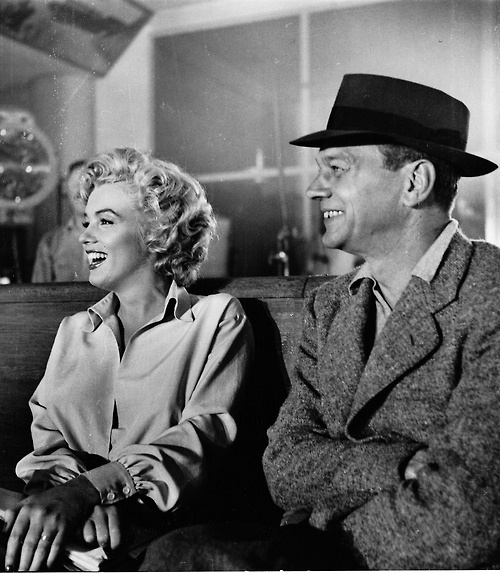
“I enjoyed her company. I enjoyed working with her,” Cotten said about working with Marilyn Monroe in her first starring role (110).
He said she had an appetite for laughter and was aware of her sense of humor describing her as a “pretty clown.”
Cotten recalls hearing about her death and receiving a phone call from the Associated Press for a comment.
“At first I was sure it had to be an accident. Such buoyancy of spirit, such sparkling anticipation, such a happy and comic attitude would deny support to any theory,” he wrote. “But she had such moments of fear and insecurity….As to all the other furtive theories-cover-up, murder, etc. – I have no knowledge or interest in such sordidness. I knew and acted with Marilyn Monroe. I am proud of having that privilege.”
Medina and Cotten in 1962
Cotten was married to his first wife from 1931 to 1960 when she passed away from leukemia.
He married Patricia Medina from 1960 until his death in 1994. Cotten said she was the most beautiful woman in the world.
“If Helen of Troy’s face launched a thousand ships, Patricia’s could launch a million,” he said. “She is possibly the only truly beautiful woman ever to exist who is not disliked by one single person.”
“We are ordinary, extraordinarily lucky people,” Cotten wrote. “For that, all I can say is ‘Amen.’”
Happy birthday, Joseph Cotten, one of the best actors of classic film.
This is May’s edition of Comet Over Hollywood’s classic film references in movies.
Citizen Kane (1941) was named the greatest film of all time by the American Film Institute in 1998.
But prior to this, Madonna used themes from the Orson Welles film in her 1989 music video “Oh Father,” according to writer E. Ann Kaplan.
A scene similar to Citizen Kane in Madonna’s video “Oh Father”
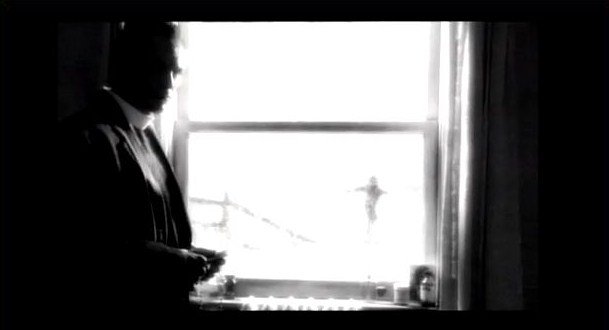
The whole video is shot in black and white. At the beginning of the music video, a priest is looking out the window, watching a little girl spin and play in the snow. Inside, the little girl’s father is lying over her mother as she dies.
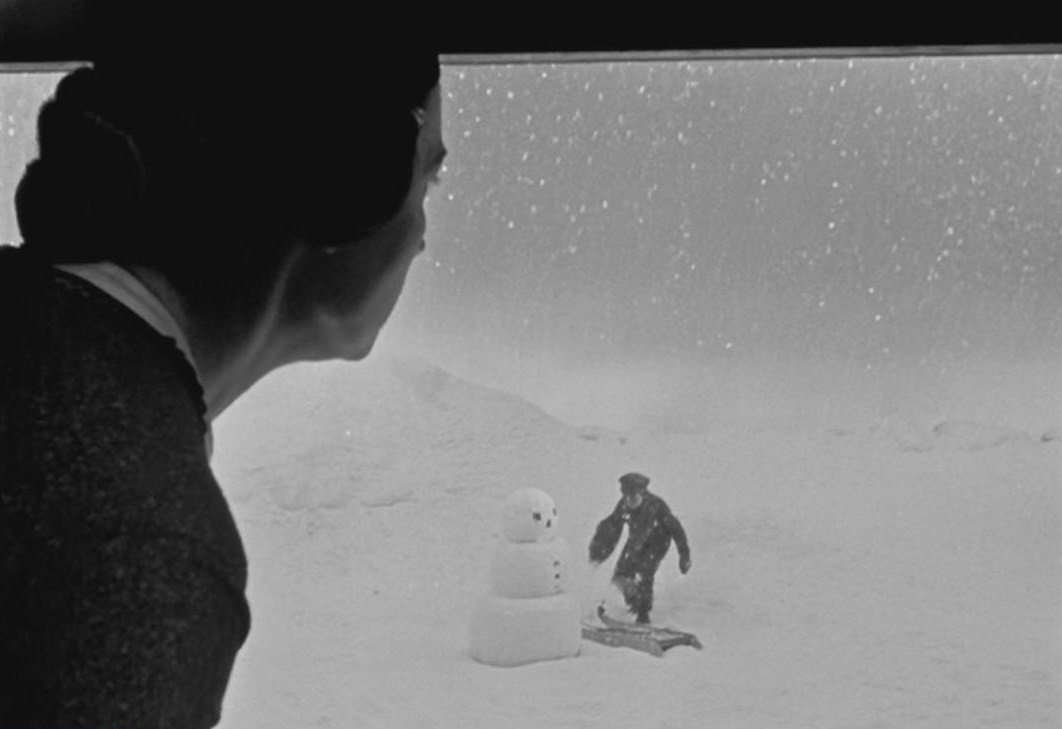
Madonna’s video was modeled after his scene of Agnes Morehead as Mary Kane watching young Charles Foster Kane playing outside. (Screen capture by Comet Over Hollywood)
The scene is similar to young Charles Foster Kane playing in the snow as his parents are inside, preparing to send him away with guardian to be raised in luxury. When Kane is taken away from his parents, he acts rebellious and is expelled from several universities.
The song and video were Madonna’s attempt to accept her mother’s death and her father remarrying.
“I had to deal with the loss of my mother and then had to deal with the guilt of her being gone and then I had to deal with the loss of my father when he married my stepmother. So I was just one angry abandoned girl. I’m still angry,” she is quoted as saying in a 2002 biography “Madonna: An Intimate Biography” by Randy Taraborelli.
My mother has been instrumental in my classic film interest.
Without her, I wouldn’t have seen 501 musicals…or any classic films for that matter.
When I was five, my mom introduced “Seven Brides for Seven Brothers” (1954) to my sisters and me. My sisters and I giggled at “The Lonesome Polecat” song but even in the “pan and scan” VHS format, I loved it.
When I was 10, we watched “The Philadelphia Story” (1940) and I remember laughing when Cary Grant pushes Katharine Hepburn in the face and knocks her down at the beginning.
One of our all-time favorites “Since You Went Away” (1944)
Along with life lessons and quizzing me on how photosynthesis works, Mom was my IMDB before I knew what IMDB was.
She told me about Ingrid Bergman’s exile from Hollywood because of her affair with Roberto Rossellini, about Annette Funicello’s battle with Multiple Sclerosis and that John Wayne was dying of cancer in “The Shootist.”
My mother has even been amazing enough to record movies off of Turner Classic Movies via VHS for nine years.
Since 2004, I’ve made lists of about 30 films a month that I would like to see.
An example of all the movies my mom records.
And since then, even when I’m not living at home, my mom still records movies for me and rarely misses any. I probably have at least 200 VHS recorded films waiting to be watched thanks to my mother’s help. If it wasn’t for her, I wouldn’t see any movies.
Each night, when I’m picking out a movie to watch, I set aside movies that I know my mother would want to see.
“Oh this one has Loretta Young,” or “I don’t think she’d want to miss Myrna Loy in this one,” I think as I save the films to watch with her.
Colorful musicals, down to Earth stories and heartwarming romances are some of our favorites to watch together.
Here are a few movies that make me think of my mom:
–Since You Went Away (1944): My mom was dying to introduce “Since You Went Away.” She’s a huge Claudette Colbert fan. I saw it for the first time back in 2005 when TCM showed it during a “Films of the 1940s” series. Between us, there isn’t a dry eye in our living room when we watch this movie. After that, it became my favorite movie, replacing my past favorite, “West Side Story” (1961).
One of our favorite outfits in “Gidget”
–Gidget (1959): My mom and I categorize the Sandra Dee and James Darren movie as one that we never want to end. She showed it to me for the first time in 2004 and I was enchanted. Our favorite things about this film are Dee’s outfits, the lighthearted theme and looking at James Darren.
-Doris Day movies: When Doris Day was Star of the Month in January 2003, I had only seen “Pillow Talk” (1959). To make sure I was introduced to more Day films, my mom recorded several including “The Glass Bottom Boat” (1966), “The Tunnel of Love” (1958), “Julie” (1956) and “Love Me or Leave Me” (1955). After that, Doris Day became my favorite actress.
Since then, Mom has aided me and in seeing all but three of Day’s films. Our favorites to watch together are “On Moonlight Bay” (1951) and “I’ll See You in My Dreams” (1951).
-Jane Powell Films: Whether it’s “Seven Brides for Seven Brothers” (1954), “Luxury Liner” (1948) or “Two Weeks With Love” (1950), we adore Jane Powell. One of my mom’s personal favorites is “A Date with Judy” (1948).
-MGM Series films: There isn’t a “Maisie” or “Dr. Kildaire” movie that we dislike, and we have seen them all. Ann Sothern, Lew Ayers and Lionel Barrymore brighten our evenings. Even though we aren’t huge Mickey Rooney fans, we also love the Andy Hardy series, especially “Love Finds Andy Hardy” (1938).
Dana Andrews and Jeanne Crain’s dresses are just two of the reasons why we love “State Fair”
–State Fair (1945): We die for Jeanne Crain’s dresses and Dana Andrews in “State Fair.” We also mourn that no state or county fair is actually like the one in this Roger’s and Hammerstein musical. The colors, the music and the spiked mince meat scene always leaves us smiling.
Other movies we like: Trashy 1950s ones such as “Susan Slade” or “A Summer Place,” Judy Garland Films, the “Four Daughters” trilogy, Hayley Mills films and most 1940s World War II era movies.
I could go on all day with movies my mother and I love, but instead I should thank her for introducing her to my hobby of classic films.
Even with my blog (which she is probably proof reading as she reads this), she’s been supportive of the beauty tips-even bathing in milk and washing my hair with champagne- just as long as I wash out the tub. She also helped me make my fruit hat when I was Carmen Miranda for Halloween in 2010.
I even got a little sad during the Turner Classic Film Festival, because she wasn’t there to hear Kate MacMurray talk about Fred MacMurray or to see Ann Blyth in person.
When I was a child, I’m sure she had no idea what sort of fanatic she was creating as she introduced us to old movies, but I don’t think she minds.
Happy Mother’s Day, Mom!
Myrtle Beach with Mom
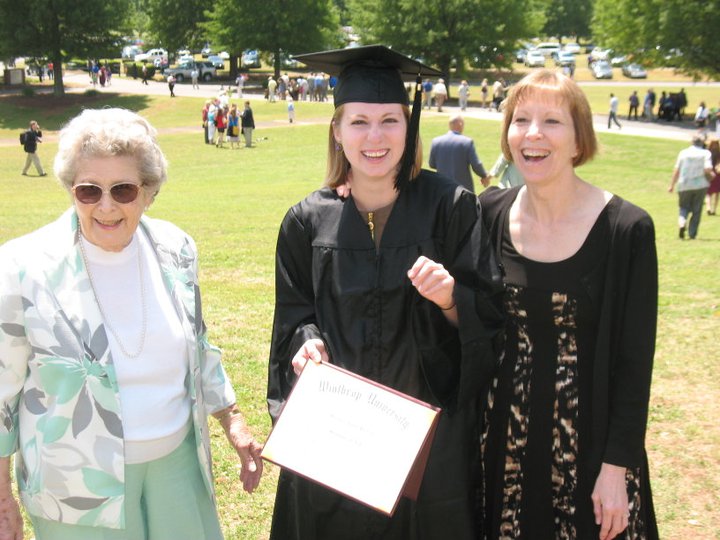
College graduation in 2011 from Winthrop University with my Mom and grandmother
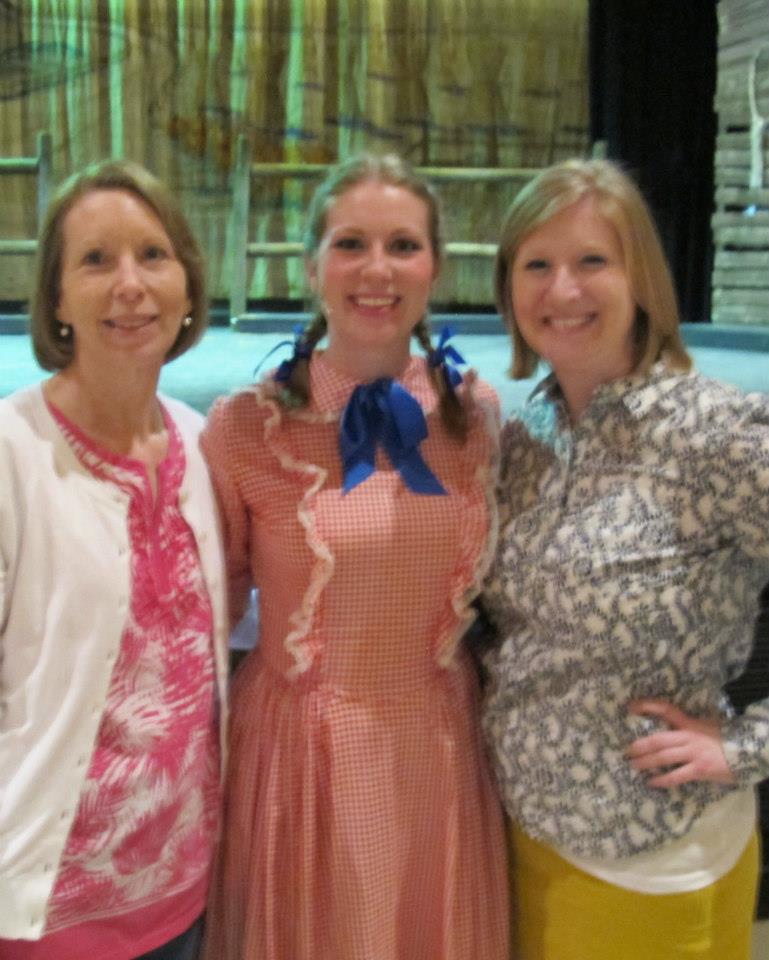
Dressed as Ado Annie when my mom and sister came to see me in Oklahoma
This is the twenty-ninth installment of the monthly classic actress beauty tips that I have read about and tested…except for this one.
Jean Harlow with her signature, exaggerated eyebrows.
Eyebrows are the frame work of the face.
Overtime that framework has been defined differently.
The 1940s were more natural and of medium thickness.
In the 1960s were heavy, emphasized with an eyebrow pencil.
But the most dramatic eyebrow look was in the 1930s. Brows were thin with exaggerated height. Several actresses shaved their eyebrows and drew on their eyebrows. Petroleum jelly or oils were used to give a shiny look on the brow, according to Return to Style.
Jean Harlow’s high arched, drawn on eyebrows became part of her signature style. Greta Garbo plucked her eyebrows thin to follow the arch of her eye socket. Marlene Dietrich shaved off all of the hair and penciled on her brow higher than her natural hairline, according to the Encyclopedia of Hair: A Cultural History.
Some actresses shaved their eyebrow for role and they never grew back:
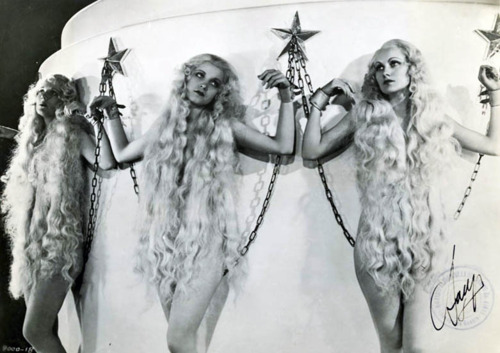
Lucille Ball dressed as a blond slave in “Roman Scandals” (1933)
-In her first film appearance “Roman Scandals” (1933), Lucille Ball was asked to shave off her eyebrows. She was playing a slave girl with a long blond wig. Her brows never grew back and she had to pencil them on the rest of her life, according to the Encyclopedia of Hair: A Cultural History.
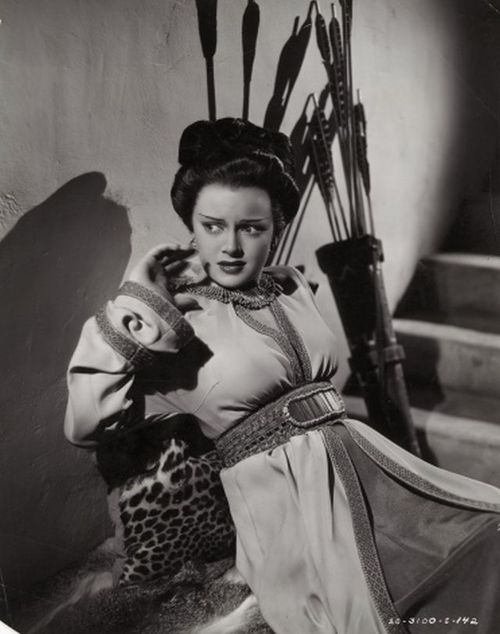
Lana Turner in “The Adventures of Marco Polo” (1938)
-Lana Turner was asked to shave her eyebrows for “The Adventures of Marco Polo” (1938) and had slanted brows were drawn on to give an “Asian look.” Her eyebrows never grew back. She later had false, stick on eyebrows made that she wore for the rest of her life. Her daughter Cheryl Crane said she only saw her mother without her false eyebrows twice, according to the book LANA: The Memories, the Myths, the Movies.
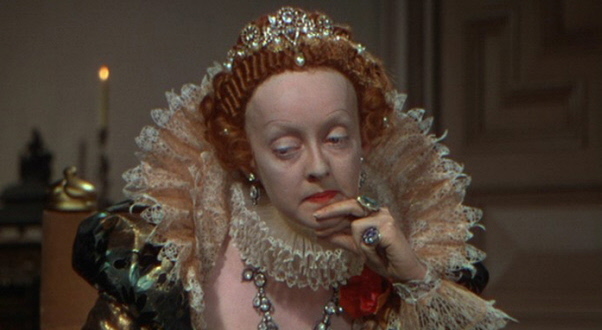
Bette Davis as Queen Elizabeth I in “The Private Lives of Elizabeth and Essex” (1939)
-For her role as Queen Elizabeth I in “The Private Lives of Elizabeth and Essex” (1939), Bette Davis shaved two inches off her hairline at the forehead and her eyebrows off. She said they never grew back properly and had to use an eyebrow pencil, according to IMDB.
To review: Though I have testedmany of all of my beauty tips but I have not shaved off my eyebrows and drawn them back on for this one. However, I think several of us have had that panicked moment of over plucking and fearing they won’t grow back properly. It’s amazing how many actresses had to deal with eyebrow issues for the remainder of their lives due to shaving them off for roles.
Rushing from place to place and waiting in lines for entertainment.
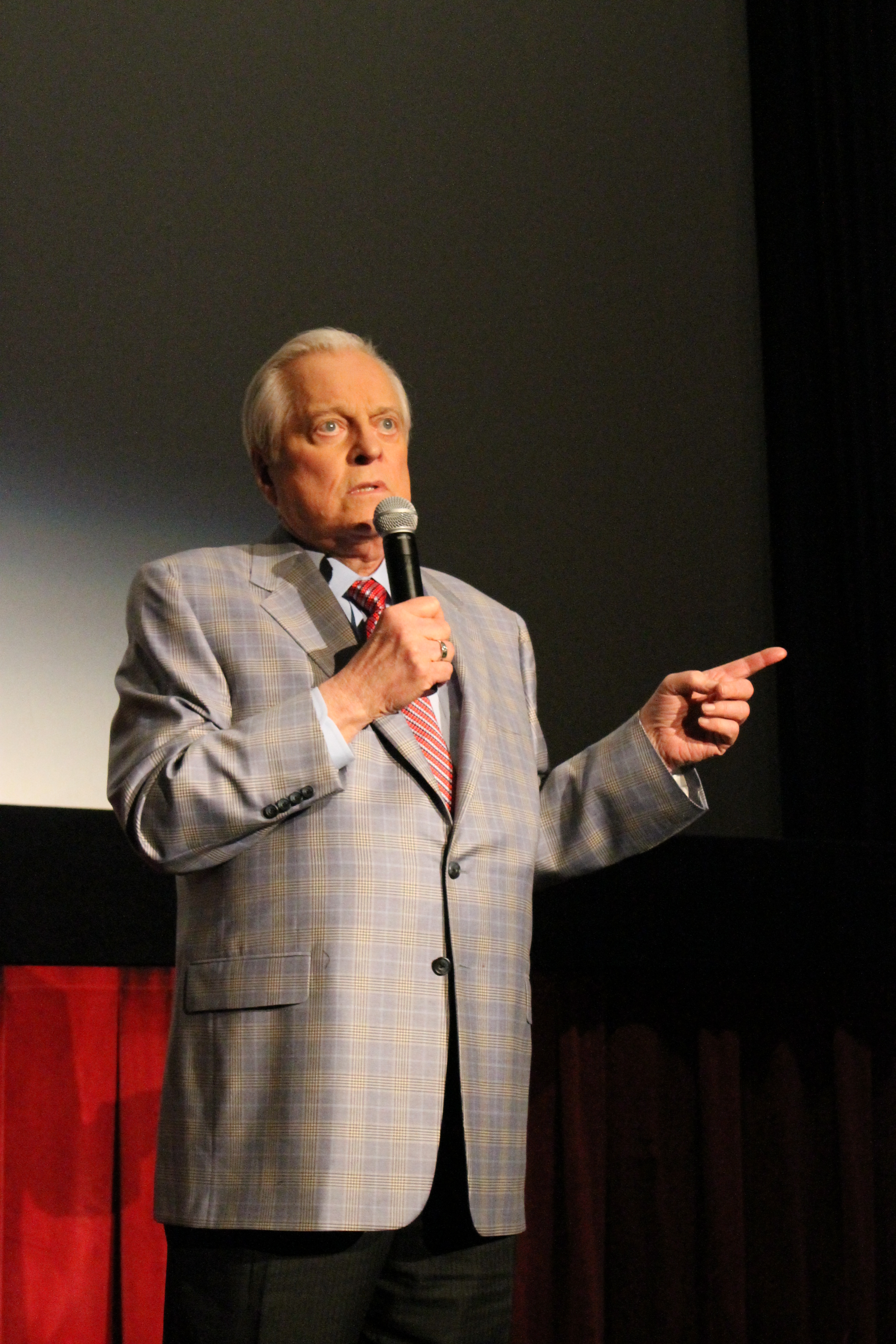
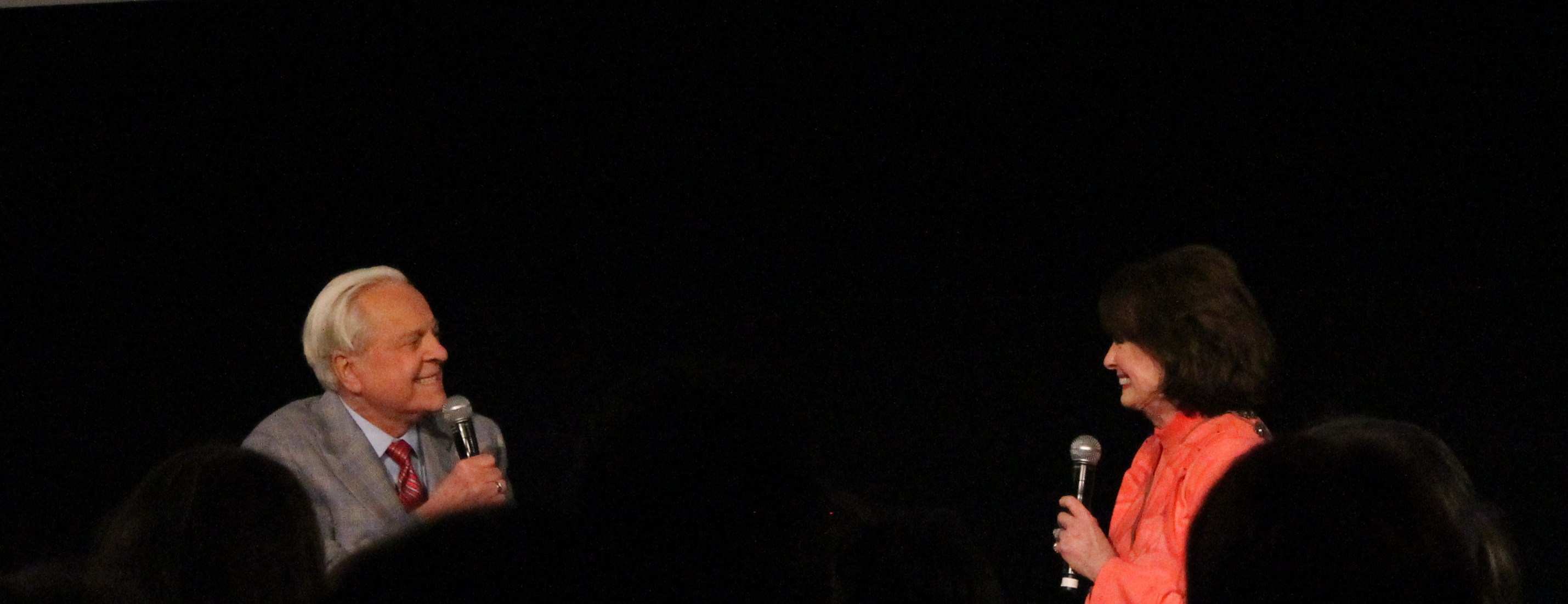
Robert Osborne introducing “Desert Song” (Comet Over Hollywood/Jessica Pickens)
Turner Classics Movie’s Robert Osborne could be considered the “Walt Disney” of the whole event.
Yes for classic film fans, the Turner Classic Film Festival (TCMFF) may be considered the “happiest place on Earth,” where thousands of people spend four days doing nothing but watching classic films and enjoying each other’s company.
Since this was my first year attending TCMFF, I can’t compare it to past years but several have said it was the best year ever, and I would believe it. After three years of wanting to go to TCMFF, I was not disappointed. I had a ball.
There were several times- riding on the plane, sitting in a movie theater, walking down Hollywood Blvd.- that I thought “Am I really here?”
I visited Hollywood once before in 2006 on a family vacation and was left rather dismayed by the disregard of history and confused by the odd people dressed like Marilyn Monroe and Shrek outside of Graumann’s Chinese Theater (now TCL Chinese).
But even those people desperate for attention in their costumes and passing out their CDs didn’t cheapen TCMFF.
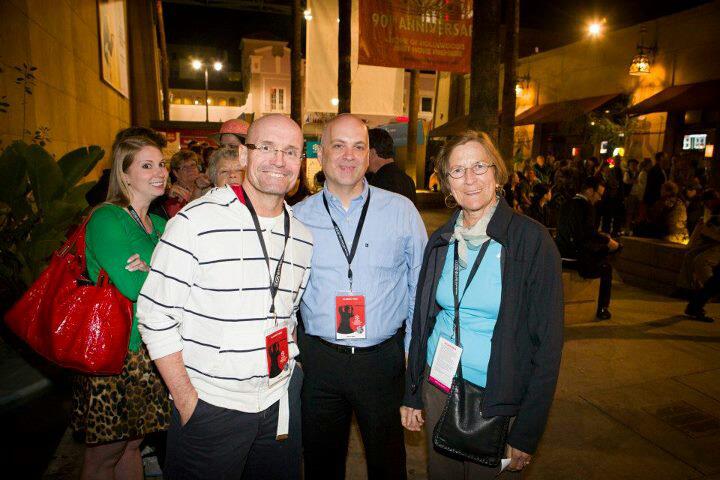
Typical me. Photo bombing a TCM picture outside the Egyptian (there I am on the left in the green)
In fact I felt like I excitedly drifted along on a cloud of old Hollywood splendor; only thinking about which movie I would watch next.
And after years of being a classic film fan I was finally with people who understood what I was talking about. I could toss around names like Van Johnson, Edward Everett Horton or mention the slang “pre-code” and every one knew exactly what I meant.
It’s an uncanny feeling to be sitting in an audience waiting to watch “Libeled Lady” and have the audience applaud when stars Jean Harlow and William Powell enter on screen.
I haven’t seen many classic films on the big screen and it’s a special experience. Not only did I realize how much I liked some films, but I noticed more. Facial expressions and shifting of eyes that you may miss on the small screen.
Though I blogged each night on my phone, I wanted to do one last review of the festival.
Films viewed during the festival:
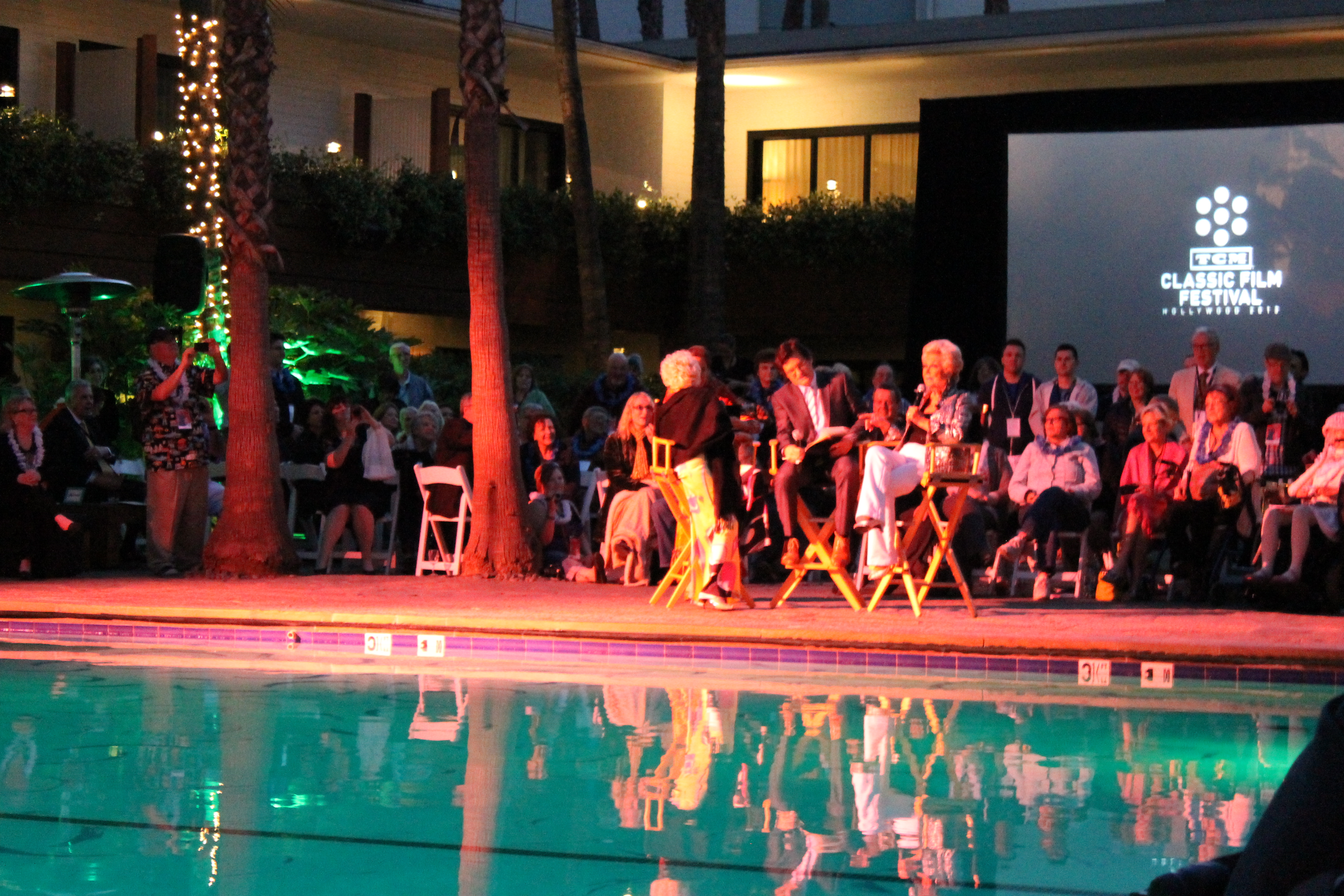
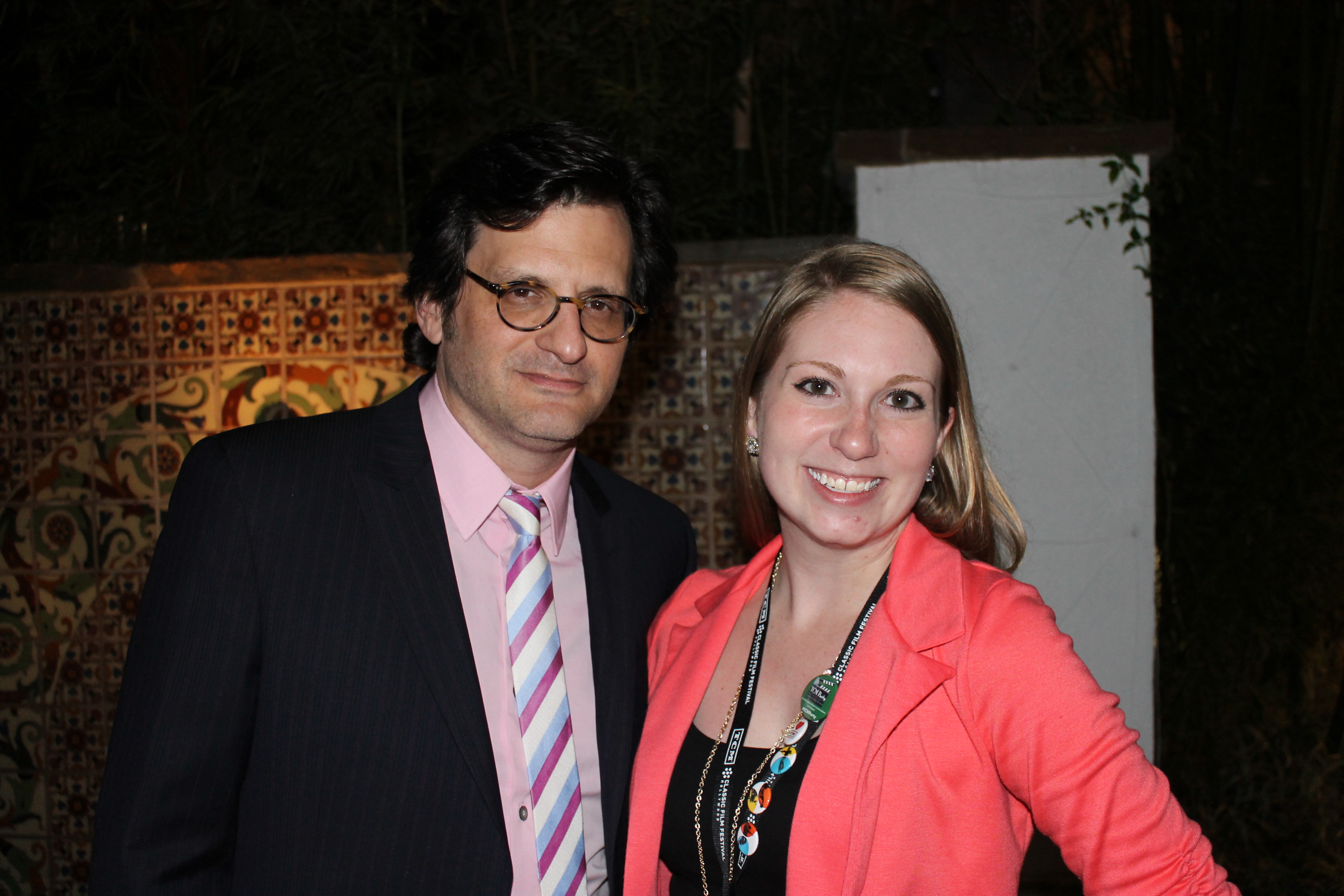
France Nuyen, Ben Mankiewicz and Mitzi Gaynor poolside at the Roosevelt Hotel (Comet Over Hollywood/Jessica Pickens)
Thursday, April 25: -South Pacific (1958)
Starring Mitzi Gaynor, Rossano Brazzi, John Kerr, Juanita Hall and France Nuyen
With guests Mitzi Gaynor and France Nuyen
The film was shown poolside at the Roosevelt Hotel and hula dancers performed before the film.
Friday, April 26: -Libeled Lady (1936)
Starring Jean Harlow, William Powell, Myrna Loy, Spencer Tracy
“Screwball comedy is a lost art,” said TCM’s Scott McGee before the film.
The whole audience also cheered as McGee said he was a huge fan of William Powell’s.
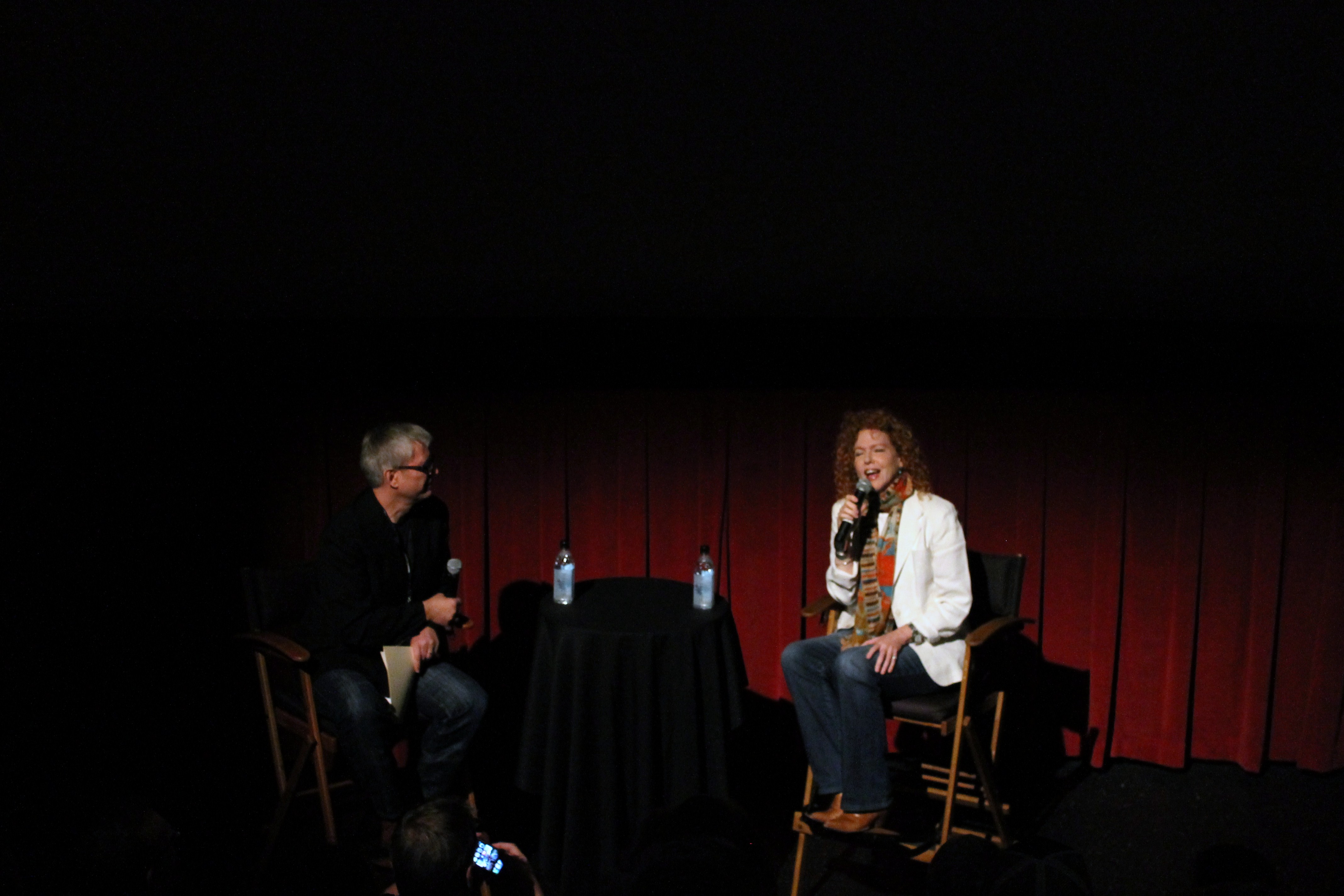
Kate MacMurray introducing “Suddenly It’s Spring” (Comet Over Hollywood/Jessica Pickens)
-Suddenly, It’s Spring (1947)*
Starring Paulette Goddard, Fred MacMurray, MacDonald Carey. Introduced by MacMurray’s daughter Kate.
MacMurray’s daughter shared wonderful stories about her father including: MacMurray, a saxophonist and also once a singer for a jazz band, played the saxophone for the My Three Sons TV show theme song. -Notorious (1946) starring Ingrid Bergman and Cary Grant. Introduced by Rose McGowan
–It (1927) starring Clara Bow
This was my first silent film with a live orchestra accompaniment.
“Clara was a great natural talent of movies,” said Bow biographer David Stenn. -Hondo (1954) starring John Wayne and Geraldine Page Introduced by Leonard Maltin.
This was my FIRST EVER 3D film.
For more on Friday: https://cometoverhollywood.com/2013/04/27/turner-classic-film-festival-macmurray-harlow-hitchcock-bow-and-wayne/
Saturday, April 27: -Bugs Bunny Cartoons for his 75th birthday
Very clever of TCM to start a Saturday with cartoons. Leonard Maltin introduced the cartoons saying how Warner Brother’s cartoons were the first to have the characters talk at the screen.
(Comet Over Hollywood/Jessica Pickens)
-Alfred Hitchcock’s A Lady Vanishes (1936) Introduced by 98-year-old actor Norman Lloyd.
Lloyd gave up a tennis game to speak before the film and said A Lady Vanishes and 39 Steps were the last two English films Hitchcock made and were both perfection.
“I tell film students, don’t go to film school. Just watch 39 Steps,” Lloyd said.
-Desert Song (1943)* starring Dennis Morgan, Irene Manning, Bruce Cabot. Introduced by Robert Osborne
A film that had not been shown over 50 years due to copyright, this was my 500th musical that I’ve seen.
It seems fitting that my 500th musical would end with me meeting Robert Osborne afterwards.
Robert Osborne and Ann Blyth introducing Mildred Pierce (Comet Over Hollywood/Jessica Pickens)
-Mildred Pierce (1945) starring Joan Crawford, Ann Blyth, Zachary Scott, Jack Carson, Eve Arden
Introduced by Robert Osborne and Ann Blyth
“I have nothing but wonderful memories of Joan,” Blyth said. -Island of Lost Souls (1932) starring Charles Laughton, Lelia Hyams, Richard Arlen
I love that TCM also ended nights with a horror film at midnight.
For more on Saturday: https://cometoverhollywood.com/2013/04/28/i-have-nothing-but-wonderful-memories-of-joan-mildred-pierce-and-ann-blyth/
Sunday, April 28 -Come September (1961) starring Rock Hudson, Gina Lollabrigida, Bobby Daren, Sandra Dee
Introduced by Vanity Fair correspondent Matt Tyrnauer -I Am Suzanne (1933)* starring Lilian Harvey and Gene Raymond. Introduced by MoMa archivist Katie Trainor
Though this film was very odd (the plot revolved around marionette puppets), it was worth seeing. Trainor said the film had not been seen in 80 years. This was also my 501st musical -It Happened One Night (1934) starring Clark Gable and Claudette Colbert.
–The General (1926) and One Week (1920) starring Buster Keaton. Introduced by Robert Osborne
A special screening because it was the second to last film to be shown in Graumann’s before being remodeled to IMAX. The crowd booed when Osborne announced this.
For more on Sunday: https://cometoverhollywood.com/2013/04/29/and-so-it-ends-review-of-the-last-day-of-the-tcm-film-festival/
Along with the films it was a pleasure to meet so many fellow bloggers and Twitter pals in person. Especially since I have talked to many of you for three years. There were screams of excitement and embracing as we kindred classic film souls finally met in person.
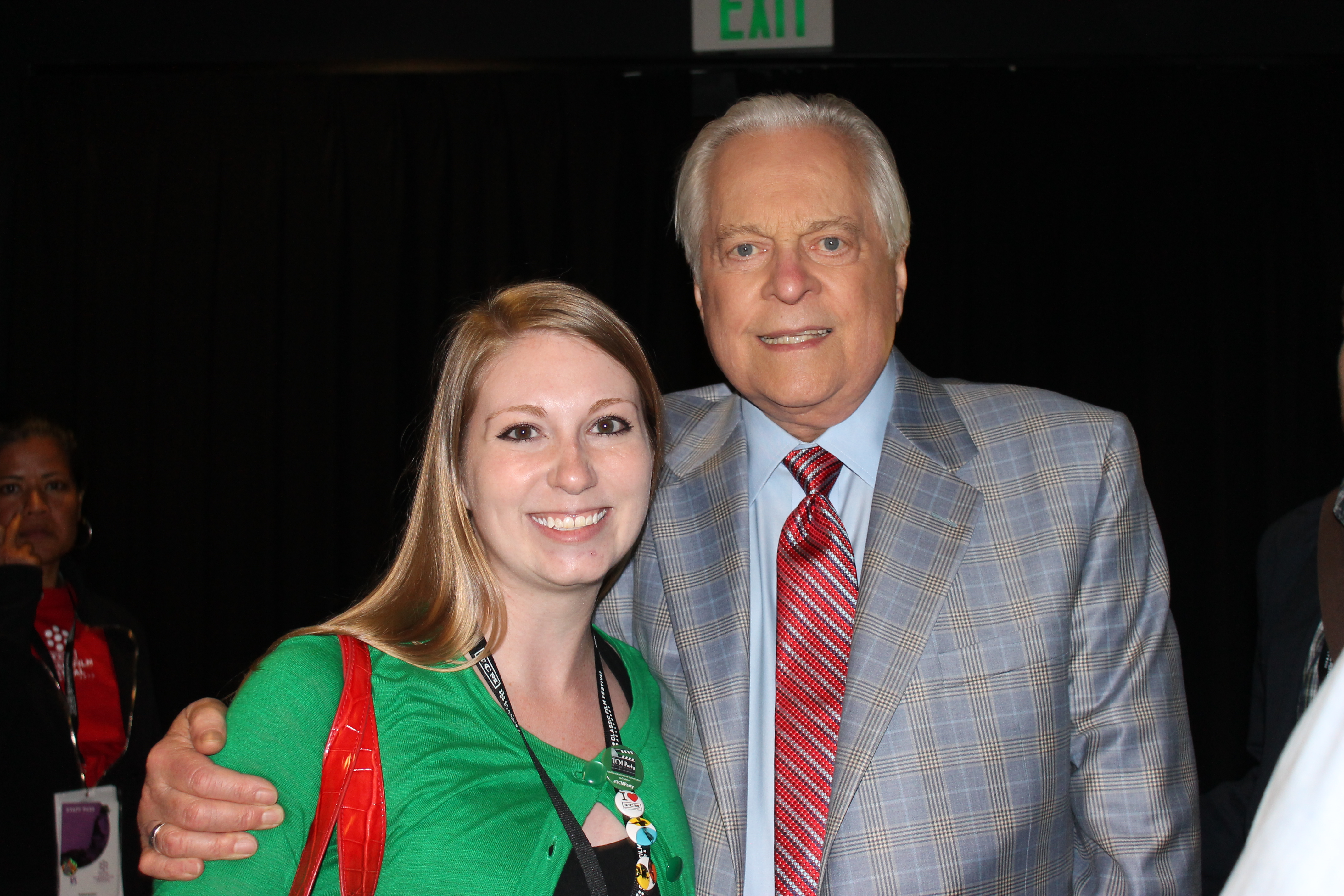
With knees shaking, I met my favorite person in the whole world, Robert Osborne
With another favorite, Ben Mankiewicz
Sad to be returning home, I ran into TCM’s Scott McGee who was on my flight home!
My favorite film of the festival: “Suddenly, It’s Spring” (1947). I had never seen it and it was wonderful. MacMurray’s daughter also gave one of my favorite talks during the festival
My favorite day of the Festival was Friday since it held so many firsts for me.
Now, as I sit on my couch back in North Carolina, I can only count the days until next year.
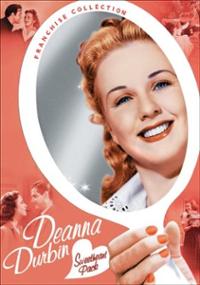
The first time saw Deanna Durbin was on the front of a DVD case.
The DVDs that introduced me to Deanna
I was 14 and gazed at this pretty, young lady happily looking back at me on the front of the “Deanna Durbin: Sweetheart Pack.”
Though I had no idea who Durbin was, I bought the DVDs.
The first film I watched was “Three Smart Girls” (1936) and immediately fell in love with Durbin’s smile, singing voice and charm.
Through the years, I’ve tried to watch as many musicals as possible- now up to 470 movie musicals-and Durbin’s films have been some of my favorite.
Debuting in films at age 15, Durbin’s popularity pulled Universal Studios out of bankruptcy, won her a Juvenile Oscar in 1938 and made her one of the top paid women in the United States.
Her popularity was world wide with fans such as Winston Churchill and Anne Frank. She influenced fashion in “Nice Girl” (1941) with a white organdy, ruffled dress, according to USA Today.
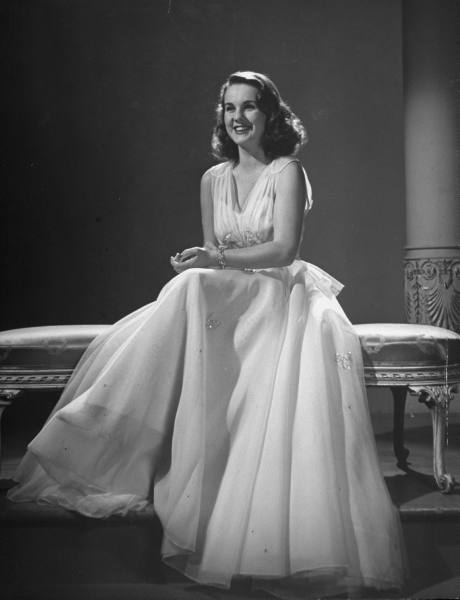
1938 LIFE magazine photo of Durbin
She was considered for the role of Dorthy in “Wizard of Oz” (1939) (as was Shirley Temple) and to be the voice of Snow White in the 1937 Walt Disney cartoon. However her voice was considered too mature at 14.
Similar to fellow child star Shirley Temple, Durbin had dolls and other merchandise created in her likeness. Today, it’s difficult to find a Deanna Durbin doll under $200.
After her first on-screen kiss with Robert Stack in “First Love” (1939) she transitioned into teen and adult roles with leading men such as Joseph Cotton, Gene Kelly and Tom Drake.
But after 21 films and at the height of her popularity, Durbin left films and lived the remainder of her life in France.
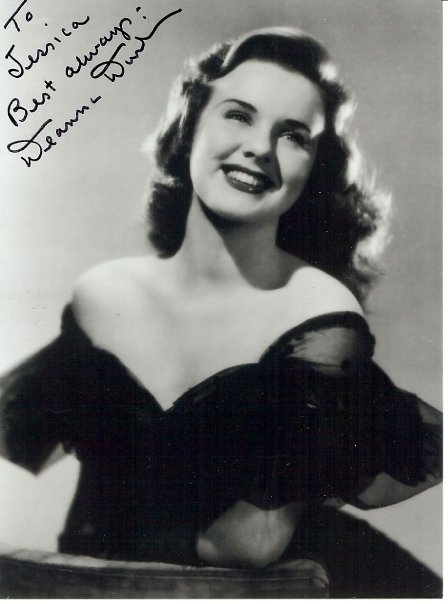
Long after she had left films, her influence and sunny disposition continued to spread, this time to fans like myself. Durbin quickly became one of my favorite movie stars and singers as I worked my way through her films. In 2005, she was kind enough to respond to a fan letter with an autograph and even paying for postage from France.
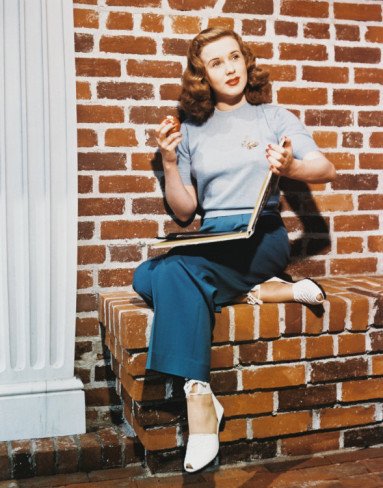
Durbin in color
My favorite Deanna Durbin films include “The Amazing Mrs. Holliday” (1943) where she plays a missionary caring for World War II orphans, and “It Started With Eve” (1941). Though Durbin has great chemistry with “Eve” leading man Robert Cummings, she has even more impressive chemistry with Charles Laughton. The rumba scene with Laughton is one of my favorite comedic scenes of the English actor.
My favorite songs of Durbin’s include “Amapola” and “Les Filles de Cadiz.”
It was announced Tuesday that Durbin passed away at the age of 91.
Though she is gone, she will forever be singing in our hearts.















 Comet Over Hollywood