Searching for ‘Rosebud:’ Child star searches for himself in autobiography

Dickie Moore with Pete the Pup in

Dickie Moore with Pete the Pup in “Our Gang” in 1930. Moore said he didn’t enjoy the Hal Roach series because he didn’t feel he fit in

Dick Moore was searching for his “Rosebud.”

In “Citizen Kane,” a sled with the word “Rosebud” was the key to Charles Foster Kane’s lost childhood.

For Moore, early memories were a slew of movie scenes with James Cagney, Barbara Stanwyck and Paul Muni. He was the breadwinner for his out of work parents and went to school at a studio with other acting children.

His childhood was far a normal childhood of peanut butter and jelly sandwiches and playing at recess.
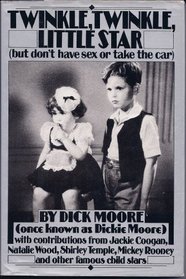
bookIn Dick Moore’s book, “Twinkle, Twinkle, Little Star (but don’t have sex or take the car),” Moore shares his memories of performing as child star Dickie Moore and interviews 31 child actors to see how their experiences compare to his.

Some of these actors include Stymie of Our Gang, Roddy McDowall, Jane Powell, Jane Withers, Jackie Coogan, Edith Fellows, Natalie Wood, Jackie Cooper, Shirley Temple, Baby Peggy (Diana Serra Cary) and Peggy Ann Garner.

“All of us shared common lives and times, huge responsibilities and salaries that shriveled fathers’ egos,” Moore wrote

Some children wanted to go into show business, like Jane Withers. Others were pushed by their mothers (or saber-tooth tigers of the Hollywood jungle, according to Diana Cary), like Natalie Wood who sat on a director’s lap and sing him a song while a movie was location in Santa Rosa. And some happened by accident.

Moore was one of those accidents. A friend of a friend of his mother’s was a casting director who happened to stop by the Moore home. The studio pursued Mrs. Moore for Dickie to be in pictures. She said no, but finally gave in since Dickie’s father was out of work.

Dickie was 11 months old in his first film and playing John Barrymore as a baby.

Once Moore started acting, his father had an even more difficult time finding work. Employers assumed he made enough money and other parents brought their children to see Mr. Moore at work, hoping he could put them in films. Mr. Temple had the same problem.

The book explores how each child got into films, their home life, the affect on non-acting siblings and birthday parties.

Most of the young actors’ parties were opportunities for publicity and magazine photographers to put their faces in magazines.

“Everyone was posing. The whole business of publicity made parties seem synthetic. If you have a party, it’s supposed to just be with people,” said actor Gene Reynolds. “But most of our parties were stunt to get pictures in magazines so where is the fun in that?”

Shirley Temple cutting the cake at her birthday party in 1935.

Shirley Temple cutting the cake at her birthday party in 1935.

Shirley Temple, the first child to carry a full weight picture on her own, would have three birthday parties each year: one with other child actors, one on set with the crew and one with her family.

“The parties were endless…Fox would have one for a large number of people I didn’t know, a lot of children I’d never seen in my life and would never seen again. And I was he hostess. It was kind of strange. I figured it was part of my job.”

Temple was also very isolated, as were many children. Moore’s parents allowed him freedom to play outside while others had no friends.

“Parents often discouraged their children from forming solid friendships because friends might tell each other about a part that was coming up and then, from the parents’ point of view, that wrong child would get the job,” Moore wrote.

Competition was high among child actors: Who could cry the best on cue, lying about ages to be younger and trying to look young, i.e. pigtails, short dresses.

Adult co-stars and their treatment to youngsters are discussed in the book. Marlene Dietrich was warm and friendly in “The Blue Angel,” Franchet Tone taught him how to play chess during “The Bride Wore Red” and Gary Cooper suggested what type of gun Moore should buy.

Moore with Barbara Stanwyck in

Moore with Barbara Stanwyck in “So Big”

But Moore’s favorite female adult star was Barbara Stanwyck was Moore’s favorite in “So Big.”

“Affectionate and demonstrative, she was easy to understand. She talked but didn’t fuss,” Moore wrote. “She was a direct and gracious woman, who seemed extremely interested in whatever interested me.”

Unanimously children liked working with Spencer Tracy because he would look right at you during a scene and listen to your lines.

Bobs Watson followed Tracy around during “Boys Town.”

“Often after a scene, he’d reach over and hug me and take me on his lap,” Watson said. “I felt like a little puppy. I would follow him around and stand close, hoping it would call me over and he often would.”

The two most disliked were W.C Fields and Wallace Beery.

“We did four long film together,” Jackie Cooper said about Beery. “They couldn’t find eight guys to carry his casket.”

Margaret O’Brien said he stole her lunch and Jane Powell said he would steal props off the set.

Two children got along with him: Darryl Hickman and Jackie Coogan.

Coogan’s father was a veteran in the business and it seems some of the tougher actors respected him because of this.
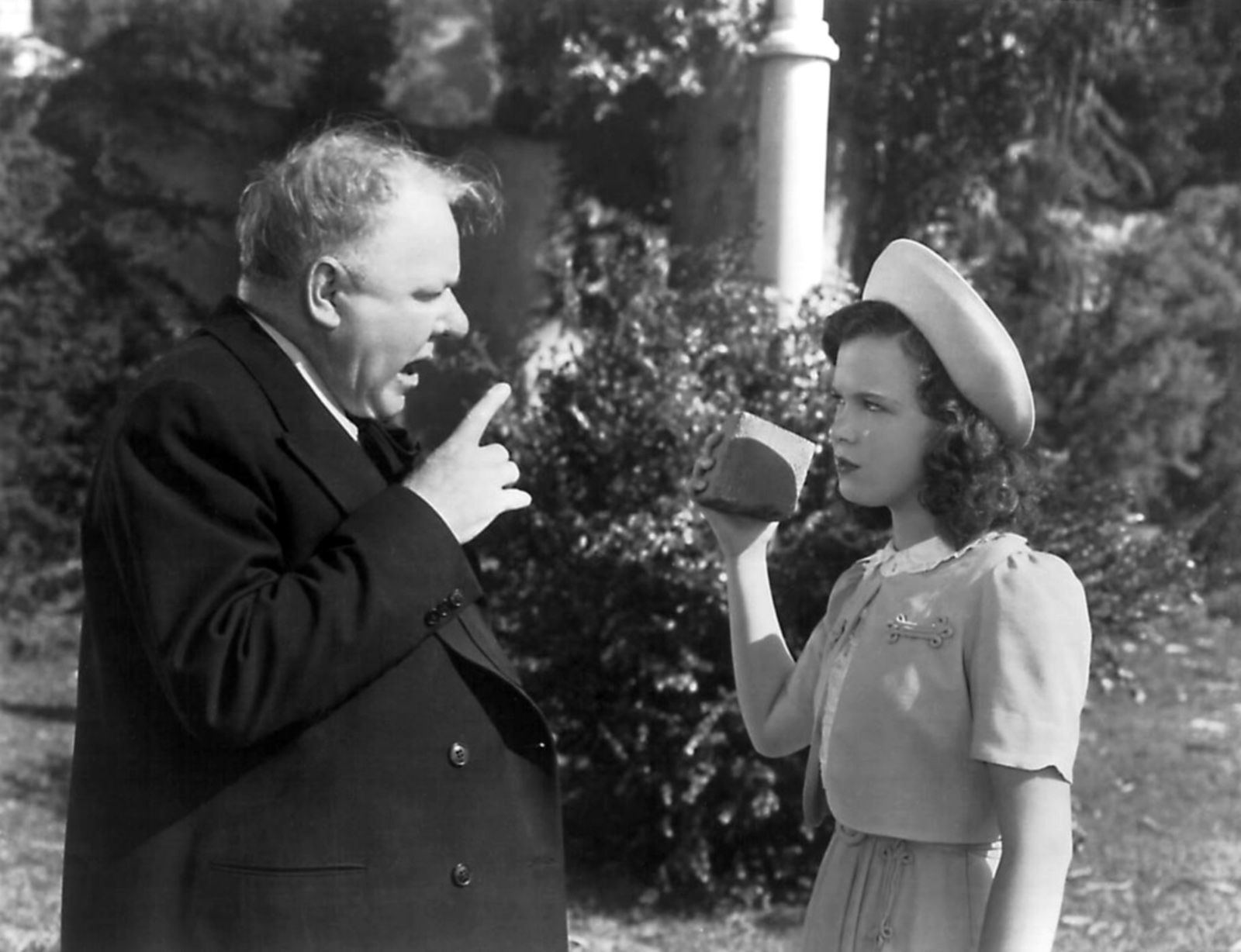
W.C. Fields and Gloria Jean in

W.C. Fields and Gloria Jean in “Never Give a Sucker an Even Break.”

Fields notoriously disliked children and was known for getting drunk while filming. But Gloria Jean got along with him, because she tried to look out for him.

While the book tells some humorous and heartwarming stories, there is an underlying sadness. It’s like reading Romeo and Juliet and knowing the lovers die at the end of the play.

You know that for many of the child stars, their career would come to an end.

Children such as Jackie Coogan and Baby Peggy faced financial problems when their family member squandered or stole the millions they had earned for their family.

The biggest fear for a child star is to age, as many faded away when they got older. Moore was in magazines and on ice cream lids (similar to baseball cards) until he had scarlet fever and was away from the screen for a year, taking him back to the bottom.

Baby Peggy (Diana Serra Cary) and her fan mail.

Baby Peggy (Diana Serra Cary) and her fan mail.

Baby Peggy felt she was a has-been at five.

Others like Jackie Cooper, Natalie Wood and Roddy McDowall went on to have a successful adult life.

But many child stars, even Jane Withers who loved acting, did not wish for their children to go into the business-they wanted them to have a normal childhood.

“They were wrong,” Roddy McDowall told Moore. “They were wrong to take us children and do that to our lives, to twist our environment in that way and then leave it for us to sort out.”

“Twinkle Twinkle Little Star..” is one of the best classic Hollywood books I have ever read about one of the most complicated and fascinating subjects.

If you can find it for a decent price, I highly suggest it.

This is part of my Children in Film blogathon. Read all of the entries here: https://cometoverhollywood.com/2013/05/24/children-in-films-blogathon-the-contributors/

Check out the Comet Over Hollywood Facebook page for the latest updates or follow on Twitter at @HollywoodComet.

“But first and foremost, I remember mama”

An actress won an Academy Award in 1948 for not saying a word.

But the actress I feel should have won, spoke with a Norwegian accent.

Jane Wyman won the Academy Award for Best Actress for the role as a deaf/mute in “Johnny Belinda.”

Jane Wyman winning the Academy Award for Best Actress for Johnny Belinda

Jane Wyman winning the Academy Award for Best Actress for Johnny Belinda

“I accept this very graciously for keeping my mouth shut once, I think I’ll do it again,” Wyman said when she accepted the award.

While I enjoy the movie “Johnny Belinda” and think Wyman did a good job, she isn’t the actress I would have picked.

The nominations that year were:

•Jane Wyman for “Johnny Belinda

•Ingrid Bergman for “Joan of Arc

•Olivia de Havilland for “The Snake Pit

•Irene Dunne for “I Remember Mama

•Barbara Stanwyck for Sorry, Wrong Number

Of the five women, I would have picked Olivia de Havilland or Irene Dunne.

I’m a huge Stanwyck fan, but her performance in “Sorry, Wrong Number” annoys me. I’ve never seen “Joan of Arc.” Olivia de Havilland gives a convincing, heartbreaking performance of a woman who can’t remember how she got into a state asylum in “The Snake Pit.”

But today I’m here to recognize Irene Dunne for her role as Martha “Mama”Hanson in “I Remember Mama.”

The movie, narrated by her daughter Katrin (Barbara Bel Geddes), follows a Norwegian immigrant family in 1910 San Francisco as they grow up and face joys and sadness.

“For long as I could remember, the house on the Larkin Street Hill had been home. Papa and Mama had both born in Norway but they came to San Francisco because Mama’s sisters were here, all of us were born here. Nels, the oldest and the only boy, my sister Christine and the littlest sister Dagmar but first and foremost I remember Mama,” she narrates.

The Hanson family gathered, counting their expenses.

The Hanson family gathered, counting their expenses.

And every night the family would gather together, counting their expenses and the money brought into the house. The family never wanted to go “to the bank,” a little box kept in a closet with money that was supposed to be saved to get Mama a warm winter coat.

When the family wouldn’t have to take money from the bank, Mama would sigh happily and say, “It’s good, we do not have to go to the bank.”

The movie is filled with memorable scenes:

•Dagmar (June Hedin) has surgery and Mama isn’t allowed to see her. “I’m not a visitor, I’m her mama,” she says. Mama knows Dagmar is afraid staying in the hospital overnight, so pretends to be a cleaning woman and cleans the hospital floors working her way to the children’s ward. She then sings Dagmar, and all the other children to sleep.

Mama (Irene Dunne) pretends to be a wash woman in the hospital to see her daughter, Dagmar. (LIFE photo by Allan Grant)

Mama (Irene Dunne) pretends to be a wash woman in the hospital to see her daughter, Dagmar. (LIFE photo by Allan Grant)

•Papa (Philip Dorn) is watching as his son Nels (Steve Brown) tries to smoke a pipe for the first time. He lights the pipe for Nels, knowing his son will get sick, and then comforts him when he does-teaching him a lesson in smoking.

•Aunt Trina (Ellen Corby) wants to marry Mr. Thorkelson (Edgar Bergen), the shy funeral director, and her sisters make fun of her. Mama makes them stop by subtly reminding them about how one cried all night on her wedding night and the other’s husband tried to run away before the wedding.

•Mama (Dunne) goes to see famous writer Florence Dana Moorhead (Florence Bates) to help Katrin with her writing. Mama gives Miss Moorhead, a lover of food, recipes in exchange for Miss Moorhead to read Katrin’s stories.

I found Dunne’s role to be heartwarming and believable. In the film she handled situations firmly, with tenderness or humor.  The warm nature of the film may not have made it memorable to the Academy, but I like movies about families. I suppose it makes me think of my own and how my mother likes this movie as well.

This was Dunne’s last of five Oscar nominations she would receive. The others were “Cimarron,” “Theodora Goes Wild,” “The Awful Truth” and “Love Affair.”

While the performances by Jane Wyman and Olivia De Havilland were good, for me “first and foremost, I remember mama.”

oscar

This post is part of the 31 Days of Oscar Blogathon, hosted by Once Upon a ScreenOutspoken & Freckled and Paula’s Cinema Club. It runs Feb. 1 – Mar. 3, in conjunction with Turner Classic Movies’ 31 Days of Oscar.

Favorite Films: So Proudly We Hail (1943)


Claudette Colbert, Paulette Goddard, Veronica Lake

Claudette Colbert, Paulette Goddard and Veronica Lake.

The three very different Paramount Pictures actresses are brought together to star in one of my favorite 1940s films, “So Proudly We Hail” (1943).

The film follows a group of U.S. Army nurses- Claudette Colbert (as Lt. Janet Davidson) and Paulette Goddard (as Lt. Joan O’Doul)- who leave for Hawaii for their tour of duty. Shortly after they leave, Pearl Harbor is attacked and the United States is brought into World War II. The military ship picks up nurses and wounded from Pearl Harbor, one a troubled nurse Lt. Olivia D’Arcy, played by Veronica Lake. The nurses are then sent to the Philippines, first assisting soldiers in Bataan and then evacuating to Corregidor.

From a dramatization of Doolittle’s Raid in “Thirty Seconds Over Tokyo” to “Mrs. Miniver” showing life on the British home front and the Battle of Dunkirk, Hollywood made several films that depicted what was going on overseas during World War II.

While I enjoy most 1940s era World War II films, I love “So Proudly We Hail” because of its focus on military nurses.

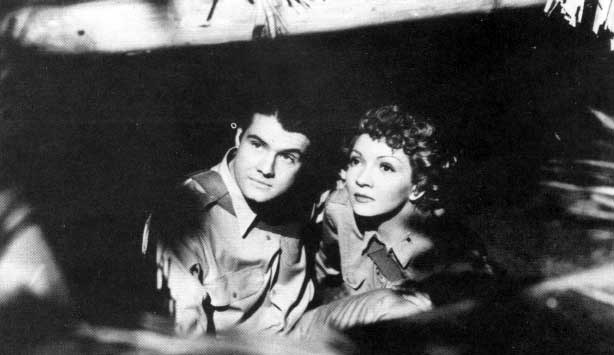
Lt. Summers (George Reeves) and Lt. Davidson (Claudette Colbert)

Lt. Summers (George Reeves) and Lt. Davidson (Claudette Colbert)

Colbert is the real star of the film; the rock of the group of nurses, leading them to aid injured soldiers. Goddard and Lake flank her as secondary female leads: Goddard the flirty, glamor girl and Lake the troubled, quiet nurse.

Their differences in real life as actresses as well as the differences in their characters illustrate the wide range of people who were brought in to serve together during war time.

“The events in this movie were still very much on the minds of Americans when this film came out,” said Turner Classic Movies prime time host Robert Osborne in the DVD introduction. “Events in the movie had happened for real recently and news reports were still coming out.”

Movies like this are made to make viewers feel proud and patriotic of their country, but what I like about “So Proudly We Haill” is that I feel it’s fairly realistic.

Nurses with 104 degree temperatures from malaria are still caring for men while others are craving tomatoes and milk, items that can’t be found on the military front.

“What is a heroine,” One nurse asks, tired of all the attention on their voyage home.

“I don’t know. Anyone who is still alive,” another says.

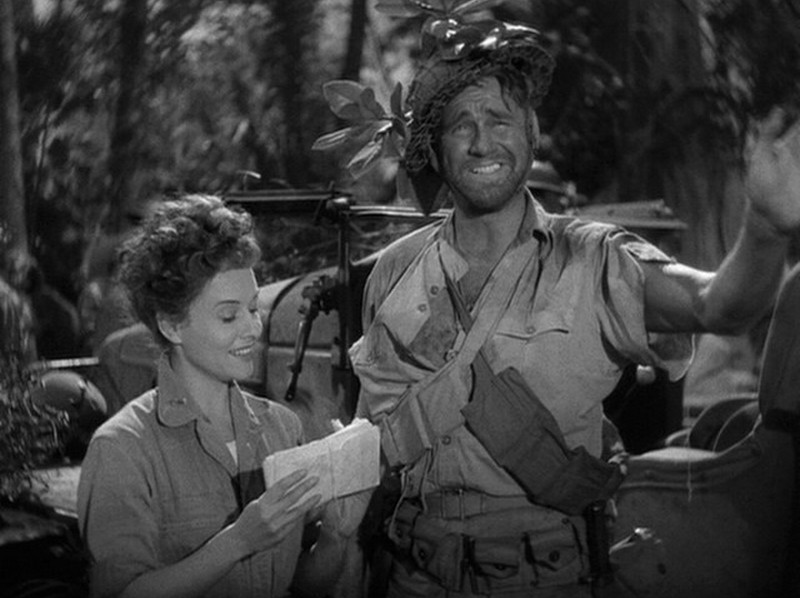
Joan (Paulette Goddard) and Kansas (Sonny Tufts)

Joan (Paulette Goddard) and Kansas (Sonny Tufts)

While Claudette Colbert is consistently good in all of her films, “So Proudly We Hail” gave Veronica Lake and Paulette Goddard the chance to show off their acting chops.

One scene that sticks out is when Goddard and Colbert find out why Lake acts cold towards the other nurses:

She opens up to Colbert about why she is angry and is there to “kill Japs”:

“Today is Christmas, isn’t it? The time for cheer and good fellowship and for peace. Well, today’s my wedding day. He and I were to be married today in St. Louis. And why weren’t we? Because he’s dead. He died that first morning. They killed him. I saw him. He was running across the field to his plane and they killed him. Sixty bullets – sixty! By the time I got to him he was dead. His face was gone – I couldn’t see him anymore. Just blood – blood all over.”

For Goddard, the scene that sticks out is when she tearfully says goodbye to soldiers in a military hospital before being shipped back to the United States.

When the film starts, Goddard is flirty, saying she has two fiancés, because she can’t say no to an engagement. But throughout the film, as she sees the horrors of war, she wants to help in every way she can, attending to soldiers and never sleeping. At the end she gives the wounded soldiers small gifts of hers and her old love letters for some laughs.

Other scenes that stick out to me:

• When Pearl Harbor is attacked, the nurses and military personnel are on a boat several miles out watch the bombing. There are screams of horror and disbelief, though they watch the attacks.

• Lt. O’Doul (Goddard) wearing a lacy black nightgown throughout the film. The night gown first enters as a dress for the Christmas party. Later she wears it every night to keep her moral up.

• The son of Nurse Capt. “Ma” McGregor has his legs amputated and soon after dies. Her son never knew his father, because he died in battle, and now Ma’s grandson won’t know his father either.

“My son like his father died for what he knew what is right. And if we don’t make it right, then they will all rise up and destroy us,” she says.

•The scene when the nurses are left behind during an evacuation. The nurses are the last to ship out during evacuation as the Japanese move closer. Lt. O’Doul forgets her nightgown, holding their truck up and the male drivers are shot. As Lt. Davidson (Colbert) searches for the truck keys to drive them out the nurses panic.

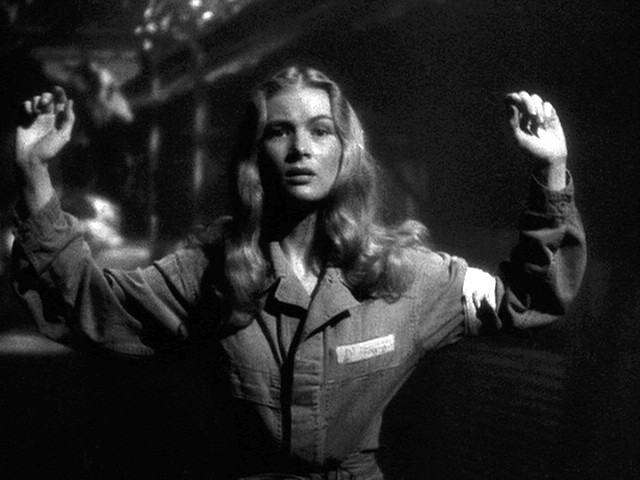
Veronica Lake "surrendering" to Japanese.

Veronica Lake “surrendering” to Japanese.

“I was in Nanking. I saw what they did. They fight over the women like dogs,” said Lt. Peterson (Ann Doran) panicking.

-During this scene is when Lt. D’Arcy dies. She takes a grenade, pulls out the pin, puts it in her uniform and walks towards the Japanese pretending to surrender. She dies to protect her peers and to “kill Japs” which is what she originally said she wanted to do. The scene is horrifying and shocking for a 1940s film.

• When the Japanese bomb the military hospital, sweet nurse Lt. Rosemary Larson, (Barbara Britton) is killed when the roof of the hospital collapses.

• When Lt. Davidson and Lt. Summers (George Reeves) get married and are given gifts of bread and peanut butter. Another sign of how much items we take for granted were valued.

The movie also has two romances: A playful and joking one between Paulette Goddard and a marine played by Sonny Tufts, and a more serious, passionate one with Claudette Colbert and a soldier played by George Reeves. However, I don’t feel the relationship takes away from the true purpose of the film.

As mentioned before, the three actresses were very different, and it has been rumored that they didn’t get along.

“All three were popular actresses and not accustomed to sharing close-ups,” Osborne said.

In Veronica Lake’s autobiography, she said she got along with her co-stars while it was Colbert and Goddard who locked horn. However, actor George Reeves disagreed.

“George Reeves said Veronica was the difficult one,” Osborne said. “Claudette was the moral builder for the whole cast, and if there was a problem it was because all three were so different. Reeves said it takes three to make a quarrel and Colbert wasn’t into that. She was too busy doing her work.”

 Check out the Comet Over Hollywood Facebook page .

Did that performance deserve an Oscar?: Luise Rainer in “The Great Ziegfeld” (1936)

This post is part of the 31 Days of Oscar Blogathon, hosted by Once Upon a ScreenOutspoken & Freckled and Paula’s Cinema Club. It runs Feb. 1 – Mar. 3, in conjunction with Turner Classic Movies’ 31 Days of Oscar.

 Occasionally you look at Academy Award winners, raise an eyebrow and say, “Really?”

Luise Rainer’s 1936 Best Actress win for “The Great Ziegfeld” is one of those for me.

Now don’t get me wrong. I adore Rainer, nicknamed “The Viennese Teardrop.”

Luise Rainer as Anna Held in "The Great Ziegfeld"

Luise Rainer as Anna Held in “The Great Ziegfeld”

It’s amazing that she was the first actress to win two Best Actress Awards back to back and is still with us at age 103. She did a good job with her role in “The Great Ziegfeld” but it did not leave me wowed.

The Great Ziegfeld” is a fictionalized biography of Broadway producer Florenz Ziegfeld, played by William Powell.

Rainer plays Anna Held, who the film says is Ziegfeld’s first wife. In reality, Held and Ziegfeld lived together for a year while she was getting divorced. After the divorce was finalized, the couple announced that they considered themselves married, though they never officially were, according to Musicals 101. Ziegfeld later went on to marry Billie Burke, who many people know as Glenda the Good Witch in “The Wizard of Oz” (1939). Burke is played by Myrna Loy in the film.

Out of the nearly three hour movie, Rainer is in roughly 40 minutes.

In the film, Held is a bit of a diva. For example, she throws a temper tantrum (and orchids) when Ziegfeld tells the press that Held bathes in milk for publicity. Another time she gets upset because Ziegfeld is producing two shows, and will only let her be in one.

“I’m so disappointed in you I could scream,” she cries. “I thought you loved me more than anything else in the world. I thought I was your one ideal, your only ambition.”

In the end, Ziegfeld treats Held rather badly, going after a character played by Virginia Bruce in the film. I think Bruce’s character is supposed to be Lilliane Lorraine, who Ziegfeld left Held for in real life. In the movie, Anna Held leaves Ziegfeld after seeing him embracing another woman.

So let’s see who was Rainer up against in 1936:

-Irene Dunne for “Theodora Goes Wild

-Gladys George for Valiant is the Word for Carrie

-Carole Lombard for My Man Godfrey

-Norma Shearer for Romeo and Juliet

Of those films, the only one I haven’t seen is “Valiant is the Word for Carrie.”

Shearer, Dunne and Lombard were already established stars and are all excellent in their films.

However here is why I don’t believe they won:

1. “Theodora Goes Wild” and “My Man Godfrey” both were comedic roles. Though comedy is usually more difficult to perform, it doesn’t seem to be taken as seriously with awards.

2. Shearer is good as Juliet in “Romeo and Juliet,” but she is a 34-year-old woman playing a 16-year-old girl. That may not have had anything to do with her not winning the award, but it does make the role less believable.

The 1936 Academy Awards had other odd nominations:

-Deanna Durbin musical “Three Smart Girls” was nominated for Best Picture

-Stuart Erwin was nominated for Best Supporting Actor for “Pigskin Parade

-Best Song nomination for “Do I Remember?” from “Suzy,” a song performed by a dubbed Jean Harlow.

Apparently, Rainer’s win was also controversial at the time, since she was still rather unknown and the role was considered more a supporting one.

Luise Rainer (center in black) performing "It's Delightful to Be Married."

Luise Rainer (center in black) performing “It’s Delightful to Be Married.”

Some say she won because of the $2 million budget MGM studio head Louis B. Mayer spent on the film (though this doesn’t make since to me, since it also won Best Picture). Others say it’s because of the broken hearted telephone call to Ziegfeld, congratulating him on his marriage to Billie Burke.

Why do I think Rainer won the 1936 Best Actress Award?

I personally wonder if it was process of elimination and reluctance to give the award for a comedic performance.

Who do I feel deserved the award? Either Dunne or Lombard.

Rainer went on to win the Academy Award for Best Actress in 1937 for her role as O-Lan, a Chinese woman, in “The Good Earth.” The role is a personal favorite of Rainer’s, and an award I feel she deserved.

Winning the Academy Award two years in a row is something Rainer said was one of the worse things that could have happened to her.

“The Oscar is not the curse,” she said. “The real curse is that once you have an Oscar, they think you can do anything.”

Check out the Comet Over Hollywood Facebook page 

Liz and Dick (2012)……

“…….”

That was pretty much how I felt as the credits rolled Sunday night after the premiere of “Liz and Dick, the Lifetime dramatization of the tumultuous romance that Elizabeth Taylor and Richard Burton had during the 1960s.

Like most film fans, I was aghast when it was announced that Lindsay Lohan would be playing Elizabeth Taylor in a biopic. (In all honesty, I’m not the biggest fan of classic Hollywood biographical films, because they don’t seem accurate and draw on all the negatives of that performer.)

As Burton and Taylor's romance begins on the set of "Cleopatra"

As Burton and Taylor’s romance begins on the set of “Cleopatra”

However, many of us seemed to relax and laugh off the film when it was released that the film was made for the small screen, rather than for theaters.

Sitting down Sunday night, I was prepared for a good laugh, thinking the movie would be hilariously bad like camp classics “Susan Slade” (1961) or “Harlow” (1965).

But no. “Liz and Dick” wasn’t bad in a humorous way, it was just bad and unforgivably boring.

The 88 minute movie- two hours with commercials- dragged and seemed as long as Taylor’s three hour epic “Cleopatra” (1963).

The only actor who actually seemed like they were trying in the film was Grant Bowler who played Richard Burton.

Lohan seemed to go through the motions, even not trying to imitate Elizabeth Taylor’s voice. In one scene, Taylor has a temper tantrum and starts throwing things and knocking over tables. Lohan’s efforts were hilariously half-hearted.

Though Lohan’s has received bad publicity over the past several years, many people were saying this was her comeback, and she told new sources that she was excited about the role.

“I’m a huge Elizabeth Taylor fan and I relate to her on a lot of levels,” Lohan said in a Behind the Scenes interview. “Such as living in the public eye and the stress of what other people say about you, whether it’s true or not.”

The odd narrating technique.

The odd narrating technique.

But whatever excitement Lohan may have had for the role didn’t show through at all. On the contrary, she acted like she wanted to be anywhere but there.

Aside from the acting, the writing in the film was horrible.

The film begins with Burton and Taylor sitting in director’s chairs, dressed in black and telling us their story like we are in an interview. This made absolutely no sense to me, and I wasn’t sure why it was necessary.

The first twenty-three minutes involved Taylor and Burton sneaking around like 16-year-olds and having sex.

There were other hilariously odd lines like Taylor shouting “I’m bored! I’m so bored!” in which the viewers replied, “So are we.”

We were just as bored.

We were just as bored.

Other unintentionally hilarious moments were:

-Friend: “You’ve been married four times.” Liz: “Who’s counting?!”

-“I won’t live without you!” Liz shouts as she runs away from the camera like a six-year-old

-Liz having hysterics about her chubby fingers.

-1980s Liz, with Lohan looking more like Joan Collins from Dynasty than Elizabeth Taylor

The most angering part of the film is that Burton and Taylor’s second marriage was barely mentioned. The couple was married from 1964 to 1974 and then remarried again in 1975 to 1976.

Lohan looking like she's on the set of "Dynasty"

Lohan looking like she’s on the set of “Dynasty”

The appeal of Elizabeth Taylor and Richard Burton’s romance is that they loved each other so passionately that they couldn’t live with or without each other and that did not show through on the screen to me.

In all honesty, in the last 30 minutes of the movie, I was so disgusted and bored, I was barely paying attention. The real entertainment from the film was those live tweeting, making witty remarks and sharing my sentiments.

A few of my favorite tweets from that evening:

livetweet5

livetweet4

liz and dick

livetweet2

Check out the Comet Over Hollywood Facebook page

Dogs on Film: Since You Went Away

As many of you know the wartime film “Since You Went Away” (1944) is one of my all time favorite movies.

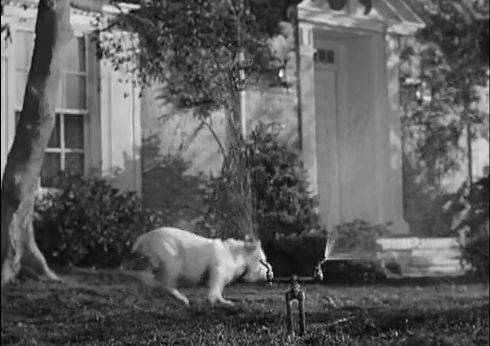
It has everything: An excellent cast filled with cameos, poignant moments, and magnificent camera work. But one of my favorite things about the film is the Hilton’s English Bulldog Soda.

Soda plops himself on a map as Col. Smollett and Bridget look for her father’s military base.

The movie revolves around Ann Hilton (Claudette Colbert), her two daughters Jane and Bridget (Jennifer Jones and Shirley Temple), their boarder Col. Smollett (Monty Wooley) and a slew of other characters that move in and out of their lives.  However, though Soda is just their pet, he still plays an instrumental role in the film-he even has his own theme music during the movie. When ever Soda has an appearance, a little tune is played by an oboe.

Soda seems to respond or foreshadow the main characters emotions throughout the film.

A few examples: 

Soda sitting on Mr. Hilton’s bed

•When we enter the film, Ann is coming back from seeing Mr. Hilton off to fight in the war. Soda is lying sadly, flat on the floor in front of his Mr. Hilton’s favorite chair. One of his owners has left him.  Jane and Bridget come home from school and Mrs. Hilton tries to put on a happy front for them. But her daughters start to cry, because they realize nothing will be the same without their dad. At this moment, Soda trots into the room-sensing his family is sad and he needs to be with them. Soda hops up on to Mr. Hilton’s bed and rests his head on his master’s robe.

•Another moment the girls are gathered around their mother as she reads a letter from Mr. Hilton. Soda is laying near the chair with her as if he is listening too.

•The Hilton’s rent the master bedroom to a boarder while trying to make ends meet without Mr. Hilton’s salary.  Col. Smollett ends up renting the room.  Smollett is very particular- he wants his eggs boiled exactly at 2.5 minutes and is irritated by the laundry hanging in the bathroom-among other things. It comes to no surprise that he has a low tolerance for dogs. So of course,  Soda attaches himself to Smollett, much to his dismay. The Colonel announces his displeasure for the dog right when he comes into the house.

Soda pestering Col. Smollett during a game of charades.

Soda growls and barks at Col. Smollett as he starts to put his belongings in the room, most likely saying, “This is my master’s bedroom, you shouldn’t be here.”  When Smollett is about to go to bed, Soda is laying on Mr. Hilton’s bed and Col. Smollett says, “That monstrous animal seems to have attached himself to this bed.”

Soda is protecting his family against this strange man in their household, but Soda gets more friendly towards Col. Smollett-as Smollett does towards Soda. At first he complains about the dog and doesn’t like how Soda follows him around. At his birthday party, Soda begs for cake beside Smollett’s chair. During a game of charades at the Christmas party, Smollet is lying on the floor, and Soda walks up and starts licking him on the face. Though Col. Smollett won’t admit it, he likes Soda’s company towards the end of the movie and even calls him when its time to go to bed.

Comforting Mrs. Hilton

•Soda seems to be in tune with what is going on around him and his family. Like I mentioned earlier, he is aware when his master has left, but he is also aware when Mr. Hilton is in danger. Mrs. Hilton receives bad news about her husband from the War Department. That night, she sits in her husband’s chair and looks through their scrap book which includes a dance card from the night they were engaged, the horoscope for the day they were married and their daughter’s birth announcements. As Ann Hilton starts to cry, Soda trots into the room, puts his front paws on the chair and she hugs Soda as she sobs.

On Christmas Eve, Mrs. Hilton gets a telephone call with a cable gram message containing good news about her husband. As Mrs. Hilton happily calls out to her daughters that their father is coming home, Soda perks up from his spot in bed with Col. Smollett, barks and runs to join his family.

Though several of Soda’s scenes are rather emotional, Soda also offers a good bit of comic relief.  Some of the funny scenes are when he is bothering Col. Smollett. My personal favorite is when Soda is sitting on the front lawn and the sprinkler turns on, he runs away and shakes himself. Unfortunately, the scene directly after this is when Mrs. Hilton gets a message from the War Department.  Soda’s water sprinkler scene gives us a false sense of security and happiness with the Hilton family, but also offering a funny moment before we receive bad news.

Running from the sprinkler!

Though Soda isn’t the star of “Since You Went Away,” his performance is as enjoyable as the cameos of Guy Madison, Keenan Wynn and Lionel Barrymore. He is my personal favorite movie dog, and I’d like to name a dog ‘Soda’ after him.  Soda is aware of his surroundings and family’s emotion during wartime and tries to take care of them.


Check out the Comet Over Hollywood Facebook page for the latest updates.

These Amazing Shadows-preserving our history

In October Comet Over Hollywood was approached, along with other classic film blogs, to review “These Amazing Shadows,” a documentary directed by Kurt Norton and Paul Mariano.  The documentary, which airs at 10 p.m., Thursday, Dec. 29, 2011, on PBS, explores the foundation of the National Film Registry in 1988 and the importance of preserving culturally significant films.

“These Amazing Shadows” explains clearly how the Film Preservation Act of 1988 came into being.

It began when media mogul Ted Turner purchased the entire MGM film library and proceeded to colorize many of the black and white films.  According to Turner he was improving the movies and had every right to colorize them. “Last time I checked, they were my films,” Turner said.

But this did not sit well with members of Hollywood-directors and actors alike were furious.

Orson Welles famously said, “Keep Ted Turner and his damn Crayolas away from my movies.” Ginger Rogers, Sydney Pollack, Woody Allen and James Stewart were just a few to speak out against the process before Congress.

Eventually the Film Preservation Act would be enacted and the National Film Registry would pick 25 significant films to preserve each year.

Had the documentary chosen to focus solely on the history of the Film Preservation Act and the National Film Registry, it would have been nothing more than a short history lesson.  Thankfully, “These Amazing Shadows” delves deeper into why film is so important and why particular movies are chosen for the registry.

The documentary takes the time to expand upon why the Film Registry includes other movie genres including industrial, educational, documentary and home movies, touching on how these other areas shape American culture and life.

Watching this documentary it becomes very clear that films are not just for entertainment, but that they can be time capsules of our history and culture. Speakers in the documentary from other countries saw movies like “West Side Story” (1961) and thought that was what America was like.

Many of the movies in the registry are relatively unknown when compared to stable mates such as “The Wizard of Oz”(1939) and “Cascablanca” (1942).  Some of the most surprising films in the registry are “Gus Visser and His Singing Duck” (1925), a two minute film demonstrating sound, and the 1950s cartoon advertisement “Let’s All Go to the Lobby” which encouraged patrons to go buy snacks.

Other films in the registry are as simple as a 1939 home movie of daily life in Minnesota or the disturbing footage of President John F. Kennedy getting shot. Neither of these were block buster Hollywood films but contribute to the history of America.

“These Amazing Shadows” poignantly conveys that a movie is more than a series images burned into film.  A good film functions as art, a time capsule, or a reflection of culture.  But even seemingly insignificant films like a man talking with a duck still deserved to be respected for its cultural value.

Ultimately, “These Amazing Shadows” is a near perfect documentary. It left me informed, emotional and in awe. I was uplifted that so many films have been rescued and preserved through the National Film Registry, but also found myself holding a warning, “If we don’t save and preserve films, we won’t have a history.”

Check out the Comet Over Hollywood Facebook page 

Review: Battleground (1949)

Originally posted in 2011, this review on “Battleground” and is now repurposed for the William Wellman Blogathon.

Battleground (1949)

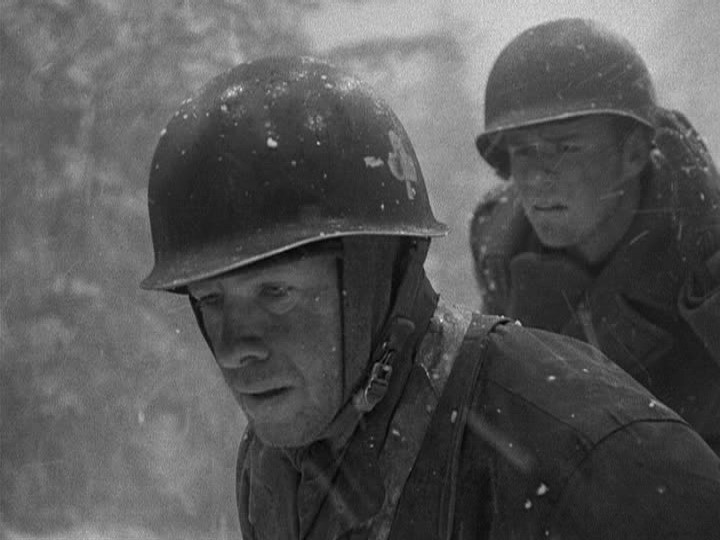
Van Johnson and John Hodiak listening to a Christmas Eve sermon in “Battleground”

Brief plot: The film depiction of the 101st Airborne Division when they are trapped in Bastogne during the Battle of the Bulge. The division is surrounded by Germans and unable to get any air support due to heavy fog that lasts for days. The World War 2 film has a star-studded cast with Van Johnson, John Hodiak, James Whitmore, Marshall Thompson, Riccardo Montalbon, George Murphy, Don Taylor and Leon Ames.

Why I love it:

I originally saw this film when I was in high school-the sole reason I wanted to see it was because of my insane crush on Van Johnson.  But as I watched it, I feel in love with the script, the way it is shot, all of the characters and the tone of the film.

James Whitmore discovering the sun finally breaks through the fog, shouts “It’s shinin’!”

Accuracy: World War 2 is my favorite period in history-the way the whole United States bonded together in a way that we will most likely never see again. I really like war films made during war time, but there is a certain amount of patriotic propaganda mixed in that makes war time battle films not as credible-I’m not saying I like them less for this, they just generally aren’t as historically accurate.

I also enjoy several war films made in the 1950s and 1960s, but they also have their own historical inaccuracies. The hairstyles and dresses are usually 1950s or 1960s styles, rather than 1940s styles. An example of this is Gina Lollabridgda in “Never So Few.” Her outfits are all wrong for wartime-let alone for a woman living in war torn Asia.

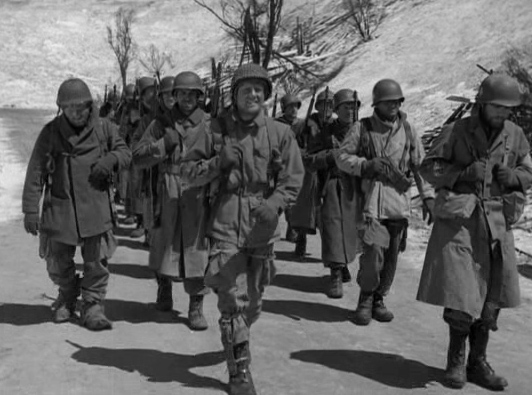
“Battleground” is made just soon enough after the war to be patriotic, but also very accurate. I’ve heard that it is one of the most accurate war films of the Golden Era- depicting conditions and sentiments of the soldiers. I would like to clarify that I say its the most accurate WW2 depiction of the Golden Era, because I realize that in recent years, films like “Sands of Iwo Jima” and “Band of Brothers” have given a better historic account of the events.

George Murphy as “Pop”

Filming: I love the way this film is shot. The darkness of their uniforms against the snow and fog that lead the soldiers to be trapped in Bastgone is perfect. There is almost a grittiness to it too. Though the snow is pure and white, it is ugly and dangerous because the reason why they are surrounded and with no help from air support. William “Wild Bill” Wellman directed the film, and this might have alot to do with the gritty feel of the film.

Cast: Look at the actors I listed above. Could you ask for a better cast? Sure, none of them were ever as big as Clark Gable or Spencer Tracy, but they were all amazing actors. I really think this film helped both John Hodiak and Van Johnson flex their acting muscles better than fluff films they were in before.  I also love Marshall Thompson’s performance. He starts off as a young kid, eager and excited to fight, but as the situation in Bastogne gets more serious, he becomes bitter.

Script: I enjoyed the story line, but I also liked the little Army jokes or lingo they used. For example, whenever they were talking about the Army, they had an ongoing joke of “I found a home in the Army.” Or how they called bombs “In-coming mail.”  Though the film is only 2 hours and doesn’t give us enough time to really get to know the characters, we learn their personalities enough by things they say or sing. The country character, Abner always says “That’s for sure, that’s for dang sure” and butchers the name of Bastogne calling Baaast-oog-nee.” Another example is John Hodiak’s character is well spoken, educated and was a newspaper man.  Douglas Fowley, who plays Private Kippton, always clicks his false teeth in the film-something he really knew how to do in real life and it added a bit of his personality to the script.

Another thing I like about the film is that the screenwriter actually fought in the Battle of the Bulge, so he had some knowledge of the events. Things like Ricardo Montalbon’s character never seeing snow before and getting excited, isn’t just hokey Hollywood glitter-it actually happened.

Marching back to Bastonge

To Review: This film was made at a time that MGM was switching from L. B. Mayer to Dore Schary as studio head, so it’s a little different from the frothy MGM movies we are used to.

Though I realize there are several World War 2 movies, more realistic than this one, “Battleground” is my favorite war movie. I think this film was made at the right time, giving the U.S. a few years to recover from the war but also before the downward spiral of the communist scare began.

Before I leave, I’d like to share with you my favorite scene:

Check out the Comet Over Hollywood Facebook page .

The most beautiful woman in Hollywood: Hedy Lamarr book review

Hedy Lamarr-The most beautiful face on screen

Dubbed “The Most Beautiful Woman in Films” in the 1940s, actress, art connoisseur and inventor of radio guided torpedoes during World War 2, Hedy Lamarr has an impressive resume. However, writing a book is not one of them.

Lamarr’s autobiography “Ecstasy and Me” published in 1966 reminds me of a bad late-1960s film: story lines that jump around with random flashbacks that don’t make sense.

The book begins talking about how important sex has been in her life. She shares a few anecdotes of some of her earliest sexual exposures as a young girl and how once a husband was having sex with another woman-in their bed, while Hedy was asleep.

What does any of this have do with anything? To be honest, I’m not sure.  I think Miss Lamarr is attempting to say that her sexual encounters shaped her life or draw some sort of metaphor. After telling these stories she says, “But we will discuss these experiences further later,” but she really doesn’t.

Films

The controversial nude scene in “Ecstasy” wasn’t censor’s biggest problem with the film.

Hedy continues to give a vague account of her childhood, jumping from birth to age 14 when she became interested in acting to 17 when she was in her first film, “Symphony of Love (Symphonie Der Liebre)” which is now known as “Ecstasy” (1933).

Hedy actually does talk about “Ecstasy” in some detail. The famous nude scene was filmed under some false pretenses. She didn’t want to do it at al, but was told she would “ruin the picture” if she didn’t. The director made a deal with her and said he would film the shot from 50 yards away on a hill. But the director was sneaky and used a telephoto lens to zoom up on the scene (28).  However, the real censorship issue wasn’t the nudity but the close-up of Hedy’s face while she was supposed to be having sex-she was really being poked in the butt with a safety pin to get the desired facial expressions (18).

Hedy Lamarr skims over most of her films with the exception of “Ecstasy” (1933), “Algiers” (1938) and “Samson and Delilah” (1949).

I wanted to hear more about one of my personal favorites, “Ziegfeld Girl” (1941) and she didn’t even mention her relationships with Lana Turner or Judy Garland. She glossed over “Come Live with Me” (1941) and “Heavenly Body” (1945) and dismissed “Her Highness and the Bellboy’ (1945)  saying it was so bad she didn’t care to discuss it-though she did say June Allyson had the best role in the film.

Hedy surprisingly got along with the notoriously difficult Cecil B. DeMille during “Samson and Delilah.” DeMille gave actors quarters whenever they came up with a good idea for the movie-Hedy received five.

Besides the three films she listed above, Hedy doesn’t have a lot of mainstream well known films. I think part of this was because she was deemed difficult to work with and also turned down several roles. The casting agencies referred to her as “The Hedy problem.”

Gossip

One of my favorite parts of reading star autobiographies are the back stories to movies, friendships with other stars and relationships with co-stars. You don’t get a lot of this from Hedy Lamarr. Hedy actually made false names for some actors. Since it was 1966, several of them or their families were still living. So if she was talking about sleeping with an actor she may say, “We will refer to him as Sam.”

Though she does share a few unexpected tidbits:

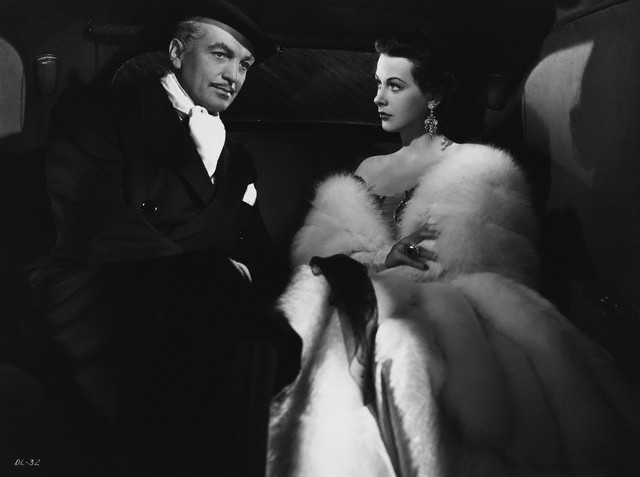
Hedy Lamarr and John Loder in “Dishonored Lady” (1947). They were going through a divorce at this point which made good publicity for the film.

•She got along with Robert Young in “H.M. Pulham, Esq.” (1941)-a personal favorite of mine and also her favorite film- and thought he was a great actor. She once asked Louis B. Mayer why Young wasn’t a big star and Mayer said he didn’t have any sex appeal. Hedy said she was pleased when he was a success in the television series “Father Knows Best.”

•One thing that surprised me the most was Reginald Gardner was one of Hedy’s first close friends in Hollywood. Hedy even said, “We became very good friends. In fact we really should have become husband and wife. Frankly, I wanted to marry him, but he was never sure enough” (50). This sure was surprising to me!

•Hedy told a very funny anecdote concerning Errol Flynn and his crazy parties. Hedy told her stand-in Sylvia who went to a Flynn party with her, “Many of the bathrooms have peepholes or ceilings with squares of opaque glass though which you can’t see out but someone can see in. So be careful. Never got to a room Errol sends you to change if there is swimming” (182). One time Hedy, Errol and another party guest watched a “busty Italian star” changing into her bathing suit and laughed when she sniffed her armpits and tried to hide red clothing marks.

Love

One thing Hedy Lamarr did not make a passing grade in was love. She went in and out of marriages like people buy and return clothes. She married Austrian munitions aristocrat Fritz Mandl because of his prestige, but she didn’t love him. She found he was demanding and kept her a virtual prisoner so she fled. I’ve heard that he allegedly forced Hedy into a sexual relationship with Hitler, but she doesn’t discuss this.

Hedy then rushed into marriage with writer Gene Markey-Joan Bennet’s ex-husband- who she was married to for less than a year. The two knew each other for a few days and got married. They adopted baby James Markey together but it was right before their divorce. During this time a single woman couldn’t adopt a baby. Hedy included a long column Louella Parson’s wrote about “Hedy Lamarr suffering for her adopted baby boy.” But Hedy ends the topic of James Markey after this article and never says what happens with the legal battle, though in her obituary he is listed as one of her children.

Probably her best marriage (if that’s saying much) was to actor John Loder. They actually had a courtship, but they got married because he wanted to see how many times they could have sex in one day on their honeymoon-in competition with a story he heard. The real problem with this marriage was Hedy. I think she was too demanding of him but he was also lazy. She got obsessively protective over her children and seemed to divorce him because she wanted her children to herself.

Later Hedy married three other times. One was because she simply wanted a husband and to settle down and he seemed like a good candidate. The others were also for security.

That’s a wrap

Hedy Lamarr in court in 1966-at the time this book was published

In all, I did think the book was interesting and it was nice to learn a little more about Hedy Lamarr, but it was a really poorly written book. I felt like she left me hanging on a lot of aspects and I wanted to know more or a different side of the story.

The book was published during a bad time in her life. She had just been arrested for stealing a few inexpensive items from a store and didn’t have much money. She even said her lawyer and friends like Frank Sinatra would bring her food to make sure she was fed.

Hedy seemed like a bit of a rash diva, but I still like her. She had an interesting out look on life-detailed in the book with a transcript of a psychologist conversation.

I plan on reading the Hedy Lamarr biography that came out last year so I can hopefully get some more information.

Life Lessons from Hedy

At the end of Hedy’s book she some life tips she has learned. I will leave you with my favorites:

-I never drink beer, it’s too plebeian.

-I’d rather wear jewels in my hair then anywhere else. The face should have the advantage of this brilliance.

-American men, as a group, seem to be interested in only two things, money and breasts. It seems a very narrow outlook.

-I don’t fear death because I don’t fear anything I don’t understand. When I start to think about it, I order a massage and it goes away.

-I can excuse anything but boredom. Boring people don’t have to stay that way.

**Also, happy birthday to Hedy Lamarr with this book review. I inadvertently planned to publish it today and had no idea it was her birthday!**

Check out the Comet Over Hollywood Facebook page 

Jessica Pickens: Girl Reporter

Comet Over Hollywood is moving!

Well…not the blog, but the blogger!

The backstory

Ever since I’ve been in the fourth grade I wanted to be a writer. I had a big imagination and pictured myself on the cover of Good Housekeeping magazine with my best seller.

In high school I got more interested in newspapers and majored in mass communications-journalism at Winthrop University getting involved in the school newspaper The Johnsonian, TV show, Winthrop Close-Up and radio station, WINR.

Starting in March, I started looking for a reporter position in the southeast. By the time I graduated in May, I figured out that getting a job at a newspaper was going to be harder than I thought (as some of you in media related fields might also have found).

For the past two months I’ve been working at a local Greenville newspaper as an advertising representative while still looking for a reporter position.

Two weeks ago, I got a job at The Elkin Tribune in Elkin, N.C. So I will be packing up and moving up to North Carolina-spreading my classic movie love to a whole new state!

Celebration

In honor of this exciting, nerve-wracking event, I’m dedicating this post to journalists in movies. Everyone is invited to the party!

Glenda Farrell as Torchy Blaine most likely up to no good.

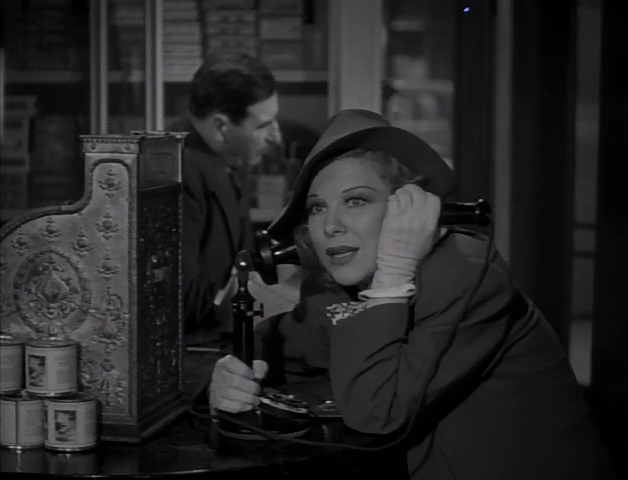
Torchy Blaine Series: Torchy Blaine was a series of films made during the 1930s much like Boston Blackie, The Falcon or Andy Hardy. Torchy Blaine snooped and got into trouble in eight films from 1937 to 1939 (yep, they knew how to churn them out in those days). Torchy Blaine is a wise-cracking and troublesome female reporter. She eavesdrops, bugs rooms and follows people in order to get information-all highly illegal in these days, according to my Media Law and Ethics classes at Winthrop. Not only does Torchy usually get caught by the bad guys she is spying on, but she is constantly at odds with her policeman boyfriend, Steve McBride. At the end of each film, Steve and Torchy usually agree to get married but Torchy has to agree to give up her reporter career-as we all know, this doesn’t happen. Review: These films are very silly but equally entertaining. Through the eight part series, Glenda Farrell, Lola Lane and Jane Wyman all play Torchy.  But Glenda is my favorite Torchy. However, Lola wears some adorable lounging pajamas in “Torchy Blaine in Panama.”

Citizen Kane (1940): I don’t feel that I can discuss journalism movies without mentioning Citizen Kane. The film follows Orson Welles as Charles Foster Kane and his rise as the top newspaper publisher. We all know this film is based off the life of William Randolph Hearst-who was still living at the time. In Joseph Cotton’s autobiography “Vanity Gets You Somewhere,” Cotton says “Kane” was set to premiere in Radio City Music Hall. Hearst made sure it did not play there-or in several other movie houses across the United States. That goes to show just how powerful he was. Review: I do really like this film. It was a bit of an ‘Indie’ film in its day so its funny that is revered so much now. I really enjoy it for the historical background of it as well.

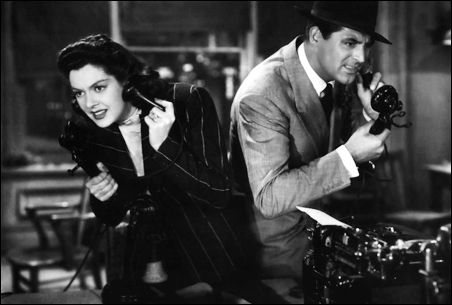
Cary Grant and Rosalind Russell getting the scoop in “His Girl Friday”

His Girl Friday (1940): When you say “female reporters in film” Rosalind Russell with her crazy hats in “His Girl Friday” automatically comes to mind.  Roz plays the ex-wife of Cary Grant, her reporter co-worker, and is engaged to Ralph Bellamy. On the day that Roz and Ralph are supposed to get married, a huge murder story breaks and news hound that she is, Roz can’t stay away. Not surprisingly, Ralph Bellamy doesn’t get the girl in the end (like always), and Roz and Cary fall back in love in the midst of copy and photography. Review: I really enjoy this movie, but you REALLY HAVE TO PAY ATTENTION.  For comedic value, Cary and Rosalind talk very, very fast. Several actresses turned down this role including Carole Lombard, Ginger Rogers, Claudette Colbert, Irene Dunne and Jean Arthur. I think Carole, Jean and Irene would have been perfect for the role, but I like seeing Rosalind in a role that is both sexy, funny and strong. Around this time she was flexing her comedic muscles with “The Women” and “No Time For Comedy,” and this is most definitely one of her best during this period.

Foreign Correspondent (1940): Though the United States had not yet joined the war, this Alfred Hitchcock directed film follows American reporter, John Jones-played by my heartthrob Joel McCrea-is sent on assignment to report on the war. Jones starts to uncover a spy ring in England that is aiding the Axis. Jones also meets and falls in love with Carol Fisher-played by one of my favorites, Laraine Day. I don’t want to say too much, because I don’t want to ruin this Hitchcock thriller, but watch for a disaster ending. Hitchcock does it ingeniously. Review: I actually think this is the film the secured in my mind that I wanted to be a journalist. The excitement and discovery that Joel McCrea experienced was irresistible. To this day my AIM name is even the title of this film.

Claudette Colbert and Ray Milland in “Arise My Love.” This photo has nothing to do with journalism. Just makes me happy!

Arise, My Love (1940): This film also follows a reporter in Europe during the start of World War II. This time our hero reporter is Claudette Colbert as Augusta Nash, based off real life reporter Martha Gellhorn. Nash saves pilot Ray Milland (as Tom Martin) before he is about to be executed by Fascists for his involvement in the Spanish Civil War. Nash saves him, exclusively for the purpose of a story. Martin is thankful for his life, but also a little peeved. The two begin to fall in love though they resist because of their conflicting life styles: Nash doesn’t want to give up her career and Martin wants to fight in the upcoming war. Review: Colbert said this was one of her favorite films that she made. It might be one of my favorites too. There is a good mix of romance, adventure and journalism. Ray Milland is probably at his handsomest here.

Meet John Doe (1941): This is another film about unethical journalism. Barbara Stanwyck as Ann Mitchell is fired from her reporter job. To get her job back Ann prints a fake suicide letter in the newspaper signed by “John Doe” who says he will kill himself on Christmas Eve because he can’t take the world’s ‘social ills’ any longer. To prove the letter isn’t a fake (which it obviously is) Ann searches for a man who agrees to pose as John Doe. Gary Cooper (Long John Willowby) and his friend The Colonel (played by Walter Brennan) are in need of money and John agrees to play the part. John Doe becomes a national figure, inspiring people all over to change their ways and come together. However, the role of John Doe requires John to commit suicide. If he doesn’t, it will let down his believers, and newspaper publisher D.B. Norton (played by loveable or hateable Edward Arnold) doesn’t want to disappoint his readers. Review: I love love love this movie. It’s a perfect example at just what journalism can do. Barbara Stanwyck and Gary Cooper are so perfect together. We also get a treat of seeing Walter and Gary break out in mouth organ music. One of THE perfect examples of Frank Capra’s ‘social change’ films.

For other ‘Gary Cooper duped by the press’ films see Mr. Deeds Goes to Town.

The real Ernie Pyle who is portrayed by Burgess Meredith in “The Story of G.I. Joe”

Story of G.I. Joe (1945): This is a semi-autobiographical film about World War II war correspondent Ernie Pyle, played by Burgess Meredith.  Pyle joins Company C, 18th Infantry, lead by Lit. Walker played by Robert Mitchum, and fights with them in North Africa and Italy, documenting their experiences along the way. Pyle learns more about the men personally and we watch as battle wears on their nerves. The film follows real life and ends with Pyle being killed by a Japanese sniper. Review: This is one of my favorite war films, mostly because Ernie Pyle is one of my role models. When I interviewed at Fort Jackson-an Army base in Columbia, S.C.- there was a display about Ernie Pyle. I was so proud that they were honoring him and really wanted to be part of that newspaper. “G.I. Joe” was the only film Robert Mitchum was ever nominated for an Academy Award and unfortunately lost. I really feel that he deserved it.

There is an unintentional running theme throughout all of those films. All of them were made during war years and several from 1940. Here is a brief list of other films featuring journalists. I’ve listed the actors who portray reporters.

Other films:

My Dear Miss Aldrich (1937) -Maureen O’Sullivan and Walter Pidgeon

Nothing Sacred (1937)- Frederic March

Everything Happens at Night (1939)- Ray Milland and Robert Cummings

Philadelphia Story (1940)- James Stewart and Ruth Hussey

Lifeboat (1944)-Tallulah Bankhead

Objective Burma (1945)- Henry Hull

Close to My Heart (1951)- Ray Milland

The Sell Out (1952)- Walter Pidgeon

Roman Holiday (1953)-Gregory Peck

Never Let Me Go (1953)- Clark Gable

Teacher’s Pet (1958)- Doris Day and Clark Gable

Check out the Comet Over Hollywood Facebook page  or follow on Twitter at @HollywoodComet