30 years of Gidget

As summer comes to a close, so does my “Gidget” series.

For three summers, I have spent a lot of time with Gidget, the surfing girl midget. Because of my love for the 1959 version and casually watching the films that followed, I decided to really delve into a film that was a catalyst for the beach film phenomenon.

Some people dismiss “Gidget” (1959) as teenage romantic fluff with cute Sandra Dee. Say what you will, but this film—and the book it was adapted from—launched the whole surfing industry. After the film was released in 1959, the Beach Boys started making records, along with the whole beach film franchise such as the Frankie Avalon and Annette Funicello films, to copycat films like “Surf Party” with Bobby Vinton and Jackie DeShannon.

Continue reading

Review: The New Gidget TV series (1986-1988)

The 1980s are remembered for big hair, leg warmers and neon colored clothing set to a soundtrack of David Bowie and Michael Jackson. But it was also filled with 1960s nostalgia and reboots.

The Monkees were on a revival tour in 1986, Sam and Dave’s “Soul Man” sold Campbell’s Soup, and the California Raisins sang Marvin Gaye’s “Heard It Through the Grapevine.”

And then there were the television reboots. There was “The New Leave It to Beaver” (1983-89), The New Monkees (1987), The Munsters Today (1987-91), and The New Lassie (1989-92).

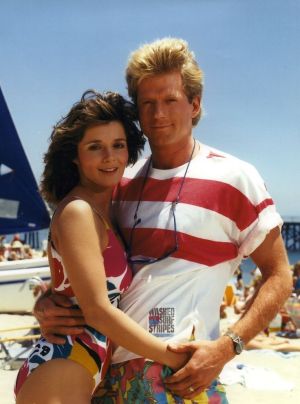
Caryn Richman and Dean Butler as Gidget and Moondoggie in a publicty shot for “The New Gidget.”

And there was “The New Gidget” (1986-88), which was the last film or TV show about Frances “Gidget” Lawrence, the surfing girl midget. While three made-for-TV movies filled the gap (Gidget Grows Up, Gidget Gets Married, and Gidget’s Summer Reunion), “The New Gidget” (1986-88) comes 20 years after the first Gidget (1965-66) TV show graced the small screen.

Following the made-for-TV movie “Gidget’s Summer Reunion” (1985), the television show follows married Gidget (Caryn Richman) and Jeff “Moondoggie” Griffin (Dean Butler) working as a travel agent and architect. Gidget’s niece Dani (Sydney Penny) lives with the couple while her parents, Gidget’s sister Anne and brother-in-law John, live overseas. William Schallert plays Gidget’s father, Russ Lawrence, and reminds Gidget that Dani’s exploits aren’t too different from her own as a teenager. Gidget’s old friend LaRue (Jill Jacobson) runs the travel agency with her in Santa Monica.

Continue reading

Review: Gidget TV series (1965-1966)

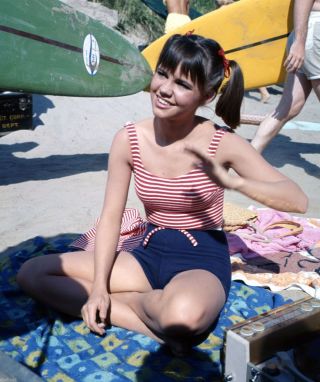
Until a few weeks ago, I never had watched an episode of the TV version of “Gidget” (1965-66) starring Sally Field. But as I kicked off my third summer of surfing through the “Gidget” franchise, I bought the series and took the plunge—and then I binge watched all 32 episodes for two weeks until I finished.

As I have mentioned before, my favorite Gidget in the films is Sandra Dee, who originated the role. At second place was Karen Valentine, who played Gidget in a TV film “Gidget Grows Up” (1969). However, I have to admit that Sally Field may nudge Valentine from that spot.

Frances “Gidget” Lawrence’s life story undergoes several adjustments throughout the duration of the Gidget series (1959-1986). In 1959, we start off with a shy, smart, innocent only child of two parents. Once she finds love in Hawaii (1961) and Rome (1963), Gidget gets less naïve and more precocious.

Continue reading

Musical Monday: Balalaika (1939)

It’s no secret that the Hollywood Comet loves musicals.
In 2010, I revealed I had seen 400 movie musicals over the course of eight years. Now that number is over 500. To celebrate and share this musical love, here is my weekly feature about musicals.

This week’s musical:
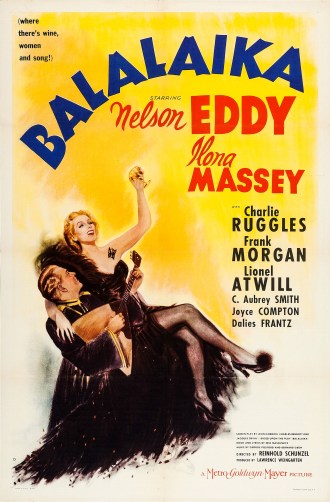
Balalaika (1939) – Musical #227

Studio:
Metro-Goldwyn-Mayer

Director:
Reinhold Schünzel

Starring:
Nelson Eddy, Ilona Massey, Charles Ruggles, Frank Morgan, Lionel Atwill, C. Aubrey Smith, Joyce Compton, Phillip Terry, George Tobias

Plot:
Beginning in St. Petersburg, Russia in 1914, Lydia Pavlovna Marakova (Massey) is a singer in a cafe and the daughter of a political activist. She meets and falls in love with Prince Peter Karagin (Eddy), who poses as a commoner. World War I begins the same day it’s revealed that Lydia’s family had a plot to kill the prince and his father (Smith). The war seperated Lydia and Peter.

Continue reading

Olympic Stars that Didn’t Soar in Hollywood

During the past two weeks, Comet Over Hollywood has looked at Olympic athletes who found Hollywood fame after exhibiting their athletic prowess. Some Olympians were scouted for Hollywood but their stars didn’t rise has high as others.

Eleanor Holm
Eleanor Holm was an Olympic swimmer who competed for the United States in 1928 summer Olympics in Amsterdam where she finished fifth in the 100-meter backstroke. At the 1932 Los Angeles Olympics, Holm won a gold medal in the 100-meter backstroke.

Eleanor Holm at the 1932 Olympics

Eleanor Holm at the 1932 Olympics

Between the 1928 and 1932 Olympics, producer Florenz Ziegfeld hired her to perform in the Ziegfeld Follies on Broadway in 1930. She left the show to train for the 1932 Olympics. After the 1932 Olympics, she was placed under contract to Warner Bros. for $500 a week, but despite studio-hired acting coaches, she declared herself a spectacular flop as an actress, according to her 2004 obituary.

Holm was to compete in the 1936 Berlin Olympics and where she would be the first woman to compete on the United States Olympic team three times.

Holm boarded the ship to sail for Berlin for the 1936 games and when she got to Berlin, she was no longer on the team. Olympic president Avery Brundage expelled Holm for breaking curfew and drinking while traveling to Berlin.

“All I did was drink a couple of glasses of champagne,” she told People magazine in 1996. “I was married, singing in a nightclub with my husband’s band. I was not exactly a child.”

In 1938, Holm starred aside fellow Olympian Glenn Morris in “Tarzan’s Revenge.” This was the only film she was in. After this she married producer Billy Rose from 1939 to 1954. She starred in Rose’s New York World’s Fair Aquacades, swimming with fellow Olympian gold medalists Johnny Weissmuller in the 1939 show and Buster Crabbe in 1940.
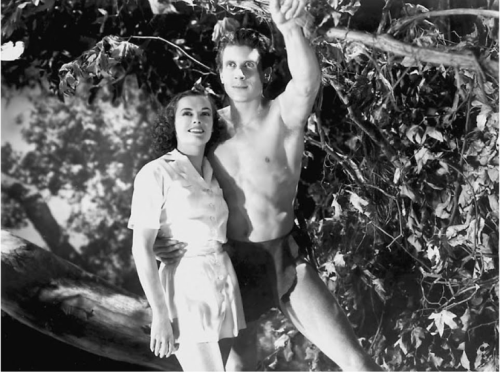
Olympians Eleanor Holm and Glenn Morris in "Tarzan's Revenge" (1938)

Olympians Eleanor Holm and Glenn Morris in “Tarzan’s Revenge” (1938)
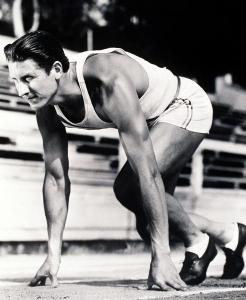
 

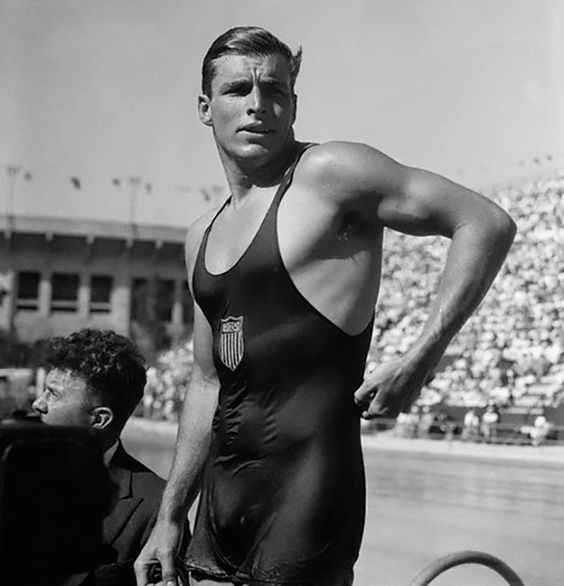
Glenn Morris at the 1936 Olympics

Glenn Morris at the 1936 Olympics

Glenn Morris
Glenn Morris competed on the United States team at the 1936 Berlin summer Olympics and won a gold medal for the decathlon. After the Olympics, Morris had a brief Hollywood career.

His film career started with an uncredited role in “She Married an Artist” (1937) at Columbian Pictures, and he was the fourth Olympian to play Tarzan.

Distributed through 20th Century Fox, Morris starred in a low budget Tarzan film, “Tarzan’s Revenge” (1938) which co-starred with Olympic swimmer Eleanor Holm.

After the Tarzan film, Morris acted in one more film, “Hold That Co-Ed” (1938) before leaving Hollywood.

Murray Rose
Murray Rose is an Australian swimmer who won six Olympic medals at the 1956 Melbourne and 1960 Rome Olympics. All three of the medals at the Melbourne Olympics were gold and he won a gold medal in Rome as well as one silver and one bronze.
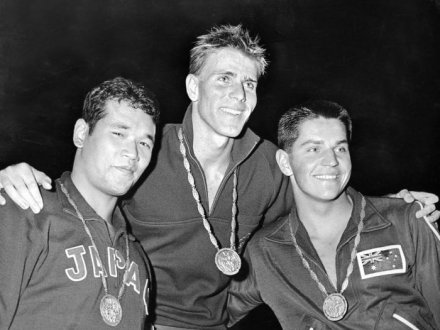
Murray Rose (center) at the 1960 Olympics with his gold medal

Murray Rose (center) at the 1960 Olympics with his gold medal

After graduating from college at the University of California, Rose entered a brief Hollywood career. His first film was the beach movie “Ride the Wild Surf” (1964) with Tab Hunter, Peter Brown, Shelley Fabares and Fabian. Columbia called him “one of the best bets for stardom in a long time,” according to Hollywood Surf and Beach Movies: The First Wave, 1959-1969 by Thomas Lisanti.
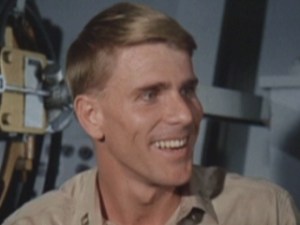
Murray Rose in "Ice Station Zebra" (1968)

Murray Rose in “Ice Station Zebra” (1968)

From 1964 to 2008, Rose made a total of 10 film and TV appearances including an appearance on the TV shows “Dr. Kildare” and “Patty Duke.” He also had a role in the 1968 film “Ice Station Zebra” with Rock Hudson and Ernest Borgnine.

However, he was not passionate enough about acting to continue perusing it, according to his 2012 obituary.

Don’t miss our other Olympic spotlights:

Check out the Comet Over Hollywood Facebook page, follow on Twitter at @HollywoodComet or e-mail at cometoverhollywood@gmail.com

Olympics to Hollywood: Harold Sakata

Harold Sakata in the 1948 Olympics

Harold Sakata in the 1948 Olympics

You probably know him best as a James Bond henchman with a lethal bowler hat. But Harold Sakata’s career started as an Olympian.

Born in Hawaii, Sakata competed on the United States team in the 1948 Summer Olympics in London, England. Sakata won a silver medal for lifting 380 pounds in the men’s weightlifting portion in the light-heavyweight division.

After the Olympics, he was a professional wrestler under the name of Tosh Togo in the 1950s and 1960s, according to the Hawaii Sports Hall of Fame.

But despite his silver medal winning, Sakata’s athletics aren’t what he’s best known for.

Noticed for his muscular build, James Bond producers hired Sakata to play Oddjob, Auric Goldfinger’s personal bodyguard in the film “Goldfinger” (1964). Oddjob wore a steel-rimmed bowler hat that he would toss at enemies.

Continue reading

Esther Williams and the Canceled Olympics

What do you do when you’re an athlete and the Olympics are canceled? Become one of Hollywood’s top stars.

At least, that’s what Esther Williams did.

esther1

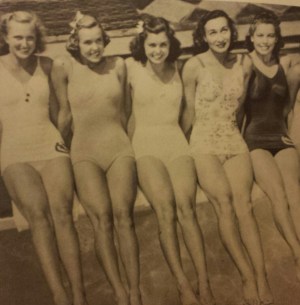
17-year-old Esther Williams (third from left) with the Los Angeles Athletic Swim Club team in 1939.

In 1939, 17-year-old Esther Williams was the United States women’s 100 meter freestyle national champion at the Amateur Athletic Union (AAU) Championship. She represented the Los Angeles Athletic Club with the winning time of 1:09, which was better than all but one of the swimmers for the next six years, according to the International Swimming Hall of Fame.

The AAU formerly worked closely with the United States Olympic Committee.

Williams was assured a spot on the United States team for the 1940 Summer Olympics which were going to be held in Tokyo, Japan. But the games were canceled due to the outbreak of World War II.

She felt her career as a swimmer was over when the Olympics were canceled and she didn’t receive a swimming scholarship to the University of Southern California, she wrote in her autobiography “The Million Dollar Mermaid.”

She said stardom was her consolation prize.

Continue reading

Olympics to Hollywood: Bruce Bennett/Herman Brix

Bruce Bennett or Herman Brix? He went by either name

You may know him as actor Bruce Bennett who played Joan Crawford’s ex-husband in Mildred Pierce (1945) or perhaps as yet another actor who played Tarzan. Others know him by his birth name Herman Brix, which he was using when he won an Olympic silver medalist.

Before the Olympics and Hollywood, Bennett played football for the University of Washington when they competed in 1926 Rose Bowl Game against the University of Alabama. In that game he played against future actor Johnny Mack Brown, who was half back for Alabama. Alabama won the game 20-19.

In 1928, Herman Brix competed on the United States team in the Summer Olympic games in Amsterdam—also attended by Johnny Weissmuller and Buster Crabbe—and won a silver medal for men’s shot put in the track and field portion of the games. Brix threw the shot put 15.75 meters, breaking the world shot put record with his toss. But  then his teammate John Kuck followed with a throw that set a new world record. Kuck won the gold.

Continue reading

Olympics to Hollywood: Buster Crabbe

Johnny Weissmuller wasn’t the only swimming Olympian to play Tarzan. There was also Clarence “Buster” Crabbe.

Crabbe and Weissmuller knew each other before their Hollywood days and were competitive.

Crabbe developed his swimming (and surfing) prowess while growing up on a pineapple plantation in Hawaii. His athleticism didn’t stop there. He was even the light-heavyweight boxing champion at the University of Hawaii, according to his Los Angeles Times 1983 obituary.

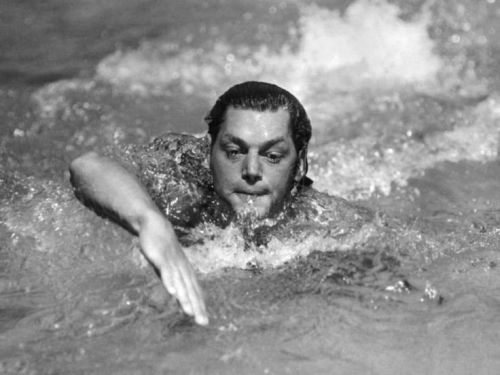
Buster Crabbe at the 1932 Olympics

Buster Crabbe at the 1932 Olympics

Crabbed competed on the United States Olympic team with Weissmuller at the 1928 Summer Olympics in Amsterdam.  Crabbe won a bronze medal for the men’s 1500 meter freestyle.

But in 1932 Crabbe’s luck changed. He competed again at the 1932 Summer Olympics in Los Angeles and this time won a gold medal for the men’s 400 meter freestyle.

Continue reading

Olympics to Hollywood: Johnny Weissmuller

Today, most Olympic fans in the United States are proud of Michael Phelps, who has broken records for both swimming and amount of gold medals won in one Olympic game.

But in the 1920s, the same pride and idolization was for another swimmer: Johnny Weissmuller, one of the first international swimming superstars.

Johnny Weissmuller in the 1924 Summer Olympics in Paris.

Johnny Weissmuller in the 1924 Summer Olympics in Paris.

Weissmuller is best known now for swinging through trees with his signature yodeling yell and speaking in broken English in the film role of Tarzan the Ape man. But his fame began as an Olympic swimmer.

Continue reading