It’s no secret that the Hollywood Comet loves musicals. In 2010, I revealed I had seen 400 movie musicals over the course of eight years. Now that number is over 500. To celebrate and share this musical love, here is my weekly feature about musicals.
Starring:
Charles Kaley, Marion Shilling, Cliff Edwards, Gwen Lee, Ethelind Terry, Rubin, Jack Benny (uncredited voice on radio), Ann Dvorak (uncredited), Mary Doran (uncredited)
Plot:
Roy (Kaley) is a jerk of a songwriter who uses his old romances and love letters as inspiration for his songs. He even attempts to capitalize off his friend’s death through a song.
Multiple actors have played Ebenezer Scrooge in numerous adaptations of Charles Dickens’ story “A Christmas Carol.” But one actor performed the role every year, creating a 20 year tradition.
From 1934 to 1953, Lionel Barrymore came into homes over the radio as the miserly Scrooge who is visited by three ghosts as a warning to change his cruel ways.
Barrymore only missed two performances in the 20 year span: in 1936 when his wife Irene Fenwick died on Dec. 24, 1936; and in 1938.
John Barrymore took over for his brother in 1936 broadcast and Orson Welles performed the role in 1938.
Lionel Barrymore’s radio performance in “A Christmas Carol” is credited as making the Charles Dickens story popular in the United States, according to the book “The Man Who Invented Christmas” by Deckle Edge.
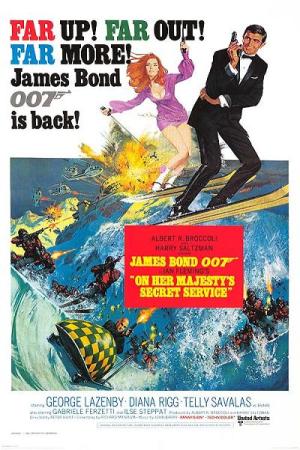
On Her Majesty’s Secret Service (1969) is a standout film within the James Bond franchise. It was the first James Bond film to not star Sean Connery and the only Bond film to star model-turned-actor George Lazenby. It also happens to be the only James Bond film set during Christmas time.
Released in the United States on Dec. 19, 1969, the film follows Agent 007 (Lazenby) as he travels undercover as a genealogist to a clinical allergy institute in the Swiss Alps. The institute is a front for SPECTRE, the crime syndicate operated by Bond’s arch-nemesis, Ernst Stavro Blofeld (Telly Savalas). Bond’s goal is to uncover what research Blofeld is really conducting and why it involves 12 beautiful women from all over the world. Outside of this excursion, Bond also falls in love with Contessa Teresa “Tracy” di Vicenzo, played by Diana Rigg.
It’s no secret that the Hollywood Comet loves musicals. In 2010, I revealed I had seen 400 movie musicals over the course of eight years. Now that number is over 500. To celebrate and share this musical love, here is my weekly feature about musicals.
Starring:
Shirley Temple, Robert Young, Alice Faye, Eugene Pallette, Arthur Treacher, Willie Fung, Philip Ahn, Allan Lane
Plot:
Barbara (Temple), nicknamed Ching-Ching, is an orphan in China after her missionary parents were killed and now lives with other missionaries. When there’s danger in town, Ching-Ching’s friend, Sun Lo (Philip Ahn) puts her on a boat for Shanghai so she will be safe. Ching-Ching gets lost in Shanghai and is befriended by American Tommy Randall (Young). Ching-Ching accidentally ends up on a boat for the United States. On the ship, Tommy and Susan Parker (Faye) care for Barbara/Ching-Ching, but neither can adopt her because they aren’t married. The two get married to give Barbara a home.
At age 4 in 1917, she made her first film appearance as an uncredited fairy in “The Primrose Ring.” Actress Loretta Young performed in 94 films from 1917 to 1989 and was the star of the successful television show, “The Loretta Young Show.” Young acted almost all her life, performing in her last role, the TV movie “Lady In A Corner” (1989), at age 76.
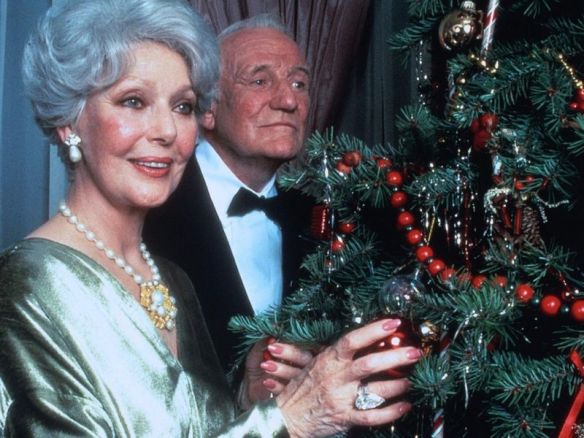
But we are focusing on Young’s second to last role: the TV movie “Christmas Eve” (1986).
Loretta Young and Trevor Howard in “Christmas Eve” (1986)
Young plays wealthy Amanda Kingsley, who dedicates her time to helping the homeless, taking in stray cats, reading to children and directing choirs. Her butler Maitland (Trevor Howard) is her begrudging but loving, sidekick and friend who accompanies her on these all-night outings of helping the needy.
It’s no secret that the Hollywood Comet loves musicals. In 2010, I revealed I had seen 400 movie musicals over the course of eight years. Now that number is over 500. To celebrate and share this musical love, here is my weekly feature about musicals.
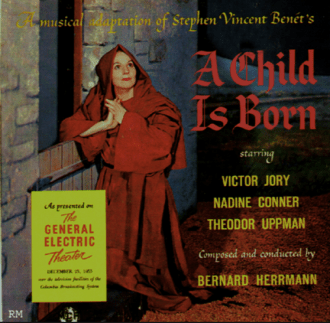
Album cover for the 1955 version of “A Child is Born”
This week’s musical:
General Electric Theater presents “A Child is Born” (1955) – Musical #557
Studio:
CBS Television Network
Director:
Don Medford
Starring:
Nadine Conner, Robert Middleton, Harve Presnell, Marian Seldes, Nyra Monsour, Ross Elliott, Roger Wagner Chorale Themselves as Hosts: Ronald Reagan, Nancy Reagan, Patti Reagan
Plot:
An operatic retelling of the Nativity story. The story is in the point of view of the Innkeeper (Middleton) and his wife (Connor). The wife is restless, still mourning the death of her baby, and feels something new is coming to the world. Roman soldiers take every room in the inn so when Joseph (Elliott) comes to the door, the Innkeeper and his wife allow them to stay in the stable when they see that Mary is pregnant.
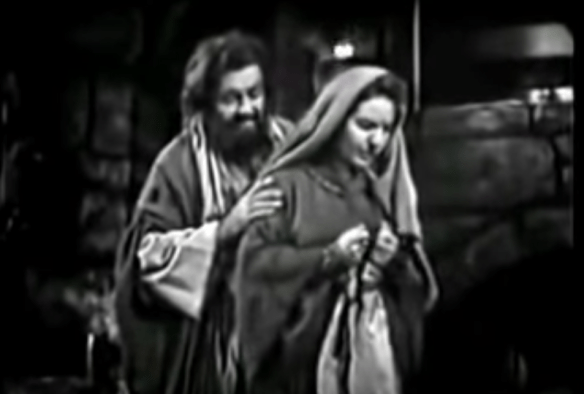
The Innkeeper (Middleton) and his wife (Conner)
Trivia:
-“A Child is Born” was Broadcast live for the first time on the General Electric Theater on Dec. 25, 1955. The show was Broadcast live again the following year on Dec. 23, 1956. The 1955 version starred Victor Jory and Theodore Uppman, as Dismas the thief. In the 1956 version, Victor Jory is not in the play and Harve Presnell plays Dismas the thief.
-The score was composed and conducted by Bernard Herrmann. This was Bernard Herrmann’s last project of 1955.
-The adaptation of the Nativity story was written by Stephen Vincent Benet and originally was performed on the radio program “Cavalcade of America.” The 1942 performance starred husband-and-wife actors Alfred Lunt and Lynn Fontanne.
-This short opera aired on the General Electric Theater, which showcased a story, play or musical every week. The show ran from 1953 to 1962.
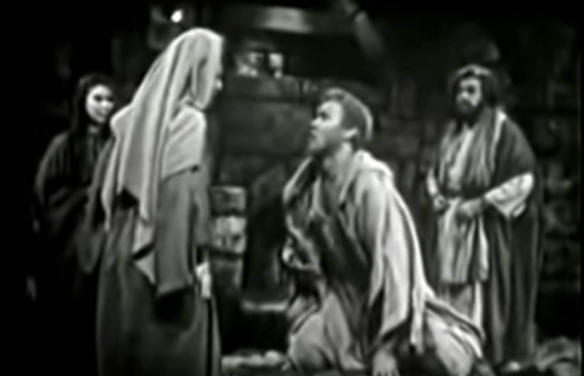
Harve Presnell as a thief
Highlight:
-Bernard Herrmann’s score
Notable songs:
-Shot like an opera so not really one song.
My review:
“A Child is Born” is a very solemn television operetta, which consists of more singing than dialogue.
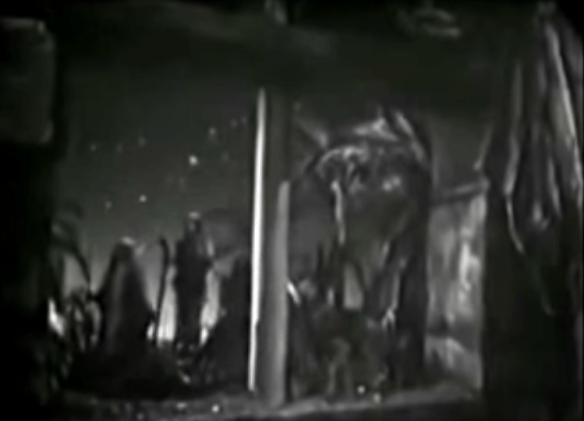
This Nativity story is tells of the Innkeeper and his wife. That being said, we do not see the Virgin Mary or baby Jesus. We only see Joseph knocking on the door of the inn and the audience watches the shepherds and wise men come to visit the child through a window of the inn.
Shepherds and wise men visiting the Christ child.
I sought this 30 minute opera out not only because it is a musical related to Christmas, but because the music was composed and conducted for the “General Electric Theater” TV episode by Academy Award winning composer Bernard Herrmann. The music in this play is beautiful and solemn. For me, Herrmann’s score is the best part of “A Child is Born.”
Metropolitan Opera singer Nadine Conner carries 85 percent of the singing throughout the film. Conner has a lovely voice, but admittedly, it’s a little tiring to hear the same person’s singing voice continuously throughout the piece without any other singers. The Innkeeper, played by Robert Middleton, does not sing, nor do the two servant girls, played by Marian Seldes and Nyra Monsour.
Harve Presnell, in only his second film or TV appearance, comes in at the last 10 minutes of the film along with the Roger Wagoner Chorale. Presnell and the Chorale sing beautifully, but I wish their songs had come in earlier to break some monotony. Presnell plays a thief, who is moved not to steal when he sees the Christ Child.
Critics and audiences weren’t complimentary of this operetta when it was Broadcast live in 1955. One complaint was that the set never changes and shows only one room of the inn. Audiences also felt that the play wasn’t inspiring as it should have been. Critics also said Herrmann’s music was “not distinguished,” according to Bruce Kimmel’s liner notes for the “Child is Born” album.
I’m inclined to agree that I certainly didn’t feel moved by this story of the Nativity, like I thought I would have. I mainly felt tired after the 30 minutes. Part of this had to do with Nadine Conner’s constant singing. Another reason was the two servant girls over acting and shouting.
However, I disagree that Herrmann’s music was “not distinguished.” His score was the highlight the brief TV show, and if I felt moved, it was because of his music.
It’s curious to me that if “A Child was Born” was unpopular in 1955, why it was Broadcast again in 1956.
It proved to be confusing while searching for 1955 version vs. the 1956 version. The only version I could find online was the 1956 version, though many people seem to think there isn’t a difference. However, Victor Jory was in the original cast, and is even billed on the front of the record, and he is not in the version I watched.
It’s no secret that the Hollywood Comet loves musicals. In 2010, I revealed I had seen 400 movie musicals over the course of eight years. Now that number is over 500. To celebrate and share this musical love, here is my weekly feature about musicals.
This week’s musical:
“Scrooge” (1970)– Musical #399
Studio:
National General Pictures
Director:
Ronald Neame
Starring:
Albert Finney, Alec Guinness, David Collings, Michael Medwin, Kenneth More, Edith Evans, Kenneth More, Suzanne Neve, Richard Beaumont
Plot:
A musical adaptation of Charles Dickens’ story of “The Christmas Carol.” Bitter, old Ebenezer Scrooge (Finney) has no time for happiness and good cheer on Christmas. A series of ghosts visit him in the night and take him on a journey of self-exploration of his past, present and future.
Awards and Nominations:
-Nominated for Best Art Direction-Set Decoration by Terence Marsh, Robert Cartwright, Pamela Cornell
-Nominated for Best Costume Design by Margaret Furse
-Nominated for Best Music, Original Song for the song “Thank You Very Much” by Leslie Bricusse
-Nominated for Best Music, Original Song Score, Leslie Bricusse, Ian Fraser, Herbert W. Spencer
Trivia:
-Richard Harris was originally cast as Scrooge. He had to bow out due to the film “Bloomfield” (1971). The role was then offered to Rex Harrison, who also had to back out, according to Behaving Badly: A Life of Richard Harris by Cliff Goodwin
-Albert Finney was 34 when he played the elderly Ebenezer Scrooge
-Alec Guinness’ Jacob Marley had a large number called “Make the Most of This Life” which was cut from the film
-It took three hours to put on Finney’s his Scrooge make-up
-This musical version was adapted into a stage musical in 1992 starring Anthony Newley as Scrooge
Young Scrooge with old Scrooge, both played by Albert Finney
Notable Songs:
-“I Hate People” performed by Albert Finney
-“December the 25th” performed by the chorus
-“Happiness” performed by Suzanne Neve
-“You…You” performed by Albert Finney
-“I Like Life” performed by Albert Finney and Kenneth Moore
-“Thank You Very Much” performed by Anton Rodgers & Ensemble
My review:
Since 1901, Charles Dickens’ “A Christmas Carol” has been adapted for film 20 different ways: from silent shorts to animation with Mickey Mouse and featuring Muppets (Note: not spoofs like Scrooged, but following the Dickens story). On television, nearly 30 different TV specials and plays have aired since 1944, and more than 60 TV and film parodies have been made: from “Scrooged” to “My Little Pony.”
This 1970 film version takes Dickens’ story and adds music. This version and “The Muppet Christmas Carol” (1992) are the only two feature film versions of “A Christmas Carol” that are musicals.
Starring Albert Finney, this 1970 film comes at the tail end of the musical era, which began to die in the mid-1960s. There are a few show-stopping numbers, such as “Thank You Very Much” while everyone is dancing down the street and a finale that recaps most of the songs. I have actually had “Thank You Very Much” in my head since I re-watched this on Saturday.
I don’t feel Albert Finney isn’t the strongest film characterization of Ebenezer Scrooge — my pick is George C. Scott — but his Scrooge is a little different from those played by the likes of Reginald Owens and Alistair Sim. I felt sorry for Finney’s Scrooge. We get a better sense of Scrooge’s unhappy and painful life through his unhappy childhood, which ultimately drove away his love Isabelle.
Albert Finney as Scrooge
We see how much Isabelle leaving Scrooge hurt him, as older Scrooge cries about the incident after reliving it with the Ghost of Christmas Past (Edith Evans). I was struck with a thought about the Dickens story for the first time: Is Scrooge a person who handled a breakup really badly and let his life and home deteriorate to this?
Finney’s Scrooge isn’t a very old man with white hair. He is probably in his 50s or 60s and we get a sense that his aging is due to bitterness. I also feel the set in this film truly depicts how rundown and desolate Scrooge’s home is. Almost as bad as Miss Haversham in Great Expectations, with curtains so old and dirty the fabric is practically crumbling and cobweb’s caking the wall.
Finney’s singing isn’t amazing. It’s more of a talk/grumble to the tune than singing, similar to Rex Harrison’s talking style. I do enjoy Finney singing “I Hate People.” His talking can also be hard to understand with his “old man voice,” which can grate on my nerves at times. Richard Harris was originally set to play the role of Scrooge, which I would have been interested in seeing. I almost feel Harris would have done a better job, as he also did sing.
While the characterization of Scrooge was more sympathetic, this was maybe my least favorite characterization of Bob Cratchet and his family (my favorite being Gene Lockhart and his real family in the 1938 version). Tiny Tim was almost too…sweet for my tastes and always beaming.
As for the ghosts, Edith Evans as the Ghost of Christmas Past and Kenneth Moore as the Ghost of Christmas Present are wonderful. Evans is sympathetic, but like a stern grandmother and Moore is appropriately jolly.
Edith Evans as the Ghost of Christmas Past
Kenneth Moore as the Ghost of Christmas Present
I can’t forget to mention Alec Guinness as Jacob Marley. I was excited to see his name there, thinking I would love his characterization as much as I loved Basil Rathbone’s on a “Shower of Stars” TV version. But I didn’t love it. Guinness was fine, but his voice was odd and he walked with a weird movement. Almost like he was a child pretending to be a ghost. Guinness would have been better suited as Scrooge than Marley. Actually, Peter O’Toole would have made a cool Marley, but that’s another discussion.
Alec Guinness as Jacob Marley
We see Marley two times in this film. This is the only film adaptation that we see Scrooge actually go to hell and Marley is there to greet him. Really bizarre.
While this isn’t my favorite “Christmas Carol” adaptation, it had some interesting points. I do just wish Richard Harris had been Scrooge.
What’s your favorite film version of “A Christmas Carol”?
It’s no secret that the Hollywood Comet loves musicals. In 2010, I revealed I had seen 400 movie musicals over the course of eight years. Now that number is over 500. To celebrate and share this musical love, here is my weekly feature about musicals.
Starring:
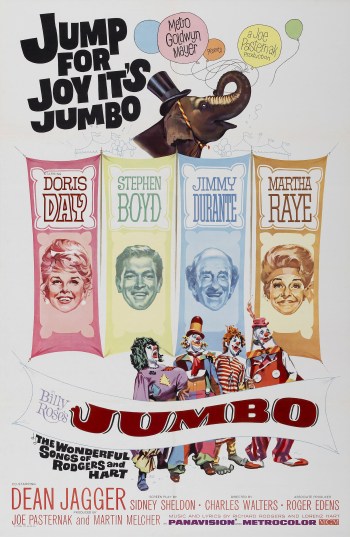
Doris Day, Stephen Boyd, Martha Raye, Jimmy Durante, Dean Jagger, John Astin (uncredited)
Plot:
Set in the early 1900s, the Wonder Circus is run by Pop Wonder (Durante) and his daughter Kitty (Day) with their main attraction Jumbo the Elephant. The circus is floundering financially and unpaid performers are quitting left and right to join other shows. Kitty hires a drifter Sam (Boyd) who does odd jobs and various performances. Kitty falls for Sam, but does Sam have the circus’s best interest in mind?
Awards and Nominations:
George Stoll was nominated for an Academy Award for Best Music, Scoring of Music, Adaptation or Treatment
Trivia:
Though she sang the title track for some of her films, this was Doris Day’s last musical film.
The film is based on a Billy Rose produced show, which opened on Broadway on Nov. 16, 1935, at the Hippodrome.
Though the four leads had doubles for the circus routines, they all went to circus school so the actor’s shots and would blend with the stunt doubles, according to Charles Walters: The Director Who Made Hollywood Dance by Brent Phillips.
Jimmy Durante starred in both the 1935 Broadway show and the 1962 film. Aside from a cameo in “It’s a Mad, Mad, Mad, Mad World,” this was Durante’s last major role in a feature film.
Director Charles Walters originally wanted Richard Burton as the male lead, according to Phillips’ book.
Choreographed by Busby Berkeley. This was Berkeley’s last film. Director Charles Walters hired Berkeley because he felt he was the only one who could effectively stage the large circus numbers in the manner they were performed on Broadway, according to Charles Walters: The Director Who Made Hollywood Dance by Brent Phillips.
Music written by Richard Rodgers and Lorenz Hart
Stephen Boyd is dubbed by James Joyce
Highlights:
Doris Day’s costuming
Circus acts
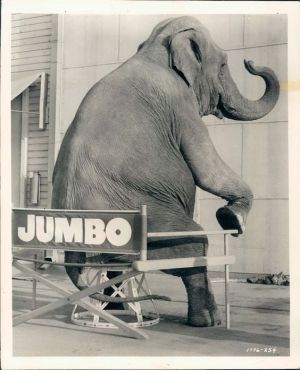
Jumbo the elephant
Martha Raye dressed as a lion during the “Circus On Parade” number
Notable Songs:
“Over and Over Again” performed by Doris Day
“This Can’t Be Love” performed by Doris Day
“Circus On Parade” performed by Jimmy Durante, Martha Raye, Doris Day
“The Most Beautiful Girl in the World” performed by Stephen Boyd, dubbed by James Joyce, and reprised by Jimmy Durante
“My Romance” performed by Doris Day
“Why Can’t I?” performed by Doris Day and Martha Raye
My review:
I will watch any film that includes:
1. Doris Day
2. Circus themes
And “Jumbo” has both of those features that would pull me into the film. The first time I saw this movie in 2003 at the dawn of my Doris Day love, I don’t remember particularly loving this movie. Revisiting it more than 10 years later, I enjoyed it for the most part but it does have its flaws.
Shot in gorgeous in Metrocolor, the movie is visually pleasing with circus costumes, big tops and Doris’s long blond (wig) hair. The Richard Rogers and Lorenz Hart written music also helps. “This Can’t Be Love,” “My Romance” and “Over and Over Again” are lovely and enjoyable songs.
“Jumbo” starts off as incredibly enjoyable. The ending leaves me a little deflated, not because it’s sad, but because the last eight minutes is a ridiculous long rendition of “Saw Dust, Spangles and Dreams.” This is complete with the lead cast (including Stephen Boyd) doing a clown act and Boyd is even a lion tamer.
Jimmy Durante is, as always, humorous and adorable. And because he always seems so sweet, your heart breaks with him at the thought of potentially losing his circus and beloved elephant Jumbo. I also love that Durante was in the original 1935 Broadway show, as well as this film.
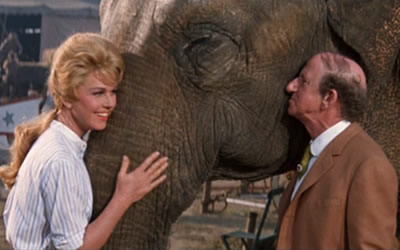
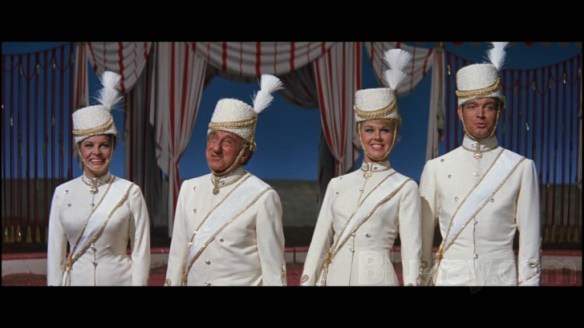
Doris Day, Syd the Elephant and Jimmy Durante
In some films, Martha Raye’s prescience can be a bit much for me, but I enjoy her role in this movie. She’s funny and she and Doris Day perform a lovely duet. I’m not positive how they got along offset, but they make a charming set of female friends in this movie.
As for our star: With all of her films, Doris Day shines in this movie. Though it’s obviously a wig, her long turn-of-the-century hairstyle looks nice on her and her costumes are colorful. She makes an energetic, joyful and fun circus performer. The only issue is I can’t help but feel that this movie would have been more effective 10 years earlier when Day was under contract with Warner Brother’s.
While “Jumbo” is fun, I just feel that it’s a 1952 movie musical trying to fit in 1962. By 1962, movie musicals were starting to decline. They were also taking a more serious tone, such as “West Side Story” (1961), which looked at racism and gang violence. “Jumbo” producer Joe Pasternak produced many of MGM’s Technicolor extravaganzas in the 1940s and 1950s, such as “Thrill of Romance” (1944) starring Esther Williams, “Anchors Away” (1945) starring Frank Sinatra and Gene Kelly, and “In the Good Old Summertime” (1949) starring Judy Garland. Even he knew that “Jumbo” didn’t fit in anymore.
“We were getting older while the audiences were getting younger. Doris Day wasn’t a kid,” Pasternak said.
The film rights to the 1935 Broadway play were purchased by MGM in 1943, to co-star Judy Garland, Mickey Rooney, Wallace Beery and Frank Morgan. Later in 1947, it was set to star Garland or Kathryn Grayson with Frank Sinatra. And again, in 1952, Debbie Reynolds, Red Skelton, and Donald O’Connor were to be in the film, according to the book “Charles Walters: The Director Who Made Hollywood Dance” by Brent Phillips.
I can picture this film with any of the above listed in the time frame they were originally considered. Doris Day, Durante and Raye would have been even better in this film in 1952. Maybe Gordon MacRea could have played the leading man.
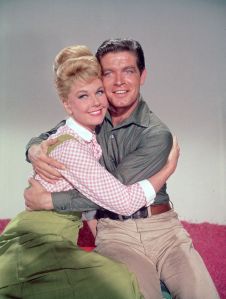
Raye, Durante, Day, Boyd in “Jumbo”
Another flaw was casting actor Stephen Boyd as the leading man. I love Stephen Boyd (and I had a major crush on him after first seeing this film) and I think he’s a great actor. However, Boyd doesn’t fit in a musical. This just doesn’t seem his style and he ended up being dubbed.
Director Charles Walters said Boyd worked hard on the film but wasn’t right for the film. Walters did say Boyd had a good sense of humor on set, which I was happy to hear. However, instead of Boyd, Walters wanted Richard Burton instead, which would not have been better than Boyd.
The only lead star in this film that didn’t receive enough screen time was the film’s namesake: Jumbo, played by Syd the elephant. For a film named after the elephant’s character, Syd probably only was on screen for 15 minutes of the 126 film.
For a movie about Jumbo, you see very little of the elephant, but his scenes are enjoyable. You get to see Jumbo do a few acts and play the tuba. I love elephants, so I particularly enjoyed his scenes.
Though “Billy Rose’s Jumbo” should have been released in theaters at least five years earlier to be relevant to audiences, it still is a fairly enjoyable film.
It’s no secret that the Hollywood Comet loves musicals. In 2010, I revealed I had seen 400 movie musicals over the course of eight years. Now that number is over 500. To celebrate and share this musical love, here is my weekly feature about musicals.
Starring:
Rita Hayworth, Janet Blair, Lee Bowman, Marc Platt, Leslie Brooks, Florence Bates, Professor Lamberti, Shelly Winters (uncredited)
Plot:
Told as a retrospective story to a LIFE magazine reporter, a theater in London never closed or missed a performance during the German blitz in London throughout World War II. The stars of the show were Rosalind Bruce (Hayworth), Judy Kane (Blair) and Tommy Lawson (Platt) are the stars of the show. Rosalind is an American and ends up falling in love with British flyer Paul Lundy (Bowman).
Trivia:
-Loosely based on the Windmill Theatre in London, which never closed during World War II and the German blitz
-Rita Hayworth took time off after filming “Tonight and Every Night” to have her baby, daughter Rebecca, who she had with Orson Welles, according to a “Movie of the Week” feature in the Feb. 12, 1945, issue of LIFE magazine.
-Originally was set to be a drama with Ida Lupino and Merle Oberon. After Hayworth’s success in “Cover Girl,” Columbia cast Hayworth in the film instead and made it into a musical, according to Turner Classic Movie Host Ben Mankiewicz.
-Because Rita Hayworth was pregnant during the filming, costume designer Jean Louis had to find creative ways to hide her pregnancy.
-Based on the play “Heart of a City.”
-Choreographed by Jack Cole, who dances during the number “What Does an English Girl Think of a Yank?”
-Rita Hayworth was dubbed by Martha Mears
Highlights:
-Rita Hayworth’s “You Excite Me” number, choreographed by Jack Cole
-Marc Platt’s dancing, particularly when he is auditioning
Notable Songs:
-“Tonight and Every Night” performed by Janet Blair, the cast and Rita Hayworth, dubbed by Martha Mears
-“You Excite Me” performed by Rita Hayworth, dubbed by Martha Mears
-“The Boy I Left Behind” performed by Janet Blair, Rita Hayworth, dubbed by Martha Mears
-“What Does an English Girl Think of a Yank?” performed by Rita Hayworth, dubbed by Martha Mears (mainly notable for the dancing.)
-“Anywhere” performed by Janet Blair
My review:(with vague SPOILERS)
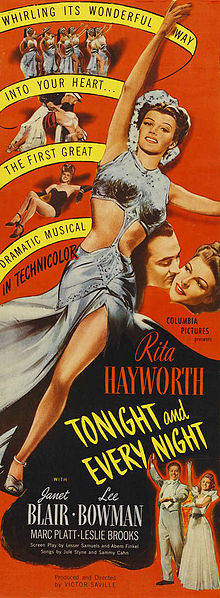
“Tonight and Every Night” is my favorite Rita Hayworth film. This is a fairly forgotten and underrated musical, which is a shame. “Tonight and Every Night” explodes with gorgeous Technicolor and has a few fantastic dance numbers choreographed by Jack Cole.
This isn’t your average fluffy musical. I think what I like best about this lively film is that it’s set during World War II and mixes musical comedy with a serious theme: the German blitz on England during World War II. The storyline focuses on a theater in London vowing never to close or end a performance during the Blitz. This plot makes the film interesting and gives it weight. In the film, the actors even decide to make a dormitory out of the theater, sleeping in dressing rooms and making a little canteen. Rita Hayworth’s romance with Lee Bowman is more of a subplot to this than the main focus. (SLIGHT SPOILER)“Tonight and Every Night” also takes very sad and serious turn at the end that leaves me in tears every time. Turner Classic Movies host Ben Mankiewicz said 1945 audiences were unprepared and shocked by an ending that wasn’t happy. Most musicals from the dawn of sound to the 1950s didn’t leave the audience sad. Out of the pre-1959 musicals I have seen, this is the only one that leaves me sad.
Mankiewicz also said that this film originally wasn’t intended to be a musical and was going to star Ida Lupino and Merle Oberon. While I can picture how this film would have played out, I am happy that it ended up being a musical — even if Rita Hayworth was dubbed.
While singing may not have been a strong suit of Hayworth’s, her dancing is superb. I often find that Hayworth’s dancing skills are overlooked, as she’s often remembered for film noirs like “The Lady from Shanghai” or “Gilda.” However, I would list her in the top 10 best dancers in Hollywood of the classic era. Her best dance numbers in this film are “You Excite Me” and “What Does an English Girl Think of a Yank?”
Another fantastic dancer in this film is Marc Platt. Not a well-known name, Platt was also one of the brothers in “Seven Brides for Seven Brothers” and danced in “Oklahoma.” This seems to be one of the few films that he had a speaking role in. Most notably in this film, Platt auditions for Florence Bates dancing to classical, opera, boogie-woogie and a Hitler speech.
Also in the film is Janet Blair who is beautiful to look at and has a lovely singing voice. She and Rita Hayworth compliment each other well on-screen.
“Tonight and Every Night” will maybe make you laugh and smile, and maybe even cry, but it’s a fast-moving Technicolor marvel that you shouldn’t miss.

 This week’s musical: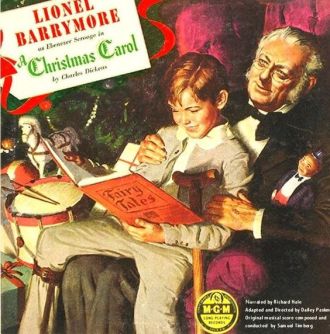


 by Cliff Goodwin



 ” (1945)– Musical #181
 Comet Over Hollywood