Pages to Screen: The Bishop’s Wife

When a novel is turned into a film, several things can happen:
The novel source material is often better than the film, as the story on-screen misses nuances or thoughts portrayed in a book.

Other times, the film and book are so similar that they complement each other.

And occasionally, you wonder how such a lovely film could have come from the original book.
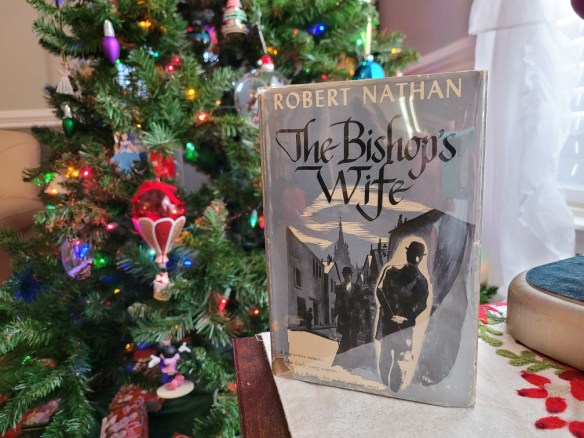
Resized_20231221_160638

A photo of my copy of The Bishop’s Wife by Robert Nathan

That is how I felt while reading Robert Nathan’s 1928 novel, “The Bishop’s Wife.” The brief 192-page novel isn’t bad; it’s just quite different from the 1947 film it was transformed into, starring Cary Grant, Loretta Young and David Niven.

The nuts and bolts are there: there is a bishop, Henry Brougham, who is fundraising to build a cathedral; his wife, Julia Brougham, their daughter; and an angel who comes to visit them.
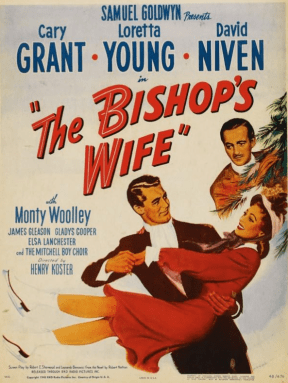
bisho's wife5In the beloved holiday classic films, the story follows the Bishop, played by David Niven, who feels he must build the most spectacular new cathedral the city has ever seen. As he fundraises and rubs elbows with the rich (such as Gladys Cooper’s character), the Bishop loses sight of what’s important about his religious role and alienates his family. His wife Julia, played by Loretta Young, longs for when they were happy and in love and first married, living in a less wealthy part of town. In an answer to his prayer for guidance for the chapel, an angel named Dudley, played by Cary Grant, visits the Bishop. The Bishop is constantly annoyed by Dudley and his perfection, but mainly because Julia enjoys Dudley’s attention, and Dudley seems to be falling for his wife. Dudley helps Julia see the simple pleasures of life, like buying a new hat or going ice skating, while showing a less-willing bishop that a cathedral is not what he needs.

In Nathan’s 1928 book, similarly, everyone is dissatisfied and looking for something, but in a different way.

The Bishop, Henry Brougham, is looking for a new archdeacon and a way to build a new cathedral. But the book — as the title alludes — is really about the Bishop’s wife, Julia. As a young girl, Julia imagined what she would feel and learn in marriage and the love she would feel, but that’s missing. She’s a perfect wife but feels no love or passion in her marriage. In the book, what is missing from Julia’s life is mainly that she is sexually dissatisfied. On their wedding night, the Bishop indicated that sex was “an act of hygiene” and not necessary to their love, as the Bishop feels he has to have pure and moral thoughts. In the book, Julia is much more meek and mild than Loretta Young’s character in the film, who seems kind and intelligent but weary.

Since she finds no love from Henry, Julia throws herself into her work as a dutiful wife and pouring affection over their little daughter Juliet, named for the tragic love of “Romeo and Juliet.”

Even young Juliet feels things are missing from her life, as she feels that she needs to be loved and adored by all her friends and adults.
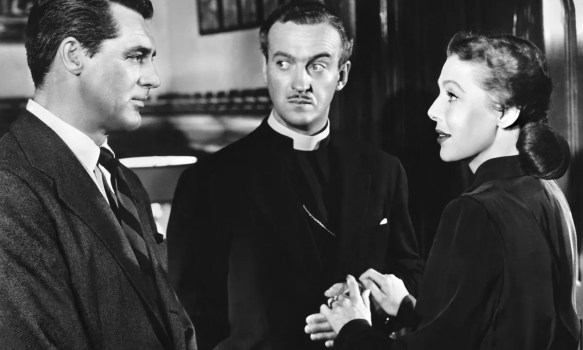
bishop's wife

Cary Grant as Dudley the angel, David Niven as the Bishop, and Loretta Young as Julia (the Bishop’s Wife) in the film version of Robert Nathan’s book, The Bishop’s Wife

And then there’s the angel named Michael in the book. He’s philosophical, and instead of trying to halt the cathedral like in the film, he helps ask wealthy individuals for even more money. Michael makes Julia feel a longing she had kept buried, and Michael too longs for his past and a home.

In the film, Dudley shows Julia affection and love through simple pleasures, and in the book, Michael and Julia embrace at the end and they hear heavenly music. In both, Julia becomes frightened and sends the angel away.

Professor Wutheridge’s character is also in the book (played by Monty Woolley in the film), but he isn’t an old friend of the Bishop and Julia. The professor makes his first appearance in Chapter 9 (of 19), and he is a scholar who attends the Bishop’s services and has philosophical conversations with Michael. Michael even tells the professor he’s an angel, but this is the only person he tells besides the Bishop. In comparison, no one but the Bishop knows Dudley is an angel, but the professor figures it out in the film.
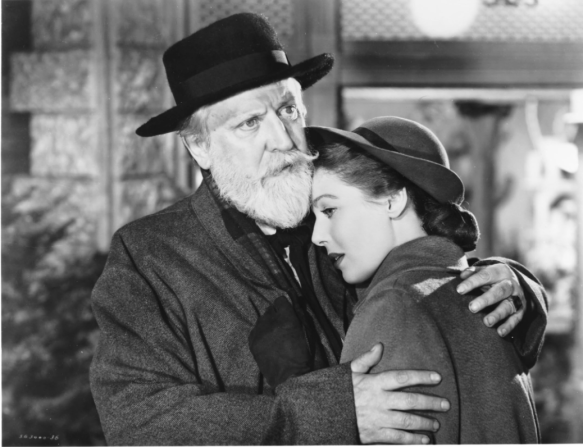
bisho's wfe5

Monty Woolley and Loretta Young in the 1947 film, The Bishop’s Wife

Chapter 9 is our first introduction to the topic of Christmas in the book.

While I type this review, I’m wondering if you may think, “Well, these do sound fairly similar!” and on paper, they do. But while reading the novel, you are struck by how different they are.

In 1928, the book received praising reviews.

“I know of no other contemporary American writer of fiction who is quite like Robert Nathan. His new book The Bishop’s Wife will give those who admire this highlight individual writer a chance to read him at his best,” wrote Arnold Mulder in his Oct. 8, 1928, review in the Post-Crescent.

The Oct. 14, 1928, review in The Los Angeles Times notes that the book is full of “charm, quiet humor and wisdom that it must prove a delight to every man who loves subtlety, sweetness and a dash of the devil.”

Again, while I didn’t dislike the book, the charm and humor were lost on me here as I compared it to the charming and magical 1947 film. While I watched the movie after I finished reading the book, I wondered, “How did they create this lovely story out of the book?”
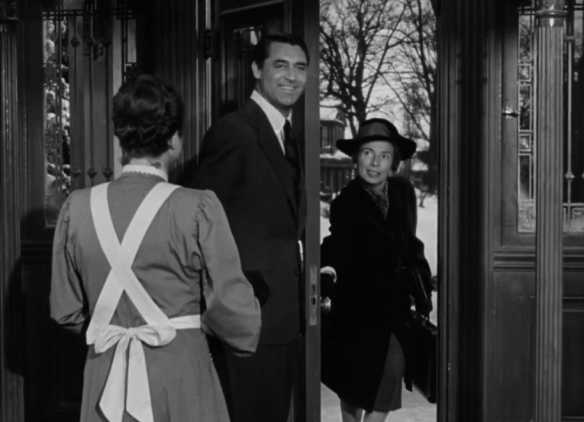
bishop's wife4

Elsa Lanchester and Sara Haden admiring Cary Grant’s Dudley in the film version of The Bishop’s Wife. Screenshot by Comet Over Hollywood

There are so many wonderful, new scenes in the film that make the story for me. For example, when Dudley the angel goes to the wealthy, miserly Mrs. Hamilton (Gladys Cooper) and finally breaks her cold exterior. Or how the Bishop’s secretary (Sara Haden) and the family’s maid (Elsa Lanchester) can’t stop craning their necks at the extremely attractive new visitor, Dudley, and how they both start wearing flowers in their hair around him.
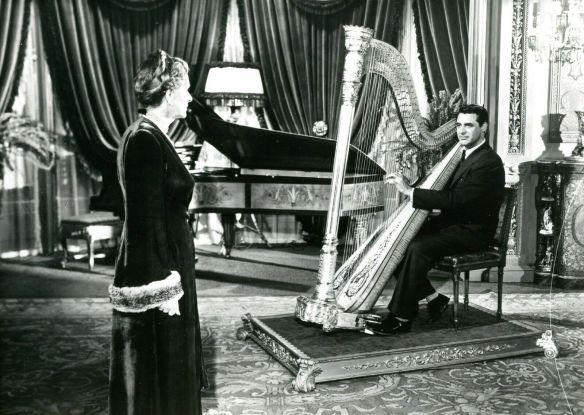
bishop's wife3

Gladys Cooper and Cary Grant in the film version of The Bishop’s Wife

There is also no confrontation between the angel and the Bishop telling him to leave. Instead, Michael departs on his own without much fanfare. The Bishop is much less vocal or powerful in the book, and in the end, everyone is largely left the way they were. In the novel, the Bishop never does anything to make his wife happy, not on his own, at least because Julia decides what will make her happy: another child to love.

While Robert Nathan’s “The Bishop’s Wife” was quite different, it’s interesting to read the source material for a favorite film and marvel at the work of screenwriters and how they can transform a 192-page stale novel and transform it into a beautiful film.
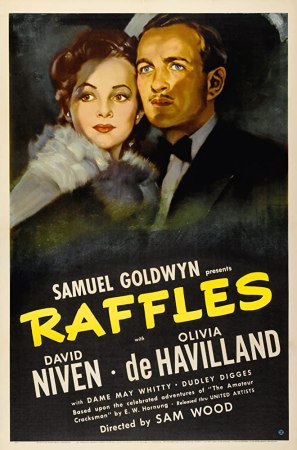
Watching 1939: Raffles (1939)

In 2011, I announced I was trying to see every film released in 1939. This new series chronicles films released in 1939 as I watch them. As we start out this blog feature, this section may become more concrete as I search for a common thread that runs throughout each film of the year. Right now, that’s difficult. 

1939 film: 
Raffles (1939)

Release date: 
Dec. 29, 1939

Cast: 
David Niven, Olivia de Havilland, Dame May Whitty, Dudley Digges, Douglas Walton, E.E. Clive, Lionel Pape, Peter Godfrey, Margaret Seddon

Studio: 
Samuel Goldwyn Productions

Director: 
Sam Wood

Plot:
Charming cricket player A. J. Raffles (Niven) leads a double life. One of an athlete who is invited into high society circles, and another as a jewel thief. Raffles steals jewels and priceless art and gives it to those who are financially in need and could benefit from the reward offered for the item. Raffles’s illegal activities complicate his relationship with his girlfriend Gwen (de Havilland), especially when her brother Bunny (Walton) runs into financial issues, and Raffles plans to steal a priceless necklace to help him out.

Continue reading

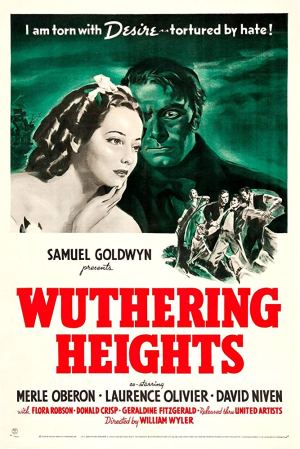
Watching 1939: Wuthering Heights (1939)

In 2011, I announced I was trying to see every film released in 1939. This new series chronicles films released in 1939 as I watch them. As we start out this blog feature, this section may become more concrete as I search for a common thread that runs throughout each film of the year. Right now, that’s difficult. 

1939 film:  Wuthering Heights (1939)

Release date:  March 24, 1939

Cast:  Merle Oberon, Laurence Olivier, David Niven, Flora Robson, Geraldine Fitzgerald, Hugh Williams, Leo G. Carroll, Cecil Kellaway, Miles Mander, Sarita Wooton, Rex Downing, Douglas Scott, Donald Crisp

Studio:  The Samuel Goldwyn Company

Director:  William Wyler

Plot:
Mr. Earnshaw (Kellaway) lives with his two children Hindley (Scott) and Cathy (Wooton) at the family farmhouse, Wuthering Heights. When returning from a trip to London, Earnshaw brings home a young gypsy waif, Heathcliff (Downing). Heathcliff is raised as Earnshaw’s own with Hindley and Cathy – Hindley hates Heathcliff and Cathy befriends him, eventually falling in love with him. After Earnshaw dies the three grow up, Hindley (Williams) becomes the master of Wuthering Heights, drinks too much, and puts Heathcliff (Olivier) where he feels he belongs, as a servant. Cathy (Oberon) falls in love with Heathcliff, but he doesn’t behave in the grand manner she wants out of life and she doesn’t feel he can give her the life she wants. Their paths divide and come back together, and their mutual love destroys everything around them.

Continue reading

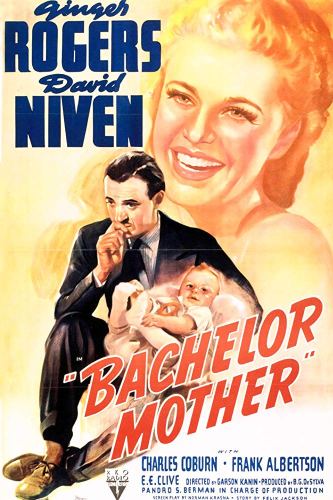
Watching 1939: Bachelor Mother (1939)

In 2011, I announced I was trying to see every film released in 1939. This new series chronicles films released in 1939 as I watch them. As we start out this blog feature, this section may become more concrete as I search for a common thread that runs throughout each film of the year. Right now, that’s difficult. 

1939 film:  Bachelor Mother (1939)

Release date:  June 30, 1939

Cast:  Ginger Rogers, David Niven, Charles Coburn, Frank Albertson, E.E. Clive, Ferike Boros, Elbert Coplen Jr., Dennie Moore, June Wilkins

Studio:  RKO Radio Pictures

Director:  Garson Kanin

Plot: Department store work Polly Parish (Rogers) is returning home one day when she finds a baby left on a doorstep. She catches him before he roles off and takes him to a nearby orphanage. No one will believe Polly that it’s not her baby and is forced to take responsibility for the baby. The department store owner’s playboy son, David Merlin (Niven) takes an interest in Polly, and David’s father (Coburn) believes the baby is his grandson.

Continue reading

Musical Monday: Happy Go Lovely (1951)

It’s no secret that the Hollywood Comet loves musicals.
In 2010, I revealed I had seen 400 movie musicals over the course of eight years. Now that number is over 500. To celebrate and share this musical love, here is my weekly feature about musicals.

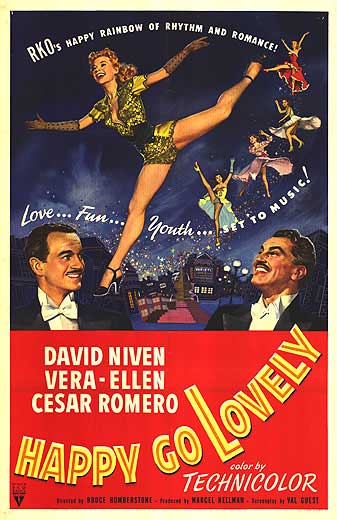
b70-15397This week’s musical:
“Happy Go Lovely” –Musical #125

Studio:
Associated British-Pathé (UK) and RKO Radio Pictures (US)

Director:
H. Bruce Humberstone

Starring:
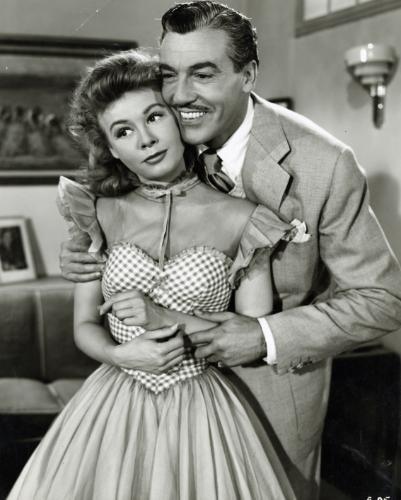
David Niven, Vera-Ellen, Cesar Romero, Bobby Howes, Diane Hart, Kay Kendall (uncredited)

Plot:
Director John Frost (Romero) is putting on a show in Edenborough, Scotland, but doesn’t have a funds to do it. When a rumor starts that chorus dancer Janet Jones (Vera-Ellen) is engaged to greeting card millionaire B.G. Bruno (Niven), John makes Janet the lead with hopes that Bruno will put money in the show.

Trivia:
-This film was made in Great Britain in attempt to compete with American films and incorporate American pop culture in British films. They did so by starring and directing American talent, according to Popular Music On Screen: From Hollywood Musical to Music Video by John Mundy
-British musical films were struggling. Casting American talent in their films was one strategy to solve this, according to The International Film Musical edited by Corey Creekmur, Linda Mokdad
-When screened in the United States, a gag involving a kilt had to be cut, according to Banned in the U.S.A.: British Films in the United States and their Censorship, 1933-1966 by Anthony Slide.
-Vera-Ellen’s singing was dubbed by Eve Boswell, a singer popular in Great  Britain in the 1950s.

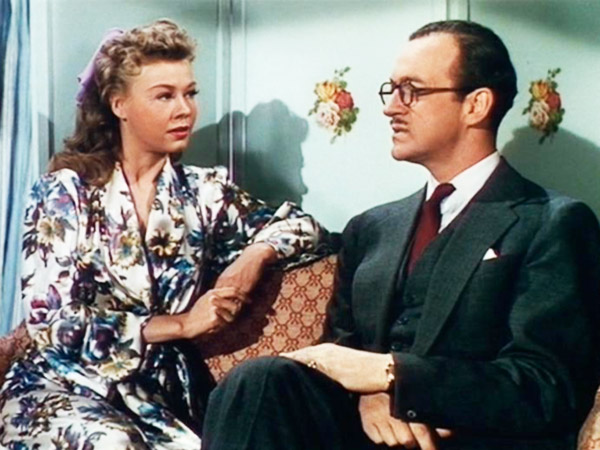
Vera-Ellen and David Niven in "Happy Go Lovely"

Vera-Ellen and David Niven in “Happy Go Lovely”

Notable Songs:
-“One, Two, Three” performed by Vera-Ellen
-“Would You-Could You?” performed by Vera-Ellen

Vera-Ellen and Cesar Romero in "Happy Go Lovely"

Vera-Ellen and Cesar Romero in “Happy Go Lovely”

My Review:
I love this musical.
There are some first time film watching experiences that you remember and sometimes reflect on. “Happy Go Lovely” is one of those for me. Sometimes I randomly remember laying on the couch on a Friday, fall afternoon after coming home from high school. It was the weekend and I was ready to relax with classic films. That film binge started with “Happy Go Lovely.” I loved it then and I love it now.
It’s a silly, and simple plot and it’s largely forgotten. I think that it’s not as recognized today by American audiences since it was made in Great Britain with stars popular in America.
This is a fun little cinderella story that starts with a big misunderstanding and a rumor which eventually becomes reality.
I always enjoy seeing Vera-Ellen on screen. We only had her in films for such a brief time: her career spanned from 1945 to 1957 with only 16 film and TV appearances. She always had a glittering prescience and is one of the best dancers to ever grace the silver screen.
Then we have David Niven. Niven is always charming, humorous and seems sincere in his acting, regardless of the role.
And to top it all off, we have Cesar Romero!
For a little British musical, “Happy Go Lovely” has a fun cast with a few laugh out loud moments and catchy songs. And it’s in Technicolor.
If you enjoy musicals and are looking for a little slice of escapism, this is one of my favorite “go-to’s.”

Check out the Comet Over Hollywood Facebook page, follow on Twitter at @HollywoodComet or e-mail at cometoverhollywood@gmail.com

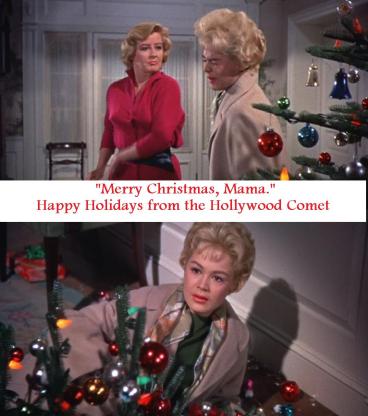
Tyrone Power Santa: Merry Christmas from Comet

Merry Christmas! 

A Christmas card from me to you. Screencapped from Summer Place by Me

A Christmas card from me to you. Screencapped from Summer Place by Me

With some help from my coworkers at the Shelby Star, I recorded a Christmas Eve video for everyone.

As my present to all of you, here is an anecdote I found from the official Tyrone Power page: King of 20th Century Fox.  David Niven tells how Tyrone Power plays Santa at a children’s Christmas party (sadly I have no photos): 

One Christmas I gave a party for my two small sons, and Tyrone Power offered to play Santa Claus. He lived a few blocks from me, and I went over to help him dress and brief him on the impending operation.

He was extremely nervous.

“This is worse than a first night on Broadway,” he said, helping himself liberally to the scotch bottle. “I’ve never performed for a bunch of kids before.”

I pushed and pulled him into the padded stomach, bulky red outfit, and high black boots rented from Western Costume Company and helped him fasten on a black belt, a huge white beard, and little red cap.

“Don’t worry about it,” I said. “It’s all fixed. I’ve left the gate open at the bottom of the garden. I’ve rigged up some sleigh bells down there and stashed away the presents, and at exactly six o’clock we’ll give ’em the bells; then you pick up the sack and make it up the lawn to the house — they’re all expecting you.”

After discovering he would be entertaining 50 children- including the offspring of Gary Cooper, Rosalind Russell, the Fairbanks’, Deborah Kerr, Loretta Young, Charles Boyer, Edgar Bergen and Jerry Lewis- Ty was drinking a great deal of scotch.

During the five minute drive to the party Ty begged me to let him off the hook.

“Why don’t you do it? he asked. “It’s your party.”

“You suggested it,” I said firmly.

By six o’clock Santa Claus was loaded; sack on shoulder and hidden in some bushes at the bottom of my garden.

“Off you go,” I said to Ty. “Lots of luck!”

When he was spotted by the excited children, shrill shrieks and applause broke out. At that point I had intended to turn on the garden lights to illuminate the scene but for some reason I missed the switch and turned on the sprinklers. Ty fell down. He picked himself up, gave me a marked look and squelched on toward the shining, expectant faces in the windows.

Like all actors, once the curtain was up and the adrenaline had started pumping, Ty was relaxed and happy in his work.

“HO! HO! HO!” he boomed.  “And who is this lovely woolly lamb for, eh? Candace Bergen. Come here, little girl. HO! HO! HO!”

He was doing beautifully by the time I had sneaked in by the back door, seated in a big chair in the hall with excited children climbing all over him.

“Maria Cooper! My, what a pretty girl! HO! HO! HO! You tell your daddy that old Santa thought he was just dandy in High Noon and ask him for Grace Kelly’s phone number while you’re about it. HO! HO! HO!”

Maria Cooper was a little more sophisticated than the other children. “Where did you see the picture, Santa?” she asked sweetly.

“Oh,” said Ty, pointing vaguely above him, “Up there!”

After a while Santa made his good-byes and staggered off down the lawn. Some of the children cried when he left.

Back at the bottom of the garden, I helped him out of his outfit. He was as excited as if he had just given a triumphant Broadway performance of King Lear.

“I really enjoyed that!” he said. “Weren’t the kids a great audience?” 

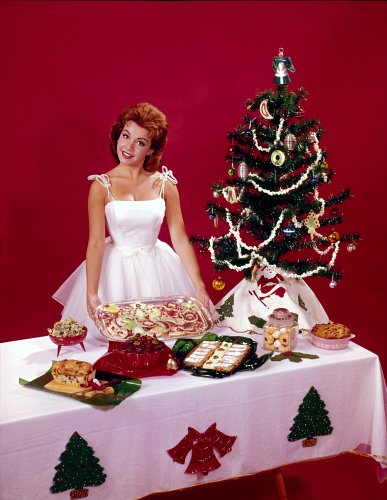
And Merry Christmas from one of my favorites- Annette Funicello

And Merry Christmas from one of my favorites- Annette Funicello


Check out the Comet Over Hollywood Facebook page 

Island of misfit Christmas movies


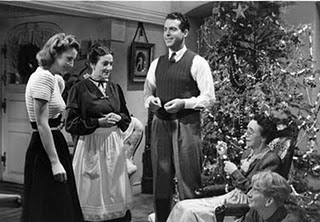
Stanyck, Bondi, MacMurray, Patterson and Holloway in “Remember the Night”: My favorite Christmas movie

Tis the season for Christmas posts. For these last five days before Christmas, I’m going to try to post several posts. Probably not every day, but at least throughout the week.

This post deals with two things my family and I love combined together: Christmas and movies.

For at least the past 22 years, it’s a Christmas family tradition for us to watch “Rudolph The Red-Nosed Reindeer” (1964), “A Charlie Brown Christmas” (1965) and “A Garfield Christmas” (1987) on Christmas Eve or Christmas Day.

Of course we also watch classic holiday films such as “The Bishop’s Wife” (1947), “Miracle on 34th Street” (1947), “White Christmas” (1954), “Christmas in Connecticut” (1945) and “It’s A Wonderful Life” (1946); just to name a few.

But instead of doing a worn out review of all of these wonderful classic films, I want to highlight some holiday films that are sometimes forgotten by the general public:


Rogers and Niven celebrating the New Year in “Bachelor Mother”

Bachelor Mother (1939):

I always forget this is a Christmas movie and I bet you do too. Polly Parish (Ginger Rogers) is working as a sales girl in a department store during the Christmas holidays. One day she finds a baby on the steps outside an orphange and picks it up before it rolls down the stairs. No one believes that it isn’t her’s and she is forced to take it home.  The store owner, J.B. Merlin (Charles Cobern) and his son David (David Niven) make sure that Polly doesn’t get rid of her baby, all during the Christmas season. To review: I love movies with babies and this is a very funny movie. My favorite part is when Rogers and Niven go out to celebrate the New Year.

Beyond Christmas (original title: Beyond Tomorrow) (1940): Last year, I had my mother tape this movie and we randomly watched it in the middle of the summer. This is one of my favorite Christmas movies. The movie stars Harry Carry, C. Aubrey Smith and Charles Winninger as three old bachelors who live together. Every Christmas they drink their Tom and Jerry’s and do nothing more.  But this year, the men decided to invite strangers off the street for Christmas dinner. The strangers (Jean Parker and Richard Carlson) eventually fall in love. The three old men die shortly after Christmas in a plane accident, but their ghosts help bring the couple together and work through rough times.  To review: It’s a really heartwarming, cute film. The whole thing might not take place during Christmas, but it reflects the spirit of Christmas.

 It Happened on 5th Avenue (1947): I only just saw this movie last Christmas and think it is really charming. McKeever the hobo (Victor Moore) lives in wealthy folks mansions when he knows they are away in another home. He invites recently evicted Jim Bullock (Don DeFore) and Bullock’s homeless army buddies to stay in millionaire Jim O’Connors (Charles Ruggles) mansion for the Christmas season. O’Connor and his daughter and ex-wife (Gail Storm and Ann Harding) come back to their mansion after family problems and live amongst the homeless folks, never telling them their real identity. To review: Its a really cute movie and also rather funny. Charles Ruggles and Ann Harding are perfect in it, and Victor Moore always plays the best absent-minded characters.

Love Finds Andy Hardy (1938): Mickey Rooney usually drives me bananas, but I really enjoy the Andy Hardy movies and this is my favorite.  Christmas doesn’t come without crisis for the Hardy family.  Mom Hardy has to go take care of sick grandma and Andy is swamped with girls:
– Polly Benedict (Ann Rutherford) is going away for the holidays leaving Andy without a date for the Christmas dance
– Andy Hardy agrees to take Beezy’s girl, Cynthia Potter, (Lana Turner) to a dance to discourage other dates
-Betsy Jenkins (Judy Garland) comes back to Carvel a grown up woman.
All the women causes a lot of confusion and crazy Mickey Rooney moments.  The Hardy’s are worried mom won’t be able to come home for Christmas, but in the end it all works out. Andy gets his date to the dance, Betsy sings and mom makes it home on Christmas Eve. To Review: It’s a really cute movie, and a chance to see Judy Garland treated like a young woman rather than a child. It’s also fun to see three of Andy’s love interests all in one movie.

Remember the Night (1940): A couple of years ago, Turner Classic Movies premiered this Preston Sturges film. With the release of the DVD last year, it’s gaining popularity, but still isn’t up to par with other Christmas classics. Lee Leander (Barbara Stanwyck) steals an expensive diamond bracelet and is on trial only a few days before Christmas. Prosecuting lawyer John Sargent (Fred MacMurray) postpones the trial until after Christmas, since it is hard to get a jury to convict someone as guilty before Christmas. John hates to see Lee spend Christmas in jail so offers to for her to stay with his mother (Beulah Bondi), aunt (Elizabeth Patterson) and farm hand (Sterling Holloway) in Indiana.  To review: This is my favorite Christmas movie. The two old women together bickering is adorable, Fred MacMurray and Barbara Stanwyck have fantastic chemistry and Sterling Holloway offers a lot of comic relief.

Hattie McDaniel putting the presents under the tree that General Hilton sent to her in “Since You Went Away”

Since You Went Away(1944): 

This is a World War II movie that takes place on the American home front. The film follows a year with the Hilton family: Ann (Claudette Colbert), Jane (Jennifer Jones) and Brig (Shirley Temple) as they struggle with their father away at war, rationing and taking in boarders. The whole movie isn’t a Christmas movie, only at the very end. The family has a Christmas party with friends and a few soldiers. They play games and try to forget that their father isn’t there to join in the fun and some loved ones were killed in the war. But in the end, they get the best Christmas present they could ever ask for. To review: This is sort of like “Meet Me in St. Louis”: The whole thing isn’t a Christmas movie, but can be considered a Christmas movie. It’s one of my all time favorite films. I think that it really shows the true Christmas spirit and what is imporant at Christmas: family.

Check out the Comet Over Hollywood Facebook page