Musical Monday: Down To Their Last Yacht (1934)

It’s no secret that the Hollywood Comet loves musicals.
In 2010, I revealed I had seen 400 movie musicals over the course of eight years. Now that number is over 500. To celebrate and share this musical love, here is my weekly feature about musicals.
yacht2This week’s musical:
Down to Their Last Yacht (1934) – Musical #556

Studio:
RKO Radio Pictures

Director:
Paul Sloane

Starring:
Mary Boland, Polly Moran, Ned Sparks, Sidney Fox, Sidney Blackmer, Sterling Holloway, Marjorie Gateson, Irene Franklin, Ramsay Hill, Lynne Carver (uncredited)

Plot:
When the wealthy New York Colt-Stratton’s (Fox, Hill Gateson) lose everything in the 1929 crash, they become part of the working class. All they have left is their yacht. Nella Fitzgerald (Moran) approaches the family with the idea to rent out the yacht for a cruise for the nouveau riche. One of the passengers, gambler Barry Forbes (Blackmer), falls in love with Lucy Colt-Stratton (Fox) during the voyage. During the sea trip, the boat shipwrecks on South Sea Island of Malakamokolu. The island is ruled by Queen Malakamokalu (Boland), who made herself the ruler of the island. She makes all the passengers labor around the island. She also gives them an ultimatum: Either Barry marries her or she kills them all.

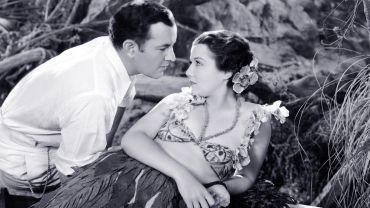
Sidney Blackmer and Sidney Fox in "Down to Their Last Yacht"

Sidney Blackmer and Sidney Fox in “Down to Their Last Yacht”

Trivia:
-Producer Lou Brock’s last film for RKO.
-Scored by Max Steiner

Highlights:
-Ned Sparks humor

Notable Songs:
-“Tiny Little Finger on Your Hand” performed by Sidney Blackmer
-“There’s Nothing Else to Do in Ma-La-Ka-Mo-Ka-Lu” performed by the chorus
-“South Sea Bolero” performed by the chorus

My review:
“Down to Their Last Yacht” is an odd little comedy mixed with music. It’s a little scatterbrained, but pretty funny and has some pre-code humor. The film begins and you think it is going to follow the three Down Colt-Strattons more, but they have a fairly minor role, except for Lucy, played by Sidney-Fox. The names you recognize are in the supporting cast (Polly Moran, Mary Bolland, Ned Sparks), but unfortunately, the straight-faced Ned Sparks is wasted in this film. He’s hardly in it.
The film was going a fairly predictable path until the boat shipwrecks. That was pretty unexpected and the plot takes a completely different turn. I’ll admit I was a little disappointed by this. The plot went completely zany, when I hoped the film was going to focus more on the social-registry family who now has to work for a living.
This is one of those movies that is comedy first and musical second, but it has enough songs to qualify as a musical. The songs aren’t memorable but they’re catchy.
“Down to Their Last Yacht” isn’t well-known as a musical, pre-code or comedy, but it’s enjoyable. It’s a quirky little hour long film filled with nonsense that you should catch.

Polly Moran in "Down to Their Last Yacht"

Polly Moran in “Down to Their Last Yacht”

Check out the Comet Over Hollywood Facebook page, follow on Twitter at @HollywoodComet or e-mail at cometoverhollywood@gmail.com

Musical Monday: Ziegfeld Girl (1941)

It’s no secret that the Hollywood Comet loves musicals.
In 2010, I revealed I had seen 400 movie musicals over the course of eight years. Now that number is over 500. To celebrate and share this musical love, here is my weekly feature about musicals.

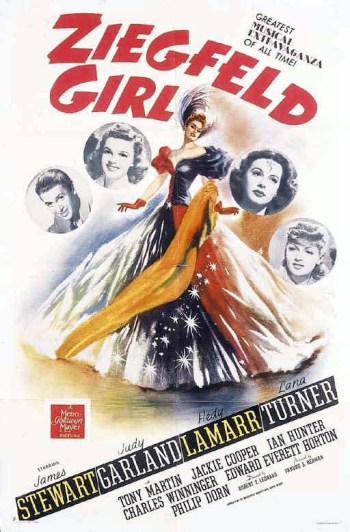
ziegfeld2This week’s musical:
Ziegfeld Girl” (1941) Musical #126

Studio:
Metro-Goldwyn-Mayer

Director:
Robert Z. Leonard, Busby Berkeley

Starring:
Lana Turner, Judy Garland, Hedy Lamarr, James Stewart, Jackie Cooper, Charles Winninger, Tony Martin, Ian Hunter, Eve Arden, Philip Dorn, Al Shean, Edward Everett Horton, Dan Daily, Fay Holden, Felix Bressart, Rose Hobart, Leslie Brooks (uncredited), Georgia Carroll (uncredited), Joyce Compton (uncredited), Patricia Dane (uncredited), Myrna Dell (uncredited), Jean Wallace (uncredited)

Plot:
Three girls are selected to be in the latest Broadway production of Florenz Ziegfeld:
• Sheila (Turner), a Brooklyn native who is discovered while working on an elevator in a department store
• Susie (Garland), a performer in an act on vaudeville with her father. The only problem is Mr. Ziegfeld only wants Susie and not her dad (Winninger)
• Sandra (Lamarr), who is discovered while she is with her violinist husband (Dorn), who is auditioning for the orchestra.
The film follows the girls as they rise to fame and the trials they face on their way up: alcohol, wooing men who try to take them away from husbands and boyfriends and getting accustomed to more money. They all learn that fame has a great price.

Trivia:
-Florenz Ziegfeld was a famous Broadway producer who died in 1932. He was known for his lavish sets and elaborate costumes that “glorified the American girl.” Ziegfeld is a God-like figure in this film: he is discussed but never seen.

-“Ziegfeld Girl” is one of three films MGM dedicated to Florenz Ziegfeld. This film is a follow up to “The Great Ziegfeld” (1936), a biopic of Ziegfeld starring William Powell as the impresario. “Ziegfeld Girl” is a sequel which shows the life of the Ziegfeld Girls. The third film was “Ziegfeld Follies” (1946), which just showed multiple Ziegfeld-like acts.

-Hedy Lamarr requested to be in this film as a change of pace from her other dramatic roles, according to historian John Fricke.

-Two of the actors in the film were in original Florenz Ziegfeld produced films: Charles Winneger, who was in the original stage production of Show Boat, and Al Shean, who was part of the act Gallagher and Shean. Winninger and Shean recreate one of the Gallagher and Shean numbers in the film.

ziegfeld5

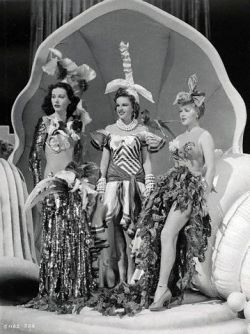
Hedy Lamarr, Judy Garland and Lana Turner in costume for the “Minnie from Trinidad” number

-The production of this film was originally announced in 1938 and was to star Eleanor Powell, Joan Crawford, Margaret Sullivan and Virginia Bruce (who was in The Great Ziegfeld). It was several years before the script was developed and the film was recast with newer talent, according to film historian John Fricke.

-James Stewart’s last film before joining the military to fight in World War II. His next film was “It’s a Wonderful Life” in 1946.

-The finale of “Ziegfeld Girl” edits in multiple numbers from “The Great Ziegfeld.” Judy Garland’s character is dressed in a costume which recreates the “Pretty Girl” number from the 1936 film, on top of the large tower.

-Busby Berkely choreographed the numbers in the film.

-The original finale was going to be “We Must Have Music” with Judy Garland, but it was deleted.

-Judy Garland felt a little inferior to her co-stars. A frequent story she shared was: When Lana Turner came onset, the technicians would whistle. When Hedy would pass through, they would sigh. When Judy came on set they would tell her hello, according to “Beautiful: The Life of Hedy Lamarr” by Stephen Michael Shearer.

-“Ziegfeld Girl” was the game changer in Lana Turner’s career, and it led to more serious, dramatic and adult roles. The role was even expanded for Turner during filming.

-Lana Turner was originally supposed to die at the end of the film, according to TCM film historian Robert Osborne. Her death had negative reactions from preview audiences and is now cut to be left ambiguous.

-Model and later wife of Kay Kyser, Georgia Carroll, said in 2008 that Hedy Lamarr was shy and private during the filming. Hedy Lamarr and Judy Garland were friends and Lamarr and Lana Turner were cordial, according to “Beautiful: The life of Hedy Lamarr” by Stephen Michael Shearer.

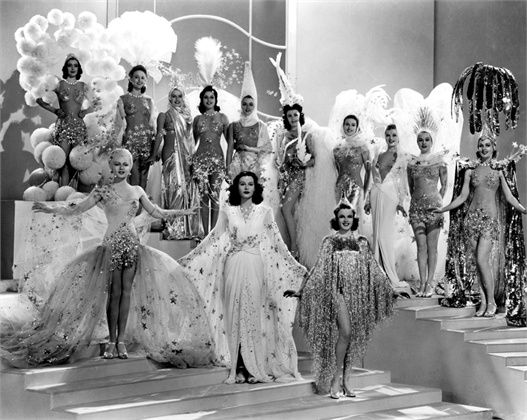
Publicity still of the costumes from the "You've Stepped Out of a Dream" number

Publicity still of the costumes from the “You’ve Stepped Out of a Dream” number

Highlights:
-Elaborate costumes by Adrian
-Eve Arden’s sassy character

Notable Songs:
-“You Stepped Out of a Dream” performed by Tony Martin
-“Minnie from Trinidad” performed by Judy Garland
-“You Never Looked So Beautiful” performed by the chorus, borrowed by the 1936 film
-“I’m Always Chasing Rainbows” performed by Judy Garland
-“Laugh? I Thought I’d Split My Sides” performed by Judy Garland and Charles Winninger
-“Caribbean Love Song” performed by Tony Martin
-“Mr. Gallagher and Mr. Shean” performed by Charles Winninger and Al Shean

My review:
In the grand scheme of film history, “Ziegfeld Girl” (1941) may not be very important. It is notable because it gave Lana Turner’s career the boost it needed, landing her in more sophisticated and adult roles. But when it comes to Metro-Goldwyn-Mayer movie musicals, this one isn’t even listed in the top 10.

But I love it. “Ziegfeld Girl” may be overly long (with a run time of 2 hours and 12 minutes) and the plot may be rather fluffy, but I think it’s a great example of the lavish luxury that was a Metro-Goldwyn-Mayer film.

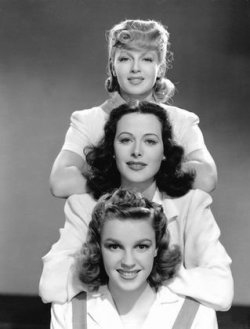
Publicity still of Lana Turner, Hedy Lamarr and Judy Garland

Publicity still of Lana Turner, Hedy Lamarr and Judy Garland

With the Adrian gowns and themes of fame and newly found wealth, “Ziegfeld Girl” oozes glamour, sophistication and the jewel-encrusted style many people dream about. For some reason, for me, this film holds the definition of MGM glamour more than other well-known MGM films like “Singin’ in the Rain” (1952), “The Women” (1939) or “Grand Hotel” (1932).

I think one major reason for this is the “You Stepped Out of a Dream” number where Tony Martin sings as women in elaborate (yet eccentric) costumes walk up and down stairs like goddesses.

After it’s release, Hedda Hopper said that the film is so beautiful that it “makes you ill that it’s not in color.” I can’t say I agree though. While Technicolor would have made “Ziegfeld Girl” even more glorious, I somehow think that black-and-white suits it and glitters more than color would. Color would have almost been too distracting.

The cast of this film is also bursting at the seams. Not only are the leading ladies three of MGM’s most well-known and top stars, the character actors seemingly just keep coming out of the woodwork through the film.

The only thing I don’t love about this film is the finale. Pasting together “Great Ziegfeld” (1936) feels off, though you could look at it as tying it back to the original film and making “Ziegfeld Girl” a true sequel. But that’s a bit of a stretch. It really comes off as lazy, and costume and dance styles had changed so much in five years that it doesn’t fit. However, the originally planned “We Must Have Music” finale is also weak (it’s included on the DVD special features). They would have been better off ending with “Minnie from Trinidad.”

I do also enjoy that two original Ziegfeld players- Charles Winninger and Al Shean- are included in the film.

I first saw “Ziegfeld Girl” in 2004 or 2005 and I fell in love with it and I still really love this movie. I loved it so much that “ziegfeldgirl1941” was part of my e-mail address at the time. I even tried to convince my mom to play “You Stepped Out of a Dream” when I walked downstairs to my prom date (she refused so this didn’t happen).

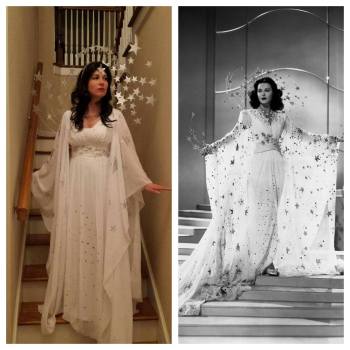
If the glamour of this film was a soap or a perfume, I would buy it and wear it. But since it’s not, I did the next best thing. I created Hedy Lamarr’s “Stepped out of a Dream” costume designed by Adrian for this Halloween. I bought the sleeveless white dress but made the rest of the costume- sewing on sleeves, cutting out and gluing silver stars and sequins, using 12 glue sticks to attach the wire with stars on a board on my back (Adrian also used a board on Hedy’s back.) If this 20-hour project doesn’t describe my love for “Ziegfeld Girl,” I’m not sure what does.

My version of Hedy Lamarr's "Dream" costume

My version of Hedy Lamarr’s “Dream” costume

If you love MGM glamour and musicals, I would give this one a watch. I’ll give you fair warning that it’s a bit dramatic in parts, like when Lana Turner’s luck starts to change, but it’s such a fabulous look at MGM in it’s prime.

Check out the Comet Over Hollywood Facebook page, follow on Twitter at @HollywoodComet or e-mail at cometoverhollywood@gmail.com

Musical Monday: Can’t Help Singing (1944)

It’s no secret that the Hollywood Comet loves musicals.
In 2010, I revealed I had seen 400 movie musicals over the course of eight years. Now that number is over 500. To celebrate and share this musical love, here is my weekly feature about musicals.

This week’s musical:
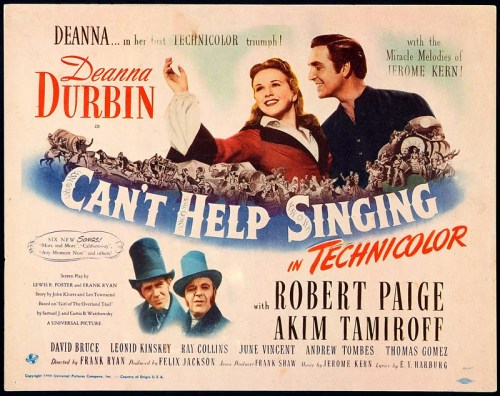
Can’t Help Singing” (1944)– Musical #137

cant-help-singing

Studio:
Universal Studios

Director:
Frank Ryan

Starring:
Deanna Durbin, Robert Paige, Akim Tamiroff, David Bruce, Ray Collins, Leonid Kinskey, June Vincent, Thomas Gomez, Clara Blandick, Iron Eyes Cody (uncredited), Edward Earle (uncredited)

Plot:
Caroline (Durbin) is in love with Lt. Latham (Bruce), but her father Senator Frost (Collins) hates the lieutenant. When Senator Frost convinces President Polk (Earle) to send Lt. Latham to California to guard gold shipments, Caroline leaves Washington, DC, and heads west with a wagon train to follow Lt. Latham. She ends up sharing a wagon with Johnny Lawlor (Paige) who distracts her attentions from Lt. Latham.

Awards and Nominations:
-Nominated for an Academy Award for Best Music, Scoring of a Musical Picture (Jerome Kern and Hans J. Salter)
-Nominated for an Academy Award for Best Music, Original Song (Jerome Kern and E.Y. Harburg)

Deanna Durbin in "Can't Help Singing," her first and only Technicolor film

Deanna Durbin in “Can’t Help Singing,” her first and only Technicolor film

Trivia:
-Deanna Durbin’s first and only color film. A Universal Studios publicity brochure said: “For the last eight years, Deanna has been in a black and white shadow on the screen before them. Now she is being brought to them in all the beauty of her natural coloring.”
-20th Century Fox built a fort for the film “Buffalo Bill” (1944) and Universal Studios rented this fort from Fox to use for this film.
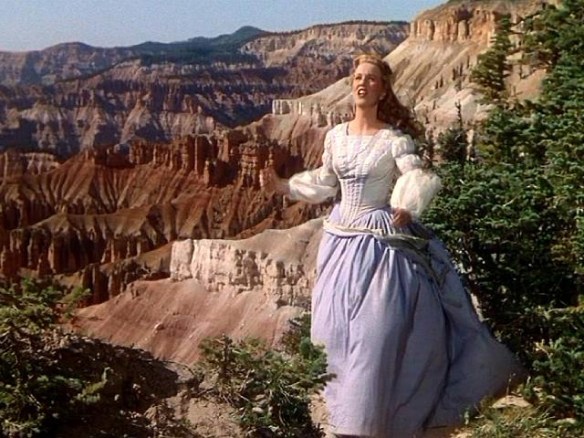
-Filmed in Utah, because the mountains in California are brown and Utah’s green mountains photographed better in Technicolor, according to When Hollywood Came to Town: A History of Movie Making in Utah by James D’Arc
-Film based on the story “Girl of the Overland Trail” by Samuel J. and Curtis B. Warshawsky

Highlights:
-Deanna Durbin in color

Deanna Durbin on location in Utah at the Cedar Breaks

Deanna Durbin on location in Utah at the Cedar Breaks

Notable Songs:
-“Can’t Help Singing” performed by Deanna Durbin and Robert Paige
-“Any Moment Now” performed by Deanna Durbin
-“Elbow Room” performed by the chorus
-“More and More” performed by Deanna Durbin
-“Californ-i-yay” performed by Deanna Durbin and Robert Paige

My review:
Though Deanna Durbin is known for her operatic singing voice, her films made under contract to Universal put music secondary to the plot. For example, where most of Judy Garland’s films were filled with songs that mixed evenly into the plot, Durbin’s films will primarily be a comedy or drama where she sings two or three songs.

“Can’t Help Singing” is one of few Durbin films that is strictly a musical with western elements coming secondary. It’s her first and only film in Technicolor, features multiple songs from Durbin, songs from her leading man Robert Paige (this is also rare in a Durbin film. Many of her leading men were non-singers), and songs featuring other characters that help move the plot along. This musical was one of Universal Studios most expensive films.

This is a fun little musical because it does feature a great deal of humor and a pleasant romance between Durbin and Paige. I really enjoyed Robert Paige as a leading man in this film. My only complaint is that he didn’t sing more and that he wasn’t in more prominent films throughout his career.

Akim Tamiroff and Leonid Kinskey are there as a comedic duo, who thankfully aren’t tiresome or annoying.

Durbin’s film career started in 1936 and she left in 1948. As Universal’s top star, it’s a shame that this is her only Technicolor film, but not surprising. Color was still very expensive and not as common during this time. It really is a treat to see Deanna Durbin in color. She looks gorgeous, her costume are lovely and the backdrop of Utah is lush and colorful.

While not my favorite Deanna Durbin film (that’s 1941’s It Started with Eve) “Can’t Help Singing” is a lot of fun. Durbin’s lilting happiness in her songs will make you want to sing as well.

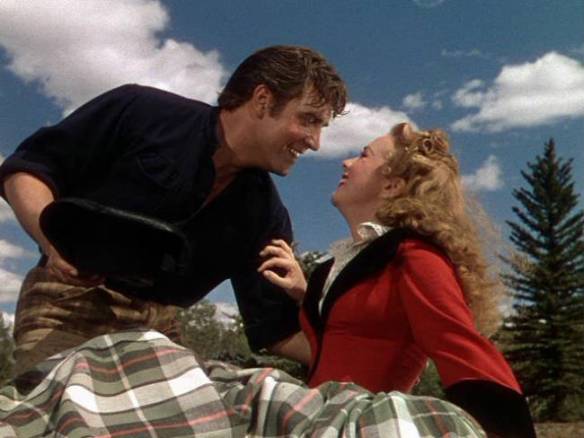
Robert Paige and Deanna Durbin in "Can't Help Singing"

Robert Paige and Deanna Durbin in “Can’t Help Singing”

Check out the Comet Over Hollywood Facebook page, follow on Twitter at @HollywoodComet or e-mail at cometoverhollywood@gmail.com

Musical Monday: Irene (1940)

It’s no secret that the Hollywood Comet loves musicals.
In 2010, I revealed I had seen 400 movie musicals over the course of eight years. Now that number is over 500. To celebrate and share this musical love, here is my weekly feature about musicals.

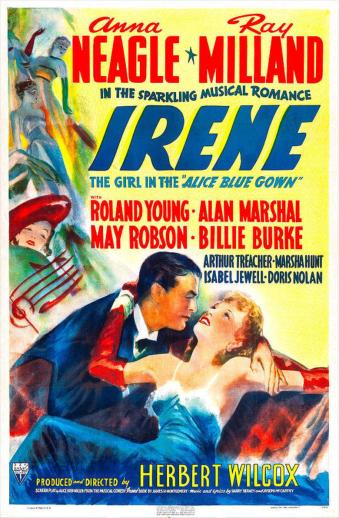
ireneThis week’s musical:
“Irene” (1940)– Musical #555

Studio:
RKO Radio Pictures

Director:
Herbert Wilcox

Starring:
Anna Neagel, Ray Milland, Roland Young, Marsha Hunt, Alan Marshal, May Robson, Billie Burke, Arthur Treacher, Isabel Jewell, Doris Nolan, Nella Walker, Alexander D’Arcy (uncredited)
Themselves: Martha Tilton, The Dandridge Sisters: Dorothy and Vivian Dandridge

Plot:
Irene O’Dare (Neagel) is an upholster’s assistant. She meets Don Marshall (Milland) while measuring chairs at a wealthy Long Island home. Don anonymously purchased the fashionable women’s clothing store Madame Lucy’s and he is Madame Lucy. He arranges for Irene to become a model there and the two are smitten. Don and Madame Lucy’s manager Mr. Smith (Young) arrange a publicity stunt by sending their well-dressed models to Mrs. Herman Vincent’s (Burke) society party. Irene is assigned to wear the store’s most exclusive dress, ruins it and wears an early 1900s dress of her mother’s instead-causing a wow. She explodes on the society scene and Mrs. Herman Vincent’s son (Marshal) – proposes to her.

Trivia:
-Based on a Broadway musical that originally premiered in 1919 and was revived in the 1920s and 1970s (which Debbie Reynolds and Jane Powell both starred in).

-A version of the 1926 film “Irene” starring Colleen Moore

Anna Neagle after the black and white film turns to color for a brief segment.

Anna Neagle after the black and white film turns to color for a brief segment.

Awards and Nominations
-Anthony Collins was nominated for the Academy Award for Best Music (Scoring). He lost to Alfred Newman for “Tin Pan Alley.”

Highlights:
-Credits featuring puppets of Anna Neagel and Ray Milland
-Changes to color for a scene midway through for a brief segment

Notable Songs:
-“Alice in a Blue Dress” performed multiple times by Anna Neagle, The Dandridge Sisters, Martha Tilton
-“You’ve Got Me Out On a Limb” performed by Anna Neagle
-“Irene”
-“Castle of Dreams”

My review:
While “Irene” is listed as a musical, it’s more of a comedy with a few musical and dance numbers thrown in. Regardless, it’s incredibly delightful.

This is an up-to-date Cinderella story. A wealthy man notices a shop girl and makes her a model glamour girl. The movie is joyful, funny and has beautiful fashion for vintage clothing lovers.

Ray Milland and Anna Neagle in the "Alice Blue Gown." This portion of the film is in color.

Ray Milland and Anna Neagle in the “Alice Blue Gown.” This portion of the film is in color.

Many of our Musical Monday features are filled with four to even twelve musical numbers. Many non-musical films also feature song, such as a singer in a nightclub, such as Sam in “Casablanca” or Lou Gehrig and his wife dancing to “Always” in “Pride of the Yankees.”

“Irene” sits awkwardly in the middle of these two. While it isn’t a song-extravaganza, it also can’t comfortably be dismissed as not a musical. It features two prominent song and dance numbers, the lead sings, the lead also has her own solo dance number at the end of the film, and some nightclub singers are sprinkled throughout. So that’s why we are qualifying “Irene” as a musical — the original Broadway play was also a musical.

The black and white film even turns to color so Anna Neagle can enter in her “Alice Blue Gown” and the audience can marvel and Anna can sing about it.

“Irene” had me laughing and smiling. If you don’t like musicals but love 1940s comedies, this is a happy medium for you. Too many songs won’t deter you.

Check out the Comet Over Hollywood Facebook page, follow on Twitter at @HollywoodComet or e-mail at cometoverhollywood@gmail.com

Musical Monday: My Sister Eileen (1955)

It’s no secret that the Hollywood Comet loves musicals.
In 2010, I revealed I had seen 400 movie musicals over the course of eight years. Now that number is over 500. To celebrate and share this musical love, here is my weekly feature about musicals.

This week’s musical:
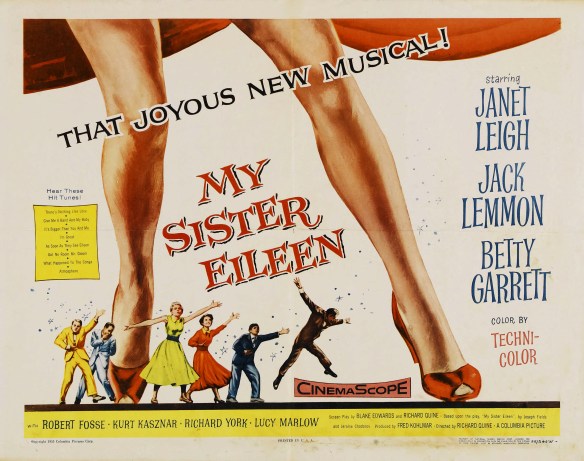
My Sister Eileen (1955)– Musical #320

my-sister-eilleen

Studio:
Columbia Pictures

Director:
Richard Quine

Starring:
Betty Garrett, Janet Leigh, Jack Lemmon, Bob Fosse, Kurt Kasznar, Dick York, Tommy Rall, Kathryn Grant (uncredited), Lucy Marlow

Plot:
Sisters Ruth (Garrett) and Eileen Sherwood (Leigh) move from Ohio to New York City. Ruth wants to become a journalist and Eileen hopes to break into Broadway. They have a hard time finding jobs and making ends meet while living in a shoddy Greenwich Village apartment right above Subway construction. Ruth also spends much of her time feeling sorry for herself since she isn’t as beautiful as her little sister Eileen, who is swarmed by men.

Trivia:
-Musical remake of the 1942 comedy “My Sister Eileen” starring Rosalind Russell and Janet Blair

-In 1953, a musical adaptation of the 1940s story called “Wonderful Town” premiered on Broadway. The music was written Leonard Bernstein with lyrics by Adolph Green and Betty Comden. Columbia felt the film rights to this version were too expensive so the story was rewritten for the screen and featured music by Jule Styne and Leo Robin. “All of them had a team of lawyers looking over their shoulders. Everything had to be cleared and approved legally,” Janet Leigh wrote in her autobiography “There Really Was a Hollywood.”

-Judy Holliday was originally cast as Ruth, but Betty Garrett ended up with the role.

-The script was written by Blake Edwards and Richard Quine, who also directed the film.

-Aldo Ray turned own the role of the muscular neighbor Ted, which went to Dick York.

-“My Sister Eileen” was Janet Leigh’s first project under contract with Columbia.

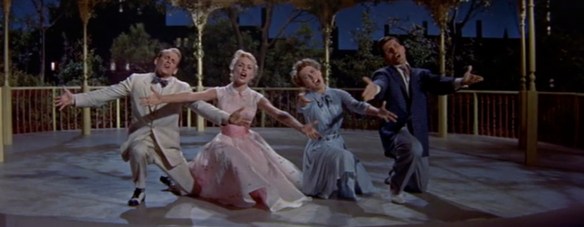
my-sister3

Notable Songs:
None memorable enough to note

My review:
If it wasn’t for my Musical Monday feature, I would not have ever watched “My Sister Eileen” (1955) a second time.

As far as musical remakes of dramas and comedies go, this one is pretty bad. Based on a novel, the original “My Sister Eileen” premiered in 1942 starring Rosalind Russell as Ruth and Janet Blair as Eileen. It’s hilarious and charming.

In both stories, Eileen is gorgeous and Ruth doesn’t have a chance finding a man with her beautiful sister around. However, in the 1955 version, the plot focuses mostly on romance and both sisters finding romance. Unlike the 1942 version, the 1950s version casts just enough men for both leading ladies.

In the 1942 version, while Ruth would like romance, she is more concerned with her writing career and looking out for her little sister. Steve Daly of “Entertainment Weekly” noted some “1950s backlash” against feminists in the 1955 version in comparison to the 1942 version.

This movie was screened at the 2016 Turner Classic Movies Film Festival with Jack Lemmon’s son, Chris, helping present it. Of all films, I was surprised this one was selected to showcase Jack Lemmon’s career because it’s well…a lemon. Lemmon is also hardly in the movie. In an hour and 48 minutes, I would estimate he’s maybe in 20 minutes of the film.

Janet Leigh is a capable singer and dancer. According to Janet Leigh’s autobiography, choreographer Bob Fosse was pleased with her dancing skills. Dancers Tommy Rall and Bob Fosse perform some impressive dance numbers but they can’t save the film.  You also get to hear Dick York and Jack Lemmon sing. In my opinion, there aren’t any memorable songs and while the cast is relatively stellar, I enjoy the cast from the 1942 version more.

If producers had been willing to pay for “Wonderful Town,” I’m curious if the film would have been better. It’s hard to go wrong with a score by Leonard Bernstein (West Side Story) and lyrics by Betty Comden and Adolph Green (Singing in the Rain). Maybe with a Bernstein/Comden/Green score, some of the songs would have been memorable. The story was also rearranged, and I’m curious how it’s different.

Maybe I would think this was a better movie if I hadn’t already watched the original. I want to like it. It’s colorful and has a good cast, but I find it irritating. Maybe you will enjoy it better.

my-sister5

Check out the Comet Over Hollywood Facebook page, follow on Twitter at @HollywoodComet or e-mail at cometoverhollywood@gmail.com

Musical Monday: Live a Little, Love a Little (1968)

It’s no secret that the Hollywood Comet loves musicals.
In 2010, I revealed I had seen 400 movie musicals over the course of eight years. Now that number is over 500. To celebrate and share this musical love, here is my weekly feature about musicals.

liveThis week’s musical:
Live a Little, Love a Little (1968) – Musical #548

Studio:
Metro-Goldwyn-Mayer

Director:
Norman Taurog

Starring:
Elvis Presley, Michele Carey, Dick Sargent, Rudy Vallee, Don Porter, Sterling Holloway, Celeste Yarnall, Marcia Mae Jones (uncredited), Ann Doran (uncredited)

Plot:
Greg Nolan (Presley) is a photographer who loses his job, apartment and freedom to do what he pleases when he meets Bernice (Carey). To pay for a new apartment that Bernice finds him, Greg works two photographer jobs at the same time while trying to his bosses (Vallee, Porter) from finding out.

Trivia:
-Director Norman Taurog retired after this film
-Based on the book Kiss My Firm But Pliant Lips by Dan Greenburg, published in 1965
-Shot on location in Hollywood and around Los Angeles

Highlights:
-Elvis talking to a Great Dane during a dream sequence. But the Great Dane is actually a man dressed like a Great Dane.

live5

.Gif courtesy of Giphy.com

The dog even dances in the next number

The dog even dances in the next number

Notable Songs:
-“A Little Less Conversation” performed by Elvis Presley
-“Edge of Reality” performed by Elvis Presley (during a dream sequence in a suit made to look like pajamas)
-“Almost in Love” performed by Elvis Presley

My review:
I watched this movie in June and I’m just now writing about it. I think I have been so stunned by how bad it was I had to recover for a few months.

And before anyone starts with saying “Well of course and Elvis movie is bad,” all of his other films (Girl Happy, GI Blues, Blue Hawaii, It Happened at the World’s Fair) look like gold in comparison to this one. It’s true: most of Elvis Presley movies have as much substance as a bunch of fluffy, sweet cotton candy.

Bernice (Carey) won't leave Greg (Presley) alone. Also pictured, Celeste Yarnall.

Bernice (Carey) won’t leave Greg (Presley) alone. Also pictured, Celeste Yarnall.

But “Live a Little, Love a Little” is different. Maybe it’s because it came in 1968, just a year before movies like “Easy Rider” were released. Films were changing and it’s obvious that “Live a Little” was trying to follow that lead. It’s shot like a weird, late-1960s movie with innovative camera work, a plot that doesn’t make much sense (or have a storyline), and a storyline that hops around. It also features crazy, unconventional male/female relationships and a woman out to get men and whatever she wants.

This isn’t your conventional Elvis Presley love story. He doesn’t even want the girl! The movie starts with him minding his own business when Michele Carey’s character virtually throws herself at him and then forces him to stay at her house. After sleeping there for three days, he leaves to head back to his own apartment to find it leased to a new family-thanks to his new looney girlfriend (a term I use loosely). The girl tells Elvis her name is Bernice but she goes by about two as well (Susie, Betty and Alice). Elvis then loses his job after randomly because of Bernice’s shenanigans and starts working as a photographer for two companies simultaneously.

Throughout the whole movie Elvis is trying to get rid of Bernice and then ends up with her at the end. It’s unreal. I think I only stuck with this movie because I was paralyzed by how bad it was.

In all, the movie was also more mature than other Presley films referencing drug use, adult language and sexual encounters. That wasn’t what made me dislike the movie, though it was different. While Elvis was the rebel of the 1950s, he was slipping in the new world of the late-1960s. It appears that he’s trying to keep up in this film but isn’t comfortable doing so.

There are only two notable features of this swirling mess of a film:
1. Elvis introduces the song “A Little Less Conversation”
2. A weird dream sequence with Elvis talking to a man dressed like a Great Dane. It’s only notable because it’s so weird.

live7

This film was also directed by Hollywood veteran Norman Taurog, who started in Hollywood in 1920 and directed films like “Boys Town” and “Presenting Lily Mars.” He also was famously Jackie Cooper’s uncle who made him cry on set for films. Taurog retired after this movie and I can’t help but wonder if it was related to the film just being plain bad.

If you are a die-hard Elvis Presley fan, don’t let me review deter you. Just be prepared to not see the regular Elvis you are used to seeing in his other race car driving, beach frolicking, girl loving films.

Check out the Comet Over Hollywood Facebook page, follow on Twitter at @HollywoodComet or e-mail at cometoverhollywood@gmail.com

Musical Monday: Broadway Thru a Keyhole (1933)

It’s no secret that the Hollywood Comet loves musicals.
In 2010, I revealed I had seen 400 movie musicals over the course of eight years. Now that number is over 500. To celebrate and share this musical love, here is my weekly feature about musicals.

broadway-thruThis week’s musical:
Broadway Thru a Keyhole (1933) – Musical #554

Studio:
20th Century Pictures

Director:
Lowell Sherman

Starring:
Constance Cummings, Paul Kelly, Russ Columbo, Blossom Seeley, Texas Guinan, Gregory Ratoff, Hobart Cavanaugh, Helen Jerome Eddy, Lucille Ball (uncredited), Charles Lane (uncredited), Ann Sheridan (uncredited), Esther Muir (uncredited), Dennis O’Keefe (uncredited), Walter Winchell (uncredited voice)
Themselves: Eddie Foy Jr., Frances Williams, Dewey Barto and George Mann comedy team

Plot:
A childhood friend of gangster Frank Rocci (Kelly) asks if he can help her sister Joan Whalen (Cummings) get a job. Frank does and when he meets Joan after years apart, he is smitten with Joan and puts the pressure on club owner Max Mefoofski (Ratoff) to make Joan the star of the club’s show. The only problem is that Joan falls in love with bandleader Clark Brian (Columbo).

Paul Kelly and Constance Cummings in "Broadway Thru a Keyhole"

Paul Kelly and Constance Cummings in “Broadway Thru a Keyhole”

Trivia:
-Written by famed columnist Walter Winchell. The story was said to be similar to a love-triangle between dancer Ruby Keeler, her husband singer Al Jolson and New York Gangster, Johnny “Irish” Costello. Winchell denied that the story was based on the three individuals, according to Unsung Hollywood Musicals of the Golden Era: 50 Overlooked Films and Their Stars, 1929-1939 by Edwin M. Bradley.

Highlights:
-The movie begins with a hand taking a key out of the door and the camera zooms in to look through a keyhole. Following this are sights and sounds of Broadway.
-Texas Guinan’s character in the film

Notable Songs:
-“Doin’ the Uptown Lowdown” performed by Frances Williams
-“When You Were a Girl on a Scooter and I the Boy on the Bike” performed by Constance Cummings and Eddie Foy, Jr.
-“You Are My Past, Present and Future” performed by Russ Columbo
-“I Love You Pizzicato” performed by Russ Columbo and Constance Cummings

My review:
“Broadway Thru a Keyhole” was a wonderful romp. It has a great comedic supporting cast, biting Pre-Code jokes and is a fun plot all over.

The plot is nothing out of the ordinary: gangster helps young girl succeed in her career, falls in love with her, she falls in love with someone else, and the gangster doesn’t want to let her go. But though this isn’t an unusual plot line, this one little film is special because it is more joke than crime.

Maybe it’s a little different because it was written by gossip columnist Walter Winchell. There are some wonderful pre-code lines such as: “I knew a hypochondriac once and was he GOOD.”

Texas Guinan in "Broadway Thru a Keyhole."

Texas Guinan in “Broadway Thru a Keyhole.”

But even better than the pre-code jokes is famed speakeasy owner and performer Texas Guinan’s role in the film. Her character is similar to her real-life character and it’s a treat to see her on the screen. Sadly, Guinan died four days after this film premiered.

The musical has fairly catchy songs. Leading lady Constance Cummings isn’t a stellar singer. However, I’m not sure if this is on purpose. I was curious if Cummings was cast to show that often young women were on looks and their boyfriend’s power rather than on their talent. Or I could be thinking too much into it and Cummings was cast to use this as a vehicle. Russ Columbo brings the singing talent in his smooth, crooner tone — though he isn’t a great actor. Knowing Columbo is dead a year after this film, however, makes his performance a little sad to watch.

Many of the numbers have a Busby Berkeley feel to them, though he wasn’t involved in the film. For example, one number has girls singing faces in musical notes and there are several over-head dancing shots.

“Broadway Through a Keyhole” is a musical you don’t often hear about, but if you love pre-code and 1930s musicals, be sure to add this film to your list.

Constance Cummings and Russ Columbo in "Broadway Thru a Keyhole."

Constance Cummings and Russ Columbo in “Broadway Thru a Keyhole.”

Check out the Comet Over Hollywood Facebook page, follow on Twitter at @HollywoodComet or e-mail at cometoverhollywood@gmail.com

Musical Monday: Reveille with Beverly (1943)

It’s no secret that the Hollywood Comet loves musicals.
In 2010, I revealed I had seen 400 movie musicals over the course of eight years. Now that number is over 500. To celebrate and share this musical love, here is my weekly feature about musicals.

beverly4This week’s musical:
Reveille With Beverly (1943)– Musical #323

Studio:
Columbia

Director:
Charles Barton

Starring:
Ann Miller, William Wright, Dick Purcell, Andrew Tombes, Franklin Pangborn, Adele Mara, Douglas Leavitt, Barbara Brown, Larry Parks, Doodles Weaver (uncredited), Irene Ryan (uncredited), Lee and Lynn Wilde
As themselves:

  • Bob Crosby and his orchestra
  • Freddie Slack and his orchestra with Ella Mae Morse
  • Duke Ellington
  • Count Bassie
  • Frank Sinatra
  • Mills Brothers
  • The Radio Rogues

Plot:
A switchboard operator, Beverly Ross (Miller), at the local radio station KFEL has dreams of having her own jive radio show. She eventually gets her own time slot and features all of the top jive music. While on the radio, Beverly catches ear (and eye) of soldier Barry Lang (Wright), who is wealthy and switches places with his chauffeur buddy Andy Adams (Purcell) to see if he can win Beverly without his millions.

Andrew Tombes and Ann Miller in "Revellie with Beverly"

Andrew Tombes and Ann Miller in “Revellie with Beverly”

Trivia:
-The film is based off the radio show Reveille with Beverly which was hosted by Jean Ruth Hay. Jean Hay served as technical adviser to the film and narrates the trailer for the film.

Highlights:
-All of the musical performances

Notable Songs:
-“Cow Cow Boogie” performed by Ella Mae Morse
-“Big Noise from Winnetka” performed by Bob Crosby and his Bobcat Orchestra, singers Lyn and Lee Wilde
-“Take the A Train” performed by Duke Ellington, sung by Betty Roche
-“One O’Clock Jump” performed by Count Bassie
-“Night and Day” performed by Frank Sintra

<iframe width=”560″ height=”315″ src=”https://www.youtube.com/embed/hLc7rohX9As&#8221; frameborder=”0″ allowfullscreen><!–iframe>

My review:
“Reveille with Beverly” is one of those guilty pleasure musicals. It has very little plot but for fans of 1940s big band and jive, it’s a dream.

“Reveille with Beverly” is based on a real radio show called “Reveille with Beverly” which was DJed be a young lady named Jean Ruth Hay. The Los Angeles radio show was on the air from 1941 to 1944 for soldiers fighting in World War II. They could hear it on ships, fighting or in the air.

Advertisement for Jean Ruth Hay's radio show.

Advertisement for Jean Ruth Hay’s radio show.

The idea of the radio show came when soldiers Jean knew said they hated starting their day with the blast of a bugle. Hay also said that government officials would sometimes provide a script to read which included names of songs that didn’t exist. These scripts turned out to be code for the French Underground. Hay even married bandleader Freddie Slack, who is featured in this film.

The real show is merely a premise for the plot and all else is fictional. The movie has multiple laugh-out-loud funny scenes, particularly with Franklin Pangborn who is furious that Beverly’s show is in his time slot. While there is a bit of a plot, the majority of the film are musical performances of 1943 hits. When Beverly’s record starts spinning, we’re transported to a video of Bob Crosby and his band or Duke Ellington performing “Take the A Train” on a train.

All the songs had me dancing in my seat. I saw this movie for the first time in 2009 and it introduced me to Ella Mae Morse, who I wasn’t familiar with prior. Now she is one of my favorites.

Admittedly, there may be some who don’t enjoy this style of movie. If you aren’t interested in a string of jive musical numbers, you should probably stay away.

This isn’t your usual Ann Miller film, who was still early in her career. Ann only tap dances once and it’s a patriotic number at the end of the film.

Just writing this review makes me want to watch “Reveille with Beverly” again. It’s a brief hour and 18 minutes that will leave you dancing and humming by the end.

Ann Miller in her tap dancing finale.

Ann Miller in her tap dancing finale.

If anyone knows where to listen to some of Jean Ruth Hay’s original broadcasts, leave me a message! I would love to hear them.

Check out the Comet Over Hollywood Facebook page, follow on Twitter at @HollywoodComet or e-mail at cometoverhollywood@gmail.com

Musical Monday: New Moon (1940)

It’s no secret that the Hollywood Comet loves musicals.
In 2010, I revealed I had seen 400 movie musicals over the course of eight years. Now that number is over 500. To celebrate and share this musical love, here is my weekly feature about musicals.

This week’s musical:
New Moon” (1940)– Musical #374

Poster - New Moon (1940)_02

Studio:
Metro-Goldwyn-Mayer

Director:
Robert Z. Leonard, W.S. Van Dyke (uncredited)

Starring:
Jeanette MacDonald, Nelson Eddy, Mary Boland, George Zucco, Dick Purcell, Grant Mithcell, Joe Yule, Nat Pendleton (uncredited), Buster Keaton (scenes deleted)

Plot:
Marianne de Beaumanoir (MacDonald) is heading from France to New Orleans. On the same boat as a prisoner is nobleman Duc de Villiers (Eddy), using the name of Charles Henri. Marianne meets him on board, believing that he’s the ship’s captain. He is sold as a servant in New Orleans and becomes the servant of Marianne, and she is angry that he lied to her. Little to their knowledge, Charles’ enemies are sailing to New Orleans from France.

Continue reading

Musical Monday: The Vagabond Lover (1929)

It’s no secret that the Hollywood Comet loves musicals.
In 2010, I revealed I had seen 400 movie musicals over the course of eight years. Now that number is over 500. To celebrate and share this musical love, here is my weekly feature about musicals.

This week’s musical:
The Vagabond Lover” (1929)– Musical #356

vagabond2


Studio:
RKO Radio Pictures

Director:
Marshall Neilan

Starring:
Rudy Vallee, Sally Blane, Marie Dressler, Nella Walker, Malcolm Waite, Charles Sellon, Alan Roscoe, The Connecticut Yankees band

Plot:
Saxophone player Rudy Bronson (Vallee) forms a jazz band. To get off the ground, he and his band go to the home of famous bandleader Ted Grant (Waite) for an audition. Grant isn’t interested and kicks them out of his home and then heads out of town. Grant’s neighbors Jean Whitehall (Blane) and her aunt Ethel Bertha Whitehall (Dressler) mistaken Rudy and his band for Ted Grant. Rudy and his band play along but find themselves in hot water when they’re presented at a society fundraiser as Ted Grant and his band.

Rudy Vallee and Sally Blane in "Vagabond Lover"

Rudy Vallee and Sally Blane in “Vagabond Lover”

Trivia:
-Rudy Vallee’s first feature film
-“Vagabond Lover” was briefly Vallee’s publicity nickname

Notable Songs:
-“Nobody’s Sweetheart” performed by Rudy Vallee and the Connecticut Yankees
-“If You Were the Only Girl in the World” performed by Rudy Vallee
-“A Little Kiss Each Morning (A Little Kiss Each Night)” performed by Rudy Vallee
-“I Love You, Believe Me, I Love You” performed by Rudy Vallee

My review:
“The Vagabond Lover” is both an early film with sound and also Rudy Vallee’s film. It’s interesting to see this early film to see how both musicals and Rudy Vallee acting improved.

It’s very obvious that studios are still trying to figure out hot to best use sound. While the story line is less muddled than films like “Broadway Melody of 1929,” the sound volumes are often muddy. Sometimes the music is louder than the singing or talking, and other times I feel like the actors are shouting to be picked up by the microphone.

Sally Blane and Marie Dressler in Vagabond Lover

Sally Blane and Marie Dressler in Vagabond Lover

In his first film, Rudy Vallee isn’t a very good actor. But he apparently improved his acting craft over the years because Vallee was a skilled comedic actor in the 1940s and 1950s.

“Vagabond Lover” is just over an hour-long. It’s not terrible, but rather lackluster. Marie Dressler is wasted in the film and doesn’t exercise her comedic talents. Sally Blane is lovely, but is merely window dressing in the movie.

Overall, it’s watchable but not one I would be pressed to revisit.

Check out the Comet Over Hollywood Facebook page, follow on Twitter at @HollywoodComet or e-mail at cometoverhollywood@gmail.com