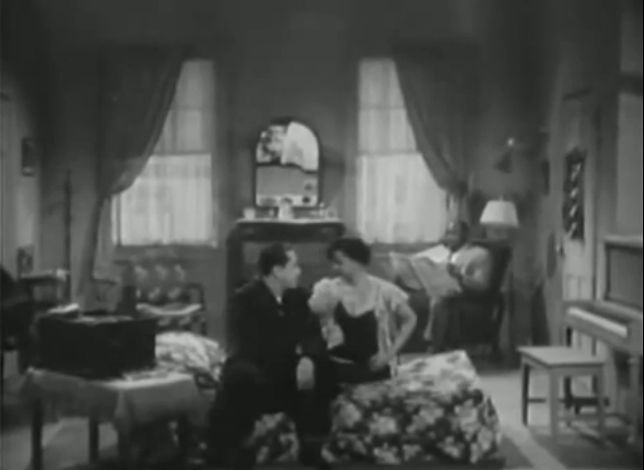
Musical Monday: “Centennial Summer” (1946)

It’s no secret that the Hollywood Comet loves musicals.
In 2010, I revealed I had seen 400 movie musicals over the course of eight years. Now that number is over 500. To celebrate and share this musical love, here is my weekly feature about musicals.

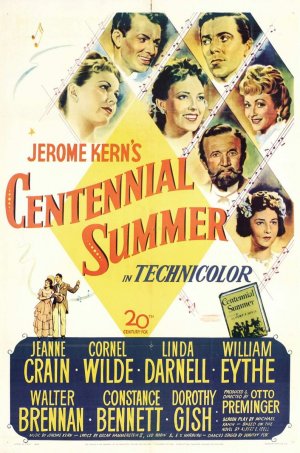
Centennial_Summer_FilmPosterThis week’s musical:
“Centennial Summer” (1946)–Musical #505

Studio:
20th Century Fox

Director:
Otto Preminger

Starring:
Jeanne Crain, Linda Darnell, Cornel Wilde, Walter Brennan, Constance Bennett, Dorothy Gish

Plot:
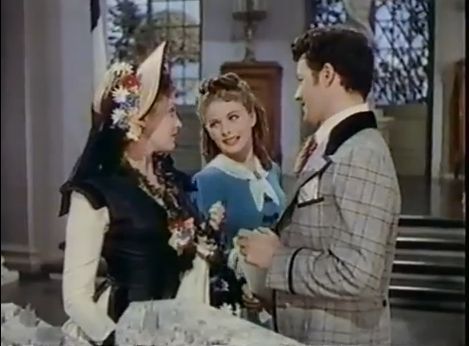
Set in Philadelphia during the United State’s centennial celebration in 1876, the plot focuses on the Rogers family. Their Aunt Zenia (Bennett) comes to visit from Paris, France for the celebration and brings her French nephew Philippe (Wilde). The oldest Rogers sisters Edith (Darnell)-the flirty older sister who gets all the boys- and Julia (Craine)-the more quiet sister who has never had a romance- immediately both are enchanted by the Frenchman. The two both work for his affections.

Trivia
-Composer Jerome Kern’s last musical score for either stage or film, according to “Hollywood Musicals Year by Year” by Stanley Green
-The film was Fox’s response to MGM’s hit “Meet Me In St. Louis” (1944). Both films focus on turn of the century nostalgia.
-Based on a book by Albert E. Idell
-Very few of the actors do their own singing. Crain was dubbed by Louanne Hogan (who also dubbed Crain in “State Fair“) and Darnell was dubbed by Kay St. Germain Wells (who also dubbed Darnell in “Hangover Square“).

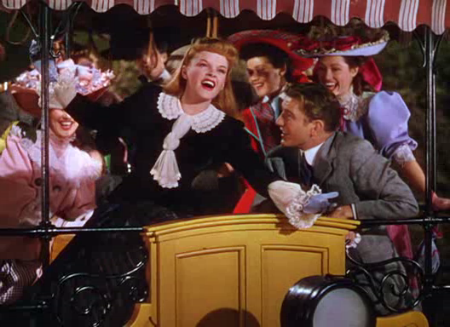
Edith (Darnell) and Julia (Craine) compete for the attentions of Phillippe (Wilde). Comet Over Hollywood/ Screencap by Jessica P.

Edith (Darnell) and Julia (Craine) compete for the attentions of Phillippe (Wilde). Comet Over Hollywood/ Screencap by Jessica P.

Highlights:
-The vibrant, Technicolor sets and costumes make this film.
-The movie includes items that were introduced during this time period such as a magic lantern show.
-Cornel Wilde carrying two dachshunds as he gets off the train….only because I’m a dachshund owner.
-I love the large cast ranging from silent film star Dorothy Gish, pre-code queen Constance Bennett to fresh faced Jeanne Craine.

Notable Songs:
For Jerome Kern’s last work before his 1945 death, none of the songs in this film were memorable.
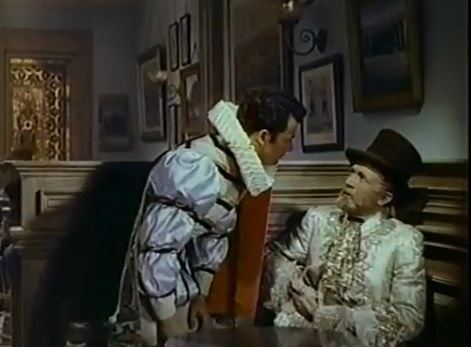
Many of them seemed misplaced. For example: Philppe (Wilde) and Jesse (Brennan) were about to have a serious conversation in a saloon about Julia (Craine) when African-American singer Avon Long enters the saloon and starts singing “Cinderella Sue.” Though the song was probably one of the more entertaining tunes in the film, it cut right into the middle of a scene. Why would they do that?

Philippe and Jesse look ridiculous dressed in French costumes (after a masquerade) in a saloon. Comet Over Hollywood/Screen Cap by Jessica P.

Philippe and Jesse look ridiculous dressed in French costumes (after a masquerade) in a saloon. Comet Over Hollywood/Screen Cap by Jessica P.

My Review:
This is actually one movie I wish was not a musical. Don’t get me wrong, I loved the cast and the story line and thoroughly enjoyed watching it. But right as the plot was moving right along, it would come to a grinding halt with a misplaced, forgettable song.
It’s very obvious that this was 20th Century Fox trying their hand at a turn-of-the-century family stories since Metro-Goldwyn-Mayer had so much success with “Meet Me in St. Louis” (1944).
However, “Centennial” is more frustrating than heartwarming.
All of the actors did a wonderful job, particularly Jeanne Crain who has always been a favorite of mine. However, Cornel Wilde’s French accent sounded more like a Charles Boyer impression.
“Centennial Summer” is a film I have searched for and wanted to see for years. Thank you to our friends over at Laura’s Miscellaneous Musings for letting me know it is currently up on Youtube and contributing to an enjoyable afternoon.

Check out the Comet Over Hollywood Facebook page, follow on Twitter at @HollywoodComet or e-mail at cometoverhollywood@gmail.com

Musical Monday: Hans Christian Andersen (1952)

It’s no secret that the Hollywood Comet loves musicals.
In 2010, I revealed I had seen 400 movie musicals over the course of eight years. Now that number is over 500. To celebrate and share this musical love, here is my weekly feature about musicals.

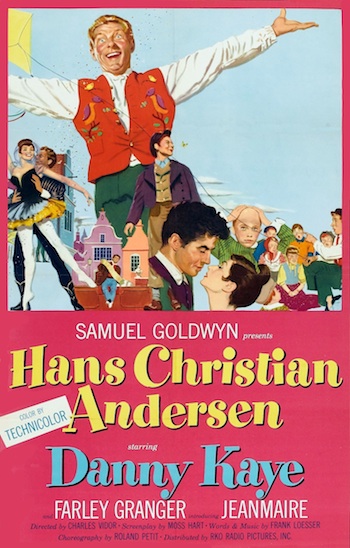
Hans_Christian_Andersen_FilmPosterThis week’s musical:
Hans Christian Andersen” –Musical #46

Studio:
Samuel Goldwyn Productions

Director:
Charles Vidor

Starring:
Danny Kaye, Farley Granger, Zizi Jeanmaire

Plot:
A fictitious telling of the life of Hans Christian Andersen. The film was not meant to be a biography of Andersen’s life but a “fairy tale about this great spinner of fairy tales,” said producer Samuel Goldwyn.
Hans Christian Andersen (Kaye) is shoe cobbler and journeys to Copenhagen. He becomes a cobbler and tells stories such as Thumbelina, The Ugly Duckling and the Emperor’s New Clothes to the local children. With his stories he also become a famous writer. Andersen does work as a cobbler for a temperamental ballerina (Jeanmaire) named Doro and falls in love, not realizing she is married to Niels (Granger). Andersen confesses his secret love by writing the ballet “The Little Mermaid” for Doro. After Doro tells Hans that she is married, he returns home to Odense.

Trivia:

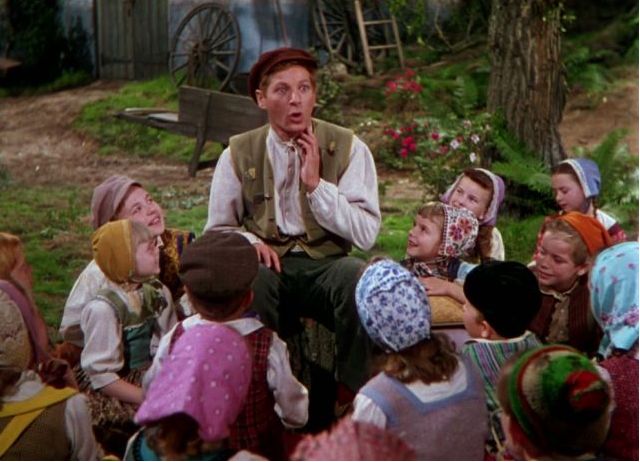
Danny Kaye as Hans Christian Anderson tells stories to village children.

Danny Kaye as Hans Christian Andersen tells stories to village children.

-Goldwyn had writers working on a “Hans Christian Andersen” musical in 1938, but the time was never right to produce it. Before starting, according to the A. Scott Berg biography “Goldwyn.”
-Farley Granger thought the film was ridiculous and said it was beginning to be a joke around town, “Boy meets girl, boy loses girl, boy gets boy,” he said, according to the “Goldwyn” biography.
-“Hans Christian Andersen” cost $4 million to make, according to “Goldwyn.”
-Danes did not appreciate the depiction of Hans Christian Andersen and Andersen scholars said Kaye looked nothing like Andersen, according to “Goldwyn.”
-“Hans Christian Andersen” is the second highest grossing Goldwyn picture behind “The Best Years of Our Lives,” according to “Goldwyn.”
-Actress and ballerina Moira Shearer was supposed to play the role of Doro couldn’t because she was pregnant.
-Samuel Goldwyn originally wanted animated
-Zizi Jeanmaire dances with Roland Petit in the Little Mermaid ballet sequence. The two were married in 1954 and remained married until Petit’s death in 2011.
-The film opened the week of Thanksgiving in 1952. It was first aired on television in 1966.
-Actress Barie Chase has an uncredited role has a ballerina.
-The soundtrack released after the film includes Jane Wyman singing the female songs with Danny Kaye.

Highlights:
-There are two notable dream sequences in the film:
1. Hans falls in love with Doro the ballet dancer has a colorful dream sequence of the couple singing “No Two People.”

2. Andersen gets locked in a closet and can not see the performance of “The Little Mermaid.” As he’s locked in the closet, he imagines how it is performed. The imagined performance is the one he audience sees.

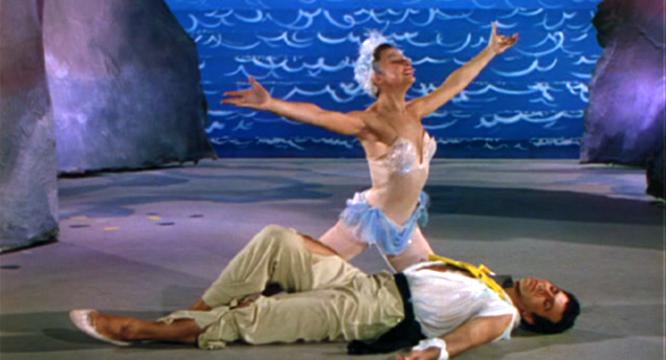
Zizi Jeanmaire as Doro performs the ballet of "The Little Mermaid" in "Hans Christian Anderson" with dancer (and future husband) Roland Petit

Zizi Jeanmaire as Doro performs the ballet of “The Little Mermaid” in “Hans Christian Andersen” with dancer (and future husband) Roland Petit

Notable Songs:
It’s hard to pick a favorite song from “Hans Christian Andersen” because there are so many lovely songs that are all very catchy:
-“Wonderful Copenhagen” sung by Danny Kaye, Joseph Walsh and sailors (a personal favorite of mine)


-“No Two People” sung by Danny Kaye and Zizi Jeanmaire (but Jane Wyman on the commercial soundtrack release)
-“Thumbelina” sung by Danny Kaye
-“The King’s New Clothes” sung by Danny Kaye
-“Ugly Duckling” sung by Danny Kaye
-“Inchworm” sung by Danny Kaye (another personal favorite)

My review:
I can’t deny that the premise of this film is a little silly. The film and main character named after a real historical figure but purposefully and admittedly has nothing to do with his life?
But I also can’t deny that I love this movie. It’s so light-hearted, happy and lovely.
It’s an interesting change of role for Danny Kaye. In films like “Up in Arms” (1944), “Wonder Man” (1945) and “The Kid from Brooklyn” (1946)- Kaye’s characters sang the fast talking songs (written by his wife Sylvia Fine) and played ridiculous zany characters. But Hans Christian Andersen allows Kaye to demonstrate his true vocal talents and play a calm, caring character. Kaye was interested in the film before even seeing the script, and I think it was a wise decision on his point.
I can see why Farley Granger didn’t like this film, because he does look rather ridiculous in his period costume and is an unsympathetic character. I’ll admit, his talent was wasted on this movie. It’s such a small role, you wonder why he was picked.
But that aside, “Hans Christian Andersen” is a film that simply makes me happy.
I love the music, I love the color and I love Danny Kaye.

Check out the Comet Over Hollywood Facebook page, follow on Twitter at @HollywoodComet or e-mail at cometoverhollywood@gmail.com

Musical Monday: “Billie” (1965)

It’s no secret that the Hollywood Comet loves musicals.
In 2010, I revealed I had seen 400 movie musicals over the course of eight years. Now that number is over 500. To celebrate and share this musical love, here is my weekly feature about musicals.

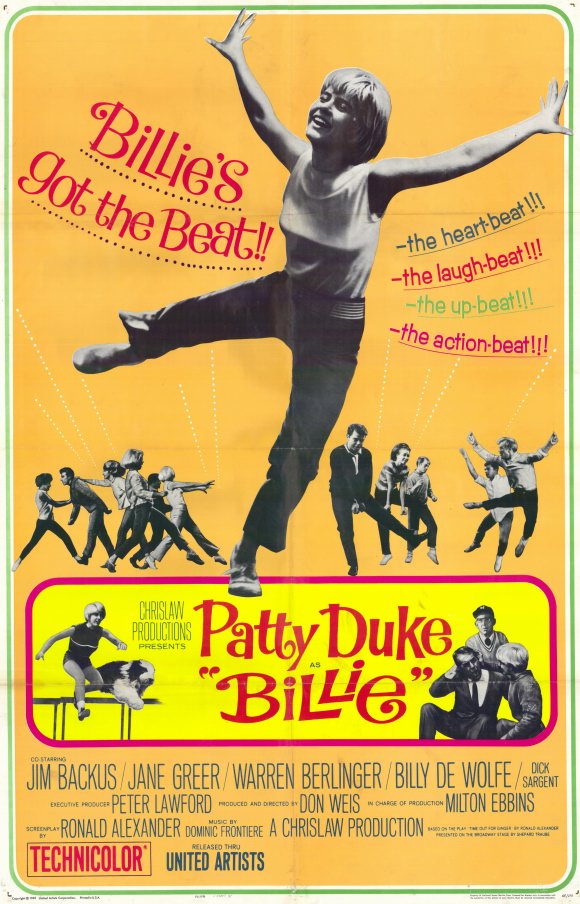
billieThis week’s musical:
Billie“- Musical #299

Studio:
Paramount Studios

Director:
Don Weis

Starring:
Patty Duke, Jane Greer, Jim Backus, Warren Berlinger, Billy de Wolfe, Charles Lane, Dick Sargent, Ted Bessell

Plot:
Fifteen year old tomboy Billie (Duke) finds herself on the boy’s track team when the coach sees how fast she can run. Her secret to fast running is “a beat” she hears in her head. Billie doesn’t like being treated differently from her male teammates and wants to be an equal, not a girl. At the same time of her track success her father (Backus) is running for mayor under a “keep women in the home” campaign.

Trivia:
-Based on a 1952 play “Time Out for Ginger”
-Filmed between seasons of “The Patty Duke Show
-Actor Peter Lawford is listed as an executive producer for the film.
-Kent McCord who later starred as Officer Jim Reed on the TV show “Adam-12” has an uncredited role as a spectator student spectator.

Highlights:
-A dance number where Billie teaches the other male and female students how to have “the beat,” complete with the latest 1960s dance moves. I don’t really see how it teaches the students anything, but it works in a nice dance number with 20 kids.
-Character actor Charles Lane plays Billie’s track coach. It’s always a treat to see him. You can see him in 1930s pre-code films all the way to 1960s
-Robert Banas who was Jet “Snowboy” in “West Side Story” leads the dance “She is a Girl is a Girl.”

Notable Songs:
-”Lonely Little in Between” sung by Patty Duke. An odd song where Billie sings about being a tom boy. Includes lyrics such as “I should have been a boy but I’m a girl.” She later sings “Funny Little Butterflies” which is the exact same tune, but now she has a crush and feels like a girl.

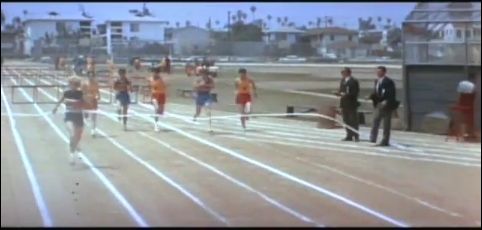
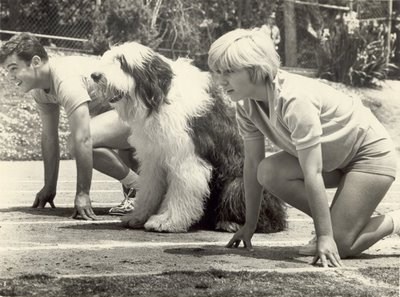
Billie wins track meets, because she hears a beat in her head that makes her run faster

Billie wins track meets, because she hears a beat in her head that makes her run faster

My Review:
The plot of “Billie” is actually pretty dumb, but it is still a fun one to catch. If you do come across it on TV, watch it–it’s seldom aired.

It has a lot of crazy one-liners such, mostly said by Jim Backus who seems to specialize in playing terrible parents (see: Rebel Without A Cause). Some quotes include “Try to be more like your sister” and “You did great today, son” to Duke. Another favorite is when Billie’s sister Jean says “I’ve decided to quit college and come home” and dad says “That’s marvelous!”

However, it is an interesting movie to see so many 1960s television actors such as Richard Deacon, Patty Duck, Jim Backus, Dick Sargent and Ted Bessell. You also get the chance to see 1940s actress Jane Greer playing Duke’s mother.

It’s also interesting because this movie has some feminist undertones in a time when beach movies were focusing on sex and pretty girls in bikinis.

Though “Billie” is a pretty terrible movie, It’s also a lot of fun. It’s fairly typical of most goofy, 1960s teen films. Overall, Patty Duke does a good job and is a driving force behind the films energy. While her character was 15 year old, Duke was actually 19 when this film was released in 1965. The dance numbers and songs are energetic and make you want to dance along.

If you are looking for some mindless, 1960s nostalgic, colorful film, “Billie” may be an alright fit.

Warren Berlinger as Mike Benson, Clown the dog and Patty Duke as Billie.

Warren Berlinger as Mike Benson, Clown the dog and Patty Duke as Billie.

Check out the Comet Over Hollywood Facebook page, follow on Twitter at @HollywoodComet or e-mail at cometoverhollywood@gmail.com

Musical Monday: “Two Weeks with Love” (1950)

It’s no secret that the Hollywood Comet loves musicals.
In 2010, I revealed I had seen 400 movie musicals over the course of eight years. Now that number is over 500. To celebrate and share this musical love, here is my weekly feature about musicals.

two weeksThis week’s musical:
Two Weeks With Love” (1950)-Musical #71

Studio:
Metro-Goldwyn-Mayer

Director:
Ray Rowland

Starring:
Jane Powell, Ricardo Montalban, Ann Harding, Louis Calhern, Debbie Reynolds, Carleton Carpenter, Phyllis Kirk, Tommy Retting, Gary Gray

Plot:
In the early 1900s, the Robinson family takes their annual summer vacation to Kissimee in the Catskills. It’s a coming of age story as 17-year-old Patti (Powell) is ready to grow up and wear corsets and date men but her mother (Harding) and father (Calhern) still thinks she is too young. That summer a handsome young Cuban named Demi (Montalban) visits the resort. While Patti swoons, her older friend Valerie (Kirk) works to keep Demi’s attention on her. In the background, Patti’s younger teenage sister Melba (Reynolds) has a crush on Billy (Carpenter) who is chasing Patti.

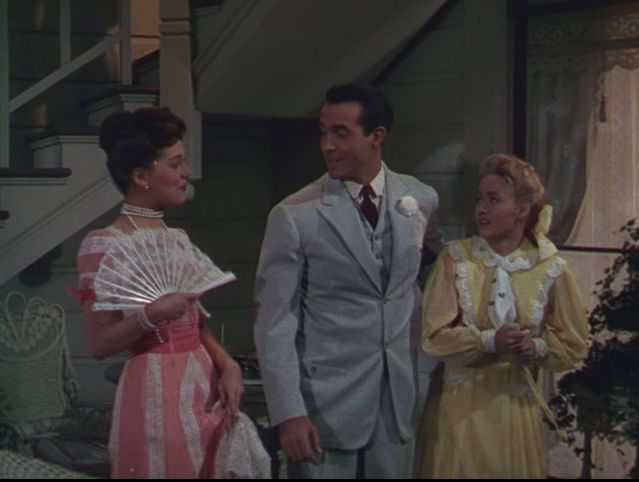
Patti's rival Valerie is always making it hard for Patti and Demi to be alone. (Kirk, Montalban, Powell) (Comet Over Hollywood/ Screen Cap by Jessica P.)

Patti’s rival Valerie is always making it hard for Patti and Demi to be alone. (Kirk, Montalban, Powell) (Comet Over Hollywood/ Screen Cap by Jessica P.)

Trivia:
-Debbie Reynolds wrote in her memoir “Unsinkable,” that her mother packed her lunch of ground up bologna and pickle juice sandwiches every day. Louis Calhern’s lunches were prepared for him by the studio, but he usually traded with Debbie for her sandwiches.

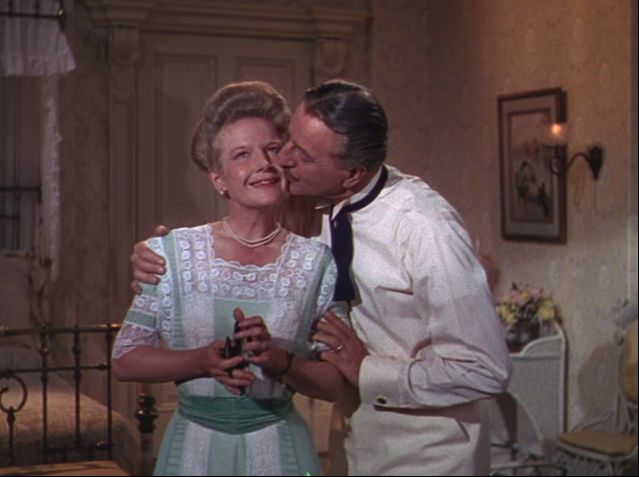
Famous stars in the 1930s, Ann Harding and Louis Calhern play Horatio and Katherine Robinson in "Two Weeks with Love." (Comet Over Hollywood/ Screen Cap by Jessica P.)

Famous stars in the 1930s, Ann Harding and Louis Calhern play Horatio and Katherine Robinson in “Two Weeks with Love.” (Comet Over Hollywood/ Screen Cap by Jessica P.)

-Jane Powell says this is one of her favorite movies, according to her autobiography “The Girl Next Door and How She Grew.”
“I loved making ‘Two Weeks with Love’ because it was a very special experience,” Powell wrote in her book. “The cast was so wonderful, I feel happy even now when I think about the film.”
-Debbie Reynolds plays the French horn during the song “That’s How I Love You.” Whether she is really playing the horn in the film or not, Reynolds played the French horn in high school.
-Louis Calhern once said he was miscast as playing the father of Debbie Reynolds and Jane Powell. “Me, with my long nose, and being as tall as I am, playing the father of two little button noses like Janie and Debbie,” Powell quoted in her book.
-Phyllis Kirk’s third movie.
-Debbie Reynolds fourth movie.
-The hotel where the family is staying in “Two Weeks with Love” is the same hotel in the first scene of “Annie Get Your Gun” (1951).
-The dances in the film were choreographed by Busby Berkeley, who was known for his kaleidoscope shots in 1930s films such as “42nd Street.”

Highlights:

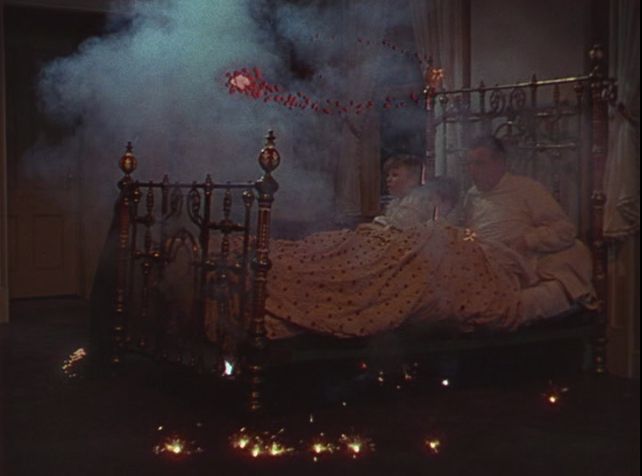
Patti's mischievous little brothers hide fireworks under their bed, and father (Calhern) accidentally lights a fuse. (Comet Over Hollywood/ Screen cap by Jessica P.)

Patti’s mischievous little brothers hide fireworks under their bed, and father (Calhern) accidentally lights a fuse. (Comet Over Hollywood/ Screen cap by Jessica P.)

-The two youngest boys hide hundreds of firecrackers under their bed. They accidentally get lit when their father unknowingly lights it with his cigar. Chaos ensues.
-Powell has a few dream sequences where she imagines Montalban is fawning over her. Both are hilarious and adorable. One is when she is alone in a canoe. She imagines he proposes to her and he tells her that she is full of “latent fire” and then is outraged that she doesn’t wear a corset.
-The second dream sequence is Powell glamorously dressed in only a corset, hat and umbrella. Everyone at the hotel is admiring her. Then, everyone’s outfits turn to royal wear and Montalban and Carpenter have a sword fight over Powell. Powell sings “My Hero” as she waltzes with Montalban.
-Calhern tries to help Powell and buys her a corset in the film, not knowing what he’s buying, he gets a surgical corset. During a dance with Montalban, it locks.

Patti (Powell) dreams of being a grown up lady who wears a corset in this dream sequence. (Comet Over Hollywood/Screen Cap by Jessica P.)

Patti (Powell) dreams of being a grown up lady who wears a corset in this dream sequence. (Comet Over Hollywood/Screen Cap by Jessica P.)

Notable Songs:
-“Abba Dabba Honeymoon” sung by Debbie Reynolds and Carleton Carpenter. This is the most notable song in the movie. Carpenter and Reynolds fast, energetic singing style is what makes it memorable. The song made the Hit Parade and Reynolds and Carleton went on tour to promote the song and the film.

-“By the Light of the Silvery Moon” sung by Ann Harding and Louis Calhern. They don’t have great voices but it’s a very sweet moment.
-“My Hero” sung by Jane Powell during the corset dream sequence.

Patti (Powell) dances the tango with Demi (Montalban) in the resort's talent show. (Comet Over Hollywood/ Screen Cap by Jessica Pickens)

Patti (Powell) dances the tango with Demi (Montalban) in the resort’s talent show. (Comet Over Hollywood/ Screen Cap by Jessica Pickens)

My Review:
Two Weeks With Love” is a joy to watch. It has an excellent cast, is fun and colorful with it’s Technicolor. But not only is it lighthearted, it’s hilarious. There are so many jokes in the movie that keep me laughing, keeping it charming and witty. It’s wonderful to see Ann Harding and Louis Calhern later in their career if you know them more from their 1930s role. In the 1930s, Harding usually played intellectual women with lose morals and Calhern played cads with gun. But later in their career, they fill the role of loving parents perfectly. Jane Powell was an established star by now and is 21 in the film, and is delightful as always. In her first major role, Debbie Reynolds energy and enthusiasm that made her famous is already shining. If you haven’t seen “Two Weeks with Love,” I highly suggest it. It may not be as famous as other 1950s MGM films, but you will remember it once you watch it.

Check out the Comet Over Hollywood Facebook page, follow on Twitter at @HollywoodComet or e-mail at cometoverhollywood@gmail.com


Musical Monday: “Moon Over Miami” (1941)

It’s no secret that the Hollywood Comet loves musicals.
In 2010, I revealed I had seen 400 movie musicals over the course of eight years. Now that number is over 500. To celebrate and share this musical love, here is my weekly feature about musicals.

This week’s musical:
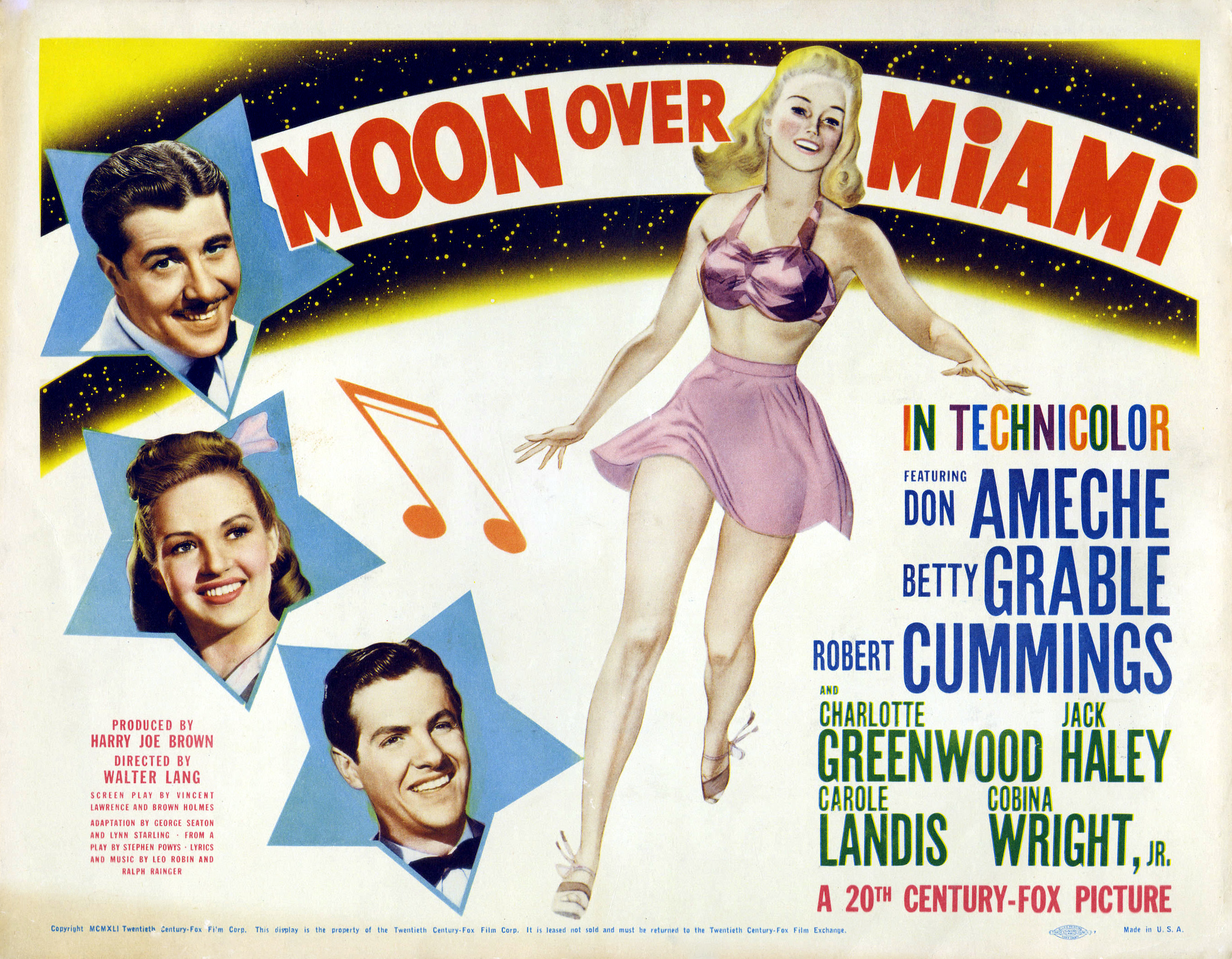
“Moon Over Miami” –Musical #162

Poster - Moon Over Miami_04

Studio:
20th Century Fox

Director:
Walter Lang

Starring:
Betty Grable, Carole Landis, Don Ameche, Robert Cummings, Charlotte Greenwood, Jack Haley

Plot:
Kay and Barbara Latimer (Grable and Landis) work with their Aunt Susan (Greenwood) at a burger joint in Texas. They think they are going to come into a windfall of money, but only ends up being $4,000. Kay comes up with a scheme where they will go to Miami on the money and get rich husbands. Kay poses as an heiress with her sister acting as her secretary and her aunt poses as her maid. Kay meets two millionaires who are smitten with her- Jeff (Cummings) and Phil (Ameche). Which will she pick and are they everything that they seem they are?

Trivia:
-Joan Davis was cast in the Carole Landis role in March 1941.
-John Payne and Dana Andrews were considered for the male leads.
-Originally supposed to star Virginia Gilmore and Gene Tierney or Arline Judge were conceived to appear in the roles of Barbara and Susan.
-Remake of “Three Blind Mice” (1938)-starring Loretta Young and Joel McCrea-and “The Greeks Had a Word for Them” (1932) starring Joan Blondell, Madge Evans and Ina Claire.
-Remade with “Three Little Girls in Blue” (1946) starring June Haver (who once was called the Pocket Betty Grable), Vivian Blaine and Vera-Ellen.

Highlights:
-The Condos Brothers (Frank and Harry) dance with Grable and then perform in an elaborate South American dance number. Grables dance in “You Started Something” with them is one of my favorite dances in the film.
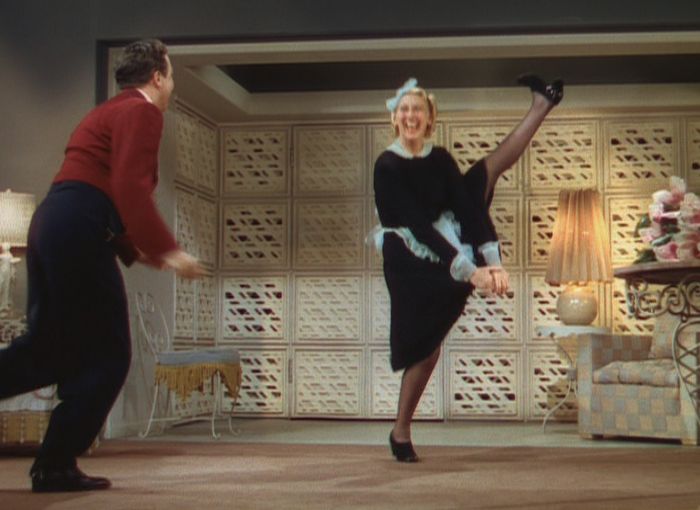
-Charlotte Greenwood’s flexible, high leg swinging dance moves

One of Charlotte Greenwood's signature dance moves (Comet Over Hollywood/ Screen cap by Jessica P)

One of Charlotte Greenwood’s signature dance moves (Comet Over Hollywood/ Screen cap by Jessica P)

-In “The Kindergarten Congo,” Grable dances with Hermes Pan, who choreographed many of Fred Astaire’s musical numbers in musical films.
-Betty Grable’s wardrobe. She buys a new wardrobe to catch a millionaire husband and every single outfit is adorable. Here are some picture of my favorites:

moonovermaimi5

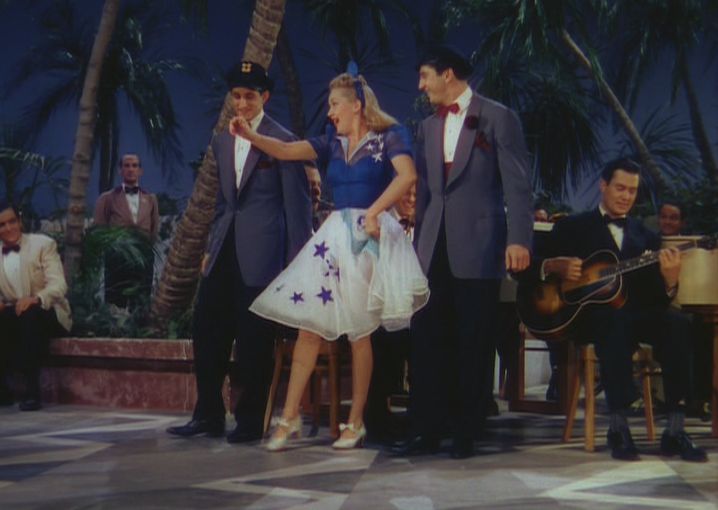
My favorite dress in Moon Over Miami. Grable is dancing with the Condos Brothers in “You Started Something” (Comet Over Hollywood/Screen cap by Jessica P.)

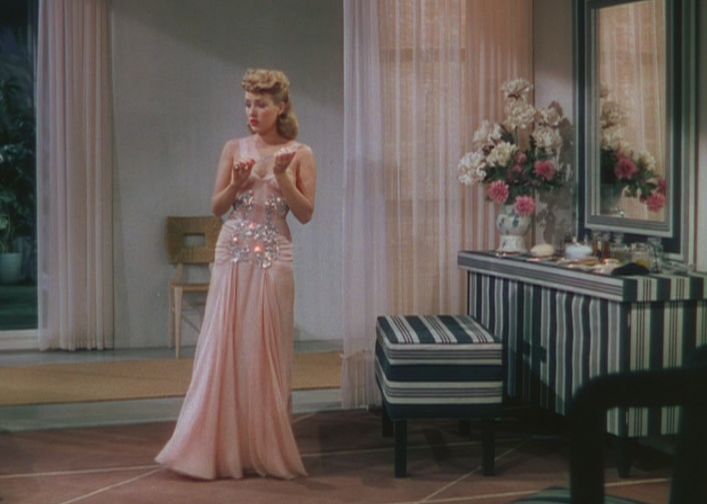
Lovely peach evening gown worn by Grable. (Comet Over Hollywood/Screen cap by Jessica P)

Lovely peach evening gown worn by Grable. (Comet Over Hollywood/Screen cap by Jessica P)

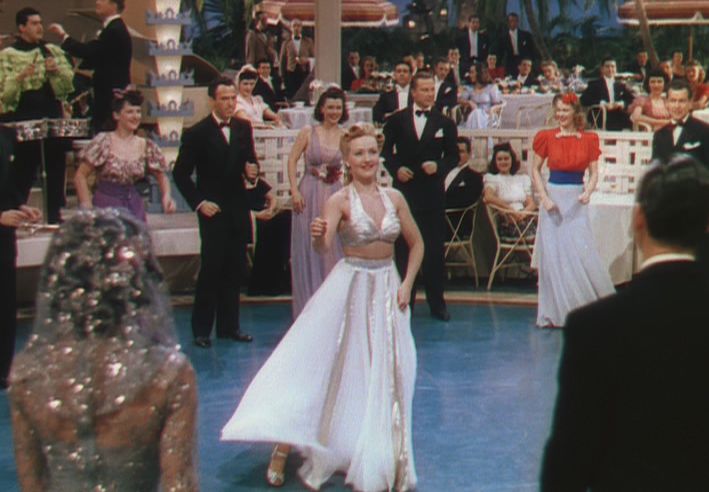
Another favorite outfit Grable wears in "The Kindergarten Conga" (Comet Over Hollywood/Screen Cap by Jessica Pickens)

Another favorite outfit Grable wears in “The Kindergarten Conga” (Comet Over Hollywood/Screen Cap by Jessica Pickens)


Notable Songs:
-“You Started Something” sung by Robert Cummings and Betty Grable
-“Kindergarten Conga” sung by Betty Grable, which is my favorite number in the film
-“Loveliness and Love” sung by Don Ameche
-“Is That Good?” sung by Charlotte Greenwood and Jack Haley

My Review:
This is my favorite Betty Grable movie and a movie I pop in when I have the blues. It’s colorful, the fashion is great and the songs are catchy and lighthearted. Grable looks her most beautiful and the supporting cast is excellent. Landis isn’t featured as much as Grable but does a great job in all of her scenes. Charlotte Greenwood is always a delight, especially with her goofy dancing. Both leading men are also entertaining and likeable. There are few things I can find wrong with “Moon Over Miami,” other than the fact that it has to end.
It isn’t a heavy film with some great intelligent message. But if you are looking for a pleasant way to spend an hour and a half, I suggest you spend it with “Moon Over Miami”

 
Check out the Comet Over Hollywood Facebook page, follow on Twitter at @HollywoodComet or e-mail at cometoverhollywood@gmail.com

Musical Monday: “Doll Face” (1945)

It’s no secret that the Hollywood Comet loves musicals.
In 2010, I revealed I had seen 400 movie musicals over the course of eight years. Now that number is over 500. To celebrate and share this musical love, here is my weekly feature about musicals.

This week’s musical:
Doll Face (1945)- Musical #474

doll face

Studio:
20th Century Fox

Director:
Lewis Seiler

Starring:
Vivian Blaine, Carmen Miranda, Dennis O’Keefe, Stephen Dunne, Perry Como, Martha Stewart (not the home decor woman)

Plot:
Mary “Doll Face” Carroll (Blaine) hopes to break out of burlesque and into the big time. When she is turned down due to her performing background, her manager Michael Hannigan (O’Keefe) decides to have a ghost written autobiography written about Mary. The author of the book Frederick Gerard (Dunne) begins to fall in love with Mary causing conflict with Michael, who also is in love with her. Using the publicity of the book, Michael begins to produce a Broadway show with the help of the other burlesque performers.

Trivia:

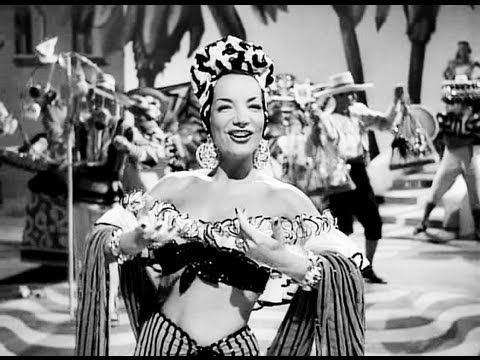
Carmen Miranda performing "Chico Chico"

Carmen Miranda performing “Chico Chico”

-Based on the 1943 play “The Naked Genius” written by burlesque performer Gypsy Rose Lee.
-Carole Landis was offered the lead in the film but turned it down, according to the book Carole Landis: A Most Beautiful Girl by Eric Lawrence Gans
-Carmen Miranda’s first starring film that is in black and white.
-“Eighty Miles Outside of Atlanta” from “Something for the Boys” can be heard in the background.
-Carmen Miranda’s song “True to the Navy” cut from the film. The song as filmed still exists. Paramount held exclusive rights to the song and wouldn’t allow 20th Century-Fox the song. It was performed by Clara Bow in “Paramount On Parade” (1930)
– “Doll Face” is one of four films Vivian Blaine and Carmen Miranda were in together. The other films included “If I’m Lucky” (1946), “Something for the Boys” (1945) and “Greenwich Village” (1944).

Notable Songs:
-Perry Como’s song “Hubba Hubba Dig You Later” became a hit for him after the film. It reached number 3 on the charts and was Como’s second Gold album, according to the book Perry Como: A Biography and Complete Career Record By Malcolm Macfarlane, Ken Crossland

My Review:
This film is fun and cute but forgettable. The songs aren’t very exciting either.
As a lover of classic films, I obviously enjoy films shot in black and white. However, casting Carmen Miranda, Hollywood’s most colorful performer, in a black and white was murderous to her career. Biographies on her life cite that her novelty was wearing off when Fox began casting her in non-color films.

Check out the Comet Over Hollywood Facebook page, follow on Twitter at @HollywoodComet or e-mail at cometoverhollywood@gmail.com

Musical Monday: “Hi-De-Ho” (1947)

It’s no secret that the Hollywood Comet loves musicals.
In 2010, I revealed I had seen 400 movie musicals over the course of eight years. Now that number is over 500. To celebrate and share this musical love, here is my weekly feature about musicals.

This week’s musical:
“Hi-De-Ho” (1947) – Musical #503

hi de ho

Studio:
All-American Studios

Director:
Josh Binney
Starring:
Cab Calloway (as himself), Ida James, Jeni Le Gon

Plot:
Cab Calloway plays himself a as a bandleader who is getting bored with his sexy singing girlfriend Minnie who he calls a moocher. Minnie is jealous of Cab’s female band manager named Nettie. Out of jealousy, Minnie gets a job at a night club that rivals the club that Cab is performing at. She also asks gangsters to kill Cab.

Trivia:
-“Hi-De-Ho” is what is known as a “race film.” The film is made up of an entirely black cast that were generally made between 1915 and 1950. These films were usually produced outside of the Hollywood studio system.
-The film also features the Peters Sisters and The Miller Brothers

Cab and Minnie the moocher

Cab and Minnie the moocher

Notable Songs:
The movie has several of Cab Calloway’s songs, but sadly no “Minnie the Moocher.”
Song include:
-“Minnie was a Hep Cat”
-“St. James Infirmary”
-“At Dawn Time”
-“Bop Bop”
-“The Hi-De-Ho Man, That’s Me”

My Review:
The plot to this film is very thin and the quality of the picture is very low. If you go strictly by the story line, “Hi-De-Ho” is lousy. However, this is a great exhibition of Cab Calloway’s music with eight songs from the big band leader. It’s also interesting for its historical value as a “race film.” If you can find this movie, I would highly suggest it for its excellent music. The only disappointing feature is that it doesn’t have the song “Minnie the Moocher.”

Check out the Comet Over Hollywood Facebook page, follow on Twitter at @HollywoodComet or e-mail at cometoverhollywood@gmail.com

Musical Monday: “Music for Madame” (1937)

It’s no secret that the Hollywood Comet loves musicals.
In 2010, I revealed I had seen 400 movie musicals over the course of eight years. Now that number is over 500. To celebrate and share this musical love, here is my weekly feature about musicals.

This week’s musical:
“Music for Madame” (1948) – Musical #504

music for madame

Studio:
RKO Radio Pictures

Director:
John G. Blystone

Starring:
Joan Fontaine, Nino Martini, Lee Patrick, Alan Mowbray, Alan Hale, Grant Mitchell, Billy Gilbert, Jack Carson

Plot:
Nino Maretti, an aspiring opera singer (Martini) is conned into thinking he is singing for important composer at a Hollywood party. In reality, Nino is singing at a Hollywood party to distract the guests as the two con artists steal priceless pearls. Jean Clemens (Fontaine) is at the same party, trying to get a symphony she wrote noticed. When Nino realizes he was used, he goes into hiding and doesn’t sing so he won’t be recognized—all the while falling in love with Jean.

Nino Martini, Joan Fontaine, and Lee Patrick (left to right) work as Hollywood film extras in "Music for Madame."

Nino Martini, Joan Fontaine, and Lee Patrick (left to right) work as Hollywood film extras in “Music for Madame.”

Trivia:
-“Music for Madame” is Fontaine’s fifth credited role on screen. The movie following “Music” is her only other musical, “Damsel in Distress” (1937) with Fred Astaire.
-Mowbray’s character was spoofing famous conductor Leopold Stokowski.
-According to IMDB, the film lost $375,000 at the box office.
-Martini was an Italian opera singer who sang with the New York City Metropolitan Opera. He made four films from 1935 to 1948. “Music for Madame” was his second to last film.
-Actor Jack Carson has a small role as an assistant director.
-Actor Ward Bond has an uncredited role in the film.

Notable Songs:
-Vesti la giubba from the opera “Pagliacci” (1892)
-“King of the Road” is sung by a truck driver who picks up Fontaine and Martini and accompanied by several car horns played by the two passengers.
-“I Want the World to Know” is the love theme of the film, written by Fontaine’s character and sung several times by Martini.

Highlights:
-Alan Hale. Hale is an excellent character actor in all of his films, but he is the only actor who stands out with humor and charisma in this film. The other actors are all pale in comparison to him.
-The scene with the truck drive singing “King of the Road” is an interesting one. He says he doesn’t have a radio so he makes music himself with all of these horns inside his vehicle. It’s not a musical masterpiece but of all the musicals I have seen, I’ve never seen a number like that.
-Martini’s acting is not the best, but he does have a beautiful singing voice.
-Fontaine looks incredibly young with a page boy bob and a bow in her hair. It’s an interesting way to see her when you are used to the sophisticated roles she played starting in the 1940s.

Jean (Fontaine) is detained by police after the pearls go missing.

Jean (Fontaine) is detained by police after the pearls go missing.

My Review:
I feel like “Music for Madame” is one of those movies that Academy Award winning actress Joan Fontaine looks back at and shudders. It’s not a terrible movie, but it’s also one I wouldn’t highly recommend. “Music for Madame” is a simple, entertaining plot but a lot of the acting is lacking. Nino Martini has a beautiful voice, but that can’t carry the film on it’s own. Fontaine is still exercising her acting chops. The most interesting character in my opinion is Alan Hale as a bumbling, music loving detective.

heck out the Comet Over Hollywood Facebook page, follow on Twitter at @HollywoodComet or e-mail at cometoverhollywood@gmail.com

Musical Monday: “You Were Meant for Me” (1948)

It’s no secret that the Hollywood Comet loves musicals.

In 2010, I revealed I had seen 400 movie musicals over the course of eight years. Now that number is over 500. To celebrate and share this musical love, here is my weekly feature about musicals.

This week’s musical:
You Were Meant for Me” (1948) – Musical #503

you were meant for me

Studio:
20th Century Fox

Director:
Lloyd Bacon

Starring:
Jeanne Crain, Dan Dailey, Oscar Levant, Barbara Lawrence, Selena Royale, Percy Kilbride

Plot:
Set in 1929, teenager Peggy Mayhew (Crain) falls in love popular bandleader Chuck Arnold (Dailey). She spontaneously kisses him on stage after winning a prize. Chuck asks to see Peggy again. When she travels to the next town to see his band, they elope. Peggy has to adapt to life on the road with musicians. The couple then struggles with their careers and their relationship when the stock market crashes.

Trivia:
-Marilyn Monroe had an uncredited role that ended up being cut from the film.
-Though Dan Dailey had been in films for eight years, this film was around the time his career was starting to take off.
-The first 20 or 30 minutes is very similar to “Orchestra Wives” (1942). Crain falls in love with a bandleader, travels to see him and they elope. Ann Rutherford does the same thing in “Orchestra Wives.” Once the couple elopes in the film, the similarities end there.

Notable Songs:
The whole film is full of fun, popular songs of the 1920s written by George Gershwin, Arthur Freed and Nacio Herb Brown such as:
-The title song “You Were Meant for Me” by Freed and Brown. This song can also be heard in other films such as “Penny Serenade” and “Singin’ in the Rain.”
-Other popular 1920s songs such as “Ain’t She Sweet,” “Crazy Rhythm” and “Ain’t Misbehavin.”

you were meant for me 2

Dan Dailey and Jeanne Crain in “You Were Meant for Me”

Highlights:
-Pianist Oscar Levant performs
-Jeanne Crain and Dan Dailey do a cute song and dance routine to “Ain’t She Sweet” while in a soda shop.
-Dan Dailey tap dancing to “Crazy Rhyme.” Though Dailey isn’t the greatest tap dancer of the 1940s and 1950s, he does a great job.
-Small role of Barbara Lawrence. Though she isn’t in the film very much, she is still delightful to see.
-Small role of Herb Anderson who played the father on the 1950s TV show “Dennis the Menace”

My Review:
“You Were Meant for Me” isn’t an award winning film, but it’s light-hearted and fun.
The musical performances in the film are mainly by Dan Dailey on stage, rather than spontaneous songs and dances brought on by emotion from the character.
The film is in black and white, which isn’t a problem for classic film fans, but shows the 20th Century Fox didn’t see it as an important musical-though it starred two of their top stars.
Crain and Dailey make a good pair and I wish they had been in more films together. Dailey is an underrated actor and does an excellent job with singing in dancing in this film. His voice is mellow and soothing and his tap dancing is believable.
My only complaint is that the film ends rather abruptly. Otherwise, it’s an enjoyable film that I highly suggest.

Check back next week for Musical Monday.

This is part of the Summer Under the Stars blogathon 

Check out the Comet Over Hollywood Facebook page for the latest updates or follow on Twitter at @HollywoodComet.

Musical Monday: “Les Parapluies de Cherbourg” (1964)

It’s no secret that the Hollywood Comet loves musicals.
In 2010, I revealed I had seen 400 movie musicals over the course of eight years. Now that number is over 500. To celebrate and share this musical love, here is my weekly feature about musicals.

This week’s musical:
“Les Parapluies de Cherbourg” or “The Umbrellas of Cherbourg” — Musical #285

umbrellas

Director:
Jacques Demy

Starring: 
Catherine Deneuve, Nino Casteluovo, Anne Vernon, Marc Michel

Plot:
Told in three part, the movie begins in 1957 and ends in 1964.
Performed much like an opera where all the French dialogue is sung, 17-year-old Geneviève (Deneuve) is in love with 20-year-old Guy (Casteluovo) who works as a mechanic.  Geneviève’s helps her mother (Vernon)  run an umbrella shop in Cherbourg, France. Her mother objects to them getting married because they are too young. Guy is drafted to fight for two years in the Algerian War.
While he is gone, Geneviève finds she is pregnant with his child. Her mother works to convince Geneviève to forget about Guy and to marry a more wealthy jewel dealer, Roland Cassard (Michel).

Highlights:
-Different from American musicals, there is no dancing and no show stopper song. If the lines were not all sung, it would be just a normal drama.
-The color is very candy-coated and gorgeous. Costumes of the actors match the brightly colored paint, wallpaper and decor.

Vernon and Deneuve (as Genvieve). Deneuve's dress matches the bright wallpaper

Vernon and Deneuve (as Genvieve). Deneuve’s dress matches the bright wallpaper

-The scene where Roland and Geneviève sit across from each other at the dinner table. As they speak to one each other, they look straight into the camera and speak.

Roland (Marc Michel) looks straight at the camera as he looks across the table as Genvieve

Roland (Marc Michel) looks straight at the camera as he looks across the table as Genvieve

-Pregnant Geneviève in a white wedding gown, looking very unhappy.

Roland and Genvieve's unhappy wedding

Roland and Genvieve’s unhappy wedding

-The 1960s fashions are gorgeous and as colorful as the backdrop.
-The heart wrenching ending that leaves so many questions

Trivia:
-Grand Prize Winner at the 1964 Cannes Film Festival
-Every actor in the all singing, opera-like film was dubbed:
Danielle Licari: Geneviève Emery
José Bartel: Guy Foucher
Christiane Legrand: Madame Emery
Georges Blaness: Roland Cassard
Claudine Meunier: Madeleine
Claire Leclerc: Aunt Élise
-“Umbrellas of Cherbourg” follows the Jacques Demy film “Lola” (1961). The character Roland Cassard is in “Lola” and in “Umbrellas” sings about a woman he once loved named Lola and how she broke his heart.
-The film is divided into three parts from 1957 to 1964: The Departure, The Absence, The Return
-An English stage version was adapted in 1979.
-Nominated for four Academy Awards in 1966 including: Best Music, Original Score for “I Will Wait for You;” Best Music, Score; Best Music, Scoring of Music, Adaptation or Treatment; Best Writing, Story and Screenplay – Written Directly for the Screen

Notable Songs:
-Each scene and scenario has it’s own song. The tunes are a mix of jazz to ballads.
-The most popular song from the film is “I Will Wait for You” sung by Geneviève and Guy before he leaves on the train to join the military.

My Review:
“Les Parapluies de Cherbourg” is one of my favorite musicals-up there with my all-time favorite “West Side Story” (1961). I love the gorgeous candy-coated color, the costumes and the heart wrenching sadness.
But most of all, I love the innovative all-singing French dialogue. Some lines are poetic while others are as simple as “Eat a little fruit” or “Have you had dinner?”
The story line is simplistic but doesn’t have the normal happy ending that an American 1950s or 1960s musical may have. Don’t let the subtitles and all singing throw you off, you won’t regret giving this musical a chance.

A few scenes to share to show the beautiful coloring”

umbrellas2

First appearance of Catherine Deneuve in the film- looking out the umbrella shop for Guy

The two sing the title song "I Will Wait for You" the day we find out Guy is drafted

The two sing the title song “I Will Wait for You” the day we find out Guy is drafted

umbrellas3

Guy and Genevieve embrace after finding out he will be drafted

umbrellas9

umbrellas7

Genevieve is pregnant with Guy’s child and Carnival is going on outside.

umbrellas11

Pregnant Genevieve sadly follows her mother’s wishes of marrying a rich man

umbrellas13

The young lover, both married, meet again after five years.

Check back next week for Musical Monday.

This is part of the Summer Under the Stars blogathon for Catherine Deneuve Day.

Check out the Comet Over Hollywood Facebook page for the latest updates or follow on Twitter at @HollywoodComet.