Musical Mondays: Something for the Boys (1944)

It’s no secret that the Hollywood Comet loves musicals.
In 2010, I revealed I had seen 400 movie musicals over the course of eight years. Now that number is over 500.
To celebrate and share this musical love, I’m starting a weekly feature about musicals.

something for the boysThis week’s musical:
Something for the Boys (1944) – Musical number #469

Starring:
Vivian Blaine, Carmen Miranda, Phil Silvers, Michael O’Shea, Perry Como, Shelia O’Ryan

Director:
Peter Seiler

Studio:
Twentieth Century Fox

Plot:
Three cousins find they are heirs to a southern plantation in Georgia. The cousins couldn’t be more different: singer Blossom Hart (Blaine), defense worker Chaquita Hart (Miranda) and con man Harry Hart (Silvers). The mansion isn’t quite what they expected and they turn it into a home for the wives of soldiers who are stationed at a nearby Army base. To help raise money for the home, they put on a show and Blossom meets and falls in love with soldiers Rocky Fulton (O’Shea).

Trivia:
-Ethel Merman starred in the original Broadway production that opened on Jan. 7, 1943 and ran for 422 performances.
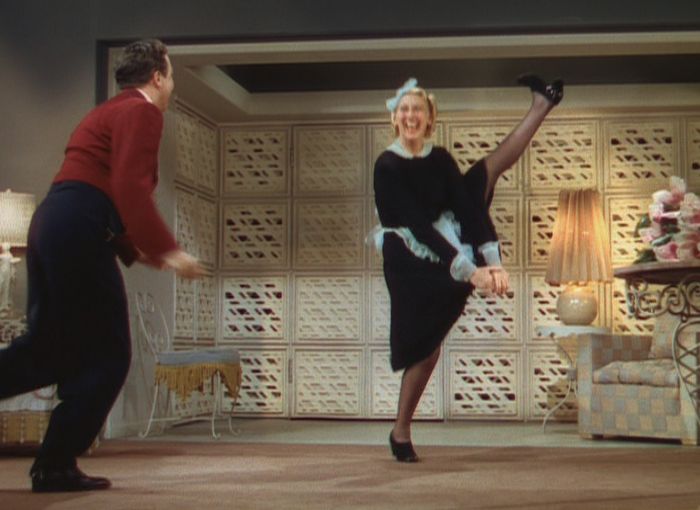
-Judy Holliday can be spotted in a brief role six minutes into the film. This is her third film.

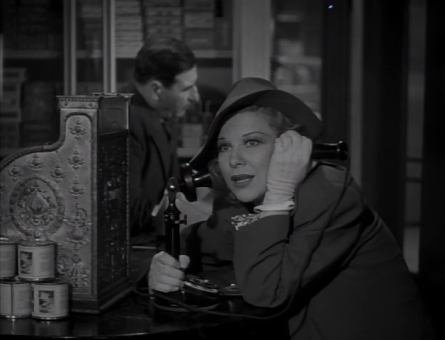
Judy Holliday in a brief role in "Something for the Boys" (Comet Over Hollywood/ Screen Cap by Jessica P.)

Judy Holliday in a brief role in “Something for the Boys” (Comet Over Hollywood/ Screen Cap by Jessica P.)

-“Something for the Boys” is one of four films Vivian Blaine and Carmen Miranda were in together. The other films included “If I’m Lucky” (1946), “Doll Face” (1945) and “Greenwich Village” (1944).

Notable Songs:
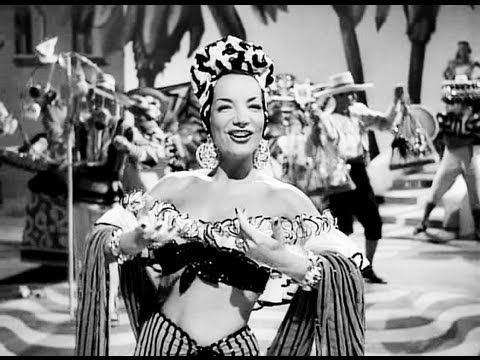
-Carmen Miranda sings “Batuca Nega” and “Samba-Boogie.” Any Miranda performance in a film is notable for her energy and colorful outfits.
-Phil Silvers performs the song “Southland.” Though he’s from New York, it seems to be a running tradition in Silvers’s films to sing songs about the South. His songs are similar to songs Al Jolson would sing.
-We get to hear songs from popular 1940s singer Perry Como, who performs “In the Middle of Nowhere” and “I Wish We Didn’t Have to Say Goodnight.”

Perry Como singing "I Wish I Didn't Have to Say Goodnight" to Cara Williams. (Comet Over Hollywood/ Screen cap by Jessica P.)

Perry Como singing “I Wish I Didn’t Have to Say Goodnight” to Cara Williams. (Comet Over Hollywood/ Screen cap by Jessica P.)

Highlights:
-A running joke in the movie is that Carmen Miranda has carborundum in her tooth filling from working as a machinist. Because of this, she always hears the radio, whether it is on or off. It’s pretty silly but a unique joke. At one point in the film, they use her to send Morse Code.

Due to Carmen Miranda's short wave radio tooth-she is being used to send Morse Code. Also pictured-Michael O'Shea, Vivian Blaine, Phil Silvers. (Comet Over Hollywood/Screen cap by Jessica P.)

Due to Carmen Miranda’s short wave radio tooth-she is being used to send Morse Code. Also pictured-Michael O’Shea, Vivian Blaine, Phil Silvers. (Comet Over Hollywood/Screen cap by Jessica P.)

-Judy Holliday says one line six minutes into the movie. Her line explains the problem Miranda may be having with carborundum in her teeth.
-Seeing Vivian Blaine star in the film. Blaine is an energetic, beautiful and talented performer who I enjoying seeing in any film. It’s a shame she is not as well remembered as other 20th Century Fox actresses.
-Jimmie Dodd of Mickey Mouse Club fame can be spotted 51 minutes into the film as a “gambling soldier.”

Vivian Blaine singing "Eighty Miles Outside of Atlanta" (Comet Over Hollywood/ Screen cap by Jessica P.)

Vivian Blaine singing “Eighty Miles Outside of Atlanta” (Comet Over Hollywood/ Screen cap by Jessica P.)

My review:
Something for the Boys” is a light but fun musical filmed during World War II. It is in color, has catchy songs and gorgeous costumes, but it somehow falls short of other Fox musicals that starred Betty Grable or Rita Hayworth.
There are some very silly jokes such as Carmen Miranda’s short-wave-radio-tooth, but it’s entertaining nonetheless. My only complaint is that I find Phil Silvers annoying and Michael O’Shea to be a weak leading man.
It’s not a well-known film with a cast of stars who are fairly forgotten today, with the exception of Carmen Miranda and Phil Silvers.
However, it’s a glittering and colorful musical comedy that will brighten a lazy afternoon.

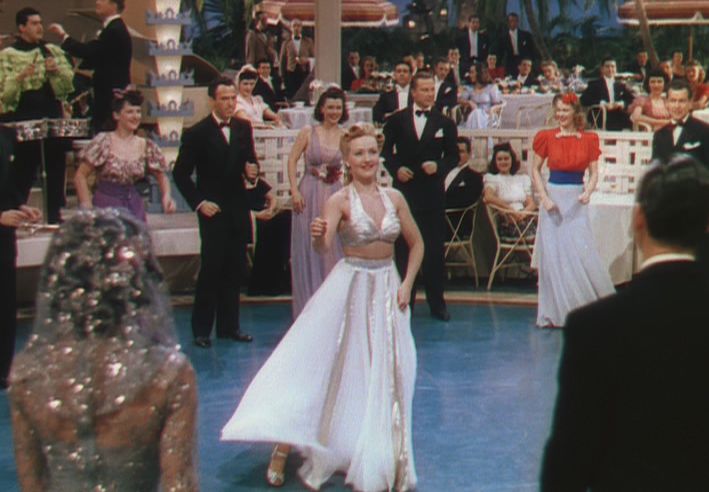
Carmen Miranda performing "Samba-Boogie" (Comet Over Hollywood/Screen cap by Jessica P.)

Carmen Miranda performing “Samba-Boogie” (Comet Over Hollywood/Screen cap by Jessica P.)

Check back next week for Musical Monday.

Check out the Comet Over Hollywood Facebook page for the latest updates or follow on Twitter at @HollywoodComet.

Musical Mondays: “Second Chorus” (1940)

It’s no secret that the Hollywood Comet loves musicals.
In 2010, I revealed I had seen 400 movie musicals over the course of eight years. Now that number is over 500.
To celebrate and share this musical love, I’m starting a weekly feature about musicals.

second chorusThis week’s musical: 
Second Chorus” (1940) – Musical #169

Starring:
Paulette Goddard, Fred Astaire, Artie Shaw, Burgess Meredith, Charles Butterworth

Director:
H.C. Potter

Studio:
Paramount Pictures

Plot:
Danny O’Neill (Astaire) and Hank Taylor (Meredith) are seventh year college students who flunk on purpose to continue playing the trumpet in their college jazz band.
They meet Ellen Miller (Goddard) who becomes their manager for the band. And when band leader Artie Shaw (as himself) hires Ellen, Danny and Hank scheme and double cross each other to get into Shaw’s band.

Trivia:
-Astaire and Meredith are both supposed to be college students. Though they were supposed to be in college for seven years, they were both much too old to be students. Astaire was 41 and Meredith was 33.
-Meredith and Goddard were married at one time, but no during this film. The two actors didn’t get married until 1944.
-Billy Butterfield dubbed Meredith’s trumpet playing and Bobby Hackett dubbed Astaire’s. If you play a musical instrument or were ever in band, it’s pretty obvious that neither is playing. They are pretty terrible at faking it.

Artie Shaw and his band performing in "Second Chorus."

Artie Shaw and his band performing in “Second Chorus.”

Notable Songs:
-No song really stands out, though you do get to hear Artie Shaw and his band perform several time. This is another example of having the opportunity to hear a popular band leader of that time period.

Highlights:
-Goddard and Astaire dance together in the song “Dig It.”


-A good comedic moment for Goddard is when she talks to varying groups of people to sell the Astaire and Meredith’s bands. She talks to proper old women, thugs and teenagers-acting like she is one of them with each.

-Astaire works in a Russian restaurant and plays in the restaurant band, dressed as a Cossack. He does the Cossack dance while (pretending) to play the trumpet.

Astaire, dressed as a Cossack, does the Cossack dance while playing the trumpet. (Comet Over Hollywood/ Screencap by Jessica Pickens)

Astaire, dressed as a Cossack, does the Cossack dance while playing the trumpet. (Comet Over Hollywood/ Screencap by Jessica Pickens)

-The finale includes Astaire directing a band while tap dancing and eventually while tap dancing and playing the trumpet. Far-fetched but fairly entertaining.

Astaire leaps while directing Artie Shaws band and tap dancing in the finale of "Second Chorus." (Comet Over Hollywood/Screen cap by Jessica Pickens)

Astaire leaps while directing Artie Shaws band and tap dancing in the finale of “Second Chorus.” (Comet Over Hollywood/Screen cap by Jessica Pickens)


My Review:
This is a fairly enjoyable film but one of Fred Astaire’s more forgettable movies. However, I would rank it better than the Astaire and Joan Fontaine musical, “A Damsel In Distress.”
Also, for a Fred Astaire musical, he had far fewer musical numbers than usual and the film seemed more like a vehicle to highlight Artie Shaw and his band.
The thing that bugged me the most were how badly Meredith and Astaire faked playing the trumpet. Bad form, puffing of cheeks, one hand playing. I guess that comes from being in the band for several years.
Also, though Astaire and Meredith are good actors, I would say Paulette Goddard acted circles around them both and was the best part of the movie.

Astaire, Goddard and Meredith in "Second Chorus"

Astaire, Goddard and Meredith in “Second Chorus”

Check back next week for Musical Monday.

Check out the Comet Over Hollywood Facebook page for the latest updates or follow on Twitter at @HollywoodComet.

My dad, the practical movie watcher

My dad, Bill Pickens, is a practical movie watcher.

When the Wicked Witch of the West cries “I’m melting!” after water is thrown on her in “The Wizard of Oz” (1939) he says, “Water wouldn’t make her melt. She would dissolve.”

James Stewart as George Bailey asks Thomas Mitchell as Uncle Billy how he lost the money in "It's a Wonderful Life."

James Stewart as George Bailey asks Thomas Mitchell as Uncle Billy how he lost the money in “It’s a Wonderful Life.”

When Uncle Billy in “It’s A Wonderful Life” (1946) loses the check that would save George Bailey’s bank, my financially responsible father is furious.

In mystery films, he is always trying to figure out the plot twist or who-done-it before the movie is over.

Maybe it’s because he’s an engineer.

But along with teaching me to drive, helping me with long nights of math homework and moving me into new apartments in college and for jobs, my dad has always been supportive of my classic film watching.

Classic films are what my parents grew up on and in return, showed my sisters and me when we were young.

It was even my dad who suggested that I watch “West Side Story” (1961) in 2003 since I was starting to show an interest in musicals.

When I became obsessed with the movie, trying to learn the dances and listening to the soundtrack every day my dad later said he “created a monster.”

But without my dad suggesting that film, I wouldn’t have gone on to see 502 musicals.

Whenever I’m home, my mom, dad and I pick out a classic movie to watch together in the evening. I try to pick out one I didn’t want to watch without them or that I feel everyone would enjoy.

Doris Day as a sheep raising suffragette in "The Ballad of Jose" (1967)

Doris Day as a sheep raising suffragette in “The Ballad of Jose” (1967)

My dad has been a pretty good sport over the last 10 years with my selections. He has sat through frothy musicals such as “Luxury Liner” (1948) starring Jane Powell and even sat through Doris Day’s last and probably worst film “The Ballad of Josie” (1967).

Another time my mom and I had him watch the smutty 1950s film “A Summer Place” (1959) starring Sandra Dee and Troy Donahue.

We chuckled as Dad shouted things about Sandra Dee’s crazy mother in the film. He made jokes like “Whatever you do that woman shoots dogs, I wouldn’t trust her” about Dorothy McGuire who was also in “Old Yeller.”

Doris Day singing "Deadwood Stage" in "Calamity Jane" (1953)

Doris Day singing “Deadwood Stage” in “Calamity Jane” (1953)

One of the only movies he has ever snuck out on and never returned was “Calamity Jane” (1953). I think it was the rather long song “The Deadwood Stage” that starts as soon as the movie begins that drove him from the room. I guess I don’t blame him.

But my favorite movies to watch with my parents are World War II films and thrillers. We all seem to enjoy those.

Films like “Battleground” (1949), “The Longest Day” (1962), “Thirty Seconds Over Tokyo” (1944) and “Objective Burma” (1945) are some of our favorite war films.

Alfred Hitchcock, John Wayne movies and live action Disney films are more of our favorites.

Some of dad’s other favorite films are “Lawrence of Arabia” (1962), “TThe King and I” (1956) and “To Kill a Mockingbird” (1962).

I guess I’m a pretty terrible daughter. After my dad has watched everything down to “Gold Diggers of 1935” (1935) and “Rose Marie” (1936), I have never seen “Lawrence of Arabia.” I guess well have to watch that sometime.

Peter O'Toole in "Lawrence of Arabia" (1962)

Peter O’Toole in “Lawrence of Arabia” (1962)

I call my mom the agent of my blog Comet Over Hollywood, because she proof reads everything and listens to my ideas.

But my dad has helped out with my film interest as well.

In 2006 we went on a family vacation to Hollywood to tour studios such as Paramount and take pictures of the hand prints in the cement outside of Grauman’s Chinese Theater.

Recently when I was traveling again to Hollywood for the Turner Classic Movies Film Festival, my parents drove me two hours to the Atlanta airport. Atlanta was a straight flight to Los Angeles and they worried about their youngest child making a connecting flight.

When I was a child, I don’t think my parents had any idea what sort of film fanatic they were creating as they introduced us to old movies, but I don’t think they mind.

Happy Father’s Day!

2007 at Disney World with dad

2007 at Disney World with Dad

Check out the Comet Over Hollywood Facebook page for the latest updates or follow on Twitter at @HollywoodComet.

An influential mermaid

My dear friends at True Classics has invited bloggers to share their “Movie Memories” during the month of June. I am honored that I was invited to participate . Head to True Classics to read the other marvelous posts!

little mermaid

Little Mermaid

I remember sitting in a dim theater and looking at lit up designs on the wall.

It was 1989 and I was about a year old, but I remember. Somehow I have an uncanny memory.

The Little Mermaid” was the last Disney feature film to be animated with hand painted cells and it was my first movie in a movie theater.

Though “The Little Mermaid” isn’t necessarily a classic film, I was very attached to the movie when I was very young. It introduced me to a love of movies and movie characters.

My sisters tell me I used to roll around in the bath water while my mother would try to bathe me pretending to be a mermaid like Ariel. A Christmas Day home video shows me excitedly playing with a new Ariel Barbie while trying to sing tunes from the film.

I even remember telling my mom that I wanted to be a mermaid when I grew up. She said, “You can’t, you have to be born a mermaid.” I found this to be a very puzzling statement.

cinderella2

Cinderella

My parents always took my sisters and me to see the new Disney cartoons but also introduced us to the classic Disney films. Cinderella (1950) was another favorite of mine at a young age.

The Little Mermaid” and “Cinderella” are typical favorite films for little girls between the age of two to six, and maybe even older.

Several years later in 1997, I saw another film that affected the way I viewed movies. In third grade, I fell in love with the Twentieth Century Fox animated film “Anastasia.”

anastasia

Anastasia

I was obsessed.  I wore a locket like in the film, learned the dances, studied Romanov history and wished I was the lost princess Anastasia Romanov. My mom told me that wouldn’t be possible. But this time I understood what she meant.

The movie interested me in history and the 1920s since the song “Paris Holds the Key to Your Heart” has cameos from Josephine Baker and Maurice Chevalier.

Again, another movie changed the way I looked at things.

At the age of 14, my dad decided to introduce me to “West Side Story.” I remember it was March and I was on spring break.

West Side Story mambo scene

West Side Story mambo scene

West Side Story” changed the way I looked at film and solidified my love for classic movies. It’s what led me to watch 501 musicals and thousands of other classic films.

But my film love all started with “The Little Mermaid.”

As I sat in the movie theater, not even two years old, my life was change. Movies became important to me at an early age, shaping my interests and world views.

Who would have thought that a disobedient teenage mermaid could be so influential.

Check out the Comet Over Hollywood Facebook page for the latest updates or follow on Twitter at @HollywoodComet.

Musical Mondays: “Thrill of a Romance” (1945)

It’s no secret that the Hollywood Comet loves musicals.
In 2010, I revealed I had seen 400 movie musicals over the course of eight years. Now that number is over 500. To celebrate and share this musical love, here is my weekly feature about musicals.

thrill posterThis week’s musical:
Thrill of a Romance” (1945)- Musical #502*

Studio:
Metro-Goldwyn-Mayer

Director:
Richard Thorpe

Starring: 
Esther Williams, Van Johnson, Frances Gifford, Henry Travers, Spring Byington, Lauritz Melchior, Tommy Dorsey and his band

Plot:
Pretty swimming teacher Cynthia Glenn (Williams) is swept off her feet by wealthy Robert Delbar (Carelton Young) who charms her in a whirlwind romance. After a short time, Cynthia and Robert are married and head to a resort for their honeymoon.
However, after only being married a few hours, Robert abandons his new bride for a business deal, leaving her alone on her honeymoon. As she mopes about being left alone, World War II hero, Major Thomas Milvaine (Johnson) sweeps in to cheer her up.
All of this happens on a glittering backdrop of Technicolor outdoor scenery, swimming sequences and musical performances from big band leader Tommy Dorsey and opera singer Lauritz Melchior.

Trivia:

Van Johnson and Esther Williams. This is my favorite outfit Esther wears in the film.

Van Johnson and Esther Williams. This is my favorite outfit Esther wears in the film.

-“Thrill of a Romance” is the first of four full-length films Esther Williams and Van Johnson made together. But this wasn’t their first film together. Williams has a brief part in “A Guy Named Joe” (1943) with Johnson. Their other films include “Easy to Wed,” “Duchess of Idaho” and “Easy to Love.”
-A young girl plays the piano and sings and is supposed to be Tommy Dorsey’s daughter in the film.  The girl isn’t Dorsey’s daughter and is actress Helene Stanley playing Susan Dorsey in the film. However, he did have a daughter named Susie in real life.

Notable songs:
-Tommy Dorsey plays one of his famous songs, “Song of India.” Aside from that song, it’s always fun to hear big band music in films, especially since that would have been the “pop standard” of that time period.
-Famous Danish opera singer Lauritz Melchior performs several songs in the film. This is notable since he was influential as an opera singer.

Highlights:
-Young Jerry Scott hiding on the terrace singing “Please Don’t Say No, Say Maybe.”
-Van Johnson lip syncing (though he can sing in real life) as Lauritz Melchior sings “Please Don’t Say No, Say Maybe.”
-Esther Williams swimming with Van Johnson

Esther and Frances Gifford.

Esther and Frances Gifford.

My review:
Not only is “Thrill of a Romance” my favorite Esther Williams film, but it is a perfect example of a mid-1940s MGM musical.
It’s not the type of musical where people break into song because they are so full of emotion they can’t speak. It is more a romantic story with a backdrop of musical performances.

Esther and Van dancing to  Tommy D

Esther and Van dancing to Tommy D

The film has a beautiful set, gorgeous costumes, catchy songs and vibrant, young actors.
MGM films always have that something extra special, and while there are a lot of special things about this movie-Esther Williams and swimming sequences stand out.
Louis B. Mayer liked to add class and culture to his films. While some musicals would have contemporary musicians featured, such as Tommy Dorsey in this one, he also featured classical performers in his films. This could vary from pianist Jose Iturbi or opera singer Lauritz Melchior, in the case of this film.
Though this movie may be dismissed as sugar coated, I always find it thoroughly enjoyable.
It will make you want to visit the resort they are staying at–and you will want Williams’s wardrobe. I don’t believe she wears more beautiful clothing in any of her other films.
It’s one of those films that if you are down, it will immediately lift your spirits.

*Though I saw this musical over eight years ago, I discovered I had never put it down on my musical list. Egads!

You can find my Esther Williams tribute here. Williams passed away at the age of 91 on June 6, 2013.

Check back next week for Musical Monday.

Check out the Comet Over Hollywood Facebook page for the latest updates or follow on Twitter at @HollywoodComet.

The All-American Aphrodite: Remembering Esther Williams

My cinema relationship with Esther Williams helped shape my film interests.

I didn’t full watch any of her films until 2003 when my film appetite craved musicals.

A swimming scene from "This Time for Keeps"

A swimming scene from “This Time for Keeps”

As I gorged on her candy-colored, aqua musical extravaganzas, I couldn’t wait until I could see another film. Each of her musicals brings back memories of spending weekends endlessly watching her movies.

When I was 15 I read her autobiography, “The Million Dollar Mermaid.” It’s my favorite film autobiography that I’ve read so far.

When I was 17, I bought one of her Esther Williams bathing suits.

Williams inspired me to practice swimming strokes and try to learn how to swim (I failed swimming lessons when I was five years old. How embarrassing).

I remember in 2004 when she was highlighted during TCM’s August Summer under the Stars series. I wasn’t looking forward to going back to school in August but my excitement of Esther Williams’ day out-weighed my dread.

Esther Williams and frequent co-star Van Johnson in "Easy to Wed"

Esther Williams and frequent co-star Van Johnson in “Easy to Wed” dressed for the number “Bonecu de Pixe.” Carmen Miranda helped them with the Portuguese lyrics.

But it’s not just how she affected my every day actions, but my film knowledge that makes her important to me.

To date, I have seen all but two of Esther Williams’ films: “A Raw Wind in Eden” and “The Big Show.”

Esther Williams’s films are a textbook example of the mid-1940s to early 1950s MGM musicals: brightly colored, beautiful clothing and lavish musical numbers that may include Williams swimming, Xavier Cugat and his band shaking maracas or opera singer Lauritz Melchior belting a tune.

Her films also introduced me to my biggest film crush- Van Johnson.

Something I have always found appealing about Williams is that she is very attainable.

Her beauty is natural and girl-next-door like and her figure is athletic, rather than actress anorexic. In her 1996 Private Screenings Interview with Robert Osborne, she said becoming a star was all an accident.

Continue reading

Musical Mondays: Rose of Washington Square (1939)

It’s no secret that the Hollywood Comet loves musicals.

In 2010, I revealed I had seen 400 movie musicals over the course of eight years. Now that number is over 500.

To celebrate and share this musical love, I’m starting a weekly feature about musicals.

This week’s musical:
Rose of Washington Square” (1939)- Musical #462

roseStarring:
Alice Faye, Tyrone Power, Al Jolson, William Frawley, Joyce Compton

Director: 
Gregory Ratoff

Studio:
Twentieth Century Fox

Plot:
Set in the 1920s, Rose (Faye) and Ted (Jolson) dream of becoming singing stars. While Ted’s career takes off, Rose works her way up while singing in speakeasies. Then Rose meets and falls in love with gambling, con-artist Bart (Power). Bart has trouble with the law but somehow keeps his troubles away from her. When Rose is discovered by Ziegfeld and makes it big on Broadway, she and Bart marry but he disappears because of trouble with the law.

Trivia:
The plot of this film strongly resembled Fanny Brice’s relationship with Jules W. Arndt Stein. Faye even sings Brice’s signature song “My Man.”

Alice Faye as Rose falls in love with gambler Tyrone Power who plays Bart.

Alice Faye as Rose falls in love with gambler Tyrone Power who plays Bart.

Brice sued 20th Century Fox for $750,000 and the studio settled with Brice for an undisclosed amount, according to the Biography documentary on Alice Faye.

The publicity made “Rose of Washington Square the biggest musical hit of 1939.

Notable songs:
-Al Jolson sings his signature songs “My Mammy,” “Toot, Toot, Tootsie” and “California, Here I Come”

-Alice Faye sings Fanny Brice’s signature ballad “My Man”

Highlights:
-Louis Prima has an appearance playing the trumpet as Alice Faye sings. Not only is it always great to have a Prima appearance in a film, but Faye later married Phil Harris who performed with Prima in Disney’s “The Jungle Book.”

-When Alice Faye sings “Rose of Washington Square” specialty dancers Igor and Tanya perform a dizzying dance. Also dancers sing and dance as they smoke a cigarette, toss the cigarette and another appears in their hand.

"Rose of Washington Square" cigarette dancing

“Rose of Washington Square” cigarette dancing

My review:
Alice Faye once said, “My voice was deeper than the plot” of many of her movies and this applies to “Rose of Washington Square.”

I love Alice Faye and will watch her in anything, but my favorite part was getting to see her perform with Louis Prima. Though Jolson was in black face, it was interesting to see him perform several of the songs that made him famous.

The movie was released during Hollywood’s best year, has a stellar cast and well-known songs, but it lacks something. Aside from the Brice vs. 20th Century Fox publicity, it is a run of the mill singer-trying-to-make-it-big musical.

Check out the Comet Over Hollywood Facebook page, follow on Twitter at @HollywoodComet or e-mail at cometoverhollywood@gmail.com

Actress Beauty Tip #30: Marilyn Monroe breakfast

This is the thirtieth installment of the monthly classic actress beauty tips that I have read about and tested.

Since I’ve started these beauty tips, I’ve tried some crazy things. Some include washing my hair with champagne and bathing in milk.

When I was living at home, my parents didn’t mind as long as I cleaned up after myself.

However, I get the feeling that I would have been scolded for Beauty Tip #30.

Recently, I’ve been reading columns by NY Magazine diet columnist, Rebecca Harrington. Harrington read about what Greta Garbo, Elizabeth Taylor and Marilyn Monroe ate and tests it for about two weeks to see the results. Most of the foods are revolting, have complicated recipes and Harringon’s accounts are hilarious.

To celebrate Marilyn Monroe’s birthday, I decided to try one of her diet tricks.

Every morning, Monroe had warm milk with a raw egg in this, according to Harrington.

An article about Monroe's diet routine in Pageant magazine, Sept. 1952

An article about Monroe’s diet routine in Pageant magazine, Sept. 1952

“To my surprise it was utterly delicious,” she said in her column. Reading this I thought, “Hm. Milk and eggs are actually two things I have at my house. I’m trying to lose weight. I should try this.”

My goal was to drink the milk and raw egg concoction for a week and see what weight loss results I had. I lasted two days.

I didn’t stop because I was hungry or that it tasted bad. The combination is actually pretty good -really only taste the milk- and I stayed full for hours after drinking it.

My issue was looking at the drippy, gooey consistency of the raw egg in my milk and that I was basically drinking salmonella-in-a-cup.

It also dawned on me that drinking a raw egg is just plain stupid. The health benefit of drinking a glass of milk and eating a hard boiled egg is probably about the same and it’s safer.

To review: The milk and raw egg combination kept me full and  tasted fine, but the fact that I was drinking a raw egg (salmonella in a cup) unnerved me. I can stay just as full and healthy by drinking a glass of milk and a cooked egg.

Check out the Comet Over Hollywood Facebook page for the latest updates.

An education from “The Philadelphia Story”

The Philadelphia Story” taught me what a hangover was when I was nine.

And who knew what yare meant before Katharine Hepburn used the word?

My fourth grade education was enhanced when I learned the meaning of those words the first time I saw “The Philadelphia Story” (1940) in 1998.

Katharine Hepburn as Tracy Lord with too many men after her

Katharine Hepburn as Tracy Lord with too many men after her

My dad was out of town one summer evening and my mother, sister and I picked a movie to watch. We loved it.

“Why did she shield her eyes from the sun like that?” I asked my mom. She explained the consequences people face the next morning after drinking too much.

For years after, I even tried to imitate Hepburn’s silly little laugh she does in the film.

I had forgotten not only about my new vocabulary words the first time I saw the film but many of the charming scenes in “The Philadelphia Story” until I saw it last night for the first time on the big screen.

Moonlight Movies at Falls Park in Greenville, SC

Moonlight Movies at Falls Park in Greenville, SC

I drove an hour to my hometown of Greenville, SC where outdoor classic films are shown every week in May at the Reedy River Falls Park.

Classic film screenings are a treat for me. Where I live, viewing movies on the big screen is rare.

It had been several years since I had seen this movie. Though I knew it was good- boasting a cast of Katharine Hepburn, Cary Grant, James Stewart, Ruth Hussey, Virginia Weidler and Roland Young-I forgot how wonderful it really was.

The leads are perfect in nearly every film but Virginia Weidler steals the show.

On paper, the film sound dizzy: A divorced woman is remarrying, the ex-husband pops back in the picture and then a reporter-who already has a girlfriend-becomes a potential romantic partner. It’s a love pentagon.

But somehow the story works when it’s acted out.

The only time it doesn’t work is in the horrible Grace Kelly remake, “High Society.”

The script of The Philadelphia Story was written specifically for Katharine Hepburn who originated the role on Broadway and reprised her role as Tracy Lord on screen. The film helped rid Hepburn of her box office poison status. 

Katharine Hepburn with Van Heflin in the stage version of The Philadelphia story

Katharine Hepburn with Van Heflin in the stage version of The Philadelphia story

In the play, Joseph Cotten played C. K. Dexter Haven (played by Cary Grant in the film version) and Macaulay Connor was played by Van Heflin (played by James Stewart). While watching the movie last night I couldn’t help picture those two performing those roles.

I have only been to one other Moonlight Movie series in Greenville back in 2011 to see Strangers on a Train. It wasn’t a pleasant experience due to people talking and continuously getting up and down during the film.

However, last night was much more relaxing and everyone was respectful of the movie.

The only disappointing thing is no one applauded when the film started or when actors entered their first scene like at the Turner Classic Film Festival, however I heard several people around me say they had never seen the movie again.

Revisiting “The Philadelphia Story” was fun and I reminded me how great a movie it was. I’m discovering seeing movies on the big screen is a very special experience.

After all-they were made to be seen that way.

Check out the Comet Over Hollywood Facebook page for the latest updates or follow on Twitter at @HollywoodComet.

The forgotten Hollywood war hero: Wayne Morris

Warner Brothers star, Wayne Morris in he 1930s

Warner Brothers star, Wayne Morris in he 1930s

He can be seen playing alongside Bette Davis as a boxer in “Kid Galahad” (1937) or a cadet running amok at the Virginia Military Institute in “Brother Rat.”

Wayne Morris may not be a name you’re familiar with but you have most likely seen the husky, affable blond in Warner Brothers 1930s and 1940s films.

But you may not be familiar with Morris’ war time record.
We frequently hear about Hollywood actors such as James Stewart, Clark Gable and Mickey Rooney who enlisted and were decorated for their bravery during World War II.

However, Morris is rarely recognized for his service and was one of World War II’s first flying aces.

His interest in flying started in Hollywood.

While filming “Flying Angles” (1940) with Jane Wyman and Dennis Morgan, Morris learned how to fly a plane.

Morris in 1944 in his plane "Meatball." The decals show how many Japanese planes he shot down.

Morris in 1944 in his plane “Meatball.” The decals show how many Japanese planes he shot down.

Once World War II began, Morris joined the Naval Reserve and became a Naval flier in 1942 on the U.S.S. Essex. He put his career on hold to fight. The same year he was married to Olympic swimmer Patricia O’Rourke.

“Every time they showed a picture aboard the Essex, I was scared to death it would be one of mine,” Morris said. “That’s something I could never have lived down.”

Morris flew 57 missions-while some actors only flew 20 or less- and made seven kills, which qualified him as an ace.  He also helped sink five enemy ships.

He originally was told he was too big to fly fighter planes until he went to his uncle-in-law, Cdr. David McCampbell who wrote him a letter, allowing him to fly the VF-15, according to “McCampbell’s Heroes: the Story of the U.S. Navy’s Most Celebrated Carrier Fighter of the Pacific”, Edwin P. Hoyt.

Three of his planes were so badly damaged by enemy fire that they were deemed unfit to fly and were dumped in the ocean, according to IMDB.

“As to what a fellow thinks when he’s scared, I guess it’s the same with anyone. You get fleeting glimpses in your mind of your home, your wife, the baby you want to see,” Morris said. “You see so clearly all the mistakes you made. You want another chance to correct those mistakes. You wonder how you could have attached so much importance to ridiculous, meaningless things in your life. But before you get to thinking too much, you’re off into action and everything else is forgotten.”

For his duty, Morris was honored with four Distinguished Flying Crosses and two Air Medals.

When he returned to Hollywood after four year at war, his once promising career floundered and Warner Brothers did not allow him to act for a year.

Jack Warner welcoming actors home from the war in 1945 including Wayne Morris, Ronald Reagan, Army Air Forces; Jack Warner; Gig Young, Coast Guard; and Harry Lewis, Army.

Jack Warner welcoming actors home from the war in 1945 including Wayne Morris, Ronald Reagan, Army Air Forces; Jack Warner; Gig Young, Coast Guard; and Harry Lewis, Army.

Morris’s most notable post-war films include “The Voice of the Turtle,” “John Loves Mary” and “Paths of Glory.” His career ended with several B-westerns.

At the age of 45, Morris passed away in 1959 from a massive heart attack.

But his service to his country was not forgotten. Morris is buried in Arlington Cemetery and was given full military honors at his funeral.

Morris with his wife Patricia and daughter Pamela in 1946.

Morris with his wife Patricia and daughter Pamela in 1946.

Though I am thankful for all men and women who serve our country, I wanted to recognize Wayne Morris.

For years I saw Wayne Morris in films and knew nothing about him except that I liked him. He is one of those character actors that can make a movie special.

Morris seemed like a regular guy. Before he started out in Hollywood, he played football at Los Angeles Junior College and worked as a forest ranger.

After I researched him and discovered his war record, I wanted to honor his service and his work in films.

Thank you to Wayne Morris and men and women in the military for serving our country.

Check out the Comet Over Hollywood Facebook page for the latest updates or follow on Twitter at @HollywoodComet. E-mail us at cometoverhollywood@gmail.com