This is the thirty-first installment of the monthly classic actress beauty tips that I have read about and tested.
Elizabeth Taylor in 1991, introducing her perfume at Macy’s
Jennifer Lopez, Britney Spears and Taylor Swift.
These celebrities may not have a perfume named for them if it wasn’t for English born actress Elizabeth Taylor.
The two time Academy Award winning actress is known for her violet colored eyes, glamorous beauty, love of diamonds and multiple marriages.
With a mix of her affair with jewelry and Old Hollywood glamour, Elizabeth Taylors’s White Diamonds perfume has been the top selling celebrity perfume since 1991. Even since her 2010 death, the perfume makes $200 million worth of sales each year.
Taylor wasn’t the first celebrity to create her own perfume. In 1957 Givenchy created a scent for Audrey Hepburn called L’Interdit, that was only released after Hepburn had worn it a few years. French actress Catherine Deneuve and Italian actress Sophia Loren both had perfume scents at one time that are no longer sold, according to a Jezebel article.
White Diamonds advertisement.
But what sets Elizabeth Taylor’s perfume apart is the fact that is still sold after 20 years.
Ever since I was a child, the gold liquid in Taylor’s rhinestone incrusted bottles intrigued me. But my mother warned me White Diamonds wasn’t the most pleasant smelling perfume. Since Mom isn’t a perfume wearing woman, I hoped she was wrong.
Recently, with Comet’s beauty tips in mind, I picked up a small bottle of White Diamonds and felt slightly glamorous that I owned an Elizabeth Taylor product.
But the day I wore White Diamonds, I felt anything but glamorous. I actually felt ill, because it smells terrible. I sprayed my wrist once and overpowered by the smell.
As I gagged, I tried to figure out how this perfume had such a strong staying power. I wonder if it’s simply that it is put out by one of the most important actresses and pop culture figures of the 20th century.
To Review: White Diamonds is a very heavy and strong scent. I personally didn’t like it and can’t imagine wearing it all day. I think Elizabeth Taylor’s excellent marketing and Old Hollywood sophistication is what has kept it on the shelves for over 20 years.
Have you ever tried wearing it? What is your opinion?
It’s no secret that the Hollywood Comet loves musicals. In 2010, I revealed I had seen 400 movie musicals over the course of eight years. Now that number is over 500. To celebrate and share this musical love, here is my weekly feature about musicals.
Starring:
Catherine Deneuve, Nino Casteluovo, Anne Vernon, Marc Michel
Plot:
Told in three part, the movie begins in 1957 and ends in 1964.
Performed much like an opera where all the French dialogue is sung, 17-year-old Geneviève (Deneuve) is in love with 20-year-old Guy (Casteluovo) who works as a mechanic. Geneviève’s helps her mother (Vernon) run an umbrella shop in Cherbourg, France. Her mother objects to them getting married because they are too young. Guy is drafted to fight for two years in the Algerian War.
While he is gone, Geneviève finds she is pregnant with his child. Her mother works to convince Geneviève to forget about Guy and to marry a more wealthy jewel dealer, Roland Cassard (Michel).
Highlights:
-Different from American musicals, there is no dancing and no show stopper song. If the lines were not all sung, it would be just a normal drama.
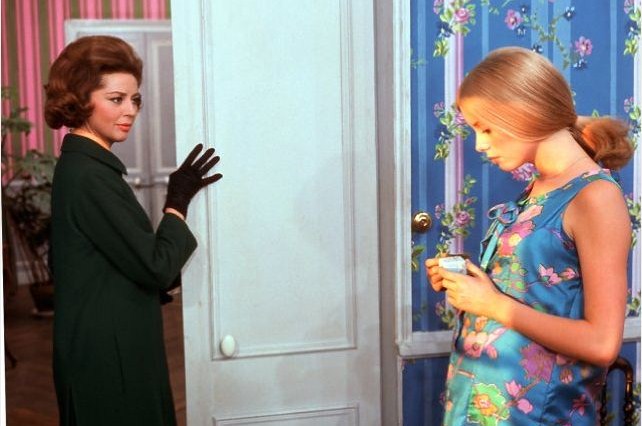
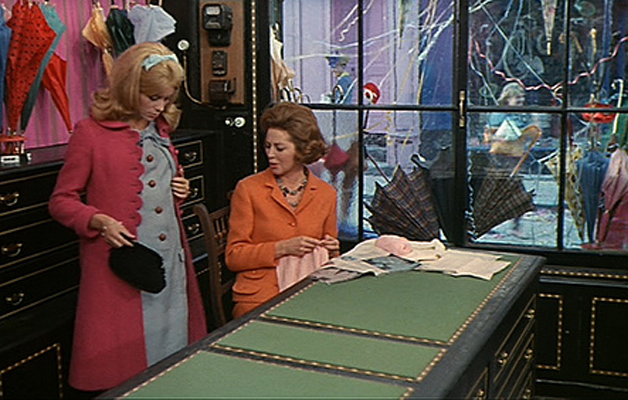
-The color is very candy-coated and gorgeous. Costumes of the actors match the brightly colored paint, wallpaper and decor.
Vernon and Deneuve (as Genvieve). Deneuve’s dress matches the bright wallpaper
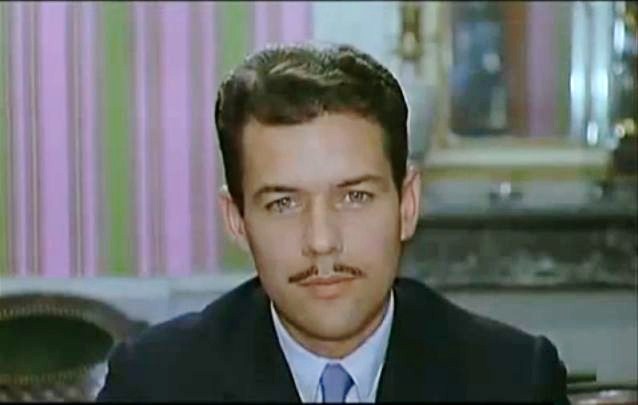
-The scene where Roland and Geneviève sit across from each other at the dinner table. As they speak to one each other, they look straight into the camera and speak.
Roland (Marc Michel) looks straight at the camera as he looks across the table as Genvieve
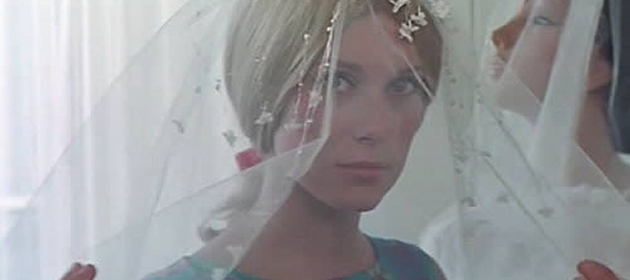
-Pregnant Geneviève in a white wedding gown, looking very unhappy.
Roland and Genvieve’s unhappy wedding
-The 1960s fashions are gorgeous and as colorful as the backdrop.
-The heart wrenching ending that leaves so many questions
Trivia:
-Grand Prize Winner at the 1964 Cannes Film Festival
-Every actor in the all singing, opera-like film was dubbed:
Danielle Licari: Geneviève Emery
José Bartel: Guy Foucher
Christiane Legrand: Madame Emery
Georges Blaness: Roland Cassard
Claudine Meunier: Madeleine
Claire Leclerc: Aunt Élise
-“Umbrellas of Cherbourg” follows the Jacques Demy film “Lola” (1961). The character Roland Cassard is in “Lola” and in “Umbrellas” sings about a woman he once loved named Lola and how she broke his heart.
-The film is divided into three parts from 1957 to 1964: The Departure, The Absence, The Return
-An English stage version was adapted in 1979.
-Nominated for four Academy Awards in 1966 including: Best Music, Original Score for “I Will Wait for You;” Best Music, Score; Best Music, Scoring of Music, Adaptation or Treatment; Best Writing, Story and Screenplay – Written Directly for the Screen
Notable Songs:
-Each scene and scenario has it’s own song. The tunes are a mix of jazz to ballads.
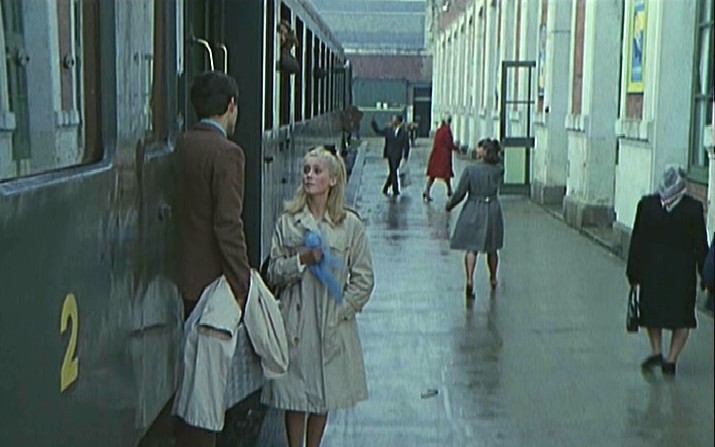
-The most popular song from the film is “I Will Wait for You” sung by Geneviève and Guy before he leaves on the train to join the military.
My Review:
“Les Parapluies de Cherbourg” is one of my favorite musicals-up there with my all-time favorite “West Side Story” (1961). I love the gorgeous candy-coated color, the costumes and the heart wrenching sadness.
But most of all, I love the innovative all-singing French dialogue. Some lines are poetic while others are as simple as “Eat a little fruit” or “Have you had dinner?”
The story line is simplistic but doesn’t have the normal happy ending that an American 1950s or 1960s musical may have. Don’t let the subtitles and all singing throw you off, you won’t regret giving this musical a chance.
A few scenes to share to show the beautiful coloring”
First appearance of Catherine Deneuve in the film- looking out the umbrella shop for Guy
The two sing the title song “I Will Wait for You” the day we find out Guy is drafted
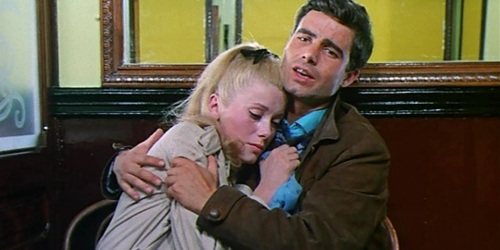
Guy and Genevieve embrace after finding out he will be drafted
Genevieve is pregnant with Guy’s child and Carnival is going on outside.
Pregnant Genevieve sadly follows her mother’s wishes of marrying a rich man
The young lover, both married, meet again after five years.
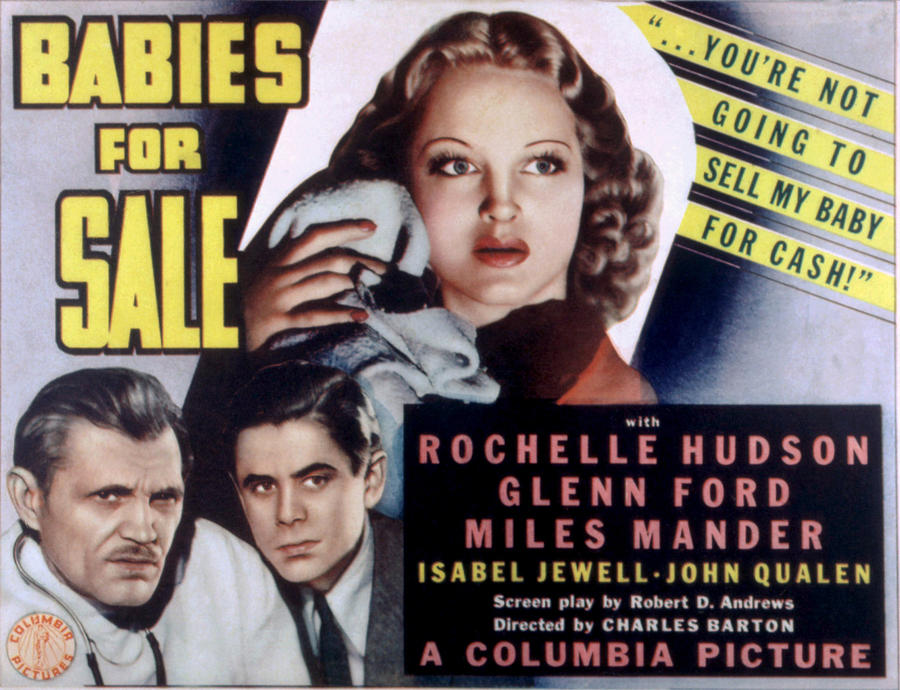
Few film titles have made me chuckle as much as this 1940 B-movie did.
But the movie starring Glenn Ford and Rochelle Hudson is not a comedy but a crime drama about organizations posing as charitable adoption agencies who are actually selling babies for thousands of dollars.
The film prefaces with:
“Producers of the film are sympathetic with the 95-percent of the charitable organizations dealing with adopted children. These institutions are honest and worthy of all support. This picture is presented as a warning to all parents and to all who plan to adopt children. That some unsupervised private institutions do exist where babies are sold for cash. Where helpless mothers are victimized and where foster parents may find lifelong tragedy instead of happiness. This is a story of one such institution and victims. What happens in this story could happen to you?”
What’s it about?
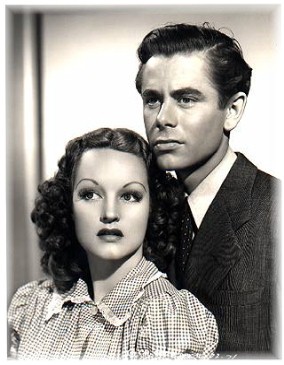
Rochelle Hudson and Glenn Ford, Columbia Pictures Studios tried to make the two actors a screen team.
Ford as Steve Burton is a reporter who gets the scoop from Dr. John Gaines (Joe De Stefani) about fake adoption agencies. Gaines tells Burton that families pay anywhere from $50 to $10,000 for a child. Single women who go to these agencies to have their babies have to work there and earn $1,000 to get their baby.
After writing the story that uses phrases such as “Selling babies by the pound” and “Thousands of babies sold for cash,” Burton faces backlash and the editor is going to retract the story. Believing what he did is right; Burton quits but doesn’t give up investigating the case.
Then the audience gets a look inside one of these agencies.
Mr. and Mrs. Howard Anderson (character actor John Qualen and Helen Brown) are facing Dr. Rankin, the owner of the adoption agency. The couple’s child has defects and will never be well. Rankin says the baby was perfectly fine when he gave them the baby they paid $10,000 for—Basically making it sound like he sold the couple a car. Desolate Mrs. Anderson runs in front of a train with the baby after they leave.
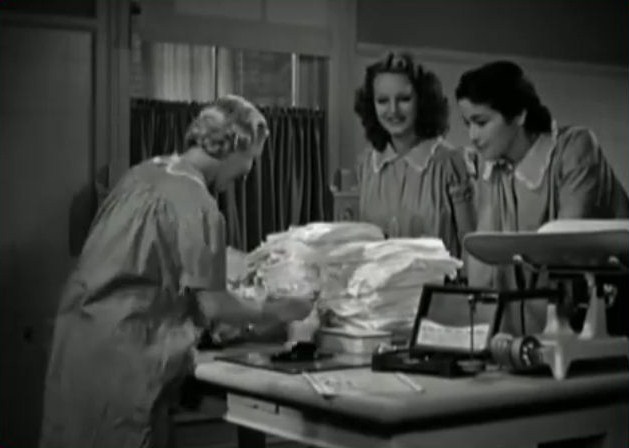
Pregnant women earning their keep to pay for their babies once they are born. (Comet Over Hollywood/ Screen cap by Jessica P.)
We meet pregnant Ruth Williams (Rochelle Hudson) whose husband died in an automobile accident.
Ruth has to work at the agency while she is pregnant to pay for her child once it’s born. During this time, Rankin tries to convince Ruth to give up her baby.
“We have to make sacrifices for the ones we love,” he tells her.
“I won’t give away my baby!” she demands.
Once her baby is born, Rankin tells Ruth that it was a stillborn, but she knows he adopted it to another family.
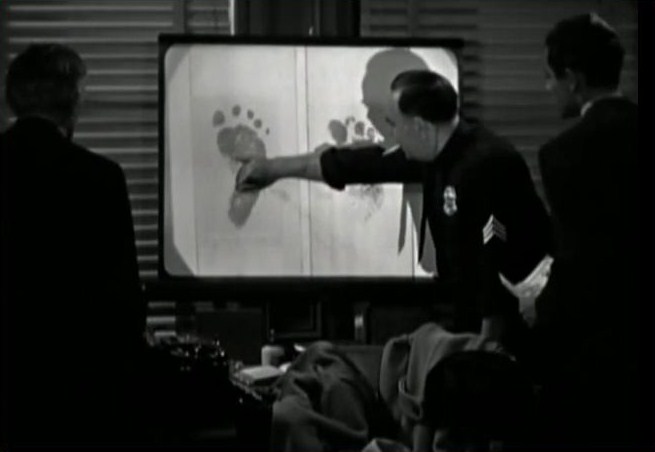
With the help of Burton, Ruth finds her baby through the use of baby foot prints taken after birth. They find Ruth’s baby with a friendly wealthy family who help put Rankin out of business.
The back story
Ex-reporter Burton helps Ruth get her baby back. (Comet Over Hollywood/ Screen cap by Jessica P.)
“Babies for Sale” was recently shown for the first time on Turner Classic Movies while the channel was celebrating the career of actor Glenn Ford. Ford was 24 and “Babies” was his fifth film.
It was Ford’s third film with Rochelle Hudson- who also starred in “Imitation of Life” (1934)- and Columbia Pictures was working to make the two a screen team but it never panned out, said TCM Primetime Host Robert Osborne.
Studious also worked to make Ford and Evelyn Keyes a screen team, starring in six films together, but their screen chemistry didn’t explode either. It wasn’t until Ford starred with Rita Hayworth in “Gilda” (1946) that he found his match.
Many of Ford’s early films were similar to “Babies for Sale,” with crime and corruption. “Babies” wasn’t made to be a box office sensation but to be shown during a double feature, Osborne said.
Also early in his career, Bruce Bennett can be spotted as a police officer.
What I thought
Though the title made me laugh, “Babies for Sale” is an entertaining movie. B-movies get a bad rap for being inexpensive, but they are some of my favorite films. The plot line are sensational using lines like “The mother had no right to keep her baby,” and the story can be told in just a little over an hour.
Ford showed potential even early in his career giving a solid performance and coming off as very likeable.
Next time you come across it, give it –and other B-movies- a chance. It will be a pleasant way to spend 65 minutes.
Ruth gets her baby back from a friendly, wealth family. (Comet Over Hollywood/Screen cap by Jessica P.)
It’s no secret that the Hollywood Comet loves musicals. In 2010, I revealed I had seen 400 movie musicals over the course of eight years. Now that number is over 500. To celebrate and share this musical love, here is my weekly feature about musicals.
Starring:
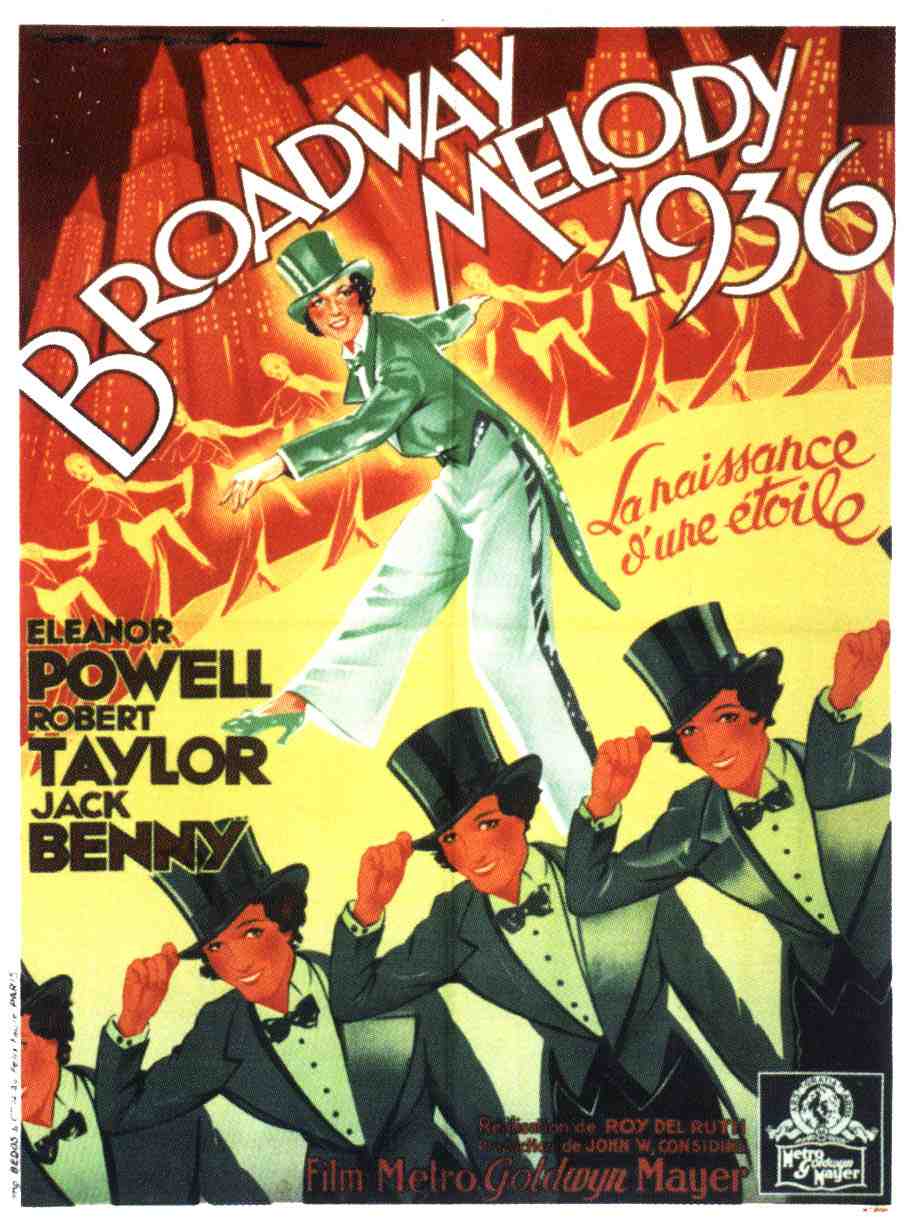
Eleanor Powell, Robert Taylor, Jack Benny, Una Merkel, Buddy Ebsen, June Knight, Frances Langford (as herself)
Plot:
This is the second “The Broadway Melody” film, following the “Broadway Melody of 1929” and is considered one of the best Broadway Melody films, according to “All about Oscar: The History and Politics of the Academy Awards” By Emanuel Levy. Bob Gordon (Taylor) wants to put on a show and his high school sweetheart Irene (Powell) is hoping he will recognize her talent. However, Lillian Brent (Knight) is putting money in the show and wants to star in the show in return. Irene poses as a sexy French star in order to get the leading role. Bert Keeler (Benny) is a Broadway columnist adding comic relief, always getting punched in the nose.
Trivia:
Powell posing as Mademoiselle Arlette-the fake French star invented by gossip columnist Bert Keeler
-MGM was apparently in danger of going bankrupt in 1935. “Broadway Melody of 1936” and other Eleanor Powell films is what saved the studio, according to the musical documentary “That’s Entertainment III” (1994).
-Powell was originally given the smaller role of a secretary played by Una Merkel and along with another dance. Powell did a dance a screen test before the film started to see her versatility and she did a dance combination of tap, ballet and acrobatics, according the book “American Classic Screen Profiles” edited by John C. Tibbetts, James M. Welsh. Because of the dance, Powell was moved to a role with higher billing.
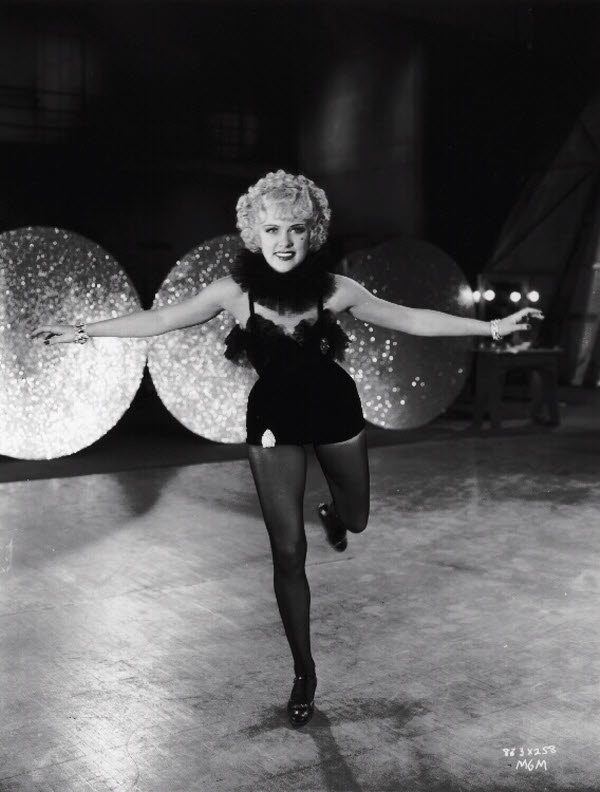
-Buddy Ebsen performs with his real life sister Vilma Ebsen in the film. Broadway Melody of 1936 is Vilma’s only film. The two started out as a vaudeville act and were once known as the “Baby Astaires”
-Part of a series of “Broadway Melody” films starting with “Broadway Melody” (1929) and followed by “Broadway Melody of 1938” (1937) and “Broadway Melody of 1940” (1940). Taylor, Powell and Ebsen starred again together in “Broadway Melody of 1938.” However, other than show business, the movies have no plot connection.
-Nominated for an Academy Award for Best Picture. “Mutiny on the Bounty” was the Best Picture winner that year.
-Also nominated for Best Writing, Original Story and won for Best Dance Direction.
-Tap dancer Eleanor Powell’s first leading role.
-Buddy Ebsen’s first film.
-Powell’s singing is dubbed by Marjorie Lane.
Robert Taylor as Bob Gordon.
Highlights:
-Robert Taylor singing “I’ve Got a Feelin’ You’re Foolin’.” Taylor is not known for his singing, but he does a good job performing. The song is performed on a rooftop dance floor and tables and chairs pop up out of the floor. The number is a great example of the excessively wealthy often represented in early to mid-1930s films.
-The odd man at the talent agency who is looking to get into show business with his different snoring sounds.
-Buddy Ebsen tap dancing with his real life sister Vilma Ebsen in the fun song “Sing Before Breakfast.”
-Eleanor Powell does a Katharine Hepburn impression from “Morning Glory.”
-In a dream sequence, Powell ballet dances to “You Are My Lucky Star” showing her versatility of dance
-Bert Keeler’s stooge dresses up like a woman to fool people about a fake French actress.
Notable songs:
The whole score is excellent because it is made up by song by composer Nacio Herb Brown including:
-“Broadway Rhythm” sung by Frances Langford
-“You Are My Lucky Star” sung by Frances Langford. Langford sings it straight and sweet and then swings the song, characterizing it with her singing style.
-“Broadway Melody”
-“I’ve Got a Feelin’ You’re Foolin'” sung by Robert Taylor and June Knight
-“Sing Before Breakfast” performed by Buddy and Vilma Ebsen
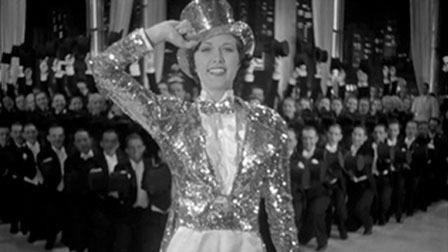
Powell in the film’s finale
My review:
“Broadway Melody of 1936” is a fun musical with excellent songs. It’s a good example of the frothy, escapism films that were relevant during the Great Depression. Eleanor Powell is a delight to watch tap dancing in any film, but especially her first starring role. While tap dancers were a dime a dozen in the 1930s, she was innovative and stood out against the rest. Robert Taylor was still in his “pretty boy” phase of his career, but aside from his looks, you can see that he has talent as an actor.
The Ebsens are wonderful to watch and it’s a treat to see the brother and sister dance together in their only film.
My only complaint is joke about the man who snores wears very thin.
“Broadway Melody of 1936” is considered the best of the “Broadway Melody” films. “Broadway Melody of 1938” is very similar with a similar cast-with the addition of Judy Garland and the great Sophie Tucker. “Broadway Melody of 1940” teams Eleanor Powell for the only time with Fred Astaire.
Check back next week for Musical Monday.
Check out the Comet Over Hollywood Facebook page for the latest updates or follow on Twitter at @HollywoodComet.
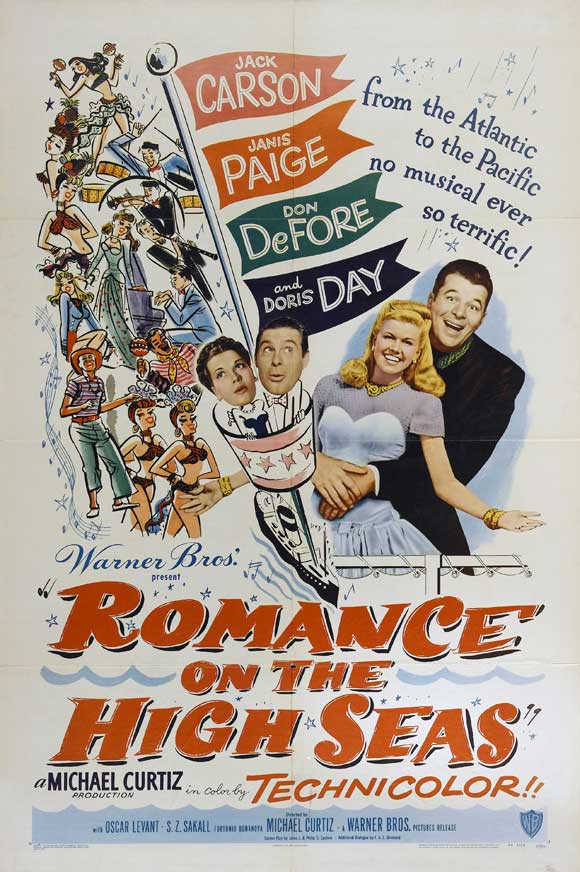
Georgia Garrett is a fast talking, cigarette smoking, flirtatious night club singer–and she is the character played by Doris Day in her very first film “Romance on the High Seas” (1948).
While other actresses worked their way up to stardom through bit parts and uncredited roles, Day starred in her first movie.
And she continued starring in all 41 of her films from 1948 to 1968.
In the film, newly married Elvira Kent (Janis Paige) and Michael Kent (Don DeFore) worry that the other spouse is having an affair.
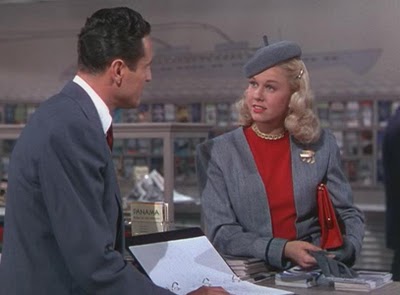
Georgia, a broke singer in a sleazy nightclub, frequents the travel agency and plans trips she never goes on and gets passport photos taken each time. Elvira meets Georgia in the travel agency while booking her trip to South America.
“But you have already had seven passport photos taken,” one travel agent says.
“But never as a blond,” Georgia coyly says.
Day as Georgia Garrett in the travel agency
On their third wedding anniversary, the Kents have to cancel a third anniversary trip due to business. Michael tells Elvira to go without him.
Suspecting that Michael is going to fool around with his pretty new secretary, Elvira sends Georgia on the cruise in her place so she can stay behind and spy on her husband.
Also afraid that his wife is going to fool around on the cruise without him, Michael sends private detective Peter Virgil (Jack Carson) on the cruise to look after his wife.
Paige as Elvira instructing Day as Garrett
Georgia, while posing as Elvira Kent, falls for Peter, and Peter thinks he is going to lose his job.
While in the 1950s and 1960s Day was known for her squeaky clean, virginal persona, but her character in “Romance” has some sass.
Day started her career as a girl singer in 1939 for big band leaders such as Les Brown and Bob Crosby, brother of Bing Crosby.
By 1945, she had her first hit with “Sentimental Journey” which resonated with soldiers fighting over seas. More hits followed such as “My Dreams are Getting Better all the Time.”
“In a sense, ‘Sentimental Journey’ became the serviceman’s theme song,” Day wrote in her autobiography, “Doris Day: Her Own Story.
Before heading back East after a visit to Los Angeles, Day was convinced to attend a party at the home of Jule Styne, an American songwriter.
When everyone started performing songs at the party, Day began to get uneasy.
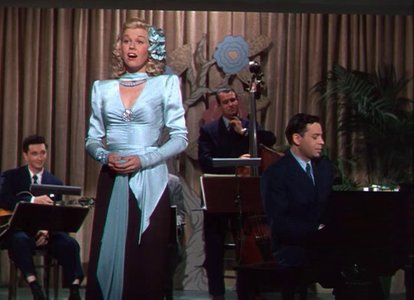
Day as a nightclub singer singing “I’m in Love”
“These people loved singing for each other but I am painfully shy at parties, and particularly shy about performing impromptu,” she wrote.
Day was also going through a divorce at the time with child actress Virginia Weidler’s older brother, George.
She was asked to sing and was convinced to sing the chorus of “Embraceable You.”
The Gershwin tune landed Day her first film role, as the star of a musical comedy.
Styne wrote the score to the Warner Brothers film “Romance on the High Seas.” Judy Garland was originally slated to play Georgia Garrett, but the deal fell through.
Then Betty Hutton was set for the film, but she got pregnant and couldn’t be in the film, according to Day’s autobiography.
“Acting in films had never so much crossed my mind. I was a singer…” she wrote. “They kept telling me how lucky I was to be testing for the lead in a major musical and how many girls would die to be in my shoes, but I was sitting glumly looking out the window, only half listening.”
Her look was made to resemble Betty Hutton and she was encouraged to sing in Hutton’s signature energetic style during the test.
“But when we shot the scene, I did it my own way,” she wrote. “I instinctively understood something then that was to sustain with me through all the years that followed-to thine own self be true. Don’t imitate.”
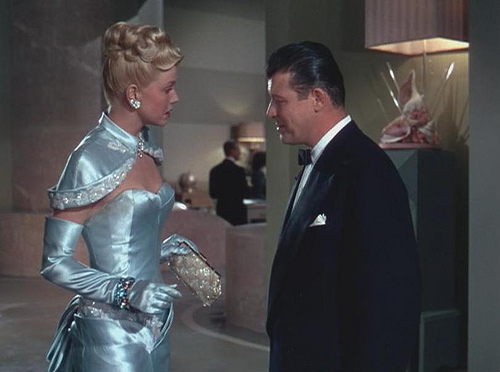
Jack Carson and Doris Day meet on board the ship
Through being herself, Day gives a hilarious performance in the sparklingly musical, comedy which included one of her top hit songs, “It’s Magic.”
After the film became a hit, Day’s option was picked up for more Warner films. However, she wasn’t pleased with the movie. She dressed very casually and didn’t like the ultra glamorous look she had in the film.
Though Day wasn’t pleased with her first film appearance, “Romance on the High Seas” is my favorite Doris Day film—and I have seen all but two of her movies.
Along with the main cast of Jack Carson, Day, Don DeFore and Janis Paige—the movie has top notch character actors. Supporting actors include S.Z. “Cuddles” Sakall, Oscar Levant and Eric Blore.
“Romance on the High Seas” has it all: glamorous wardrobes, sparkling color, hilarious jokes and quality songs written by Sammy Kahn and Jules Styne.
Though Day is best known for her bedroom farce films such as “Pillow Talk” (1959) with Universal, her early Warner Brothers films are some of her best.
Fresh faced films, sunny and shining with Day’s smile.
This is July’s edition of Comet Over Hollywood’s film references in music videos.
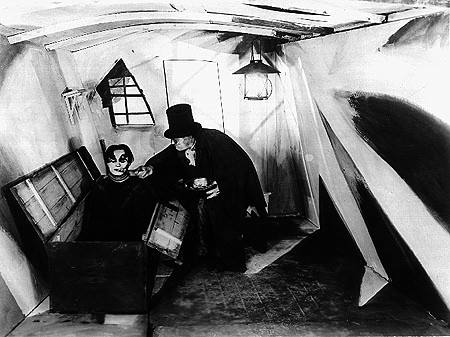
The 1920 German silent film “The Cabinet of Dr. Caligari” is the story of Francis recalling his memory of a carnival show. Dr. Caligari has a somnambulist Cesare who wakes up during the act. When Cesare is going to stab Francis’s fiancee, he kidnaps her instead. The film ends with an odd twist.
A scene from “The Cabinet of Dr. Caligari” (1920)
The video for the Red Hot Chili Peppers single “Otherside” from 2000 was influenced by the 1920 film starring Conrad Veidt.
“I was on a crazy sleeping schedule, and I saw this movie on TV and I saw this movie that looked so bizarre,” bassist Michael “Flea” Balzary said in an interview. “It stuck in my mind, and I wanted to make a rock movie to me.”
Caligari’s German Expressionism art style was the inspiration for the video, but the plot is not used within the video.
Filmed in black and white, the video was modeled after German Expressionism, they used Cubism and M.C. Escher artwork, said video director Jonathan Dayton.
“We did look at Caligari, and we looked at a lot of German Expressionist film,” Dayton said. But it was also very important to avoid ‘Caligari.’ It was both inspiration and something to work around, because it has such a strong, specific style, and there have been other videos that have completely ripped it off.”
Check back next month for August’s classic film in music videos.
It’s no secret that the Hollywood Comet loves musicals. In 2010, I revealed I had seen 400 movie musicals over the course of eight years. Now that number is over 500. To celebrate and share this musical love, here is my weekly feature about musicals.
Plot:
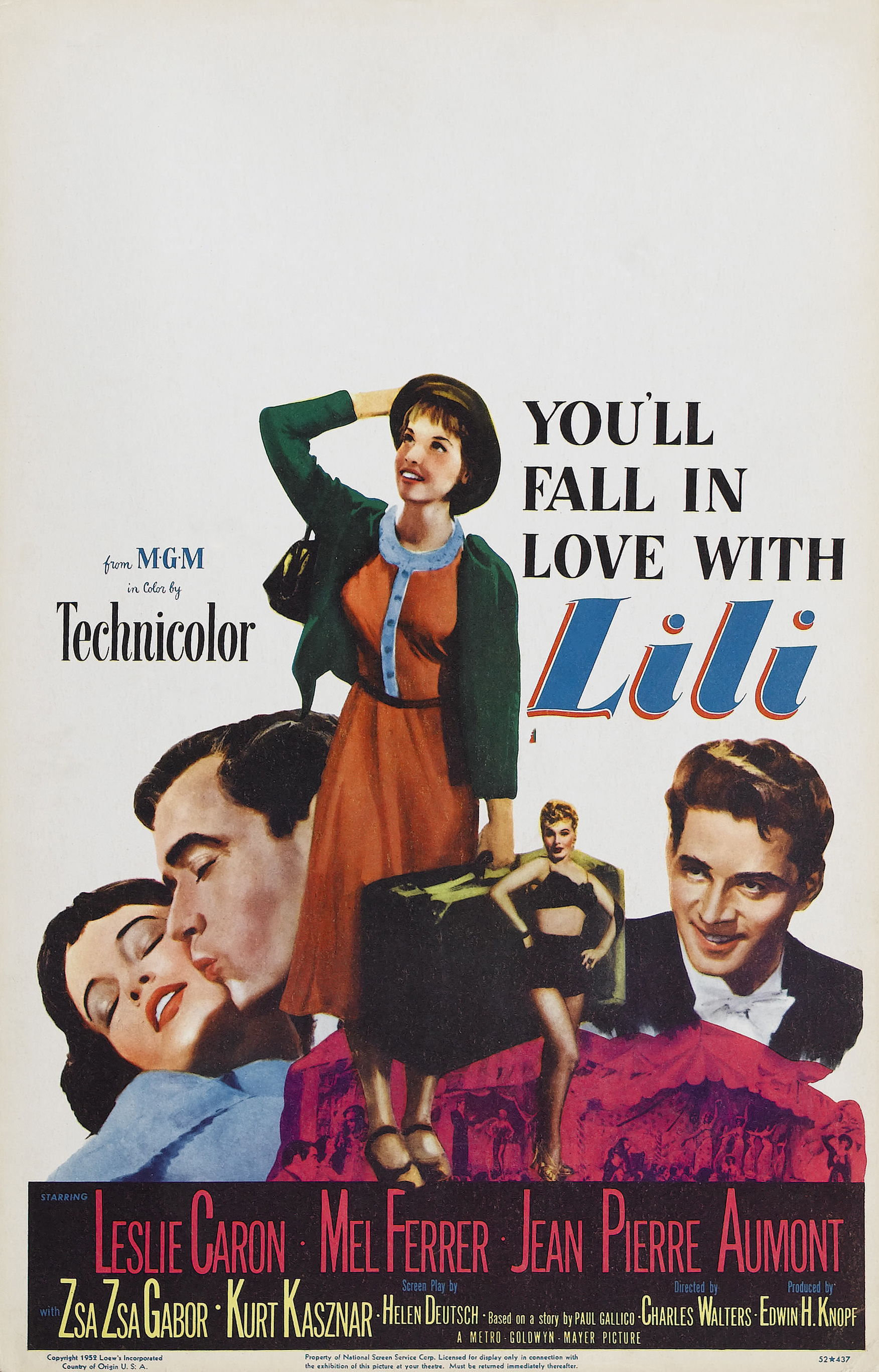
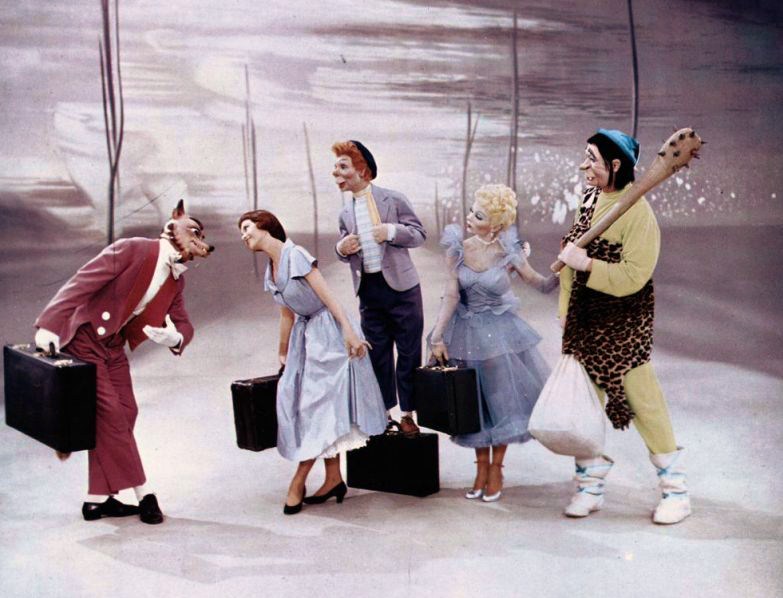
An orphan young girl named Lili (Caron) goes to work for a baker who has already died. She is taken in by a carnival group and develops a crush on the lecherous magician Marc (Aumont). After she loses a waitressing job in the carnival, she doesn’t know who to turn to. Just as she considers taking her life, a puppet calls to her from the puppet booth (with Mel Ferrer behind the curtain). Lili sings and jokes with the puppets, and a crowd grows behind her. The angry Paul (Ferrer) sees the crowd and stars an act with Lili. The whole time, Lili is still infatuated with Marc, which angers Paul.
Trivia:
-Leslie Caron is supposed to play a 16 year old girl in the film. She really was 22 years old.
-Gower Champion directed a stage version on Broadway of the movie in 1961 called “Carnival.” The Leslie Caron role was played by Anna Marie Alberghetti.
-The song “Hi-Lilli Lo-Lilli” reached #30 on the charts
-Based on the Saturday Evening Post short story “The Man Who Hated People” by Paul Gallico. The story was based on the puppet show “Kukla, Fran and Ollie”.
-Bronislau Kaper won an Academy Award for Best Music Scoring
-Other Academy Award Nominations: Leslie Caron was Best Actress, Best Art Direction for a Color film, Best Cinematography for a Color film, Charles Walters for Best Director, Helen Deutsch for Best Writing, Screenplay
-Cabaret puppeteers Walton and O’Rourke made the puppets for the film.
-Professional puppeteers worked the puppets of Carrot Top, Golo the Giant, Marguerite and Reynardo—not Mel Ferrer.
Leslie Caron as Lili talks with puppets
Highlights (and unintentional humorous scenes):
-Lecherous Aumont says about young Lili “The female soul is like a chestnut, it has to go through fire before it gets delicious”
-Mel Ferrer’s character used to be a great dancer, but his leg was injured in the war so he can no longer dance. And he’s bitter. At one point, he angrily shouts, “I shall now perform a double pirouette!” and then dramatically slams into a cabinet and says he no longer can dance. It’s hilariously awkward.
-During a dream sequence, Caron sort of dances with Aumont. She first wears a sexy waitress outfit and then is transformed into a slinky sequin dress that his assistant (Gabor) wears.
-Caron says that Carrot Top the puppet is her boyfriend.
-Ferrer walks in as Aumont is trying to seduce Caron. Ferrer basically calls her a whore, but a short time later is calling her sweet and as pure as a silver bell.
-After being hurt by both Ferrer and Aumont, Caron decides to leave. Ferrer convinces her to stay through the puppets. Caron hugs the puppets. Then Caron asks, “Why do you hide behind these puppets?” Ferrer yells, “I am the puppets!”
-Caron finally leaves town and has another dream sequence and has a dream sequence where she is walking with life sized versions of Ferrer’s puppets.
Lili dances with life size puppets during a dream sequence.
Notable Songs:
-Though this is said to be a musical, “Lili” only has one song that is sung multiple times: “Hi-Lilli, Lo-Lilli”
My Review:
Several reviews says that “Lili” is refreshing, charming and whimsical, but I can’t say that I was as enchanted. The premise of the story is fairly charming, but the puppets, the lecherous men and Mel Ferrer’s dramatic outbursts killed it for me.
The movie-dubbed a musical- was a huge waste of Leslie Caron’s immense talent as a ballet dancer. Caron’s film career started off with the extravaganza “An American in Paris” (1951) where she had elaborate dance scenes. Even in the dream sequences, Caron only made a few prances here and there, but nothing that showed off her professional dancing skills.
Following “Lili,” Caron once again got to show off her ballet skills in “The Glass Slipper” (1955) and “Daddy Long Legs” (1955).
All in all, I found “Lili” rather strange and couldn’t close my mouth from disbelief when the film ended.
It’s no secret that the Hollywood Comet loves musicals.
In 2010, I revealed I had seen 400 movie musicals over the course of eight years. Now that number is over 500. To celebrate and share this musical love, here is my weekly feature about musicals.
Starring:
Deanna Durbin, Ray Milland, Charles Winneger, Binnie Barnes, Alice Brady, Mischa Auer, Nan Grey, Barbara Read, Lucile Watson,
Plot:
Three sisters (Read, Gray, Durbin) living with their mother in Switzerland hear that their father (Winneger) is remarrying. The sisters travel to New York to see their father- who they haven’t seen in 10 years- to stop the wedding so their parents can get back together. The sisters scheme to make the new, gold-digging bride (Barnes) turn her attention to a wealthier fellow
Barbara Read, Deanna Durbin and Nan Grey as sisters in “Three Smart Girls”
Trivia:
-Opera singing actress Deanna Durbin’s first film
-Louis B. Mayer had Durbin and Judy Garland both tested for MGM Studios. Garland was signed with MGM while Universal signed Durbin. Garland cried when she saw Universal had faith in Durbin to lead in her first films, and MGM was sticking Garland into supporting roles, according to the 2010 book “The Songs of Hollywood” by Philip Furia and Laurie Patterson.
-“Three Daring Daughters” (1948) is not officially said to be a remake, the movies are very similar. Opera singing Jane Powell is similar to the Deanna Durbin role and the daughters are trying to get their newly married mother back with their father. The films end differently, though.
-The plot can also be compared to the Hayley Mills Disney film, “The Parent Trap” (1961).
-Followed by “Three Smart Girls Grow Up” (1939) and “Hers To Hold” (1943)
-Nominated for an Academy Award for Best Picture of 1936 against films such as “The Great Ziegfeld,” “Libeled Lady,” “Anthony Adverse,” “Mr. Deeds Goes To Town,” “Romeo and Juliet” and “San Francisco.” “The Great Ziegfeld” was the Best Picture winner that year.
-The film was also nominated for an Academy Award for Best Sound Recording and Best Writing for Original Screenplay.
Notable songs:
None of the songs are terribly familiar or familiar, other than “Il Bacio,” but they all showcase Durbin’s beautiful voice. Aside from a brief song from Binnie Barnes, the four songs sung in the comedy are all by Durbin.
My review:
Young Ray Milland (Screencap by I Shoot the Pictures)
Though I’m not sure how the movie was nominated for Best Picture, I really enjoy “Three Smart Girls” (1936).
The film would have catered to both adult and child audiences in 1936 with the adult and child stars in the film.
It’s also a joy to see young Ray Milland early in this film career. Though he started in films in the early 1930s, “Three Smart Girls” was around the time when he started playing credited roles.
This is not your average musical full of singing and dancing in the middle of the street. “Three Smart Girls” is a comedy serving as a vehicle for up and coming star Deanna Durbin. The plot tells that she is taking singing lessons to become an opera singer, and she will break into song when asked.
During a time when law enforcement and the military weren’t popular in the United States, Officers Pete Malloy and Jim Reed patrolled the streets of Los Angeles.
Kent McCord as Jim Reed and Martin Milner as Pete Malloy in “Adam-12” (Source: KentMcCord.com)
From September 1968 to May 1975, the two officers arrested murderers, lectured motorcyclists and helped women in childbirth in the television show “Adam-12” starring Martin Milner (Malloy) and Kent McCord (Reed).
Produced by Jack Webb, who also created “Dragnet” and “Emergency,” the show portrays the professionalism of police officers and police departments. Webb made the shows so accurate that some police academies used the shows for training, according to IMDB.
To keep the accuracy, Reed’s badge was even changed from “Policeman” to “Police Officer,” according to Adam12Code3.com. Pop culture
“Adam-12 ” shows the military style of the police force while showing that Reed and Malloy were young, contemporary and had lives outside the force.
For example, Malloy was set up on blind dates and Reed and his wife have a baby. On their day’s off, Malloy can be seen driving muscle cars and both wear loud, floral shirts-fashionable at the time.
The show conveyed realistic issues relevant to the late-1960s and 1970s:
-Marijuana use and addiction to pills, heroin and other drugs
-Teenagers running away from home to travel to San Francisco
-Disrespect for law enforcement with use of terms such as “down with the pigs” Guest stars
Popular celebrities of the time and old Hollywood stars frequently showed up on Adam-12, making the show an extra treat for current day pop culture fans. Some of these included:
-Child star Margaret O’Brien as a the mother to a delinquent child-Season Three, Episode 12
Child actress Margaret O’Brien plays mother to child delinquent Buddy Foster (brother of Jodie Foster) in the 1970 episode “Sign of the Twins” (Source: KentMcCord.com)
-Actor John Kerr as a priest- Season Two, episode 8
–Leave it to Beaver actor Tony Dow as a ex-Marine who’s car is stolen by a girl-Season Three, episode 5
-Monkees singer Mickey Dolenz as a police hating motorcyclist- Season Five, episode 1
The Cross Over Since Webb produced “Dragnet,” “Adam-12” and “Emergency” and all were set in Los Angeles—the shows overlap throughout the years.
“Emergency” started in 1972, when “Adam-12” was in its fifth season. On “Emergency,” you will occasionally see the officers drop by Rampart Hospital, the hospital “Emergency!” paramedics report to, in episodes.
Milner and McCord with Julie London as Dixie McCall-an “Emergency!” character
In season 5, episode 4 of “Adam-12” called “Lost and Found,” the police officers take a young boy to Rampart Hospital. There they run into “Emergency!” characters such as Nurse Dixie McCall (Julie London), Paramedic Roy DeSoto (Kevin Tighe), Paramedic Johnny Gage (Randolph Mantooth) and Dr. Kelly Brackett (Robert Fuller).
Supporting actors of “Adam-12” also can be seen in “Emergency!” Bing Crosby’s son, Gary Crosby plays a police officer in “Adam-12” and a paramedic in “Emergency!” In both shows, Crosby’s character is a bit of a show off, taking credit he doesn’t deserve.
Actor Marco Lopez can be seen as an officer in “Adam-12,” but has a larger role in “Emergency!” as Firefighter Marco Lopez.
What’s so special about Adam-12?
“Adam-12” was certainly not the only police show on television during the late 1960s and early 1970s. Others included:
-“The FBI” (1965 to 1974) starring Stephen Brooks and Efrem Zimbalist, Jr. telling different F.B.I. cases.
-“Hawaii Five-0” (1968 to 1980) starring Jack Lord and James McArthur about a detective who is the head of the special state police task force
-“Ironside” (1967 to 1975) starring Raymond Burr who is a paraplegic detective
– “Mannix” (1967 to 1975) starring Mike Connors who plays a private investigator
-“The Mod Squad” (1968 to 1973) starring Michael Cole, Clarence Williams III, Peggy Lipton, Tige Andrews who play “hippie” undercover cops.
Most of the crime shows on television during this time seemed to focus on daring detectives or spies, a popular topic due to the Cold War and films such as James Bond.
However, Adam-12 is one of the few TV series that showed the honest day-to-day approach of the men in blue. Reed and Malloy patrolled the streets, chased criminals through alleyways and sometimes found time to stop and eat a hamburger.
Milner, McCord and Bill Boyet. (Source: KentMcCord.com)
The television show doesn’t present their job in a glamorous but as a realistic and necessary job.
When “pig” was a popular term for police officers, Webb tried to present the police force fair. And on top of that, Reed and Malloy were attractive and pretty darn cool.
In my opinion, “Adam-12” is one of the best police shows ever made. It doesn’t clog the plot with pointless drama but keeps on target with the topic of officers keeping law and order.
It’s no secret that the Hollywood Comet loves musicals. In 2010, I revealed I had seen 400 movie musicals over the course of eight years. Now that number is over 500. To celebrate and share this musical love, I’m starting a weekly feature about musicals.
This week’s musical: Summer Magic (1964) — Musical Number 44
Starring:
Hayley Mills, Burl Ives, Dorothy McGuire, Deborah Walley, Una Merkel, Peter Brown, James Stacey, Eddie Hodges, Jimmy Mathers
Director:
James Neilson
Studio:
Walt Disney Studios
Plot:
Set at the turn of the century, the Carey family finds themselves penniless after their father dies. The family moves from Boston, Mass. to Beulah, MN to a home Nancy (Mills) remembers the family admiring while they were on vacation. Once they arrive at the home, they find it run-down, but with the help of post master Osh Popham (Ives), the family fixes up the home. Surrounding the bustle of fixing up the home, the Carey’s snobby orphan cousin Julia (Walley) comes to live with them, and Julia and Nancy fall for the same boy (James Stacey).
Nancy (Mills) and Julia (Walley)
Trivia:
-“Summer Magic” is based off the book “Mother Carey’s Chickens” by Kate Douglas Smith Wiggin
-The film is also a remake of the non-musical 1938 film “Mother Carey’s Chickens” starring Anne Shirley, Ruby Keeler, James Ellison, Walter Brennan, Fay Bainter, Virginia Weidler and Ralph Morgan.
-The movie was originally supposed to star Annette Funicello
-The song “On the Front Porch” is songwriter Robert Sherman’s personal favorite song from his own work, according to Sherman’s 1998 book “Walt’s Time: Before and Beyond”
-Walt Disney didn’t like the song “Ugly Bug Ball” sung by Burl Ives. Sherman persuaded Disney to keep the song and it went on to be a popular song from the film, according to Sherman’s book.
-The youngest brother, Peter Carey, is played by Jimmy Mathers—brother to Jerry Mather’s of “Leave It To Beaver” fame.
-Dorothy McGuire’s singing is dubbed by Marilyn Hooven
Osh (Burl Ives) sings “On the Front Porch”
Notable Songs:
-Most of the songs are silly and forgettable but are still pretty catchy, lighthearted and enjoyable. Some of my favorites include:
– Femininity- Nancy (Mills) and Julia (Walley) sing this song to Lallie Joy Popham (Wendy Turner) so that Nancy’s brother Gilly (Hodges) will notice her.
The song tells Lallie Joy to “hide the real you,” “men adore good listeners” and “don’t laugh too loud”
-Pink of Perfection- Gillie (Hodges) and Nancy (Mills) sing a song making fun of Julia saying she is a “dainty baboon,” has the “the charm of a moose” and has knock knees. The song is sung in their distain when they hear Julia is coming to stay with them.
-Ugly Bug Ball sung by Osh (Ives) and Peter (Mathers). It’s not personally my favorite song in the film and is mainly footage of different bugs crawling, but it’s catchy and cute.
-Flitterin’- sung by Mills, Hodges and McGuire (dubbed). The family sings it when they get a player piano as they are packing to Maine. It’s a brief little tune, but it’s catchy. Really, I enjoy it because I sang this song in the four times I have moved in the last two years.
My Review:
I’ll never forget the summer my mom introduced “Summer Magic” to my sisters and I. My dad was out of town on a business trip and she recorded it special off the Disney Channel for us to watch.
Since then, it has been a special favorite, filled with color, catchy Sherman brothers’ songs, and an outstanding cast. The turn-of-the-century costumes by Bill Thomas are also beautiful. Thomas dressed Deborah Walley in pink and Hayley Mills in yellow and it’s just gorgeous to see.
“Summer Magic” isn’t as well known as other Disney films such as “Old Yeller” or “The Parent Trap,” but it is a lot of fun and is a movie I grew up on.
If you like Hayley Mills films, you can’t go wrong with this one. But aside from Hayley, the supporting cast is gold! Dorothy McGuire as the mom and Burl Ives and Una Merkel are a hilarious treat as a quarreling married couple. Not to mention James Stacey and Peter Brown who round out the cast as handsome male leads (though Peter Brown disappointingly has very little screen time). You also see pre-Bonnie and Clyde Michael J. Pollard.
This is a remake of the 1938 film “Mother Carey’s Chickens,” starring Anne Shirley, Ruby Keeler, James Ellison, Frank Albertson, Fay Bainter and Donnie Dunagan (the voice of Bambi). While that is a fun (non-musical) film, I do prefer this one better. “Mother Carey’s Chickens” shows the audience when the father (Ralph Morgan) passes away. But I don’t feel like we get as deep into the romance aspect as “Summer Magic.” Also, Donnie Dunagan’s character is just annoying.
I would have loved to see what this movie would have been like had it really starred Annette Funicello, but it’s still pretty wonderful with Hayley Mills.
Even through it’s silly, forgettable songs and sometimes crazy plot, “Summer Magic” is one of my favorites. I’m fairly certain you will be “flitterin'” also.
Nancy (Mills) enters the Halloween party with handsome Tom Hamilton (Peter Brown) in “Summer Magic”
Check back next week for Musical Monday.
Check out the Comet Over Hollywood Facebook page for the latest updates or follow on Twitter at @HollywoodComet.