Merry Christmas from Claudette Colbert and Brandon Flowers

Wishing you all a very Merry Christmas and Happy Holidays!

Merry Christmas also from Priscilla Lane

On this special holiday I am sharing two clips of two of my favorite things.

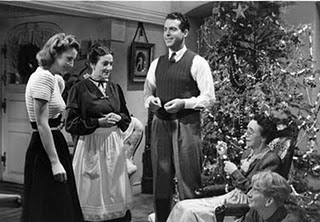
First is my favorite scene from my favorite movie, “Since You Went Away” (1944). The movie stars Claudette Colbert, Jennifer Jones, Shirley Temple, Joseph Cotton, Monty Wooley and Robert Walker. It follows a woman and her daughters as they fight the war on the home front during World War II. The clip is at the end of the film during Christmas while their father is fighting during the war.  It’s a little long, but it’s heart warming and seems to be the spirit of Christmas to me.

The second clip is vastly different. My favorite band is The Killers and I really like their frontman, Brandon Flowers who just came out with a new solo album. For the past six years they put out Christmas songs to raise money for AIDS. The clip below is their song from 2007 and it is my favorite of them all.  No, the Killers aren’t old, but they have referenced several classic films as I mentioned in a June post. I also feel like Brandon Flowers has some really old-fashioned values, which I like.  Anyhow, its a funny, clever video and song and I hope you like it.

Merry Christmas all!

Check out the Comet Over Hollywood Facebook page and Radio Waves Over Hollywood Facebook page.

Forgotten holiday films I even forgot

Errol Flynn as you have never seen him before

A couple of days ago, I enlightened you with some Christmas movies you may have forgotten. With a couple of days left to spare before the 25th (Where did the season go?) here are a few Christmas movies I even forgot in my last post.

I hope you have time to fit them in before the holiday season ends-Christmas officially ends on January 5 with the 12 days of Christmas- or remember the films for next year. Enjoy!

All Mine to Give (1957): This is a Christmas movie, but it’s a real downer. Jo (Glynis Johns) and Robert (Cameron Mitchell) raise a large family, and then they both tragically die. The kids (including Patty McCormack of “The Bad Seed”) try to continue living together, but the town threatens to split them up. However, they somehow are able to fight the greedy townsfolk and stay together. To review: This isn’t a particularly happy Christmas movie, and I only really thought it was okay. But it reminds us that family is important and shouldn’t be seperated.

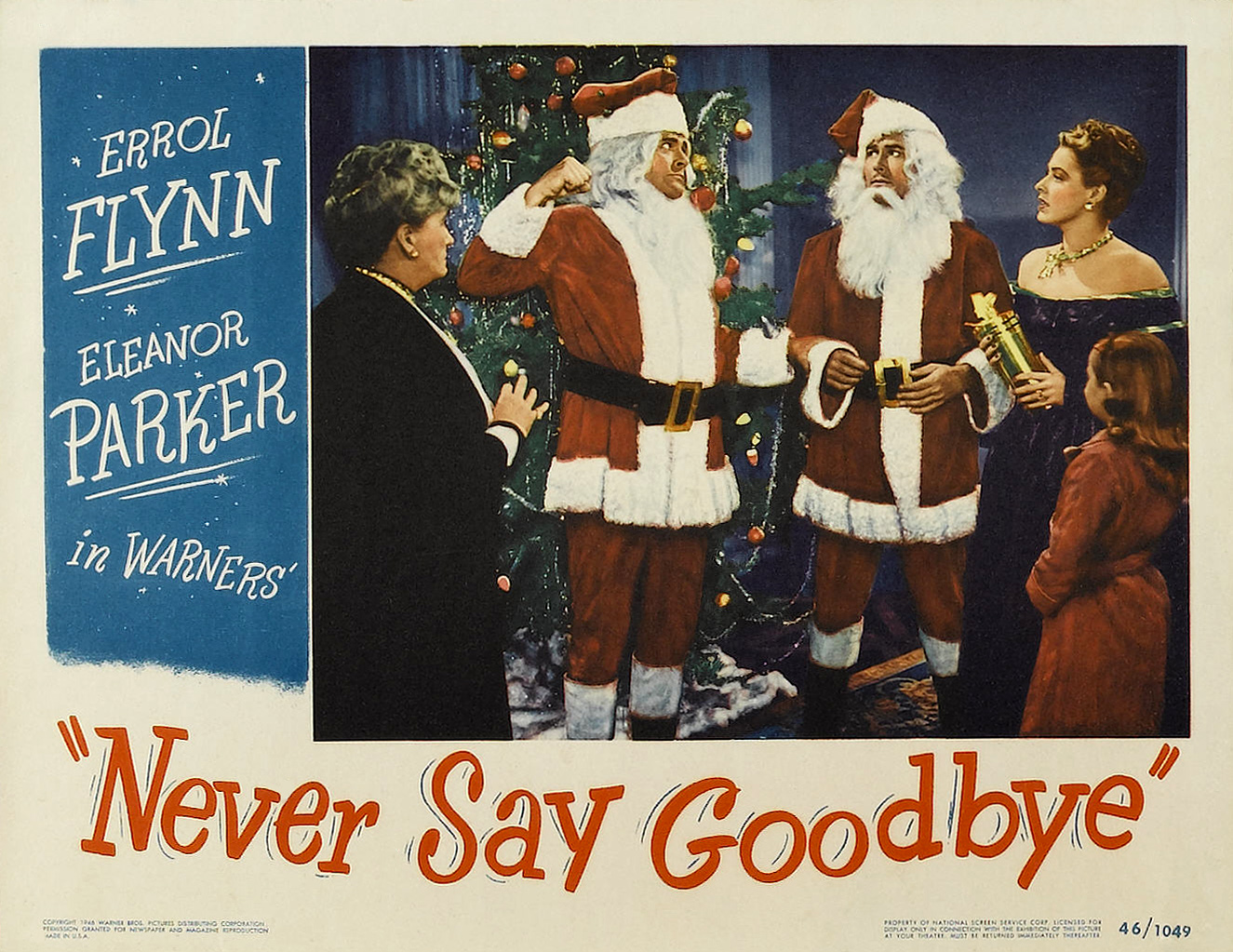
Never Say Goodbye(1946): Not your typical Christmas film, but you see Errol Flynn dressed up like Santa Claus!  Phil (Errol) and Ellen (Eleanor Parker) Gayley are divorced. Their daughter Flip (Patti Brady) and Phil aren’t very happy about the divorce and hope to win Ellen back from her new boyfriend, Rex (Donald Woods).  All of this takes place during Christmas as Phil and Rex both dress up like Santa and a comedic mix-up occurs. To review: A cute movie that really takes place during Christmas by chance, but still shows the importance of family. This is actually one of my favorite Errol Flynn movies, because we get to see him in a comedic, husband type role in New York, rather than a swashbuckling role in Spain.

Doris Day, Gordon McCrea, Rosemary DeCamp and Leon Ames in “By the Light of the Silvery Moon”

On Moonlight Bay (1951)/ By the Light of the Silvery Moon (1953):

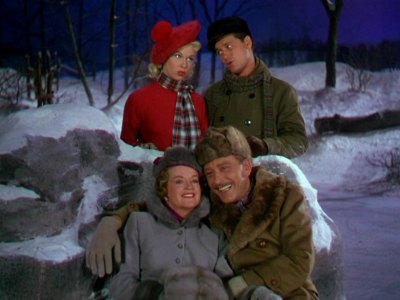
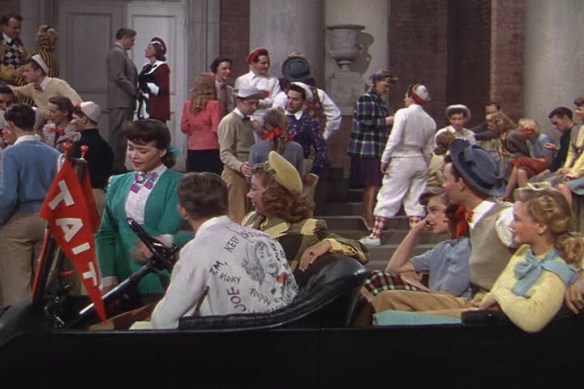
I put these two films together since they are similar and the second is the sequel to the first. In a nutshell: tomboy Margie Winfield (Doris Day) falls in love with idealistic Bill Sherman (Gordon McCrea) and her parents -mostly her father-disapprove. In the midst of both of these movies, there is Christmas. Margie breaks her leg and can’t go to the Christmas dance with Bill in “On Moonlight Bay“. Margie still manages to limp out on the porch and sing “Merry Christmas to All” with carolers.  In “By the Light of the Silvery Moon,”  Bill meets the family at a skating pond and surprises Margie and finally decides to marry her after bickering throughout the movie. To review: These are both similar to “Meet Me in St. Louis”: it takes you through a year of a family during the turn of the century and manages to fit in Christmas.  Like the others, this is a  really fun, happy family film.  “On Moonlight Bay” and “Silvery Moon” are probably my favorite Doris films. I have always enjoyed her and Gordon MacRea in films together.

Susan Slept Here (1954): Juvinile delinquent Susan Landis (Debbie Reynolds) is sent to spend the holidays with screenwriter Mark Christopher (Dick Powell) so he can study a delinquent for a script he’s writing. Lots of comedic events ensue, and the much older Christopher falls in love with the very young Landis. To review: This is a pretty well known Christmas movie, but I feel like it gets over looked as we grab for “Holiday Inn” and “It’s a Wonderful Life.”  Though Powell is 28 years older than Reynolds, its a very cute movie and worth looking into. Also keep an eye out for a much older Glenda Farrel. She is still as beautiful and funny as she was in the 1930s.

Swiss Family Robinson (1960): The Robinson family shipwrecks on a tropical island on their way to New Guinea.  Mom (Dorothy McGuire), Dad (John Mills), Fritz (James MacArthur), Ernst (Tommy Kirk) and Frances (Kevin “Moochie” Corcoran) learn how to live life on an island away from civilized Switzerland. This includes catching baby elephants, fighting off pirates (played by Sessue Hayakawa) and even celebrating Christmas. Surprisingly, yes, this movie does have Christmas in it. Fritz and Ernst return on Christmas to the treehouse after exploring the island for several months. They bring back Roberta (Janet Munro), a girl they rescued from pirates, and fight over who gets to dance with her during the Christmas celebration. To review: Sure they are in the tropics, but they find time to celebrate Christmas. Even if they didn’t, it’s still a really nice family film, and my roommate, Sybil, and her family watch it every Christmas.

Margaret O’Brien crying in Tenth Avenue Angel (1948)

Tenth Avenue Angel (1948):

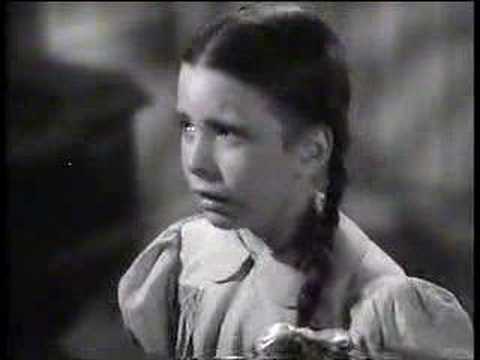
If you have ever had an urge to see Margaret O’Brien cry, here is your chance. Flavia (O’Brien) feels like everyone is lying to her. Her mother (Phyllis Thaxter) has told her old wives tales that aren’t true. Some of these are that mice turn into money, so that Flavia wouldn’t be afraid of mice (I have never heard, this have you?) and that cows kneel at midnight on Christmas Eve for Jesus. Flavia also finds out that her friend Steve (George Murphey) really didn’t travel around the world, but was in jail. After having a temper tantrum and potentially risking her pregnant mother’s life, Flavia realizes Christmas miracles do come true when she sees a cow kneeling for the Savior and her mother lives. To review: Parts of this movie are fine, but when Margaret starts shedding those tears start getting a bucket to bail out the water. I really like George Murphy, Phyllis Thaxter and Angela Lansbury in this movie, but O’Brien was also getting a little too old to play a six year old girl, when she was really 11.  

Happy holidays! Be sure to check back from one more special holiday post on Christmas day!

Check out the Comet Over Hollywood Facebook page

Island of misfit Christmas movies


Stanyck, Bondi, MacMurray, Patterson and Holloway in “Remember the Night”: My favorite Christmas movie

Tis the season for Christmas posts. For these last five days before Christmas, I’m going to try to post several posts. Probably not every day, but at least throughout the week.

This post deals with two things my family and I love combined together: Christmas and movies.

For at least the past 22 years, it’s a Christmas family tradition for us to watch “Rudolph The Red-Nosed Reindeer” (1964), “A Charlie Brown Christmas” (1965) and “A Garfield Christmas” (1987) on Christmas Eve or Christmas Day.

Of course we also watch classic holiday films such as “The Bishop’s Wife” (1947), “Miracle on 34th Street” (1947), “White Christmas” (1954), “Christmas in Connecticut” (1945) and “It’s A Wonderful Life” (1946); just to name a few.

But instead of doing a worn out review of all of these wonderful classic films, I want to highlight some holiday films that are sometimes forgotten by the general public:


Rogers and Niven celebrating the New Year in “Bachelor Mother”

Bachelor Mother (1939):

I always forget this is a Christmas movie and I bet you do too. Polly Parish (Ginger Rogers) is working as a sales girl in a department store during the Christmas holidays. One day she finds a baby on the steps outside an orphange and picks it up before it rolls down the stairs. No one believes that it isn’t her’s and she is forced to take it home.  The store owner, J.B. Merlin (Charles Cobern) and his son David (David Niven) make sure that Polly doesn’t get rid of her baby, all during the Christmas season. To review: I love movies with babies and this is a very funny movie. My favorite part is when Rogers and Niven go out to celebrate the New Year.

Beyond Christmas (original title: Beyond Tomorrow) (1940): Last year, I had my mother tape this movie and we randomly watched it in the middle of the summer. This is one of my favorite Christmas movies. The movie stars Harry Carry, C. Aubrey Smith and Charles Winninger as three old bachelors who live together. Every Christmas they drink their Tom and Jerry’s and do nothing more.  But this year, the men decided to invite strangers off the street for Christmas dinner. The strangers (Jean Parker and Richard Carlson) eventually fall in love. The three old men die shortly after Christmas in a plane accident, but their ghosts help bring the couple together and work through rough times.  To review: It’s a really heartwarming, cute film. The whole thing might not take place during Christmas, but it reflects the spirit of Christmas.

 It Happened on 5th Avenue (1947): I only just saw this movie last Christmas and think it is really charming. McKeever the hobo (Victor Moore) lives in wealthy folks mansions when he knows they are away in another home. He invites recently evicted Jim Bullock (Don DeFore) and Bullock’s homeless army buddies to stay in millionaire Jim O’Connors (Charles Ruggles) mansion for the Christmas season. O’Connor and his daughter and ex-wife (Gail Storm and Ann Harding) come back to their mansion after family problems and live amongst the homeless folks, never telling them their real identity. To review: Its a really cute movie and also rather funny. Charles Ruggles and Ann Harding are perfect in it, and Victor Moore always plays the best absent-minded characters.

Love Finds Andy Hardy (1938): Mickey Rooney usually drives me bananas, but I really enjoy the Andy Hardy movies and this is my favorite.  Christmas doesn’t come without crisis for the Hardy family.  Mom Hardy has to go take care of sick grandma and Andy is swamped with girls:
– Polly Benedict (Ann Rutherford) is going away for the holidays leaving Andy without a date for the Christmas dance
– Andy Hardy agrees to take Beezy’s girl, Cynthia Potter, (Lana Turner) to a dance to discourage other dates
-Betsy Jenkins (Judy Garland) comes back to Carvel a grown up woman.
All the women causes a lot of confusion and crazy Mickey Rooney moments.  The Hardy’s are worried mom won’t be able to come home for Christmas, but in the end it all works out. Andy gets his date to the dance, Betsy sings and mom makes it home on Christmas Eve. To Review: It’s a really cute movie, and a chance to see Judy Garland treated like a young woman rather than a child. It’s also fun to see three of Andy’s love interests all in one movie.

Remember the Night (1940): A couple of years ago, Turner Classic Movies premiered this Preston Sturges film. With the release of the DVD last year, it’s gaining popularity, but still isn’t up to par with other Christmas classics. Lee Leander (Barbara Stanwyck) steals an expensive diamond bracelet and is on trial only a few days before Christmas. Prosecuting lawyer John Sargent (Fred MacMurray) postpones the trial until after Christmas, since it is hard to get a jury to convict someone as guilty before Christmas. John hates to see Lee spend Christmas in jail so offers to for her to stay with his mother (Beulah Bondi), aunt (Elizabeth Patterson) and farm hand (Sterling Holloway) in Indiana.  To review: This is my favorite Christmas movie. The two old women together bickering is adorable, Fred MacMurray and Barbara Stanwyck have fantastic chemistry and Sterling Holloway offers a lot of comic relief.

Hattie McDaniel putting the presents under the tree that General Hilton sent to her in “Since You Went Away”

Since You Went Away(1944): 

This is a World War II movie that takes place on the American home front. The film follows a year with the Hilton family: Ann (Claudette Colbert), Jane (Jennifer Jones) and Brig (Shirley Temple) as they struggle with their father away at war, rationing and taking in boarders. The whole movie isn’t a Christmas movie, only at the very end. The family has a Christmas party with friends and a few soldiers. They play games and try to forget that their father isn’t there to join in the fun and some loved ones were killed in the war. But in the end, they get the best Christmas present they could ever ask for. To review: This is sort of like “Meet Me in St. Louis”: The whole thing isn’t a Christmas movie, but can be considered a Christmas movie. It’s one of my all time favorite films. I think that it really shows the true Christmas spirit and what is imporant at Christmas: family.

Check out the Comet Over Hollywood Facebook page

Mean King of Jing-a-ling

Edmund Gwenn and Natalie Wood in “Miracle on 34th Street” (1947)

Santa Claus.  Kris Kringle. Father Christmas.  Jolly Ole Saint Nick.

Regardless of the name you use, all of these describe the happy, friendly fat man who leaves gifts under our trees on Christmas Eve. Pop culture has built him into a beloved figure, and movies depict him as wise and loving of children.

In  “Miracle on 34th Street” (1947),  Edmund Gwenn plays the cutest Santa Claus, who sings a Dutch song with a little girl, helps Natalie Wood believe and forgives judges and psychiatrists who try to bring him down.   Gwenn played a perfect Santa Claus, and, as a child, I couldn’t believe anyone could be so mean to Ole St. Nick. This movie made me want to believe in Santa again and finds me saying like Natalie Wood, “I believe, I believe. It’s silly, but I believe.”

On the flip side, there is another classic children’s movie that may give Santa Claus a bad name. Every year my family watches the 1964 “Rudolph The Red-Nosed Reindeer” television special, and every year my dad says, “Santa is a bigot.”

It’s true. Santa is friendly while congratulating Rudolph’s parents and is excited to have another reindeer on his Christmas sleigh.  That is…until the moment that Santa sees Rudolph’s red nose.

Santa and Rudolph in “Rudolph the Red-Nosed Reindeer” (1964)

Rudolph’s red nose shines, Santa’s eyes screw up in his head, and he high-tails it out of the reindeer family’s cave simply because Rudolph is different. Santa doesn’t like Herbie the elf either for wanting to be a dentist rather than a toymaker- not that I much blame him, Herbie whines a lot.

Other than discriminating against his workers, Santa is an overall grump in the movie.  He won’t eat. He doesn’t like the song the elves sing.  He puts toys that are seemingly fine on an island by themselves, promising that he might pick them up on Christmas but only does after several years.

At the end of the movie, we can argue that Santa Claus has a change of heart. He learns to accept Rudolph and his red nose and allows him to lead the front of his sleigh.

But if you really think about it, Santa is only really using Rudolph. It’s snowing heavily, and he needs someone to light his way. Why not attach headlights to the front of the sleigh? Nope, we will use Rudolph’s red nose to lead us. For all we know, he could be back to his discriminating ways on December 26, and Rudolph will never guide the sleigh again.

The 1964 “Rudolph” is a really good movie and a family favorite. The score and storyline are overall enjoyable. Just watch out that Santa Claus doesn’t lower your Christmas spirit. It’s ironic that the Father of Christmas himself is the least jolly of them all in the film.

Happy holidays!

Check out the Comet Over Hollywood Facebook page .

Actress beauty tip #7: False Eye Lashes

1940s: Subtle lashes on Claudette Colbert

This is the seventh installment of my monthly classic actress beauty tips that I have tested. Sorry that this is a week late, finals have started at Winthrop and life has gotten busy!

Whether it be minimalistic eye make-up of the 1940s and 1950s or emphasized eyes of the 1960s, it is obvious actresses wore false eye lashes.  The lashes give their eyes an extra boost.  Prior to the 1950s it seemed like they weren’t wearing much make-up, but their lashes stood out looking full and beautiful. In the 1960s, the lashes only added more glamour too eyes already caked with eyeliner and eye shadow.

Actress Natalie Wood is one actress that wore false eye-lashes off screen.   Wood wore TWO layers of false eyelashes in the late 1960s and early 1970s, according to Suzanne Finstad’s book “Natasha: The Biography of Natalie Wood.”  Wood did this as her interest in fashion heightened and she was trying to have a darker look that she felt matched her Russian roots.

Natalie Wood in the 1960s wearing false eyelashes

Like Wood, I’ve worn false eye-lashes four or five times in the last seven years.  I love the way they make my lashes look, but I don’t find them very comfortable.  My eyes get dried out easily, especially because I wear contacts.  I’m always too afraid to blink, because I don’t want my lashes to fall off so for the rest of the day my eyes feel kind of dry and scratchy.

I also use the type that you apply the glue yourself, because I think it sticks better.  Self adhesive doesn’t stick very well and I usually end up applying more glue to it.  Though the glue sticks better, it also gets awfully messy and makes it hard to put mascara or eyeliner on your top lashes.

To review: False eyelashes make your lashes and eyes look great, but you pay a price of possible discomfort and sticky glue.

Stay tuned for some upcoming Christmas posts and January’s beauty tip!

Check out the Comet Over Hollywood Facebook page and Radio Waves Over Hollywood Facebook page.

Last “Radio Waves” show tonight!

1942: Gene Tierney, Gary Cooper, Betty Hutton and Bob Burns doing a show for soldiers

“Radio  Waves Over Hollywood” will be streaming live Thursday night from 6 p.m. to 8 p.m (Eastern time).

This will be my  last show until January so be sure to listen in!

Topics for Dec. 2:
-Favorite Christmas movies-songs and scenes
-Dubbing singing in movies
-Wrap up and recap of favorite films and such, until next semster
-And more…

So be sure to listen at 6 p.m. to 8 p.m.  live stream on www.winrfm.com (go to Listen Live) or  the old WINR website.

Call in at 803-323-2122, whether you know me or not, to contribute to the discussion.  I would love to hear from you!

And remember, non-Winthrop students can listen and call in too!

Also, if you listen to the “Radio Waves Over Hollywood” show, leave feedback for me in the comments area. Let me know what I need to work on or what you want to hear!

P.S. blog readers: I apologize for not putting up the beauty tip on the first of the month. It will be up later in the week. The last week of classes has gotten hectic!

Check out the Comet Over Hollywood Facebook page and Radio Waves Over Hollywood Facebook page.


Classic film in daily life: Classic film in ethics paper

In my classes and extracurricular activities at Winthrop University, I try to incorporate old movies as much as possible. Recently in my Media Ethics (MCOM 410) class, we were required to write a 10 to 12 page paper on an issue in diversity in the media. It could be movies, television, newspaper articles or etc.

Of course I wanted to write about movies. Instead of taking the route of how certain minority groups are stereotyped in films, I decided to write about how white actors played minority roles in films-and this happened a lot in films. White actors and actresses would don heavy make-up, false noses and over-exaggerated gestures to play different ethnic roles such as Asians, American Indians or Hispanics.

Here are movies I talked about in my paper:

Lillian Gish and Richard Bathelmess in “Broken Blossoms”

Actors playing Asians:
-Richard Barthelmess playing the Asian man  “Chinky” opposite Lillian Gish in “Broken Blossoms: The Yellow Man and the Girl” (1919)
-“ (D.W) Griffith’s caricature notions about Chinese posture perhaps have something to do with the hunched torso he (Barthlemess) uses throughout the film.” from Star Acting: Gish, Garbo, Davis by Charles Affron
-Danish Nils Asther as Chinese General Yen in “The Bitter Tea of General Yen” (1933)
-Helen Hayes playing a Chinese girl in “The Son-Daughter” (1932)
-“Anna Mae Wong was dropped in favor of Helen Hayes, whose casting then necessitated the firing of all other Chinese in the cast ‘with the exception of some Chinese as extras in long shot, because white actors looked freakish set against the faces of authentic Asian players.Pre-Code Hollywood: Sex, Immorality, and Insurrection in American Cinema; 1930-1934 by Thomas Doherty 
-Luise Rainer and Paul Muni in “The Good Earth” (1936)
-“I’m about as Chinese as Herbert Hoover.  I won’t look Chinese, no matter how much makeup I use, and I won’t sound it.” Paul Muni said in biographyActor: The Life & Times of Paul Muni by Jerome Lawrence
-Jennifer Jones as Eurasian Han Suin in “Love is a Many-Splendored Thing” (1955)

Whites playing light-skinned African Americans “passing for white”:
-Ava Gardner as Julie Laverine in “Show Boat” (1951)
-“My own personal choice would have been Lena Horne (for the role of Julie),” Gardner said.  “She was really born for this part. She would have been perfect for it…George Sidney however wanted me.” Ava: My Story by Ava Gardner
-Jeanne Craine as Pinky in “Pinky” (1949)

Actors playing American Indians:
-Mary Pickford playing Indians/Spanish women in “Ramona” and “Song of the Wild Wood Flute” (both 1910)
-Mary Pickford in Sunshine and Shadow: “I noticed rather early that Mr. Griffith seemed to favor me in the roles of Mexican and Indian women.  Perhaps it was because I was the only leading girl in Biography (the studio) with eyes that photographed dark…Whatever reason, I portrayed them all-Indian Maidens and squaws and Mexican senoras and senoritas.  I learned to apply thick applications of red clay mixed with water to my arms and legs with a sponge…don a black horse hair wig and a beaded dress”
-Donna Reed as Sacagawea (or obnoxiously nicknamed Janie) in “The Far Horizons” (1955)
-J. Carroll Nash as Chief Sitting Bull in “Annie Get Your Gun” (1950)
-Rock Hudson as Young Bull in “Winchester ’73” (1950)

Esther Williams and twin Ricardo Montalbon in “Fiesta” (1947)

Actors playing Hispanics:
-Hedy Lamarr, Spencer Tracy, John Garfield in “Tortilla Flat” (1942)
-Stereotypical sexy señoritas like Linda Darnell in “My Darling Clementine” (1946)
-Esther Williams playing Ricardo Montalbon’s twin sister in “Fiesta” (1947) and how she thought this was ridiculous.
-“Ricardo (Montalbon) came from Torrejon, Mexico. His accent was still very heavy at the time and, of course, I didn’t have one at all.  Since we were supposed to be twins, this marked difference in accents was something that troubled me, and I was sure it would bother audiences a great deal as well” The Million Dollar Mermaid: An Autobiography by Esther Williams
-John Garfield (again) and Jennifer Jones in “We Were Strangers” (1949)
-Natalie Wood as Maria in “West Side Story” (1961)

From my research and information I have gotten from Robert Osborne on TCM, whites played minority roles like these in films for a couple of reasons.
1. White audiences did not care to see authentic minority roles due to racism. It seems they preferred to see a white playing the role stereotypically.
2. If there happened to be a romance between a white and a minority (“Bitter Tea of General Yen”) white audiences would shun an authentic interracial relationship. Interracial romances were banned by the Hayes Code.

On a side note, 70 year old professor, Dr. Click, seemed to enjoy my paper and said he was informed on a new topic.

Check out the Comet Over Hollywood Facebook page and Radio Waves Over Hollywood Facebook page.

Birthday on “Radio Waves” Nov. 18 show

Shirley Temple's 9th birthday in 1938

“Radio  Waves Over Hollywood” will be streaming live this Thursday night from 6 p.m. to 8 p.m (Eastern time).

But this Thursday is a special edition of “Radio Waves.”

November 18 is the birthday of some very important people: Mickey Mouse, Johnny Mercer and Jessica Pickens (me)! I’ll be turning 22 so on my show I will be lighting candles, wearing black and playing sad songs…Not really.

This week is a special show. Since it is my birthday a few guests from off campus are dropping in to discuss their favorite movies.  My mom and others are calling in, so feel free to call in at 803-323-2122 to talk about your favorite movies!

Listen in!

Topics for Nov. 18:
 -Actors who you never expect to sing
-Songs and scenes from my favorite movies
-Movies with Thanksgiving in them
-And more…

And remember, non-Winthrop students can listen and call in too!

So be sure to listen at 6 p.m. to 8 p.m.  live stream on www.winrfm.com (go to Listen Live) or  the old WINR website.

Check out the Comet Over Hollywood Facebook page and Radio Waves Over Hollywood Facebook page.

Do you remember the forgotten man: Veterans Day edition


Joan Blondell in “Gold Diggers of 1933” singing “Remember My Forgotten Man”


Veteran’s Day was originally known as Armistice Day when the armistice was signed between the allies and the central powers at the end of the Great War in 1918.

Those who served in World War I are often called “the forgotten men.” In Hollywood history, we frequently highlight those who served in World War II, so I wanted to take a look at those who served in The Great War, or World War I.

Their service is what started Veterans Day, originally Armistice Day, when the armistice was signed in the eleventh month, the eleventh day and the eleventh hour. Don’t forget the forgotten man.

Fighting with the Allied Powers

Richard Arlen, Humphrey Bogart, Walter Brennan

Richard Arlen– Served as a fighter pilot with the Royal Flying Corps, but never saw combat.
Humphry Bogart– Served in the U.S. Navy on the Leviathan.  He had an injury on his face and mouth which left him with his lisp, according to the website “Star War.”
Walter Brennan– Injured by a gas attack during WWI which permanently affected his vocal cords.


Clive Brooks, Maurice Chevalier, Merian C. Cooper


Clive Brook-Served in the British Army
Maurice Chevalier– Enlisted in the French army and was wounded, captured and taken prisoner by the Germans in 1914. He spent two years in Alten prison camp.
Merian C. Cooper– Fighter pilot for the United States


Ronald Colman, Walt Disney, Cedric Hardwicke


Ronald Colman– Fought in the British Army. Was wounded/gassed in Messines.
Walt Disney-Was only 16 during World War I, but lied so he could serve in the Red Cross.
Cedric Hardwick-Stage actor till career interrupted by the war. Served the British Army.


Buster Keaton, Charles Laughton, Herbert Marshall


Buster Keaton– Was a Corporal in the U.S. 40 Division in France
Charles Laughton– Joined the Army as a private in 1917. Served with the Huntingdonshire Cyclist Regiment, and later with 7th Bn. Northamptonshire Regiment in the Western Front. A casualty of mustard gas.
Herbert Marshall-Lost part of his right leg in the war and wore a wooden leg for the rest of his life. May notice a limp in some of his movies.

Ken Maynard, Victor McLaglen, Adolphe Menjou

Ken Maynard– Fought in the U.S. Army
Victor McLaglen– When the war broke out, McLaglen joined the Irish Fusiliers and fought in the Middle East and serving as Provost Marshal (head of Military Police) for the city of Baghdad.
Adolphe Menjou– Captain of the Ambulance Corp in France


George O’Brien, Pat O’Brien, Jack Pickford


George O’Brien– Served in the U.S. Navy in the Pacific Fleet where he was also the Heavy Weight Boxing Champ.
Pat O’Brien– Enlisted in the U.S. Navy in 1918
Jack Pickford– (brother of Mary Pickford)  U.S. Navy Reserve in 1918. Almost court-martialed for a scandal when he accepted bribes from draftees who wanted light shore duty.  His mother had a secret meeting Wilson’s personal secretary, Joseph Tumulty. Tumulty requested Jack to be discharged to make movies in support of the Army Air Corps.


Claude Rains, Basil Rathbone, John Monk Saunders


Claude Rains-Served in the Scottish Regiment in England.
Basil Rathbone– Second Lieutenant for the Liverpool Scottish. Received the Military Cross in 1918 for bravery.
John Monk Saunders– (Hollywood Writer) Served in the Air Service.


William Desmond Taylor, Ernst Thesiger, Warren William


William Desmond Taylor– Fought in the Canadian Air Force
Ernst Thesiger– Fought in the British Army
Warren William– Fought in France with the U.S. Army

Fight with the Central Powers

Fritz Lang, Bela Lugosi, Sig Ruman

Fritz Lang-Soldier in the Austrian Army and fought in Romania and Russia.
Bela Lugosi– Was an infantry lieutenant in the Hungarian Army
Sig Ruman-Served in the Imperial German Forces

Check out the Comet Over Hollywood Facebook page, follow on Twitter @HollywoodComet or e-mail me at CometOverHollywood@gmail.com


F is for Fake, as Orson Welles said

A friend shared a CNN story with me about a woman on a cell phone passing by in the background in the 1928 Charlie Chaplin film “The Circus.”

What do all of you classic film fans think of this?

Circled person is supposedly holding a cell phone.

I personally think it’s a bunch of poppycock and don’t believe it and here is why:

 1. Videos like these are easily faked. With the mass amounts of sophisticated film software available today, anyone could dress in 1920s garb and walk around in the background of an already filmed movie. Even take “Forest Gump” (1994) for example. Remember when Tom Hanks is seen in videos taken in the 1960s such as the black students going into the University of Alabama with Governor George Wallace blocking the entrance?

 2. It could have been a person in the movie simply with their hand to their ear or holding down their hat. The public is looking at “The Circus” with preconceived notions of today and our technology. We are looking at simple gestures they are making and automatically think that holding your hand to your ear means a cell phone because we see that several times on a daily basis.

 3. From what I have heard, IF there is a time travel you can’t take contemporary items and technology with you. Cell phones didn’t exist in 1928 so you can’t have it.

 4. Hypothetically, if there is time travel and you somehow still had your cell phone, you couldn’t use it anyways. There were no satellites or cell phone towers. And who on Earth would she be talking to? From what I’ve seen in time travel movies, once you go back in time  you can’t communicate with the contemporary world. It’s not like she traveled back and time and can call someone in 2010 and say, “Hey Jennifer, yeh I got it to 1928 safely.”

I mean believe me, if there was such thing as time travel I would hop right on and go back to the good ole technology free days of the 1920s-1940s, but there isn’t in my opinion.

So there you go, there are my thoughts and as it is I think I put too much thought into it.

What do you think?  Leave a comment and let me know!

Check out the Comet Over Hollywood Facebook page and Radio Waves Over Hollywood Facebook page.