Musical Monday: Footlight Parade (1933)

It’s no secret that the Hollywood Comet loves musicals.
In 2010, I revealed I had seen 400 movie musicals over the course of eight years. Now that number is over 500. To celebrate and share this musical love, here is my weekly feature about musicals.

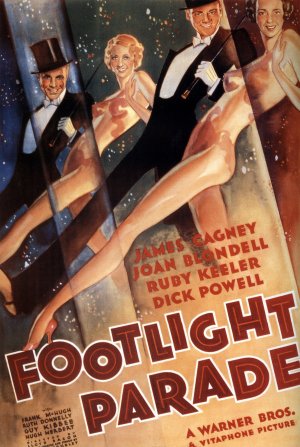
Poster for Footlight Parade. I’m not sure why the girls aren’t wearing clothes.

This week’s musical:
Footlight Parade (1933)– Musical #230

Studio:
Warner Brothers

Director:
Lloyd Bacon

Starring:
James Cagney, Joan Blondell, Ruby Keeler, Dick Powell, Frank McHugh, Guy Kibbee, Ruth Donnelly, Hugh Herbert, Claire Dodd, Gordon Westcott, Arthur Hohl, Billy Barty (uncredited)

Plot:
Chester Kent’s (Cagney) Broadway musicals are failing, because of talking films, so he reinvents himself and begins producing the musical numbers shown before the movie begins. His secretary Nan (Blondell) is in love with him and helps him with ideas, but they learn that some of his ideas are leaking out to other similar agencies. To get a movie theater contract, Chester makes a dormitory out of the theater so that no one can leak the ideas.

Continue reading

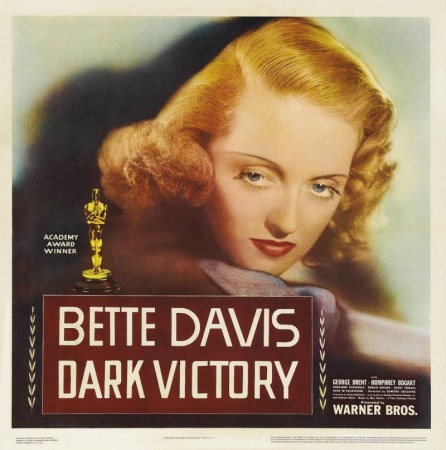
Watching 1939: Dark Victory

In 2011, I announced I was trying to see every film released in 1939. This new series chronicles films released in 1939 as I watch them. As we start out this blog feature, this section may become more concrete as I search for a common thread that runs throughout each film of the year. Right now, that’s difficult. 

1939 film:  Dark Victory (1939)

Release date:  April 20, 1939

Cast:  Bette Davis, George Brent, Humphrey Bogart, Geraldine Fitzgerald, Ronald Reagan, Henry Travers, Cora Witherspoon

Studio:  Warner Brothers

Director:  Edmund Goulding

Plot:
Socialite Judith Traherne (Davis) has been behaving erratically. Many people believe she’s drinking and partying, but her friend Ann King (Fitzgerald) tries to get her to see a doctor. Judith finally sees Dr. Frederick Steele (Brent), who diagnoses Judith with a brain tumor. Dr. Steele does surgery, but will Judith live?

Continue reading

Gidget to Beach Parties: The second wave

In 1963, the Beach Boys’ “Surfin’ USA” peaked on the charts at No. 3, and “Beach Party” became American International Picture’s highest grossing film and created the “beach party” film genre.

The 1960s is called “The Golden Age of Surfing” as Malibu brimmed with people, and the now-popular sport was working its way into music, fashion, cars and films.

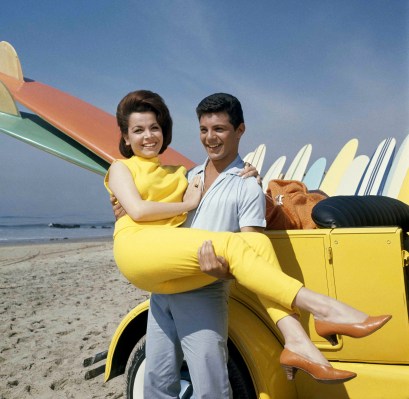
From 1963 to 1968, stars like Annette Funicello and Frankie Avalon caught waves up on the silver screen.

Annette Funicello and Frankie Avalon in their first beach film, “Beach Party.”

These films weren’t academy award winners. Movies like “Beach Blanket Bingo” or “Muscle Beach Party” mainly focused on silly gags, a non-threatening antagonist, and romantic mishaps and fights (everyone ends up together in the end).

Continue reading

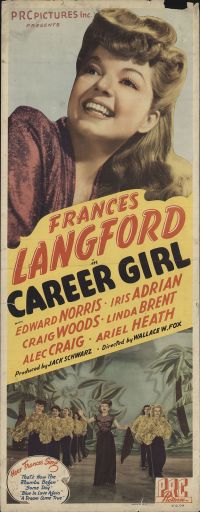
Musical Monday: Career Girl (1944)

It’s no secret that the Hollywood Comet loves musicals.
In 2010, I revealed I had seen 400 movie musicals over the course of eight years. Now that number is over 500. To celebrate and share this musical love, here is my weekly feature about musicals.

This week’s musical:
“Career Girl” (1944)– Musical #590

Studio:
Producers Releasing Corporation

Director:
Wallace Fox

Starring:
Frances Langford, Edward Norris, Iris Adrian, Craig Woods, Linda Brent, Alec Craig, Ariel Heath, Lorraine Krueger, Gladys Blake, Charles Judels, Marcy McGuire, Bess Flowers (uncredited)

Plot:
Joan Terry (Langford) traveled from Kansas City to New York City with hopes to hit it big on Broadway. While she unsuccessfully looks for work, she moves from her hotel to a women’s acting boarding house. There are lots of different personalities in the house: stuck up and catty burlesque queen Thelma (Brent), naïve Sue (Heath) who wants to be in show business, and sassy Glenda (Adrian), who becomes Joan’s good friend. Joan has a fiance in Kansas City who is put out with her career and wants her to come home to marry him, however, Steve (Norris) who is in New York also is wooing Joan.

Continue reading

The Romanovs: 100 years of legends and rumors

One-hundred years ago, on July 17, 1918, the last royal family of Russia—Tsar Nicholas II, Empress Alexandra, their five children and a few aides —were taken into a cellar and assassinated.

Romanov family portrait in 1913

And while this was the end of the Romanovs and the Russian monarchy, it was just the beginning of 100 years of legends, rumors and myths that surrounded the royal family. From a 1928 American film based on Romanov imposter Anna Anderson to a 2016 Broadway musical, the world has been fascinated by the Romanovs. The curiosity doesn’t just revolve around if any of them survived (DNA and science now tell us that they didn’t), but also the relationship with Rasputin, the “mad monk,” the royal lifestyle and the seemingly charmed lives that the grand duchesses lived.

Below are films released from 1928 to 1997 about the last Tsar of Russia and his family:

Continue reading

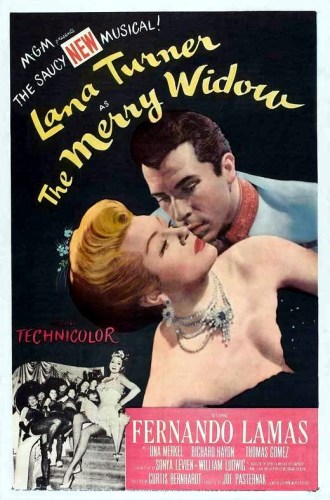
Musical Monday: The Merry Widow (1952)

It’s no secret that the Hollywood Comet loves musicals.
In 2010, I revealed I had seen 400 movie musicals over the course of eight years. Now that number is over 500. To celebrate and share this musical love, here is my weekly feature about musicals.

This week’s musical:
The Merry Widow (1952) – Musical #237

Studio:
Metro-Goldwyn-Mayer

Director:
Curtis Bernhardt

Starring:
Lana Turner, Fernando Lamas, Una Merkel, Richard Haydn, Thomas Gomez, John Abbott, King Donovan, Robert Coote, Lisa Ferraday, Sujata Rubener, Joi Lansing (uncredited), Gwen Verdon (uncredited)

Plot:
Crystal Radek (Turner) is a rich widow of a man from the kingdom of Marshovia, who left $80 million to his widow. Now living in America, she is invited to Marshovia under false pretenses. The kingdom is in financial distress and has invited her there with hopes that playboy Count Danilo (Lamas) will woo and marry Crystal for her money so the country won’t be annexed to Austria. However, Crystal switches place with her secretary Kitty (Merkel) to see if people will love her for herself.

Continue reading

Watching 1939: The Secret of Dr. Kildare (1939)

In 2011, I announced I was trying to see every film released in 1939. This new series chronicles films released in 1939 as I watch them. As we start out this blog feature, this section may become more concrete as I search for a common thread that runs throughout each film of the year. Right now, that’s difficult. 

1939 film: “The Secret of Dr. Kildare”

Release date: Nov. 24, 1939

Cast: Lew Ayres, Lionel Barrymore, Laraine Day, Lionel Atwill, Helen Gilbert, Sara Haden, Nat Pendleton, Samuel S. Hinds, Emma Dunn, Walter Kingsford, Marie Blake, Alma Kruger, Robert Kent, Grant Mitchell, Martha O’Driscoll, Nell Craig, Frank Orth, George Reed, Walter Baldwin (uncredited)

Studio:  Metro-Goldwyn-Mayer

Director:  Harold S. Bucquet

Plot:
Dr. James “Jimmy” Kildare (Ayres) is helping Dr. Gillespie (Barrymore) with research pneumonia causes and cures. At the same moment, Blair General Hospital’s medical head Dr. Carew (Kingsford) wants the doctors to help cure an heiress, Nancy Messenger (Gilbet), when her wealthy father Paul Messenger (Atwill) comes to Dr. Carew for help. Nancy has odd mood swings that are injuring her social and love life. Dr. Gillespie is ill with cancer and is very tired, but wants to continue driving on with the research. To let Dr. Gillespie rest, Dr. Kildare takes Nancy’s case, not letting her know he’s a doctor. Dr. Gillespie is angry about his decision and so is Dr. Kildare’s girlfriend, Nurse Mary Lamont (Day).

1939 Notes:
• This is the fourth Dr. Kildare film out of the 9-film series. This is one of two Dr. Kildare films released in 1939.
• Lionel Barrymore was in four films released in 1939.
• Marie Blake was in eight films released in 1939.
• 1939 helped get Laraine Day her start because she was signed to MGM this year where she found more success. This was her second “Dr. Kildare” film released that year.

Continue reading

Musical Monday: Hit the Deck (1955)

It’s no secret that the Hollywood Comet loves musicals.
In 2010, I revealed I had seen 400 movie musicals over the course of eight years. Now that number is over 500. To celebrate and share this musical love, here is my weekly feature about musicals.

This week’s musical:
Hit the Deck (1955) – Musical #63

Studio:
Metro-Goldwyn-Mayer

Director:
Roy Rowland

Starring:
Jane Powell, Tony Martin, Debbie Reynolds, Ann Miller, Russ Tamblyn, Walter Pidgeon, Vic Damone, Gene Raymond, J. Carrol Naish, Richard Anderson, Jane Darwell, Kay Armen, Alan King, Henry Slate, Alvin Greenman (uncredited), Dabbs Greer (uncredited)

Plot:
Three sailors go on leave — Bill Clark (Martin), Rico Ferrari (Damone), and Danny Smith (Tamblyn). Bill goes to find his girlfriend Ginger (Miller), Rico goes to find his mother (Armen), and Danny goes home to visit his admiral father (Pidgeon) and sister Susan (Powell). The sailors find that everyone is too busy to see them or uninterested in their visit. Danny finds out that his sister Susan is on a date in the hotel room of actor Wendell Craig (Raymond). Danny worries about Susan’s safety and he and his friends break into Wendell’s hotel room to beat him up and protect his sister. Because of this, they have to outrun shore patrol for the remainder of their leave.

Debbie Reynolds in “Hit the Deck”

Trivia:
– The last film Jane Powell made for Metro-Goldwyn-Mayer
– Russ Tamblyn was dubbed by two different people in the film: Rex Dennis and Clark Burroughs
– A version of Follow the Fleet (1936), which starred Ginger Rogers and Fred Astaire
– Kay Armen was billed as “introducing.”

Ann Miller performing in “Hit the Deck”

Notable Songs:
– “Why, Oh Why?” performed by Tony Martin, Russ Tamblyn and Vic Damone, and also by Debbie Reynolds, Jane Powell and Ann Miller
-“Lucky Bird” performed by Jane Powell
– “The Lady from the Bayou” performed by Ann Miller

Jane Powell and Vic Damone in “Hit the Deck”

My review:
Coming off the high of “Seven Brides for Seven Brothers,” singing actress Jane Powell thought she was going to start getting better and more adult roles. However, “Seven Brides” was the beginning of the end of her musical career.

And “Hit the Deck” was her last musical and film at Metro-Goldwyn-Mayer, just a year after “Seven Brides” was released.

“Hit the Deck” is fun and star-studded but it’s not the quality that she hoped for. The cast includes some of MGM’s many musical stars, Jane Powell, Tony Martin, Debbie Reynolds, Ann Miller, Russ Tamblyn, Walter Pidgeon, Vic Damone and Gene Raymond.

Jane Powell is the star of the film, but I do feel like her role takes a backseat to Debbie Reynolds and Ann Miller. They certainly get the better numbers than Powell. However, all three girls are charming.

With the exception of Russ Tamblyn, I’m not a fan of the romantic leads of Tony Martin and Vic Damone, simply because they aren’t my favorite crooners. I do love seeing Walter Pidgeon and Gene Raymond, which is a special treat. Kay Armen is built up with a big “introducing” in the credits. Armen sings a few songs but she didn’t have a large film career.

Along with the large cast, the film is very colorful. But the songs aren’t very catchy (except for “Why, Oh Why.”)

One odd thing is Russ Tamblyn is able to sing but is dubbed in the song “Hallelujah.” And the voice he’s given is ridiculous, especially when he has a high-pitched while performing that song.

While “Hit the Deck” isn’t my favorite musical or one of MGM’s best, but it is an enjoyable way to spend two hours.

Jane Powell and Vic Damone, Ann Miller and Tony Martin, and Debbie Reynolds and Russ Tamblyn

Check out the Comet Over Hollywood Facebook page, follow on Twitter at @HollywoodComet or e-mail at cometoverhollywood@gmail.com

Watching 1939: Four Wives (1939)

In 2011, I announced I was trying to see every film released in 1939. This new series chronicles films released in 1939 as I watch them. As we start out this blog feature, this section may become more concrete as I search for a common thread that runs throughout each film of the year. Right now, that’s difficult. 

1939 film:  Four Wives (1939)

Release date:  Dec. 22, 1939

Cast:  Priscilla Lane, Rosemary Lane, Lola Lane, Gale Page, Claude Rains, Jeffrey Lynn, May Robson, Dick Foran, Eddie Albert, Henry O’Neill, Vera Lewis, John Qualen, Hobart Cavanaugh (uncredited), Ruth Tobey (uncredited), Olin Howland (uncredited), George Reeves (uncredited)
Archived information: John Garfield

Studio:  Warner Brothers

Director:  Michael Curtiz

Plot:
After the death of her husband, Ann (Priscilla Lane) struggles when she learns she is pregnant with his child. She is haunted by his memory, which makes her engagement to Felix (Lynn) difficult and strained. Her sisters Emma (Page) and Thea (Lola Lane) are both trying to become mothers and Kay (Rosemary Lane) falls in love with a young doctor (Albert).

1939 Notes:
• The Lane sisters (Priscilla, Rosemary and Lola) were in two movies together released in 1939. Rosemary Lane was in five films released in 1939, and Lola Lane was in two films released in 1939.
• Priscilla Lane was in five movies released in 1939 and she co-starred with Jeffrey Lynn in four of them: Four Wives, Yes, My Darling Daughter, Daughters Courageous and Roaring Twenties. Jeffrey Lynn was in six films in 1939.
• Gale Page was in six films released in 1939.
• The second in the trilogy of films starring the Lane Sisters and Gail Page. The movies include “Four Daughters” (1938), “Four Wives” (1939) and “Four Mothers” (1941)
• One of four films directed by Michael Curtiz released in 1939.
• Eddie Albert’s third film. Albert made two films in 1939.
• Dick Foran was in four films released in 1939.
• Claude Rains was in five films released in 1939.

Jeffrey Lynn and Priscilla Lane in “Four Wives”

Other trivia: 
• While John Garfield’s character died in “Four Daughters,” he makes an appearance in memories in “Four Wives.”
• Based on a magazine story called “Sister Act” by Fannie Hurst, published in Cosmopolitan magazine.
• In response to the success of “Four Daughters” (1938), “Four Wives” and “Four Mothers” (1941) followed in the trilogy. “Daughters Courageous” was made in 1939 in response to the success of “Four Daughters.” “Daughters Courageous” was not part of the trilogy but had a similar formula and the same cast. Michael Curtiz directed “Four Wives” and “Daughters Courageous” in 1939.
• Michael Curtiz only directed the first two films, “Four Daughters” (1938) and “Four Wives” (1939). “Four Mothers” (1941) was directed by William Keighley.
• Working titles were Family Reunion, Family Affair, American Family and Sister Act.

John Garfield appears briefly in “Four Wives” from clips from “Four Daughters”

My review: Searching for the “1939 feature”:
With the success of “Four Daughters” (1938), starring the Lane Sisters and Gale Page, a few films followed: two more films in the series “Four Wives” and “Four Mothers,” and another separate film “Daughters Courageous.”

Priscilla Lane, Lola Lane, Gail Page, Rosemary Lane in a publicity photo for “Four Wives”

While some film sequels (like some of the Gidget films) aren’t great, “Four Wives” is a good sequel to “Four Daughters.” When I first saw the movie in high school, I remember feeling frustrated that the romance between Priscilla Lane and Jeffrey Lynn wasn’t picture-perfect. However, now I think it makes it more interesting that we see Priscilla Lane’s character struggle with the death of her husband and having his child, though their marriage wasn’t ideal.

However, for me the highlight was Eddie Albert in his third film role and looking as handsome and adorable can be.

While Priscilla Lane and Jeffrey Lynn were in several films together throughout the 1930s and 1940s, 1939 paired them together four times: Four Wives, Yes, My Darling Daughter, Daughters Courageous and Roaring Twenties.

The film has plenty of dramatic moments, but there are also several humorous ones, particularly with May Robson, Eddie Albert. Frank McHugh and Lola Lane.

The film leaves off with the sisters and their new babies, leaving room for a third film: “Four Mothers,” which was the last film pairing of the Lane sisters and Gail Page.

Check out the Comet Over Hollywood Facebook page, follow on Twitter at @HollywoodComet or e-mail at cometoverhollywood@gmail.com

Musical Monday: Star Spangled Rhythm (1942)

It’s no secret that the Hollywood Comet loves musicals.
In 2010, I revealed I had seen 400 movie musicals over the course of eight years. Now that number is over 500. To celebrate and share this musical love, here is my weekly feature about musicals.

This week’s musical:
Star Spangled Rhythm (1942) – Musical #418

Studio:
Paramount

Director:
George Marshall, A. Edward Sutherland (uncredited)

Starring:
Betty Hutton, Eddie Bracken, Victor Moore, Walter Abel, Anne Revere (uncredited)

Themselves: Bing Crosby, Bob Hope, Fred MacMurray, Franchot Tone, Ray Milland, Dorothy Lamour, Paulette Goddard, Vera Zorina, Mary Martin, Dick Powell, Veronica Lake, Alan Ladd, Eddie ‘Rochester’ Anderson, William Bendix, Jerry Colonna, Macdonald Carey, Susan Hayward, Marjorie Reynolds, Betty Jane Rhodes, Dona Drake, Lynne Overman, Gary Crosby, Johnny Johnston, Arthur Treacher, Walter Catlett, Sterling Holloway, Cecil B. DeMille, Preston Sturges, Ellen Drew, Eva Gabor, Frances Gifford, Susanna Foster, Diana Lynn, Jimmy Lydon, Robert Preston, Irving Bacon (uncredited), Karin Booth (uncredited), Woody Strode (uncredited)

Plot:
Sailor Johnny Webster (Bracken) is home on leave and believes his father William Webster (Moore), a former silent film star, is the head of Paramount Studios. In reality, his father is just a security guard at the studio. His father made a promise to put on a star-studded performance for the Naval base. The last 40 minutes of the film is the Naval skit.

Continue reading