It’s no secret that the Hollywood Comet loves musicals. In 2010, I revealed I had seen 400 movie musicals over the course of eight years. Now that number is over 500. To celebrate and share this musical love, here is my weekly feature about musicals.
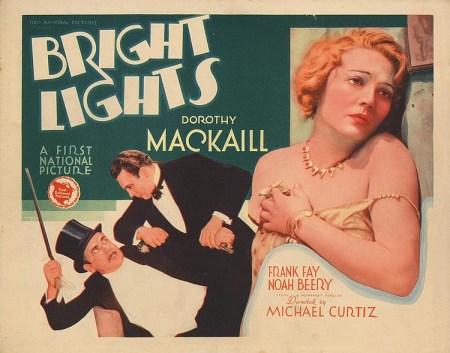
This week’s musical: Bright Lights (1930) – Musical #592
Studio:
Warner Brothers
Director:
Michael Curtiz
Starring:
Dorothy Mackaill, Frank Fay, Noah Beery, Daphne Pollard, Inez Courtney, Frank McHugh, Tom Dugan, James Murray, Edward J. Nugent, Philip Strange, Louise Beavers (uncredited), John Carradine (uncredited)
Plot:
Broadway star Louanne (Mackaill) is retiring from the stage to marry a society gentleman. However, he doesn’t know her colorful past, which she shares a watered down version to the press. Throughout her scandalous past of hula dancing at honky tonks in the Congo and dancing at a carnival show, Wally (Fay) was with her the whole time, who is in love with her. On the eve of her marriage, someone from her past shows up in the audience.
It’s no secret that the Hollywood Comet loves musicals. In 2010, I revealed I had seen 400 movie musicals over the course of eight years. Now that number is over 500. To celebrate and share this musical love, here is my weekly feature about musicals.
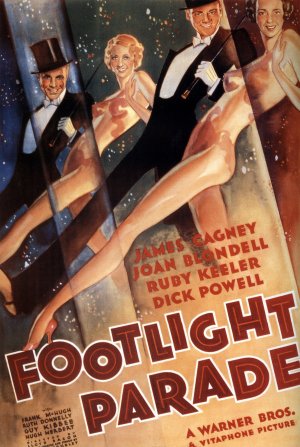
Poster for Footlight Parade. I’m not sure why the girls aren’t wearing clothes.
This week’s musical:
Footlight Parade (1933)– Musical #230
Studio:
Warner Brothers
Director:
Lloyd Bacon
Starring:
James Cagney, Joan Blondell, Ruby Keeler, Dick Powell, Frank McHugh, Guy Kibbee, Ruth Donnelly, Hugh Herbert, Claire Dodd, Gordon Westcott, Arthur Hohl, Billy Barty (uncredited)
Plot:
Chester Kent’s (Cagney) Broadway musicals are failing, because of talking films, so he reinvents himself and begins producing the musical numbers shown before the movie begins. His secretary Nan (Blondell) is in love with him and helps him with ideas, but they learn that some of his ideas are leaking out to other similar agencies. To get a movie theater contract, Chester makes a dormitory out of the theater so that no one can leak the ideas.
It’s no secret that the Hollywood Comet loves musicals. In 2010, I revealed I had seen 400 movie musicals over the course of eight years. Now that number is over 500. To celebrate and share this musical love, here is my weekly feature about musicals.
Director:
Several directors worked on this film and were uncredited: Richard Boleslawski, Allan Dwan, Edmund Goulding, Russell Mack, Charles Reisner, Roy Rowland, George Stevens and Sam Wood
Starring:
Jimmy Durante, Lupe Velez, Jack Pearl, Polly Moran, Charles Butterworth, Eddie Quillan, June Clyde, George Givot, Richard Carle, Tom Kennedy, Irene Hervey (uncredited), Curly Howard (uncredited), Moe Howard (uncredited),
As themselves: Stan Laurel, Oliver Hardy, Mickey Mouse (animated and voiced by Walt Disney), Robert Young (uncredited)
It’s no secret that the Hollywood Comet loves musicals. In 2010, I revealed I had seen 400 movie musicals over the course of eight years. Now that number is over 500. To celebrate and share this musical love, here is my weekly feature about musicals.
Starring:
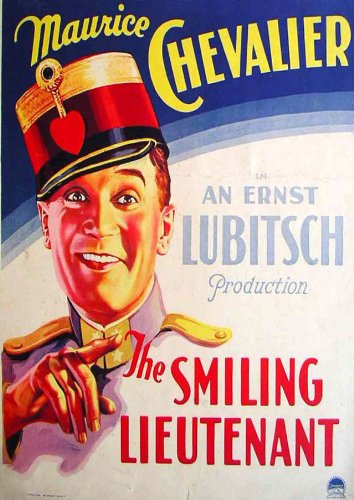
Maurice Chevalier, Claudette Colbert, Miriam Hopkins, Charles Ruggles, George Barbier, Hugh O’Connell, Elizabeth Patterson (uncredited)
Plot:
While Lt. Nikolaus ‘Niki’ von Preyn (Chevalier) is standing at attention for the visiting king of Flausenthurm, he winks at his girlfriend Franzi (Colbert). The king (Barbier) is furious, thinking Niki is laughing at his daughter, the Princess Anna (Hopkins). To escape a potential court marshall, Niki says he was winking at Princess Anna, which complicates his love life.
It’s no secret that the Hollywood Comet loves musicals. In 2010, I revealed I had seen 400 movie musicals over the course of eight years. Now that number is over 500. To celebrate and share this musical love, here is my weekly feature about musicals.
This week’s musical:
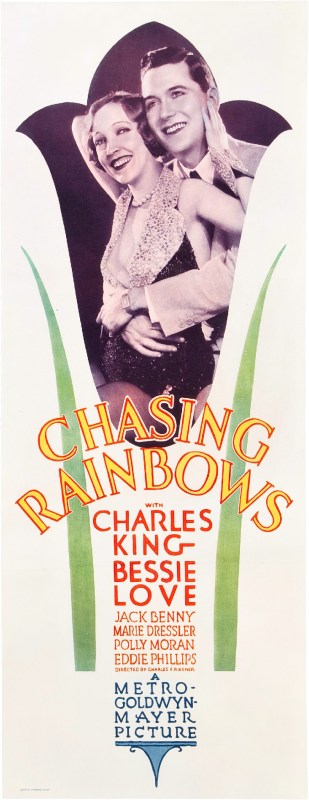
Chasing Rainbows (1930) – Musical #355
Studio:
Metro-Goldwyn-Mayer
Director:
Charles Reisner
Starring:
Bessie Love, Charles King, Jack Benny, George K. Arthur, Polly Moran, Marie Dressler, Gwen Lee, Nita Martan, Eddie Phillips, Ann Dvorak (uncredited)
Plot:
A group of actors travels across the country, touring their show. Carlie (Love) is in love with her vaudeville partner Terry (King), who falls in love with every leading lady.
Trivia:
-Introduced the song “Happy Days Are Here Again”
-The original released included a two-strip Technicolor finale, which is now lost.
-First titled “Road Showed”
-First film Jack Benny made in Hollywood, though not the first film released with him in it
Highlights:
-Marie Dressler sing/talk
Notable Songs:
-“Happy Days Are Here Again” performed by Charles King and the chorus
-“Lucky Me, Lovable You” performed by Charles King
-“My Dynamic Personality” performed by Marie Dressler
My review:
As I have noted before, musicals made shortly after the dawn of sound can be haphazard. Songs may be thrown in or randomly performed that don’t seem to fit in with the plot and dance numbers can be clumsy.
However, “Chasing Rainbows” is an exception. The mix of song and plot are done a little better in “Chasing Rainbows.” Perhaps it works better because the lead characters are in a musical show. So some songs are their performances, and others are to the person that they love.
What’s interesting is that our two leads, Charles King and Bessie Love, were both mainly done with Hollywood in 1931. Bessie Love’s career picked back up in 1950, when she started playing small roles in film and TV, but nothing at the caliber she was once at.
The actors that went on to be the biggest stars were the supporting characters: Marie Dressler and Jack Benny.
But “Chasing Rainbows” is disappointing, but it is not the fault of the director, writers or actors. When the film was released in 1930, the end of the film shift from black and white to 2-strip Technicolor finale with three songs, including Bessie Love and Charles King singing “Everybody Tap,” Charles King singing “Love Ain’t Nothin’ But the Blues” and Marie Dressler reprising “My Dynamic Personality.”
However, this footage is lost and the movie ends abruptly. Bessie Love runs out of her dressing room and the movie ends. It would have been amazing to see that number that is now lost. It is also curious that the film preservationists chose not to add a photo still with a song playing over it, like is done in so many films with lost portions. But perhaps that wasn’t an option.
It’s no secret that the Hollywood Comet loves musicals. In 2010, I revealed I had seen 400 movie musicals over the course of eight years. Now that number is over 500. To celebrate and share this musical love, here is my weekly feature about musicals.
Studio:
Hal Roach Studios
Distributed by Metro-Goldwyn-Mayer
Director:
Gus Meins, Charley Rogers
Starring:
Stan Laurel, Oliver Hardy, Virginia Karns, Charlotte Henry, Felix Knight, Florence Roberts, Henry Brandon, Scotty Beckett (uncredited), Ellen Corby (uncredited), Dickie Jones (uncredited), Gene Reynolds (uncredited), Marie Wilson (uncredited)
Plot:
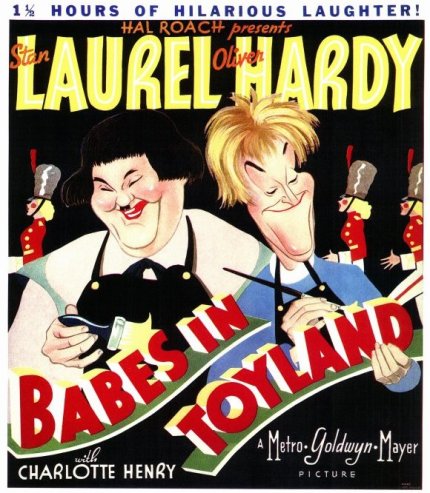
Silas Barnaby (Brandon) is the meanest man in the town of Toyland. He is demanding the mortgage from Mother Peep, the old woman who lives in the shoe (Roberts). Barnaby also wants to marry Bo-Peep (Henry), who refuses him. Along with all of Mother Peep’s children, Stannie Dee (Laurel) and Ollie Dum (Hardy) also live in the shoe. When they can’t pay the mortgage, Bo-Peep agrees to marry Barnaby, but Stannie Dee and Ollie Dum help her trick him into marrying a decoy. To get revenge, Barnaby frames Tom-Tom (Knight), who loves Bo-Peep, for kidnapping one of the Three Little Pigs.
It’s no secret that the Hollywood Comet loves musicals. In 2010, I revealed I had seen 400 movie musicals over the course of eight years. Now that number is over 500. To celebrate and share this musical love, here is my weekly feature about musicals.
Starring:
Alice White, John Miljan, Jack Mulhall, Blanche Sweet, Ford Sterling, Virginia Sale, Herman Bing
Plot:
Dixie Dugan (White) is in a failed Broadway show, “Rainbow Girl.” She meets director John Buelow (Miljan) who gives the illusion that he is high powered in Hollywood and convinces her to leave New York to pursue a Hollywood career. Unsurprisingly when Dixie gets to Hollywood, she is now welcomed with open arms. Dixie befriends a “has been” actress Donna Harris (Sweet), who tries to warn her and show her the ropes. Dixie’s boyfriend (Mulhall) who wrote the failed Broadway show is invited to Hollywood to make “Rainbow Girl” into a film. Dixie is cast, but stardom goes to her head.
Trivia:
-The finale reel was filmed in Technicolor but this print no longer survives.
-Belle Mann dubbed Alice White
-Based on Joseph Patrick McEvoy’s 1929 novel, Hollywood Girl
-This film follows Show Girl (1928) where Alice White plays Dixie Dugan. It is followed by “Dixie Dugan” (1943) where Lois Andrews plays the role of Miss Dugan.
-A French version was made (Le masque d’Hollywood (1930)) starring Suzy Vernon, Geymond Vital, Rolla Norman
Highlights:
-Showing how films are made and giving a behind the scenes feel
-Cameo appearances by Al Jolson, Ruby Keeler, Noah Beery, Noah Beery, Jr.; Walter Pidgeon, and Loretta Young
Notable Songs:
-“There’s a Tear for Every Smile in Hollywood” performed by Blanche Sweet
-“I’ve Got My Eye on You” performed by Alice White, dubbed by Belle Mann
-“Hang On to a Rainbow” performed by Alice White, dubbed by Belle Mann
My review:
A few weeks ago, I reviewed Alice White’s first talkie, “Broadway Babies,” which I thought was only mediocre. “Show Girl in Hollywood” is perhaps slightly better but still rather bland and clumsy.
I also still don’t feel endeared to Alice White. She’s cute and spunky but she just isn’t a great actor. Probably the best performance in the film comes from Blanche Sweet, who I wasn’t familiar with prior, but her film career began in 1909. Sweet’s character tells Alice White that Hollywood no longer wants you after age 30 and not to take success for granted. Unfortunately, life seems to imitate art here, as Sweet only made one more film in 1930. Sweet retired in 1935 when she got married and would not make another film or TV appearance until 1958, the same year her husband passed away.
Blanche Sweet in “Show Girl in Hollywood”
“Miss Sweet plays her part so well that she puts Miss White in the shade,” wrote New York Times film critic Mordaunt Hall in his May 5, 1930, review.
Rather than the actors and main characters, the setting is the most interesting aspect of this film is the “behind the scenes” feel of Hollywood. It’s one of those Hollywood films about Hollywood, which are usually fun. We see a film being edited, the light crew, the cameras rolling, giving the audience a feeling that they are being let into how Hollywood works. Dixie even ignores the red filming light, walks onto a sound stage, to see a gangster film being shot. Two men are struggling and it looks like one is about to go out a window, then Dixie walks up and appears in the window the man is about to fall out, ruining the shot. This showed audiences how films were made.
We end with a Graumann’s premiere with cameos from actors like Loretta Young and Al Jolson with actress and wife Ruby Keeler all giving glowing remarks about the fictional film, “Rainbow Girl. These cameos are the most exciting part of the film. I hadn’t read ahead about the film so the cameos were a surprise and a treat.
During the premiere, we see the film’s big finale and the camera pans back as if we are watching it on the screen with the rest of the audience. If only the film had ended with that, showing that Dixie Dugan was triumphant, having her own film be the actual film’s ending. But no, Alice White and Jack Mulhall go up on stage (introduced by Walter Pidgeon) to sheepishly tell the audience that it will be a little until the make another film because they are getting married. It’s painful to watch and I just thought “no one in the audience cares and neither do I.”
If you enjoy (what the kids today call) a “meta” film, take a look at this one. The behind-the-scenes film is interesting, but the actual story and lead actors are not.
It’s no secret that the Hollywood Comet loves musicals. In 2010, I revealed I had seen 400 movie musicals over the course of eight years. Now that number is over 500. To celebrate and share this musical love, here is my weekly feature about musicals.
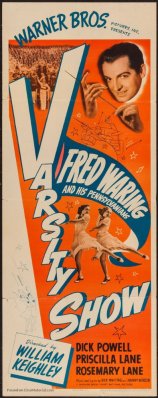
This week’s musical: Varsity Show (1937) – Musical #99
Studio:
Warner Brothers
Director:
William Keighley
Starring:
Dick Powell, Rosemary Lane, Priscilla Lane, Ted Healy, Walter Catlett, Sterling Holloway, Johnnie Davis, Lee Dixon, Ford Washington Lee, John William Sublett, Mabel Todd, Edward Brophy, Fred Waring and His Pennsylvanians, Carole Landis (uncredited)
Plot:
Winfield College students (Lane, Lane, Healy, Holloway, Davis) need a successful varsity show. The last few years have been a flop and the old-fashioned staff is ready to outlaw swing in the shows. The students try to get alumnus Chuck Daly (Powell), who is now on Broadway, to stage their show. While they think he’s a New York success, his shows have been flops.
It’s no secret that the Hollywood Comet loves musicals. In 2010, I revealed I had seen 400 movie musicals over the course of eight years. Now that number is over 500. To celebrate and share this musical love, here is my weekly feature about musicals.
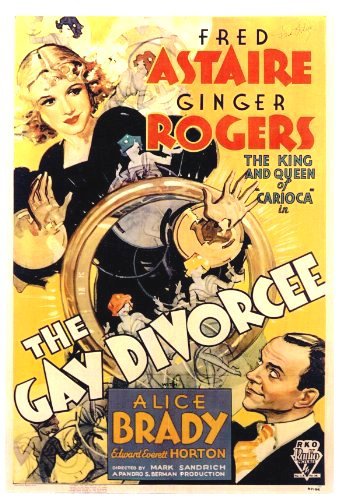
Starring:
Ginger Rogers, Fred Astaire, Alice Brady, Edward Everett Horton, Eric Blore, Erik Rhodes, William Austin, Betty Grable, Lillian Miles
Plot:
Mimi (Rogers) is traveling with her Aunt Hortense (Brady) and is looking for a
Trivia:
-This was Fred Astaire and Ginger Rogers’ second film together (out of 10 films). Following their success in “Flying Down to Rio” (1933), RKO teamed them together again.
-“The Continental” lasts 17.5 minutes. This was the longest musical number until Gene Kelly’s ballet in “An American In Paris” (1951).
-The Academy Awards for 1934 were the first to include the category for Best Original Song. Con Conrad and Herb Magidson were the first to receive this award for “The Continental.”
-Based on the 1932 Broadway show “The Gay Divorce,” which starred Fred Astaire and Claire Luce. For the film, the title was changed to “Divorcee.” Fred Astaire’s autobiography “Steps in Time” says the change was to show that the film was about the amorous adventures of a woman.
It’s no secret that the Hollywood Comet loves musicals. In 2010, I revealed I had seen 400 movie musicals over the course of eight years. Now that number is over 500. To celebrate and share this musical love, here is my weekly feature about musicals.
Starring:
Charles Kaley, Marion Shilling, Cliff Edwards, Gwen Lee, Ethelind Terry, Rubin, Jack Benny (uncredited voice on radio), Ann Dvorak (uncredited), Mary Doran (uncredited)
Plot:
Roy (Kaley) is a jerk of a songwriter who uses his old romances and love letters as inspiration for his songs. He even attempts to capitalize off his friend’s death through a song.


 ” (1934) – Musical #576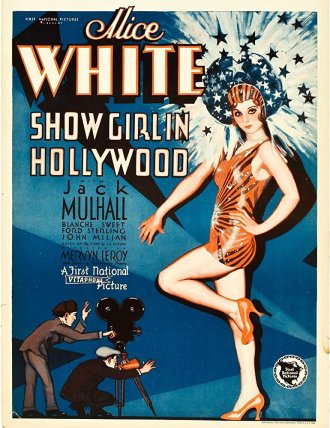
 (1930) – Musical #573