We’ll be attending our fourth Turner Classic Movies Film Festival, which is Thursday, April 28, through Sunday, May 1.
For those who have never attended, this is like a film 10k — no running (you may power walk between film — but equally as exhausting. From 9 a.m. to after 12 a.m., you watch classic film after classic film with other fans who know and love Cary Grant or Roland Young as much as you do.
Though you are sleep and food deprived (you either watch films, pack snacks or skip a film to eat) the TCM Film Festival is truly Walt Disney World for classic film fans.
It’s no secret that the Hollywood Comet loves musicals. In 2010, I revealed I had seen 400 movie musicals over the course of eight years. Now that number is over 500. To celebrate and share this musical love, here is my weekly feature about musicals.
Starring:
Marion Davies, Bing Crosby, Fifi D’Orsay, Stuart Erwin, Ned Sparks, Patsy Kelly, Bobby Watson, Sterling Holloway (uncredited)
Plot:
Sylvia Bruce (Davies) is board as a French teacher at Briarcroft’s School for Girls. After hearing a romantic tune on the radio performed by Bill Williams (Crosby), Sylvia packs her bags to head out to find excitement, romance and to thank Bill for inspiring her. Bill is heading to Hollywood to make a film with French actress Lili Yvonne (D’Orsay) and Sylvia follows him.
Film composer Bernard Herrmann is mostly known for a film that he originally disliked.
“When we left the screening of ‘Psycho,’ he said, ‘Wasn’t that the biggest piece of crap you’ve ever seen?’” said the film composer’s eldest daughter, Dorothy Herrmann. “Daddy had no use for Psycho until it became a cult classic.”
However, those shrieking, staccato violins that played during a rather violent shower scene is may be what he’s best known for.
Dorothy Herrmann spoke last weekend during a Bernard Herrmann festival—from April 15 through April 17—in Washington, D.C. The PostClassical Ensemble, Georgetown University, AFI Silver and the National Gallery of Art co-hosted one of few festivals that celebrates the composer’s life and career in film, radio and symphony.
Along with the weekend celebration, AFI Silver screened films scored by Herrmann throughout the month including “Hangover Square,” “Vertigo” and “The Bride Wore Black.”
Along with myself, fans and Herrmann’s family traveled from Kentucky, New York, Mississippi, North Carolina, California and Pennsylvania, to pay tribute to the composer. During the weekend festival, Herrmann historians and musicologists delved into the composer’s work.
It’s no secret that the Hollywood Comet loves musicals. In 2010, I revealed I had seen 400 movie musicals over the course of eight years. Now that number is over 500. To celebrate and share this musical love, here is my weekly feature about musicals.
Starring:
Shirley Temple, George Murphy, Jimmy Durante, Phyllis Brooks, Edna May Oliver, Donald Meek, Edward Ellis, El Brendel
Themselves: The Brian Sisters- Betty Brian, Doris Brian, Gwen Brian; The Brewster Twins (Barbara and Gloria Brewster)
Plot:
Orphan Betsy Brown (Temple)is adopted by friends of her parents- Pop Shea (Edward Ellis) and his daughter Barbara (Phyllis Brooks) who run a hotel for performers. However, the hotel lead is held by Sarah Wendling (Oliver) and her brother Willoughby (Meek), and Sarah hates the show business tenants and looks for every way to shut down the hotel. However, when Sarah’s nephew Roger (Murphy) meets Betsy, he’s instantly taken with the child and finds himself attracted to Barbara. Roger sets out to help the show business hotel stay open.
It’s no secret that the Hollywood Comet loves musicals. In 2010, I revealed I had seen 400 movie musicals over the course of eight years. Now that number is over 500. To celebrate and share this musical love, here is my weekly feature about musicals.
Plot:
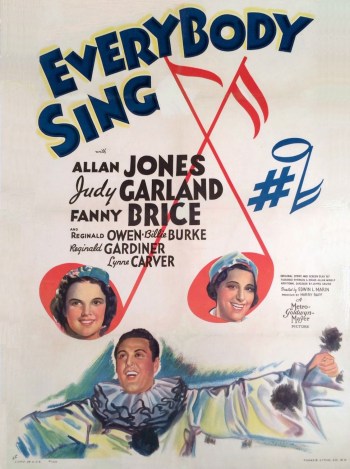
Judy (Garland) is constantly getting in trouble and expelled from her private school. She’s expelled again when she starts singing swing in her music class. When she returns home, she finds her madcap family: her actress mother (Burke), playwright father (Gardner), mother’s protegee (Owen), Russian Maid (Brice), singing cook (Jones), and ambitious older sister (Carver). No one will listen to Judy when she tries to tell them she’s expelled, no one will listen to her and they are too wrapped up in their affairs to pay attention. When her parents try to send her abroad, she escapes and gets a starring role in a musical show.
It’s no secret that the Hollywood Comet loves musicals. In 2010, I revealed I had seen 400 movie musicals over the course of eight years. Now that number is over 500. To celebrate and share this musical love, here is my weekly feature about musicals.
Starring:
Tom Drake as Richard Rodgers and Mickey Rooney as Lorenz Hart
Also Starring: June Allyson, Cyd Charisse, Perry Como, Vera-Ellen, Judy Garland, Betty Garrett, Lena Horne, Gene Kelly, Janet Leigh, Jeannette Nolan, Richard Quine, Ann Sothern, Clinton Sundberg, Marshall Thompson, Mel Torme
Plot:
Fictional biographical film of the songwriters Richard Rodgers and Lorenz Hart, chronicling their success on Broadway, abroad and in Hollywood.
Songwriters Richard Rodgers and Lorenz Hart in the 1930s. Their career is portrayed in “Words and Music.”
Trivia:
-The project started in 1946 and was originally titled, “With a Song in My Heart” and then “Easy to Remember,” according to A Ship Without A Sail: The Life of Lorenz Hart by Gary Marmorstein.
-Richard Rodgers hated the movie, according to Marmostein’s book.
-Lyricist Lorenz Hart, who Mickey Rooney plays in the film, died in 1943 at age 48. Richard Rodgers was 46 when this film was released and passed away in 1979. After Hart passed away, Rodgers became songwriting partners with Oscar Hammerstein.
-“Words and Music” was Perry Como’s first film with MGM after signing a seven-year contract. His MGM career ended promptly with this film after he sang happy birthday to Louis B. Mayer and ended it with an insult, according to the book Perry Como: A Biography and Complete Career Record by Malcolm Macfarlane, Ken Crossland.
-Mickey Rooney and Judy Garland’s last on-screen performance.
-Perry Como had two songs deleted from the film: “You’re Nearer” and “Lover,” according to the Malcolm Macfarlane and Ken Crossland book.
-Tom Drake is dubbed by Bill Lee
-Cyd Charisse is dubbed by Eileen Wilson
Highlights:
-The all-star cast
-Judy Garland and Mickey Rooney’s performance of “I Wish I Was in Love Again”
Notable Songs:
-“Manhattan” performed by Mickey Rooney
-“Mountain Greenery” performed by Perry Como
-“Where’s That Rainbow?” performed by Ann Sothern
-“On Your Toes” performed by Cyd Charissed (dubbed by Eileen Wilson) and Dee Turnell
-“Thou Swell” performed by June Allyson
-“The Lady Is A Tramp” performed by Lena Horne
– “I Wish I Were in Love Again” performed by Judy Garland and Mickey Rooney
-“Slaughter on Tenth Avenue” danced by Gene Kelly and Vera-Ellen
My review:
“Nice music, poor plot.”
This was the general consensus among the film critics after “Words and Music” had its New York City premiere on Dec. 8, 1948. And 68 years later, these critics still aren’t wrong.
This movie is in gorgeous Technicolor, has a fantastic cast of nearly all of MGM’s major musical stars, and beautiful songs with breathtaking dances. But somehow it falls short due to the story.
“Words and Music” is a musical film where the plot weaves in and out of a patchwork of musical numbers. While this format is bizarre and a little difficult to follow, it wasn’t uncommon during this time for a musical picture to mainly be a revue of song and dance with a tiny bit of plot sprinkled in. MGM did the same thing (but a little better) in 1946 with the musical “Till the Clouds Roll By”—A film about Jerome Kern. Warner Brothers had a comparable format with their 1943 film “This is the Army,” where the story halts for 45 minutes of a musical show.
But the musical numbers aren’t the problem, in fact they are the high spots of the film. We have the opportunity to see Ann Sothern in the gorgeous Technicolor number “Where’s My Rainbow?,” June Allyson adorably in the “Connecticut Yankee” number “Thou Swell,” and Lena Horne give the best rendition that ever existed of “The Lady is a Tramp.”
Mickey Rooney as Lorenz Hart and Tom Drake as Richard Rodgers
The issue is the terrible and inaccurate biographical plot line. I like Tom Drake, but he’s not a very strong leading man while playing songwriter Richard Rodger. And Mickey Rooney is over the top and fairly ridiculous as the ill-fated Lorenz Hart.
Hart had a troubled life that involved alcoholism. He also was tormented by the fact that he was only five feet tall and was a homosexual in a time where this was not embraced by society, according to the book A Ship Without A Sail: The Life of Lorenz Hart by Gary Marmorstein.
Ann Sothern gorgeous in Technicolor in the number “Where’s My Rainbow” (Comet Over Hollywood screenshot)
Unsurprisingly though, none of this is detailed in the film. “Words and Music” depicts Hart as what New York Times writer Wilfrid Sheed quipped: “a lovelorn dwarf.” In the film, Hart’s character is turned down by a fictional love interest played by Betty Garrett in the 1920s and hasn’t gotten over it 20 years later.
There is even an odd but comical scenes where Mickey Rooney buys elevated shoes to be taller to impress the girl.
Aside from Hart’s personal life, the timeline of this film is confusing. For starters, Hart holds a huge party when he first moves to Hollywood and performs a song with guest Judy Garland. It’s an energetic and standout scene in the film—until you stop and realize that in real life this didn’t happen. Hart moved to Hollywood in the early 1930s when Garland was still a little girl.
On a bittersweet note—Rooney and Garland’s performance of “I Wish I Were in Love Again” is also memorable because it was their last on-screen performance after starring together in 10 films through the late-1930s and early-1940s.
June Allyson in the number “Thou Swell” with twins Ramon Blackburn and Royce Blackburn (Comet Over Hollywood screenshot)
The musical numbers in the film also aren’t in chronological order of the years they opened on Broadway, making the story a little more confusing and “patchwork” like. For example, the film starts with the 1926 play “Peggy Ann,” then goes to the 1936 play “On Your Toes” and then back to a 1926 musical, “The Girl Friend.” While an average 1948 moviegoer may not notice this, it’s a little confusing if you are doing research or know when these musicals were on the stage.
Lastly, audiences have the opportunity to see Perry Como, aka Mr. Cool, in his first and only Metro-Goldwyn-Mayer film. Como plays a fictional pal to Rodgers and Hart at the beginning of the film. However, at the end of the movie during a tribute to Lorenz Hart, Gene Kelly introduces Perry Como as…Perry Como. Someone didn’t think that out well.
While inaccuracies in musical biopics are nothing new, it’s simply that those in “Words and Music” are awfully clumsy. Despite that, “Words and Music” is an excellent showcase of MGM’s talented singers and dancers: from Cyd Charisse, Lena Horne, June Allyson, Gene Kelly, Mel Torme, Vera-Ellen and of course, Judy Garland.
Even grumpy New York Times film critic Bosley Crowther said in his Dec. 10, 1948 review: To be sure, there is much that is appealing—especially to us reminiscent folks—about certain of the musical numbers that sit like islands in the swamp of the plot. It is pleasant to hear Betty Garrett, for a starter, sing “There’s a Small Hotel” or to watch little crinkle-faced June Allyson head a big production rendering of “Thou Swell.” There is melody and magnificence in a richly-staged dance spectacle which packages two or three numbers, notably “The Girl Friend” and “This Can’t Be Love.” And it is nice to watch Perry Como and Cyd Charisse do “Blue Room” in pastels.
If you give this one a chance, I suggest drinking in the Technicolor costumes, catchy songs and mesmerizing dance steps and ignore the plot.



 ” (1933)– Musical #123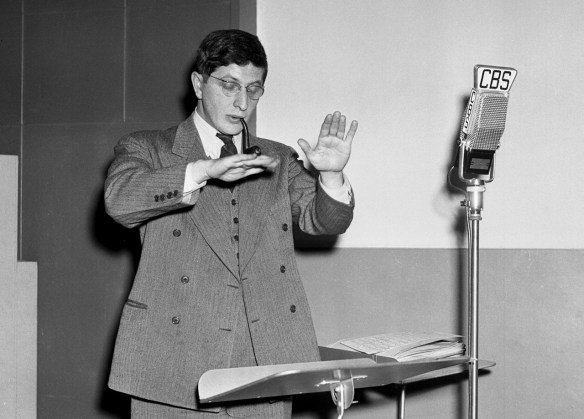
 –Musical #287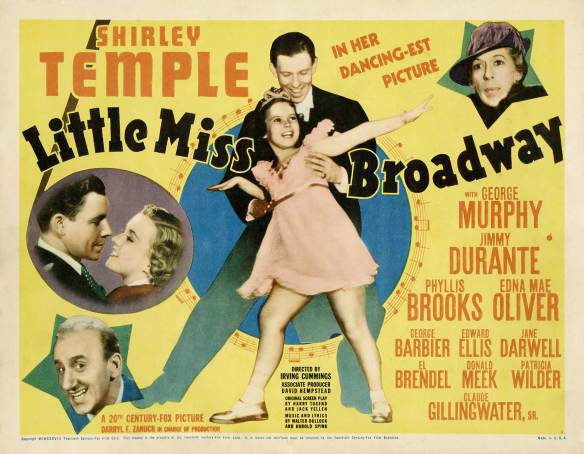
 –Musical #540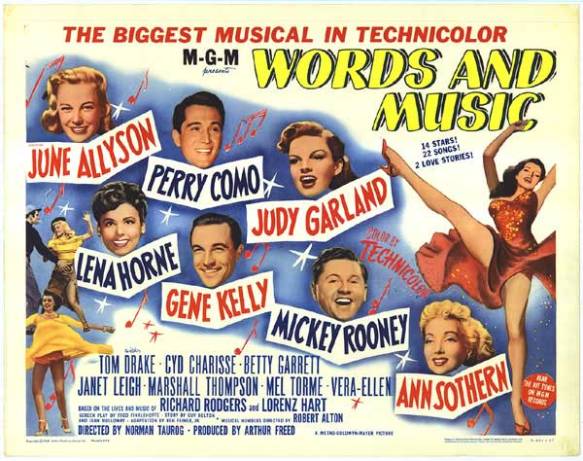

 by Gary Marmorstein.
 by Malcolm Macfarlane, Ken Crossland.
 ” performed by Judy Garland and Mickey Rooney

 Comet Over Hollywood