Musical Monday: “Jupiter’s Darling” (1955)

It’s no secret that the Hollywood Comet loves musicals.
In 2010, I revealed I had seen 400 movie musicals over the course of eight years. Now that number is over 500. To celebrate and share this musical love, here is my weekly feature about musicals.


Jupiters-darling-1955This week’s musical:

“Jupiter’s Darling” – Musical #110

Studio:
Metro-Goldwyn-Mayer

Director:
George Sidney

Starring:
Esther Williams, Howard Keel, Marge Champion, Gower Champion, George Sanders, William Demarest, Richard Haydn, Norma Varden

Plot:
A fabricated tale based on a historical event set in 216 B.C. when Hannibal (Keel) marched on Rome. Amytis (Williams) is the fiance to Roman dictator Fabius (Sanders). Curious and spirited Amytis hears Hannibal is attractive and wants to check out him, his troops and elephants that are stationed outside Rome. Amytis and her slave girl, Meta (Champion), are captured and brought to Hannibal. Amytis charms Hannibal, purposefully delaying he and his troops from attacking Rome.

Trivia:
-Remake of “The Private Life of Helen of Troy” (1927) which starred Maria Corda, Lewis Stone, Ricardo Cortez and Alice White.
-Esther William’s singing was dubbed by Jo Ann Greer.
-In the film, Esther Williams’ character rides a horse that dives off of a cliff into water. Esther Williams wrote in her autobiography, “Million Dollar Mermaid” that director George Sidney wanted her to do the stunt but she refused. Stunt man Al Lewin performed the stunt and broke his back in the process.
-Esther Williams’ last film made under contract at Metro-Goldwyn-Mayer.
-The pool Williams swims in was modeled after William Randolph Hearst’s pool at his estate, San Simeon, according to Esther Williams’ autobiography.
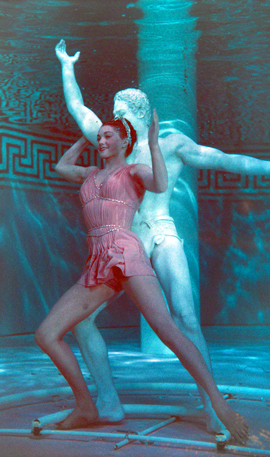
-The “underwater statues” in the “I Have a Dream” underwater sequence were secured to the bottom of the pool wearing cleats, according to Williams’ autobiography.
-Williams broke her left eardrum, which had been broken five times before in films, while swimming in the 25 feet deep pool for the “I Have a Dream” sequence, according to her autobiography.
-The Hayes of Office, which dictated the moral censorship production codes, was uncertain about the scantily clad “marble statues” during the “I Have a Dream” sequence, Williams wrote.
-The movie opened to a disappointing box office. Williams wrote this was “not surprising.”
-Howard Keel said he felt this was the best film he and Williams made together and Hannibal was his best performance, he wrote in his autobiography “Only Make Believe.”
-In one scene, Keel and Williams walk in with a leopard. The director suggested Keel pick up the leopard and the animal bit his shoulder. Thankfully he was wearing leather armor, according to Keel’s autobiography.

Esther Williams swimming with a "marble statue" in the 'I Have a Dream" sequence.

Esther Williams swimming with a “marble statue” in the ‘I Have a Dream” sequence.

Highlights:
-The underwater, swimming “I Have a Dream” dream sequence with men painted like white marble statues. Notable mainly because it’s a bit odd, but it is staged pretty nicely too since it is all underwater. This includes swimming small children dressed as cherubs who shoot arrows.
-Husband and wife dancers Marge and Gower Champion to the song “If This Be Slavery.” The actual song is silly but this is the one dance in the movie that really show cases their talent. The dance with “The Life Of An Elephant” is a bit distracted by the actual elephants (though the babies are really cute).

Notable Songs:
-“Don’t Let This Night Get Away” sung by Howard Keel
-“I Have a Dream” sung by Esther Williams, dubbed by Jo Ann Greer

My Review:
Esther Williams is one of my favorite stars, but “Jupiter’s Darling” is just no good. And Williams knew it too, according to her autobiography.
“Jupiter’s Darling” is not just a turning point in Esther Williams’ career but also the movie musical at MGM.
This musical marks the end of Esther Williams’ MGM career. At one point, she was MGM’s top star. After 12 years at MGM, it’s sad that her career at the studio that made her famous was a bit of a dud.
To put it into context, gossip columns around this time were writing “The Mermaid on the Lot has been beached,” according to Williams’ autobiography.
She was originally supposed to star the musical “Athena,” but was replaced by Jane Powell (but if you ask me-that wouldn’t have been any better of a last MGM film than this one).
Led by studio head Dore Schary, MGM was suffering and many of it’s major stars were leaving. Greer Garson, Clark Gable and Van Johnson were already “jumping ship.”
At the same time “Jupiter’s Darling” was released, Lana Turner also suffered from bad reviews for her film “The Prodigal.” Trade papers were both saying Williams and Turner were losing their fan base.
After this film, Williams was offered the lead in “The Opposite Sex,” the remake of “The Women” (1939). Williams wrote in her autobiography she thought it was ridiculous to remake the classic and refused. Williams realized Schary was probably purposefully giving her terrible scripts and that this was the end of her career, so she left and broke her contract.
It had been over 10 years since I last saw this movie and in my mind it was the worst movie.
After revisiting it- while “Jupiter’s Darling” isn’t the worst film ever made- it’s simply not very good.
In the 1950s and 1960s, several ancient history films were being made such as “The Robe,” “Ben-Hur” or “Spartacus.” “Jupiter’s Darling” fits into that fad but it just doesn’t work. Probably because it is so historically inaccurate.
The songs are ridiculous such as “Never Trust a Woman” which has lyrics about decapitating or “Hannibal” which is simply “Hannibal, oh Hannibal we’re fighting men of Hanniabl.”
I will admit that the color is beautiful and Williams’ looks gorgeous in the Roman costumes. However, set dressing and costumes can not save this film.
It’s a shame that Esther Williams glittering career had to end with such a dud. If you have never seen an Esther Williams film, don’t start with this one.

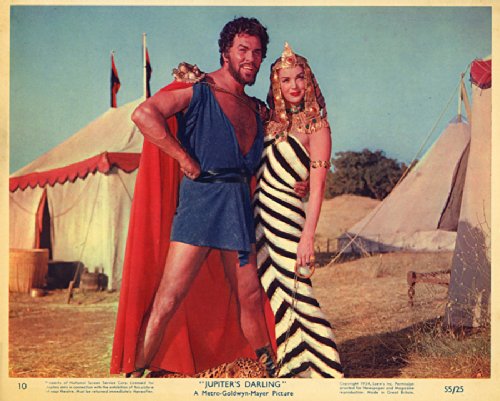
Esther Williams and Howard Keel in "Jupiter's Darling"

Esther Williams and Howard Keel in “Jupiter’s Darling”

Check out the Comet Over Hollywood Facebook page, follow on Twitter at @HollywoodComet or e-mail at cometoverhollywood@gmail.com
Musical Monday: The Daughter of Rosie O’Grady (1950)

It’s no secret that the Hollywood Comet loves musicals.
In 2010, I revealed I had seen 400 movie musicals over the course of eight years. Now that number is over 500. To celebrate and share this musical love, here is my weekly feature about musicals.


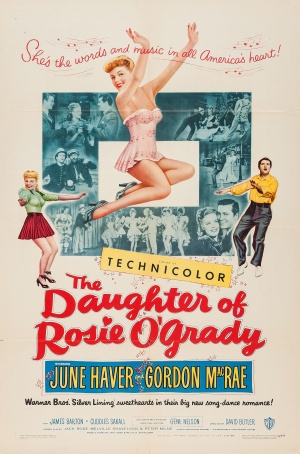
The_Daughter_of_Rosie_O'Grady_FilmPosterThis week’s musical:

“The Daughter of Rosie O’Grady” – Musical #387

Studio:
Warner Brothers

Director:
David Butler

Starring:
June Haver, Gordon MacRae, S.Z Sakall, Gene Nelson, Debbie Reynolds, Marcia Mae Jones, Jane Darwell, James Barton, Sean McClory, Virginia Lee

Plot:
Set right at the end of the Spanish-American War in 1898, overly protective father Dennis O’Grady (Barton) doesn’t want his three daughters (Haver, Reynolds, Jones) to be in show business. The vaudeville lifestyle is what caused his wife, Rosie O’Grady, to pass away. He also is wary of his daughters dating, though one is secretly married.
But Patricia (Haver)-the daughter of Rosie O’Grady- disobeys and walks through the theater district and meets Tony Pastor (Gordon). Tony takes a fancy to Patricia, and she starts a career in vaudeville and a romance with Tony.

Trivia:
-Debbie Reynold’s first speaking film. Previously she was in “June Bride” (1948) but did not have any lines.
-Gordon MacRae’s character plays Tony Pastor, who in real life was vaudeville performer and he owned a theater. He was known as the “Father of Vaudeville.” Though MacRae’s character shares a name with Pastor, there doesn’t seem to be any other similarity.

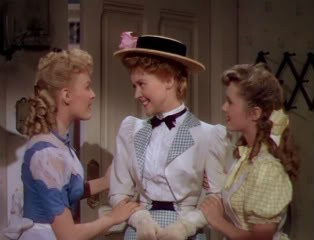
The O'Grady daughters: June Haver, Marcia Mae Jones, Debbie Reynolds

The O’Grady daughters: June Haver, Marcia Mae Jones, Debbie Reynolds

Highlights:
-Gene Nelson dancing. Nelson is one of the most underrated tap dancers of the Golden Era.
-Christmas is included in the movie. Christmas scenes always make me happy.
-Debbie Reynolds first time speaking on screen.


Notable Songs:
-“My Own True Love and I” sung by June Haver and James Barton
-“Winter” sung by June Haver
-“Daughter of Rosie O’Grady” sung by Gordon MacRae

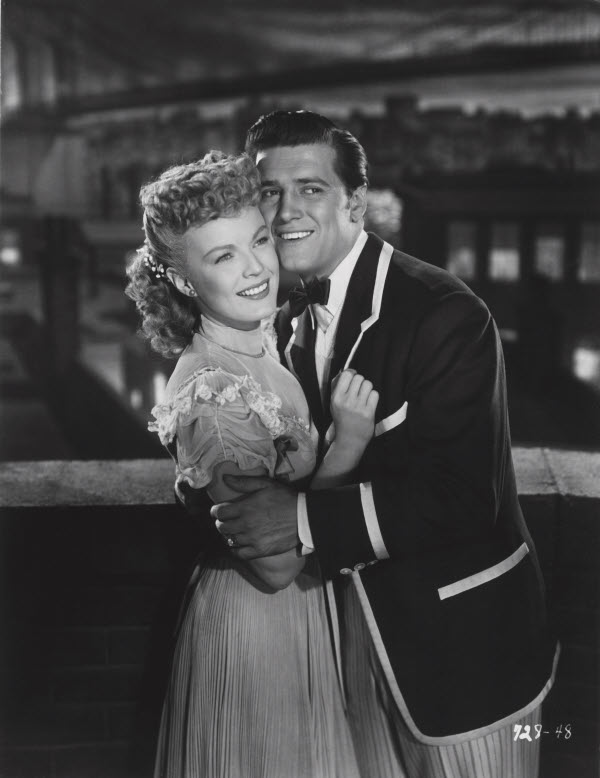
june haverMy Review:
“Daughter of Rosie O’Grady” is visually beautiful in Technicolor and chock full of Warner contract players.
However, it does not seem to be in any way connected with the 1943 20th Century Fox film “Sweet Rosie O’Grady” starring Betty Grable. No, it doesn’t appear that June Haver is supposed to be Grable’s daughter.
While the film is pleasant, something falls short.
I think it’s possibly because I feel like some of the talents are wasted.
Gene Nelson, who plays dancer Doug Martin in the film, is probably one of the most underrated dancers of the Golden Era. But that superlative isn’t obvious in this movie.
He has one solo dance and a few partner dances with Miss Haver, and while his footwork is fancy, it wasn’t enough to show off his true talent.
Golden voiced Gordon MacRae also doesn’t sing enough songs in this film.
When June Haver started in Hollywood, she was dubbed the “Pocket Betty Grable” and pitted as a rival to the star with the Million Dollar Legs. But when I see Haver in films, something is lacking that is in every Grable film for me.
She is pleasant, pretty, dances well and I like her well enough, but I can’t put my finger on what is missing.
I think the most notable thing about this film is 18-year-old Debbie Reynolds in her first speaking film role. She already had the energy and wit she was later known for.
I also love seeing former child actress Marcia Mae Jones as a lovely adult. You may know her as the snobby rich girl in “The Little Princess” (1939) who Shirley Temple dumps ashes on.
Actor James Barton was also a former vaudeville star. At the end he performs a comedic ice skating routine-but not wearing skates. One has to wonder if that was an old routine from his days on stage.
“Daughter of Rosie O’Grady” is pleasant. I wouldn’t say avoid it, but I also wouldn’t say to go out of your way to watch it.

Check out the Comet Over Hollywood Facebook page, follow on Twitter at @HollywoodComet or e-mail at cometoverhollywood@gmail.com

Musical Monday: Stingaree (1934)

It’s no secret that the Hollywood Comet loves musicals.
In 2010, I revealed I had seen 400 movie musicals over the course of eight years. Now that number is over 500. To celebrate and share this musical love, here is my weekly feature about musicals.

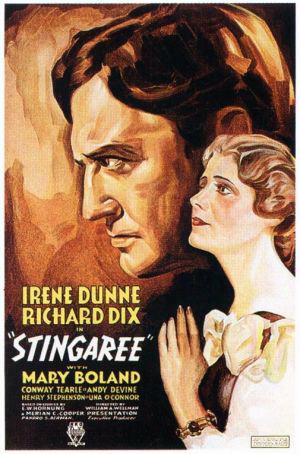
StingareeThis week’s musical:

“Stingaree” –Musical #489

Studio:

RKO Radio Pictures

Director:

William A. Wellman

Starring:

Irene Dunne, Richard Dix, Mary Boland, Conway Tearle, Andy Devine, Henry Stephenson, Una O’Connor, Reginald Owen

Plot:

Set in Australia in 1874, housemaid Hilda (Dunne) dreams of having a singing career. The mistress of of the household Mrs. Clarkson (Boland) also fancies herself as a singer, though she is terrible. Composer Sir Julian Kent (Tearle) is coming from England to Australia and Hilda wants to perform for him. Mrs. Clarkson also thinks singing for Sir Julian will be her break into opera. Outlaw Stingaree (Dix) also comes into town at the same time as Sir Julian and poses as Julian. After meeting and falling for Hilda, Stingaree is determined to help her become an opera star.

Trivia:

-Turner Classic Movies premiered this film on their channel for the first time in 2007. “Stingaree” was part of a “Lost and Found” preservation series of RKO films produced by Marion C. Cooper. Other films in the series included with other films such as “Rafter Romance” (1933), “Double Harness” (1933), “One Man’s Journey” (1933), “A Man to Remember” (1938) and “Living on Love” (1937). In 1946, Cooper obtained ownership of the films and were shown on a limited re-release in 1955 and 1956 in New York City, according to Turner Classic Movies.

-RKO original considered Jeanette MacDonald in the film, on loan out from MGM.

-Based on a 1905 novel by Ernest William Hornug.

-For the opera scenes, the standing set from Lon Chaney’s “Phantom of the Opera” (1925) was used.

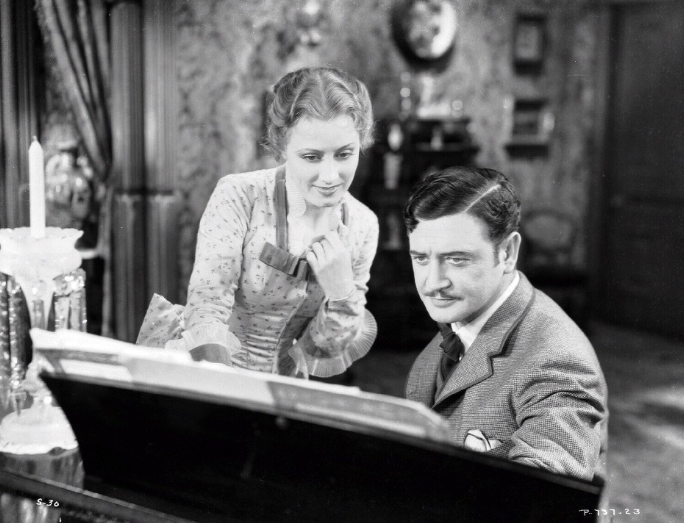
stingaree2

Notable Songs:
-“I Wish I Were a Fisherman” sung by Mary Boland (because it’s hilariously bad)

-“Once Your Mine” sung by Irene Dunne

-“Tonight is Mine” sung by Irene Dunne

Highlights:
Today’s highlights include a few scenes I enjoyed-

*Mary Boland is singing at a party and Stingaree enters with a gun to hold up the party and allow Irene Dunne to sing.

Sir Julian: My good man, being shot right now would be a favor.
Mary Boland: I will not sing for outlaws!
Richard Dix: Compassion for the outlaw!

*Mary Boland:…Why, the very foundation of empire is woman’s virginity.
Sir Julian: Chastity, madame, chastity. No empire would get very far with virginity.


My Review

I first saw “Stingaree” back in 2007 when TCM aired it along with the other Marion C. Cooper films. For whatever reason, I didn’t write it down as a musical in my musical list- which explains why this is my 488 musical.

When I revisited this film recently, I realized that it was categorized as a musical-and while it was not a flashy musical in the style of “Broadway Melody of 1936”-the film is much like “San Francisco” (1936). The bulk of the film is the romantic, melodramatic story sprinkled with quality operatic numbers.

The story of “Stingaree” may be far-fetched, but I love this movie and think it’s a lot of fun. I guess you could say Stingaree the outlaw is like Robin Hood of Australia. Rather than stealing from the rich to give to the poor, he steals the rich people’s maid to make her an operatic star. It also has a few hilarious lines in it (see: Highlights).

Irene Dunne is mostly known today for her comedic roles, but she had a beautiful singing voice in a few musicals during the 1930s. Though I love MacDonald, I’m happy Dunne was the star of this film. She brought the sweetness that was needed to Hilda. This was her second teaming with Richard Dix after “Cimarron” (1931). Frankly, Dix drove me crazy in “Cimarron,” but he’s charming and very appealing as Stingaree.

Mary Boland plays her usual character as the fretting, dizzy and selfish woman. Her terrible opera singing is pretty hilarious. And as always, Henry Stephenson makes you want to give him a hug.

I would honestly put “Stingaree” on your ‘must see’ list. For folks who don’t like musicals, the songs are not overwhelming. It’s a fun romp that is forgotten and under-appreciated.

Check out the Comet Over Hollywood Facebook page, follow on Twitter at @HollywoodComet or e-mail at cometoverhollywood@gmail.com


Musical Monday: Down Argentine Way (1940)

It’s no secret that the Hollywood Comet loves musicals.
In 2010, I revealed I had seen 400 movie musicals over the course of eight years. Now that number is over 500. To celebrate and share this musical love, here is my weekly feature about musicals.

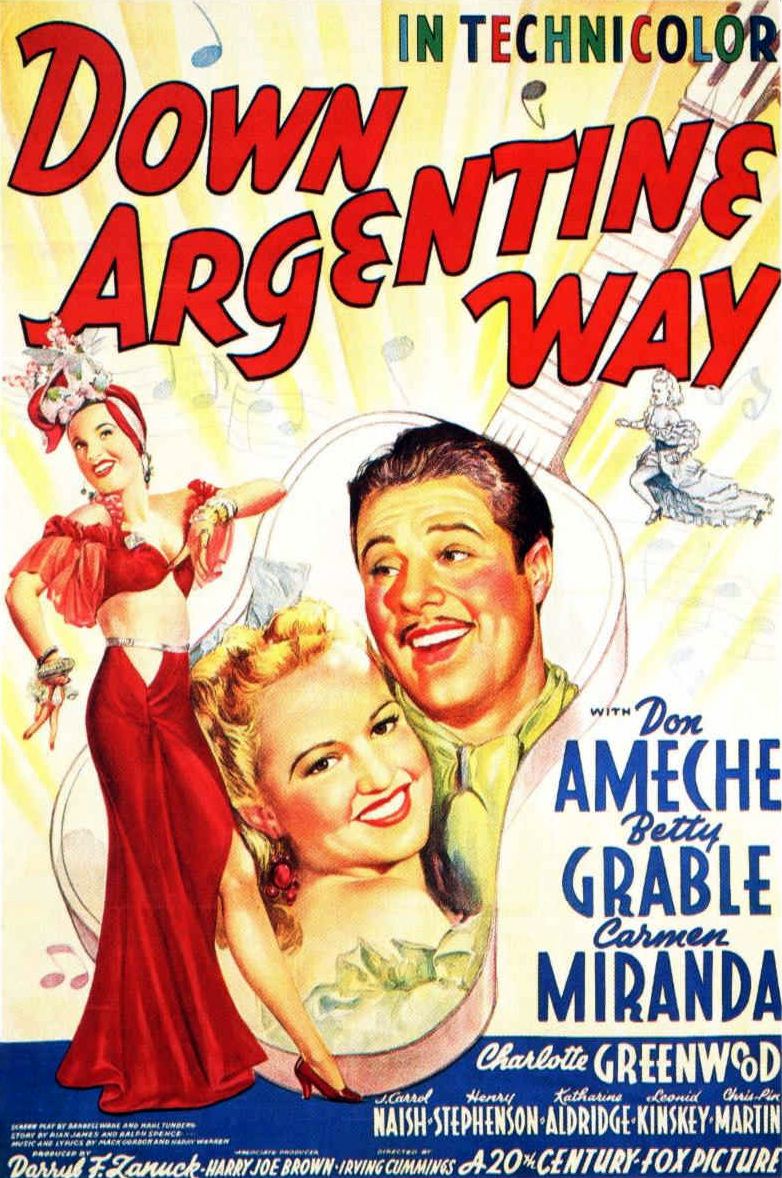
Poster - Down Argentine Way_01This week’s musical:
Down Argentine Way” — Musical #273

Studio:
20th Century Fox

Director:
Irving Cummings

Starring:
Betty Grable, Don Ameche, Charlotte Greenwood, J. Carroll Naish, Carmen Miranda (as herself), Henry Stephenson, Leonid Kinskey, Fayard and Harold Nicholas (as themselves)

Plot:
Ricardo Quintana (Ameche) travels from his home in Argentina to New York to sell his prized race horse. His father (Stephenson) tells him not to sell his horse to any relative of Binnie Crawford (Greenwood), who’s brother cheated him and the two have been in a feud ever since. In New York, Ricardo meets Glenda Crawford (Grable) and falls for her. She also wants to buy his horse, unaware of the feud. When he learns who she is, he takes back his agreement to let her buy the horse. Glenda angrily follows Ricardo to Argentina.

Trivia:
-Remake of the 1938 film, “Kentucky” starring Loretta Young, Richard Greene and Walter Brennan. “Kentucky” is set in the American south and also deals with horse racing. Young and Greene’s families are feuding, because of an incident that occurred during the Civil War.

-Originally supposed to star Alice Faye, who had to drop out. Caesar Romero was supposed to play Leonid Kinskey’s role. The film ended up being a break through film for Betty Grable, who had been in films since the early 1930s, according to Hollywood Musicals Year by Year.

-First screen appearance of Carmen Miranda. Her scenes were shot in New York at the Movetone studio in Manhattan and edited into the Hollywood film, so her only film appearances are two songs and no dialogue with the characters. Miranda was performing on Broadway in “The Streets of Paris.” She made an impression on audiences and was signed to 20th Century Fox, according to Memo from Darryl F. Zannuck.

-Film gossip columnist Louella Parsons compared Don Ameche to Rudolph Valentino in this movie. She said he “has a good singing voice, but he has never been the least exciting until this movie,” she said in a Oct. 6, 1940, column.

-Don Ameche’s role was originally offered to Desi Arnaz, according to Life on the Hyphen: The Cuban-American Way by Gustavo Pérez Firmat

-Director Irving Cummings originally wanted to cut the Nicholas Brother’s three minute tap dance scene, according to Brotherhood in Rythm: The Jazz Tap Dancing of the Nicholas Brothers by Constance Valis Hill.

Highlights:
-The Nicholas Brother’s tap dance performance.

-Carmen Miranda’s first screen appearance.

Notable Songs:
-“Down Argentine Way” sung by Betty Grable
-“Two Dreams Met” sung by Betty Grable and Don Ameche
-“Mamãe Yo Quero” sung by Carmen Miranda
-“South American Way” sung by Carmen Miranda

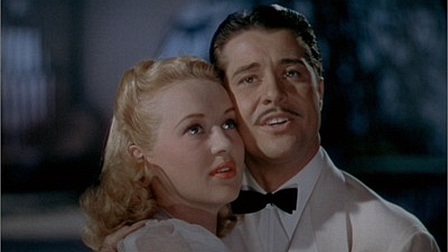
Betty Grable and Don Ameche in "Down Argentine Way"

Betty Grable and Don Ameche in “Down Argentine Way”

My Review:
“Down Argentine Way” may be looked upon as another colorful, fluffy Technicolor musical. But it’s an important step in two of the star’s careers and in Hollywood’s involvement with American foreign relations.
Catapulting star careers
Betty Grable, known for her “Million Dollar Legs,” started in films in bit roles in 1929. From 1929 through the late 1930s, she appeared as chorus girls-even in Fred Astaire/Ginger Rogers films. “Down Argentine Way” was her first major Technicolor film, showcasing her beauty and musical talents. After this film, she became one of 20th Century Fox’s top stars.
Carmen Miranda arrived in New York via Brazil in May 1939 and started in Broadway in June 1939. “Down Argentine Way” was released in October 1940, only a little over a year from the time she arrived in the United States. Her brief appearance in the film, launched an American career, primarily from 1940 to 1945, and dubbing her the Brazilian Bombshell.
Foreign policy
Now it’s time for a brief history lesson thanks to my South American History and Policy class at Winthrop University. (I even semi led a Carmen Miranda discussion in the class):
During the President F. D. Roosevelt administration in 1933, FDR said (in a nutshell) that he wanted to be a good neighbor to other nations. The Secretary of State said no country had the right to intervene in internal or external affairs of another country. The United States had troops in South America in the late 1800s and early 1900s. Due to the Good Neighbor Policy, the United States withdrew Marines who were occupying Haiti and Nicaragua.
To promote these neighborly relations, the United States worked to promote Latin America in culture. You can see the cultural impacts in films like “Down Argentine Way,” “That Night in Rio” or “Week-End in Havana.” Fashion was affected with espadrille shoes, fiesta blouses and peasant blouses. Music had a South American influence with bandleaders such as Xavier Cugat.
What does this have to do with movies? “Down Argentine Way” was one of the first Hollywood films that promoted the Good Neighbor Policy- showcasing the beautiful countries (via soundstage) and how wonderful and romantic the culture is.
“Down Argentine Way” isn’t the best film of Betty Grable, Carmen Miranda or Don Ameche. But it’s fun and beautifully colorful. The story is simple but it is important in the careers of a few Hollywood favorites.

Check out the Comet Over Hollywood Facebook page, follow on Twitter at @HollywoodComet or e-mail at cometoverhollywood@gmail.com

Musical Monday: “Thousands Cheer” (1943)

It’s no secret that the Hollywood Comet loves musicals.
In 2010, I revealed I had seen 400 movie musicals over the course of eight years. Now that number is over 500. To celebrate and share this musical love, here is my weekly feature about musicals.

thousands cheer posterThis week’s musical:
Thousands Cheer” — Musical #188

Studio:
Metro-Goldwyn-Mayer

Director:
George Sidney

Starring:
Kathryn Grayson, Gene Kelly, Mary Astor, John Boles, Ben Blue, Odette Myrtil (uncredited), Henry O’Neill (uncredited), Frances Rafferty (uncredited), Mary Elliot (uncredited)

As themselves: Mickey Rooney, Judy Garland, June Allyson, Gloria DeHaven, Red Skelton, Eleanor Powell, Ann Sothern, Lucille Ball, Virginia O’Brien, Jose Iturbi, Frank Morgan, Lena Horne, Marsha Hunt, Marilyn Maxwell, Donna Reed, Margaret O’Brien, Kay Kyser, Georgia Carroll, Bob Crosby, Cyd Charisse, Sara Haden

Band leaders: Kay Kyser and his band, Bob Crosby and his orchestra.

Plot:
Opera singing Kathryn Jones (Grayson) leaves her mother (Astor) to live on base with her military father (Boles), who is a colonel. Kathryn is also hoping to convince her divorced parents to reconcile. While on base, Kathryn hopes to build morale on the military base before the men are shipped off to fight in World War II. She meets former acrobat Pvt. Eddie Marsh (Kelly), who is not cooperative and isn’t pleased with being in Army. He hopes to transfer to the Army Air Corp, until the two end up falling in love.
The plot is a backdrop to a lavish military show Kathryn helps organize filled with comedic skits and music put on by MGM’s top contract players.

Trivia:

-Eleanor Powell’s first color film. Powell’s contract was not renewed with MGM after this film, according to “A to Z of American Women in the Performing Arts” by Liz Sonnebon.

-Fifth role for Cyd Charisse and it is uncredited. After several small roles, Charisse was signed to MGM in 1946, according to Sonnebon’s book.

-Fourth film role for Gene Kelly.

Gene Kelly and Kathryn Grayson in a publicity photo for "Thousands Cheer"

Gene Kelly and Kathryn Grayson in a publicity photo for “Thousands Cheer”

-First film for concert pianist Jose Iturbi. Iturbi is one of many classically trained musicians that MGM studio head L.B. Mayer signed on to give the studio class.

-Ranks number 29 in MGM’s top grossing musicals. “Thousands Cheer” made $3,500,000 in the box office, according to “The Rough Guide to Film Musicals” by David Parkinson.

Highlights:

-Jose Iturbi. I enjoy seeing him in any film, whether he is acting or playing the piano.

-Gene Kelly tap dancing with the broom.

-Eleanor Powell in Technicolor. She again was filmed in color in her last film “Duchess of Idaho” (1950).

Notable Songs:
-“I Dug a Ditch” sung by Kay Kyser’s Band

-“Daybreak” sung by Kathryn Grayon with Jose Iturbi on the piano

-“Three Letters in the Mail Box” sung by Kathryn Grayson

-“In a Little Spanish Town” sung by June Allyson and Gloria DeHaven

-“Should I” sung by Georgia Carroll with Kay Kyser’s band

-“Honeysuckle Rose” sung by Lena Horne

-“The Joint Is Really Jumpin’ in Carnegie Hall” sung by Judy Garland with Jose Iturbi on the piano

My Review:
As I have mentioned in previous posts, there are several wartime films just like “Thousands Cheer” – a thin plot with a ton of musical performances by big-name stars.

However, “Thousands Cheer” stands out against “Star Spangled Rhythm,” “Thank Your Lucky Stars” or “This is the Army.” Maybe it’s because of the caliber of the MGM stars that makes it more enjoyable. Or maybe it’s the Technicolor.

But truthfully, I think it’s the way the film and the showcase of stars are structured. The first half of the film is a straight musical with a plot sprinkled with songs. The last hour to 45 minutes is roughly seven musical performances and skits designed as a show to entertain troops. The performances are shown as an actual show with Mickey Rooney as the emcee between each performance.

“Thousands Cheer” holds a rare quality against other talent showcasing films-the musical performances don’t grow tiresome. I was entertained the whole time, unlike films such as “This is the Army,” where my finger was itching for the fast-forward button.

Kay Kyser's singer and wife Georgia Carroll singing "Should I" in "Thousands Cheer"

Kay Kyser’s singer and wife Georgia Carroll singing “Should I” in “Thousands Cheer”

All of the performances and songs are quality entertainment. Frank Morgan and Red Skelton’s skits are humorous and all of the music is fantastic. The two songs that I think bring down the house are Judy Garland’s “The Joint is Really Jumpin’ in Carnegie Hall” (which should be no surprise) and Kay Kyser’s band with his wife Georgia Carroll as the singer. Carroll’s glowing closeup almost makes the movie for me.

This film is still early in Gene Kelly’s film career- this was his fourth film- but you can already see his star potential in his performance and the few dance numbers he was given. Kelly and Grayson also have good chemistry, and apparently, MGM agreed, pairing them two years later in “Anchors Aweigh” (1945).

If you enjoy star spangled World War II films made for morale boosting and bursting with songs, this is for you.

Fun promotional pamphlet of caricatures of the "Thousands Cheer" songs.

Fun promotional pamphlet of caricatures of the “Thousands Cheer” songs.

Check out the Comet Over Hollywood Facebook page, follow on Twitter at @HollywoodComet or e-mail at cometoverhollywood@gmail.com

Musical Monday: Look for the Silver Lining (1949)

It’s no secret that the Hollywood Comet loves musicals.
In 2010, I revealed I had seen 400 movie musicals over the course of eight years. Now that number is over 500. To celebrate and share this musical love, here is my weekly feature about musicals.

This week’s musical:
“Look for the Silver Lining” — Musical #133

look-for-the-silver-lining-movie-poster-1949-1020437158

Studio:
Warner Brothers

Director:
David Butler

Starring:
June Haver, Gordon MacRae, Ray Bolger, Charles Ruggles, Rosemary DeCamp, Lee Wilde, Lyn Wilde, S.Z. Sakall, Will Rogers Jr. (uncredited), Dick Simmons

Plot:
Biographical film of musical star Marilyn Miller, played by June Haver. The film follows Miller’s rise to fame as a singer and dancer, starting with her family vaudeville act until she is the top star on Broadway. The film begins when Miller joins her family’s act, “The Five Columbians,” with her mother, father and two sisters. Miller meets famous vaudeville dancer Jack Donahue (Bolger) who helps her break into show business and is responsible for her first show on Broadway. During her big break, Haver meets actor Frank Carter (MacRae) and the two eventually marry.

Trivia:

Marilyn Miller in 1929

The real Marilyn Miller in 1929

-Marilyn Miller, played by Haver, was a famous Broadway musical star in the 1910s and 1920s. She was in a handful of Hollywood films, but she was more successful on the stage. The real Frank Carter, played by MacRae, married Miller in 1919 and he died in 1920 in a car accident, like the film says. Miller then married actress Mary Pickford’s brother, Jack Pickford, in 1922 and they divorced in 1927. She then married dancer Chester Lee O’Brien in 1934 until her death in 1936. Miller died from complications of a nasal surgery at the age of 37.

-In 1942, Louella Parsons announced Joan Leslie was playing the role of Marilyn Miller. Parsons hinted Rita Hayworth and Ann Miller may have been in the running for the film, according to a July 27, 1942 column in the St. Petersburg Times. Apparently plans for this film fell through or were delayed, because in 1947, Louella Parsons then announced June Haver would play the role of Miller in a St. Petersburg Times column. This time, Parsons says Vera-Ellen was “heartbroken” she didn’t receive the role of Miller, because she was a “leading candidate.”

-Last film of Lee Wilde. Her twin sister Lyn continued acting in films until 1953.

-Gordon MacRae’s second film.

-Will Roger Jr. plays his father Will Rogers.

Notable Songs:

-“Look for the Silver Lining” sung by June Haver

-“Who?” sung by Ray Bolger

-“Time on My Hands” sung by Gordon MacRae

My Review:
Visually “Look for the Silver Lining” is fun and colorful, but the actual plot is rather bland.

For a biographical film, you learn very little about Marilyn Miller other than the fact that she existed, was a very famous performer and one of her husbands died. However, I guess real life is a bit too long to stuff into an hour and 41 minute film.

Like most biographical films made during this time, the details are fairly sanitized. Only one out of three of Miller’s real husbands are discussed in the film- which is Frank Carter, the vaudeville actor who died in the car accident. At the end of the film, Miller’s character marries a character named Henry Doran, played by Dick Simmons. I’m not sure if this is supposed to be Jack Pickford, who was Miller’s next husband, or maybe a combination of her last two husbands: Pickford and Chester Lee O’Brien.

In real life, Miller also was an alcoholic and had issues with sinus infections. She died of complications after surgery that was dealing with her sinus problems.

In the film, it was implied that Miller’s health was declining but it was vague. She pirouettes as she practices for a show, then grabs her head in pain. She tells her friend Jack Donahue that her doctor says she has to “stop eating lobster, champagne, staying out late and dancing.”

Gordon MacRae as Frank Carter and June Haver as Marilyn Miller in "Look for the Silver Lining"

Gordon MacRae as Frank Carter and June Haver as Marilyn Miller in “Look for the Silver Lining”

Though Miller died in 1936, the film ends with her dancing in a colorful music number and singing the title song “Look for the Silver Lining.” But this ending is fairly typical for a musical biographical film where the lead’s life my end rather tragically. These brightly colored musicals don’t want to end on a low note, killing off the main star.

For example: “The Helen Morgan Story” (1957) about Helen Morgan (starring Ann Blyth) who died in 1941, ends with a banquet held in honor of the recovering alcoholic singer.

“The Incendiary Blonde” (1945) starring Betty Hutton as Texas Guinan, who died in 1933, ends with Hutton slowly walking out of a hospital, worried about her lover.

The stand out stars in this film for me are Ray Bolger and Gordon MacRae. June Haver’s dancing was lovely, but she wasn’t that memorable. I will say that this is one film where the leading lady actually looks fairly similar to the woman she is playing. But I was legitimately sad when MacRae’s character was killed off. I wanted to see more of him and hear more of his singing. Charles Ruggles was fun comic relief and Rosemary DeCamp is always the perfect mother.

I’m not trying to be harsh with “Look for the Silver Lining,” but there are other fabricated musical biographies that are more entertaining than this one. See: Yankee Doodle Dandy, Annie Get Your Gun, Love Me or Leave Me or Hans Christian Anderson.

Check out the Comet Over Hollywood Facebook page, follow on Twitter at @HollywoodComet or e-mail at cometoverhollywood@gmail.com
Musical Monday: “Follow the Boys” (1963)

It’s no secret that the Hollywood Comet loves musicals.
In 2010, I revealed I had seen 400 movie musicals over the course of eight years. Now that number is over 500. To celebrate and share this musical love, here is my weekly feature about musicals.

Follow the boysThis week’s musical:
Follow The Boys” –Musical #303

Studio:
Metro-Goldwyn-Mayer

Director:
Richard Thorpe

Starring:
Connie Francis, Paula Prentiss, Dany Robin, Janis Paige, Russ Tamblyn, Richard Long, Roger Perry, Ron Randell

Plot:
-Four women- Bonnie (Francis), Toni (Prentiss), Michele (Robin) and Liz (Paige)- travel to the Rivera to meet their Navy boyfriends and husbands when they go on shore leave.
-Bonnie came from North Dakota to surprise her husband, who thinks she is still at home.
-Wealthy Toni comes to see her playboy fiance Lt. Peter Langley. But Michele is also there to see Peter as a bill collector.
-Liz is tired of being a “seagull”-Naval wives that follow their husbands to each port- and wants her Lt. Commander husband to settle down.
As the girls are waiting at a French port, they learn the ship is landing in Italy instead. The four women team up to travel to meet the men.

Trivia:
-Connie Francis’s second film after “Where The Boys Are.” The film is supposed to be an unofficial sequel, according to “Hollywood Surf and Beach Movies: The First Wave, 1959-1969” by Thomas Lisanti
-Filming locations include: Cannes, France; Nice, France; Santa Margherita Ligure, Genoa, Liguria, Italy
-Filmed in Panavision and Metrocolor

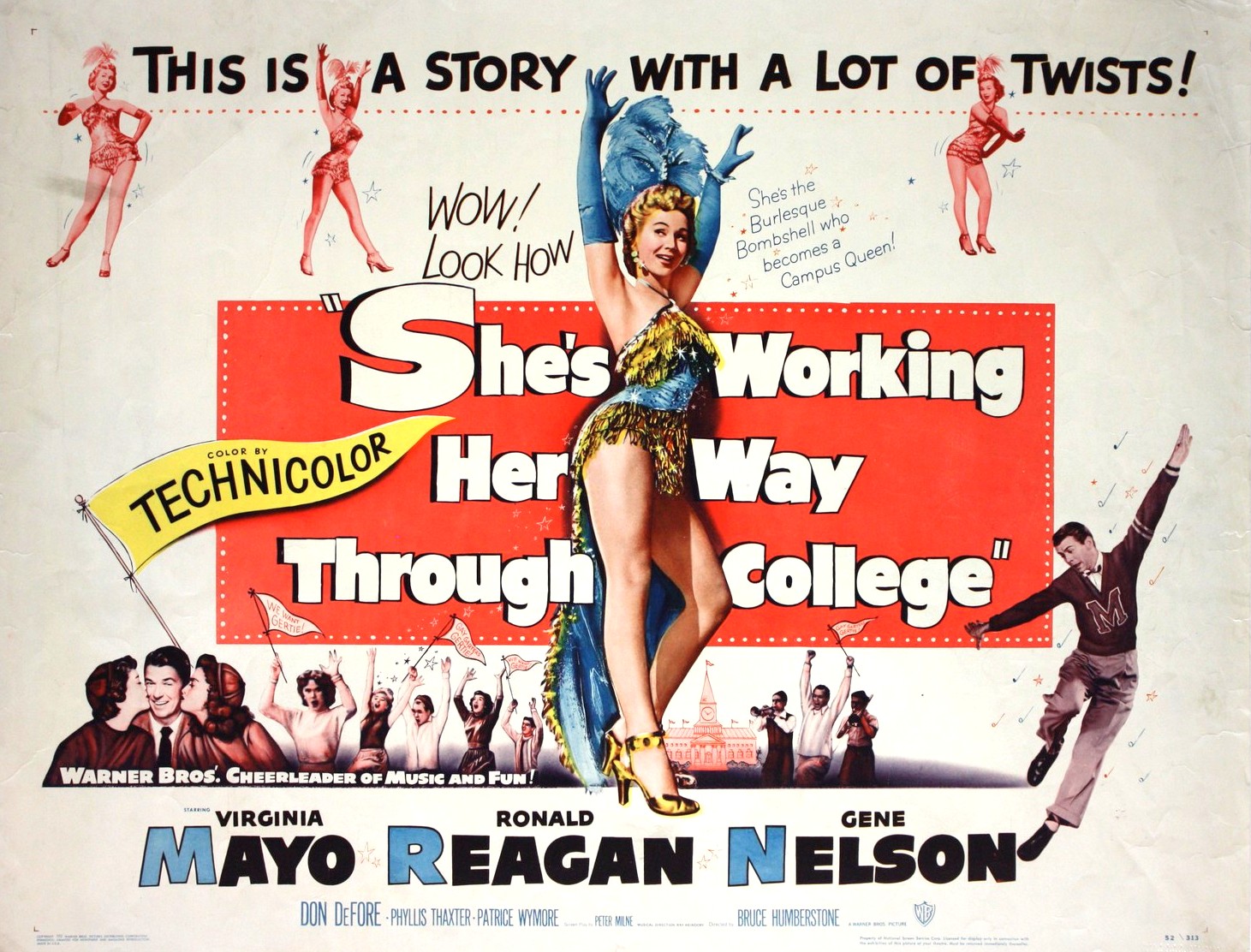
Russ Tamblyn and Paula Prentiss, Richard Long, and Dany Robin, Roger Perry and Connie Francis, Ron Randell and Janis Paige

Russ Tamblyn and Paula Prentiss, Richard Long, and Dany Robin, Roger Perry and Connie Francis, Ron Randell and Janis Paige


Highlights:

-The French Rivera and Italy in gorgeous, vibrant color.

Notable Songs:
-“Italian Lullaby” sung by Connie Francis
-“Follow the Boys” sung by Connie Francis
-“Intrigue” sung Connie Francis

My Review:
Though this is categorized as a musical, it’s more a romantic comedy where Connie Francis sings at the drop of the hat: Connie picks up a baby and sings a lullaby, Connie goes to an Italian party and is asked to sing, Connie turns on the radio and sings.
This is pretty common in frothy 1950s and 1960s films. Young singing stars such as Frankie Avalon, James Darren or Connie Francis are cast in films and have a four or five songs to spotlight their singing talents.
In many of her films, Francis has man trouble. In “Where the Boys Are,” she has trouble nabbing a guy. This time in “Follow the Boys,” she is married but he can’t get leave to see her.
I love seeing Janis Paige, Paula Prentiss and Russ Tamblyn in pretty much every film, and the scenery in the film is beautiful.
However, even with a star-studded cast, “Follow the Boys” is really merely okay.
The plot is tedious and I don’t care for the French actress Dany Robin.

Check out the Comet Over Hollywood Facebook page, follow on Twitter at @HollywoodComet or e-mail at cometoverhollywood@gmail.com
Musical Monday: The Fleet’s In (1942)

It’s no secret that the Hollywood Comet loves musicals.
In 2010, I revealed I had seen 400 movie musicals over the course of eight years. Now that number is over 500. To celebrate and share this musical love, here is my weekly feature about musicals.

HUTTON 1 FLEET'S INThis week’s musical:
“The Fleet’s In” –Musical #488

Studio:
Paramount Pictures

Director:
Victor Schertzinger

Starring:
Dorothy Lamour, William Holden, Eddie Bracken, Betty Hutton, Leif Erickson, Betty Jane Rhodes, Jimmy Dorsey (as himself)

Plot:
Sailor Casey Kirby (Holden) is dubbed a playboy when there is a picture of him in the newspaper kissing movie star Diana Golden (Rhodes). As his buddies build him up as a “sea wolf,” they bet Casey can’t woo ice queen nightclub performer “The Countess” (Lamour), who is well-known for turning down sailors. However, Casey isn’t aware that sailors are betting money him kissing the Countess in public. During all of this, the Countess’s roommate Bessie Dale (Hutton) is after Casey’s friend Barney (Bracken).

Trivia:
Betty Hutton‘s first feature film. Hutton came straight from Broadway, where she was in the play “Panama Hattie” with Ethel Merman.
-Music written by Johnny Mercer.
-Jimmy Dorsey and his Orchestra perform in the film. Dorsey is the brother of other big band leader, Tommy Dorsey. Jimmy played the saxophone and Tommy played the trombone.
-Hutton and Lamour became long time friends while making this movie, Hutton wrote in her autobiography, “Backstage, You Can Have.” ”
“I will always love her for the friendship she immediately showed to me in those early days,” she wrote.

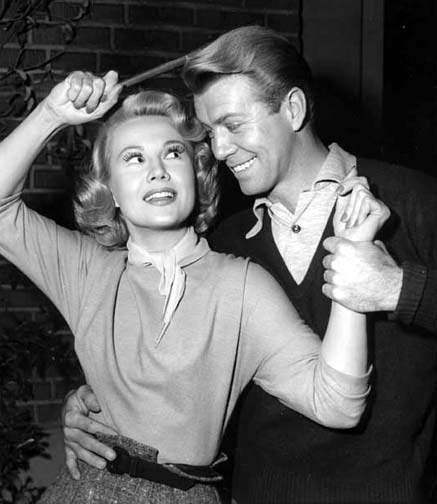
Bessie (Hutton) holds back the Countess (Lamour) when she finds out there is a bet if Casey (Holden) kisses her. Barney (Bracken) hides.

Bessie (Hutton) holds back the Countess (Lamour) when she finds out there is a bet if Casey (Holden) kisses her. Barney (Bracken) hides.

Notable Songs:
-“Tangerine” performed by Jimmy Dorsey’s band and sung by Bob Eblery and Helen O’Connell
-“When You Hear the Time Signal” sung by Dorothy Lamour
-“If You Build a Better Mousetrap” sung by Betty Hutton, performed by Jimmy Dorsey’s band
-“Not Mine” sung by Betty Hutton and Dorothy Lamour
-“I Remember You” sung by Dorothy Lamour
-“Arthur Murray Taught Me To Dancing a Hurry” sung by Betty Grable

Highlights:
-Jimmy Dorsey’s band using telephones as part of their song for “When You Hear the Time Signal”
-Betty Hutton singing and quickly dancing several dances during the song “Arthur Murray Taught Me To Dancing in a Hurray.” Lyrics are as follow with video below:

“Turkey trot
Or gavotte?
Don’t know which,
Don’t know what.
Jitterbug?
Bunny hug?
Long as you
Cut a rug!
Walk the dog,
Do the frog,
Lindy hop
Till you drop!
Ball the jack
Back to back,
Cheek to cheek
Till you’re weak.”

My Review:
This is an enormously enjoyable and funny movie.
The plot is very thin and is mainly padded with excellent music by Johnny Mercer, but it’s a wonderful piece of World War II-era escapism.
Dorothy Lamour is gorgeous and funny in her role as “The Countess.”
William Holden is still early in his career. He does well in the comedy, but you can tell he has more potential- which he proved later in his career.
For me, the real treat is Betty Hutton. I know I may be a minority in this. I have found several folks in the film community who find her exasperating or irritating. But I LOVE her energy- displayed perfectly in the “Arthur Murray” number.
There is also another funny lady in this film, who I wasn’t familiar with until I saw this film, named Cass Daley. Her singing has a similar sound to Hutton’s and she mainly makes jokes off her physical appearance. What I found interesting is that Cass Elliot of the Mama’s and the Papa’s apparently named herself for Daley.
With an entertaining cast and catchy 1940s tunes, this is a must see.

Check out the Comet Over Hollywood Facebook page, follow on Twitter at @HollywoodComet or e-mail at cometoverhollywood@gmail.com
Musical Monday: Grounds for Marriage (1951)

It’s no secret that the Hollywood Comet loves musicals.
In 2010, I revealed I had seen 400 movie musicals over the course of eight years. Now that number is over 500. To celebrate and share this musical love, here is my weekly feature about musicals.

Grounds_for_Marriage_posterThis week’s musical:
“Grounds for Marriage” –Musical #371

Studio:
Metro-Goldwyn-Mayer

Director:
Robert Z. Leonard

Starring:
Van Johnson, Kathryn Grayson, Paula Raymond, Barry Sullivan, Reginald Anderson, Lewis Stone, Richard Anderson, Theresa Harris

Plot:
When Ina Massine (Grayson) returns to New York from Europe, she tries to win back her husband Lincoln “Linc” Bartlett (Johnson) after being divorced for three years. Linc is now engaged to Agnes Young (Raymond). On the day of her New York stage comeback singing “La Boheme,” Ina has a sore throat and then suddenly looses her voice. Doctors determine that the loss of voice is psychological from the shock of Linc’s engagement. Linc then tries to throw Ina into a new romance and appoints his brother Chris (Sullivan) to do the task.

Trivia:
-The movie originally was supposed to star Robert Walker and June Allyson. After Allyson was no longer in the film, it was going to star Walker and Kathryn Grayson, according to a Hedda Hopper brief from July 28, 1949. Van Johnson replaced Walker.
-“That’s the only picture I really loved making,” Grayson said in a Jan. 7, 1951 interview with Hedda Hopper. “I’ve been in films since 1940, but I’ll confess that I have never been particularly interested in a film career until recently.”
-During the “Carmen” dream sequence, Van Johnson is dubbed by Gilbert Russell for the character Don Jose and Stephen Kemalyan for the character Escamillo.

Van Johnson and Kathryn Grayson dressed for the "Carmen" dream sequence in "Grounds for Marriage."

Van Johnson and Kathryn Grayson dressed for the “Carmen” dream sequence in “Grounds for Marriage.”

Notable Songs:
– “Carmen” performed by Kathryn Grayson and Van Johnson
-“La Boheme” performed by Kathryn Grayson
– “Tiger Rag” played by the Firehouse Five Plus Two

Highlights:
-Van Johnson playing the bird sound in the doctor’s symphony
-The “Carmen” dream sequence, which acts out the film’s predicament. Johnson is hilariously dubbed in an operatic voice. Johnson said in a Feb. 13, 1951 article in the Times Daily that he had never seen the opera.
-Van Johnson gives a speech on the common cold to the women’s club and says it’s mainly psychological or due to stress. Air is blowing on the back of Johnson’s neck and by the end of the speech, he has developed a bad cold.

My Review:
This is not your usual Kathryn Grayson musical, chock full with operatic performances in Technicolor. In fact, Grayson probably has four or five numbers because most of the movie she can’t speak or sing due to loss of voice.
Van Johnson, as always, is also a lot of fun; excelling in comedic moments and is likable (but I’m biased because he was my first film love).
I always love to see Paula Raymond in films, and I hated that she didn’t have more screen time in “Grounds for Marriage.” (Spoiler) I also would have almost preferred for Raymond to end up with Van Johnson.
It certainly isn’t the best film Grayson or Johnson made, but it is a fun and cute movie. Some of the gags can be tiring, but “Grounds for Marriage” is a nice piece of escapism.

Kathryn Grayson, Van Johnson, Paula Raymond and Barry Sullivan in a publicity photo for "Grounds for Marriage."

Kathryn Grayson, Van Johnson, Paula Raymond and Barry Sullivan in a publicity photo for “Grounds for Marriage.”

Check out the Comet Over Hollywood Facebook page, follow on Twitter at @HollywoodComet or e-mail at cometoverhollywood@gmail.com
Musical Monday: Sunny Side of the Street (1951)

It’s no secret that the Hollywood Comet loves musicals.
In 2010, I revealed I had seen 400 movie musicals over the course of eight years. Now that number is over 500. To celebrate and share this musical love, here is my weekly feature about musicals.

sunny side of the streetThis week’s musical:
“Sunny Side of the Street” –Musical #487

Studio:
Columbia Pictures Corporations

Director:
Richard Quine

Starring:
Frankie Lane (as himself), Billy Daniels (as himself), Terry Moore, Jerome Courtland, Amanda Blake, Lynn Bari, Dick Wesson, Tori Arden (as herself), Audrey Long, William Tracy

Plot:
CBS Television Studio tour guide Ted Mason (Courtland) wants to be a singing star like Frankie Lane. Studio receptionist Betty Holloway (Moore) helps push him towards his goal and get him on television. But it’s his rich former girlfriend Gloria Pelley (Long) who lands Ted a high dollar contract. Romantic jealousy ensues.

Trivia:
-Filmed in “Super Cine Color”
-Scenes in this film show executives watching color television. By 1951, CBS created a color TV system. However, it failed because it was incompatible for most viewers. Color TV systems were later adopted in 1957.
-William Tracy, who plays Pepi in “The Shop Around the Corner” (1940), plays “Al Little” in this film and never speaks a word of dialogue. The character only whispers to others.
-Singers Frankie Lane, Tori Arden and Billy Daniels play themselves in the film.

Jerome Courtland wants to be a singing star in "Sunny Side of the Street."

Jerome Courtland wants to be a singing star in “Sunny Side of the Street.”

Notable Songs:
-“On the Sunny Side of the Street” sung by Frankie Lane
-“I’m Gonna Live Till I Die” sung by Frankie Lane
-“I May Be Wrong (But I think You’re Wonderful) sung by Frankie Lane and Tori Arden

Frankie Lane and Terry Moore

Frankie Lane and Terry Moore

My Review:
This is an interesting little film. It focuses on television when most film studios were wary of this new form of entertainment that could take audiences away from movie theaters.
None of the actors are remarkable in “Sunny Side of the Street.” Lynn Bari, who generally played a siren in 1940s films, plays the role of the older friend- skeptical of men but looking for love. Prior to this film, the only place I had seen Jerome Courtland prior was as “Tex” in “Battleground” (1949).
Most of the songs were pop standards when this film was released and are sung by recording stars such as Frankie Lane, Tori Arden and Billy Daniels. It’s entertaining to get a glimpse of popular music during this time.
“Sunny Side of the Street” is 71 minutes long, which is long enough for it’s plot. It’s not a remarkable film, but an interesting glimpse at how Hollywood incorporated television into a film.

Check out the Comet Over Hollywood Facebook page, follow on Twitter at @HollywoodComet or e-mail at cometoverhollywood@gmail.com