Musical Monday: “Follow the Fleet” (1936)

It’s no secret that the Hollywood Comet loves musicals.
In 2010, I revealed I had seen 400 movie musicals over the course of eight years. Now that number is over 500. To celebrate and share this musical love, here is my weekly feature about musicals.

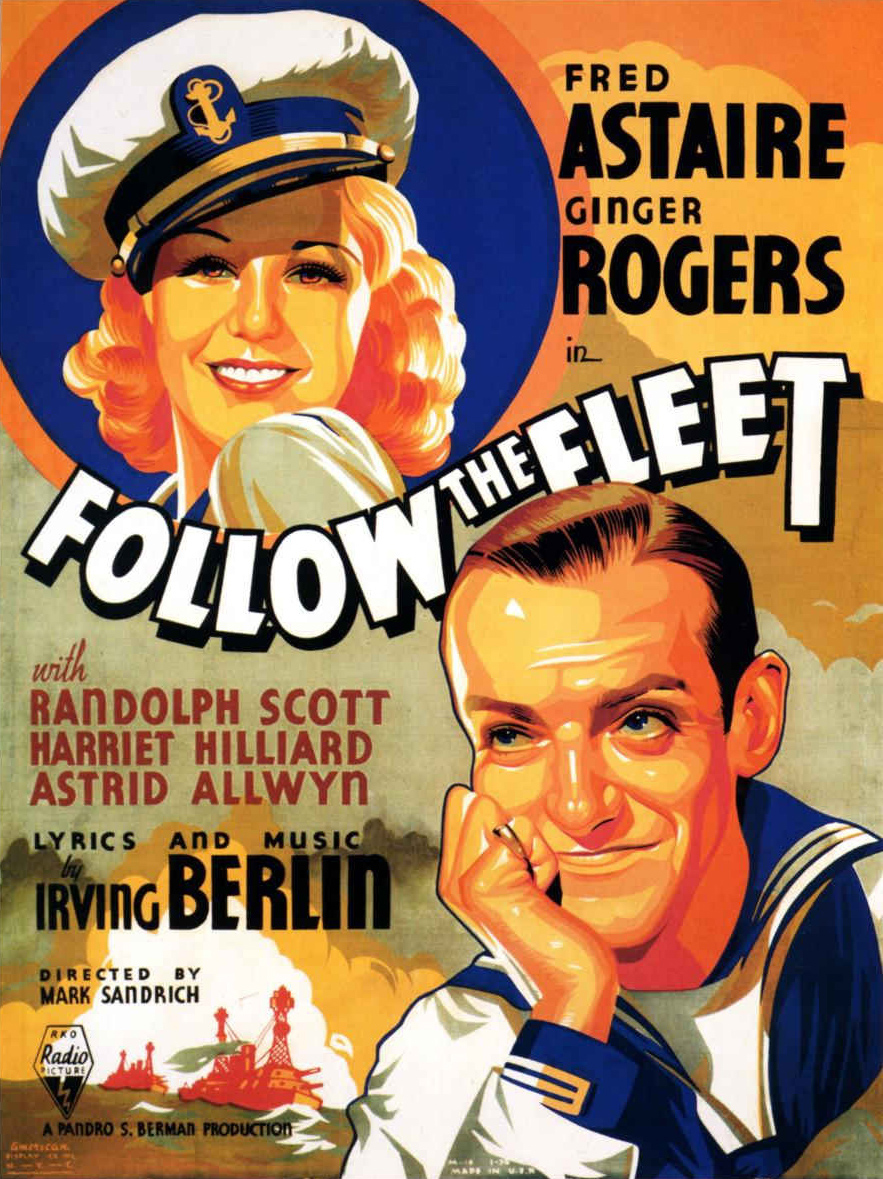
follow the fleet 2This week’s musical:
Follow the Fleet” (1936) — Musical #155

Studio:
RKO

Director:
Mark Sandrich

Starring:
Fred Astaire, Ginger Rogers, Randolph Scott, Harriet Hilliard, Betty Grable, Lucille Ball

Plot:
Bake Baker (Astaire) joined the Navy after his former dance partner Sherry Martin (Rogers) turned him down when he asked her to marry him.
Now he’s back on shore leave and he meets her by chance at a 10 cents a dance joint.
Sherry’s bookish sister Connie (Hilliard) meets Bake’s sea mate Bilge Smith (Scott) and falls in love with him. But Bilge isn’t read to settle down and starts running around with a rich divorcee.

follow the fleet

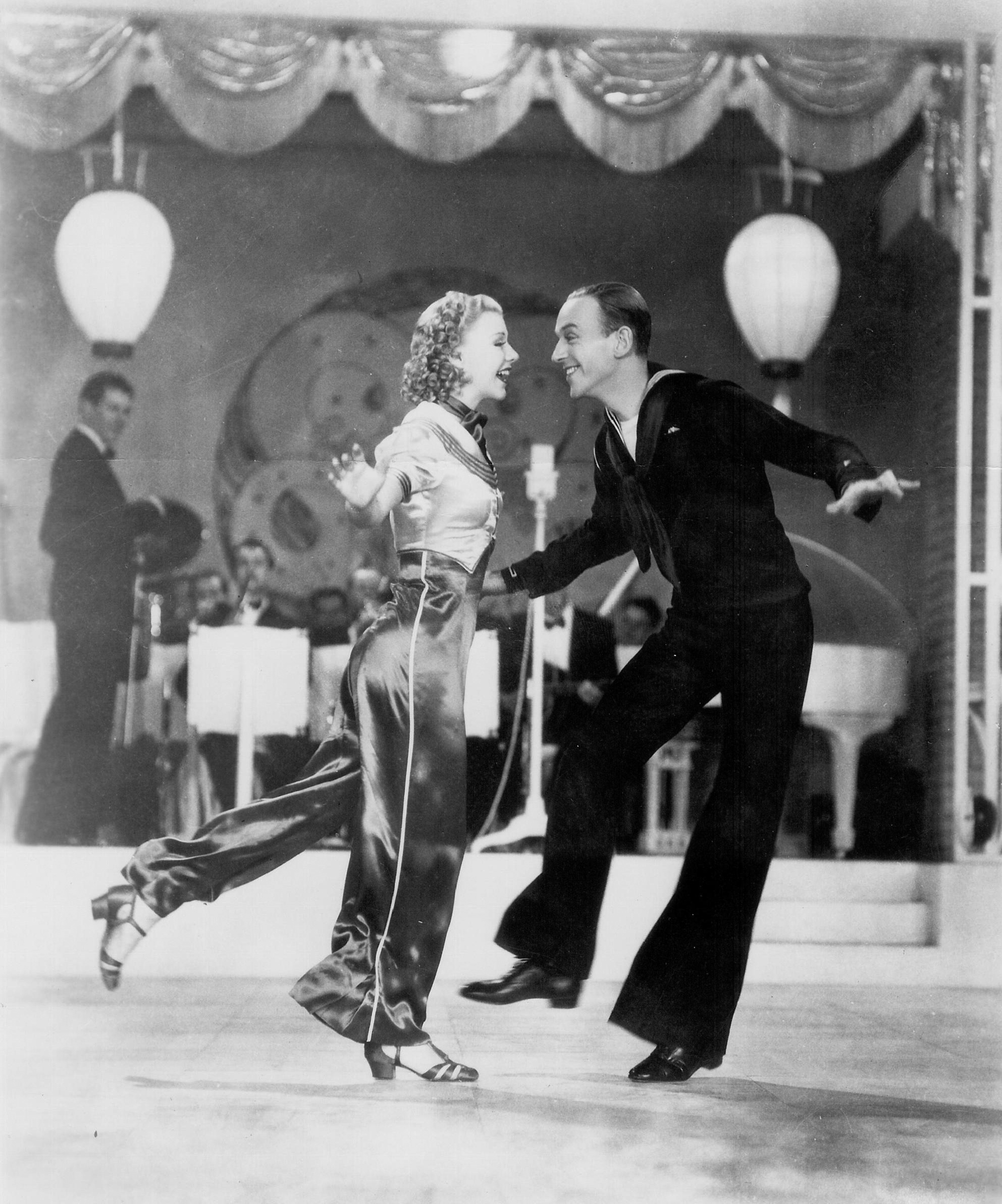
Ginger Rogers and Fred Astaire dance to “Let Yourself Go”

Trivia:
-This movie was made after the success of “Roberta.” RKO wanted to bring Randolph Scott and Irene Dunne back together again for another film with Fred Astaire and Ginger Rogers as the secondary leads, according to TCM host Robert Osborne. Dunne’s contract expired with RKO and she went on to star in “Showboat” (1936). New comer Harriet Hilliard was selected to fill the Irene Dunne role, Osborne said.
-The beaded dress Ginger Rogers wears in “Let’s Face the Music and Dance” was very heavy. Fred Astaire said the dress was too heavy to be made for dancing. During the first take, a long sleeve hit Astaire in the face. After 20 more takes, Astaire felt like the first take was their best, said Robert Osborne.
-Fred Astaire and Ginger Rogers’ fifth film together.
-The couple in the dance contest with Astaire and Rogers were unknowns picked by choreographer Hermes Pan.
-Lucille Ball and Betty Grable have small roles in the film.
-Actor/singer Tony Martin has an uncredited role in the film.
-Irving Berlin wrote “Get Thee Behind Me, Satan” was originally written for “Top Hat.”
-Adapted from the play “Shore Leave.”

Highlights:
-Ginger Rogers and Fred Astaire in the dance contest. They do impressive dance steps and Rogers is wearing pants so you can actually see the dance moves she’s doing.

Notable Songs:
All the songs are quality because the score is written by Irving Berlin but my favorites are:
-“Let Yourself Go” sung by Ginger Rogers
-“I’m Putting All My Eggs in One Basket” sung by Fred Astaire and Ginger Rogers
-“Let’s Face the Music and Dance” sung by Fred Astaire

Harriet Hilliard and Randolph Scott in "Follow the Fleet"

Harriet Hilliard and Randolph Scott in “Follow the Fleet”

My Review:
While this was following the success of “Roberta,” it isn’t quite as good as “Roberta.” Harriet Hilliard is fine, but I would have loved to see Irene Dunne in the role.
The music in this Astaire and Rogers film is terrific since the score is written by Irving Berlin. It is also a real treat that all but one of Rogers’ dance performances are done in pants so you can see her footwork better than when she is wearing a ballgown.
The plot isn’t bad but some of the lines said in the film could be bothersome to the contemporary viewer. Such as Ginger Rogers saying you have to be dumb to get a man. Or that Harriet salvages a boat for a man she doesn’t even know.
Regardless of my issues with silly parts of the plot, if you are a Fred Astaire and Ginger Rogers fan, this is definitely a movie you should see. 

Check out the Comet Over Hollywood Facebook page, follow on Twitter at @HollywoodComet or e-mail at cometoverhollywood@gmail.com

Musical Monday: “Monte Carlo” (1930)

It’s no secret that the Hollywood Comet loves musicals.
In 2010, I revealed I had seen 400 movie musicals over the course of eight years. Now that number is over 500. To celebrate and share this musical love, here is my weekly feature about musicals.

monte carloThis week’s musical:
Monte Carlo” (1930) –Musical #276

Studio:
Paramount Pictures

Director:
Ernst Lubitsch

Starring:
Jeanette MacDonald, Jack Buchanan, Zasu Pitts

Plot:
Countess Helene (MacDonald) flees minutes before her wedding and heads to Monte Carlo. The penniless countess hopes to win money at the Roulette wheel or find a wealthy man. Count Rudolph (Buchanan) takes a liking to Helene and gets closer to her by posing as the hairdresser that she hires. She falls in love with him but doesn’t want to marry what she thinks is a penniless man.

Trivia:
-Ernst Lubitsch had a crush on Jeanette MacDonald and expressed this to her. She thought he was joking and he was angry by her response, straining their relationship, according to Turner Classic Movies Host Ben Mankiewicz.
-Director Ernst Lubitsch’s second sound film.
-Actor Jack Buchanan’s American film debut. His next American film was “The Band Wagon” in 1953.

Jack Buchanan poses as a hairdresser to get closer to Jeannette MacDonald.

Jack Buchanan poses as a hairdresser to get closer to Jeannette MacDonald.

Notable Songs:
-Many of the songs don’t stick with you during the film. However “Beyond the Blue Horizon” sung by Jeanette MacDonald is the best song in the film.

My Review:
Lubitsch musicals are different from other musicals. Rather than having a show stopping tune, the songs usually add to the plot and sometimes is like sing-song talking.
Though I love Ernst Lubitsch and actress Jeanette MacDonald, I did not love this film. Jack Buchanan is wonderful in “The Band Wagon” (1953) but lackluster in this film. In most of the MacDonald-Lubitsch teamings, Maurice Chevalier was MacDonald’s leading man. Buchanan just didn’t fit as a romantic leading man.
I also felt like the movie dragged a bit. Though I struggled to get through this one, I will suggest it if you enjoy Lubitsch films. The shots are beautiful and all have “the Lubitsch touch.”

Check out the Comet Over Hollywood Facebook page, follow on Twitter at @HollywoodComet or e-mail at cometoverhollywood@gmail.com

I love to sing-a, about the moon-a and the June-a

ilovetosinga3.0

Owl Jolson loves to sing-a.

You may see me dancing around the office, shaking my finger and singing the tune from this Warner Brothers cartoon.

The 1936 cartoon “I Love to Singa” is one of those cartoons I saw as a child that has always stuck with me.

Every night before bed, I watched Warner Brother and MGM cartoons on Cartoon Network and TBS while I was growing up.

One of my favorite was the Merrie Melodies cartoon directed by Tex Avery that features Owl Jolson. This was Avery’s ninth animated short.

In the cartoon, Mama Owl is sitting on her eggs as Papa Owl paces. They are waiting on their new children to be born in their home inside a tree.

ilovetosinga2.02

Owl Jolson’s brothers are already classically trained!

When they hatch: one owl pops out singing “Chi mi frena in tal momento” from the opera Lucia di Lammermoor,  another is playing “Traumerei” on the violin and a third is playing Mendelssohn’s “Spring Song” on the flute.

Yet when the fourth owl hatches, he’s dancing and singing “I love to singa, ‘bout the moon-a and the June-a and the spring-a.”

Papa Owl covers his ears and calls him a crooner and a jazz singer.

To correct his son’s love for contemporary music, Papa tries to teach him the classics and we see Owl Jolson unhappily singing “Drink to Me Only with Thine Eyes.”

Owl Jolson runs away from home and is on a radio talent show hosted by Jack Bunny-a spoof of Jack Benny.

When his family hears little Owl on the radio, they rush down to the station, encourage his jazz music and he wins the talent show.

Picture 4

Jack Bunny holds an amateur hour contest.

“I Love to Singa” is a small tribute to Al Jolson’s film “The Jazz Singer” (1927). The song comes from the Jolson film “The Singing Kid” (1936).

The voice of Owl Jolson is child actor Tommy Bond who played Butch in the “Our Gang” series.

The cartoon demonstrates Tex Avery’s talents while paying homage to an early sound film.

One of my favorite parts of the eight minute cartoon is when all the different animals are trying out for the talent show, and all are so bad they fall through a trap door.

Owl Jolson's family accepts his love for jazz.

Owl Jolson’s family accepts his love for jazz.

My other favorite is when all the little owls hatch, already equipped with instruments and excellent musical prowess! Mama owl must be quite talented!

There isn’t one thing I don’t love about “I Love to Singa.” The title song is catchy, the jokes are witty and the name “Owl Jolson”-spoofing Al Jolson’s name- doesn’t fail to make me chuckle.

Check out the Comet Over Hollywood Facebook page, follow on Twitter at @HollywoodComet or e-mail at cometoverhollywood@gmail.com

Classic Films in Music Videos: “Girlfriend in a Coma” by The Smiths

This is January’s edition of Comet Over Hollywood’s film references in music videos.

Morrissey’s music and music videos are influenced by his love for film.

The lead singer of the 1980s band The Smiths references a 1960s British film in his music video for the 1987 song “Girlfriend in a Coma.”

As we see Morrissey’s face singing the foreground, scenes from the 1964 film “The Leather Boys” are playing the background.

The Leather Boys” stars Rita Tushingham and Colin Campbell. The film follows teenagers Dot (Tushingham) and Reggie (Campbell) who get married. Their marriage quickly turns sour as Reggie spends more time with his motorcyclist friends and the couple starts to live separately.

Writer Shelagh Delaney on the cover of the "Girlfriend in a Coma" album. ""Work Is a Four-Letter Word" played on the B-side.

Writer Shelagh Delaney on the cover of the “Girlfriend in a Coma” album. “”Work Is a Four-Letter Word” played on the B-side.

“The Leather Boys” boys is an early example of films that start to break the Hollywood Production Code that was put in place in 1934, particularly as it hints that one of motorcyclists is .

Along with the film references in the “Girlfriend in a Coma” music video, the album cover features writer Shelagh Delaney. Delaney wrote “A Taste of Honey” (1961) and “Dance with a Stranger” (1985).

Check back next month for the next classic film reference in a music video. 

Check out the Comet Over Hollywood Facebook page, follow on Twitter at @HollywoodComet or e-mail at cometoverhollywood@gmail.com

Musical Monday: “Seven Days’ Leave” (1942)

t’s no secret that the Hollywood Comet loves musicals.
In 2010, I revealed I had seen 400 movie musicals over the course of eight years. Now that number is over 500. To celebrate and share this musical love, here is my weekly feature about musicals.

seven-days-leave-movie-poster-1942-1020701154This week’s musical:
Seven Days’ Leave (1942) — Musical #475

Studio:
RKO

Director:
Tim Whelan

Starring:
Victor Mature, Lucille Ball,

Plot:
Army Private Johnny Grey (Mature) discovers he is an heir of $100,000. However, he has to marry another heiress (Ball) in seven days in order to receive the money.

Trivia:
-Ball and Mature didn’t enjoy making this film. Ball had just completed “Big Street” and wanted to be taken more seriously in film. Ball was also unhappy because her husband Desi Arnaz was away fundraising for the war relief, according to The Films of Victor Mature by James McKay
-Mature was having an affair with Rita Hayworth and wanted her to be the leading lady rather than Ball. Mature’s attitude about it didn’t help his and Ball’s relationship, according to The Films of Victor Mature by James McKay.
-Several NBC radio shows are featured such as Truth or Consequence
-Remake of the 1930 Gary Cooper film, “Seven Days Leave,” according to 1000 Questions About Canada By John Robert Colombo.

lucyHighlights:
-Victor Mature dancing and singing (but dubbed).
-Impressions of Lionel Barrymore and Ronald Colman by one of the soldiers. Though they aren’t terrific, I always enjoy hearing impressions of celebrities.
-The comedic ballroom dancing routine with Lynn Royce and Vanya. It starts out with a male and female dance number. Then a second man comes in for comedic relief, mostly at the lady’s expense.

Notable Songs:
-“Please Won’t You Leave My Girl Alone” sung by Victor Mature and a group of soldiers at the very beginning and the very end of the film. It’s not a good tune, but it’s the most memorable and catchy.
-“Can’t Get Out of This Mood” sung by Ginny Simms with the Freddy Martin Orchestra. This is the best song sung in the whole film. Moody and musically lovely.

My Review:
Neither of the stars were pleased to be in this film and I can’t blame them. The plot of having to marry someone in order to get money isn’t a new one. Romantic mix-ups should be expected. Though I wouldn’t say this movie was horrible, I also wouldn’t go out of my way to watch it multiple times.

Check out the Comet Over Hollywood Facebook page, follow on Twitter at @HollywoodComet or e-mail at cometoverhollywood@gmail.com

Classics in the Carolinas: Remembering Alicia Rhett, India Wilkes in “Gone with the Wind”

COH Alicia Rhett2

Leslie Howard with his on-screen sister Alicia Rhett.
(Scanned from “The Filming of Gone with the Wind”)

She was a true Southern lady.

Alicia Rhett was discovered on George Cukor’s Southern search for Scarlett O’Hara for the epic film “Gone with the Wind” (1939).

Rhett was cast as Ashley Wilkes’ sister, India Wilkes, in one of the biggest films of all time.

But Rhett’s art was more important to her than stardom.

“I enjoyed it (filming) immensely. I had the time of my life there (California). But when the film ended, I was happy to come home (to Charleston),” Rhett said in an interview in “The Rise of Charleston” by W. Thomas McQueene. “I liked to paint. It was what made me most happy. I really wasn’t interested in making more movies. I was interested in my art.”

Rhett was born in 1915 in Savannah, GA.   After her father was killed in World War I, her family moved to Charleston, SC, according to McQueene’s book.

Casting the role of Scarlett O’Hara for the 1939 movie wasn’t an easy. Hundreds of actresses were considered. Director George Cukor made a trip through Southern states, believing an unknown actress may be the answer to their problem.

Director George Cukor with interviews actresses to play the role of "Scarlet O'Hara": Louisa Robert, Atlanta; Susan Fallingant, Atlanta; Alicia Rhett, Charleston. (Scanned from "The Pictorial History of Gone with the Wind")

Director George Cukor with interviews actresses to play the role of “Scarlet O’Hara”: Louisa Robert, Atlanta; Susan Fallingant, Atlanta; Alicia Rhett, Charleston.
(Scanned from “The Pictorial History of Gone with the Wind”)

Hundreds of Southern women auditioned for the role of Scarlett, Melanie and Mammy, but only six women were considered for follow up auditions, according to “The Art of Gone with the Wind: The Making of a Legend,” by Judy Cameron and Paul J. Christman.

The auditions took place in 1937 in New York and the only Southerners who won roles were Alicia Rhett from Charleston, Mary Anderson who was cast as Maybelle Merriwether from Birmingham, AL and Marcella Martin of Shreveport, LA who was cast as Cathleen Calvert. Martin’s lines were dubbed because her accent wasn’t considered Southern enough, according to the Cameron and Christmas book.

“Alicia Rhett was an amateur actress. This young woman was so good,” Ann Rutherford is quoted by Cameron and Christman. Rutherford played the role of Careen, Scarlett’s younger sister. “She wasn’t Scarlett but Selznick cast her as India Wilkes. And she was excellent.”

During the filming of "Gone with the Wind," Alicia Rhett made sketches between takes. Here with Evelyn Keyes and Ann Rutherford. (Scanned from "The Filming of Gone with the Wind" by Herb Bridges)

During the filming of “Gone with the Wind,” Alicia Rhett made sketches between takes. Here with Evelyn Keyes and Ann Rutherford.
(Scanned from “The Filming of Gone with the Wind” by Herb Bridges)

The character of India Wilkes is the sister of Ashley Wilkes (Leslie Howard) and sister-in-law of Melanie Wilkes (Olivia De Havilland). In the film, India hates Scarlett O’Hara, because Scarlett marries the man India is in love with, Charles Hamilton. India never marries and Scarlett refers to her as an “old maid.”

Rhett was acting when Cukor found her in Charleston.

She was performing in the Oscar Wilde play “Lady Windermere’s Fan” at the Dock Street Theater. Her performance in the Wilde play had “style and élan,” said “Pictorial History of Gone with the Wind” by Gerald Gardner and Harriet Modell Gardner.

COH alicia rhett

Alicia Rhett visits with Mrs. John Woodbury from Louiseville, KY. Woodbury was the past-president-general of the United Daughters of the Confederacy. The Daughters dropped by to visit the filming of the Civil War film.
(Scanned from The Filming of Gone with the Wind by Herb Bridges)

“Gone with the Wind” novel author Margaret Mitchell liked Rhett for her name, according to the Gardner book.

As Rhett performed in the epic Technicolor film about the Civil War and the Reconstruction of the South, Rhett had her own family Civil War history.

Her great-grandfather was Robert Barnwell Rhett, a secessionist politician from South Carolina, according to “A Short History of Charleston” by Robert S. Rosen.

Robert Rhett became a member of the South Carolina legislature in 1826 and resigned from the United States Senate in 1852 when South Carolina seceded from the Union.

Though she was an unknown actress, Rhett enjoyed the company of her A-list co-stars.

She said Leslie Howard, who played her on-screen brother Ashley Wilkes, was “delightful” and Clark Gable, who played Rhett Butler was “charming,” she said in an interview with McQueene.

Rhett (bottom right) in a scene with Marjorie Reynolds, Evelyn Keyes and Olivia De Havilland.

Rhett (bottom right) in a scene with Marjorie Reynolds, Evelyn Keyes and Olivia De Havilland.

Rhett kept in touch with her on-screen sister-in-law Olivia De Havilland, who played Melanie Wilkes, for many years after filming. And she said Vivien Leigh was “just as pretty in person as she was on-screen,” McQueen quoted her.

But she returned to South Carolina after filming to embrace her first love: art.

Alicia Rhett who played India Wilkes, sister of Ashley Wilkes, in "Gone with the Wind" (1939)

Alicia Rhett who played India Wilkes, sister of Ashley Wilkes, in “Gone with the Wind” (1939)

Rhett went on to be one of the most important artists in Charleston, specializing in children’s portraits and also having her work hung in the president’s office at The Citadel.

Rhett passed away on January 4, 2014 at the age of 98. She was the oldest surviving member of “Gone with the Wind.”

Still living from the cast includes Olivia De Havilland, Mickey Kuhn who played Beau Wilkes and Mary Anderson.

Check out the Comet Over Hollywood Facebook page, follow on Twitter at @HollywoodComet or e-mail at cometoverhollywood@gmail.com

Party like it’s 1939

While bringing in the New Year, why not celebrate with a classic film star flare?
Here are a few beverages that some of your favorite stars may have been drinking on New Year’s Eve:

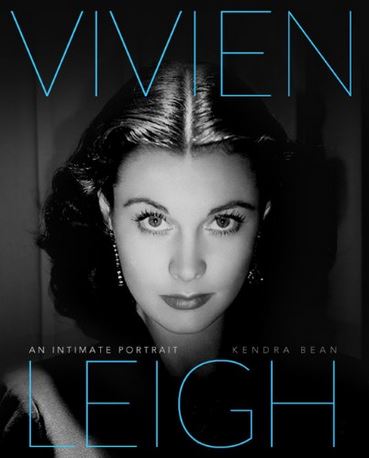
Vivien LeighVivien Leigh: Gin and Tonic
4 to 5 tonic water Ice Cubes
3 ounces gin
4 ounces tonic water
1 tablespoon squeezed lime juice
Lime wedge for garnish
Source: Vivien Leigh historian Kendra Bean

charles-butterworth-1-sizedCharles Buttersworth: Martin with Gin
2 ounces dry gin
1 ounce dry vermouth
Ice
Olives or a twist of lemon, for garnish
Source: World’s Biggest Cookbook


Actress Jean Harlow Posing in Seductive PoseJean Harlow:
2 oz Bacardi 151 light rum
2 oz sweet vermouth
lemon peel for garnish
*The Comet’s personal favorite


Portrait of John WayneJohn Wayne:
12 oz Cola
5 count Grenadine
6 count Jack Daniels


Marilyn MonroeMarilyn Monroe:
Dom Perignon 1953 Champagne
Source: World’s Biggest Cookbook


Actor and Writer Robert BenchleyRobert Benchley: Orange Blossom
3/4 oz gin
3/4 oz sweet vermouth
3/4 oz orange juice
Source: World’s Biggest Cookbook


joan-sizedJoan Crawford
Vodka on the rocks
Source: Confidential magazine, January 1957

If you don’t drink, Joan was also partial to Pepsi.


Casablanca movie image Humphrey BogartHumphrey Bogart:
Scotch
Source: World’s Biggest Cookbook


ginger rogersGinger Rogers:
Ginger Rogers didn’t drink and the “bar” in her home was a soda fountain.
Source: Ginger Rogers’s autobiography “My Own Story”


Happy New Year everyone from Comet Over Hollywood! Have a wonderful New Year’s Eve and stay safe! See you in 2014!

Cheers from Comet Over Hollywood (and Joseph Cotten)

Cheers from Comet Over Hollywood (and Joseph Cotten)

Check out the Comet Over Hollywood Facebook page, follow on Twitter at @HollywoodComet or e-mail at cometoverhollywood@gmail.com
Musical Monday: “You’ll Never Get Rich” (1941)

It’s no secret that the Hollywood Comet loves musicals.
In 2010, I revealed I had seen 400 movie musicals over the course of eight years. Now that number is over 500. To celebrate and share this musical love, here is my weekly feature about musicals.

richposterThis week’s musical:
You’ll Never Get Rich” (1941) –Musical #48

Studio:
Columbia Pictures

Director:
Sidney Lanfield

Starring:
Fred Astaire, Rita Hayworth, Robert Benchley, Osa Massen, John Hubbard, Frieda Inescourt, Guin ‘Big Boy’ Williams

Plot:
Broadway choreographer Robert Curtis (Fred Astaire) gets mixed up in the philandering of producer Martin Cortland (Benchley). Cortland buys a bracelet for a pretty chorus girl Shelia Winthrop (Hayworth) but Cortland’s wife (Frieda Inescourt) find the bracelet after Shelia refuses it. Robert gets mixed up in Courtland’s explanations to his wife, and is able to escape the confusion when he is drafted into the Army.

Trivia:
-Rita Hayworth’s first starring role in a large budget film for Columbia Pictures. It was successful at the box office and turned Hayworth into a star.
-During the filming of this movie, the famous LIFE photo of Rita Hayworth in a negligee on a bed was published, making her even more famous along with this movie.
-Nominated for two Academy Awards: Best Music, Original Score by Cole Porter for the song “Since I Kissed My Baby Goodbye.” The second was for Best Music, Scoring of a Musical Picture by Morris Stoloff.

Robert Benchley tries to woo Rita Hayworth with a bracelet in "You'll Never Get Rich"

Robert Benchley tries to woo Rita Hayworth with a bracelet in “You’ll Never Get Rich”

-Fred Astaire appeared in two pictures with Hayworth. This film and “You Were Never Lovelier.” Though he liked dancing with Hayworth, he didn’t want to do any more pictures with her. He wanted to get away from being associated as a team with any particular actress, such as Ginger Rogers, according to “Encyclopedia of American Cinema.”
-Astaire said Hayworth danced with “trained perfection and individuality,” according to his autobiography “Steps in Time: An Autobiography.”
-The film had a working title of “He’s My Uncle,” according to “The Complete Lyrics Of Cole Porter.”

The Stars on the Film:
Rita Hayworth on the film:
-“The brass at Columbia had forgotten the fact that I was a dancer, until Fred Astaire, who knew my background, reminded them,” Rita Hayworth is quoted in the book “Hollywood Gold: Films of the Forties and Fifties” by John Howard Reid. “When Fred came to Columbia to make ‘You’ll Never Get Rich,’ they asked who they wanted as a dancing partner. Fred asked for me! That surprised me, but Fred knew what he was about. He knew my work. The film was a huge success and as a result, I was loaned out to Fox for ‘My Gal Sal.'”

Fred Astaire on the film:
Rita danced with trained perfection and individuality. Of course, she knew through experience what the dancing business was all about,” Fred Astaire is quoted in the book “Hollywood Gold: Films of the Forties and Fifties” by John Howard Reid. “That was apparent when I started working with her. I enjoyed making both ‘You’ll Never Get Rich’ and ‘You Were Never Lovelier‘ because of Rita.”

“She’s a natural. She’s constantly surprising me. Nothing is too difficult for her. She watches, goes up, practices up and the next day she has it perfect,” in the Oct. 1941, “Born to Dance-Together” in Movie Stars Parade.

Highlights:
-The film begins with Robert Benchley riding in a vehicle. He tells the chauffeur to slow down and we see the credits in the form of billboards along the road.
-The first musical number is an interesting dance number that mixes modern dance and tap dancing together.

-Fred Astaire and Rita Hayworth’s duet tap dance at the beginning of the film when Astaire is showing her how to do a dance in the show. The number show’s off just how good a dancer Hayworth is.

-Popular 1940s singer Martha Tilton shows up at the end as a specialty performance for the “Wedding Cake Walk” number.

Singer Martha Tilton makes an appearance singing "The Wedding Cake Walk."  (Comet Over Hollywood/Screen Cap by Jessica Pickens)

Singer Martha Tilton makes an appearance singing “The Wedding Cake Walk.” (Comet Over Hollywood/Screen Cap by Jessica Pickens)

Notable Songs:
-Shootin’ the Works for Uncle Sam sung by Fred Astaire
-The Wedding Cake Walk sung by Martha Tilton

My Review:
The biggest point of interest with “You’ll Never Get Rich” is this is the film that made Rita Hayworth a star and showed Fred Astaire could have other dancing partners besides Ginger Rogers.
While Fred Astaire sings a few songs and we hear two songs from the Four Tones group, this musical seems to focus more on dancing. It’s a vehicle for Rita Hayworth, showing off how good of a dancer she is, so she isn’t dubbed like she is in musicals in the future.
The plot is a bit zany and runs on miscommunication jokes, however it’s a fairly cute and entertaining film. The thing that stands out the most are the excellent dancing numbers with Rita Hayworth and Fred Astaire.

Rita Hayworth and Fred Astaire dancing in the "So Near and Yet So Far" number.

Rita Hayworth and Fred Astaire dancing in the “So Near and Yet So Far” number.

Check out the Comet Over Hollywood Facebook page, follow on Twitter at @HollywoodComet or e-mail at cometoverhollywood@gmail.com

Christmas with the Comet: “The Homecoming” (1971)

homecomingApplesauce cake, decorating the tree and a blooming Christmas cactus.

All of these are characteristic of the Walton family Christmas, but one thing is missing.

John Walton, the father, hasn’t returned from his job 50 miles away. It’s snowing, and the Walton family heard over the radio there has been a bus accident.

On Christmas Eve in 1933, it’s John Boy Walton’s job to find his Daddy.

This isn’t an episode of “The Waltons” but the made-for-television-movie “The Homecoming: A Christmas Story” that aired on Dec. 19, 1971.

The 100-minute movie became the pilot for the television series “The Waltons” that aired from Sept. 1972 to 1981.

The television film is set in Virginia on Waltons Mountain and introduces the Walton children, grandparents and mother as they wait for John Walton to return on Christmas Eve.

Mary Ellen wants to decorate the Christmas tree with a bird's nest and Olivia Walton agrees it makes the tree look nice.

Mary Ellen wants to decorate the Christmas tree with a bird’s nest, and Olivia Walton agrees it makes the tree look nice.

We see the growing pains of 13-year-old Mary Ellen, Erin as a young tattle tale, Jason’s desire to become a musician and the youngest children’s excitement about Santa Claus.

As it gets later, Olivia Walton (Patricia Neal) gets anxious about her husband’s return and sends her oldest son, John Boy (Richard Thomas), out to find his father.

During the search, John Boy runs out of gas and stops at an African-American church, and gets help from Hawthorne Dooley (Cleavon Little).

Hawthorne and John Boy visit the Baldwin sisters (Josephine Hutchinson, Dorothy Stickney), known for their bootleg whiskey, for help during the search.

As John Boy searches for his father, we get a glimpse at how he wants to be a writer, how he feels like a “mother duck’ to his brothers and sisters, and wants to be like his father, but isn’t good at farming and doesn’t like to hunt.

The Walton family originally appeared as the Spencer family in the film “Spencer’s Mountain” (1963), starring Henry Fonda, Maureen O’Hara and James McArthur.

The film was inspired by the book written by Earl Hamner, Jr. about life in Virginia.  Hamner was not directly involved in the filming of “Spencer’s Mountain” like he later was with the 1970s TV show, according to “The Waltons: Nostalgia and Myth in Seventies America” by Mike Chopra-Gant.

The family again appears in “The Homecoming,” but the name was changed from Spencer to Walton to avoid legal problems with Warner Brothers, according to Chopra-Gant’s book.

Hamner said “The Homecoming” was a story he planned to write for many years based on his childhood, and he also wrote the screenplay and narrated the film, according to the Chopra-Grant book.

Lines in the film such as “What a woman I married” and “All my babies are thoroughbreds” are part of Hamner’s childhood. They were said by his father, Earl Hamner, Sr, according to the book “Earl Hamner: From Walton’s Mountain to Tomorrow: a Biography”  by James E. Person.

The popularity of the television film spawned the television series.

“The Homecoming” gives us a glimpse at a Southern family living in the Blue Ridge Mountains during the Depression.

All Elizabeth Walton wants for Christmas is a doll. When she receives one from a missionary, it's broken.

All Elizabeth Walton wants for Christmas is a doll. When she receives one from a missionary, it’s broken.

Olivia Walton can’t afford toys for the children and only plans on giving them hand-knitted scarves for Christmas. The family doesn’t have a phone, and buying the sugar for the applesauce cake was extravagant.

All little Elizabeth Walton wanted for Christmas was a page of dolls from the Sears-Roebuck catalog.

There are several funny scenes as the children bicker or as we meet the Baldwin sisters.

John Boy and Hawthorne stop at the Baldwin sister home for gas.

John Boy and Hawthorne stop at the Baldwin sister home for gas.

We also see the family’s strength and love through moving and heart-warming scenes, such as when John Walton finally returns home and recognizes John-Boy’s yearn for writing through his Christmas gift of writing tablets.

It is the perfect mix of drama, comedy and heart.

While all the child actors are the same, several of the characters in the television movie are different from the actors on the television show:

The Film:

John “John-Boy” Walton, Jr.- Richard Thomas

John Walton, Sr.- Andrew Duggan

Olivia Walton -Patricia Neal

Zeb/Grandpa” Walton -Edgar Bergen

Esther “Grandma” Walton- Ellen Corby

Jason Walton- Jon Walmsley

Mary Ellen Walton- Judy Norton Taylor

Erin Walton-Mary Elizabeth McDonough

Ben Walton- Eric Scott

Jim-Bob Walton -David W. Harper

Elizabeth Walton-Kami Cotler

Emily Baldwin- Dorothy Stickney

Mamie Baldwin- Josephine Hutchinson

Ike Godsey- Woodrow Parfrey

The Show:

John “John-Boy” Walton, Jr.- Richard Thomas

John Walton, Sr.- Ralph Waite

Olivia Walton – Michael Learned

Zeb/Grandpa” Walton- Will Geer

Esther “Grandma” Walton- Ellen Corby

Jason Walton- Jon Walmsley

Mary Ellen Walton- Judy Norton Taylor

Erin Walton-Mary Elizabeth McDonough

Ben Walton -Eric Scott

Jim-Bob Walton- David W. Harper

Elizabeth Walton-Kami Cotler

Emily Baldwin- Mary Jackson

Mamie Baldwin – Helen Kleeb

Ike Godsey- Joe Conley

It’s difficult to say if I like the casting of the show more than the film. After watching both for many years, each cast member has their own special touch.

While I love the television show, Patricia Neal as Olivia Walton has a certain grit and realism. Michael Learned is tough and motherly with her children but is glamorous in comparison to Neal.

Patricia Neal and Andrew Duggan play John and Olivia Walton in the Walton TV movie. Michael Learned and Ralph Waite play the parents on the TV show.

Patricia Neal and Andrew Duggan play John and Olivia Walton in the Walton TV movie. Michael Learned and Ralph Waite play the parents on the TV show.

Andrew Duggan is a bigger and more rugged man as John Walton in comparison to Ralph Waite.

Grandpa Walton, played by Edgar Bergen and Will Geer, are similar characters. Both loveable, kind and constantly scolded by Grandma Walton.

Fun fact: This is a reteaming for Ellen Corby and Edgar Bergen, whose characters were married in “I Remember Mama” (1949).

Though the family struggles during the Great Depression in both the film and series, they aren’t poor hillbillies but are working the best they can to stay afloat with little complaint.

I have watched the television show and the film since I was a child, and the warmth that comes from the series feels like you are welcomed into the Walton home.

John Boy receives writing tablets for Christmas from his father.

John Boy receives writing tablets for Christmas from his father.

“We walked a fine line between sentiment and sickeningly sentimentality,” Hamner later wrote about the film. “In the homecoming, Mary Ellen asks her mother if she’s pretty. Olivia replies, without missing a beat of the work she’s doing, ‘No, I think you’re beautiful.’ No tear in the eye, no touching, just a matter of fact statement.”

If you have the opportunity to see “The Homecoming” (and it’s on Youtube), you won’t be drowned in saccharine sweetness but realism and heart. It’s sentimental and welcoming.

Some of my favorite quotes:
Elizabeth: I’m not going to have any babies
Erin: What are you going to have, Elizabeth?
Elizabeth: Puppies!

Mary Ellen: You’re all a bunch of pissants.
Erin: Mama! Mary Ellen is calling us names.
Elizabeth: She said we were pissants. I don’t feel like a pissant.

Missionary: Why look to a foreign country for heathens when the Blue Ridge Mountains are full of them!

Mamie Baldwin: Papa always called them cousins, sister!
Emily Baldwin: Well, they sure dropped out of the family after Papa died.

Emily Baldwin: The nice thing about life is you never know when there is going to be a party!

The Walton children in the movie are the same actors as on the show.

The Walton children in the movie are the same actors as on the show.

Check out the Comet Over Hollywood Facebook page, follow on Twitter at @HollywoodComet or e-mail at cometoverhollywood@gmail.com
Christmas Musical Monday: “Holiday Inn” (1942)

It’s no secret that the Hollywood Comet loves musicals.
In 2010, I revealed I had seen 400 movie musicals over the course of eight years. Now that number is over 500. To celebrate and share this musical love, here is my weekly feature about musicals.

holiday inn posterThis week’s musical:
Holiday Inn” (1942) –Musical #22

Studio:
Paramount Pictures

Director:
Mark Sandrich

Starring:
Fred Astaire, Bing Crosby, Marjorie Reynolds, Virginia Dale, Walter Abel, Louise Beavers

Plot:
Singer Jim Hardy (Bing Crosby) and dancer Ted Hanover (Fred Astaire) are both in love with Lila Dixon (Virginia Dale). When Lila jilts Jim for Ted, Jim decides to quit show business and live on a farm.Jim ends up converting his farm into a nightclub and hotel called the Holiday Inn which is only opened during the 15 holidays of the year.
When Jim meets Linda Mason (Marjorie Reynolds), she agrees to appear in his shows at the inn, and the two fall in love. However, Jim works to keep Linda from meeting Ted -who was also jilted by Lila-so he doesn’t steal her for an act and her heart.
Holidays and their songs include:
Christmas (twice)-  “White Christmas”
New Years (twice) -“Happy Holidays” and “Let’s Start the New Year Right”
Valentines Day- “Be Careful, It’s My Heart”
Abraham’s Birthday: “Abraham”
Washington’s Birthday: “I Can’t Tell a Lie”
Easter: “Easter Parade”
Fourth of July: “Song of Freedom” and “Let’s Say it with Fireworks”
-Thanksgiving- “I’ve Got Plenty to Be Thankful For”

Trivia:
-The hotel chain Holiday Inn was inspired by the title of this film, according to the hotel founder Kemmons Wilson’s New York times obituary.
-This film introduced the song “White Christmas.” Irving Berlin thought of the song “White Christmas” in 1935 on the set of “Top Hat” and wanted to use it for a Fred Astaire-Ginger Rogers film. Astaire liked the tune but it was never used until their film. Irving Berlin and Moss Hart worked and copyrighted the idea for a musical revue revolving around tunes for each holiday, according to “The Complete Lyrics of Irving Berlin” by Robert Kimball and Linda Emmett.

– Irving Berlin had a hard time writing the Christmas song “White Christmas” since he was Jewish. He ran the song by Bing Crosby, who thought it would be great, according to “Christmas’s Most Wanted” by Kevin Cuddihy.

Bing Crosby and Marjorie Reynolds (dubbed by Martha Mears) sing "White Christmas" at the end of the film.

Bing Crosby and Marjorie Reynolds (dubbed by Martha Mears) sing “White Christmas” which became a hit due to this film.

-The film originally was supposed include a dance number for Labor Day.

-The original version of the song “White Christmas” talked about basking in Los Angeles and longing for an old fashioned Christmas in New England. But the version we know now is more nostalgic, discussing a Christmas that a person won’t experience first hand-much like the soldiers fighting over seas during World War II, according to “World War II and the Postwar Years in America.”

-Mary Martin turned down the role of Linda played by Marjorie Reynolds because she was pregnant, according to her autobiography.

-Fred Astaire’s shoes he danced in during the Firecracker routine were auctioned off for $116,000 that went towards the war effort.

-The popularity of the song “White Christmas” created the spin off film “White Christmas” (1954) also starring Bing Crosby and co-starring Danny Kaye, Vera-Ellen and Rosemary Clooney, according to the book “Christmas’s Most Wanted.”

-Fred Astaire was the first choice for the Danny Kaye Role in “White Christmas” (1954) to be a reunion after “Holiday Inn,” but Astaire turned down the role, according to the “Christmas Encyclopedia” by William D. Crump

-Paramount Pictures did not market this film as a Christmas movie since it covers many other holidays, according to “World War II and the Postwar Years in America” by William and Nancy Young.

Fred Astaire in firecracker number for the Fourth of July.

Fred Astaire in firecracker number for the Fourth of July.

-The Fourth of July number was expanded and made more patriotic after the bombing of Pearl Harbor; including the song “Song of Freedom,” “Let’s Say it with Firecrackers” and a movie reel of war workers and soldiers marching.

-Paramount thought “Be Careful, It’s My Heart” would be the hit from the film. Though it made the Hit Parade first with Tommy Dorsey’s Band, “White Christmas” was the true hit, according to “World War II and the Postwar Years in America.”

-Won an Academy Award for Best Original Song- “White Christmas” by Irving Berlin. It was nominated for an Academy Award for Best Score by Robert Emmett Dolan and Best Original Story by Irving Berlin.

-Marjorie Reynolds is dubbed by Martha Mears.

Highlights:

Fred Astaire dances with Marjorie Reynolds during the New Years scene where he took drinks of bourbon before each take.

Fred Astaire dances with Marjorie Reynolds during the New Years scene where he took drinks of bourbon before each take.

-Fred Astaire and Bing Crosby imitate each other in the number “I’ll Capture Your Heart Singing.” 
-Fred Astaire’s drunken New Years Eve dance. Supposedly Astaire had a drink of bourbon before each take-it took seven-to appear drunk in the scene.
-Fred Astaire’s “Say it With Fireworks” dance for the Fourth of July number where he throws down fireworks while he taps.
-The cartoon turkey on the calendar that runs between the dates for Thanksgiving Day. This is referring to “Franksgiving,” a controversy that occurred during the Roosevelt administration. President Roosevelt wanted to make Thanksgiving a week earlier.


Notable Songs: 
Since the music is by Irving Berlin, all of the songs are fantastic. The top songs include:
-“White Christmas” sung by Bing Crosby. This is the most famous song in the movie. The version sung by Cosby in the movie is the one you hear most on the radio.
-“You’re Easy to Dance With” sung and danced by Fred Astaire and Virginia Dale
-“I Can’t Tell a Life” sung by Fred Astaire for Washington’s Birthday dressed in period clothing.
-“Easter Parade” sung by Bing Crosby to Marjorie Reynolds for the Easter portion.

My Review:
When I first saw this movie several years ago, I didn’t like it.
I thought Fred Astaire was a bit of a heel and had no redeeming features. However, as I rewatch it, I see both men are heels at different points in the movie.
Characters aside- the thing that stands out the most is the music-all revolving around holidays. Irving Berlin’s songs written for each holiday are catchy and clever.
Fred Astaire also is able to show off his dancing abilities both with partners and in solo numbers. Bing Crosby has an excellent score and sings the song he is most remembered for.
“Holiday Inn” is an interesting topic for a film and is musically beautiful.
If you are looking for a Christmas movie, it doesn’t completely revolve around the holiday (but Christmas is in the film three times) and introduced one of the most loved holiday songs.

Bing Crosby, Marjorie Reynolds, Fred Astaire, Virginia Dale

Bing Crosby, Marjorie Reynolds, Fred Astaire, Virginia Dale

Check out the Comet Over Hollywood Facebook page, follow on Twitter at @HollywoodComet or e-mail at cometoverhollywood@gmail.com