Musical Monday: “Billie” (1965)

It’s no secret that the Hollywood Comet loves musicals.
In 2010, I revealed I had seen 400 movie musicals over the course of eight years. Now that number is over 500. To celebrate and share this musical love, here is my weekly feature about musicals.

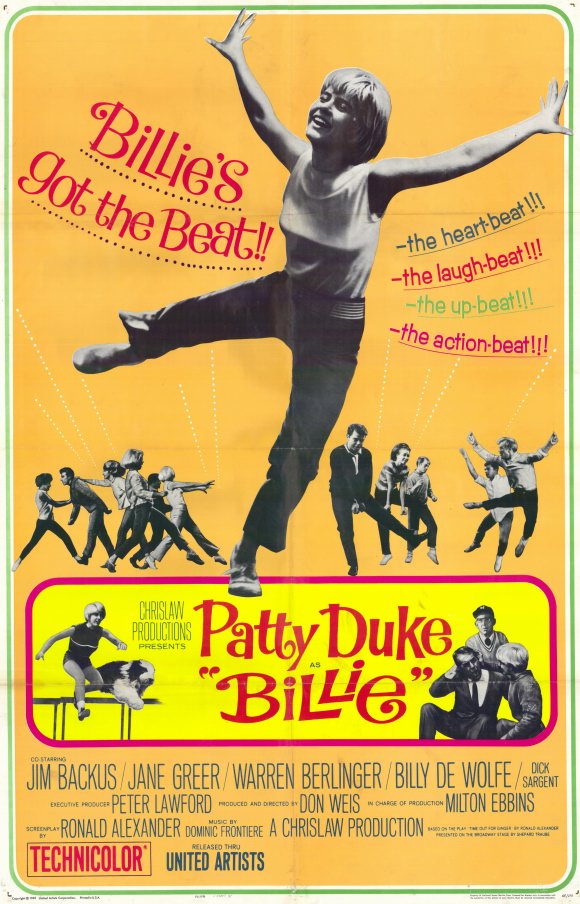
billieThis week’s musical:
Billie“- Musical #299

Studio:
Paramount Studios

Director:
Don Weis

Starring:
Patty Duke, Jane Greer, Jim Backus, Warren Berlinger, Billy de Wolfe, Charles Lane, Dick Sargent, Ted Bessell

Plot:
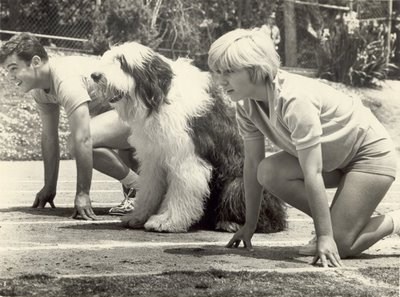
Fifteen year old tomboy Billie (Duke) finds herself on the boy’s track team when the coach sees how fast she can run. Her secret to fast running is “a beat” she hears in her head. Billie doesn’t like being treated differently from her male teammates and wants to be an equal, not a girl. At the same time of her track success her father (Backus) is running for mayor under a “keep women in the home” campaign.

Trivia:
-Based on a 1952 play “Time Out for Ginger”
-Filmed between seasons of “The Patty Duke Show
-Actor Peter Lawford is listed as an executive producer for the film.
-Kent McCord who later starred as Officer Jim Reed on the TV show “Adam-12” has an uncredited role as a spectator student spectator.

Highlights:
-A dance number where Billie teaches the other male and female students how to have “the beat,” complete with the latest 1960s dance moves. I don’t really see how it teaches the students anything, but it works in a nice dance number with 20 kids.
-Character actor Charles Lane plays Billie’s track coach. It’s always a treat to see him. You can see him in 1930s pre-code films all the way to 1960s
-Robert Banas who was Jet “Snowboy” in “West Side Story” leads the dance “She is a Girl is a Girl.”

Notable Songs:
-”Lonely Little in Between” sung by Patty Duke. An odd song where Billie sings about being a tom boy. Includes lyrics such as “I should have been a boy but I’m a girl.” She later sings “Funny Little Butterflies” which is the exact same tune, but now she has a crush and feels like a girl.

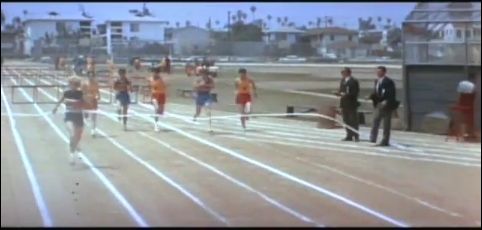
Billie wins track meets, because she hears a beat in her head that makes her run faster

Billie wins track meets, because she hears a beat in her head that makes her run faster

My Review:
The plot of “Billie” is actually pretty dumb, but it is still a fun one to catch. If you do come across it on TV, watch it–it’s seldom aired.

It has a lot of crazy one-liners such, mostly said by Jim Backus who seems to specialize in playing terrible parents (see: Rebel Without A Cause). Some quotes include “Try to be more like your sister” and “You did great today, son” to Duke. Another favorite is when Billie’s sister Jean says “I’ve decided to quit college and come home” and dad says “That’s marvelous!”

However, it is an interesting movie to see so many 1960s television actors such as Richard Deacon, Patty Duck, Jim Backus, Dick Sargent and Ted Bessell. You also get the chance to see 1940s actress Jane Greer playing Duke’s mother.

It’s also interesting because this movie has some feminist undertones in a time when beach movies were focusing on sex and pretty girls in bikinis.

Though “Billie” is a pretty terrible movie, It’s also a lot of fun. It’s fairly typical of most goofy, 1960s teen films. Overall, Patty Duke does a good job and is a driving force behind the films energy. While her character was 15 year old, Duke was actually 19 when this film was released in 1965. The dance numbers and songs are energetic and make you want to dance along.

If you are looking for some mindless, 1960s nostalgic, colorful film, “Billie” may be an alright fit.

Warren Berlinger as Mike Benson, Clown the dog and Patty Duke as Billie.

Warren Berlinger as Mike Benson, Clown the dog and Patty Duke as Billie.

Check out the Comet Over Hollywood Facebook page, follow on Twitter at @HollywoodComet or e-mail at cometoverhollywood@gmail.com
Actress Beauty Tip #32: Susan Hayward diet

This is the thirty-second installment of the monthly classic actress beauty tips that I have read about and tested.

Actress Susan Hayward stayed thin with a three day diet of eggs and tomatoes.

Actress Susan Hayward stayed thin with a three day diet of eggs and tomatoes.

This week I went on a diet for Comet Over Hollywood.

Red-headed Academy Award winning actress Susan Hayward claimed she stayed under 118 pounds by eating 2 eggs (prepared any way) and one tomato three times a day for consecutive three days.

“If you continue more than three days, you may start clucking like a hen,” Hayward said in an interview.

Hayward claimed you could lose five pounds in three days with this diet, which seems highly doubtful to me.

“Her (Susan Hayward) measurements are the same as they were when she was 20,” beauty columnist Lydia Lane wrote about the then 47-year-old actress in an Aug. 2, 1964, column, “Susan Hayward Gives Diet Tips.”

The Comet isn’t anywhere near 118 pounds, but I’m always a fan of weight loss and eating healthy. I decided to give it a try. I like both eggs and tomatoes so I figured it couldn’t be that hard. Here is how the three days went for me:

Tuesday, Oct. 1:
Breakfast: Two eggs scrambled with a cut up tomato. It was delicious and filling. However, I realized eating one whole tomato for a meal is ALOT of tomato. Or alot more than I’m used to eating.
Lunch: Was still full from breakfast so didn’t eat the hard boiled eggs and cut up tomato I brought for lunch.
Dinner: Felt a bit like I was getting a cold so talked myself into getting a McDouble from McDonalds, instead of eating eggs and tomatoes for dinner.

Wednesday, Oct. 2 
Breakfast: Two scrambled eggs and a tomato again. Still tasted good.
Lunch: Two hard boiled eggs and a tomato. Enjoyable meal made even better when I dabbed my egg in mustard.
Dinner: Sunny-side up eggs on a toasted sandwich with a cut up tomato on the sandwich. Ate the rest of the tomato by itself. Filling but growing weary of eggs.

Thursday, Oct. 3
Breakfast: Skipped breakfast because running late for work.
Lunch: Another delicious meal of hard boiled eggs with a tiny bit of mustard and a tomato.
Dinner: I went to the fair….and had a chicken pita wrap….Nothing fried or terribly unhealthy, but still not part of the diet.

Friday, Oct. 4
I was going to add one more day to the diet since I cheated on two meals but ended up not eating all day because was too busy at work. Had spaghetti for dinner

Hayward shows off her figure as she dances in the John Wayne film

Hayward shows off her figure as she dances in the John Wayne film “The Conqueror” (1954).

To review: Since it was only for a few days, I can’t say if I lost weight. I can say I continuously wanted to eat a cheeseburger. However, eating healthier made me feel a little better about life. I stayed full after eating and my usually oily hair and skin felt fresher than usual at the end of the day.

For me, eating eggs and tomatoes for both breakfast and lunch isn’t difficult, but eating it a third time for dinner is when it got tiresome. By that point, I wanted to cook a pork chop or even just eat some cereal and toast.

I can’t say I will continue with Susan Hayward’s diet, but will probably continue to incorporate eggs into my diet at least once a day. I did consider taking a break for two days and doing the diet for three more consecutive days, but I’m pretty tired of eggs and tomatoes right now.

So in review, though I didn’t drop rapid weight, I did feel better about life during this diet. 

Check out the Comet Over Hollywood Facebook page, follow on Twitter at @HollywoodComet or e-mail at cometoverhollywood@gmail.com

Classic movies in music videos: Countdown by Beyonce

This is October’s edition of Comet Over Hollywood’s film references in music videos.

Beyonce’s channels Audrey Hepburn in her music video “Countdown” released in October of 2011.

About 15 seconds into the video, Beyonce can be seen wearing a beatnik style outfit complete with a black turtleneck, black pants, white socks and black loafers.

Beyonce channels Audrey Hepburn from  "Funny Face" (1957) in her 2011 video "Countdown"

Beyonce channels Audrey Hepburn from
“Funny Face” (1957) in her 2011 video “Countdown”

The outfit is reminiscent of the outfit Audrey Hepburn wears in the 1957 musical “Funny Face.” In the film, Hepburn plays an intellectual shop girl who is transformed into a model.  Hepburn is taken to Paris but has more interest in talking with the beatnik crowd.

Audrey Hepburn dances in a beatnik cafe in "Funny Face" (1957)

Audrey Hepburn dances in a beatnik cafe in “Funny Face” (1957)

The white socks Hepburn wears in the scene caused trouble on set.

Hepburn thought all black, including the socks looked better. Director Stanley Donen said if she wore all black, she would fade into the the background in the dimly lit scene and there would be no definition in her movement, according to the Sam Irvin book “Kay Thompson: From Funny Face to Eloise.”

Hepburn burst into tears, went into her dressing room but came out wearing the white socks. Later she sent Donen a note saying he was right about the socks, according to Irvin.

Along with “Funny Face,” Beyonce also briefly references “Fame,” Twiggy in a Vogue shoot, “Dreamgirls” and “Flashdance.”

Check out the Comet Over Hollywood Facebook page, follow on Twitter at @HollywoodComet or e-mail at cometoverhollywood@gmail.com
Musical Monday: “Two Weeks with Love” (1950)

It’s no secret that the Hollywood Comet loves musicals.
In 2010, I revealed I had seen 400 movie musicals over the course of eight years. Now that number is over 500. To celebrate and share this musical love, here is my weekly feature about musicals.

two weeksThis week’s musical:
Two Weeks With Love” (1950)-Musical #71

Studio:
Metro-Goldwyn-Mayer

Director:
Ray Rowland

Starring:
Jane Powell, Ricardo Montalban, Ann Harding, Louis Calhern, Debbie Reynolds, Carleton Carpenter, Phyllis Kirk, Tommy Retting, Gary Gray

Plot:
In the early 1900s, the Robinson family takes their annual summer vacation to Kissimee in the Catskills. It’s a coming of age story as 17-year-old Patti (Powell) is ready to grow up and wear corsets and date men but her mother (Harding) and father (Calhern) still thinks she is too young. That summer a handsome young Cuban named Demi (Montalban) visits the resort. While Patti swoons, her older friend Valerie (Kirk) works to keep Demi’s attention on her. In the background, Patti’s younger teenage sister Melba (Reynolds) has a crush on Billy (Carpenter) who is chasing Patti.

Patti's rival Valerie is always making it hard for Patti and Demi to be alone. (Kirk, Montalban, Powell) (Comet Over Hollywood/ Screen Cap by Jessica P.)

Patti’s rival Valerie is always making it hard for Patti and Demi to be alone. (Kirk, Montalban, Powell) (Comet Over Hollywood/ Screen Cap by Jessica P.)

Trivia:
-Debbie Reynolds wrote in her memoir “Unsinkable,” that her mother packed her lunch of ground up bologna and pickle juice sandwiches every day. Louis Calhern’s lunches were prepared for him by the studio, but he usually traded with Debbie for her sandwiches.

Famous stars in the 1930s, Ann Harding and Louis Calhern play Horatio and Katherine Robinson in "Two Weeks with Love." (Comet Over Hollywood/ Screen Cap by Jessica P.)

Famous stars in the 1930s, Ann Harding and Louis Calhern play Horatio and Katherine Robinson in “Two Weeks with Love.” (Comet Over Hollywood/ Screen Cap by Jessica P.)

-Jane Powell says this is one of her favorite movies, according to her autobiography “The Girl Next Door and How She Grew.”
“I loved making ‘Two Weeks with Love’ because it was a very special experience,” Powell wrote in her book. “The cast was so wonderful, I feel happy even now when I think about the film.”
-Debbie Reynolds plays the French horn during the song “That’s How I Love You.” Whether she is really playing the horn in the film or not, Reynolds played the French horn in high school.
-Louis Calhern once said he was miscast as playing the father of Debbie Reynolds and Jane Powell. “Me, with my long nose, and being as tall as I am, playing the father of two little button noses like Janie and Debbie,” Powell quoted in her book.
-Phyllis Kirk’s third movie.
-Debbie Reynolds fourth movie.
-The hotel where the family is staying in “Two Weeks with Love” is the same hotel in the first scene of “Annie Get Your Gun” (1951).
-The dances in the film were choreographed by Busby Berkeley, who was known for his kaleidoscope shots in 1930s films such as “42nd Street.”

Highlights:

Patti's mischievous little brothers hide fireworks under their bed, and father (Calhern) accidentally lights a fuse. (Comet Over Hollywood/ Screen cap by Jessica P.)

Patti’s mischievous little brothers hide fireworks under their bed, and father (Calhern) accidentally lights a fuse. (Comet Over Hollywood/ Screen cap by Jessica P.)

-The two youngest boys hide hundreds of firecrackers under their bed. They accidentally get lit when their father unknowingly lights it with his cigar. Chaos ensues.
-Powell has a few dream sequences where she imagines Montalban is fawning over her. Both are hilarious and adorable. One is when she is alone in a canoe. She imagines he proposes to her and he tells her that she is full of “latent fire” and then is outraged that she doesn’t wear a corset.
-The second dream sequence is Powell glamorously dressed in only a corset, hat and umbrella. Everyone at the hotel is admiring her. Then, everyone’s outfits turn to royal wear and Montalban and Carpenter have a sword fight over Powell. Powell sings “My Hero” as she waltzes with Montalban.
-Calhern tries to help Powell and buys her a corset in the film, not knowing what he’s buying, he gets a surgical corset. During a dance with Montalban, it locks.

Patti (Powell) dreams of being a grown up lady who wears a corset in this dream sequence. (Comet Over Hollywood/Screen Cap by Jessica P.)

Patti (Powell) dreams of being a grown up lady who wears a corset in this dream sequence. (Comet Over Hollywood/Screen Cap by Jessica P.)

Notable Songs:
-“Abba Dabba Honeymoon” sung by Debbie Reynolds and Carleton Carpenter. This is the most notable song in the movie. Carpenter and Reynolds fast, energetic singing style is what makes it memorable. The song made the Hit Parade and Reynolds and Carleton went on tour to promote the song and the film.

-“By the Light of the Silvery Moon” sung by Ann Harding and Louis Calhern. They don’t have great voices but it’s a very sweet moment.
-“My Hero” sung by Jane Powell during the corset dream sequence.

Patti (Powell) dances the tango with Demi (Montalban) in the resort's talent show. (Comet Over Hollywood/ Screen Cap by Jessica Pickens)

Patti (Powell) dances the tango with Demi (Montalban) in the resort’s talent show. (Comet Over Hollywood/ Screen Cap by Jessica Pickens)

My Review:
Two Weeks With Love” is a joy to watch. It has an excellent cast, is fun and colorful with it’s Technicolor. But not only is it lighthearted, it’s hilarious. There are so many jokes in the movie that keep me laughing, keeping it charming and witty. It’s wonderful to see Ann Harding and Louis Calhern later in their career if you know them more from their 1930s role. In the 1930s, Harding usually played intellectual women with lose morals and Calhern played cads with gun. But later in their career, they fill the role of loving parents perfectly. Jane Powell was an established star by now and is 21 in the film, and is delightful as always. In her first major role, Debbie Reynolds energy and enthusiasm that made her famous is already shining. If you haven’t seen “Two Weeks with Love,” I highly suggest it. It may not be as famous as other 1950s MGM films, but you will remember it once you watch it.

Check out the Comet Over Hollywood Facebook page, follow on Twitter at @HollywoodComet or e-mail at cometoverhollywood@gmail.com


“The Wizard of Oz” in 3D: Was it necessary?

My parents introduced “The Wizard of Oz” to me when I was a baby.

My sisters and I all have dressed up as Dorothy for Halloween or a book character day at least once.
We also have Dorothy Barbies, dolls and my mom owns “The Wizard of Oz” collectors decorative plates.

Needless to say, the Pickens family are fans of the film.

I grew up with “The Wizard of Oz” just as my parents did when it was shown yearly on television.

wizard of oz2

“The Wizard of Oz” was what taught me about the state of Kansas and what a cyclone was.
Like most movies, the information and lessons it taught me molded my young mind.

When I heard the 1939 film starring Judy Garland as Dorothy was going to be released in 3D and IMAX, I had mixed emotions.
1. I wanted to see the film on the big screen, because I never had before.
2. I don’t like 3D and avoid it at all costs. Why did they feel the conversion was necessary?

Though I wasn’t pleased with the thought of 3D or paying $17 for a movie ticket, I couldn’t pass up watching a classic film in a movie theater- something that doesn’t happen much in my area.

Ray Bolger as the Scarecrow, Bert Lahr as the Cowardly Lion, Judy Garland as Dorothy and Jack Haley as the Tin Man in "The Wizard of Oz"

Ray Bolger as the Scarecrow, Bert Lahr as the Cowardly Lion, Judy Garland as Dorothy and Jack Haley as the Tin Man in “The Wizard of Oz”

Tuesday evening I made the 50 minute drive to Charlotte, NC to see the “Wizard of Oz.”

The Technicolor was lush, I laughed at the supporting characters, cried at the end of the movie and I enjoyed myself. It had been years since I watched “The Wizard of Oz” from start to finish. I forgot how funny the jokes are and how visually beautiful it is.

Having the opportunity to see a classic film on the big screen is a special experience. Even if you have seen the movie before, you pick up on jokes and subtle movements and expressions better than you can on your television. You are also forced to pay attention to the film, because it is just you and the screen.

But the big question is, was the 3D necessary or distracting?

The 3D wasn’t obtrusive or dramatic. Many scenes looked similar to if you were watching a 2D version of the film. The times it stood out the most were when the Wicked Witch (played by Margaret Hamilton) pointed at the camera or when Glenda the Good Witch (played by Billie Burke) gestured with her silver wand.

The Lollipop Guild

The Lollipop Guild

The 3D mostly was used for depth. Dorothy sat a little further out from her surroundings as she sang “Somewhere Over the Rainbow” and the Lollipop Guild stood out as well. These scenes weren’t bothersome, but there just wasn’t much purpose to it.

The only other 3D film I have watched in a theater the John Wayne film “Hondo” (1953) at the Turner Classic Film Festival. While the 3D wasn’t used excessively in “Hondo,” it’s use was more dramatic. Native Americans rode on horses towards the screen and arrows looked like they were coming at you.
There was nothing that dramatic in “The Wizard of Oz,” not even a flying monkey looking like it was going to share your seat.

There were a few times I felt 3D made things a bit blurry (or maybe it’s my bad eye sight) like when the Scarecrow (Ray Bolger), Dorothy (Garland), the Cowardly Lion (Bert Lahr) and the Tin Man (Jack Haley) ran through the poppy field. Another area I felt was a bit blurry was when Dorothy opened the door to Oz-taking the film for sepia tone to Technicolor.

In general, I’m not a fan of colorization of black and white films such as “It’s A Wonderful Life” (1946) or “Rebecca of Sunnybrook Farm” (1938). I feel that modifying a film from 2D to 3D falls under the same distasteful category as colorization. All of these tactics are to bring in younger audiences. But why change art? If a younger audience doesn’t like the “Mona Lisa” would we paint a smile on her?

“3D falls into the category of digital ‘remixing,’ colorizing and other changes,” said my broadcast journalism professor, Haney Howell. “The director shot the movie from his perspective, not that of some geek who thinks he can make it better.”

Buddy Ebsen was originally cast as the Tin Man but was allergic to the makeup. His big break came in the from of the 1960s TV show, "The Beverly Hillbillies."

Buddy Ebsen was originally cast as the Tin Man but was allergic to the makeup. His big break came in the from of the 1960s TV show, “The Beverly Hillbillies.”

From 1938 to 1939, the script of “The Wizard of Oz” had several rewrites and stars were recast in the film. Shirley Temple was originally considered for the role of Dorothy. Buddy Ebsen was going to be the Tin Man but was allergic to the silver face paint, and Jack Haley was cast instead. Margaret Hamilton, who played the Wicked Witch of the West, received third degree burns on her hands and face during her firey exit with the Munchkins.

A lot of blood, sweat and tears went into the director’s vision of “The Wizard of Oz.” Modifying the film from 2D to 3D is going against artistic wishes.

When it was announced “Wizard of Oz” was going to be in 3D, it was said, “If 3D was around in 1939, this is how it would have been shot.” Which is a ridiculous response.

Filmmakers have had 3D capabilities of some sort since the 1920s and 1930s. MGM even made a short film in 1935 called “Audioscopiks” testings 3-D. Then 3D film fell briefly into the mainstream from 1952 to 1954. Hollywood was using 3D to pull movie goers away from their television screens and back into theaters.
So saying “If 3D was around” is a fairly ignorant response.

But to answer the $64 question of “Was 3D necessary?”: No, probably not. But so far, since “The Wizard of Oz” was released last Friday, it has made roughly $3 million. It has served the purpose the money making purpose it was supposed to.

Regardless, I really enjoyed seeing “The Wizard of Oz” for the first time on the big screenscreen.

But as Dorothy says, “If I ever go looking for my heart’s desire again, I won’t look any further than my own backyard. Because if it isn’t there, I never really lost it to begin with.”

The popularity of “The Wizard of Oz” has remained for over 75 years, so why look any further to improve on it when it isn’t needed.

sepia dorothy

Check out the Comet Over Hollywood Facebook page, follow on Twitter at @HollywoodComet or e-mail at cometoverhollywood@gmail.com

Musical Monday: “Moon Over Miami” (1941)

It’s no secret that the Hollywood Comet loves musicals.
In 2010, I revealed I had seen 400 movie musicals over the course of eight years. Now that number is over 500. To celebrate and share this musical love, here is my weekly feature about musicals.

This week’s musical:
“Moon Over Miami” –Musical #162

Poster - Moon Over Miami_04

Studio:
20th Century Fox

Director:
Walter Lang

Starring:
Betty Grable, Carole Landis, Don Ameche, Robert Cummings, Charlotte Greenwood, Jack Haley

Plot:
Kay and Barbara Latimer (Grable and Landis) work with their Aunt Susan (Greenwood) at a burger joint in Texas. They think they are going to come into a windfall of money, but only ends up being $4,000. Kay comes up with a scheme where they will go to Miami on the money and get rich husbands. Kay poses as an heiress with her sister acting as her secretary and her aunt poses as her maid. Kay meets two millionaires who are smitten with her- Jeff (Cummings) and Phil (Ameche). Which will she pick and are they everything that they seem they are?

Trivia:
-Joan Davis was cast in the Carole Landis role in March 1941.
-John Payne and Dana Andrews were considered for the male leads.
-Originally supposed to star Virginia Gilmore and Gene Tierney or Arline Judge were conceived to appear in the roles of Barbara and Susan.
-Remake of “Three Blind Mice” (1938)-starring Loretta Young and Joel McCrea-and “The Greeks Had a Word for Them” (1932) starring Joan Blondell, Madge Evans and Ina Claire.
-Remade with “Three Little Girls in Blue” (1946) starring June Haver (who once was called the Pocket Betty Grable), Vivian Blaine and Vera-Ellen.

Highlights:
-The Condos Brothers (Frank and Harry) dance with Grable and then perform in an elaborate South American dance number. Grables dance in “You Started Something” with them is one of my favorite dances in the film.
-Charlotte Greenwood’s flexible, high leg swinging dance moves

One of Charlotte Greenwood's signature dance moves (Comet Over Hollywood/ Screen cap by Jessica P)

One of Charlotte Greenwood’s signature dance moves (Comet Over Hollywood/ Screen cap by Jessica P)

-In “The Kindergarten Congo,” Grable dances with Hermes Pan, who choreographed many of Fred Astaire’s musical numbers in musical films.
-Betty Grable’s wardrobe. She buys a new wardrobe to catch a millionaire husband and every single outfit is adorable. Here are some picture of my favorites:

moonovermaimi5

My favorite dress in Moon Over Miami. Grable is dancing with the Condos Brothers in “You Started Something” (Comet Over Hollywood/Screen cap by Jessica P.)

Lovely peach evening gown worn by Grable. (Comet Over Hollywood/Screen cap by Jessica P)

Lovely peach evening gown worn by Grable. (Comet Over Hollywood/Screen cap by Jessica P)

Another favorite outfit Grable wears in "The Kindergarten Conga" (Comet Over Hollywood/Screen Cap by Jessica Pickens)

Another favorite outfit Grable wears in “The Kindergarten Conga” (Comet Over Hollywood/Screen Cap by Jessica Pickens)


Notable Songs:
-“You Started Something” sung by Robert Cummings and Betty Grable
-“Kindergarten Conga” sung by Betty Grable, which is my favorite number in the film
-“Loveliness and Love” sung by Don Ameche
-“Is That Good?” sung by Charlotte Greenwood and Jack Haley

My Review:
This is my favorite Betty Grable movie and a movie I pop in when I have the blues. It’s colorful, the fashion is great and the songs are catchy and lighthearted. Grable looks her most beautiful and the supporting cast is excellent. Landis isn’t featured as much as Grable but does a great job in all of her scenes. Charlotte Greenwood is always a delight, especially with her goofy dancing. Both leading men are also entertaining and likeable. There are few things I can find wrong with “Moon Over Miami,” other than the fact that it has to end.
It isn’t a heavy film with some great intelligent message. But if you are looking for a pleasant way to spend an hour and a half, I suggest you spend it with “Moon Over Miami”

 
Check out the Comet Over Hollywood Facebook page, follow on Twitter at @HollywoodComet or e-mail at cometoverhollywood@gmail.com

Hot off the presses: Unethical reporters in classic films

A man is killed and sent C.O.D. to a Hollywood actress.

Rather than call the police, the actress calls her reporter friend to help her out.

The reporter investigates the case like he’s a detective.

He sneaks in houses searching for clues and finds jewels that can be used as evidence. The reporter then puts the diamonds in an ice cube tray to hide them from police.

Reporter George Brent investigates a murder in "A Corpse Came C.O.D."

Reporter George Brent investigates a murder in “The Corpse Came C.O.D.”

As these events occurred in “The Corpse Came C.O.D.” (1947) starring George Brent and Joan Blondell, my dad turns to me and asks, “I hope you don’t do these things at work.”

Later when Brent gets in a fist fight with a bad guy my dad asks, “Is there anyone at the Star that would be able to do that?”

As a reporter who loves classic movies, I go out of my way to watch films where the hero plays a reporter.

However, if I researched my stories using the same methods that reporters used in films, I would most likely get fired.

Glenda Farrell stars as Torchy Blane, a troublesome and wise-cracking reporter in 1930s films. Blane comically gets her information by hiding in trashcans and bugging rooms, techniques not used by contemporary reporters.

Glenda Farrell stars as Torchy Blane, a troublesome and wise-cracking reporter in 1930s films. Blane comically gets her information by hiding in trashcans and bugging rooms, techniques not used by contemporary reporters.

In classic films, reporters are often solving crimes like a police officer and often receive information by unethical means. At the Shelby Star, we do a lot of research on our stories, but I doubt we will ever solve a crime.

In the 1930s Torchy Blane film series, Torchy is constantly at odds with her detective boyfriend Steve McBride for being where she shouldn’t be.

The nine films follow the wise-cracking female reporter, played by Glenda Farrell, Lola Lane and Jane Wyman.

Torchy can be seen eavesdropping, bugging rooms, hiding in trash cans and following bad guys to get the scoop on a story.

If I hid in a trashcan to find out the latest secrets of Cleveland County, North Carolina, not only would that be breaking media laws, I would also smell pretty bad.

John Qualen hides in a desk in "His Girl Friday."

John Qualen hides in a desk in “His Girl Friday.”

In “His Girl Friday” (1940), reporter Hildy Johnson, played by Rosalind Russell, hides an accused murdered in her rolltop desk to get the scoop on a story. Unfortunately, I don’t have a rolltop desk at work, but even if I did, I’m not sure how the sheriff would feel if I stored suspects in my desk.

In another George Brent film “You Can’t Escape Forever” (1942), managing editor, Brent will get hunches by tugging on his ear like he’s communicating with somebody via Morse code.

Then Brent will come up with a fantastic hunch that he will print in the paper, which usually ends up being true.

If reporters worked solely on hunches without fact checking, the paper would be full of corrections that had to be run, rather than news stories.

In “The Philadelphia Story” (1940) reporters James Stewart and Ruth Hussey pose as family friends at the wedding of Katharine Hepburn. The two are tabloid writers there to get information on the story.

Getting information under false pretenses is unethical by today’s standards and would most likely leave you with a lawsuit.

Though there are several comedic representations of newspapers, there are films that represent journalism in a truer light, such as “The Story of G.I. Joe” (1945) about war journalist Ernie Pyle or “Citizen Kane” (1940) about the power of journalism.

Robert Mitchum and Burgess Meredith (as Ernie Pyle) in World War II film "The Story of G.I. Joe" about reporting on the front lines.

Robert Mitchum and Burgess Meredith (as Ernie Pyle) in World War II film “The Story of G.I. Joe” about reporting on the front lines.

As someone who works in newspapers, I don’t take offense to the unethical journalism in the 1930s and 1940s films, because I know most of it is there for comedic relief.

It doesn’t make me stop watching the films; you just have to take it all with a grain of salt, as you would with any movie.

Clearly newspapers have changed a great deal from the 1930s to today.  However, it does make me wonder how media laws and ethics have changed in the past 75 years.

So for my father: No dad, we don’t do any of that at the Star.

This is part of the Breaking News: Journalism in Classic Films blogathon co-hosted by myself and Lindsay at Lindsay’s Movie Musings. Read all of the wonderful contributions here! 

MBDCIKA EC019

Check out the Comet Over Hollywood Facebook page, follow on Twitter at @HollywoodComet or e-mail at cometoverhollywood@gmail.com

Musical Monday: “Doll Face” (1945)

It’s no secret that the Hollywood Comet loves musicals.
In 2010, I revealed I had seen 400 movie musicals over the course of eight years. Now that number is over 500. To celebrate and share this musical love, here is my weekly feature about musicals.

This week’s musical:
Doll Face (1945)- Musical #474

doll face

Studio:
20th Century Fox

Director:
Lewis Seiler

Starring:
Vivian Blaine, Carmen Miranda, Dennis O’Keefe, Stephen Dunne, Perry Como, Martha Stewart (not the home decor woman)

Plot:
Mary “Doll Face” Carroll (Blaine) hopes to break out of burlesque and into the big time. When she is turned down due to her performing background, her manager Michael Hannigan (O’Keefe) decides to have a ghost written autobiography written about Mary. The author of the book Frederick Gerard (Dunne) begins to fall in love with Mary causing conflict with Michael, who also is in love with her. Using the publicity of the book, Michael begins to produce a Broadway show with the help of the other burlesque performers.

Trivia:

Carmen Miranda performing "Chico Chico"

Carmen Miranda performing “Chico Chico”

-Based on the 1943 play “The Naked Genius” written by burlesque performer Gypsy Rose Lee.
-Carole Landis was offered the lead in the film but turned it down, according to the book Carole Landis: A Most Beautiful Girl by Eric Lawrence Gans
-Carmen Miranda’s first starring film that is in black and white.
-“Eighty Miles Outside of Atlanta” from “Something for the Boys” can be heard in the background.
-Carmen Miranda’s song “True to the Navy” cut from the film. The song as filmed still exists. Paramount held exclusive rights to the song and wouldn’t allow 20th Century-Fox the song. It was performed by Clara Bow in “Paramount On Parade” (1930)
– “Doll Face” is one of four films Vivian Blaine and Carmen Miranda were in together. The other films included “If I’m Lucky” (1946), “Something for the Boys” (1945) and “Greenwich Village” (1944).

Notable Songs:
-Perry Como’s song “Hubba Hubba Dig You Later” became a hit for him after the film. It reached number 3 on the charts and was Como’s second Gold album, according to the book Perry Como: A Biography and Complete Career Record By Malcolm Macfarlane, Ken Crossland

My Review:
This film is fun and cute but forgettable. The songs aren’t very exciting either.
As a lover of classic films, I obviously enjoy films shot in black and white. However, casting Carmen Miranda, Hollywood’s most colorful performer, in a black and white was murderous to her career. Biographies on her life cite that her novelty was wearing off when Fox began casting her in non-color films.

Check out the Comet Over Hollywood Facebook page, follow on Twitter at @HollywoodComet or e-mail at cometoverhollywood@gmail.com

Leaving Hollywood for a new habit: An interview with Dolores Hart

She gave Elvis his first on-screen kiss.

Roles in “The Courtship of Eddie’s Father” and “The Ticklish Affair” that later went to Shirley Jones were originally offered to her.

Her career began in 1957 with the film “Loving You” along side Elvis Presley and ended in 1963 with the film “Come Fly with Me.”

But at the height of her career in 1963, Dolores Hart left Hollywood to follow a vocational calling to become a nun.

Dolores Hart in the 1960s and now as Revered Mother Dolores today (Comet Over Hollywood/Jessica Pickens)

Dolores Hart in the 1960s and now as Reverend Mother Dolores today (Comet Over Hollywood/Jessica Pickens)

 “I am not leaving anyone or anything behind me. I am taking with me a full and grateful heart,” Hart left as a statement with her publicist.

The media frenzy that followed cited her broken engagement with her former fiancé Don Robinson. The National Enquirer headline read “Star Driven into Nunnery by her Love for Elvis.” Colleagues and friends were dumbfounded.

To Hollywood, family and friends, Hart’s decision to become a nun may have seemed rash. But her choice was a long road of exploration of her faith that was triggered by her first visit to the Abbey of Regina Laudis in 1958.

Hart published the book “The Ear of the Heart: An Actress’ Journey from Hollywood to Holy Vows” in May that explores her parent’s tumultuous marriage, why she became a Catholic, her career as a film star and her life as a nun.

Her parents had the desire to become Hollywood film stars. However, her father Bert Hicks mainly played bit roles. Her parents divorced while she was still young. While attending Catholic school, she decided to convert so she could have hot chocolate and cinnamon rolls with the other children.

She is often asked if her role as Saint Claire in “Francis of Assisi” (1961) is what influenced her decision to become a nun. The role had no effect but meeting Pope John XXIII while filming left an impact on the actress.

Saturday morning, I had the privilege to meet with Dolores Hart in Charlotte, NC before she spoke at the Charlotte Eucharist Convention. “Ear of the Heart” is one of the best celebrity autobiographies I have read. Rather than full of gossip and salacious rumors, it discusses her journey through life. I couldn’t help but feel calm and soothed every time I picked it up.

We met and spoke about her book as well as her time in Hollywood and at Regina Laudis.

Though she was a little older and was dressed in a nun’s habit and robe, her smile and sparkling clear blue eyes were the same ones you see in her films such as “Where the Boys Are.”

Revered Mother Dolores was warm, personable and an overall lovely woman.

IMG_6649

Reverend Mother Dolores and myself in Charlotte, NC on Sept. 14

 Q: Tell me about the Eucharist Conference you are in town for today.

I’m actually not that familiar with it because I have been in an enclosed monastery.  I don’t remember anything like this before I entered. It’s wonderful seeing the intensity of love for the sacrament…Not love in the usual form of the word but transcending love that can hold the passion of and sadness of life.

Q: What influenced you to write the book?

I think it’s because my old friend Dick DeNeut encouraged me to do it. He told me if I didn’t write it soon, I would forget everything. We started in 2003 and it has taken a long time to put it in its present form. I’m fortunate to have someone like Dick. He knows me so well and we were very close. We have had strong communication for decades. I think the beautiful part of the preparation is that he would always be frank with me. He wouldn’t say things that made me feel good but would be frank in order to awaken and receive an honest response.

Q: Which Catholic celebrities in Hollywood supported your decision?

Dolores Hart with George Hamilton in "Where he Boys Are"

Dolores Hart with George Hamilton in “Where he Boys Are”

Hart discusses in her book being friends with other Hollywood Catholics during her stardom such as Irene Dunne and Loretta Young. She once was invited to speak at a Jesuits’ Church of the Blessed Sacrament breakfast in 1958 that was attended by Catholic celebrities.

June Haver was one of the most faithful friends I had in Hollywood, and so was Patricia Neal. Others were complimentary. June would visit several times a year and try to find ways to help us. She loved visiting our dairy farm and working with the farm animals. Once she asked how the pigs reproduce. We told her we had a semen tank, but it was actually running low. She said that was how she would help us. Well, the local newspaper in town heard about it and came out with a story saying June Haver was buying nuns a semen tank. It was hysterical. But she would come to visit us on a yearly basis.

Q: How often were you compared to June Haver, who once entered as a nun and later left?

Dolores Hart with Elvis Presley in 1957 in a still for "Loving You"

Dolores Hart with Elvis Presley in 1957 in a still for “Loving You”

When I first started considering, Mother Benedict told me to take some time to put everything in order so I wouldn’t become another statistic. I didn’t know June at the time and I wasn’t aware of her personal struggles. She once entered as a nun herself and left. When we finally met I could perceive the depth of goodness and that she had struggled a great deal. She was very honest and never claimed what wasn’t true. She was a great lesson to me.

Q: How did Hollywood help or hurt you in a cloistered community?

I didn’t understand in the beginning how I could benefit from my Hollywood experiences. I accept the time in Hollwood as part of God’s will. I appreciate the goodness of the venture. I didn’t leave to reach for something better or a higher value.

People in the industry are so open. Producer Hal Wallis saw some sort of value in me to give me a seven year contract. He was furious when I left and told me not to bother coming back to work for him. I understood that because I was breaking professional expectation of truth. That was a profound step in his reality of life. But then after 15 years, he broke down and we became friends again. His wife Martha Hyer still sends us a basket of fruit every year.

My agent Harry Bernson sent me a note and asked if I had swallowed razor blades and said I had committed suicide. But then he eventually saw it was the right thing.

Those friendships shown to me by a number of actors showed me integrity of human values in every religion.

Q: If you hadn’t left Hollywood, how do you think your career would have ended up?

If I hadn’t left Hollywood, we probably wouldn’t be talking right now. The interest in me wouldn’t be there. People are interested because I became a nun.

I don’t think my career would have petered out, but then I have seen so many people come and go and you never see them again. Depending on roles, most women in Hollywood only work until their early 40s. You can’t bank on your career being a given.

My grandfather was a movie projectionist and had seen all the films. When I got older, I confessed to him that I wanted to become an actress. He told me he had seen them all and knew I would be the best at it. For a grandfather to say that was the best possible compliment.

Q: You also left Hollywood right before things began rapidly changing. Were you aware of the changes in Hollywood with the studio system?

Because I was still a member of the Academy, I still had an interest in what was happening with the studios, but I don’t remember judging it. People say that the film industry is what led the way to society changes. I could tell changes by the way people talked and dressed. There was a deeper sense of fear that life wasn’t worth much. I noticed people were dressing sort of in a dumpy way. I couldn’t believe a woman would wear jeans and high heels in the airport. That was really campy to me.

I think the film industry really reflected what was going on in society. They were always champions in exfoliating what was going on with people.

Hart with fan mail in 1960

Hart with fan mail in 1960

Q: How much fan mail do you receive each year?

It depends on what’s going on. As I have been on tour for the book, I have received a considerable amount. I usually receive two or three letters a day. By the end of the week it turns into a mountain of mail, so it’s a continuous obligation. When the documentary “God is Bigger than Elvis” came out two years ago, the situation changed. We did the film and it was my break through back into public life. I got so much fan mail after and I had to have some of the sisters help me stamp and address letters.

 Q: One last question, do you still watch any of your movies?

I have seen them so often that they bore me. I will watch them though if someone requests to watch a movie with me. Sometimes I discover something new by a question they present. The community doesn’t want to see my movies anymore, because they are tired of them.

For more on her kiss with Elvis and acting with Montgomery Clift stay tuned to Comet Over Hollywood in the coming days for a full book review.

Check out the Comet Over Hollywood Facebook page, follow on Twitter at @HollywoodComet or e-mail at cometoverhollywood@gmail.com
Musical Monday: “Hi-De-Ho” (1947)

It’s no secret that the Hollywood Comet loves musicals.
In 2010, I revealed I had seen 400 movie musicals over the course of eight years. Now that number is over 500. To celebrate and share this musical love, here is my weekly feature about musicals.

This week’s musical:
“Hi-De-Ho” (1947) – Musical #503

hi de ho

Studio:
All-American Studios

Director:
Josh Binney
Starring:
Cab Calloway (as himself), Ida James, Jeni Le Gon

Plot:
Cab Calloway plays himself a as a bandleader who is getting bored with his sexy singing girlfriend Minnie who he calls a moocher. Minnie is jealous of Cab’s female band manager named Nettie. Out of jealousy, Minnie gets a job at a night club that rivals the club that Cab is performing at. She also asks gangsters to kill Cab.

Trivia:
-“Hi-De-Ho” is what is known as a “race film.” The film is made up of an entirely black cast that were generally made between 1915 and 1950. These films were usually produced outside of the Hollywood studio system.
-The film also features the Peters Sisters and The Miller Brothers

Cab and Minnie the moocher

Cab and Minnie the moocher

Notable Songs:
The movie has several of Cab Calloway’s songs, but sadly no “Minnie the Moocher.”
Song include:
-“Minnie was a Hep Cat”
-“St. James Infirmary”
-“At Dawn Time”
-“Bop Bop”
-“The Hi-De-Ho Man, That’s Me”

My Review:
The plot to this film is very thin and the quality of the picture is very low. If you go strictly by the story line, “Hi-De-Ho” is lousy. However, this is a great exhibition of Cab Calloway’s music with eight songs from the big band leader. It’s also interesting for its historical value as a “race film.” If you can find this movie, I would highly suggest it for its excellent music. The only disappointing feature is that it doesn’t have the song “Minnie the Moocher.”

Check out the Comet Over Hollywood Facebook page, follow on Twitter at @HollywoodComet or e-mail at cometoverhollywood@gmail.com